China's recent moves to
devalue its currency is an obvious move to boost its flagging economy by making
the price of their products more appealing to consumers around the world.
While that may prove to be a short-term bandaid to China's economic problems, there is a crisis of a different sort that will prove to be
almost impossible to solve.
Back in 1978, China
introduced its controversial one child policy, just as its population was set
to cross the one billion mark. This was implemented by the nation's
central government in September 1980 and sought to reduce the nation's
burgeoning population growth to levels that would not strain the nation's
resources. While the program was generally "universal", there
were exceptions to the rule, for instance, when a first child was born
handicapped, parents were allowed to have more than one child. The one child policy resulted in a significant drop in China's fertility rate as shown here:

By 2013, the World Bank
measured China's fertility rate at 1.67 births per woman, down from nearly 6
children per woman in the late 1960s. The current level is well below the
replacement fertility rate of approximately 2.1, meaning that future
generations will be less populous than the previous ones as you will see later in this posting.
On top of the dropping
fertility rate, there has been a corresponding increase in life expectancy as
shown here:

Life expectancy (measured
from birth) has risen from less than 60 years in the late 1960s to 75.35 years in
2013, similar to the life expectancies in the developed world. Life
expectancy has improved as a result of China's growing economy which has led
to widespread improvements in nutrition and health care. Unfortunately, the dropping fertility rate and rising life expectancy are working together to create a population and economic crisis.
While the figures are a
bit dated, a 2010 article by Feng Wang at the Brookings Institute notes that
there is one number that characterized China's demographics - 160 million:
1.) China had more
than 160 million internal immigrants who have moved geographically as they have
sought better lives through work.
2.) China has more than
160 million citizens who are 60 years and older.
3.) China has more than
160 million families that have only one child.
As the years pass, these
numbers will change significantly, particularly the number of Chinese aged 60
and above which is projected to reach 300 million by 2030. This aging
population will prove to be problematic since it will reduce the number of labourers
necessary to keep China's economy growing.
Now, let's look at the problems that the one child
policy has created?
1.) It has skewed the
nation's gender distribution. Since China has traditionally been a
patriarchal society, male children are generally preferred, particularly in rural areas. For a
generation, the number of boys being born has outstripped the number of girls,
reaching a peak of 1.22 to 1 in 2008 as shown on this graphic:

This means that for every
122 boys born, there are only 100 girls. This compares to an average of
1.07 for the entire world. This has been achieved, at least in part, through the use of
selective abortions. As the decades pass, there will be between 20 and 30
million Chinese men who will be unable to find wives. A study by Jane Golley et al suggests that the
proportion of unmatched, low-skill males of reproductive age could be as high
as one in four by 2030 and that any beneficial effects of policies undertaken
to restore the balance could take decades to reduce the gender imbalance.
2.) China has an aging
population problem as shown on this
population pyramid:

The small base of the
pyramid is showing that China has a relatively small population of males and
females under the age of 19. This is far different that the population
pyramid of the early 1970s as shown here:

The broad base of this
pyramid is typical of a developing nation with a high fertility rate and a
relatively low life expectancy.
China's aging problem is
going to get even worse in the future as shown on this projected population
pyramid from 2040:
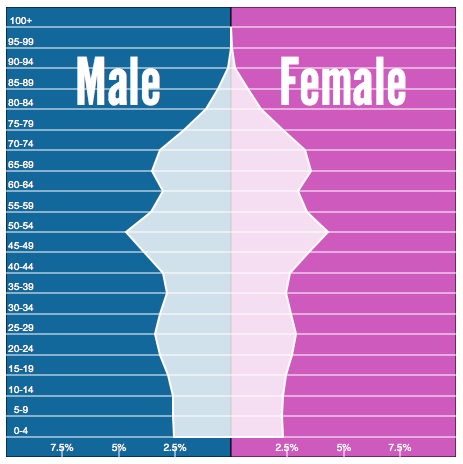
This pyramid quite
clearly shows that fewer and fewer younger Chinese will be economically
supporting more and more older Chinese, a direct result of the one child policy and the increase in life expectancy.
Here is a graphic showing how China's elderly
population is projected to rise out to 2050:

By 2050, nearly one in
four Chinese will be elderly, the highest level in the world.
China's recent moves to
loosen its one child policy will eventually reduce the gender and demographic
stresses on the nation's economy, however, as I noted above, it will take more
than one generation to make a significant difference. By that time,
China's economic miracle could well be over and the world will no longer be
able to rely on China's might as its economic driver.


 Posts
Posts


