Showing posts with label Fourth Industrial Revolution. Show all posts

Wednesday, December 8, 2021

The Fourth Industrial Revolution and Inequality - A Primer for Class Warfare

For anyone who has been paying attention since the beginning of the COVID-19 pandemic, it is clear that there is an underlying agenda being promoted by the global ruling class through their World Economic Forum.  While the "Build Back Better" or "Great Reset" narrative setting up our post-pandemic world sounds like it may lead to positive changes in the world, in fact, the WEF has already clearly stated the negative impacts of Klaus Schwab and his Fourth Industrial Revolution, another moniker for the Great Reset.


As background and just in case you haven't been paying attention, here is a brief discussion from 2016 of the Fourth Industrial Revolution sourced from the World Economic Forum and written by none other than Herr Schwab himself:


Here is a key quote which sets the stage for the Fourth Industrial Revolution:


"The First Industrial Revolution used water and steam power to mechanize production. The Second used electric power to create mass production. The Third used electronics and information technology to automate production. Now a Fourth Industrial Revolution is building on the Third, the digital revolution that has been occurring since the middle of the last century. It is characterized by a fusion of technologies that is blurring the lines between the physical, digital, and biological spheres.


There are three reasons why today’s transformations represent not merely a prolongation of the Third Industrial Revolution but rather the arrival of a Fourth and distinct one: velocity, scope, and systems impact. The speed of current breakthroughs has no historical precedent. When compared with previous industrial revolutions, the Fourth is evolving at an exponential rather than a linear pace. Moreover, it is disrupting almost every industry in every country. And the breadth and depth of these changes herald the transformation of entire systems of production, management, and governance....


The possibilities of billions of people connected by mobile devices, with unprecedented processing power, storage capacity, and access to knowledge, are unlimited. And these possibilities will be multiplied by emerging technology breakthroughs in fields such as artificial intelligence, robotics, the Internet of Things, autonomous vehicles, 3-D printing, nanotechnology, biotechnology, materials science, energy storage, and quantum computing."


Here is what Schwab sees as the "upside" to the Fourth Industrial Revolution:


"Like the revolutions that preceded it, the Fourth Industrial Revolution has the potential to raise global income levels and improve the quality of life for populations around the world. To date, those who have gained the most from it have been consumers able to afford and access the digital world; technology has made possible new products and services that increase the efficiency and pleasure of our personal lives. Ordering a cab, booking a flight, buying a product, making a payment, listening to music, watching a film, or playing a game—any of these can now be done remotely.


In the future, technological innovation will also lead to a supply-side miracle, with long-term gains in efficiency and productivity. Transportation and communication costs will drop, logistics and global supply chains will become more effective, and the cost of trade will diminish, all of which will open new markets and drive economic growth."


As well, back in 2016, Schwab "blessed" the world with his mind-numbingly boring and excessively esoteric book "The Fourth Industrial Revolution" as shown here:


And yet, in this epitaph for humanity, there are some glimpses of what the future of the world could look like, particularly for certain, select humans, as the world moves into its fourth technological revolution.  In this tome (or, better yet, tomb) for humanity, Schwab outlines his vision for what lies ahead and, given his penchant for all things technological and digital, clearly outlines the importance of technology to our new world:


"We have yet to grasp fully the speed and breadth of this new revolution. Consider the unlimited possibilities of having billions of people connected by mobile devices, giving rise to unprecedented processing power, storage capabilities and knowledge access. Or think about the staggering confluence of emerging technology breakthroughs, covering wide-ranging fields such as artificial intelligence (AI), robotics, the internet of things (IoT), autonomous vehicles, 3D printing, nanotechnology, biotechnology, materials science, energy storage and quantum computing, to name a few. Many of these innovations are in their infancy, but they are already reaching an inflection point in their development as they build on and amplify each other in a fusion of technologies across the physical, digital and biological worlds.


We are witnessing profound shifts across all industries, marked by the emergence of new business models, the disruption of incumbents and the reshaping of production, consumption, transportation and delivery systems. On the societal front, a paradigm shift is underway in how we work and communicate, as well as how we express, inform and entertain ourselves. Equally, governments and institutions are being reshaped, as are systems of education, healthcare and transportation, among many others. New ways of using technology to change behaviour and our systems of production and consumption also offer the potential for supporting the regeneration and preservation of natural environments, rather than creating hidden costs in the form of externalities."


Doesn't that sound utopic? 


Of course, like with all wonderful things, there is a downside.  While the ruling class gets wealthier and wealthier and societal inequality continues to grow, a fact that has become very clear during the pandemic which has locked down and economically punished the serf/organ donor/useless eater class as shown here:


...and, in response, here:


Not surprisingly, this "wrench in the gears of progress" concerns Herr Schwab and his fellow ruling class peers as quoted from section 3.5 "The Individual" in his aforementioned book.  In this quote, he discusses inequality but not the inequality that most of us consider when we hear the term (with all bolds being mine):


"Until now, technology has primarily enabled us to do things in easier, faster and more efficient ways. It has also provided us with opportunities for personal development. But we are beginning to see that there is much more on offer and at stake. For all the reasons already mentioned, we are at the threshold of a radical systemic change that requires human beings to adapt continuously. As a result, we may witness an increasing degree of polarization in the world, marked by those who embrace change versus those who resist it.


This gives rise to an inequality that goes beyond the societal one described earlier. This ontological inequality will separate those who adapt from those who resist – the material winners and losers in all senses of the word. The winners may even benefit from some form of radical human improvement generated by certain segments of the fourth industrial revolution (such as genetic engineering) from which the losers will be deprived. This risks creating class conflicts and other clashes unlike anything we have seen before. This potential division and the tensions it stirs will be exacerbated by a generational divide caused by those who have only known and grown up in a digital world versus those who have not and who must adapt. It also gives rise to many ethical issues."


And there you have it.  Schwab is concerned that his precious technology will separate the world into two classes:


1.) Winners who will accept and thereby benefit from the gifts offered by the Fourth Industrial Revolution and its accompanying technological/digital advances and how these advances will benefit the human body itself, leading to the evolution toward what I call Homo Superiorus.


2.) Losers who choose not to adapt to and evolve with these technological and digital world marvels.


Schwab states that it is this societal divide that will result in "class conflicts and clashes unlike anything we have seen before", in other words, class warfare.  


This brings to mind two movies of relatively recent vintage.  Here is a screen capture from Ready Player One, a dystopic vision of the future  (2045) where the vast bulk of humanity lives in squalid poverty, thriving only in an online fantasy world:
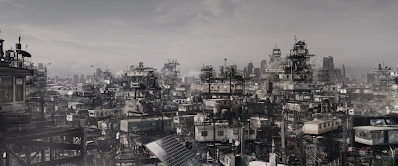
 

An even better analogy is found in the movie Elysium where an overpopulated Earth is populated with masses of impoverished humanity while the select few oligarchs live on a luxurious, technically advanced  artificial world that orbits the planet.


Without exaggeration, I believe that this could be our future if we relent to the forces that are now rebuilding society without our permission and, in many cases, without our knowledge.  The growing use of universal basic incomes, the development of central bank digital currencies and the issuance of universal so-called vaccine passports are three additional methods of rebuilding society for the benefit of "the few", a scenario that would have been unthinkable even a very short time ago.


Keeping in mind that many of the world's current political leaders and technocrats have close and historic associations with the World Economic Forum, Schwab's vision of a class war which pits technological "winners" against technological "losers" could prove to be prescient.  The Fourth Industrial Revolution will create a massive global underclass that will be forced to forage for their very existence while the technocracy rules from “on high”.


Remember readers, most importantly, resistance is not futile.  We do NOT have to be assimilated.


Wednesday, October 13, 2021

Saudi Arabia 4th Industrial Revolution

While the mainstream media would love for us to believe that the World Economic Forum's Fourth Industrial Revolution aka the Great Reset is nothing more than a conspiracy theory cooked up by tinfoil hat-wearing wing nuts, there is one very clear cut example of the implementation of a new economic reality in the world.


In this posting, we'll look at the links between the World Economic Forum and Saudi Arabia.  Let's start with this screen capture from the WEF's "Special Meeting on the Middle East in the Fourth Industrial Revolution Overview" which was to be held in Saudi Arabia on April 5th and 6th, 2020:


If you look through the entire document, you will notice that there is not a single mention of human rights since apparently Saudi Arabia's abysmal record on human rights is immaterial when it comes to the Fourth Industrial Revolution.


On July 28, 2021, Saudi Arabia inaugurated the nation's Fourth Industrial Revolution Center in partnership with the World Economic Forum at the first Saudi forum for the Fourth Industrial Revolution in Riyadh which was attended by WEF founder and Executive Chairman, Klaus Schwab.  


Here is the announcement the inauguration on the KSA government's website:


Here is an excerpt from the announcement with my bold:


"Chairman of the Board of Directors of King Abdulaziz City for Science and Technology (KACST) Eng. Abdullah Amer Al-Sawahah announced today the inauguration of the 4th Industrial Revolution Center in partnership with the World Economic Forum (WEF).


This was on the sidelines of the first Saudi Forum for the 4th Industrial Revolution, which is organized by KACST at its headquarters with the participation of the founder and Chairman of the Board of Directors of the World Economic Forum, Professor Klaus Schwab, a number of ministers and officials, and a group of local and international speakers.


The inauguration of the center comes within the support and empowerment of research, development, and innovation system in Saudi Arabia by the Custodian of the Two Holy Mosques King Salman bin Abdulaziz Al Saud, and His Royal Highness Prince Mohammed bin Salman bin Abdulaziz, Crown Prince, Deputy Prime Minister and Minister of Defense.


For his part, the founder and Chairman of the Board of Directors of the World Economic Forum, Professor Klaus Schwab, congratulated Saudi Arabia on inaugurating the 4th Industrial Revolution Center, which aims to harness new technologies with the best principles of flexible governance, which need government, business, and civil society together to make technology a force for good and ensure that society benefits from it.


The forum had four sessions as follows:


1.) Harnessing the techniques of the Fourth Industrial Revolution to serve the development and the application of flexible governance between the government, business sector, and civil society.


2.) Enabling Fourth Industry Techniques for Industrial Transformation and Increased Productivity, Sustainability, and Innovation”


3.) Shaping the future of transportation and enacting policies to avoid obstacles to self-driving vehicles and drones


4.) Using Fourth Industrial Revolution Techniques to Build Health Systems Capable of Facing Future Crises


Here is the lead page for the website of the Kingdom of Saudi Arabia's (KSA) Center for the Fourth Industrial Revolution aka C4IR KSA:


...and, just in case you would happen to think that the KSA's choice of the "Fourth Industrial Revolution" moniker is merely coincidental, you will notice this in the top left-hand side of the webpage:


Saudi Arabia's C4IR not a think-tank, rather it is:


"...a do tank to advance the benefits of 4IR in Saudi Arabia through the development and implementation of practical and adaptive protocols for the governance of emerging technologies."


C4IR KSA is one of many WEF Affliliate centers around the globe that form the C4IR Network, connecting centers across the globe to catalyze international collaborative efforts towards concert multi-stakeholder output fo route development and testing of scalable technology governance frameworks, whatever that may mean.


Here are the objections of C4IR KSA:


(1) Optimize the technological benefits from the Fourth Industrial Revolution (4IR) in the Kingdom of Saudi Arabia and to accelerate the implementation of robust protocols for the governance of emerging 4IR technologies 


(2) Engage with key public-private sector stakeholders to co-design and pilot innovative approaches for the adoption and governance of 4IR technologies. 


(3) Empower the 4IR capabilities landscape by building national talents through hands-on international collaborations with the global C4IR network of partners.


Given Klaus Schwab's fixation on the mitigation of climate change, one wonders how on earth the world's largest producer of oil fits into his grand vision of a hydrocarbon-free, Greta Thunberg-approved world.  At the Forum's session on "Acclerating Clean Energy Transformation", Saudi Oil Minister Prince Abdulaziz bin Salman stated the following:


"We can use the technology of the Fourth Industrial Revolution to observe energy transition and reach goals for reduction of greenhouse emissions, whether it is increasing efficiency and use of renewables like wind and solar power, or the development of new fuel sources like blue and green hydrogen."


Here are some additional quotes from the Forum which are very reminiscent of issues that are discussed on the World Economic Forum's website:


"The Fourth Industrial Revolution is transforming the basics of human life, and the Kingdom has achieved good, significant and outstanding results in several sectors related to the Fourth Industrial Revolution and it is leading many sectors in the world....Saudi Arabia has human resources that enable the Kingdom to become an engine for digital transformation in energy with the presence of the younger generation, and most importantly, for the benefit of humanity as a whole, not just Saudi Arabia. The Internet of Things allowed us to monitor and transport oil."


In the recent past, he has claimed that Saudi Arabia wants to become another Germany when it comes to renewable energy as shown in this quote from January 2021:


"We're working with so many countries on green hydrogen and blue hydrogen and ... I could say that we will be pioneering more of that blue hydrogen and green hydrogen...We would be converting 50 per cent of our power sector's fuel into gas, and the rest will be coming from renewables.  In tandem with that, we will be saving thousands and hundreds of thousands of barrels of oil that are going to waste, that we could export....We [as] Saudi Arabia [are] a staunch believer of [the] Paris Agreement. And we will do everything as a government to enable our government companies to achieve their targets,"


Let's close this posting with this definition from the World Economic Forum:


"The Fourth Industrial Revolution represents a fundamental change in the way we live, work and relate to one another. It is a new chapter in human development, enabled by extraordinary technology advances commensurate with those of the first, second and third industrial revolutions. These advances are merging the physical, digital and biological worlds in ways that create both huge promise and potential peril. The speed, breadth and depth of this revolution is forcing us to rethink how countries develop, how organisations create value and even what it means to be human. The Fourth Industrial Revolution is about more than just technology-driven change; it is an opportunity to help everyone, including leaders, policy-makers and people from all income groups and nations, to harness converging technologies in order to create an inclusive, human-centred future. The real opportunity is to look beyond technology, and find ways to give the greatest number of people the ability to positively impact their families, organisations and communities."


So, as you can see, whether we like it or not, the World Economic Forum's vision of a future technological utopia has already been adopted wholeheartedly by at least one nation.  What is fascinating to see is that the World Economic Forum makes no mention of Saudi Arabia's shameful record on human and women's rights, choosing to ignore those uncomfortable issues since they involve the lives of the useless eaters.  In fact, here is the only mention that I could find about Saudi Arabia's strict policies on the WEF website:


But, then again, Schwab's Fourth Industrial Revolution was never about improving life for the sweaty masses of useless eaters, was it?


Friday, December 4, 2020

The World Economic Forum and Transhumanism Part 1 - The Vision of Karl Schwab

Let's open this blog by looking at a definition:


Transhumanismthe belief or theory that the human race can evolve beyond its current physical and mental limitations, especially by means of science and technology.


Now, let's move along to the subject of this posting.  At the centre of a new global order, a highly influential figure by the name of Karl Schwab, founder and current head of the World Economic Forum, has made it quite clear what he believes lies ahead for humanity as technology and Homo Sapiens merge.  Fortunately, (or unfortunately depending on your viewpoint), he has made his roadmap for the future of humanity through the implementation of the Fourth Industrial Revolution very clear in three of his books; The Fourth Industrial Revolution (2016), Shaping the Future of the Fourth Industrial Revolution (2018) and Covid-19: The Great Reset (2020).  Let's look at some quotes from his second book published in 2018 that outline his vision for all of us.  Please note that all bolds are mine.


Here is the cover of Schwab's second missive:


Now, let's look at some key excerpts:


1.) Klaus Schwab. “Shaping the Fourth Industrial Revolution.” Preface


Public trust in business, government, the media and even civil society has fallen to the point where more than half of the world feels the current system is failing them. The widening gap in trust between those in their country’s top income quartile and the rest of the population indicates that social cohesion is fragile at best, and very close to breaking down at worst.


It is in this precarious political and social context that we face both the opportunities and the challenges of a range of powerful, emerging technologies—from artificial intelligence, to biotechnologies, advanced materials to quantum computing—that will drive radical shifts in the way we live, and which I have described as comprising the Fourth Industrial Revolution.


These emerging technologies are not merely incremental advances on today’s digital technologies. Fourth Industrial Revolution technologies are truly disruptive—they upend existing ways of sensing, calculating, organizing, acting and delivering. They represent entirely new ways of creating value for organizations and citizens. They will, over time, transform all the systems we take for granted today—from the way we produce and transport goods and services, to the way we communicate, the way we collaborate, and the way we “experience the world around us. Already, advances in neurotechnologies and biotechnologies are forcing us to question what it means to be human.


2.) Klaus Schwab. “Shaping the Fourth Industrial Revolution. Section 1 The Fourth Industrial Revolution - Chapter 2


Fourth Industrial Revolution technologies will not stop at becoming part of the physical world around us—they will become part of us. Indeed, some of us already feel that our smartphones have become an extension of ourselves. Today’s external devices—from wearable computers to virtual reality headsets—will almost certainly become implantable in our bodies and brains. Exoskeletons and prosthetics will increase our physical power, while advances in neurotechnology enhance our cognitive abilities. We will become better able to manipulate our own genes, and those of our children. These developments raise profound questions: Where do we draw “the line between human and machine? What does it mean to be human?


3.) Klaus Schwab. “Shaping the Fourth Industrial Revolution.”  Section 2.3 Altering the Human Being - Chapter 11


Biotechnologies will change the future, and they will change us. Firms are already engineering bacteria to produce everything from resins to personal care products, and Chinese scientists have used CRISPR to combat cancer. Mitochondrial replacement therapy, otherwise known as three-parent in vitro fertilization, is facing regulatory decisions in several countries, and scientists are preparing for a gene-drive against malaria by targeting mosquitos in Africa.  This is just the science present. The future will challenge our understanding of what it means to be human, from both a biological and a social standpoint. Emerging biotechnology agendas promise to improve and augment human lifespans and to enhance physical and mental health. The opportunity for the integration of digital technologies with biological tissues is also growing, and what that portends for the next decades is inspiring a range of emotions, from hope to wonder to fear.”


4.) Klaus Schwab. “Shaping the Fourth Industrial Revolution.” Section 2.3 Altering the Human Being - Introduction


The lines between technologies and beings are becoming blurred, and not just by the ability to create lifelike robots or synthetic organisms. Instead, it is about the ability of new technologies to literally become part of us. Technologies already influence how we understand ourselves, how we think about each other, and how we determine our realities. As the technologies in this section give us deeper access to parts of ourselves, we may begin to integrate digital technologies into our bodies. The metaphor of the “cyborg” may seem to have lost its ability to shock, but the future may see curious mixes of digital-and-analog life that will redefine our very natures. The chapters here cover biotechnologies, neurotechnologies and brain science, and virtual and augmented reality devices. Perhaps more than any other set of technologies in the Fourth Industrial Revolution, these will challenge us ethically. These technologies will operate within our own biology and change how we interface with the world. They are capable of crossing the boundaries of body and mind, enhancing our physical abilities, and even having a lasting impact on life itself. They are more than mere tools, and demand special “consideration for their ability to augment or intrude upon human beings, human behaviors and human rights.


How will this new reality take place?  Of course, more and more technology!


5.) Klaus Schwab. “Shaping the Fourth Industrial Revolution.” Chapter 5 - New Computing Technologies


Computers are also physically becoming part of us. External wearable devices, such as smart watches, intelligent earbuds and augmented reality glasses, are giving way to active implantable microchips that break the skin barrier of our bodies, creating intriguing possibilities that range from integrated treatment systems to opportunities for human enhancement.


Biological computing could soon allow us to replace specialized microchips with custom-designed organisms, a key aspect of a new cultural form of expression and consumption called “biohacking.”Researchers at MIT have demonstrated that sensors, memory switches and circuits can be encoded in common human gut bacteria, indicating that our biomes could, for example, be purposefully designed to detect and treat inflammatory bowel disease or colon cancer.


Such potential benefits come, however, with challenges and risks. The increase in possibilities for the two-way flow of information between us and our environment highlights the challenge of continually expanding bandwidth, as well as improving compression technology. The vast amounts of data created in a digitally driven world require new approaches that offer dense, long-term storage. One solution is using DNA to store information. In 2012, Harvard’s George Church demonstrated the possibility of storing data on DNA at more than 100,000 times the density of the best flash memory options available. It was also stable at a wide range of temperatures: according to Church, “You can drop it wherever you want, in the desert or your backyard, and it will be there 400,000 years later.


Let's close this posting with a final thought from Klaus Schwab.  According to Schwab's Shaping the Fourth Industrial Revolution, we all have a role to play in shaping our new post-human reality and, of course, we will all benefit from his vision:


Given that many disruptive technologies are only just emerging from laboratories, garages, and research and development departments around the world, and that related regulations are in the process of being written and updated, there is a window of opportunity for citizens and leaders from all sectors to work together to shape the systems of the Fourth Industrial Revolution. We must seize that opportunity. If we succeed, the benefits include spreading prosperity more widely, reducing inequality and reversing the loss of trust that is dividing societies and polarizing politics. The Fourth Industrial Revolution could produce systems that support healthier, longer-lived populations with higher levels of economic and physical security, happily engaged in meaningful and fulfilling activities in a sustainable environmental context.


One thing that the Fourth Industrial Revolution is certain to produce is a small group of very wealthy technoplutocrats (think Bill Gates et al) who will benefit massively from their investments in the technologies required to merge humanity and technology.  While Schwab touts the reduction in inequality as a benefit of his Fourth Industrial Revolution, my suggestion is that the vast majority of the world's most impoverished will see only marginal improvements in their lives, if that.


In Part 2 of this posting, we will look at the World Economic Forum's views on the Internet of Bodies, a key part of the Fourth Industrial Revolution and what concerns it should raise with all of us.


Monday, November 9, 2020

The Fourth Industrial Revolution - Part 2 - Life After the Great Reset

In Part 1 of this two part series on the World Economic Forum's Fourth Industrial Revolution, we took a look at the blueprint for the WEF's Fourth Industrial Revolution also known as "The Great Reset".  In Part 2, we'll take a closer look how the WEF believes that our collective futures could look in light of the massive societal reengineering that must take place (in their belief system) in response to the COVID-19 pandemic.


Let's go back to 2016.  Here is an article which appeared on the WEF's website on November 11, 2016:


The writer, Ida Auken, a Member of Parliament in Denmark as you can see here:


You will note that Ms. Auken is considered to be one of Europe's 40 most promising young leaders under the age of 40.


She opens her missive with the following:


"Welcome to the year 2030. Welcome to my city - or should I say, "our city". I don't own anything. I don't own a car. I don't own a house. I don't own any appliances or any clothes.


It might seem odd to you, but it makes perfect sense for us in this city. Everything you considered a product, has now become a service. We have access to transportation, accommodation, food and all the things we need in our daily lives. One by one all these things became free, so it ended up not making sense for us to own much."


So then, who "owns" what you "share"?  The oligarchy?  Who owns the factories where the goods that you share are manufactured?  The oligarchy?  Who profits from these factories?  Once again, the oligarchy?  Who owns the place where you live?  The government or the oligarchy?


She goes on to give us more details of what life will be like in 2030:


"First communication became digitized and free to everyone. Then, when clean energy became free, things started to move quickly. Transportation dropped dramatically in price. It made no sense for us to own cars anymore, because we could call a driverless vehicle or a flying car for longer journeys within minutes. We started transporting ourselves in a much more organized and coordinated way when public transport became easier, quicker and more convenient than the car. Now I can hardly believe that we accepted congestion and traffic jams, not to mention the air pollution from combustion engines. What were we thinking?


Sometimes I use my bike when I go to see some of my friends. I enjoy the exercise and the ride. It kind of gets the soul to come along on the journey. Funny how some things seem never seem to lose their excitement: walking, biking, cooking, drawing and growing plants. It makes perfect sense and reminds us of how our culture emerged out of a close relationship with nature."


Here's more on life in 2030:


"In our city we don't pay any rent, because someone else is using our free space whenever we do not need it. My living room is used for business meetings when I am not there.


Once in awhile, I will choose to cook for myself. It is easy - the necessary kitchen equipment is delivered at my door within minutes. Since transport became free, we stopped having all those things stuffed into our home. Why keep a pasta-maker and a crepe cooker crammed into our cupboards? We can just order them when we need them.


This also made the breakthrough of the circular economy easier. When products are turned into services, no one has an interest in things with a short life span. Everything is designed for durability, repairability and recyclability. The materials are flowing more quickly in our economy and can be transformed to new products pretty easily. Environmental problems seem far away, since we only use clean energy and clean production methods. The air is clean, the water is clean and nobody would dare to touch the protected areas of nature because they constitute such value to our well being. In the cities we have plenty of green space and plants and trees all over. I still do not understand why in the past we filled all free spots in the city with concrete.


Shopping? I can't really remember what that is. For most of us, it has been turned into choosing things to use. Sometimes I find this fun, and sometimes I just want the algorithm to do it for me. It knows my taste better than I do by now.


When AI and robots took over so much of our work, we suddenly had time to eat well, sleep well and spend time with other people. The concept of rush hour makes no sense anymore, since the work that we do can be done at any time. I don't really know if I would call it work anymore. It is more like thinking-time, creation-time and development-time."


But, as absolutely wonderful as the future sounds, even people living in a "utopia" have concerns:


"My biggest concern is all the people who do not live in our city. Those we lost on the way. Those who decided that it became too much, all this technology. Those who felt obsolete and useless when robots and AI took over big parts of our jobs. Those who got upset with the political system and turned against it. They live different kind of lives outside of the city. Some have formed little self-supplying communities. Others just stayed in the empty and abandoned houses in small 19th century villages.


Once in awhile I get annoyed about the fact that I have no real privacy. No where I can go and not be registered. I know that, somewhere, everything I do, think and dream of is recorded. I just hope that nobody will use it against me."


At the bottom of the article, Ms. Auken notes that "this is a scenario showing where we could be heading - for better or worse" and that it is merely used to "start a discussion about some of the pros and cons of the current technological development".  That said, the very fact that it appears on the World Economic Forum's website at all suggests that it is being floated as a trial balloon to gauge public reaction to our new destiny.


Just in case you thought that this might be a one-off on the part of the World Economic Forum, here is a promotional video from the WEF that prepares us for our journey to 2030:


Let's close this posting, taking a closer look at one of the shills promoting the WEF's Great Reset and the complete rebuilding of society:  


Here's another shill from the same side of the Atlantic Ocean:


And, lastly, here is Canada's very own, homegrown shill touting the "Great Reset" (aka the Fourth Industrial Revolution) on behalf of all Canadians (or at least on behalf of Chrystia Freeland and Mark Carney):


I hope that this two part series has helped you to better understand where we are headed, at least if the World Economic Forum and its pantheon of influential politicians, billionaires and other hangers-on have their way with society.  Despite what the WEF promises, this will not be a utopia unless you happen to be one of the fortunate few who reside comfortably in their massive homes and travelling in their private jets at the top of the global "food chain".


Friday, November 6, 2020

The Fourth Industrial Revolution - Part 1 - The Technological Blueprint for the Future

The COVID-19 pandemic is being used by the leaders of many governments around the world to retool and reshape the economy.  This "new normal" is being created at the behest of the World Economic Forum, a group formed back in 1971 as the European Management Forum by Klaus Schwab, a German engineer/economist born during the rule of the National Socialist Party in 1938.  While some people believe that Schwab's vision of the future is worthy of praise, in fact, it is quite clear that his version of social utopia is not shared with the vast majority of humanity in the Western world as well as those living in developing economies.  In this posting, I want to take a look at a publication from the World Economic Forum (WEF) which clearly outlines Schwab's vision of a social utopia, one that he has convinced many influential government leaders and private sector plutocrats is the answer to society's woes and to their personal benefit.  In the first of this two part series, I want to look at some background regarding the Fourth Industrial Revolution followed by Part 2 which will look at the WEF's more specific scenario for our collective futures.


In his 2016 book, The Fourth Industrial Revolution, Schwab begins by stating the following:


"Of the many diverse and fascinating challenges we face today, the most intense and important is how to understand and shape the new technology revolution, which entails nothing less than a transformation of humankind. We are at the beginning of a revolution that is fundamentally changing the way we live, work, and relate to one another. In its scale, scope and complexity, what I consider to be the fourth industrial revolution is unlike anything humankind has experienced before.


We have yet to grasp fully the speed and breadth of this new revolution. Consider the unlimited possibilities of having billions of people connected by mobile devices, giving rise to unprecedented processing power, storage capabilities and knowledge access. Or think about the staggering confluence of emerging technology breakthroughs, covering wide-ranging fields such as artificial intelligence (AI), robotics, the internet of things (IoT), autonomous vehicles, 3D printing, nanotechnology, biotechnology, materials science, energy storage and quantum computing, to name a few. Many of these innovations are in their infancy, but they are already reaching an inflection point in their development as they build on and amplify each other in a fusion of technologies across the physical, digital and biological worlds."


Here is a WEF documentary on the Fourth Industrial Revolution (4IR) in case you needed more background:


Schwab has a clear fixation with technology as the ultimate solution to the world's problems.  His obsession with technologic solutions is very clearly outlined in a WEF report "Deep Shift - Technology Tipping Points and Societal Impact" which you can find here.  In this September 2015 Survey Report, the Global Agenda Council on the Future of Software and Society (note how the two are linked even in the title of the report), the WEF surveyed over 800 executives and experts from the information and communications technology sector on the "tipping points", moments when specific technological shifts will hit mainstream society, shifts that will shape our collective digital futures.  The report outlines 21 factors or tipping points (all of which are technological) that form the blueprint for the Fourth Industrial Revolution as seen by Schwab and his World Economic Forum.


Here is the front page of the report:


According to the report, there are six megatrends which are shaping society:


1.) People and the internet - How people connect with others, information and the world around them is being transformed through a combination of technologies. Wearable and implantable technologies will enhance people’s “digital presence”, allowing them to interact with objects and one another in new ways.


2.) Computing, communications and storage everywhere - The continued rapid decline in the size and cost of computing and connectivity technologies is driving an exponential growth in the potential to access and leverage the internet. This will lead to ubiquitous computing

power being available, where everyone has access to a supercomputer in their pocket, with nearly unlimited storage capacity.


3.) The Internet of Things - Smaller, cheaper and smarter sensors are being introduced – in homes, clothes and accessories, cities, transport and energy networks, as well as manufacturing processes.


4.) Artificial intelligence (AI) and big data - Exponential digitization creates exponentially more data – about everything and everyone. In parallel, the sophistication of the problems software can address, and the ability for software to learn and evolve itself, is advancing rapidly.

This is built on the rise of big data for decision-making, and the influence that AI and robotics are starting to have on decision-making and jobs.


5.) The sharing economy and distributed trust - The internet is driving a shift towards networks and platform-based social and economic models. Assets can be shared, creating not just new efficiencies but also whole new business models and opportunities for social self- organization. The blockchain, an emerging technology, replaces the need for third-party institutions to provide trust for financial, contract and voting activities.


6.) The digitization of matter - Physical objects are “printed” from raw materials via additive, or 3D, printing, a process that transforms industrial manufacturing, allows for printing products at home and creates a whole set of human health opportunities.


The respondents to the survey rated the selected technology tipping points by their likelihood to occur by 2025 as follows:


Here is a diagram showing the average year that the respondents expected each tipping point to occur:


Let's look in detail at four of the tipping points and their positive and negative impacts according to Schwab:


1.) Implantable Technologies - People are becoming more and more connected to devices, and those devices are increasingly becoming connected to their bodies. Devices are not just being worn, but also being implanted into bodies, serving communications, location and behaviour monitoring, and health functions.  Pacemakers and cochlear implants were just the beginning of this, with many more health devices constantly being launched. These devices will be able to sense the parameters of diseases; they will enable individuals to take action, send data to monitoring centres, or potentially release healing medicines automatically.


Smart tattoos and other unique chips could help with identification and location. Implanted devices will likely also help to communicate thoughts normally expressed verbally through a “built-in” smartphone, and potentially unexpressed thoughts or moods by reading brainwaves and other signals.


Positive impacts are as follows:


– Reduction in missing children

– Increased positive health outcomes

– Increased self-sufficiency

– Better decision-making

– Image recognition and availability of personal data (anonymous network that will “yelp”2 people)


Negative impacts are as follows:


– Privacy/potential surveillance

– Decreased data security

– Escapism and addiction

– Increased distractions (i.e. attention deficit disorder)


2.) Robotics and Services - Robotics is beginning to influence many jobs, from manufacturing to agriculture, and retail to services. According to the International Federation of Robotics, the world now includes 1.1 million working robots, and machines account for 80% of the work in manufacturing a car.  Robots are streamlining supply chains to deliver more efficient and predictable business results.


Positive impacts are as follows: 


– Supply chain and logistics, eliminations

– More leisure time

– Improved health outcomes (big data for pharmaceutical gains in research and development)

– Banking ATM as early adopter

– More access to materials

– Production “re-shoring” (i.e. replacing overseas workers with robots).


Negative impacts are as follows:


– Job losses

– Liability, accountability

– Day-to-day social norms, end of 9-to-5 and 24-hour

services

– Hacking and cyber-risk


3.) 3D Printing and Human Health - One day, 3D printers may create not only things, but also human organs – a process called “bioprinting”. In much the same process as for printed objects, an organ is printed layer by layer from a digital 3D model.27 The material used to print an organ would obviously be different from what is used to print a bike, and experimenting can be done with the kinds of materials that will work, such as titanium powder for making bones. 3D printing has great potential to service custom design needs; and, there is nothing more custom than a human body.


Positive impacts are as follows:


– Addressing the shortage of donated organs (an average of 21 people die each day waiting for transplants that can’t take place because of the lack of an organ)

– Prosthetic printing: limb/body part replacements

– Hospitals printing for each patient requiring surgery (e.g. splints, casts, implants, screws)

– Personalized medicine: 3D printing growing fastest where each customer needs a slightly different version of a body part (e.g. a crown for a tooth)

– Printing components of medical equipment that are difficult or expensive to source, such as transducers

– Printing, for example, dental implants, pacemakers and pens for bone fracture at local hospitals instead of importing them, to reduce the cost of operations

– Fundamental changes in drug testing, which can be done on real human objects given the availability of fully printed organs

– Printing of food, thus improving food security


Negative impacts

– Uncontrolled or unregulated production of body parts, medical equipment or food

– Growth in waste for disposal, and further burden on the environment

– Major ethical debates stemming from the printing of body parts and bodies: Who will control the ability to produce them? Who will ensure the quality of the resulting organs?

– Perverted disincentives for health: If everything can be replaced, why live in a healthy way?

– Impact on agriculture from printing food


4.) AI and White-Collar Jobs - Just in case white-collar workers felt safe, Schwab believes that a significant portion of white-collar jobs could be computerized, thanks to Artificial Intelligence. He notes that AI is good at matching patterns and automating processes, which makes the technology amenable to many functions in large organizations. An environment can be envisioned in the future where AI replaces a range of functions performed today by people.


Positive impact are as follows:


– Cost reductions

– Efficiency gains

– Unlocking innovation, opportunities for small business,

start-ups (smaller barriers to entry, “software as a service” for everything)


Negative impacts are as follows:


– Job losses

– Accountability and liability

– Change to legal, financial disclosure, risk

– Job automation (refer to the Oxford Martin study)


One thing that is interesting is that a very significant number of the tipping points have "privacy concerns" as one of their negative impacts.  This is not terribly surprising given that we live in the surveillance era where everyone from governments to the technology sector are in the data collection business, accumulating our personal information and using it for purposes that clearly breach our privacy.


Schwab is so fixated on the advent of a Fourth Industrial Revolution that he has written a book on the subject in 2016 entitled "The Fourth Industrial Revolution", another book in 2018 entitled "Shaping the Fourth Industrial Revolution" and a third book was just released in July 2020, entitled "COVID-19 - The Great Reset" which outlines how the current pandemic will be used as a launching pad for the "Great Reset" aka the Fourth Industrial Revolution.  Here is a brief quote from the book's introduction:


Many of us are pondering when things will return to normal. The short response is: never. Nothing will ever return to the “broken” sense of normalcy that prevailed prior to the crisis because the coronavirus pandemic marks a fundamental inflection point in our global trajectory. Some analysts call it a major bifurcation, others refer to a deep crisis of “biblical” proportions, but the essence remains the same: the world as we knew it in the early months of 2020 is no more, dissolved in the context of the pandemic. Radical changes of such consequence are coming that some pundits have referred to a “before coronavirus” (BC) and “after coronavirus” (AC) era. We will continue to be surprised by both the rapidity and unexpected nature of these changes – as they conflate with each other, they will provoke second-, third-, fourth- and more-order consequences, cascading effects and unforeseen outcomes. In so doing, they will shape a “new normal” radically different from the one we will be progressively leaving behind. Many of our beliefs and assumptions about what the world could or should look like will be shattered in the process.


Here is a quote from the section entitled "Accelerating the digital transformation":


With the pandemic, the “digital transformation” that so many analysts have been referring to for years, without being exactly sure what it meant, has found its catalyst. One major effect of confinement will be the expansion and progression of the digital world in a decisive and often permanent manner. This is noticeable not only in its most mundane and anecdotal aspects (more online conversations, more streaming to entertain, more digital content in general), but also in terms of forcing more profound changes in how companies operate, something that is explored in more depth in the next chapter. In April 2020, several tech leaders observed how quickly and radically the necessities created by the health crisis had precipitated the adoption of a wide range of technologies. In the space of just one month, it appeared that many companies in terms of tech take-up fast-forwarded by several years. For the digitally savvy, this meant good things, while, for the others, a very poor outlook (sometimes catastrophically so). Satya Nadella, CEO of Microsoft, observed that social- and physical-distancing requirements created “a remote everything”, bringing forward the adoption of a wide range of technologies by two years, while Sundar Pichai, Google’s CEO, marvelled at the impressive leap in digital activity, forecasting a “significant and lasting” effect on sectors as different as online work, education, shopping, medicine and entertainment.


I believe that is enough to digest for this posting.  While on the surface it may appear that Klaus Schwab's vision for the post-pandemic world/Fourth Industrial Revolution is laudable, in fact, his concentration on the growing use of technology to solve all of the world's woes is leading to one key fact that he seems quite capable of ignoring - enriching the few (technology sector players) at the expense of the many (the proletariat).  What I find truly appalling is that one man who is really a nobody in the grand scheme of things has somehow managed to get the attention of the vast majority of the Western world's leadership (i.e. useful idiots), convincing them that his vision is the only path to the future


Dystopia here we come.  In Part 2 of this posting, I will take a much more intimate look at the World Economic Forum's more specific predictions for what lies ahead over the next decade and the massive changes that they anticipate for "the proletariat".