Showing posts with label firearms. Show all posts

Wednesday, June 1, 2022

Manufacturing Guns in America - A Statistical Summary

While the mass shooting in Uvalde, Texas on May 24, 2022 which took the lives of 22 individuals, received 24 hour a day covering from the media, mass shootings in the United States are far from rare as shown on these screen captures from gunviolencearchive.org which show mass shooting events in the month prior to the Uvalde shooting:


In this posting, we'll look at some interesting firearms data from a recent report released by the Bureau of Alcohol, Tobacco, Firearms and Explosives:


1.) Under the Gun Control Act (GCA) of 1968 and its amendments, any individual or entity engaged in the business of manufacturing firearms or ammunition must obtain a federal firearms licence of which there are eleven types as follows:


2.) All manufacturers must complete an annual Firearms manufacturing and Exportation Report or AMFER.  Here is a graphic showing the growing number of active licensed manufacturers between 2016 and 2020 noting that there is significant underreporting (29.9 percent over five years):


3.) Here is a graphic showing the growth in the total number of licensed domestic Gun Control Act firearms  manufactured over the period between 2000 and 2020:


Between 2000 and 2020, manufacturing of licensed domestic GCA firearms grew by 187 percent and between 2010 and 2020, grew by 103 percent with the most significant growth taking place between 2010 and 2013.  


4.) When measured on a per 100,000 persons in the United States basis, we find the following:

 

Over the twenty years between 2000 and 2020, the American population grew by 18 percent. The number of domestically manufactured firearms per 100,000 persons in the United States basis grew by 187 percent between 2000 and 2020  and by 89 percent over the ten year period between 2010 and 2020.


5.) Here is a table showing the top ten parent companies of licensed GCA manufacturers of all types of firearms between 2016 and 2020:


The top ten firearms manufacturers produced 69.7 percent of all domestic firearms manufactured between 2016 and 2020.


6.) Here is a graphic showing how the types of firearms manufactured has changed over the past two decades:


Pistols became the dominant firearm manufactured in the United States in 2010 (with the exception of 2015).  In 2000, the total number of rifles manufactured was 59 percent more than the number of pistols manufactured.  In 2020, 100 percent more pistols than rifles were produced and distributed.  In 2000, pistols constituted 26 percent of all GCA firearms manufactured which grew to 50 percent in 2020.


7.) Here is a table showing the top ten parent companies of licensed pistol manufacturers:


The top ten pistol manufacturers produced 89.4 percent of all pistols produced between 2016 and 2020.


8.) Here is a table showing the top ten parent companies of licensed rifle manufacturers:


The top ten rifle manufacturers produced 74.6 percent of all rifles produced between 2016 and 2020.


Let's close with this graphic from Visual Capitalist's Nick Routley which very nicely summarizes some of the data in this posting:


I hope that this information helps all of us to better understand the manufacturing aspect of America's gun culture.  


Thursday, January 7, 2021

A Divided America - Firearms Ownership and Partisan Politics

With the United States in a state of ongoing partisan turmoil, recent data released by the Federal Bureau of Investigation shows how some Americans are responding to the societal and political uncertainties.


Here is an up-to-date screen capture from the Federal Bureau of Investigation's website showing the number of firearms background checks (NICS) on a monthly basis going back to 1998:


While every background check does not result in the purchase of a firearm, one can still assume that a substantial percentage of these background checks will result in the purchase of a firearm (or firearms).  As you will see later in this posting, sales of firearms in America have shown significant growth.


As you can see, 2020 was a record year for firearms background checks in the United States.  For all of 2020, 39,695,315 background checks were initiated, up 11,325,565 or 39.9 percent on a year-over-year basis.  The highest month was December when 3,937,066 background checks were initiated, up 1,000,172 or 34.1 percent from the same month in 2019.  For the entire year, there were 8 months which had in excess of 3 million background checks initiated and in all twelve months, there were more bacround checks initiate when compared to 2019.  If we look back one decade to 2010, the number of background checks has risen by 275.5 percent from 14,033,824 to its current level of 39,695,315.


According to Statista, here are the monthly unit sales of firearms broken down by type in the United States from January 2019 to August 2020:


When we compare firearms sales in the month of August 2020 to that of August 2019, sales rose from 1,160,550 units in 2019 to 1,780,000 in August 2020, an increase of 53 percent on a year-over-year basis. 


This has led to this for Smith & Wesson:


...and this for Sturm, Ruger and Company:


Given this from Joe Biden's campaign:


... and these statistics about gun laws:


....and these statistics about gun ownership:


...firearm ownership and gun control are proving to be yet another divisive issue in the United States, a significant concern given the record level of firearms background checks that have been initiated in 2020 particularly given the highly partisan political climate in Washington.


Friday, November 13, 2020

Firearms and the Defeat of Donald Trump

There are often unintended consequences to the actions that governments take but rarely do they occur before an administration actually takes office.  The 2020 Presidential election in the United States is turning out to be a prime example of "what can go wrong, will go wrong".


Let's start by looking at this:


The Biden campaign promised the following (among others):


1.) banning the manufacture and sale of assault weapons and high-capacity magazines.


2.) regulate the possession of existing assault weapons under the National Firearms Act.


3.) buy back the assault weapons and high-capacity magazines already in our communities.


4.) reduce the stockpiling of weapons by limiting the number of firearms an individual may purchase to one per month.


5.) require background checks for all gun sales.


6.) reinstate the Obama-Biden policy to keep guns out of the hands of certain people that are unable to manage their affairs for mental health reasons.


7.) close the hate-crime loophole which allows an individual who has been convicted of a hate crime from possessing a firearm.


8.) end the online sale of firearms, ammunition, gun parts and kits.


Now, let's take a look at the most recent data from the Federal Bureau of Investigation's monthly NICS firearms background checks:


In the month of October 2020, there were 3,305,465 background checks completed under the National Instant Criminal Background Checks System (NICS).  While background checks are not the same as sales, the FBI's NICS database is a reasonable proxy for predicting gun sales.  In total, so far in 2020, 32,131,914 NICS background checks have been completed, an all-time record and well above the previous record of 28, 369,750 background checks completed during all of 2019.  In part, this is due to the unrest that the United States experienced during the demonstrations held in mid-2020 but I would suspect that some of this increase, particularly during October 2020, is due to the aforementioned campaign promises made by the Biden/Harris campaign.


According to calculations made by the National Shooting Sport Foundation (NSSF), nearly 5 million of these NICS checks were for first time gun owners in the first seven months of 2020 as quoted here:


"NSSF tracks the background checks associated with the sale of a firearm based on the FBI’s National Instant Background Check System (NICS). NSSF-adjusted NICS checks for January through July 2020 is a record 12.1 million, which is up 71.7 percent from the 7.1 million NSSF-adjusted NICS January through July 2019. This equates to nearly 5 million first-time gun owners in the first seven months of 2020.


“This is a tectonic shift in the firearm and ammunition industry marketplace and complete transformation of today’s gun-owning community,” said Lawrence G. Keane, NSSF Senior Vice President of General Counsel. “These first-time buyers represent a group of people who, until now, were agnostic regarding firearm ownership. That’s rapidly changing, and these Americans are taking hold of their God-given right to keep and bear arms and protect themselves and their loved ones.”


NSSF surveys revealed that 58 percent of firearm purchases were among African American men and women, the largest increase of any demographic group. Women comprised 40 percent of first-time gun purchasers. Retailers noted that they are seeing a 95 percent increase in firearm sales and a 139 percent increase in ammunition sales over the same period in 2019.


Several factors are contributing to the sustained surge in firearm purchases. Sales spiked in March, with a record-setting 2.3 million NICS background checks conducted for a firearm sale, the same month the coronavirus pandemic struck. During this time, police warned response times would be tested while mayors and governors emptied prisons, including violent felons. Some of those were rearrested within days for committing another violent crime. After Memorial Day, protests turned to looting, riots and destruction, which continues today in several major metropolitan areas. Politically-charged calls to defund police also continue to spur sales.


This is also an election year and firearm sales typically rise during presidential election years. However, this year, Democratic candidates Joe Biden and U.S. Sen. Kamala Harris (D-Calif.) are calling for stringent gun control measures, including forcible confiscation, banning entire classes of firearms from lawful possession, licensing schemes and repealing the Protection of Lawful Commerce in Arms Act, which would expose the firearm industry to frivolous and harassing lawsuits." (my bolds)


According to an article on the Gun and Survival website, gun buyers are worried about several issues; volatile political rhetoric, civil unrest, police brutality, Black Lives Matter and the economic decline due to the COVID-19 lockdown.  According to the article, gun buyers are "...also worried about the risk of increased gun control if the Democrats win the White House".


Given that the Democrats appear to have taken control of the White House, it will be interesting to see what happens to NICS background checks during November and December of 2020 and the first half of January 2021 before the Pence Administration controls America's "gun narrative".  I would be rather surprised if Biden's threats to control firearms doesn't result in record sales of guns in an already high gun ownership society.


Monday, September 14, 2020

Civil Unrest in America - An Unintended Consequence

Updated January 2021


Sometimes fear does result in unintended consequences.  Recent press releases from two of America's largest gun manufacturers show us what the recent civil unrest and the 2020 election have created in the most heavily armed civilian population in the world.


Sturm, Ruger and Company is the largest gun manufacturing company in the United States.  Here is the first page of the company's press release showing their results for the second quarter of 2020:


Net firearms sales rose from $94.999 million in the third quarter of 2019 to $145.705 million in the second quarter of 2020, an increase of 53.4 percent.  Over the first three-quarters of the year, net firearms sales rose by 30.9 percent on a year-over-year basis, hitting $399.608 million.  The company's strong operational and financial performance allowed them to award a one-time special dividend of $5.00 per share in the second quarter.


Sturm's Chief Executive Officer Christopher J. Killoy made the following comments about the second quarter results:


Consumer demand showed no signs of letting up during the quarter as concerns about personal protection and home defense were stoked by civil unrest in some cities around the United States, the call, by some, for the reduction in funding and authority of law enforcement organizations, and the continuing COVID-19 pandemic. As a result of this unprecedented demand, inventories remained significantly reduced at all levels in the channel during the third quarter.


The sell-through of the company's products from their independent distributors to retailers increased by 50 percent in the first three-quarters of 2020 on a year-over-year basis.  Demand was so high that Ruger's finished goods inventory and distributors' inventories of their products declined by 31 percent during the most recent quarter.


Now let's look at the financial results of America's second largest gun manufacturing company, Smith & Wesson.  Here is the first page of the company's press release showing their results for the first quarter of fiscal 2021:


Net sales rose from $123.665 million in the first quarter of fiscal 2020 to $277.965 million in the first quarter of fiscal 2021, an increase of 124.8 percent.  Firearms sales rose a remarkable 140.9 percent during the first quarter of fiscal 2021, hitting $229.9 million.


Smith & Wesson's President and Chief Executive Officer Mark Smith had this to say about the company's second quarter results:


 "Today, I am pleased to report record-breaking first quarter financial results for Smith & Wesson Brands, Inc. These results could not have been possible without our dedicated employees, who not only worked diligently to manufacture and fulfill the strong flow of customer orders with a broad assortment of our highly sought-after firearms, but did so with a heightened commitment to the health and safety protocols that our operations management team put in place at the start of the pandemic. Our record revenue and unit sales during the quarter demonstrates our ability to rapidly respond to increased demand through our flexible manufacturing model and our state-of-the-art distribution facility, delivering outstanding products that resonate with the firearms consumer."


He also stated that:


"Our record revenue and unit sales during the quarter demonstrates our ability to rapidly respond to increased demand through our flexible manufacturing model and our state-of-the-art distribution facility, delivering outstanding products that resonate with the firearms consumer."


The company's performance has allowed them to pay down their debt and reduce their net debt to zero as well as paying its first quarterly dividend of $0.05 per share to its shareholders.


Just in case you were curious, here is the number of background firearms checks that have been done by the FBI's National Instant Criminal Background Check System or NICS on a monthly basis since 1998: 


As you can see, the months of March, May, June, July and August through to December of 2020 have seen background checks in excess of 3 million for the first time since records were kept and 2020's total of 39,695,315 sets a new record by a very, very wide margin.


While one can never prove that the current social unrest in some of America's largest cities and the winning of the Presidency by Joe Biden who has pledged to control firearms has created higher demand for personal firearms, the coincidence of higher sales by two of the United States' would suggest that there is at least some connection between civilians wanting to protect themselves and the current violence plaguing American streets.


Friday, March 20, 2020

Americans' Response to COVID-19

Thanks to one American online retailer, we have a fascinating look at the impact of the COVID-19 panic on Americans and its not just about toilet paper, hand sanitizer and bottled water.

Here is a map from Ammo.com:


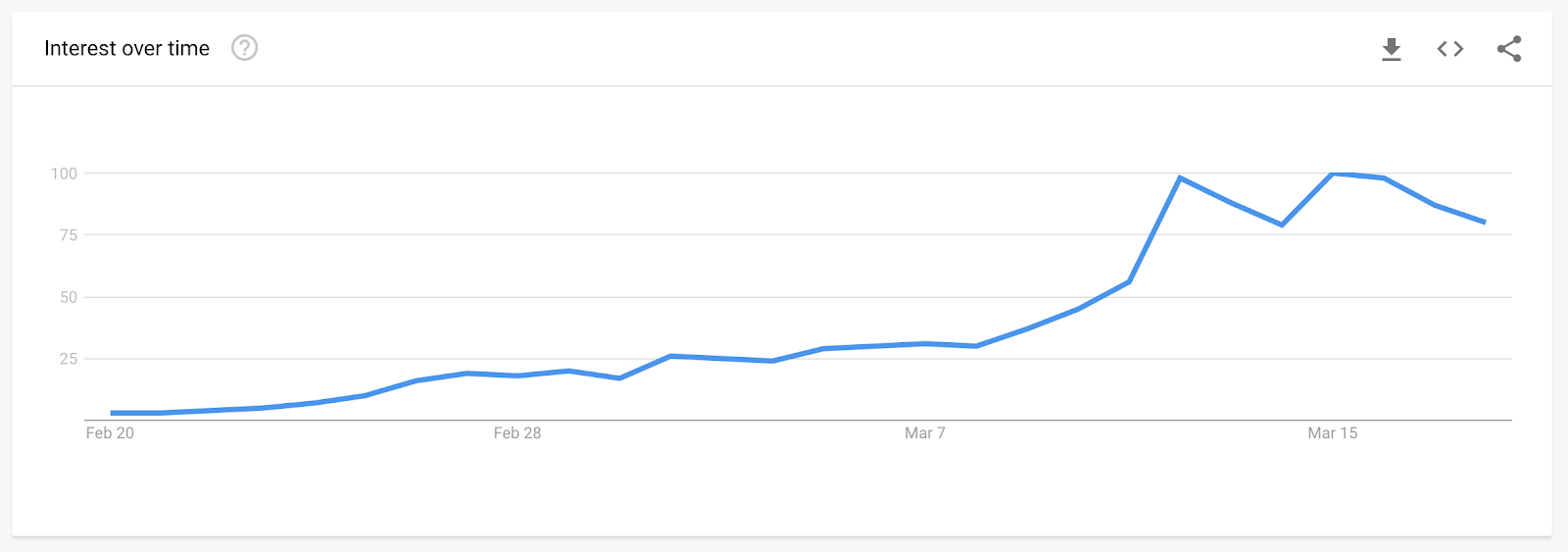
Ammo.com notes that Americans are purchasing ammunition at an unprecedented rate.  On February 23, 2020, an Ammo.com press release noticed that ammunition sales jumped significantly in February.  According to Google Trends, searches for the word "coronavirus" began to rise around February 23.  Since then, the measurement matrix of interest for the term "coronavirus" has continued to increase, rising from 5 on February 23, 2020 to 100 on March 15, 2020 as shown here:


When comparing the period 11 days prior to February 23 (i.e. February 12 to 22) to the period 11 days after February 23 (i.e. February 23 to March 4), Ammo.com noted that their total number of transactions had increased by 68 percent.  

On March 10, the day that the number of confirmed coronavirus cases reached 1000 in the United States, a ten-fold increase in one week, there was a surge in sales of 276 percent that continued throughout the week and into the weekend.

When comparing 22 days worth of sales from February 23 to March 15 with sales from February 1 to February 22, Ammo.com found the following:

1.) 309% increase in revenue

2.) 78% increase in conversion rate

3.) 222% increase in transactions

4.) 77% increase in site traffic

5.) 27% increase in average order

Here are the top 30 state rankings by total sales volume and showing the most popular caliber of ammunition purchased:


Here are the following top five increases sales by caliber:

1.) 40 Cal (S&W) ammo: 645% 

2.) 7.62x39 ammo: 386%

3.) 12 gauge shotgun shells: 368%

4.) 9mm ammo: 308%

5.) 5.56x45 ammo: 296%

Significant sales increases were also noted in .45 ACP ammunition and .22 long rifle ammunition.

One thing is certain, if (or when) medical martial law is declared in the United States, many American households will feel that they are well equipped to deal with whatever may lie ahead.  This is yet another unintended consequence (like the hoarding of toilet paper) that results from governments trying control their citizens by instilling fear.

Thursday, February 21, 2019

The Federal Government and The Gun Culture

A recently released study by the U.S. Government Accountability Office examined purchases and inventory controls of firearms, ammunition and other tactical equipment in the federal government.  The GAO looked at 20 federal law enforcement agencies, their expenditures on firearms, ammunition and tactical equipment over the fiscal years from 2010 to 2017.

In 2012, the Bureau of Justice reported that the federal government employed approximately 120,000 federal law enforcement officers (FLEO) in non-military agencies.  These officers have the authority to make arrests and carry firearms with the majority of them being law enforcement agents with the Department of Homeland Security and the Department of Justice.  Law enforcement officers are also found in the Department of Health and Human Services, the Environmental Protection Agency and, rather surprisingly, the Internal Revenue Service.  Government agencies that purchase firearms, ammunition and tactical equipment must report these purchases on a publicly available website, USASpending.gov.

Here are the 20 federal government agencies that have more than 250 FLEOs that are covered by the GAO report, their missions and the number of FLEOs that each agency employs:


It is important to note that, while the GAO released all of the data on the Health and Human Services, Internal Revenue Service and Transportation Security Administration to Congress, some of the data was deemed to be sensitive and, as such, has not been released to the general public in this report.  

Here are four examples of the firearms used by federal officers:


Here are examples of the tactical equipment used by federal officers:


In total, the 20 federal agencies reported the following spending on weapons between fiscal 2010 and 2017:

1.) Firearms - at least $38.8 million.  Eighteen agencies reporting the purchase of at least 44,551 firearms. The most firearms were purchased by the Bureau of Alcohol, Tobacco, Firearms and Explosives (ATF) with purchased at least 8,500 firearms.  Here is a breakdown of the types of firearms purchased by the 18 aforementioned agencies:


2.) Ammunition - at least $325.9 million.  Customs and Border Protection purchased $128 million worth of ammunition, the most among all 20 agencies.  Sixteen agencies reported the total number of rounds that they purchased; over the period between 2010 and 2017, these 16 agencies purchased at least 767 million rounds of ammunition with Customs and Border Protection purchasing a total of 429 million rounds.  Here is a breakdown of the types of ammunition purchased by the 16 aforementioned agencies:


3.) Tactical Equipment - at least $1.14 billion.  Seventeen agencies reported the purchase of tactical equipment with Customs and Border Protection spending $609 million, the most among the 17 reporting agencies.  In total, Customs and Border Protection, the FBI, the DEA and the U.S. Marshals Service reported spending at least $755 million in manned aircraft.  Here is a breakdown of the types of tactical equipment purchased:


Here is a graphic breaking down the types of tactical equipment purchased by each of the 17 agencies that reported their data to the GAO:


While all of this data is interesting, it is noteworthy that some of the data on the USASpending.gov website does not match what was reported to the GAO.  For instance, Immigration and Customs Enforcement (ICE) reported spending $146,198,549 on ammunition through the USASpending.gov website and only $47,965,399 to the GAO, a difference of 205 percent.

In closing, let's look at a particularly interesting part of the statistics reported by the GAO regarding the Internal Revenue Service and its firearms inventory:


Note that the IRS could not supply a great deal of information on firearms, ammunition and tactical equipment inventories and purchases because it was not retained in their system.  Try pulling that excuse when the Internal Revenue Service comes looking for your personal tax records!

With three of the twenty government departments supplying only partial information to the public, American taxpayers will not have a full sense of how much of their tax dollars are spent arming the federal government outside of the defense sector, however, as we can see from the GAO's report, the government is most certainly not lacking when it comes to firearms, ammunition and tactical weapons that can be used to protect them from us.