Showing posts with label global economy. Show all posts

Friday, January 13, 2023

The World Economic Forum's Vision for Global Economic Growth

In this recent publication:


...the self-annointed/self-appointed ruling class at the World Economic Forum looks at the future of the public-private economic model (i.e. stakeholder capitalism) particularly as it relates to the Fourth Industrial Revolution that it has promoted for our collective futures.  The publication begins by noting this:


"Against the backdrop of an increasingly contested geoeconomic world order, governments in many countries are restructuring industrial policies to serve well-defined strategic purposes.1 This is in line with historical precedent, as times of crisis or uncertainty tend to see governments take the lead in prioritizing specific problems and marshalling the actors and resources required to solve them.


In parallel, businesses are becoming more purpose- driven in their approach to markets, driven by investor movements prioritizing environmental, social and governance (ESG) investing as well as by public pressure.


This twin trend has the potential to underpin a new era of public-private convergence on addressing the most important problems facing humanity, with governments taking more initiative on market co- creation and businesses taking more responsibility for orienting their products and services towards social and environmental outcomes."


The WEF firmly believes that this plan which will create the "markets of tomorrow" will solve all of the most important national, regional and global problems that plague the world today.  One might almost be under the impression that the ruling class really cares about the organ donor class and its difficulties.


The data for this report was gleaned from the WEF's global Executive Opinion Survey and sheds light on these three questions:


1.) Which technologies have the highest strategic importance around the world? 


2.) Which sectors enable the growth of new markets? 


3.) What are the bottlenecks obstructing the growth of new markets to act on these strategic priorities?


I would bet that my readers don't sleep at night worrying about these issues....that along with how you are going to pay for food, rent, fuel, your mortgage and car payments but that's why we're the serf class and they are the ruling class.


Let's move along and look at the answers to the three questions cited above:


1.) Which technologies have the highest strategic importance around the world? 


Let's start by looking at the "markets of tomorrow' through the lens of technological priorities.  Of course, being the child of technocrat Klaus Schwab who never heard about any technology that he didn't warmly embrace, the report focuses on technology as it relates to the economic foundations of the global economy.Business leaders were asked for their three top choices to answer "Which technologies are of strategic importance to your country in the next 10 years?".  Here is an overview of the responses from global executives:


What we need to remember is that technology, particularly intelligence agents and robots, are predicted to displace as much as 14 percent (or more) of the world's current human labor according to a study by McKinsey.  We need to remember that technology is not always our friend but it certainly is a close friend to the investor/executive class.


Agricultural technologies topped the list of strategic priorities in 44 of the 120 nations in the study, many of which are located in Latin America and Sub-Saharan Africa where economies are increasingly reliant on agricultural imports, not to mention the ever-present bogeyman of global climate change on crop yields.  This must thrill billionaires like Farmer Bill Gates who is clearly of the "technology can solve the global food problem" ilk and "I have the money to invest in your agricultural technology as long as I stand to benefit personally.".


Here is a map showing the highest strategic importance of various technologies in each economy:


2.) Which sectors will enable the growth of new markets?


Here is a graphic showing the top ten sectors of the economy are most likely to experience new market creation in the opinion of the global executive class:


Here is a map showing the top sectors of the economy that are most likely to experience new market creation for each of the 120 nations in the WEF executive survey:


Again, you'll notice a significant geographic divide with Latin American and African leaders anticipating the most growth in primary sectors like agriculture, forestry and fishing and the more advanced economies anticipating growth in energy technology, information technology and other technology services.


3.) What are the bottlenecks obstructing the growth of new markets to act on these strategic priorities?


Let's close by looking at the top ten obstacles/bottlenecks to the growth of new markets in the eyes of the global executive class:


Lower- and middle-income economies rank infrastructure and finance as the biggest obstacles to expanding markets whereas high-income economies rank a lack of skills and talent and a lack of public sector initiative as the biggest obstacles.  This is rather ironic given that it is these same advanced economies that are seeing employment in their manufacturing sectors gutted as the sectors increasingly automate.  Apparently, all of the talk about retraining redundant low-skilled workers and turning them into highly-skilled tech sector workers is just that....talk.


Under the World Economic Forum's vision for the world, the private (and I might add unelected) sector will become increasingly important to the control of the global economy.  We can see that in the conclusion of the report as quoted here with my bolds:


"The findings from leading executives around the world can be interpreted as a strong signal from the private sector that a dynamic public sector would be welcome as a means of unlocking untapped potential for market creation. The evidence of new approaches to industrial and investment policy around the world suggest that this kind of public-sector dynamism may be on an upswing. This may augur well for the markets of tomorrow, which will ultimately rest on a shift towards identifying and solving the key strategic challenges in different national contexts and building dialogue and symbiotic partnerships between public and private sectors, fuelled by the need to solve the most pressing problems."


In other words, give us the tax dollars that you have collected from your organ donor class citizens and get out of the way so that the executive class can maximize its control over the global economy by ever-expanding the markets of tomorrow which, if the Great COVID-19 Recession was a harbinger of things to come, means even greater wealth for a select few billionaires while the rest of us wile away our remaining days, unemployed, subsisting on a universal basic income and living in "our" non-owned "homes" using goods that we have rented from the "landlord class".


Thursday, January 20, 2022

Simulating A Global Financial Collapse - A Prediction for the Future

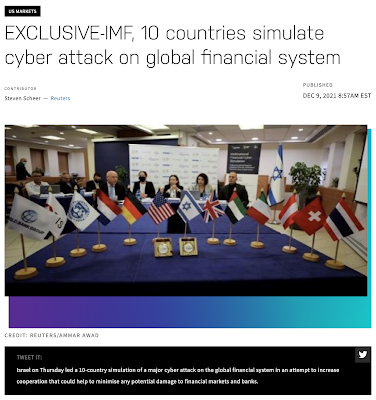
While it didn't really make headline news, a recent simulation gives us a sense of what could happen to the global financial system if an unthinkable catastrophe damages or destroys the world's digital infrastructure.


Here is the report on the simulation of a cyber attack on the world's financial system from the NASDAQ website:


On December 9, 2021, Israel led a ten nation simulation of a major cyber attack on the global financial system under the moniker "Collective Strength".  This exercise which took place over ten days was undertaken to ensure that should such an attack take place in the real world, cooperation among nations would minimize damage to the banking and stock market sectors.  The participants included treasury officials from Austria, Germany, Israel, Italy, the Netherlands, Thailand, the United Arab Emirates, the United Kingdom and the United States and also included officials from the International Monetary Fund, the World Bank and the Bank of International Settlements (BIS), the central bank for central banks.


The exercise featured several different scenarios which involved attacks on the integrity of transactions between importers and exporters, liquidity, foreign exchange, bond markets and, most interesting given the post-truth era that we live in, fake news reports which resulted in a run on banks and turmoil in global markets.  In the simulation, participants were faced with the following:


"The banks are appealing for emergency liquidity assistance in a multitude of currencies to put a halt to the chaos as counterparties withdraw their funds and limit access to liquidity, leaving the banks in disarray and ruin."


One of the groups involved is Tel Aviv-based BeST or Be Strategic Solutions, a crisis management software company which has run simulations involving cyber and data privacy issues and physical security among others as shown here:  


Now, let's look at another aspect of cybersecurity.  It is not terribly surprising, but the man with all of the answers has a stake in cybersecurity.  At the Cyber Polygon 2021 event held in June 2021, the founder of the World Economic Forum,one Klaus Schwab, made some interesting comments about securing the global digital infrastructure.    You can find Schwab's comments at the 2 hour and 15 minute mark in this video:


Here is a quote:


"We have come together today to discuss how we can --- your digital infrastructure systems and protect companies but also societies from cyber attacks.  We must do so with a broader mission in mind; to improve the state of our digital world by enhancing, on the one hand, global cooperation but also public-private corporation (a much-used Schwab buzz phrase)....


Digital connections are embedded in our homes, our workplaces and through operation technology our critical infrastructure.... (this connectivity) has enabled us to continue to function during a time of unprecedented crisis.  Technology has been central to the way we have collectively managed the COVID-19 pandemic and the global crisis.  Digital infrastructure made it possible to deliver essential services.  It helped business to run.  And it helped us to maintain contact with each other."


...(digitalization) has also opened us up to new challenges.  One of the most important amongst them is how to ensure digital technologies and communications are safe, secure and trustworthy.  Many technology leaders have noted that within a few short months, we have achieved advances in digital transformation that might have otherwise taken years.  But this digital dividend...is fragile.  Cyber incidents can undermine the trust in key online services and they could derail adoption of socially valuable innovations."


As a technology "guru", Schwab's vision of the future relies very, very heavily on a healthy global digital infrastructure, particularly necessary for his transhumanist vision where Homo superiorus relies on a merger of biology and technology for the creation of a new superior form of humanity.  It isn't surprising that the World Economic Forum is playing a key role in global cybersecurity given that its entire raison d'ĂȘtre is ensuring that the global elite remain just that, elite.


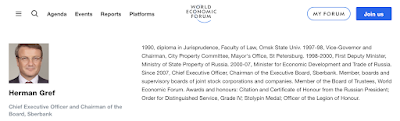
As an aside, you'll notice that one individual is given top billing in Schwab's opening comments; Herman Gref, Chief Executive Officer and Chairman of the Board of Sberbank (a Russian bank) who just happens to be on the Board of Trustees for the WEF as shown here:


The presence of Sberbank's leader on both the WEF's Board of Trustees and at the Cyber Polygon exercise is quite interesting given that the bank is only in 51st place among global banks in 2021 and 402nd place in 2020 when ranked by sales, profit, assets and market value.


Let's close this posting with a couple of thoughts.  First, back in October 2019, this simulation took place:


Coincidentally (?), four months later, the globe was experiencing a massive reality check as the COVID-19 pandemic took place.  Now, we have another simulation, this time of a cyber attack on the world's financial system.  How long will it be before this too is a real world occurrence?


Second, the potential for a cyber attack on key parts of the global financial infrastructure should make one realize just how fragile our entire economy has become.  We are fully reliant on the digital infrastructure for nearly every aspect of our lives; from the production and delivery of electricity, food, fuel, water and the other necessities of life along with the financial services that we all use on a daily basis.  What would happen if the entire banking system was shut down, making it impossible to use credit and debit cards or withdraw fiat currency from our local ATMs etcetera?  


While Schwab rightly points out that the world has made unprecedented advances in digital services over that past two years that would not have been possible without the COVID-19 pandemic, I would suggest that this transformation has made the global digital infrastructure even more vulnerable, creating a world that was completely unthinkable three decades ago and, should it shut down, would push the vast majority of humanity back to the comparatively primitive lives that were lived by our great grandparents.


Monday, May 29, 2017

Breaking Down the Global Economy

We regularly hear that China is catching up to the United States when it comes to the size of its economy, an issue that is of particular concern to the Trump Administration.  While the gap may be closing, according to recent data from the World Bank, China's GDP still lags well behind that of the United States as shown on this recent listing showing data for the 183 largest economies from 2015:


The gap of $7.029 trillion between the United States and China is still very substantial with the U.S. having 24.32 percent of the world's $74.152 trillion economy compared to 14.84 percent for China.  Formerly number two finisher, Japan, has fallen to third place and now contributes only 5.91 percent of the global GDP, well less than half of China's contribution.  It is also quite apparent how massive the output gap is between the major economies and those that contribute less. 

While looking at the data is kind of boring, the folks at Howmuch.net have created this rather interesting graphic, showing the global economy in a Voronoi diagram as shown here:


The American economy is approximately the same size as the combined economies of the third through tenth largest economies combined; Japan ($4.38 trillion), Germany ($3.36 trillion), United Kingdom ($2.86 trillion), France ($2.42 trillion), India ($2.09 trillion), Italy ($1.82 trillion), Brazil ($1.77 trillion) and Canada ($1.55 trillion).

Looking at the global economy by continental region, we find the following:

Asia - 33.84 percent of global GDP
North America - 27.95 percent of global GDP
Europe - 21.37 percent of global GDP

That leaves the remaining regions including Africa, South America and Australia sharing 16.84 percent of the global economy.  As well, the 40 largest economies in the world produce 90.6 percent of global economic output; this leaves more than 100 nations sharing the remaining 9.4 percent of the global economy.  Even nations like India, the second-most populous nation on earth with its 1.337 billion people, contributes only 2.38 percent to the total global economy.

In closing, there is one additional way to look at the World Bank database; by national income level.  Here is a breakdown of total GDP in dollars and share of global GDP for each national income level:

Low income - $394.2 billion or 0.53 percent
Lower middle income - $5.861 trillion or 7.9 percent
Upper middle income - $20.492 trillion or 27.6 percent
High income - $47.412 trillion or 63.9 percent


Despite the perception that the emerging economies of the world are taking over the global economy, the numbers clearly show that they have a long way to go before they are a significant threat to the world's advanced economies.  
  

Wednesday, January 11, 2017

Ignoring the Reality of Economic Policy Uncertainty

While the stock market is on a tear and there seems to be nothing that will interrupt its rise to the stratosphere, an interesting measure shows that the market is definitely in uncharted territory.

Three professors, Scott Baker from Northwestern University, Nick Bloom from Stanford and Steven Davis from the University of Chicago, have developed an index called the Economic Policy Uncertainty Index (EPU) which has a very unique basis; it is based on an analysis of news items, both past and present.

As we know, since the near-global financial meltdown, concerns about monetary, fiscal and regulatory policies have come to the forefront, particularly since it has become apparent that these policies created the crisis in the first place and have been relatively ineffective at creating pre-Great Recession levels of economic growth and stability.  To look at the role of policy uncertainty, the authors created the Economic Policy Uncertainty Index (EPU) by looking at the 10 leading newspapers in the United States going back to 1985 (the LA Times, USA Today, Chicago Tribune, Washington Post, Boston Globe, Wall Street Journal, Miami Herald, Dallas Morning News, Houston Chronicle, San Francisco Chronicle and New York Times) that contain the following "triple"; "economic" or "economy", "uncertain" or "uncertainty" and one or more of the following; "congress", "deficit", "Federal Reserve", "legislation", "regulation" or "White House".  Here is a graph showing the results:


You can see that the EPU spikes during each crisis over the past three decades including Black Monday in 1987, the first Gulf War, the Long Term Capital Management Crisis, the uncertainty of the 2000 election, September 11, 2001, the Gulf War, the Wall Street/Lehman/TARP crisis etcetera.  This is not terribly surprising but it shows a very close relationship between crises and the use of certain words in the media.

The authors then pushed their examination back in time to 1900, using six major United States newspapers (the LA Times, Chicago Tribune, Boston Globe, Wall Street Journal, New York Times and Washington Post) which shows the following with key events highlighted:


You will also note that there is an upward drift of the EPU over the past century which the authors attribute to the growing role of the government in the economy and the growing level of political polarization in the United States.

The authors used a similar method to create EPU indices for eleven other G10 economies including Australia, Brazil, Canada, Chile, China, Europe, France, Germany, India, Ireland, Italy, Japan, Korea, Netherlands, Russia, Spain and the United Kingdom along with a global index, some of which are shown here:  
  
1.) The United States:


2.) The United Kingdom which clearly shows the impact of Brexit:


3.) Europe:


4.) China:


When combined, this is what the global monthly EPU chart looks like when calculated using a GDP-weighted average of monthly EPU index values for the 17 nations that comprise two-thirds of the global GDP:


It certainly appears that the stock market, in particular those in the United States, is not reflecting any sense of the elevated levels of monetary, fiscal and regulatory uncertainties that exist in the "real world".  With the world's economy so interconnected, the record levels of the EPU index should cause investors to ponder whether now is the time to jump into the market or whether one should wait until the policy dust settles.