Showing posts with label nuclear weapons. Show all posts

Tuesday, February 20, 2024

Nuclear Brinkmanship - Russia's Response to Its Threatened Borders

In two recent postings on Telegram, Russia's former President and Prime Minister and current Deputy Chairman of the Security Council of Russia Dimitry Medvedev clearly lays out how the future will unravel if Russia is attacked by NATO and if the nation is forced to return in its 1991 borders.  His proposal is, to say the least, alarming. 

Here's the first posting on his Telegram account dated February 7, 2024:


Here is a translation thanks to Yandex Translate with my bolds for emphasis:


"Sunak, Scholz, Macron, Norwegian, Finnish, Polish and other chiefs from NATO countries say that "we must be ready for war with Russia."


And although Russia has repeatedly said that there are no plans for conflict with NATO and EU countries, extremely dangerous chatter on this topic continues. The reasons are obvious. It is necessary to divert the attention of voters in order to justify the multibillion-dollar spending on the hated Bandera "Ukraine". After all, huge amounts of money are not spent on solving social problems in these states, but on a war in a dying country alien to taxpayers, whose population has scattered across Europe and is terrorizing local residents. Therefore, every day the leaders of these countries broadcast: we need to prepare for war with Russia and continue to help Ukraine, and therefore we need to produce more tanks, shells, drones and other weapons.


But all European bosses cynically lie to their citizens. If, God forbid, such a war happens, then it will not go according to its scenario. It will not be conducted in trenches using artillery, armored vehicles, drones and electronic warfare.


NATO is a huge military bloc, the population of the Alliance countries is almost 1 billion people, and their combined military budget can reach one and a half trillion dollars.


Therefore, due to the disparity of our military capabilities, we simply will have no choice. The answer will be asymmetric. Ballistic and cruise missiles with special warheads will be used to protect the territorial integrity of our country. This is based on our doctrinal military documents and is well known to everyone. And this is the notorious Apocalypse. The end of everything.


Therefore, Western politicians should tell their voters the bitter truth, and not hold them for brainless idiots. To explain to them what is really going to happen, and not to repeat the false mantra of readiness for war with Russia."


As though that weren't enough of a threat against the Western powers that have spent the past decade blocking Russia into a "diplomatic corner", here's what Medvedev had to say on February 18, 2024:


Here, again thanks to Yandex Translate, is the translation:


"Some time ago, I wrote here on my TG channel: "A nuclear power cannot lose a war." Immediately, snotty Anglo-American suckers jumped out with heart-rending cries: "No, it's not like that at all, even the United States lost in wars." This is a blatant lie. I wasn't talking about Vietnam, Afghanistan, or dozens of other places where the Americans waged colonial wars of conquest. I wrote about historical Wars in which the defense of one's Fatherland takes place. Their land, their people, their values. These are the kind of wars the nuclear powers have never lost to anyone.


Why am I writing about this again? Yes, I read the words of all sorts of Pistorius and Shapps and I think: are they really such assholes or are they pretending? "The world cannot afford Russia's victory in this war." How is that? But here's how.


OK. Let's imagine for a minute that Russia lost, and "Ukraine and its allies" won. What would be such a victory for our neo–Nazi enemies with their Western sponsors? Well, as it has been said many times, a return to the borders of 1991. That is, the direct and irreversible collapse of present-day Russia, which, according to the Constitution, includes new territories. And then there was a furious civil war with the final disappearance of our country from the world map. Tens of millions of victims. The death of our future. The collapse of everything.


And now the main question is: do these idiots really believe that the people of Russia will swallow such a division of their country? That we will all think something like this: "Well, alas, it happened. They won. Today's Russia has disappeared. It is a pity, of course, but we must continue to live in a crumbling, dying country, because nuclear war is much more terrible for us than the death of our loved ones, our children, our Russia..."? And that the leadership of the state, headed by the Supreme Commander-in-Chief of the Armed Forces of the Russian Federation, in this case, will tremble to make the most difficult decisions?


And so. It will be completely different. The collapse of Russia will have much more terrible consequences than the results of an ordinary, even the most protracted war. For attempts to return Russia to the borders of 1991 will lead to only one thing. To a global war with Western countries using the entire strategic arsenal of our state. In Kiev, Berlin, London, Washington. To all other beautiful historical sites that have long been included in the flight objectives of our nuclear triad.


Will we have the courage to do this if the disappearance of a thousand-year-old country, our great Homeland, is at stake, and the sacrifices made by the people of Russia over the centuries will be in vain?


The answer is obvious.


So it's better to let them return everything before it's too late. Or we will return it ourselves with maximum losses for the enemy. Like Avdiivka. Our warriors are heroes!"


Looking from the Western perspective, this is the kind of idiocy that passes for diplomacy in Washington when dealing with Russia, in this case, a response to Russia's movement of nuclear weapons into Belarus which would result in all-out nuclear war with NATO should Russia use its weapons:


The "gentlemen" sponsoring this Senate resolution make themselves somewhat useful by volunteering to fight on the front lines should hostilities break out between Russia and NATO.  


Western leaders, particularly those in Washington, have convinced themselves and their voters that Russia is on the brink of a humiliating loss in Ukraine.  They seem to ignore history which shows that a cornered Russian bear is one that will act to protect its borders.  Just ask those who still remain alive among the Nazi soldiers that felt the brunt of Russia's defensiveness when Rossiya-matushka is threatened.  Washington and its NATO puppet states would be wise to learn from the past.


Nuclear brinkmanship is an unwinnable game.  We all lose.  Even Senators Lindsay Graham and Richard Blumenthal. 


Friday, May 5, 2023

The Relationship Between North and South Korea - Part 2 - South Korea's Attitude Toward North Korea

In part one of this two part posting, we looked at background information on North Korea's nuclear weapons and missile program in light of the United States recent announcement of the Washington Declaration which stated that America would use its nuclear might to protect South Korea.  In the second part of this posting, we'll look at the attitudes of South Koreans toward North Korea's weapons programs and the perception of the threat and their preferred actions.


In November 2022, the Asan Institute for Policy Studies undertook a poll which was published in April 2023 as "Transitioning Attitudes on North Korea: Perceived Threat and Preferred Response":


Asan researchers asked South Koreans how they felt about North Korea and the evolving threat and compared these responses to those in the past as well as comparing attitudes among various demographic groups.  Let's look at some of the key findings of the study:


1.) South Koreans' image of North Korea:  Respondents were asked about the words that come to mind when they hear the words "North Korea".  Responses were as follows:


Dictatorship under Kim Jong-un - 34.2 percent


Nuclear weapons - 32.3 percent


Korean unification - 12.5 percent


Socialist political system - 8.7 percent


Inter-Korean economic cooperation - 6 percent


Planned economy - 1 percent


Negative images of North Korea were highest at 66.5 percent with positive images being expressed by 18.5 percent and neutral images being expressed by 9.7 recent of respondents.  Negative perceptions were highest among South Koreans over the age of 60 (77 percent) and in their 30s (76 percent) with the lowest negative perceptions among those in their 40s (56.3 percent).


2.) North Korea as a security risk: Pollsters asked respondents to prioritize the following threats: “North Korea’s nuclear threat,”“China’s rise,”“new Cold War paradigm,”“spread of terrorism,” “infectious diseases, such as COVID-19,” “climate change,” and “supply chain insecurity.”  Here is a graphic summarizing the results, showing both the first and second responses:


Traditional security concerns were viewed as the most significant challenge by 72.3 percent of respondents.  North Korea was deemed to be the most critical security concern among South Koreans with 67.4 percent deeming that North Korea was either the first- or second-most issue of concern.  This is roughly the same as the next two traditional security concerns, the Cold War and China.


Pollsters then expanded the security risk issues with North Korea, specifying the nation's nuclear program.  In 2020, 59.2 percent of South Koreans expressed interest in North Korea's nuclear program; this rose to 80.9 percent in 2022 as shown on this graphic:


Surprisingly, among the 80.9 percent, only 30 percent were extremely interested with the remaining 50.9 percent being only somewhat interested.


If we look back in time, we can see that South Koreans' negative views on South Korea's national security has varied widely over the past decade:


The current level of 70.7 percent is the highest on record, substantially higher that the previous peaks of 63.3 percent in February 2013 and 60 percent in March 2016, with both of those peaks coinciding with North Korea's third and fourth nuclear tests.


3.) Responding to the North Korean nuclear threat: As a proxy for South Korean attitudes about a United States security guarantee, pollsters asked respondents whether the U.S. would use nuclear weapons to defend South Korea in response to a hypothetical nuclear attack by North Korea.  Here is a graphic showing how the response to this question as evolved over time:


The belief that the United States would use nuclear weapons to defend South Korea was highest among those aged 60 and older at 66.3 percent and those in their 20s at 55.8 percent and lowest among those in their 40s at 43.6 percent.  When asked whether the United States would intervene militarily to defend South Korea in the event of an attack by North Korea (i.e. not necessarily using nuclear weapons), approximately 90 percent of South Koreans believe that Washington will come to their defense.


When asked if they supported the development of a domestically spearheaded nuclear program, 64.3 percent of respondents expressed support.  The highest support was found among those aged 60 and older at 80.3 percent and lowest among those their 20s at 53.1 percent.  When asked if the United States should deploy nuclear weapons in South Korea, 61.1 percent of respondents expressed support.  The highest support was among those aged 60 and older at 79.7 percent and lowest among those in their 40s at 36.1 percent.


Let's close this posting with a quote from the study:


"Given that the Yoon administration will likely maintain a firm policy towards North Korea in 2023, we expect Pyongyang to not let up on its provocation for the foreseeable future. We also do not have any reason to believe that we will see a significant improvement in inter-Korean relations. With South Korean sentiments being negative toward North Korea, the South Korean public will likely support a strengthened deterrence posture. If the policymakers are serious about non-proliferation, they must keep the public informed about the costs of nuclear armament while working to rebuild trust in extended deterrence. In this regard, the leaders should embrace more public debate on these issues and strengthen bilateral and trilateral security cooperation in and around the Korean Peninsula."


The geopolitical situation on the Korean Peninsula is a powder keg.  All that it will take is one itchy finger on a trigger to start what will surely be a deadly war of attrition just as it was between 1950 and 1953 with resulted in the deaths of between two and three million civilians and over 650,000 casualties for the South Koreans and United Nations forces, nearly 500,000 casualties for Chinese forces and at least 500,000 casualties for North Korean forces.  The potential for the first use of nuclear weapons since 1945 is certainly a concern given that all parties to the North Korea/South Korea/United States seem to believe that using such weapons is the only way to protect themselves.


Wednesday, May 3, 2023

The Relationship Between North and South Korea - Part 1 - North Korea's Nuclear Program

With this in mind:


and, these sentences in particular:


"President Biden highlighted the U.S. commitment to extend deterrence to the ROK is backed by the full range of U.S. capabilities, including nuclear. Going forward, the United States will further enhance the regular visibility of strategic assets to the Korean Peninsula, as evidenced by the upcoming visit of a U.S. nuclear ballistic missile submarine to the ROK, and will expand and deepen coordination between our militaries."


...I'd like to take a look at recent developments on the Korean Peninsula.  In this two part posting, we'll look at an update to North Korea's nuclear program and South Korea's response to what they view as an existential threat even though the nation's current leadership claims that they will not pursue their own nuclear arms program.


Thanks to the nonprofit, nonpartisan global security organization, the Nuclear Threat Initiative or NTI, we can track North Korea's missile tests in a database which records all flight tests of missiles launched by the DPRK which are capable of carrying and delivering a payload of at least 500 kilograms or 1102 pounds a distance of at least 300 kilometres or 186 miles going back to the first test in April 1984.


Here is a map showing the launch sites of all of the missile tests that fall within those parameters going back to 1984:


To date, there have been 226 tests with the latest recorded test taking place on December 30, 2022.The most launches (26) have taken place on the Hodo Peninsula launch site followed by 20 at the Kittaeryong Missile Base and 16 at the Pyongyang International Airport.


Here is a graphic showing the launch test results from 1991 to the present broken down by success or failure:


According to NTI, North Korea has an estimated 40 to 50 nuclear warheads in its stockpile and an estimated 25 to 48 kilograms of plutonium and 600 to 950 kilograms of highly-enriched uranium in its inventory (estimates are uncertain).  The highest yield nuclear test was between 100 and 370 kilotons and took place in September 2017.  The nation announced a self-imposed nuclear testing moratorium in 2018. It has the following ballistic missiles with nuclear potential in its inventory:


1.) Intercontinental ballistic missiles (ICBMs): Hwasong-14, Hwasong-15, Hwasong-16, Taepodong-2


2.) Intermediate-range ballistic missiles (IRBMs): Hwasong-10, Hwasong-12


3.) Medium-range ballistic missiles (MRBMs): Pukguksong-2, Hwasong-7, Hwasong-9


4.) Submarine-launched ballistic missiles (SLBMs): Pukguksong-3, Pukguksong-4, Pukguksong-5 


North Korea also claims that it has cruise missiles that have the capability to deliver nuclear warheads.  


Here is a graphic showing the types of missiles launched over the entire timeframe of North Korea's missile program noting that the majority of the missiles launched in 2022 are of the "unknown" type:


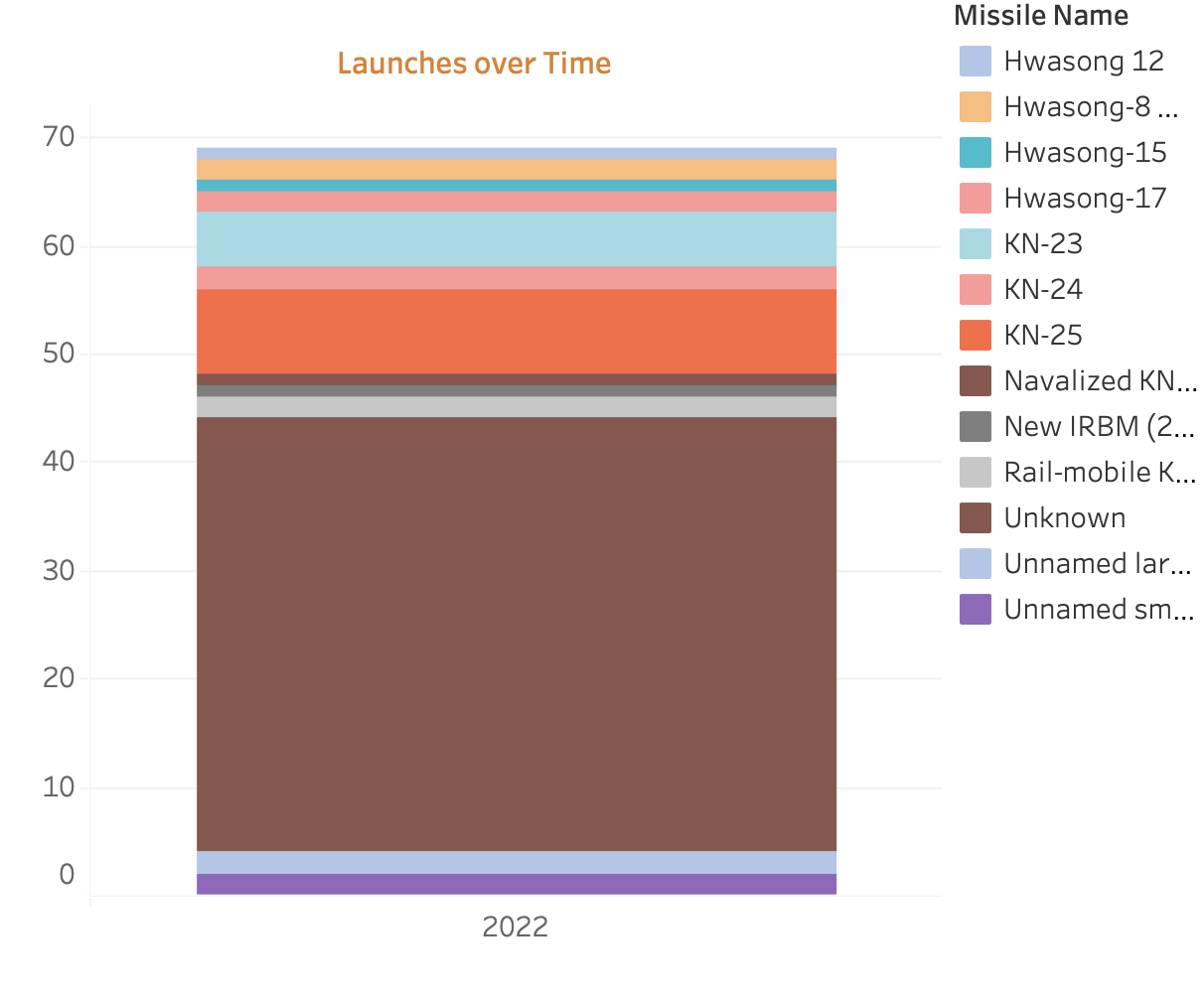
It appears that 2022 was a very successful year and by far the most busy year for North Korea's missile program with a total of 42 successful and 5 failures out of 69 total launches with 32 having unknown results.  This compares to 27 launches in 2019, the second busiest year on record.  Here is a graphic showing the launch sites for 2022:


Here is a graphic showing a detailed breakdown of missiles launched in 2022:


I hope that this information has provided you with sufficient background to understand how North Korea has taken steps to both ensure that it is protected from attacks by external forces and how it could ultimately threaten the United States itself with its intercontinental ballistic missiles.  The possession of nuclear weapon capability also provides Pyongyang with international prestige and allows it to undertake coercive diplomacy, putting it on par with Washington's "diplomatic model".  The Biden Administration's recent announcement will play right into North Korean leader Kim Jong-un's concerns that his nation is under an existential threat from both the south and far east.


In part 2 of this posting, we will examine how South Koreans feel about North Korea's nuclear program and how they want their government to respond.


Wednesday, May 18, 2022

China's Response to Japan and the Concept of Nuclear Sharing

Back in early March 2022, a rather profound statement by one of Japan's former Prime Ministers has set the stage for a major and threatening change in the Far East.  Let's examine this potential change and how the major power in the region has recently responded.  


Here is the article from Asahi Shimbun, one of Japan's largest newspapers, dated February 28, 2022:


Here are some key quotes from Abe's appearance on Fuji Television Network which is discussed in the article with my bolds:


"Former Prime Minister Shinzo Abe floated the idea of Japan “sharing” in the possession of nuclear weapons, as is practiced by some NATO members, a possibility flatly rejected by Prime Minister Fumio Kishida. 


Abe expressed his belief on a TV program aired by Fuji Television Network Inc. on Feb. 27.


The former prime minister was discussing NATO’s nuclear deterrence concept with which multiple countries share nuclear capabilities, when debating the Russian invasion of Ukraine. Among NATO members, the United States has deployed nuclear weapons in certain countries in Europe for when they might need them.


“Although Japan is a signatory of the Treaty on the Non-Proliferation of Nuclear Weapons and has adopted the Three Non-Nuclear Principles, we should not regard a discussion on how the world’s security is maintained as taboo,” Abe said....


Abe said in the TV program, “As Shoichi Nakagawa was lambasted for saying we should discuss (possessing nuclear weapons), people avoid debating it. However, I believe that we should discuss the issue.”


Abe also said people are talking about how Ukraine’s fate might have been different if the country had not given up its nuclear weapons in the 1990s. 


Although he said that it is important to make progress toward achieving the goal of abolishing nuclear weapons, Abe also stressed, “We should discuss various options, as far as how defending this country (Japan) and its people is concerned.”...


Kishida (Japan's current Prime Minister) said nuclear sharing would mean that a country makes use of the U.S. nuclear deterrence capabilities for its own defense.


That would allow the United States to deploy its nuclear weapons in the country even in peacetime and maintain an arrangement in which the country can load nuclear weapons onto its own fighter jets in the event of emergencies."


The nuclear sharing/deterrence concept is used by NATO to allow member nations without nuclear weapons to share nuclear weapons owned by the United States.  Beyond the alliances three nuclear states (the United States, United Kingdom and France), five other nations participate in the nuclear sharing program; Belgium, Germany, Italy, the Netherlands and Turkey.  Seven other nations participate in the Support of Nuclear Operations With Conventional Air Tactics (SNOWCAT) which provide assistance in nuclear missions using conventional air support.  These nations include the Czech Republic, Denmark, Greece, Hungary, Norway, Poland and Romania.  While the United States and NATO do not disclose exact figures for its nuclear weapons deployed in Europe, it is estimated that there are 100 U.S.-owned weapons located at six bases; Kleine Brogel in Belgium, Büchel Air Base in Germany, Aviano and Ghedi Air Bases in Italy, Volkel Air Base in the Netherlands, and Incirlik in Turkey.


Currently, Japan, the only nation in the world that has been the "beneficiary" of nuclear weapons use, has a Three Non-Nuclear Principles philosophy to nuclear weapons which was implemented in 1967 as revealed in the following quote from then Prime Minister Eisaku Sato:


"My responsibility is to achieve and maintain safety in Japan under the Three Non-Nuclear Principles of not possessing, not producing and not permitting the introduction of nuclear weapons, in line with Japan's Peace Constitution." 


Obviously, the presence of nuclear weapons in Japan would have a profound impact on the balance of power in the Far East.  China has taken notice of this development and, given the instability of the region over Taiwan, the world should be paying attention.  A recent opinion piece in China Daily, a daily newspaper owned by the Chinese Communist Party, provides insight into China's interpretation of Shinzo Abe's suggestion:


Here are some quotes (with my bolds) from the opinion piece, keeping in mind that atrocities that imperialist Japan inflicted on China prior to and during the Second World War (between 1937 to 1945 aka the Second Sino-Japanese war):


"Some former Japanese politicians and senior officials of the Liberal Democratic Party have advocated "nuclear sharing", claiming that the deployment of nuclear weapons by the United States in Japan should not be a taboo subject for discussion. The Japan Restoration Party, a right-wing opposition party, also submitted a proposal to the Ministry of Foreign Affairs of Japan to discuss nuclear sharing.


Although the Japanese government has said it still adheres to the three non-nuclear principles of "no possession, manufacture and import of nuclear weapons", it has said that it is an issue for discussion. This attitude of the Japanese government undoubtedly shows its support for "nuclear sharing".


So-called nuclear sharing is a Cold War nuclear deterrent arrangement between the United States and its North Atlantic Treaty Organization allies.


The Cold War is long over, and "nuclear sharing" should have been relegated to the trash can of history. However, the US and its NATO allies continue to maintain the practice, despite many arguing that the policy violates the Treaty on the Non-Proliferation of Nuclear Weapons as these so-called shared nuclear forces are highly opaque, increasing the risk of nuclear proliferation and conflict....


The world cannot help but ask what does Japan want with nuclear weapons? The root cause is undoubtedly that Japanese militarism still lingers on. Some forces in Japan are still clinging to outdated security concepts. The international community must not condone Japan's nuclear ambitions.


Japan should abandon the idea of nuclear weapons, earnestly fulfill its international obligations on nuclear non-proliferation, honor its commitment to the three non-nuclear principles and safeguard global and regional peace and security with a responsible attitude."


That's pretty clear, isn't it?


When considering China's views on arming Japan, history must be our guide.  China was invaded and occupied by the imperialist Japanese military between 1931 when Japan invaded and occupied Manchuria and 1945 when Japan surrendered to Allied Forces.  Massive attrocities were committed (i.e. the Rape of Nanking which resulted in the deaths of at least 300,000 people in two months) and recent calculations by China show that at least 35 million military and non-military people were killed over the 14 year period.  It is any wonder that China still distrusts Japan?


Should Japan's leadership seriously consider tossing aside the Three Non-Nuclear Principles that it has upheld for over five decades all in the name of furthering Washington's goals in the Far East, particularly when it comes to Taiwan, we can assure ourselves that China's warning will be accompanied with actions that could ultimately lead to a nuclear war.


Friday, November 26, 2021

Iran's Nuclear Weapon Breakout Timeline - Bracing the World for War

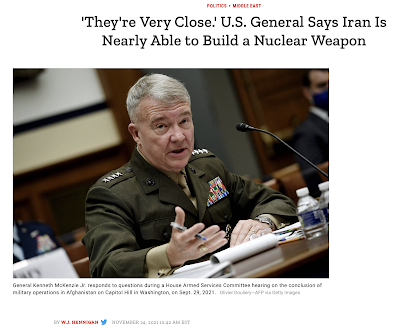
Let's open this posting with a quote from General Kenneth McKenzie, commander of the U.S. Central Command from this article in Time Magazine about Iran's nuclear program and how it is progressing in the post-JCPOA period:


"Our president said they’re not going to have a nuclear weapon. The diplomats are in the lead on this, but Central Command always has a variety of plans that we could execute, if directed....They’re very close this time. I think they like the idea of being able to breakout.”


In this posting, we will look at a very recent report from the Institute For Science and International Security (ISIS) which analyzes the information provided in the International Atomic Energy Agency's (IAEA) quarterly Verification and monitoring in the Islamic Republic of Iran, the latest of which is dated November 17, 2021:


As background, under the terms of the Joint Comprehensive Plan of Action or JCPOA which went into effect in January 2016.  Under the JCPOA, Iran agreed to not produce either rate highly enriched uranium or plutonium that could be used in a nuclear weapon (uranium enriched to 5 percent is used in nuclear power plants and 20 percent is used in research reactors or for medical equipment).  The agreement limited the numbers and types of centrifuges that Iran could operate as well as the size of its stockpile of enriched uranium.  Iran also agreed to implement protocols that would allow the IAEA to unfettered access to its nuclear facilities to prevent the nation from secretly developing nuclear weapons.  U.S. President Donald Trump withdrew from the JCPOA on May 8, 2018, reinstating all previous sanctions that were removed as part of the deal with Iran and the P5+1 signatories.  Since that time, Iran has taken steps to ramp up its nuclear program as shown in this quote from a backgrounder on the Council on Foreign Relations website:


"In response to the other parties’ actions, which Tehran claimed amounted to breaches of the deal, Iran started exceeding agreed-upon limits to its stockpile of low-enriched uranium in 2019, and began enriching uranium to higher concentrations (though still far short of the purity required for weapons). It also began developing new centrifuges to accelerate uranium enrichment; resuming heavy water production at its Arak facility; and enriching uranium [PDF] at Fordow, which rendered the isotopes produced there unusable for medical purposes.


In 2020, Iran took more steps away from its nuclear pledges, following a series of attacks on its interests. In January, after the U.S. targeted killing of a top Iranian general, Qasem Soleimani, Iran announced that it would no longer limit its uranium enrichment. In October, it began constructing a centrifuge production center at Natanz to replace one that was destroyed months earlier in an attack it blamed on Israel. And in November, in response to the assassination of a prominent nuclear scientist, which it also attributed to Israel, Iran’s parliament passed a law that led to a substantial boost in uranium enrichment at Fordow.


The following year, Iran announced new restrictions on the IAEA’s ability to inspect its facilities, and soon after ended its monitoring agreement with the agency completely."


Let's look at the aforementioned report by the Institute for Science and International Security.  According to ISIS, the most recent report from the IAEA shows that the following progress has been made in Iran's nuclear enrichment program:


"Iran has enough enriched uranium hexafluoride (UF6) in the form of near 20 and 60 percent enriched uranium to produce enough weapon-grade uranium (WGU), taken here as 25 kilograms (kg), for a single nuclear weapon in as little as three weeks. It could do so without using any of its stock of uranium enriched up to 5 percent as feedstock. The growth of Iran’s stocks of near 20 and 60 percent enriched uranium has dangerously reduced breakout timelines. 


Iran could continue producing more weapon-grade uranium, using its substantial stock of uranium enriched between two and five percent. In just over two months after the commencement of breakout, Iran could have produced enough additional WGU for a second weapon. After about 3.5 months, it would have enough for a third weapon. The additional production of enough WGU for a fourth weapon would be slower, taking six months, reflecting the depletion of Iran’s pre-existing stocks of enriched uranium. 


Iran appears to have continued producing near 20 percent enriched uranium metal, although the IAEA does not provide details in its latest report. Despite Iran’s claims of civil use, uranium metal is a key material in nuclear weapons. Iran’s move to create the wherewithal to make uranium metal as well as making the metal itself is concerning because Iran is both instituting a nuclear weapons capability and increasing its knowledge and experience in this key area. 


Iran experimented with using near 20 percent enriched uranium as feed in advanced centrifuges at the Natanz Pilot Fuel Enrichment Plant (PFEP), likely gaining important new knowledge in producing highly enriched uranium (HEU) using advanced centrifuges. This is also the first time Iran has started feeding a centrifuge cascade with uranium enriched more than 5 percent at any of its three enrichment plants, possibly gaining additional, irreversible knowledge in setting up and using equipment designed for smaller feed quantities and higher enriched uranium feed. 


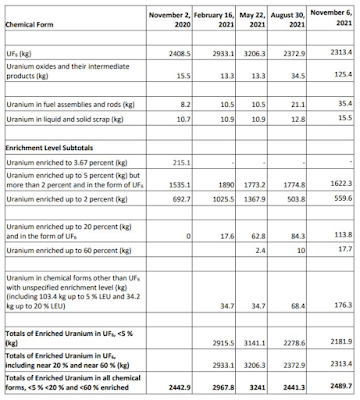
In essence, Iran is effectively breaking out slowly by producing 60 percent enriched uranium and continuing to accumulate it. As of November 6, Iran had a stock of 17.7 kg of near 60 percent enriched uranium (in uranium mass or U mass), or 26.1 kg (in hexafluoride mass). If Iran accumulated about 40 kg of 60 percent enriched uranium (U mass), it would have enough to be able to further enrich it and quickly produce 25 kg of weapon-grade uranium (U mass) in just a few advanced centrifuge cascades. 


Alternatively, 40 kg of 60 percent enriched uranium is more than enough to fashion a nuclear explosive directly, without any further enrichment, although Iran’s known nuclear weapons designs use WGU. 


Iran’s current production rate of 60 percent enriched uranium is 42 kg per year (U mass), meaning that it could accumulate its first amount of 40 kg in about 6.4 months, or by the spring of 2022."


Here is a table showing the growth in Iran's stockpile of enriched uranium:


The IAEA is most concerned about Iran's production of 60 percent enriched uranium (HEU) which began on April 17, 2021 which are not in line with its long-term enrichment and enrichment research and development plans submitted to the IAEA on January 16, 2016.  Here is a quote from the ISIS report:


"During this reporting period, Iran continued to produce 60 percent enriched uranium, or HEU. This level of enrichment is associated with a key step in the traditional stepwise process of climbing from natural uranium to 90 percent enriched uranium, or WGU. Iran also instituted the production of HEU, albeit on a limited scale, by feeding 20 percent enriched uranium into a small number of IR-4 and IR-6 centrifuges.


Sixty percent enriched uranium can be used directly in nuclear weapons. About 40 kg (U mass) is more than enough to make a nuclear explosive, compared to the less than 25 kg (U mass) of 90 percent enriched uranium the Institute uses as sufficient for Iran to manufacture a nuclear explosive. Iran’s accumulation of 60 percent enriched uranium remains a highly provocative, dangerous step."


Moreover, the manner in which Iran has proceeded to enrich to 60 percent, starting from near 5 percent enriched material, is innovative, suggesting Iran continues to gain valuable experience in producing HEU, and by extension even WGU. It is practicing breakout under a civilian cover, and also learning to reduce the number of steps that it would need to go from natural uranium to WGU."


With the growth in Iran's stockpiles of 20 percent and 60 percent enriched uranium, the breakout timeline (the time required from Iran to produce enough enriched uranium for a nuclear weapon) has become "dangerously short". Given that 25 kilograms of weapon-grade uranium is required for a nuclear weapon, the ISIS report claims the following:


"Iran now has enough 20 and 60 percent enriched uranium to use as feed for the first 25 kilograms of weapon-grade uranium, producing about 10 kg of weapon-grade uranium from the 60 percent stock and 15 kg of weapon-grade uranium from the 20 percent stock. Each weapon-grade uranium stock can be produced in parallel, significantly reducing the timeline for production of 25 kilograms of weapon-grade uranium....


Currently, under the scenario outlined above, the result is that within about three weeks, Iran could produce its first quantity of 25 kg of weapon-grade uranium."


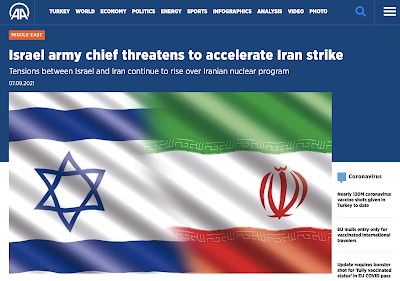
With this information in mind, one has to wonder how long it will be before both the United States and Israel take military action to destroy Iran's ability to further enrich its stockpile of uranium, dragging the world into yet another war, particularly given this:


...and this...