Showing posts with label pandemic treaty. Show all posts

Wednesday, June 7, 2023

Funding the World Health Organization's Pandemic Treaty

While its implementation is pretty much being ignored by the dinosaur media, the World Health Organization's pandemic treaty moves ever closer to being adopted by the elected non thinkers that are in control of the Western world today.  There is one key aspect of the treaty that should be important to all of us given that we, the taxpayers of the world, will be paying for whether we like it or not.


Let's start by looking at the background of the pandemic treaty known internally as the "WHO convention, agreement or other international instrument on pandemic prevention, preparedness and response" aka WHO CA+ and why the World Health Organization believes that its implementation is a necessity:


"In recognition of the catastrophic failure of the international community in showing solidarity and equity in response to the coronavirus disease (COVID-19) pandemic, the World Health Assembly convened a second special session in December 2021, where it established an Intergovernmental Negotiating Body (INB) open to all Member States and Associate Members (and regional economic integration organizations as appropriate) to draft and negotiate a WHO convention, agreement or other international instrument on pandemic prevention, preparedness and response, with a view to its adoption under Article 19, or under other provisions of the WHO Constitution as may be deemed appropriate by the INB."


Obviously, implementing this formidable pandemic treaty will require ongoing funding.  Under Article 19 "Sustainable and predictable financing" of the Zero Draft of the WHO CA+ , we find this with my bolds:


"1. The Parties recognize the important role that financial resources play in achieving the objective of the WHO CA+ and the primary financial responsibility of national governments in protecting and promoting the health of their populations. In that regard, each Party shall:


(a) cooperate with other Parties, within the means and resources at its disposal, to raise financial resources for effective implementation of the WHO CA+ through bilateral and multilateral funding mechanisms;


(b) plan and provide adequate financial support in line with its national fiscal capacities for: (i) strengthening pandemic prevention, preparedness, response and recovery of health systems; (ii) implementing its national plans, programmes and priorities; and (iii) strengthening health systems and progressive realization of universal health coverage;


(c) commit to prioritize and increase or maintain, including through greater collaboration between the health, finance and private sectors, as appropriate, domestic funding by allocating in its annual budgets not lower than 5% of its current health expenditure to pandemic prevention, preparedness, response and health systems recovery, notably for improving and sustaining relevant capacities and working to achieve universal health coverage; and


(d) commit to allocate, in accordance with its respective capacities, XX% of its gross domestic product for international cooperation and assistance on pandemic prevention, preparedness, response and health systems recovery, particularly for developing countries, including through international organizations and existing and new mechanisms."


Notice that under subsection (d), the zero draft does not specify the actual percentage of a nation's GDP that it must commit to spend on pandemic prevention, preparedness and response, rather it is listed as "XX%".  This bears watching as we may find that our rulers have made commitments that are far in excess of what is fiscally reasonable, particularly given the high and growing level of government debt today, to the World Health Organization, a non-elected, non-governmental body that has proven itself to be incompetent during the COVID-19 pandemic and that it functions as the health arm of Bill Gates.


Under the pandemic treaty, signatories will be obliged to spend no less than 5 percent of their current health expenditures on pandemic preparedness.  This will obviously vary by nation since, as shown on these graphics, health expenditures from public sources as a share of total health expenditures vary greatly by nation:


Many nations are already suffering from underfunded or poorly funded public health care systems (i.e. Canada) with wait times, physician and nurse shortages and other negative issues plaguing the health care systems.  The very thought of allocating additional taxpayers' dollars to the World Health Organization should, at the very least, make all of us very angry and we should be insisting that our politicians do not accede to the pandemic treaty since they have already proven themselves to be inept when it comes to effectively operating publicly-funded health care systems.


Friday, December 9, 2022

The World Health Organization's Pandemic Treaty - Surveillance in the Time of a Pandemic

During the COVID-19 pandemic, governments around the world took unusual measures to surveil their citizens, in particular, the use of contact tracing through the use of mobile apps which allowed governments to identify people's movements and who they associated with as well as enforcing quarantine orders, all with the alleged purpose of tracking infections.  While most people were so frightened by the spectre of contacting an infected person, there was concern in some quarters that personal privacy was being breached as governments collected and processed ever larger volumes of personal data.


This surveillance template is not going to disappear in the future if the World Health Organization gets its way.  In a conceptual zero draft copy of this document which is part of the WHO's plans to "...draft and negotiate a convention, agreement or other international instrument on pandemic prevention, preparedness and response...":


This conceptual zero draft of a potential international pandemic treaty is being considered by the Intergovernmental Negotiating Body (INB) as shown here:


The conceptual zero draft was discussed in the meeting held during the three day period from December 5, 2022 to December 7, 2022 the zero draft will be ready for negotiation at the fourth INB meeting which is scheduled to start on February 27, 2023 as shown here:


Here is the surveillance part of the draft document:


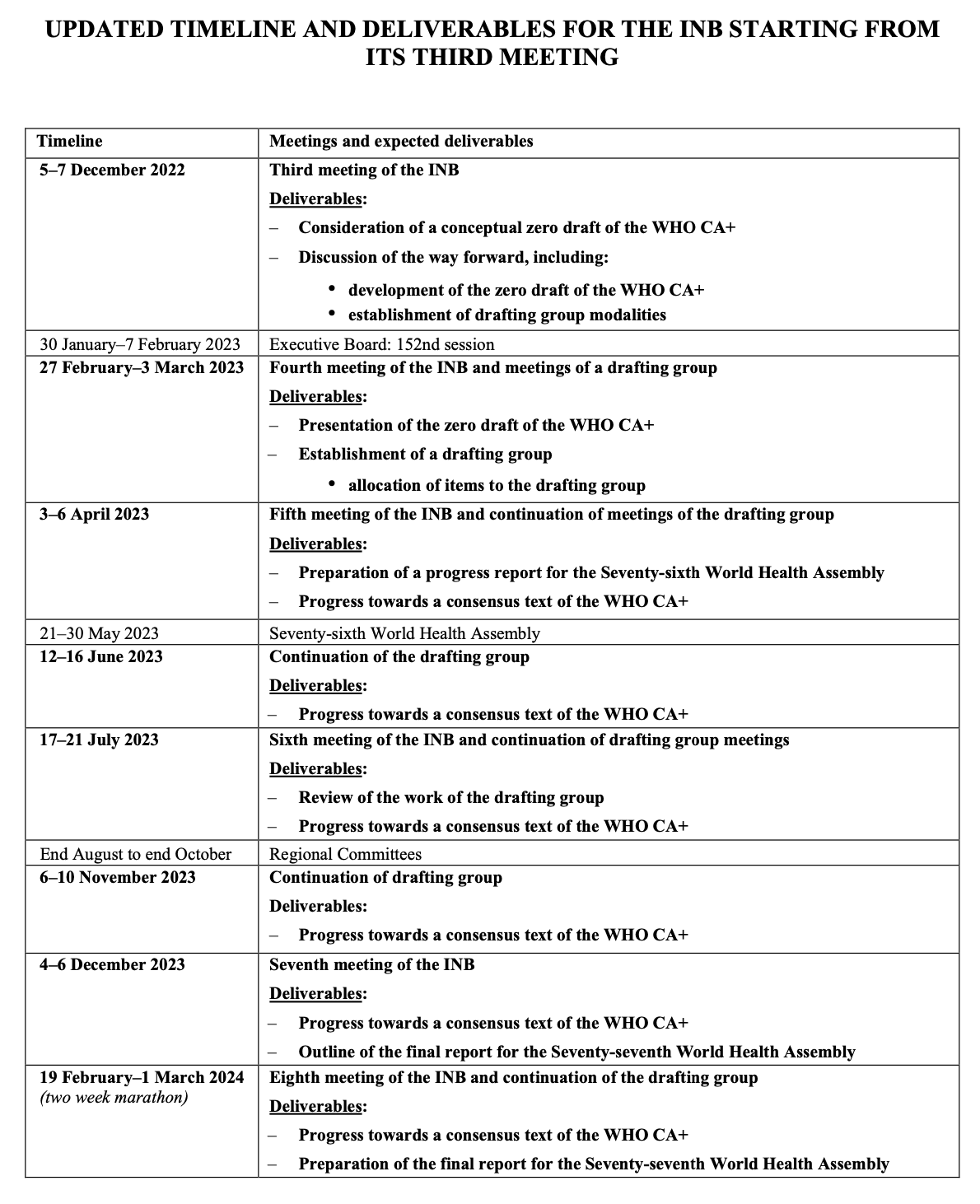
Here is the updated timeframe for implementation of the World Health Organization's pandemic treaty:


If the treaty passes (and you can pretty much assure yourself that it will), it will be adopted under Articles 19, 20 and 21 of the World Health Organization Treaty which read as follows:


This means that the World Health Assembly (WHA) will be allowed to impose legally binding pandemic conventions on the WHO's member states if two-thirds of the WHA members vote in favour of the agreement.


So there you have it.  The global future response to a pandemic will be driven by a non-elected group of individuals who are largely under the control of this man, the world's foremost untrained virologist, vaccinologist and self-appointed expert on pandemics:


Monday, May 16, 2022

The World Health Organization's Pandemic Treaty - Reliniquishing Our Health Sovereignty

Back in December 2021 when everyone was distracted with the first appearance of the Omicron variant, yet another SARS-CoV-2 variant, the World Health Organization (aka the Bill Gates Health Organization) made an announcement regarding a decision that was made to protect the world from future infectious disease crises as announced here:


On December 1, 2021, the 194 members of the WHO's World Health Assembly met in its second-ever Special Session (WHASS) where it adopted a sole decision entitled "The World Together" which established an intergovernmental negotiating body or INB to:


"...negotiate a WHO convention, agreement or or other international instrument on pandemic prevention, preparedness and response ..."


The convention was initially proposed by Chile and the European Union in 2020.


This decision was made with a view to the adoption under Article 19 of the WHO Constitution, or other provisions of the Constitution as may be deemed appropriate by the INB what can best be described as a "pandemic treaty" which, on the surface, sounds delightfully proactive since the underlying logic is to correct the problems of global governance that failed during the COVID-19 pandemic.  


As background, article 19 of the WHO Constitution provides the World Health Assembly with the authority to adopt conventions or agreements on any matter within WHO’s competence. The sole instrument established under Article 19 to date is the WHO Framework Convention on Tobacco Control, which has made a significant and rapid contribution to protecting people from tobacco since its entry into force in 2005."


The INB held a second meeting on February 24, 2022 where two committee co-chairs reflecting a balance of developed and developing economies were elected along with four vice-chairs, one from each of WHO's six regions. Here is a list of those elected:


Co-chair:  Mr Roland Driece of the Netherlands

Co-Chair:  Ms Precious Matsoso of South Africa

Vice-chair: Ambassador Tovar da Silva Nunes of Brazil

Vice-chair:  Mr Ahmed Soliman of Egypt

Vice-chair: Dr Viroj Tangcharoensathien of Thailand

Vice-chair: Mr Kazuho Taguchi of Japan 


The Method of Work for the establishment of a WHO pandemic treaty was also established in which the six chairs as noted above were to begin the development of a working draft for the treaty which is to be presented for consideration of the INB at its second meeting which is to be held no later that August 1, 2022.  At this point, the INB will identify the provision of the WHO Constitution under which the instrument should be adopted.


The INB held an additional meeting (resumed session) on March 14 and 15, 2022 with the Bureau members proposing the following five ways to bring about a world that is better equipped to prevent and respond to future pandemics:


1.) building national, regional and global capacities based on a whole-of-government and whole-of-society approach; 


2.) establishing global access and benefit sharing for all pathogens, and determining a global policy for the equitable production and distribution of countermeasures; 


3.) establishing robust systems and tools for pandemic preparedness and response; 


4.) establishing a long-term plan for sustainable financing to ensure support for global health threat management and response systems; 


5.) empowering WHO to fulfil its mandate as the directing and coordinating authority on international health work, including for pandemic preparedness and response.


Here is a screen capture showing the recommendations by the INB's chairs and co-chairs:


Note that under the fifth recommendation, the WHO will be the directing and coordinating authority on pandemic preparedness and response, a rather frightening prospect.


According to a 2022 paper entitled "The futility of the pandemic treaty: caught between globalism and statism" by Clare Wenham, Mark Eccleston-Turner and Maike Voss, the following are also part of the proposed issues that should be covered by the treaty:


"...access to medical equipment and countermeasures, including vaccines, diagnostics and treatments; capacity-building and standard-setting of health care systems; cooperation in research and technology; a ‘one health’ approach; data-sharing; reform of the WHO alarm mechanism, the public health emergency of international concern declaration process and travel restrictions; and cross-cutting issues, such as accountability, investment in health systems, increased power for the WHO and increased global coordination. Issues beyond the typical boundaries of health, such as trade and supply chains and international travel, have also been raised as potential substantive topics for the treaty to address.  Finally, many member states framed the development of a treaty in terms of human rights, solidarity and equity, including redressing failures that have occurred during COVID-19."


The authors also note that non-compliance has been a WHO problem for more than 50 years meaning that any treaty would have to use incentives or sanctions to ensure adherence to a pandemic treaty as quoted here:


1.) "Incentives could be designed to ensure that governments adhere to the pandemic treaty, whatever the content might be. For example, if a barrier to implementing effective surveillance systems is financing, a ‘carrot’ would be to ensure that funds are available to help with system-wide development. Similarly, if prompt reporting and sharing epidemiological data is seen as counterproductive to national (economic) security, financial or human resources could be made available upon the submission of such reports, mitigating the sting of any trade challenges."


2.) "Sanctions for non-compliance are the alternative, yet these seem politically unsellable in the present climate. Moreover, sanctions may lead to greater concealment of outbreaks by states not wishing to be punished. Given the WHO's current lack of enforcement power, coupled with a lack of financing, it appears that a pandemic treaty under the aegis of the WHO would merely maintain the status quo in compliance." 


The INB will be holding an additional resumed session between June 6 and 8, 2022.  Here is a complete timeline and list of deliverables for the INB through to 2024:


Let's close with this posting with a couple of points that we should be considering:


1.) Do we want a non-elected body (WHO) to be in charge of forcing governments to implement its agenda during the next pandemic?  Since WHO seems very closely tied to China, what if WHO's recommendation during the next pandemic is a "Shanghai-style lockdown" where people are basically locked into their homes, forced into internment camps and have their pets inhumanely disposed of by the state?  Do we want WHO dictating policies that will have a significant impact on our economies given that their recommended response to the COVID-19 pandemic resulted in significant economic losses for individuals and states?


2.) Given this:


...and this, showing that the Bill & Melinda Gates Foundation is also a key donor to GAVI which itself is also a donor to WHO:


...and the fact that Bill Gates has never seen a vaccine that he didn't like (a fact that has been proven time and time again during the current pandemic), do we really want to put our future into the hands of man who is best known as a purveyor of virus-prone software and who is profiting from the COVID-19 vaccines?


Unfortunately, the mainstream media has paid very little attention to the ongoing story behind what could turn out to be a very significant development in the global response to the next pandemic, one that would see an elected body of questionably qualified individuals dictating how our governments will respond to the next edition of a "COVID-xx" virus, resulting in nations completely relinquishing their sovereignty to an organ of the United Nations.


One last thing - do you remember electing either of these men to rule the world? I didn't think so.