Showing posts with label vaccine trials. Show all posts

Thursday, December 8, 2022

A Vaccine for Strep A - Big Pharma to the Rescue

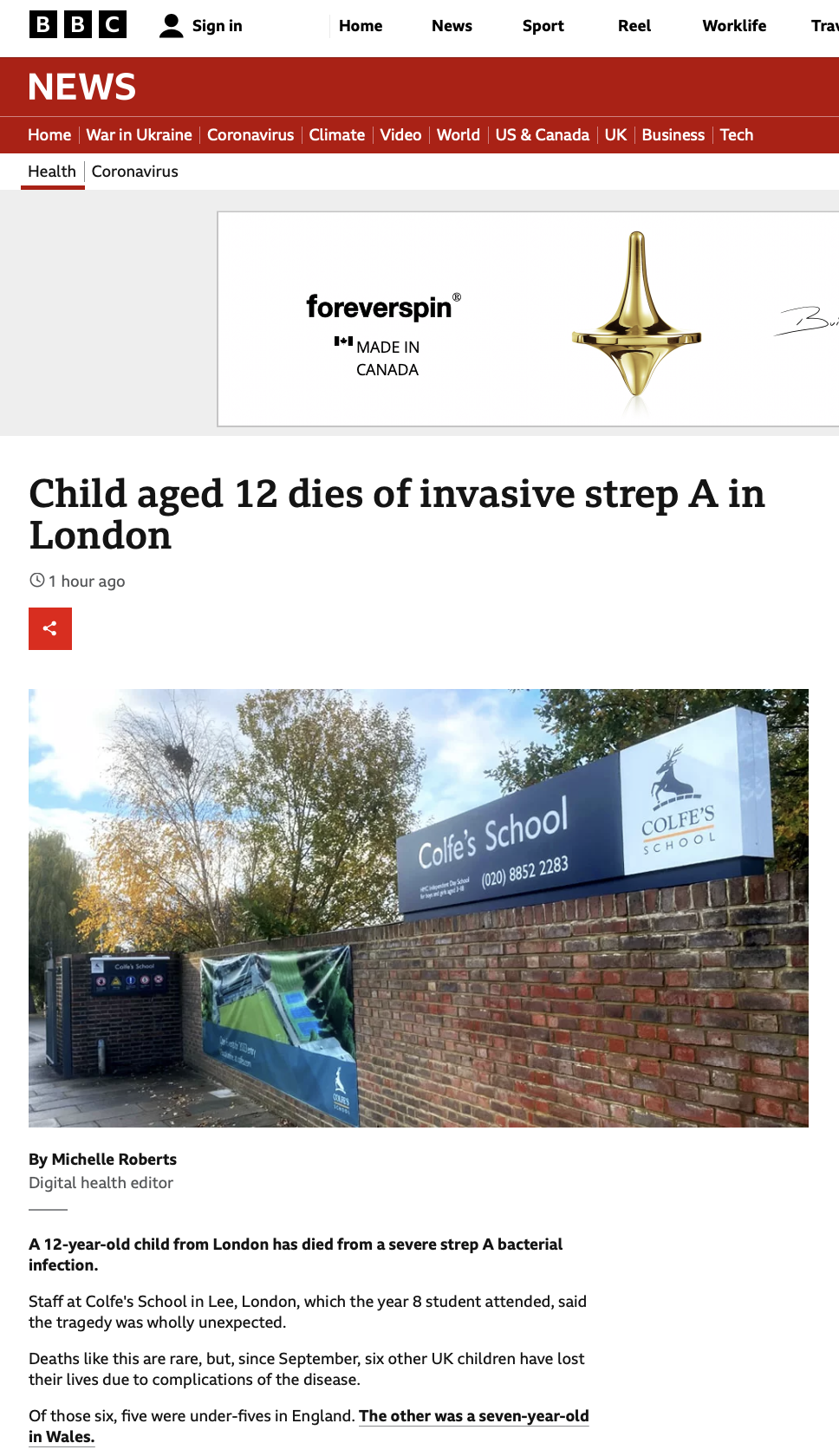
The latest health scare headlines look like this:


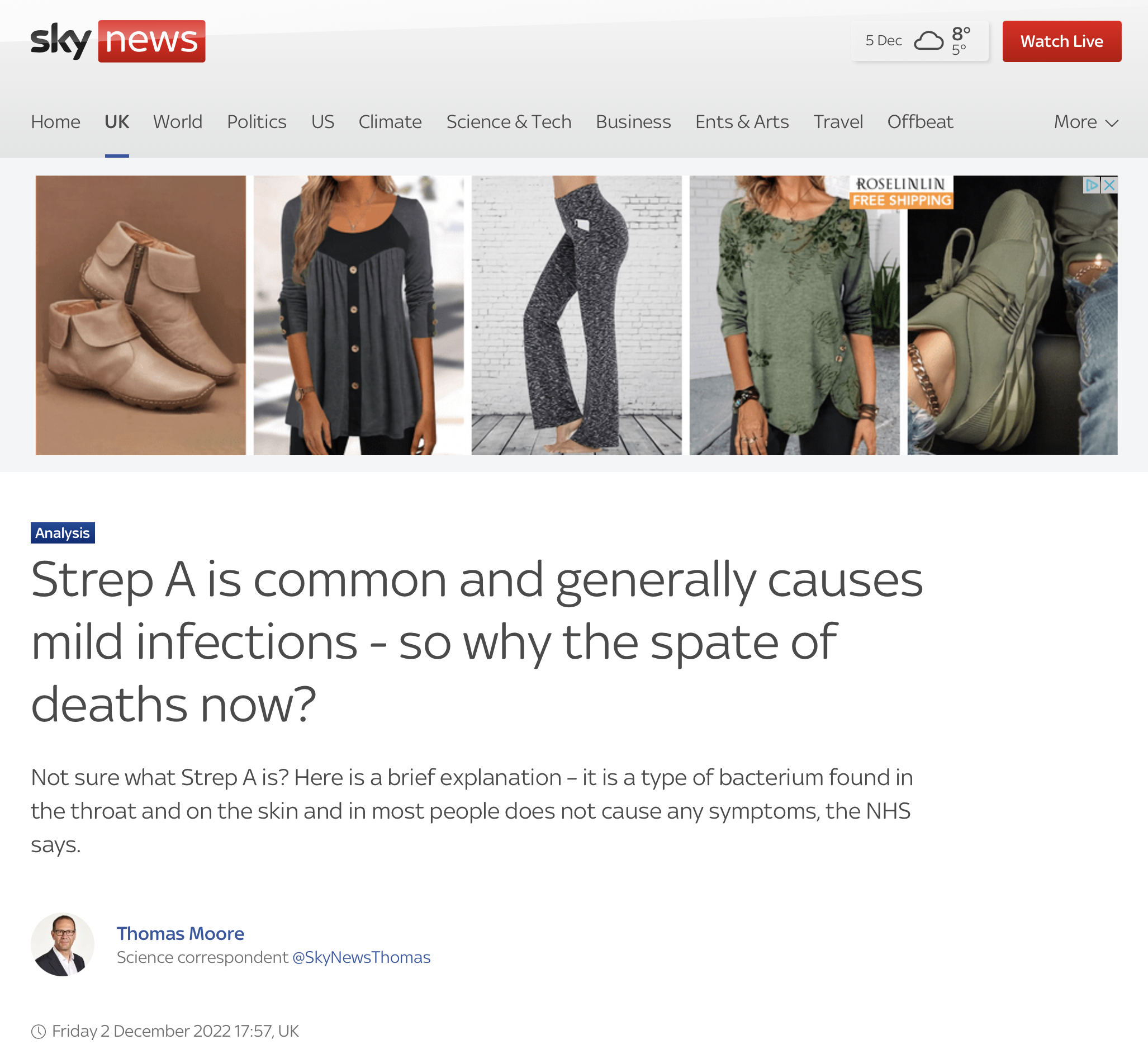
....and this:


...and this:


...along with this press release from the United Kingdom Security Agency:


Here's where the pharmaceutical industry enters into the picture.  Here is an announcement from the University of Alberta in Canada:


According to the press release:


"Group A streptococcus bacteria, more commonly known as strep A, kills more than 500,000 people a year, and there’s currently no vaccine. Strep A can trigger a variety of severe diseases and conditions including rheumatic fever and necrotizing fasciitis (flesh-eating disease). It can also cause a handful of neurological conditions, explains Lawrence Richer, including Sydenham chorea, a disorder typically affecting children that is characterized by constant movement and can be extremely debilitating. Children and marginalized populations are disproportionately affected by strep A infections."


Researchers at Griffith University in South East Queensland, Australia created the vaccine by combining two of the molecules found on every strain of strep A which they hope will enhance the body's immune response against all strains of the bacteria.


The current trial at the University of Alberta builds on many years of investments in early-phase clinical trials.  A prototype vaccine was trialled in Australia in a pilot study and no adverse events were recorded.  This trial will include 10 to 20 patients and will first demonstrate safety and then demonstrate efficacy.  If the trial is successful, the Li Ka Shing Applied Virology Institute at the University of Alberta, the translation and commercialization arm of the Li Ka Shing Institute of Virology, will support a larger number of patients in Phase 2 trials.


If you are interested in signing up, here is a link that you can use to volunteer if you are healthy and are between the ages of 18 and 45 years:


Volunteers will make a total of six one-hour visits to the testing facility at the University of Alberta, have blood drawn at each visit, receive three total vaccine injections over ten months, agree to be monitored for 10 months and receive a massive payment of $50 for each visit!


And, once again and when the hard work of research is done, it will eventually be Big Pharma to the rescue when they buy the patents and then sell the vaccine to a vulnerable public at some highly inflated price!  Given the current headlines, it will be fascinating to watch the progress of the trials for this vaccine to see if it is rolled out to the public as quickly as the COVID-19 vaccines.


Monday, December 6, 2021

The Early Danger Signs of Pfizer's COVID-19 Vaccine

After having been sued by the group Public Health and Medical Professionals for Transparency, we now have a complete picture of the adverse events connected to the early days of the rollout of Pfizer's BNT162b2 COVID-19 vaccine now known as Comirnaty.  This document was released under a Freedom of Information request against the Food and Drug Administration, the U.S. government body responsible for approving Pfizer's COVID-19 vaccine.


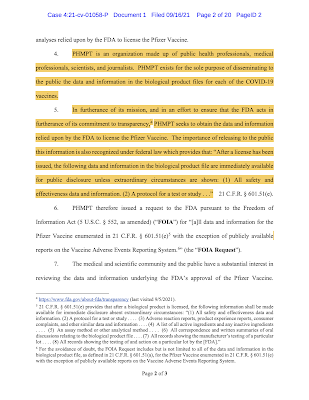
Let's open with this screen capture showing the first three pages of the civil action taken by Public Health and Medical Professionals for Transparency (PHMPT) which was filed on September 16, 2021:


As background, PHMPT is a non-profit organization headquartered in Fort Worth, Texas.  It consists of "...public health professionals, medical professionals, scientists, and journalists exists solely to obtain and disseminate the data relied upon by the FDA to license COVID-19 vaccines. The organization takes no position on the data other than that it should be made publicly available to allow independent experts to conduct their own review and analyses."


The suit was filed by PHMPT because the FDA originally denied PHMPT's Freedom of Information Act request for the documentation on the data behind the FDA's conclusion that the Pfizer vaccine was safe and effective because PHMPT did "not demonstrate a compelling need that involves an imminent threat to the life or physical safety of an individual” or “that there exists an urgency to inform the public concerning actual or alleged Federal Government activity".  We'll let the documents tell us whether that is actually true.


Now, let's look at one of the key documents, Cumulative Analysis of Post-Authorization Adverse Event Reports of [the Vaccine] Received Through 28-Feb-2021 which looks at data from the first two and a half months after the vaccine received Emergency Use Authorization from the Food and Drug Administration.  


Here is the lead page of Pfizer's document which was submitted to the FDA as part of its approval process for BNT162b2:


The time period covered by this analysis includes data from the United States and foreign nations in the post-authorization period reported through to February 28, 2021, in other words, the very early days of the vaccine rollout which began around December 1, 2020.  The vast majority of adverse events were reported from the United States and most involved women (29,914 vs. 9,182 for men) and those between the ages of 31 and 50 years old.  


Let's look at some of the key sections noting that Pfizer states that the reports are submitted voluntarily and that the magnitude of underreporting is unknown (see page 5).  The report also notes the following with my bolds:


"Due to the large numbers of spontaneous adverse event reports received for the product, the MAH (marketing authorization holder - BioNTech) has prioritised the processing of serious cases, in order to meet expedited regulatory reporting timelines and ensure these reports are available for signal detection and evaluation activity. The increased volume of reports has not impacted case processing for serious reports, and compliance metrics continue to be monitored weekly with prompt action taken as needed to maintain compliance with expedited reporting obligations. Non-serious cases are entered into the safety database no later than 4 calendar days from receipt. Entrance into the database includes the coding of all adverse events; this allow for a manual review of events being received but may not include immediate case processing to completion. Non-serious cases are processed as soon as possible and no later than 90 days from receipt. Pfizer has also taken a multiple actions to help alleviate the large increase of adverse event reports. This includes significant technology enhancements, and process and workflow solutions, as well as increasing the number of data entry and case processing colleagues."


Even Pfizer is admitting that there were a large number of adverse events reported which meant that they had to prioritize the most serious cases with the less serious cases taking up to 90 days to be processed and added to the adverse event database.


Note that I have provided you with the page numbers from the report should you care to look the facts up for yourself.


1.) General Adverse Event Data (pages 6, 7 and 8): 


Here is Figure 1 as referred to above:


Here is a table showing the selected characteristics of all cases during the reporting interval:


Note that according to Pfizer's own data, there were already 1223 deaths attributed to the administration of their COVID-19 vaccine with 11,361 individuals having not recovered by the end of February 28, 2021 and 520 still experiencing adverse symptoms well after administration of the vaccine (sequelae).


2.) Anaphylaxis (page 10):


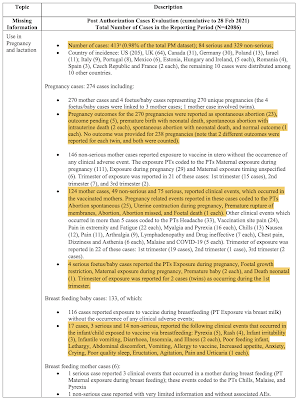
3.) Use in pregnancy and lactation  (page 12):


It is important to remember that the vaccine was not approved for pregnant or nursing women at that point in time.


4.) Vaccine Effectiveness (page 13 and 14):


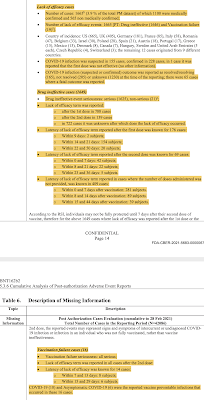
a.) Defining Vaccine Failure and Drug Ineffectiveness:


b.) Drug ineffective cases noting that according to the RSI, individuals may not be fully protected until 7 days after their second dose of vaccine:


5.) Cardiovascular Adverse Events of Special Interest (page 16):


Of these events, 136 were fatal, 767 were resolved or resolving, 21 were resolved with sequelae and 140 were not resolved  (380 unknown).


6.) Facial Paralysis (page 19):


As an aside, throughout the document these sentences appear frequently as part of Pfizer's conclusions:


"This cumulative case review does not raise new safety issues. Surveillance will continue."


Apparently even the deaths of over 1200 "customers" associated with the administration of its vaccine isn't of any particular concern to Pfizer and most definitely should not be a reason to withdraw its COVID-19 vaccine from the market even though this has happened:


I believe that is enough information to digest.  If you wish to further investigate other adverse events, I would suggest that you peruse the document for yourself as found at this link.


Let's close with this summary from Pfizer's report:


"The data do not reveal any novel safety concerns or risks requiring label changes and support a favorable benefit risk profile of to the BNT162b2 vaccine."


In other words, nothing to see here FDA, just move along.  Full speed ahead.  I guess that killing people is no longer sufficient grounds for removing a pharmaceutical from the marketplace which shows us just how corrupt the FDA's approval process has become.


There is one thing that we can be certain of in the post-truth COVID-19 era; Pfizer's vaccine is most assuredly providing a favourable benefit to Pfizer's and BioNTech's profitability, deaths and serious adverse events be damned.  


Tuesday, October 12, 2021

COVID-19 Vaccines - Comparing the Traditional Vaccine Trial Paradigm and the Outbreak Trial Paradigm

Governments keep assuring us that it is safe to get vaccinated with the "fully tested COVID-19 vaccines" that were developed in record time to beat back the pandemic.  Without thinking too deeply about it, one might believe their anti-unvaxxed rhetoric if it weren't for the fact that information which can be gleaned from various government and scientific websites showing this to be at least questionable and, at the worst, a complete fabrication.  In this posting, we'll look at several different sources showing the timelines for the development of vaccines throughout history and compare it to the current situation for the vaccines being administered during the pandemic.


Let's start with this video from Canada's federal government about the COVID-19 vaccines and why you should trust the government's approval of the products:


Here's Canada's taxpayer funded CBC (aka the Coronavirus Brainwashing Corporation) weighing in on the subject of mixing and matching COVID-19 vaccine doses:


Note the comment by Canada's Chief Public Health Officer, Theresa Tam, that "...recommendations undergo evolution over time and this is the next stage of the increased understanding of our vaccines."


Let's look at several different sources which will clearly show us just how novel the process has been for the rollout of the COVID-19 vaccines.


1.) Here's what the Canadian government has to say about the development of vaccines (in general) as found on the nation's Library of Parliament HillNotes website which was posted in June 2020 and revised in November 2020:


Notice that according to the Canadian government it can take between 9 and 15 years to complete all three phases of a clinical trial.


Here is the key quote:


"Once an appropriate immune response is detected, the candidate vaccine moves into three phases of human clinical trials to test its safety and efficacy. Each clinical trial phase for a vaccine can still take several years or more to complete."


2.) Here is a graphic from Pfizer showing how pharmaceutical trials work:


What is important to note in this graphic is that Phase 3 trials involve between several hundred to three thousand people and Phase 4 trials involve several thousand people.  Such is not the case in the current "trials" of the COVID-19 vaccines where hundreds of millions of test subjects have been given up to three doses of the newly minted vaccines.


3.) A paper that appeared in Nature back in September 2020 entitled "Traditional and accelerated vaccine-development pipelines" by Florian Krammer provides an interesting comparison of normal vaccine development timelines and the timeline for development of the COVID_19 vaccines as shown here:


4.) Here is a graphic from the Centers for Disease Control and Prevention showing the "Vaccine Life Cycle" which doesn't show the actual time periods required for each phase of the trial but does show Phase 4 which takes place after FDA approval:


The CDC does state this about the development of vaccines:


5.) A paper entitled "Developing COVID-19 Vaccines at Pandemic Speed by Nicole Lurie et al which appeared in the New England Journal of Medicine in March 2020 actually provides us with an interesting comparison of the traditional vaccine development paradigm and the paradigm used during a pandemic which clearly shows where changes to the normal process occur:


Here is a quote from the paper:


"Vaccine development is a lengthy, expensive process. Attrition is high, and it typically takes multiple candidates and many years to produce a licensed vaccine. Because of the cost and high failure rates, developers typically follow a linear sequence of steps, with multiple pauses for data analysis or manufacturing-process checks. Developing a vaccine quickly requires a new pandemic paradigm (see diagram), with a fast start and many steps executed in parallel before confirming a successful outcome of another step, hence resulting in elevated financial risk. For example, for platforms with experience in humans, phase 1 clinical trials may be able to proceed in parallel with testing in animal models."


One thing that the authors of the paper do not mention is that the current crop of COVID-19 vaccines still could prove to be failures at stopping the transmission  of the virus as well as reducing hospitalizations and the occurrence of serious cases.  While some researchers are stating that the vaccines are reducing serious cases, the data is still incomplete and with the rise of the Delta variant, all bets are off.


Now, let's look at the facts as they currently stand.  According to the manufacturers of the current COVID-19 vaccines, the trials are not even close to being completed:


1.) PfizerBioNTech - Phase 3 to be completed on May 2, 2023 (estimated)


2.) Moderna - Phase 3 to be completed on October 27, 2022 (estimated)


3.) Johnson & Johnson/Janssen - Phase 3 to be completed on January 2, 2023 (estimated)


4.) AstraZeneca - Phase 3 to be completed on February 14, 2023 (estimated)


Now, let's look at Canada's "mix and match" vaccine strategy.  Actually, there are plans to study this issue as shown here:


...however, the trial status is "pending" and the study only started on May 3, 2021 so, despite what Theresa Tam says, Canadian researchers still have no idea of whether this mixing of vaccines could result in adverse events or whether it will provide immunity to the COVID-19 virus.


As far as administering a third dose of a COVID-19 vaccine (booster dose), here is the plan to study that issue using residents of long-term care facilities, noting that the study has not even commenced:


Given the fact that proper vaccine testing can take up to a decade and a half to complete through to the end of Phase 3 or Phase 4 trials as I have outlined in this posting and that we still have between 13 and 20 months to complete Phase 3 trials for the Pfizer, Moderna, Johnson & Johnson  and AstraZeneca vaccines, how can governments around the world allow Phase 3 trials for the COVID-19 vaccines to be taking place using hundreds of millions of their citizens rather than the several hundred to several thousand participants as would be typical for a Phase 3/Phase 4 trial?  


Monday, September 20, 2021

Pfizer, the FDA and the COVID-19 Vaccine Booster for the Elderly

The United States Food and Drug Administration (FDA) has recently approved a third shot or booster of Pfizer's COVID-19 vaccine, Comirnaty, for people at least 65 years old and those that are at risk for severe disease at a recent meeting of the FDA's Vaccines and Related Biological Products Advisory COmmmitee (VRBPAC).  At the same meeting, the members of VRBPAC voted against an additional dose of COomirntay for the wider population.  With that in mind, let's look at the details of the document supplied to the members of VRBPAC by Pfizer to get a sense of how much testing was actually done on these of a third shot and who could be at risk from the repercussions of this decision.


Let's start with some background information by looking at Pfizer's viewpoint on the waning effectiveness of Comirnaty both over time and by SARS-CoV-2 variant in its submission to the FDA:


Please note that Pfizer admits that the "...data supports the need for a booster (third) dose of Comirntay approximately 6 months after the second dose....for individuals 16 years of age and older".  Pfizer also states the following:


"Among vaccinated healthcare workers, decreased neutralizing antibody titers have been associated with vaccinees’ breakthrough infections, along with increased viral load...emerging data suggest that vaccine protection may wane approximately 6 to 8 months following the second dose, and evidence is building to suggest that administration of booster doses of COVID-19 mRNA vaccines is potentially an urgent emerging public health issue."


Thank goodness that Pfizer's profits from Comirnaty have already been "deposited into the bank".


Here is another quote showing how poorly the Comirnaty vaccine performs from an observational study conducted by the State of Israel Ministry of Health with my bold:


"The State of Israel Ministry of Health (Israel MoH) conducted an observational study to assess the effectiveness of BNT162b2 against various SARS-CoV-2 outcomes from 20 June 2021 through 17 July 2021....In this evaluation, among individuals ≥16 years of age, BNT162b2 effectiveness against SARSCoV-2 infection was only 39.0% (95% CI: 9.0%, 59.0%) and against symptomatic COVID-19 was 40.5% (95% CI: 8.7%, 61.2%) between 20 June 2021 and 17 July 2021. This was considerably lower than published effectiveness estimates from an earlier time period. Specifically, between 24 January 2021 to 03 April 2021 VE against these same endpoints was greater than or equal to 95 percent."


To address the requirements for a trial of a booster, Pfizer implemented a substudy of the original study supplied to the FDA for the Emergency Use Authorization.  This study consisted of the following:


1.) Phase 1 - 23 doubly vaccinated participants between 24 and 75 years of age with 11 of these being between the ages of 18 and 55 and 12 being between the ages of 65 and 75 years.  All participants were healthy and were not a high risk for SARS-CoV-2 infection or had antibodies from a previous infection.  The Phase 1 cut-off date was May 13, 2021 and no adverse events were recorded after that date.


Instead of being run consecutively as would normally be the case, Pfizer ran Phases 2 and 3 together, a highly unusual practice.


2.) Phase 2/3 - 306 participants aged 19 to 55 years of age (originally 312 participants with four participants withdrawing after receiving their booster with 2 being lost to followup) and 2 who withdrew from the study.  The range of duration between the second and third doses was 4.8 to 8.0 months and the median was 6.8 months.  This portion of the study was conducted in the United States, Argentina, Brazil Germany, South Africa and Turkey.  The Phase 2/3 cut-off date was June 17, 2021 and no adverse events were recorded after that date.


Here is a table showing the demographics of the two trials as screen captured from this document:


In accordance with FDA guidance, the safety and effectiveness of the booster dose given in Phase 2/3 was extrapolated to individuals 16 and 17 years of age and individuals older than 55 years of age as shown here:


Okay, let's let this sink in.  The Pfizer booster Phase 1 trial included only 12 older participants between the ages of 65 and 75 with a median age of 69.0 years and a mean (average) age of 69.3 years  None of the participants in this age range had comorbidities and none were obese.  No Phase 2/3 trial was undertaken for any participant over the age of 55 years; in the case of this trial, the safety and effectiveness of the vaccine was extrapolated from the Phase 2/3 trial results for the younger age group (19 years to 55 years).  Basically, the FDA made the decision to allow Pfizer to use a booster shot for Americans aged 65 and older based on a test which included only 12 people with a maximum age of 75 years, no comorbidities and not obese, which will certainly prove to be a challenge in the "real world" given that most Americans over the age of 65 have at least one significant health issue.  In addition, the length of the trial was very short at only one month and the effectiveness of the vaccine at improving immunity was also measured only 1 month after completion of the vaccination so we have no idea of what additional protection that a booster will offer as time passes.  


As well, Pfizer has made it impossible to follow the medium- and long-term effects of the booster vaccine since they unblinded all of the Phase 2/3 participants in both the vaccine and placebo groups by offering them a booster containing Comirnaty:


I have nothing to add except that I would ask you to ruminate on how the FDA could approve a booster shot for elderly Americans based on a flawed test that included a stacked deck of only 12 individuals between the ages of 65 and 76 years.  Do you think that the mainstream media reported this?  Not on your life.


This whole thing is turning out to be one giant Big Pharma clusterf@ck.