Showing posts with label Boeing. Show all posts

Wednesday, March 27, 2019

Boeing and Its Connections to Washington

Updated December 2019

With Boeing finding itself on the receiving end of bad news thanks to issues related to its 737 Max 8 model and with Washington's seeming reluctance to be among the first nations to banish these airplanes from the sky, especially considering the large number of 737 Max 8s that are flying in American airspace, I thought it would be prudent to look at a key aspect of Boeing's business model.

According to Defense News, in 2018, Boeing was the fifth largest defense contractor in the world when measured in terms of defense revenue (2017 data) as shown here:


According to Boeing's financial results for the fourth quarter of 2018, the company had record fourth quarter revenue of $28.3 billion ($101.1 billion on a full year basis) thanks to record commercial delivers and higher defense volumes.  Here is a table showing the company's revenues and earnings from its Defense, Space and Security operations:


Higher revenue in the fourth quarter of 2018 was driven by increased volumes across F/A-18, satellites and weapons.  During the quarter, Boeing was awarded a contract for a joint ground system to provide tactical satellite communications for the United States Air Force, completed a successful test for the United States Air Force's Minuteman III and unveiled the SB>1 DEFIANT helicopter to the United States Army.  In January 2019, Boeing also delivered the first two KC-46 Tankers to the United States Air Force.  It is key to note that Boeing's order backlog at Defense, Space and Security was $57.166 billion of which 70 percent or $39.9 billion represents customers inside the United States (i.e. U.S. taxpayers).  Boeing projects that revenues for its Defense, Space and Security segment will be between $26.5 and $27.5 billion for fiscal 2019.

Now, given that Boeing is a very important part of America's military-industrial-intelligence network, let's look at a key aspect of Boeing's business which receives relatively little attention.  According to Open Secrets, here is a historical look at Boeing's contributions to political candidates by political party going back to 1990:


Boeing's total political contributions of $4.551 million in 2018 put it in 82nd place out of 19,087 organizations.

Here is a table providing a detailed breakdown of the same data:


Here is a table showing how the political contributions were divided between the House and Senate:


Here are the top recipients of Boeing's generosity:


Here is a list of members of the Senate Committee on Armed Services:


Here is a list of key members of the House Committee on Armed Services:


It is interesting (but not terribly shocking) to note that there is some overlap between the House and Senate recipients of Boeing's generosity and the list of members of the Committee on Armed Services.

Lastly for this section, let's look at which members of the House and Senate own Boeing stock:


Let's look at Washington's other favourite pastime, lobbying.  Here is a graphic showing how much Boeing has spent on lobbying over the past two decades:


Boeing's lobbying expenditures of $15.12 million put it in 10th place out of 4,163 lobbying entities in 2018.

As you can see here, Boeing stands in first place among its Defense/Aerospace peers when it comes to spending on lobbying:


In 2018, Boeing had 98 lobbyists, 71 (or 72.4 percent) of which are revolvers (i.e. had government connections).  Here is a partial listing of the lobbyists that worked on Boeing's behalf in 2018:


Here are the government agencies and government bodies that Boeing lobbied in 2018:


Here is a partial listing of issues that concerned Boeing in 2018:


Boeing was among the top ten lobbyists when it came to the Tax Cuts and Jobs Act (H.R. 1), the bill that saw the corporate income tax rate drop to 21 percent, an obvious benefit to Boeing.  That said, it is interesting to note that Boeing's effective federal and state tax rates looked like this over the decade between 2008 and 2017:


Apparently, an effective tax rate of 8.4 percent is seen as way too high for a company that made total pretax profits of $54.865 billion over the decade.  But, thanks to the tax cuts, here is what Boeing has proposed:


As you can see from this data, Boeing is one of the big players when it comes to spending money to gain influence in Washington.  Apparently, Boeing's management is well aware that Washington is for sale and that there is an excellent chance that spending money on political candidates and lobbying will be returned many-fold to Boeing's bottom line. 
  

Friday, October 30, 2015

Reauthorizing the "Bank of Boeing"

Many of us have either heard very little about or are unaware of an Executive Branch agency that exists with the "mission of supporting American jobs by facilitating the export of U.S. goods and services".  In this era of declining manufacturing in America, this agency sounds like a great thing, unless it costs taxpayers more than it provides.

EXIM also known as the Export-Import Bank of the United States, was formed in 1934 by the Roosevelt Administration with the initial goal of providing funding to the Soviet Union and Cuba.  In fact, the first loan issued by EXIM was to the nation of Cuba so that it could purchase $3.8 million worth of silver ingots from the United States.  It became an independent agency on July 31, 1945 and became a self-funding federal government agency in 2007 although all loans are still backed by the federal government, otherwise known as the American taxpayer.  One of the requirements of EXIM is that it be reauthorized by Congress every four or five years and, on September 19, 2014, under House Joint Resolution 124, the operating authority of the Export-Import Bank was extended until June 30th, 2015.  Since July 1, 2015, this is what has been displayed on the EXIM website:


Since July 1, 2015,  EXIM has lost its authority to issue new loan guarantees to foreign purchasers of American goods.

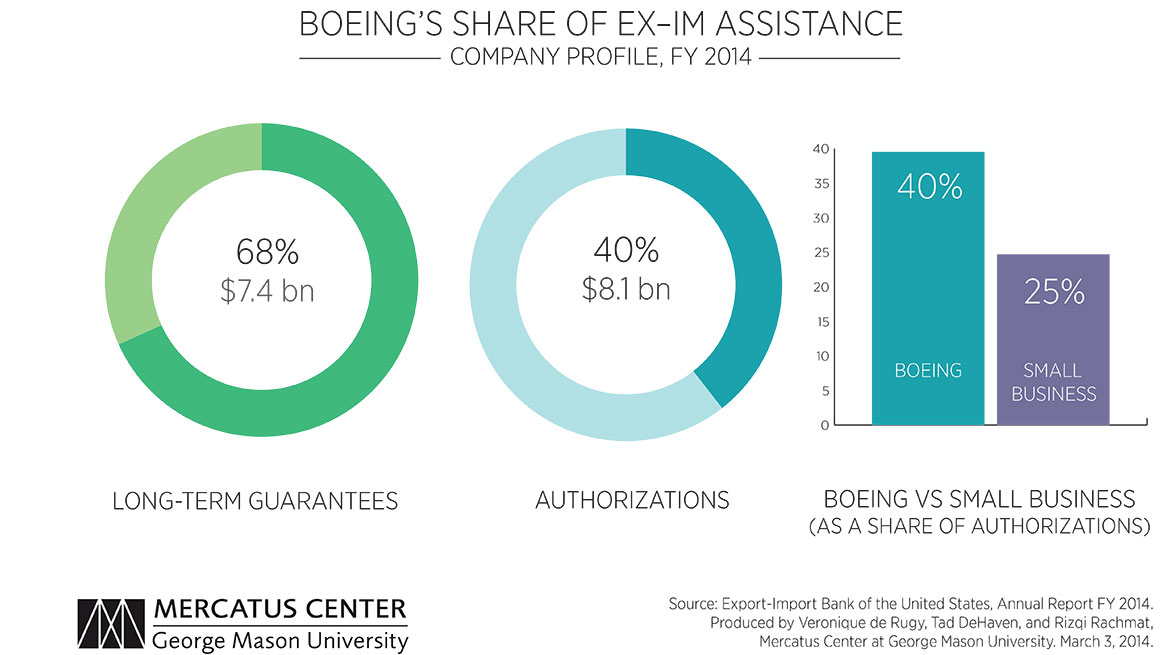
While EXIM's primary goal is to basically create jobs in the United States through the manufacturing and exportation of American-made goods by guaranteeing loans for foreign purchasers of said goods (and services), its operation has been questioned by many analysts.   This is particularly the case for Boeing, a major player in the world's aircraft manufacturing industry.  EXIM, sometimes referred to as "The Bank of Boeing" is a major backer of Seattle, Washington-based Boeing as you can see on this diagram from the Mercatus Center:


On top of that, according to a recent article by Veronique de Rugy, EXIM reached out to Boeing for assistance in drafting new bank rules that were to be put in place to ensure that its loans take into consideration the negative impact that they have on non-subsidized American companies.  To see how distorted EXIM's disbursements have become, here is a table showing the state rankings for EXIM's disbursements between 2007 and 2014:


Not surprisingly, the state of Washington is by far the biggest beneficiary with total EXIM disbursements of $50.63 billion which means that 22.67 percent of the state's total export value being supported by EXIM.  As well, you can see that small businesses really get the short end of things; only $57.06 billion worth of small business exports are supported by EXIM out of the total of $235.62 billion worth of exports which were supported by EXIM between 2007 and 2014.  In the case of Washington, a tiny 1.03 percent of EXIM disbursements went to small businesses.

Now that we have a bit of background, let's look at the present.  On October 27, 2015, Roll Call 576 took place, voting on House Resolution 597.  This vote received relatively little coverage by the mainstream media.  For your information, here is the text of H.R. 597, otherwise known as the Export-Import Bank Reform and Reauthorization Act of 2015:


Here is a listing of who voted for and against H.R. 597 by party:


Here are the yeas:


Here are the nays:


Given that the continued existence of EXIM is critical to Boeing, let's look at how much money Boeing has spent trying to convince Washington of its viewpoint on many issues since 1998:


So far in 2015, Boeing has spent $16.755 million on lobbying in Washington, compared to $15.23 million in 2014 which put it at number 10 out of 3514 lobbyists, and could well set a "personal best" this year.   When it comes to all lobbying on trade, in 2015, Boeing has spent the fourth highest amount, following Wal-Mart, Big Pharma and the United Parcel Service.  On top of that, Boeing spent $3.253 million on campaign contributions in the 2014 cycle, benefitting these individuals and many more:


Current Democratic presidential candidate Hillary Clinton has even offered her opinion on EXIM at a recent speech in New Hampshire.  She called for "speedy reauthorization of the Export-Import Bank".  As well, back in November 2014, she stated the following:

Thank you for mentioning the EXIM Bank, because I’m a very strong supporter of the EXIM Bank, because it is a tool for us to be competitive in order to support our businesses exporting.  But there are those who wish to end the role of the Export-Import Bank, and it’s not based on evidence, it’s based on ideology.

In contrast, her main competitor, Senator Bernie Sanders, issued the following statement after the Senate voted on an amendment that would see EXIM reauthorized for five years back in June:

"At a time when almost every major corporation in this country has shut down plants and outsourced millions of American jobs, we should not be providing corporate welfare to multi-national corporations through the Export-Import Bank.

Instead of providing low-interest loans to multi-national companies that are shipping jobs to China and other low-wage countries, we should be investing in small businesses and worker-owned enterprises that want to create jobs in the United States of America.  If the Export-Import Bank cannot be reformed to become a vehicle for real job creation in the United States, it should be eliminated. 


Now that H.R. 597 has passed the House, it will be interesting to see whether Boeing has spent sufficient lobbying money to ensure that the "Bank of Boeing" receives the final stamp of approval, ensuring its continued existence for the near future.  With the Republicans and Democrats being split over EXIM, its future is certainly uncertain.