Updated May 2017
The Trump Administration's early 2017 moves to suppress the flow of citizens from six nations because of security concerns and its backing of the failed raid in Yemen, is rather interesting, given that the majority of the perpetrators of the September 11, 2001 terrorist activities came from one nation; the Kingdom of Saudi Arabia (KSA). This does come as a bit of a surprise in one sense but, given the current Secretary of State, Rex Tillerson, and his past position as Chairman of the Board and CEO of ExxonMobil, this posting will show you that this should not be a shock to anyone.
The Trump Administration's early 2017 moves to suppress the flow of citizens from six nations because of security concerns and its backing of the failed raid in Yemen, is rather interesting, given that the majority of the perpetrators of the September 11, 2001 terrorist activities came from one nation; the Kingdom of Saudi Arabia (KSA). This does come as a bit of a surprise in one sense but, given the current Secretary of State, Rex Tillerson, and his past position as Chairman of the Board and CEO of ExxonMobil, this posting will show you that this should not be a shock to anyone.
According to ExxonMobil, the corporation is
one of the largest foreign investors in Saudi Arabia through its subsidiary,
ExxonMobil Saudi Arabia Inc. (EMSA) and has a very long history of operating in
the Kingdom as shown here:

ExxonMobil has an 85 year
track record of being one of the largest investors in the KSA as a joint
venture partner with the now 100 percent Saudi-owned Saudi Arabian Oil Company
(Saudi Aramco) and Saudi Basic Industries Corporation (SABIC). ExxonMobil is also one of the KSA's largest private sector purchases of Saudi Aramco crude oil
Let's look at a bit of
background. Back in 1948, Standard Oil Company (now Exxon) and
Soccony-Vacuum Oil Company (became Mobil) became part owners of the original
Arabian American Oil Company (Aramco), providing market outlets and capital
investments to develop the massive Saudi oil and natural gas reserves. In
1950, then-Saudi King Abdulaziz threatened to nationalize the nation's oil
facilities, a move that forced Aramco to share its profits 50/50 with the KSA.
This also resulted in a move of the company's headquarters from New York
City to Dhahran. In 1973, the Saudi government purchased a 25
percent interest in Aramco, increasing its participation interest to 60 percent
in 1974. In 1980, the Saudi government completed its purchase of Aramco,
owning 100 percent of its crude oil concession rights, production and
facilities. Saudi Aramco now owns the largest oil reserves among all
companies in the world and is the world's largest producer of oil.
Let's look at
ExxonMobil's current activities in the KSA which include petrochemicals
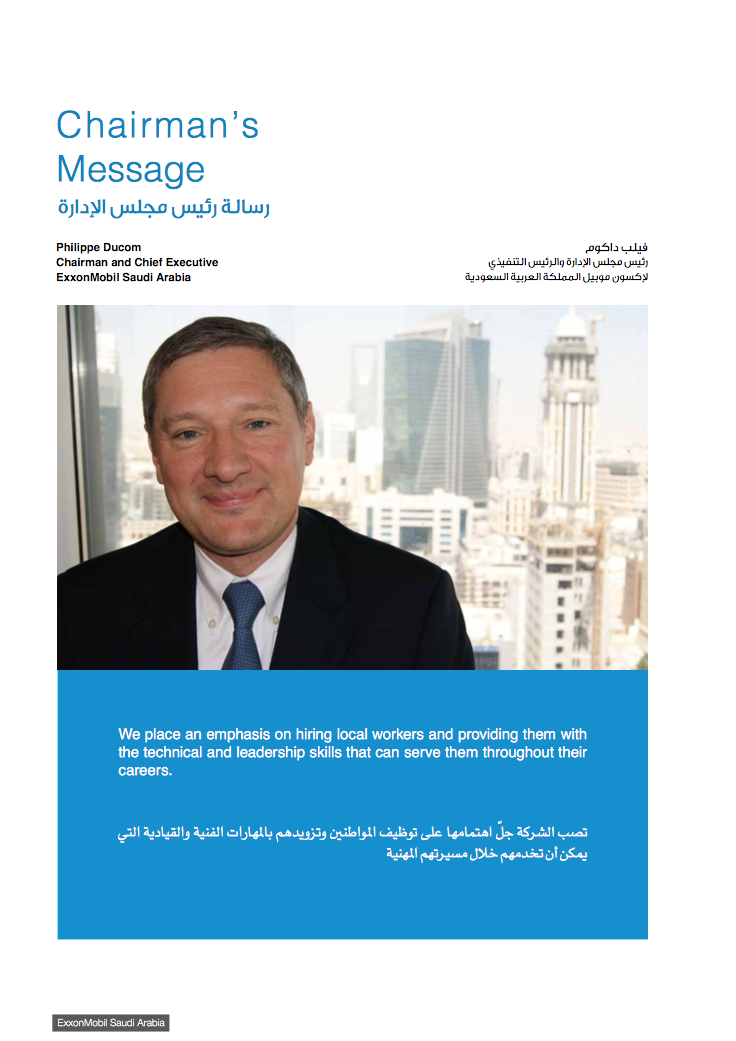
manufacturing and petroleum refining operations starting with this screen capture of the first two pages of the company's ExxonMobil Saudi Arabia brochure:

Here is a list of the company's facilities in Saudi Arabia:
1.) Saudi Aramco Mobil Refinery (SAMREF):
This 400,000 BOPD refinery is owned 50/50 by Saudi Aramco and a
subsidiary of ExxonMobil and is one of the world's largest single-train crude oil refineries. It employs 727 Saudi nationals, a 90 percent
Saudization level. Most of its production is domestically consumed.
Here
is a photo of the facility:

2.) Saudi Yanbu Petrochemical Company (YANPET):
This facility has two world-class 800,000 metric ton per year crackers,
producing mainly ethylene and is one of the largest and lowest-cost producers
in the world. It is equally owned by the Saudi Basic Industries Corporation
(SABIC) and a subsidiary of ExxonMobil. It employs 1300 workers of which
87 percent are Saudi nationals.
3.) Al-Julbail Petrochemical Company (KEMYA):
This facility has the capacity to produce 900,000 tonnes of ethylene and
1.3 million tonnes of polyethylene annually. It is equally owned by SABI
and an ExxonMobil affiliate. It employed nearly 1200 people, over 98 percent of
which are Saudi nationals. The two shareholders have also developed the $3.4 billion Al-Jubail Elastomer/Saudi Elastomers Project (SEP) as part of the KEMYA facility which will produce
about 400,000 tonnes per year of synthetic rubber.
Let's put some of these
numbers into perspective. In 2015, the Al-Jubail and Yanbu facilities
produced 1.6 million tonnes of ethylene, 17.8 percent of ExxonMobil's total
global production of 9.0 million tonnes. These facilities also produced
1.4 million tonnes of polyethylene, 16.3 percent of ExxonMobil's total global
production of 8.6 million tonnes. The SAMREF refinery produced 200,000
BOPD (ExxonMobil share), 4 percent of ExxonMobil's 5.035 million BOPD global
total. As you can see, the ExxonMobil-owned facilities in the Kingdom of
Saudi Arabia provide a significant portion of the company's cash flow.
Not only is ExxonMobil
helping to develop Saudi infrastructure, it supports educational programs including one rather
interesting prorgram, the Global Women in Management project which trains 30
Saudi women annually since its inception in 2011. The project seeks to
strengthen their management leadership and technical skills to "build the
next generation of women". What I find fascinating about this is
that Saudi women still have no voting rights, no right to drive their own
vehicle and must be covered completely when in public, in fact, the KSA is one
of the most female-repressive societies in the world. I cannot imagine
that training 30 women annually is going to make one bit of difference to Saudi
Arabia's misogynistic society. In the health realm, ExxonMobil founded the Prince
Salmoan Center for Disability Research to support the Kingdom's disabled
citizens. They also support the Zahra Breast Cancer Association, the Saudi
Alzheimer's Disease Association and the Disabled Children's Association.
With this background, I
think that we can get some sense of why Saudi Arabia was treated differently
than its Middle East neighbours when it came to moves by the Trump Administration
and its ExxonMobil-sourced Secretary of State. It certainly appears that
it's more business as usual in the hallowed halls of the nation's capital.


 Posts
Posts


