Showing posts with label SNB. Show all posts

Thursday, March 10, 2016

Negative Interest Rates - Opening Pandora's Box

The Bank for International Settlements (BIS), better known as the central bank for central banks, recently released an analysis of the latest and greatest monetary policy ammunition in central banking, negative interest rates.  The analysis looks at the implications of a negative interest rate environment and the uncertainty that it creates for both individuals and institutions.

With policy rates hovering close to the zero lower bound for most of the world's most influential central banks, the weak global economy has caused four of Europe's central banks to implement an untried and untested policy, moving their interest rates below zero.  Outside of Japan who most recently adopted this novel approach to stimulating growth, the Danmarks Nationalbank (DN), the European Central Bank (ECB), Sweden's Sveriges Riksbank (SR) and the Swiss National Bank (SNB) have all introduced negative rates as shown on this graphic:


As you can see, each of the four central banks lowered its rates further into negative territory in a number of steps as it appeared that the policies were not having their intended affect.

Each of the banks had different reasons for taking this drastic (and desperate step) including countering low inflation, currency appreciation pressures and pegging an exchange rate floor.  This interest rate game started with the ECB who moved to a negative rate in mid-2014 to "underpin the firm anchoring of medium to long-term inflation expectations" in other words, to prevent deflationary pressures, and on March 10, 2016, further lowered the rate from -0.03 percent to -0.04 percent.    The Riksbank adopted a negative policy during Q1 2015, again, to "safeguard the role of the inflation target as a nominal anchor for price settling and wage formation".  In both cases, the central bank continued its other unconventional monetary policies of purchasing assets including government bonds and other asset-backed securities, moves that have likely put upward pressure on longer term interest rates.  Interestingly, in the case of Sweden, the Riksbank will own 30 percent of outstanding government debt by mid-2016.  The Swiss National Bank opted for a negative interest rate policy in December 2014 (-0.25 percent) to maintain a floor on the value of the Swiss franc which had appreciated substantially as capital flooded into the Swiss "safe haven".  Upward pressure on the value of the franc continued, making Switzerland's exports more expensive, and the SNB lowered its interest rate further to -.0.75 percent in January 2015.  Denmark's central bank saw a surge in demand for the Danish kroner after the Swiss National Bank's decision and, in order to prevent further currency appreciation, cut its negative interest rate to -0.75 percent in early 2015.  Once the value of the kroner had stabilized, Denmark's Nationalbank raised its key policy rate to -0.65 percent.  As you can see, the interactions between these four central banks has led to a "rush to the bottom" with the three national central banks being forced to lower their rates further to prevent their own national currency from becoming increasingly overvalued.  Perhaps one could term this as an unintended consequence of poorly executed central bank policies.

What impact has this had on the economies of these countries?  Let's look at the impact on money markets.  So far, these modestly negative policy rates have seen the rates being passed on to other money market rates (i.e. T-Bills, lending rates, overnight rates, CDs etcetera) as you can see on these graphs:


In all four jurisdictions, the overnight rate (the interest rate at which financial institutions borrow and lend funds among themselves or the rate at which the central bank charges financial institutions to borrow money overnight) has tracked the negative bank rate.  While the point of negative interest rates was to prod banks to lend, evidence suggests that banks are able to avoid negative rates by extending maturities or lending to riskier counterparties.

Now, let's look at what has happened to other interest rates that are of greater interest to households:


While the banks have passed along the costs of negative interest rates to their wholesale depositors, they have not done so for households.  As you can see, deposit rates for retail depositors (i.e. you and I) have not been pushed into negative territory, largely because the banks were concerned that such a move would create a run on deposits as customers fled to cash, a situation that seems to have occurred in Japan where there is a reported shortage of house safes and rise in demand for 10,000 yen notes.  As well, it is interesting to see that interest rates on mortgages have risen in Denmark, Sweden and Switzerland since a negative interest rate environment was implemented.  This is a critical problem since the entire point of negative rates is to get consumers and businesses to borrow until it hurts.  If negative interest rates are not passed along to household and corporate borrowers, there is absolutely no reason for implementing a negative interest rate policy.  In a perfect "damned if you do, damned if you don't" scenario, if banks do implement a negative interest rate policy on their lending rates, there could be significant negative impacts on bank profitability unless negative rates are imposed on deposits which could result in a run on deposits.  So far, in the nations with a negative interest rate policy, there has not been an abnormal increase in the demand for currency but this is likely related to the fact that negative interest rates in these jurisdictions have not been passed along to consumers.

Let's close this posting with a quote from the analysis, keeping in mind that both the Federal Reserve and the Bank of Canada have already floated negative interest rate trial balloons:


"So far, zero has not proved to be a technically binding lower limit for central bank policy rates. Nonetheless, there is great uncertainty about the behaviour of individuals and institutions if rates were to decline further into negative territory or remain negative for a prolonged period. It is unknown whether the transmission mechanisms will continue to operate as in the past and not be subject to "tipping points". Furthermore, an extended period of negative interest rates has so far been limited to the euro area and neighbouring economies. It is not clear how negative policy rates would play out in other institutional settings."  (my bold) 

Central banks are opening a monetary policy "Pandora's Box" with their latest imaginative policy, one that may be difficult to close in the future.

Monday, January 19, 2015

Negative Interest Rates - A Desperate Measure

Updated February 12, 2015

Switzerland National Bank's (SNB) recent announcement that they were allowing the value of the Swiss franc to float upwards against the euro, discontinuing the ceiling exchange rate of CHF1.20 to one euro and that they were cutting interest rates on deposits to minus 0.75 percent took the market by surprise.  Up until January 15, 2015, the Swiss central bank sold Swiss francs whenever the franc threatened to rise above the 1.20 per euro mark.  This is the second time in recent months that Switzerland has taken steps to prevent a overvaluation of the Swiss franc; on December 18, 2014, the SNB announced that it was allowing interest rates on sight deposit accounts to fall into negative territory at minus -0.25 percent.  Why is the Swiss National Bank doing this and what do negative interest rates mean?

Keeping in mind that it is generally a nation's commercial banking system that has money on deposit with a central bank, the theory behind negative interest rates is that by charging commercial banks for holding money with the central bank, the banking system is forced to seek better returns elsewhere through one of two mechanisms:

1.) investing in the domestic economy through lending to businesses and individuals within the Eurozone.  This will help drive up economic growth in the local economy.

2.) transferring their money to foreign central banks or banking systems.  As capital flows out of a nation, it helps weaken its currency and makes the nation's exports more competitive since the price drops because of the lower exchange rate.  This also drives up economic growth.

Basically, the SNB is lowering interest rates to ensure that monetary conditions do not tighten, a problem that could occur when the Swiss franc appreciates as investors increased their demands for a safe haven investment vehicle.  Introducing negative interest rates make it less attractive for investors to hold Swiss franc assets and investments.

Economists believed that negative interest rates were a sure-fire way to stimulate an economy, however, the example of Europe clearly shows otherwise.  Back on June 11, 2014, the European Central Bank (ECB) cut interest rates on its deposit facility to minus 0.1 percent.  This negative interest rate applied to:

1.) banks’ average reserve holdings in excess of the minimum reserve requirements;

2.) government deposits held with the Eurosystem that exceed certain thresholds that will be set in the relevant Guideline to be published by 7 June;

3.) Eurosystem reserve management services accounts if not currently remunerated; 
4.) participants’ account balances in TARGET2 (payment transaction settlements between banks and between banks and the ECB);

5.) non-Eurosystem NCB balances (overnight deposits) held in TARGET2; and (vi) other accounts held by third parties with Eurosystem central banks when stipulated that they are not currently remunerated or are remunerated at the deposit facility rate.


On September 4, 2014, the ECB announced this:

At today’s meeting the Governing Council of the ECB took the following monetary policy decisions:

1   The interest rate on the main refinancing operations of the Eurosystem will be decreased by 10 basis points to 0.05%, starting from the operation to be settled on 10 September 2014.
2   The interest rate on the marginal lending facility will be decreased by 10 basis points to 0.30%, with effect from 10 September 2014.
 

3   The interest rate on the deposit facility will be decreased by 10 basis points to -0.20%, with effect from 10 September 2014.
”

As an aside, in contrast to the ECB, the Federal Reserve actually pays interest on both required reserve balances (balances that are held to satisfy depository institutions' reserve requirements) and on excess reserves (balances held in excess of required reserve balances).  The Federal Reserve has paid interest of 0.25 percent on these reserves since January 2009.  This may not seem like much, however, it has led to a massive explosion in the size of excess reserves held by the Fed as shown here:


This is $2.5 trillion that commercial banks are NOT lending to consumers and businesses.
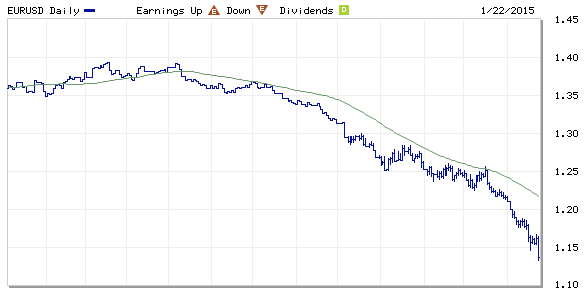
Now, back to Europe.  Let's look at what happened to the euro to United States dollar exchange rate over the last half of 2014 and the first weeks of 2015:


After the ECB cut interest rates on deposits to negative territory, the euro dropped from USD1.36 to the euro to its current level of USD1.12, a drop of 17.6 percent.  This should have stimulated Europe's economy over the past quarter since goods imported into Europe are more expensive for domestic consumers and goods exported from Europe are less expensive for overseas consumers.

In fact, this is what has happened to Europe's economy:


Quarter-over-quarter growth in the third quarter of 2014 rose by a minuscule 0.2 percent, up from 0.1 percent in the second quarter of 2014 for the euro area (EA18).

Here is what quarter-over-quarter growth rates for each of the EU28 member states looked like in the third quarter of 2014:


Now that's what we call modest improvement in economic growth!

So what happened to all of that money that banks were supposed to invest in loans to stimulate economic growth?  It appears that a substantial portion of that money went directly into three places:

1.) Switzerland where the euro dropped in value against the Swiss franc as shown here:
  

2.) Germany where the money went into bunds, pushing the yield on five year bunds into negative territory as shown here:


This tells us that investors are desperately seeking to avoid the substantial capital losses that can occur when investing in bonds that carry a higher degree of risk and that they are perfectly willing to let Germany charge them to hold onto their money.  

3.) United States where, as I showed above, the value of the euro against the United States dollar has dropped by 14.7 percent over the last six months.  European purchases of Treasuries are still taking place, particularly given that the interest rate paid on Treasuries exceeds the rates on German and Swiss bonds.  It is also quite likely that the current ultra-low rates on Treasuries are due to the inflow of money from Europe.  As the value of the USD climbs, it will put significant pressure on the American trade balance as U.S. exports become more and more expensive and imports become cheaper.  At some point, the Federal Reserve will have to act to push the value of the U.S. dollar down, perhaps following the lead of the SNB and ECB into negative interest rate territory.

As we can see from this posting, negative interest rates are definitely not the panacea that will cure Europe's economic woes.   Obviously, the positive aspects of negative interest rates in Europe have failed to appear, at least to this point in time.  In fact, the very existence of negative interest rates in the first place suggests that all of the monetary policy experimentation by the world's central bankers has been an abject failure.  In their desperate efforts to revive the world's economy during 2008 and 2009, the efforts of central bankers have ended up painting them into a policy corner from which extraction appears to becoming extremely complex and perhaps impossible. The spillover effects from the past five years of central bank intervention are becoming increasingly difficult to control and predict; the example of Switzerland is just the latest example of  monetary policy failure.

Thursday, January 15, 2015

Why Did the Swiss National Bank Unpeg the Swiss Franc?

Updated January 19, 2015

The announcement that the Swiss National Bank (SNB) was allowing the Swiss franc to "readjust" in value took the market by storm.  Switzerland had long been preventing the value of the euro to weaken below 1.20 against the franc, maintaining the cap by printing francs to buy euros in the market to maintain its currency at a value that would keep Switzerland's exports competitively priced in the world's markets.

Here is the wording of the SNB announcement:

"The Swiss National Bank (SNB) is discontinuing the minimum exchange rate of CHF 1.20 per euro. At the same time, it is lowering the interest rate on sight deposit account balances that exceed a given exemption threshold by 0.5 percentage points, to −0.75%. It is moving the target range for the three-month Libor further into negative territory, to between –1.25% and −0.25%, from the current range of between −0.75% and 0.25%.

The minimum exchange rate was introduced during a period of exceptional overvaluation of the Swiss franc and an extremely high level of uncertainty on the financial markets. This exceptional and temporary measure protected the Swiss economy from serious harm. While the Swiss franc is still high, the overvaluation has decreased as a whole since the introduction of the minimum exchange rate. The economy was able to take advantage of this phase to adjust to the new situation.

Recently, divergences between the monetary policies of the major currency areas have increased significantly – a trend that is likely to become even more pronounced. The euro has depreciated considerably against the US dollar and this, in turn, has caused the Swiss franc to weaken against the US dollar. In these circumstances, the SNB concluded that enforcing and maintaining the minimum exchange rate for the Swiss franc against the euro is no longer justified.

The SNB is lowering interest rates significantly to ensure that the discontinuation of the minimum exchange rate does not lead to an inappropriate tightening of monetary conditions. The SNB will continue to take account of the exchange rate situation in formulating its monetary policy in future. If necessary, it will therefore remain active in the foreign exchange market to influence monetary conditions.

When the SNB removed the cap on the value of the franc, its valued immediately soared against other currencies, particularly the euro as shown on this chart:


It now only takes around CHF 0.99 to buy one euro, down from CHF 1.20 before the announcement.

If we look at this graph, we get a sense for why the SNB took this unprecedented move:


The Swiss National Bank has a very substantial inventory of euros on its balance sheet, acquired as the SNB kept buying euros to keep the value of the Swiss franc from rising, an action that was particularly necessary during the Eurozone crisis in late 2009 and 2010.  At the end of the third quarter of 2014, the SNB was sitting on €174,335 million which makes up 44.6 percent of the foreign currencies held on its balance sheet.  With the European Central Bank (ECB) heading towards its own quantitative easing program which will put additional downward pressure on the value of the euro as Europe's own interest rates fall even further, the cost of holding the value of the Swiss franc below the old peg level would likely have become more and more expensive, leaving the SNB with even more euros on its balance sheet that are worth even less.

What can we learn from this?  The spillover effects from central bank monetary policy interventions are interacting with each other, resulting in a series of unintended consequences.  With globalization, one central bank, even a relatively small one like the SNB cannot act without provoking a response in another economy.