Showing posts with label Second World War. Show all posts

Tuesday, September 5, 2017

The Genesis of a Divided Korea

Updated September 2018

With the recent moves toward a denuclearized North Korea and with the rapprochement between the North and Soutn, it is a good time to take a look at a brief history of the Korean Peninsula and how its geopolitical history was largely framed by foreign powers, most particularly the United States and the Soviet Union after the end of the Second World War.

As you may or may not be aware, the war over the Korean Peninsula began on June 25, 1950 and ended on July 27, 1953 when the two adversaries signed an armistice which divided the peninsula near the 38th parallel.  The war, the first of the new Cold War era, actually had its origins several years earlier when the Second World War ended and the Americans and Soviets ended up "inheriting" the Korean Peninsula which had been part of the Japanese Empire since the early part of the 20th century.  Korea had long been the target of its neighbours, Japan and the Soviet Union /Russia.  Japan defeated China in 1895 (Sino-Japanese war) and then defeated the Russians in the Russo-Japanese War (1904 - 1905), hostilities which eventually resulted in Japan's formal annexation of the entire peninsula in 1910.  Japan treated Korea as a conquered land, taking over many of Korea's vital internal functions including foreign relations, its military, banking and communications sectors.  Japan also forced Koreans to worship at Shinto shrines in a move to assimilate the Koreans.  As well, between 700,000 and 800,000 Koreans were forced to migrate to Japan, particularly over the years between 1939 and 1945 to assist Japan in its war effort.  It is estimated that, by the end of the Second World War, there were approximately 2 million Koreans living in Japan with over 200,000 fighting for Japan.  Following Japan's defeat in 1945, an estimated 1.0 to 1.4 million Koreans left Japan to return to the Korean Peninsula.  Given Japan's defeat, the Korean Peninsula was part of the spoils of war "inherited" by the Allies, particularly the United States and the Soviet Union which used Korea as a pawn in their decades-long battle between communism and democracy/capitalism.  In August 1945, Colonel Dean Rusk, future Secretary of State under John F. Kennedy and Lyndon Johnson and Colonel Charles Bonesteel where charged with indentifying a line of control between the south and north parts of the Korean Peninsula that both the United States and USSR could agree upon.  The Americans were very concerned that the Soviets would move quickly to occupy the entire peninsula, a scenario that was not unlikely given that the nearest U.S. forces were over 600 miles away on Okinawa.

Here's what Rusk had to say about how the Korean Peninsula was divided in 1945:

"During a meeting on August 14, 1945, the same day as the Japanese surrender, [Bonesteel] and I retired to an adjacent room late at night and studied intently a map of the Korean peninsula. Working in haste and under great pressure, we had a formidable task: to pick a zone for the American occupation. Neither Tic nor I was a Korea expert, but it seemed to us that Seoul, the capital, should be in the American sector. We also knew that the U.S. Army opposed an extensive area of occupation. Using a National Geographic map, we looked just north of Seoul for a convenient dividing line but could not find a natural geographical line. We saw instead the thirty-eighth parallel and decided to recommend that ... [Our commanders] accepted it without too much haggling, and surprisingly, so did the Soviets."

Even though the Korean Peninsula had been unified since 688 AD, the Americans felt that the Korean Peninsula should be divided with Seoul on the south side as the capital of the Republic of Korea (ROK) and Pyongyang on the north side of the border as the capital of the Democratic People's Republic of Korea (DPRK).  As stated above, even though it made no sense economically or geographically, the two aforementioned gentlemen picked the 38th parallel as the dividing line, a division that was considered to be only temporary at the time as it was hoped that reunification would take place relatively quickly. 

Over the next years, both the Soviet Union and the United States built up regimes on their respective sides of the 38th parallel with the Americans supporting Syngman Rhee, an ardent Korean nationalist who was educated in the United States and who spent 30 years living in Hawaii, being elected president of the Korean Provisional Government in 1919.  He also lived in Washington, D.C.; becoming the only well known Korean leader in the United States.  He campaigned for a policy of independence and unification of the Korean Peninsula and became president of South Korea in 1948 in an election held under United Nations auspices.  As an aside and just in case we think that the North Koreans have the lock on brutality, in June 1950 just after the invasion, President Rhee ordered the execution of at least 100,000 people who were seen to be allied with the communists.   The Soviet Union supported Kim Il-sung, a Korean guerrilla fighter who had fought alongside Chinese communist forces to expel the Americans from North Korea.  Kim Il-sung's grandson, Kim Jong-un, is now the leader of North Korea .

In 1949, President Truman approved National Security Council Paper 8/2 which outlined the steps necessary for the creation of a South Korea that was independent of the United States, a nation that would be capable of achieving economic, military and political independence and providing for its own survival with American diplomatic and financial support as shown on this page from the paper:


It was the intention of the Truman Administration to withdraw from South Korea as "early as practicable".  Paper 8/2 also warned that the Soviet Union intended to dominate the entire Korean Peninsula.  Congress, however, saw the Korean situation as untenable, refusing to pass a Korean aid bill that would have seen the United States provide economic assistance to Korea for three additional years.  Rather than the three year period that the Truman Administration wanted, they had to settle for the continuation of temporary economic assistance to South Korea which was due to expire on February 15, 1950. 

On January 12th, 1950, Secretary of State Dean Acheson gave a speech to the National Press Club in Washington on the Far East.  In that speech, he stated the following:

"In the first place, the defeat and the disarmament of Japan has placed upon the United States the necessity of assuming the military defense of Japan so long as that is required, both in the interest of our security and in the interests of the security of the entire Pacific area and, in all honor, in the interest of Japanese security. We have American—and there are Australia—troops in Japan. I am not in a position to speak for the Australians, but I can assure you that there is not intention of any sort of abandoning or weakening the defenses of Japan and that whatever arrangements are to be made either through permanent settlement or otherwise, that defense must and shall be maintained.

The defensive perimeter runs along the Aleutians to Japan and then goes to the Ryukyus. We hold important defense positions in the Ryukyu Islands, and those we will continue to hold. In the interest of the population of the Ryukyu Islands, we will at an appropriate time offer to hold these islands under trusteeship of the United Nations. But they are essential parts of the defensive perimeter of the Pacific, and they must and will be held.

So far as the military security of other areas in the Pacific is concerned, it must be clear that no person can guarantee these areas against military attack. But it must also be clear that such a guarantee is hardly sensible or necessary within the realm of practical relationship.

Should such an attack occur—one hesitates to say where such an armed attack could come from—the initial reliance must be on the people attacked to resist it and then upon the commitments of the entire civilized world under the Charter of the United Nations which so far has not proved a weak reed to lean on by any people who are determined to protect their independence against outside aggression. But it is a mistake, I think, in considering Pacific and Far Eastern problems to become obsessed with military considerations. Important as they are, there are other problems that press, and these other problems are not capable of solution through military means. These other problems arise out of the susceptibility of many areas, and many countries in the Pacific area, to subversion and penetration. That cannot be stopped military means." (my bold)

You will notice that the American defensive perimeter described in Acheson's speech does not include a guarantee of U.S. military protection to the Republic of Korea (i.e. South Korea) or for Taiwan for that matter.  He makes it quite clear that the military security of regions outside of the area defined by the Aleutian Islands, Japan and Ryukyus (a chain of Japanese islands to the south of the main islands) including Okinawa and other islands as shown on this map:  


...are the responsibility of their own governments and upon the world, under the Charter of the United Nations.

While the intent of Acheson's speech was to convince the American public and Congress that further aid to Korea was necessary, scholars and politicians focussed on the "defensive perimeter" aspect of the speech, making it appear as though the United States would not come to the aid of the South Koreans in any future conflict over the Korean Peninsula.  Critics and many South Koreans also felt that Acheson's speech gave Pyongyang the message that it could pursue forcible reunification of the peninsula without reprisal from American armed forces.  Less than six months after Acheson's speech, on June 25th, 1950, the North Koreans invaded South Korea as shown on this map which shows how North Korea overran most of South Korea:


It is always an interesting exercise to look back in history and see how the geopolitical agendas of conquering nations often have strongly negative consequences when they are put into practice, particularly when it comes to carving up territory.  In the case of the Korean Peninsula, the use of the Korean Peninsula as a proxy for the Cold War by both the United States and the Soviet Union led to millions of deaths and divided a nation that had been unified for centuries.  The current issues with North Korea have their genesis in a meeting held on August 14, 1945 when two gentlemen drew a line on a National Geographic map of Korea.  Since then, the Korean Peninsula has existed as one of the world's longest-lasting hostilities.


Wednesday, July 12, 2017

America's Long History of Fake News


Updated January 2019

While one might think that the fake news mantra during and since the 2016 U.S. presidential election is a relatively new development, in fact, as you will see from this posting, America's experience with fake news goes back at least 75 years to the Franklin Roosevelt presidency.  It was during the initial phases of the Nazi occupation of Europe that Americans were exposed to a particularly nefarious bit of fake news.

First, let's set up the situation.  The date is October 27, 1941.  Four months earlier, the Wehrmacht had begun their invasion of the Soviet Union and by December 1941, this is what Europe looked like:


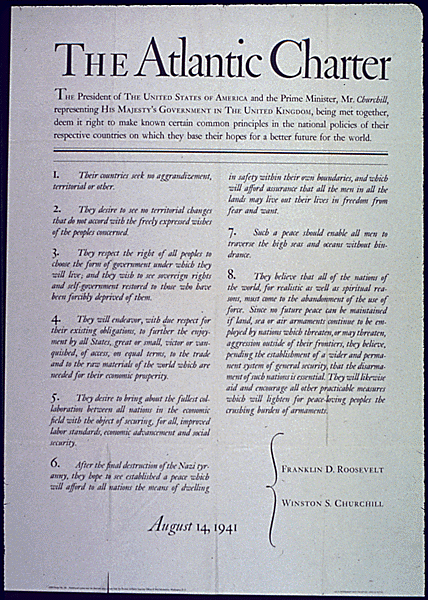
Since July of 1940, the newly appointed U.K. Prime Minister, Winston Churchill, had begged a neutral United States after the Germany Navy had destroyed 11 British destroyers over a ten day period.  In the 1940 presidential election campaign, Franklin Roosevelt had promised voters that "...your boys are not going to be sent into any foreign wars."  By January 1941, the sentiment had changed somewhat after Churchill stated that if Britain had the tools, they could finish the job against the Nazis.  As such, the Lend-Lease Act of March 1941 was enacted, lending American military and other supplies to nations whose security was vital to the United States.  This led to the formation of the "Atlantic Charter", an policy statement/declaration dated August 14, 1941 which broadly stated the aims of both the United States and Britain in the European war and in its aftermath.  Both countries agreed not to expand their territory, to establish freedom of the seas and to restore self-government for all nations occupied during the war.  Here is the document:


President Roosevelt had hoped that the Charter would encourage the American people to back further U.S. intervention in the European war, however, public opinion remained strongly against such a policy.     

Never one to give up easily, Franklin Roosevelt tried another tactic to get American voters to back participation in the Second World War in the fall of 1941.  On October 27, 1941, just over one month prior to the attack on Pearl Harbour and two and a half months after the Atlantic Charter was signed, President Roosevelt addressed the nation on the radio stating the following:

"Five months ago tonight I proclaimed to the American people the existence of a state of unlimited emergency.

Since then much has happened. Our Army and Navy are temporarily in Iceland in the defense of the Western Hemisphere.

Hitler has attacked shipping in areas close to the Americas in the North and South Atlantic.

Many American-owned merchant ships have been sunk on the high seas. One American destroyer was attacked on September fourth. Another destroyer was attacked and hit on October seventeenth. Eleven brave and loyal men of our Navy were killed by the Nazis.

We have wished to avoid shooting. But the shooting has started. And history has recorded who fired the first shot. In the long run, however, all that will matter is who fired the last shot.

America has been attacked. The U.S.S. Kearny is not just a navy ship. She belongs to every man, woman and child in this nation.

Illinois, Alabama, California, North Carolina, Ohio, Louisiana Texas, Pennsylvania, Georgia, Arkansas, New York, Virginia-those are the home states of the honored dead and wounded of the Kearny. Hitler's torpedo was directed at every American whether he lives on our sea coasts or in the innermost part of the nation, far from the seas and far from the guns and tanks of the marching hordes of would-be conquerors of the world.

The purpose of Hitler's attack was to frighten the American people off the high seas-to force us to make a trembling retreat. This is not the first time he has misjudged the American spirit. That spirit is now aroused.

If our national policy were to be dominated by the fear of shooting, then all of our ships and those of our sister Republics would have to be tied up in home harbors. Our Navy would have to remain respectfully-abjectly-behind any line which Hitler might decree on any ocean as his own dictated version of his own war zone.

Naturally we reject that absurd and insulting suggestion. We reject it because of our own self-interest, because of our own self-respect, because, most of all, of our own good faith. Freedom of the seas is now, as it has always been, a fundamental policy of your government and mine.

Hitler has often protested that his plans for conquest do not extend across the Atlantic Ocean. But his submarines and raiders prove otherwise. So does the entire design of his new world order.

For example, I have in my possession a secret map made in Germany by Hitler's government-by the planners of the new world order. It is a map of South America and a part of Central America, as Hitler proposes to reorganize it. Today in this area there are fourteen separate countries. The geographical experts of Berlin, however, have ruthlessly obliterated all existing boundary lines; and have divided South America into five vassal states, bringing the whole continent under their domination. And they have also so arranged it that the territory of one of these new puppet states includes the Republic of Panama and our great life line-the Panama Canal.

That is his plan. It will never go into effect.

This map makes clear the Nazi design not only against South America but against the United States itself...." (my bold)

You will notice that President Roosevelt mentions a secret map of South and Central America, made in Germany by Hitler's government.  Here is the map, complete with annotations in German and the word "Geheim" or secret marked in the top left corner:


It certainly looks convincing, doesn't it? 

Here's what Joseph Goebbels, Germany's propaganda minister had to say in response to Franklin Roosevelt's accusations in an essay dated November 30, 1941:

"Mr. Roosevelt claimed that he had proof in his hands that the Axis powers were planning to reorganize South and Central America. They were planning to transform the existing fourteen countries into five states that would be under their control. His proof was a secret map allegedly produced by the Reich government. The American government also claims to possess another Reich document. According to it, the Reich government plans to abolish the existing religions of the world once it has won the war — Catholicism, Protestantism, Mohammedanism, Hinduism, Buddhism, and Judaism. They are to be replaced by an international National Socialist church, the cross by the swastika, and God by the Führer. That is what he claims.

It is clear to us that Mr. Roosevelt needed this grand swindle to whip up American public opinion. He needed the heaviest possible ammunition, since the American people are at the moment more intelligent than their government and want absolutely nothing to do with the war in Europe. We really are not all that interested in Mr. Roosevelt’s opinion of the intelligence of his people nor in what he thinks them capable of believing, and normally would see no need to reply to his bald-faced and outrageous lies which so clearly bear the signs of fabrication. In this case, however, it is a matter of a political falsification which seems to us to have a clear and ominous purpose, and gave us such an easy chance to show up the liars to the entire world that we could hardly let the opportunity pass. We had to overcome our moral scruples, however, to confront the liar and ask him where he got these alleged documents from, where they can be found, and if he was ready to show them to the public.

Things went as we expected. Mr. Roosevelt, the president of a nation of 130 million, dodged our questions. He claimed the authenticity of the documents was unassailable; he had them. They could not be published, however, since they were secret and publishing them would reveal the source. And the map in question that carved up Central and South America had markings in pencil that could compromise the source that provided them. He, Roosevelt, did not want to cause any difficulties for the poor chap who passed them along...

The Reich government published two formal denials on 1 November, which boxed Roosevelt’s ears so strongly that he had to chose between revealing his documents or proving himself a forger and liar to the entire world. He chose the latter. The U.S. press gave headline treatment to the German denials and asked for a response. Mr. Roosevelt accepted the blows, rubbed his cheeks, and said nothing. We made every conceivable suggestion to ease the publication of the documents, but the U.S. president preferred to be thought a liar and forger than to prove his absurd accusations." (my bold)

In reality and while we certainly cannot trust Joseph Goebbels, we will never really know whether or not this map was key in persuading the voters of the United States to join the Allied forces, largely because the Japanese Attack on Pearl Harbour occurred relatively shortly thereafter.  That said, research by William Boyd suggests that the map may well have been created by British Security Coordination (BSC) as part of their mandate to covertly convince the United States public that they needed to end their isolationist and non-interventionist stance and join the war in Europe.  BSC was founded in May 1940 by Winston Churchill and headed by a Canadian, William Stephenson (aka A Man Called Intrepid), working on behalf of the British Secret Intelligence Services.  An office was opened in the Rockefeller Center in downtown Manhattan under the guise of a Passport Control Office with the agreement of Franklin Roosevelt and the FBI's J. Edgar Hoover.  BSC planted pro-British and anti-German stories in the American media (at the time consisting of newspapers and radio).  It even had its own shortwave radio station, WRUL, which was also used to broadcast anti-isolationist news stories and a press agency, the Overseas News Agency (ONA) that fed "news stories" to American newspapers.   As I stated above, the goal of BSC was to make Americans think that joining the war was a positive thing, freeing President Roosevelt and Congress to act without fear of public backlash.

According to the research of William Boyd, it appears that the supposed Nazi map of a divided South America and German-controlled Panama Canal is a forgery created by BSC with the purpose of convincing America that the Nazis would soon be on their doorstep.  The public story of the map was that it had been stolen from a German courier's bag in Buenos Aires, Argentina after he was involved in a car accident.  The courier was being followed by a British agent who managed to grab the map from his bag and forward it to Washington.  Mr. Boyd is convinced that the map was created by BSC's department of forgery known as Station M, located across the border in Canada.

As you can see from this story, the parallels to today's United States - Russia geopolitical influence peddling is stunning.  An apparently fake Nazi map sourced from the British (not to mention BSC's intervention in American media) was being used in an attempt to sway America, its president and its political leadership.  While we'll never know whether President Roosevelt knew that the map was possibly a fake, the British involvement in propagandizing America with fake news during the Second World War is undeniable.  Apparently, as we can see from this story, the peddling of fake news is not just a phenomenon of the 21st century and has great potential to sway voters.       

Tuesday, December 20, 2016

The American President That Understood Russia


Updated July 2017

Remembering that John Kennedy actually fought in the Second World War and lost a brother, Joseph, who was killed in action in August 1944, this speech given at the American University commencement on June 10, 1963 is particularly pertinent given the increasingly loud beating of the anti-Russia war drums in Washington:


Here is one of the most interesting excerpts from the speech, particularly since this speech was eight short months after the Cuban Missile crisis took the world to the brink of nuclear war:

"Among the many traits the peoples of our two countries have in common, none is stronger than our mutual abhorrence of war. Almost unique among the major world powers, we have never been at war with each other. And no nation in the history of battle ever suffered more than the Soviet Union suffered in the course of the Second World War. At least 20 million lost their lives. Countless millions of homes and farms were burned or sacked. A third of the nation's territory, including nearly two thirds of its industrial base, was turned into a wasteland--a loss equivalent to the devastation of this country east of Chicago."


Let's look at some statistics to help us better understand President Kennedy's empathy for the Soviet nation.  Looking back at history, according to the National World War II Museum database, here is a country-by-country listing of deaths during the Second World War:


The Soviet Union's losses of at least 24 million people which included between 8.8 million and 10.7 million military deaths and between 13.3 million and 15.2 million civilian deaths puts them into first place, just ahead of China which lost a total of 20 million people, 16 million to 17 million of which were civilians.  Here is a graph showing how the war impacted the population of Russia between 1920 and 1990:


The Soviet losses of at least 24 million people compare to 418,500 total deaths for the United States of which only 2000 were civilian over the entirety of the war.  There was a significant gender bias to Soviet deaths; within the first six months of the 1944 invasion, an estimated 5 million Red Army soldiers were killed and the nation lost territory equal to the size of the United States between the East Coast and Springfield, Illinois.  A 2007 study by Elizabeth Brainerd at Williams College estimated total Soviet war deaths at 27 million or nearly 14 percent of the nation's total prewar population.  The war had a massive impact on the nation's sex ratio, particularly in the 20 to 29 year-old age group; the prewar ratio (in 1941 prior to Hitler's June 22 invasion) was 0.91 men to one woman, dropping to 0.65 men to one woman in 1946.  Here is a graph showing how the sex ratio varied by year of birth:


Besides the massive loss of military and civilian lives during the war, there was a significant negative impact on the birth rate; in 1940, the Soviet birth rate was 34.6 per 1000 population, falling to 26.0 per 1000 population in 1946 as shown on this graphic:


This means that an estimated 11.5 million Soviet babies were not born during the war years alone who would have otherwise been born 


As Ms. Brainard puts it, this is another uncounted cost of the Second World War on the Soviet Union.


It is fascinating to look at history and see that, despite his very significant conflicts with the Soviet Union, President John Kennedy was still able to put the Soviet suffering during the Second World War into context, enabling him to at least have some degree of understanding regarding the Soviet world view.  The mainstream media's current obsession with Russia reflects the views of a significant portion of the American ruling class, particularly those who are connected with the military-industrial-political complex.  As I have said before, should hostilities break out between the United States and Russia, you can be assured that the ruling class and their children will not be on the front lines, it will once again be Main Street America that will be making the sacrifice.