Showing posts with label Yemen. Show all posts

Monday, February 14, 2022

The High Human Cost of the War in Yemen

One war in the world is now in its seventh year but you would never know it unless you happen to get your news from a non-mainstream source.  


Here is some background from the Council on Foreign Relations and the Brookings Institution regarding this ongoing conflict which involves one of the world's most underdeveloped nations and one of Washington's best friends in the Middle East (with my bold):


"Yemen’s civil war began in 2014 when Houthi insurgents—Shiite rebels with links to Iran and a history of rising up against the Sunni government—took control of Yemen’s capital and largest city, Sana’a, demanding lower fuel prices and a new government. Following failed negotiations, the rebels seized the presidential palace in January 2015, leading President Abd Rabbu Mansour Hadi and his government to resign. Beginning in March 2015, a coalition of Gulf states led by Saudi Arabia launched a campaign of economic isolation and air strikes against the Houthi insurgents, with U.S. logistical and intelligence support.


The Saudis intervened in March 2015 to support Hadi. The main driver behind the intervention was Prince Mohammed bin Salman (MBS) who promised a short, decisive war. Instead it became a stalemate with catastrophic consequences for the Yemeni people. The Saudis blockaded the country, denying food and medicine to most of the population.


President Barack Obama backed the Saudi war. The United States supported the passage of United Nations Security Council Resolution 2216, which sanctions the Houthis and Saleh, endorses Hadi’s government, and calls for the rebels to disarm. It’s completely unbalanced and a barrier to getting peace. Iran supports the Houthis with expertise, arms, and ballistic missiles smuggled into the country. The United States provides intelligence and crucial logistical support for the Saudis and their allies. 


President Trump doubled down on Obama’s support for MBS’s war. The administration has focused on Iran’s support for the Houthis and ignored egregious Saudi bombings of school and hospitals. The Saudis’ war is very expensive for the kingdom, disastrously devastating for Yemen, and a strategic plus for Iran.


Saudi oil wealth explains much about why America has consistently subsumed its Yemen policy to the designs of the kingdom." 


According to the Brookings Institution, the war in Yemen costs the Saudis at least $50 billion annually.  It is also important to remember that the United States has sold significant arms to the Saudi royal family, arms that are being used against Yemeni civilians.  Under the Trump administration, Washington signed arms deal in May 2017 as shown here:


...and the Biden Administration as shown here:


...along with diplomatically backing Saudi Arabia as shown here:


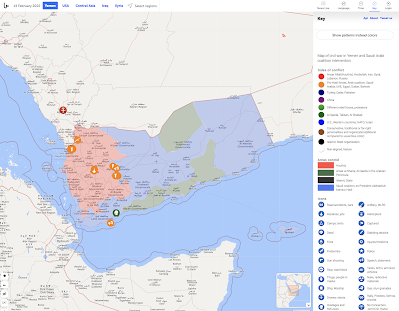
As background, here is a current map showing the situation on the ground in Yemen showing that Saudi Arabia controls a substantial portion of the nation:


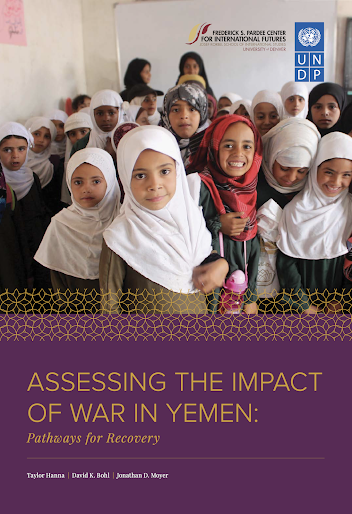
Now, let's look at the impact of Washington's relationship with Saudi Arabia, particularly the impact of the Saudi royal family's war on Yemen's civilians.  According to a recent report from the United Nations:
 

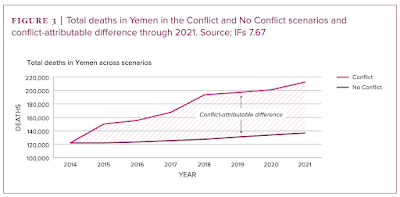
...the conflict has resulted in significantly higher deaths than would normally have been expected as shown on this graphic which compares the conflict and no-conflict scenarios (page 32 of the report):
 

It has also resulted in a significant loss of economic output as shown here (page 33 of the report):


The conflict has also resulted in significant damage to over one-third of Yemen's schools, 40 percent of health facilities, 40 percent of housing assets, 40 percent of water, sanitation and hygiene assets and over half to he nation's power infrastructure.  The estimated cost to recover the lost infrastructure is estimated at between $20 billion and $25 billion over a five year period.


Here is a table showing the contrast between the conflict and no-conflict scenarios (page 33 of the report):


Entesaf Organization for Women and Child Rights has recently released a report with the following information:


1.) approximately 800,000 women are among Yemenis displaced by the war.


2.) between the start of aggression on March 26, 2015 to December 8, 2021, 2412 women were killed and 2825 were injured as a result of Saudi-led raids.


3.) 1.2 milion Yemeni women suffer from malnutrition with 8000 dying annually due to the blockade.  Of the displaced women, half are pregnant and more than 70 percent of birth medicines are not available in Yemen due to the Saudi-led blockade of all sea, land and air borders since November 2017.  In addition, out of every 1000 live births, more than 27 die annually. 


4.) More than 400,000 Yemeni children are suffering from severe malnutrition with 80,000 of those at risk for death.


Here is a video explaining the plight of Yemen's children:


In large part, the blame for this suffering of Yemen's civilians must be laid at the feet of the decision makers from both parties in Washington who repeatedly find themselves siding with Saudi Arabia, a nation well known for its human rights abuses.  While this sort of behaviour is frequently used by Washington to justify military intervention, such is not the case with Saudi Arabia simply because the Saudi royal family controls the world's most productive oil fields.


Thursday, November 7, 2019

The Unreported War and Its High Cost to Civilians

The war that is pretty much ignored by the mainstream media, particularly in the United States, just passed a milestone although you'd be hard-pressed to learn anything about it.

According to an analysis by the Armed Conflict Location & Event Data Project or ACLED, the war in Yemen has now resulted in the deaths of over 100,000 people and more than 40,000 conflict events have taken place since 2015.  Here is a breakdown:

1.) approximately 20,000 fatalities have been reported so far in 2019 - this is the second most deadly year after 2018.

2.) approximately 8,000 fatalities have been reported so far in 2019 - the number of conflict events has dropped since March 2019 thanks to a drop in the number of shellings and airstrikes however the actual number of battles has not decreased.

3.) April was the most deadly month in 2019 with over 2,500 reported fatalities compared to "only" 1,700 in September.  The third quarter of 2019 has seen the lowest number of reported fatalities since the end of 2017 due to a decline in battle intensity.

4.) the number of coalition airstrikes has declined over the past year while Houthi attacks on Saudi Arabia increased until the group announced a unilateral ceasefire against targets inside Saudi Arabian territory in September 2019.  It is important to note that the Saudis only partially accepted the ceasefire and continue to conduct attacks inside Yemen.

The impact on civilians has been significant.  Since 2015, ACLED has tracked approximately 4900 attacks that directly targeted civilians resulting in more than 12,000 civilian deaths; so far in 2019, there have been approximately 1,100 civilian deaths.  The Saudi-led coalition is responsible for over 8,000 of directly targeted civilian deaths and the Houthis are responsible for over 2,000 civilian deaths from direct targeting. 

Here is a map of Yemen showing the events that have resulted in 30 or more deaths so far in 2019:


Thanks to the Yemen Data Project, we also have statistics showing the impact of coalition air raids on Yemen and its civilians.  According to their statistics, 20,824 coalition air raids have resulted in the deaths of 8,632 civilians and injuries to 9,714 civilians.  Here is a graphic showing the number of air raids per governorate in Yemen:


Here is a graphic showing the timeline of the coalition air raids and the number of air raids per month:


Here is a graphic showing the number of attacks against various types of non-military infrastructure:


With Saudi Arabia playing a leading role in the coalition fighting in Yemen, let's close this rather sobering look at one of the world's least reported wars with this:


You will notice that the vast majority of the Royal Saudi Air Force fighter inventory is comprised of F-15S/SA and F-15C manufactured by Boeing (formerly McDonnell Douglas) strike fighters, followed by Tornado IDS strike fighters manufactured by a European consortium and Typhoon strike fighters, also manufactured by a European consortium.  In other words, the United States defense industry is largely responsible for supplying the Saudi Royal Family with the means to kill thousands of innocent Yemeni civilians.  But, one thing we know for certain, Washington will go on rubber-stamping the sale of American fighter jets to their second-best friends in the Middle East, civilian deaths be damned.

Thursday, October 3, 2019

Washington, Saudi Arabia and Yemen - The Other Side of the Narrative

Updated December 2019

The October 2019 capture of significant numbers of Saudi troops by the Houthis in Yemen received modest coverage in the Western mainstream media.  This rather significant turn of events in Yemen does not bode well for Saudi Arabia and its de factor ruler, Crown Prince Mohammad bin Salman (MBS).  In this posting, I want to look at how Iran's Press TV covered the story and provide an alternative to the narrative being presented by the Trump Administration and, in particular, how Secretary of State Mike Pompeo is selling his narrative to American voters.

According to a Houthi spokesman, Colonel Yahiya Sarea, three Saudi brigades had surrendered to Anasarallah (Victory from God Almighty), the Houthi rebel movement, resulting in the capture of 2,400 soldiers (including children  who are being forced to fight by the Saudis according to Iranian news reports) plus Yemeni and Sudanese mercenaries as well as several hundred Saudi battle vehicles in the Najran Province located in southwestern Saudi Arabia near the border with Yemen as shown on this map:  


Here is the news coverage of the Yemeni Army's large-scale offensive by Iran's PressTV:


If you watch the video, you can see Saudi forces fleeing in armoured personnel carriers at the 4 minute mark, captured and damaged Saudi vehicles at the 5 minute 30 second mark onwards as shown in this screen capture:


...and this screen capture showing a lineup of captured military vehicles from the 10 minute mark:


At the 9 minute 30 second mark, you can see the first of a long parade of captured and rather ragged looking Saudi fighters:


At the 13 minute 10 second mark, we see a pile of surrendered weapons:


...as well as this weapon mounted on a truck at the 20 minute 30 second mark which was captured by the Houthis:


At the 14 minute 30 second mark, we see an unidentified plane flying overhead followed by an explosion on the ground where the narrator claims that Saudi air forces were bombing their own troops.  At the 22 minute mark, we see a Yemeni soldier moving a fully functional captured Oshkosh American-manufactured military vehicle, adding to the inventory of the Houthi fighters.

According a blog posting written by Colonel W. Patrick Lang, a retired senior officer of the United States Military Intelligence and U.S. Army Special Forces, senior Saudi commanders deserted their men shortly after the ambush by Houthis and Salih loyalist parts of the Yemeni Army began.  Thanks to a video released by Iran's Press TV, we can see the ambush taking place and what was left behind by the Saudi troops.  Colonel Lang notes that the vehicles, including armoured vehicles, contain large numbers of weapons, ammunition and other supplies.  Among the vehicles captured are fully tracked M-113 U.S. built armoured personnel carriers equipped with radar trained air defense Gatling guns as shown on this screen capture from the 23 minute 45 second mark of the video:


Some of the vehicles are marked (in Arabic) as belonging to the Saudi Arabia National Guard (SANG), a group of tribal elements (i.e Bedouin tribe members) that are loyal to the Saudi royal family and that serve to protect the country from internal rebellion as shown on this screen capture from the 23 minute 14 second mark of the video:


The Arabic characters on the door of the vehicle look very, very similar to the Arabic on the Saudi Arabian National Guard emblem as shown here:


The United States has spent decades training and modernizing this force; here is a June 2013 news release from the Defense Security Operation Agency showing a sale of $4.0 billion worth of American military equipment designed to modernize SANG:


Note the following quote from the news release:

"This proposed sale will contribute to the foreign policy and national security of the United States by making a key regional ally and partner in the international fight against terrorism more capable of defeating those who would threaten regional stability and less reliant on the deployment of U.S. combat forces to maintain or restore stability in the Middle East."
  
Here is a screen capture from the website of the U.S. Army Office of the Program Manager - Saudi Arabian National Guard (OPM - SANG):


Here is OPM - SANG's mission:

"To develop within the Saudi Arabian National Guard (SANG) the capability to unilaterally initiate, sustain and operate modern military organizations and systems in conjunction with other Kingdom defense forces. These capabilities include force expansion and sustainment, medical services, and light armored vehicle fielding, as well as a robust construction program that is jointly managed by OPM and SANG personnel."

And, in light of the recent actions in Yemen, how is Washington's modernization of the Saudi Arabian National Guard forces working out for the fight against terrorism and the threats to regional stability?  Apparently, Washington can arm Saudi Arabia all they want but recent activities clearly show that unless the Saudis are willing to fight, it's a lost cause.  And, as we know, there are always two sides to any narrative.  Thanks to Iran's PressTV, we have an opportunity to explore the other side of recent events along the Saudi Arabia - Yemen frontier which suggest that the Saudi Royal Family may be far more vulnerable than we are being led to believe.

Monday, May 6, 2019

Yemen's Grim Future - The High Human Cost of War

The war that is getting almost no attention from the world's press is looking increasingly grim for civilians in Yemen.  A recent report by Jonathan D. Moyer at the Josef Korbel School of International Studies at the University Of Denver and commissioned by the United Nations Development Program looks at the human, social and economic impact of the current war in Yemen and explores hypothetical scenarios which assess the consequences of extending the war as far out as 2030.

Let's open by looking at some background.  The conflict in Yemen began in 2014 when Houthi rebels (Shiite branch of Islam) with links to Iran and al-Qaeda took control of Sana'a, the capital city of Yemen, demanding lower fuel prices and a new government that was not Sunni-controlled.  Following the failure of negotiations, the Houthis seized the presidential palace in January 2015, leading then President Abd Rabbu Mansour Hadi and his government to resign.  In March 2015, a coalition of Gulf states led by Saudi Arabia (a Sunni/Wahhabist nation) launched a campaign of economic sanctions and air strikes against the Houthis.  It is important to keep in mind that the United States has provided both logistical and intelligence support to the anti-Houthi coalition despite the fact that the Houthis do not pose a direct threat to the United States.

Not only has the United States provided logistical and intelligence support, it has also been busy using drones to attack the Houthis; since its first conflict-related strike in 2014, a total of 283 drone strikes have taken place as shown on this table:


Here is a map showing the current on-the-ground situation in Yemen :


Prior to the conflict, Yemen ranked 153rd on the Human Development Index, 138th in extreme poverty, 147th in life expectancy and 172nd in educational attainment.  As though that weren't bad enough, the situation continues to worsen.   According to the United Nations Office for the Coordination of Humanitarian Affairs, an estimated 24 million people (out of a population of 30 million) in Yemen require some form of humanitarian or protection assistance including 14.3 million who are in acute need and 9.6 million who are one step away from famine.  In 2018, food prices rose by 60 percent and fuel prices have now risen by 200 percent compared to pre-war levels.   As well, nearly half of the nation's health facilities are non-functional resulting in 14 million people in acute need of health care.  Two million children are unable to attend school with 36 percent of girls and 24 percent of boys lacking access to education.

Let's look at some key findings by the authors of the study.  The report uses three alternative scenarios; one where the conflict ends in 2019, one where it ends in 2022 and one where it ends in 2030.  In each case, the authors looked at the impact of the conflict on demography, the economy, infrastructure and health.  Let's look at each in turn:

1.) Conflict ends in 2019:

Deaths - 233,000 or 0.8 percent of the 2019 population with 102, 000 combat deaths and 131,000 indirect deaths due to lack of food, medical care etcetera.  There will be an estimated child death every 11 minutes and 54 seconds in 2019 with a total of 140,000 children under the age of five dying.

Economy - $89 billion of economic output lost, USD2000 reduction in GDP per capita at Purchasing Power Parity

Demography - 36 percent of school-aged children with no access to education, 14 percent of children living with malnutrition, 17 percent of the total population in 2019 living with malnutrition, 40 percent of the 2019 population living in extreme poverty.

2.) Conflict ends in 2020:

Deaths - 482,000 or 1.5 percent of the 2022 population with 166, 000 combat deaths and 316,000 indirect deaths due to lack of food, medical care etcetera.  There will be an estimated child death every 7 minutes in 2022 with a total of 331,000 children under the age of five dying.

Economy - $181 billion of economic output lost, USD2600 reduction in GDP per capita at Purchasing Power Parity

Demography - 43 percent of school-aged children with no access to education, 24 percent of children living with malnutrition, 31 percent of the total population in 2022 living with malnutrition, 49.4 percent of the 2022 population living in extreme poverty.

3.) Conflict ends in 2030:

Deaths - 1,800,000 or 4.6 percent of the 2030 population with 296, 000 combat deaths and 1,240,000 indirect deaths due to lack of food, medical care etcetera.  There will be an estimated child death every 21 minutes and 24 seconds in 2030 with a total of 1,500,000 children under the age of five dying.

Economy - $657 billion of economic output lost, USD4600 reduction in GDP per capita at Purchasing Power Parity

Demography - 48 percent of school-aged children with no access to education, 55 percent of children living with malnutrition, 84 percent of the total population in 2030 living with malnutrition, 71 percent of the 2030 population living in extreme poverty.

In case you happen to think that there is no chance that the war in Yemen can continue for another 11 years, keep in mind that the war in Afghanistan started on October 7, 2001, 6,416 days ago.

The scale of the impact of the unreported war in Yemen on its civilian population is stunning, particularly should the conflict continue for an additional three years.  The 63,000 combatants and civilians killed between 2016 and 2018 will pale in comparison to the impact of a war that extends for another decade.  However, with this recent occurrence:


...it's looking increasingly likely that a quick resolution to this conflict and a reprieve for Yemen's beleaguered civilian population is highly unlikely.   

Thursday, October 18, 2018

The Crisis in Yemen - How Washington is Fighting Both Sides of the Same War

Given this recent certification to Congress from U.S. Secretary of State Mike Pompeo which allows continued sales of U.S.-built arms to Saudi Arabia:


...one would think that all is well in Yemen and that the Saudi's are doing their very best to ensure that Yemenis are not suffering at their hands.  Unfortunately, as you will see in this posting, according to the United Nations World Food Program and other reputable sources, Yemen continues to suffer at the hands of the Saudi Royal family particularly given that King Salman is the Commander-in-Chief of the Royal Saudi Arabian Armed Forces and his son, Mohammad Salman bin Abdulaziz Al Saud who is affectionately referred to as MBS is the nation's Defense Minister as shown on this diagram:


One of the biggest problems facing Yemen is the nation's overall lack of food.  The latest statistics from the World Food Program (WFP) shows the following:

1.) 18 million people are food insecure (i.e. they do not have enough food)

2.) more than 8 million are severely food insecure and must rely on external sources of food

3.) 3 million pregnant and nursing women and children under the age of 5 need nutritional supports with the rate of child malnutrition is one of the highest in the world

4.) more than half of Yemeni families are purchasing food on credit because salaries have not been paid to public sector employees since September 2016

The World Food Program has the goal of providing 9.5 million people with 100 percent of their daily nutritional requirements.  WFP requires total funding of $91.4 million to sustain their Yemeni food program until February 2019.

Here is a fact sheet from the United States Agency for International Development or USAID, a taxpayer funded U.S. government agency providing additional background on Yemen's food emergency:


As you can see, USAID has made significant contributions through its Food for Peace program with the vision of "reducing hunger and malnutrition, ensuring that all individuals have adequate, safe and nutritious food to support a healthy and productive lifestyle".  In total, American taxpayers have generously funded food for Yemen, spending a total of $872.2 million since fiscal 2016 on food aid for Yemenis

As well, according to the Famine Early Warming Systems Network or FEWS NET, Yemen's food situation likely to grow significantly worse over the next few months as shown here:


FEWS NET notes that Saudi-led conflict near the main Red Sea port of Al Hudaydah has resulted in concerns that the meagre amount of food that is getting into Yemen may be further disrupted.  As well, the main road between Al Hudaydah and Sana'a City, the nation's capital and largest city, has worsened Yemen's food crisis.

Now, let's look at the other side of the equation, the link between Washington - Saudi Arabia and arms.  Between 1950 and 2009, Washington enacted 418 arms sales with Saudi Arabia with a total value of $106.8 billion.  According to SIPRI, between 2013 and 2017, the United States is the world's largest exporter of arms with Saudi Arabia being its biggest client by a wide margin as shown here:


Here is a summary of the most recent major proposed sale of $110 billion worth of U.S. armaments to the Saudi Royal family:


A recent report from the Congressional Research Service entitled "Saudi Arabia: Background and U.S. Relations" makes this observation about the Saudi - Yemeni situation:

"Since March 2015, the U.S.-trained Saudi military has used U.S.-origin weaponry, U.S. logistical assistance, and shared intelligence in support of military operations in Yemen. Legislation has been proposed in the 115th Congress to condition or disapprove of some U.S. weapons sales and condition or direct the President to end U.S. support to Saudi operations without specific authorization....

Saudi Arabia’s armed forces have relied on U.S. arms sales, training, and service support for decades. Congress has broadly supported U.S. arms sales to the kingdom, while seeking to maintain Israel’s qualitative military edge (QME) over potential Arab adversaries and expressing concern about the merits or terms of individual sales cases in some instances. Some Members of Congress have at times expressed concern about the potential for U.S. arms sales to contribute to or help drive arms races in the Gulf region and broader Middle East and about Saudi use of U.S. origin weaponry in Yemen." (my bolds)

Let's summarize.  The Saudi Royal family and the military coalition that it controls is obviously to blame for the food insecurity in Yemen which now impacts 18 million Yemenis including young children and pregnant/nursing women largely using materiel supplied by the United States military-industrial-Congressional complex.  As a result of the conflict which has left Yemen in tatters, U.S. taxpayers have now spent nearly $900 million on supplying much needed food aid for Yemenis.  Nonetheless, Secretary of State Mike Pompeo recently certified that sales of U.S.-built military equipment should continue because "...the governments of Saudi Arabia and United Arab Emirates are undertaking demonstrable actions to reduce the risk of harm to civilians and civilian infrastructure resulting from military operations of these governments."

How bad does the situation in Yemen have to become before Washington realizes that its second-best friend in the Middle East is guilty of what can best be described as a crime against humanity?  How long will it be before U.S. taxpayers realize that they are fighting both sides in the same war?

Wednesday, September 19, 2018

How Washington Excuses Saudi Arabia's Potential War Crimes

Given that Saudi killings of civilians in Yemen have made headline news in the Western media over the past few weeks, this announcement from Mike Pompeo on the United States Department of State website is most interesting:


In case you weren't aware, the NDAA is the National Defense Authorization Act, the most recent iteration of which can be found here under the title H.R. 5515 - John S. McCain National Defense Authorization Act for Fiscal Year 2019.  Under section 1290 of the NDAA, we find this:


By law under section 1290, not later than 180 and 360 days after the enactment of the NDAA, the Secretary of State must submit to Congress a certification indicating whether the Government of Saudi Arabia and the Government of the United Arab Emirates are undertaking the following measures:

(A) an urgent and good faith effort to support diplomatic efforts to end the civil war in Yemen;

(B) appropriate measures to alleviate the humanitarian crisis in Yemen by increasing access for Yemenis to food, fuel, medicine, and medical evacuation, including through the appropriate use of Yemen’s Red Sea ports, including the port of Hudaydah, the airport in Sana’a, and external border crossings with Saudi Arabia; and

(C) demonstrable actions to reduce the risk of harm to civilians and civilian infrastructure resulting from military operations of the Government of Saudi Arabia and the Government of the United Arab Emirates in Yemen, including by—

(i) complying with applicable agreements and laws regulating defense articles purchased or transferred from the United States; and

(ii) taking appropriate steps to avoid disproportionate harm to civilians and civilian infrastructure; and in the case of Saudi Arabia, the Government of Saudi Arabia is undertaking appropriate actions to reduce any unnecessary delays to shipments associated with secondary inspection and clearance processes other than UNVIM (the United Nations Verification and Inspection Mechanism for Yemen)."  (my bold)

As you can see from the State Department announcement, Mike Pompeo believes that Saudi Arabian forces are doing the very best that they can to avoid civilian casualties.  By providing this certification, Washington is able to continue to sell arms to the Saudis and the UAE.

While that little announcement was designed for public consumption, here is the entire document dated September 10, 2018 which justifies in detail the facts behind the certification:


One of the key sentences in the document can be found here:

"Our support to the Saudi-led Coalition promotes U.S. national security priorities, including on counterterrorism and countering Iran's destabilizing behaviour."

It always seems to be about Iran, doesn't it?

With State's assurances that the Saudi-led Coalition ifs doing its very best to eliminate civilian casualties and ensure that aid reaches Yemenis, let's look at some statistics from the conflict which began in 2014.  According to the Council on Foreign Relations, we find the following:

1.) 22.2 million Yemenis in need of aid.

2.) 2 million displaced Yemenis.

3.) 16,200 civilian casualties since March 2015.

United Nations data suggests even worse casualty data with 6,660 civilians killed and 10,563 injured for a total of 17,223 between March 2015 and August 23, 2018 with the actual number of casualties likely being much higher.

While the Certification focusses on the Saudi - UAE Coalition, the United States is also guilty.  In 2016, the United States conducted an estimated 35 strikes in Yemen, rising to 130 strikes in 2017 as shown on this table:


A recent announcement by the United Nations Human Rights Office also shows that the situation in Yemen is far different than the State Department would have Congress believe, suggesting that war crimes may have been committed by both sides in the conflict:


War crimes include rape and other sexual violence, torture, humiliating and degrading treatment and child recruitment (children as young as 11 years of age).

Here is a quote from the most recent report dated August 17, 2018 (i.e less than a month prior to  Mike Pompeo's Certification under Section 1290 of the NDAA was announced) by the Group of Regional and International Eminent Experts on Yemen:

"Individuals in the Government and the coalition, including Saudi Arabia and the United Arab Emirates, may have conducted attacks in violation of the principles of distinction, proportionality and precaution that may amount to war crimes..."

I hope that gives you some perspective on the ongoing war in Yemen, a war that receives almost no traction in the American media.  Given that the United Nations has significant evidence that war crimes may have been committed by the Saudi-led coalition, it is fascinating to see that the Department of State is willing to give the Saudis a passing grade when it comes to its treatment of Yemeni civilians.  Then again, it shouldn't be terribly surprising given that the United States defense industry is supplying arms to the Saudi-led coalition and that Washington is clearly controlled by the American military-industrial complex.

And, just in case you wondered, this fellow has given his whole-hearted endorsement to Secretary Pompeo's certification of Saudi Arabia: