Showing posts with label banking sector. Show all posts

Thursday, March 23, 2023

The Federal Deposit Insurance Corporation - Can It Really Protect American Savers?

With the American banking sector under stresses that have not been seen since 2008 and the response by the Biden Administration to the crisis, it is important to better understand the ability of the Federal Deposit Insurance Corporation (FDIC) to respond to this ongoing crisis.


First, let's look at the total funds on deposit with American commercial banks from Table 2 of the Federal Reserve's H.8 weekly report dated March 17, 2023:


There is currently $17.5947 trillion on deposit at American commercial banks, down from $18.0164 in February 2022.  Note that this amount includes all deposits not just those that are covered by the FDIC.


Now, let's go to the 2022 Annual Report for the Federal Deposit Insurance Corporation.  Here is a graphic showing the estimated Deposit Insurance Fund's (DIF) insured deposits going back to March 31, 2012:


As of September 30, 2022, there were an estimated $9.9 trillion of FDIC insured deposits in approxamtedly 865 million accounts at 4,755 institutions, keeping in mind that the maximum coverage is $250,000 per depositor per FDIC-insured bank, per ownership category.


Here is a graphic showing the deposit insurance fund (DIF) reserve ratios going back to March 31, 2012 with the aforementioned statutory minima reserve ratio being highlighted with a dashed horizon line:


The current DIF reserve ratio of 1.26 percent is well below the legally mandated 1.35 percent minimum.  FDIC's management claimed that "extraordinary growth in insured deposits during the first and second quarters of 2020 caused the DIF reserve ratio to decline below the statutory minimum of 1.35 percent".  As such, the FDIC board of directors adopted a "Restoration Plan" to restore the reserve ratio to at least 1.35 percent within eight years as required by the Federal Deposit Insurance Act.  Notably, the FDIC's board notes that this will only happen if there are no "extraordinary circumstances".  In June 2022, the FDIC projected that the statutory minimum of 1.35 percent would not be reached by September 30, 2029, and, as such, approved an Amended Restoration Plan which increased the initial base deposit insurance assessment rate of 2 basis points.


Here is a table which summarizes the financial situation of the FDIC:


To cover $9.9 trillion worth of protected deposits, the FDIC's insurance fund balance is only $128.218 billion.  This is where the problem lies given that there were already $163.809 in insured deposits at 42 "problem institutions".


The Federal Deposit Insurance Corporation's deposit insurance scheme is clearly not designed to protect depositors from the collapse of either large banking institutions or a multiple of small banking institutions at one time (as is happening now).  In the cases of the Silicon Valley Bank and Signature Bank, depositors were granted coverage for all of their deposits because Treasury Secretary Janet Yellen and two-thirds of the FDIC and Federal Reserve boards agreed that there was a "systemic risk" to the American financial system as quoted here:


...and here:


The only problem is that the implementation of the systemic risk exception creates an imbalance in the banking sector as exemplified in this exchange between Senator Lankford and Janet Yellen at the Senate Committee on Finance Committee Hearing on the President's Fiscal Year 2024 Budget held on March 16, 2023:


Imagine that, the government and the Federal Reserve not being able to see the unintended consequences of their policies.  Given her responses, how on earth did Janet Yellen ever become the head of the Federal Reserve let alone the Secretary of the Treasury?


If you wish to watch the entire exchange, please go to the 1 hour and 50 minute mark of the video of the Committee on Finance Hearing at this link.


The banking sector in the United States (and given the global nature of the banking system) is under stresses that have not been seen since the Great Recession.  The Federal Deposit Insurance Corporation is not capable of ensuring that depositors are covered and, given the nearly $10 trillion in savings in commercial banks, even Washington will not have the funding to protect the savings of millions of Americans should there be a catastrophic failure of one or two of the major players in the banking system.


Monday, March 20, 2023

Global Systemically Important Banks and Credit Suisse - A House of Cards

With the recent turmoil in the American banking sector, the collapse of Credit Suisse and the global interconnectedness of the banking system, the potential impact of the collapse of four banks in the past few days is, to put it mildly, concerning.  This is particularly the case for the death of Credit Suisse, a bank that has been deemed "systemically important" as you will see in this posting.


The world's largest and most influential banks have received a classification as the Global Systemically Important Banks or G-SIBs.  The 2022 list of G-SIBs is the most recent iteration of the listing and is based on data to the end of 2021.  The 30 banks on the list receive their designation from the Basel Committee on Banking Supervision according to methodology that was revised in 2018 to reflect the importance of higher loss absorbency requirements.  Global Systemically Important Banks are institutions that are perceived as not being allowed to fail due several factors, most importantly, the concern that their failure would trigger a wider financial collapse and a threat to the global economy as was experienced in 2008 when the world's banking system nearly collapsed.


Global systemic importance is measured in terms of the impact that a bank’s failure can have on the global financial system and wider economy, rather than the likelihood that a failure could occur.


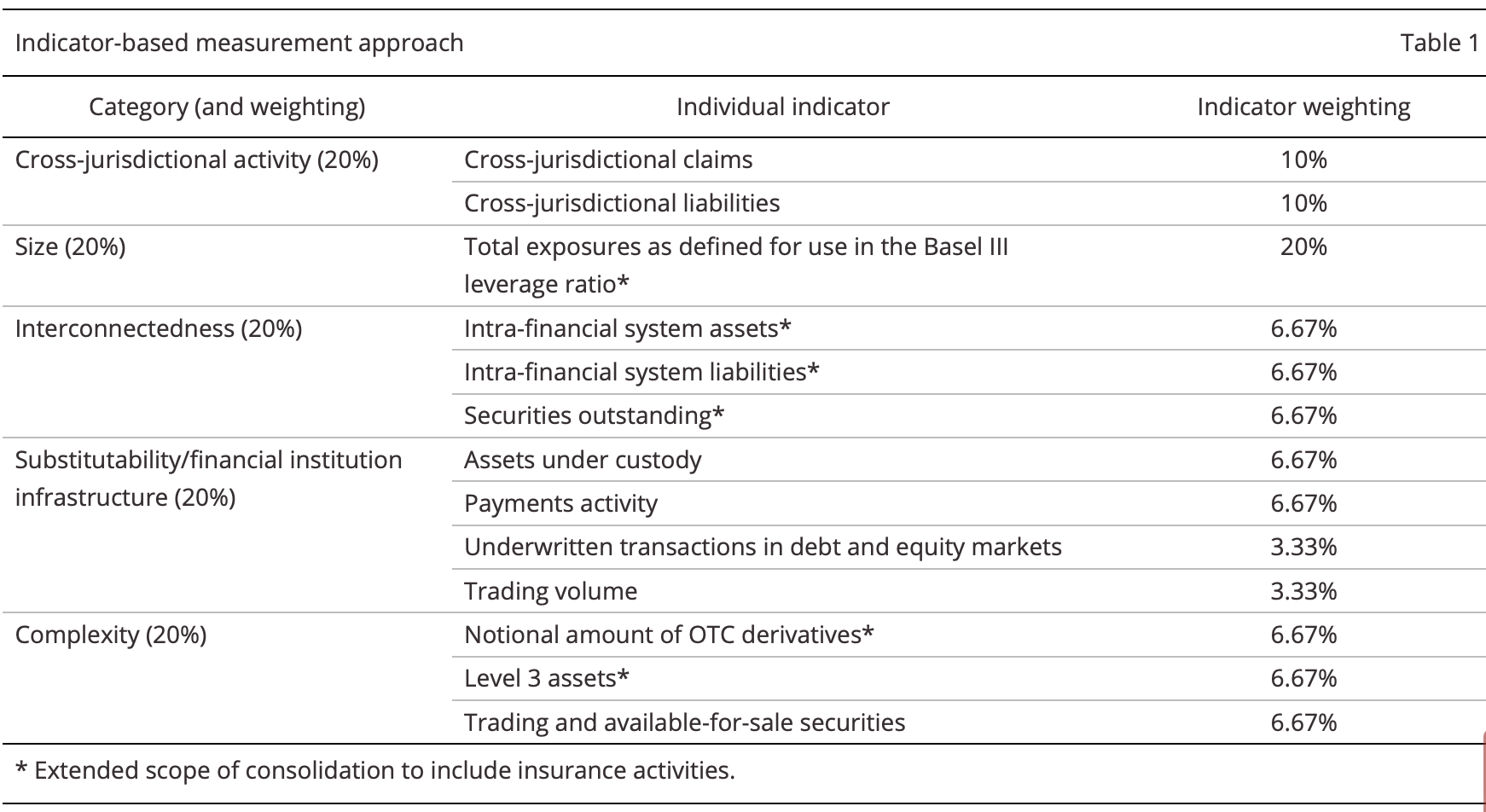
The methodology that assess the systemic importance of G-SIBs relies on several indicators which can be categorized as follows:


1.) size


2.) cross-jurisdictional activity


3.) interconnectedness


4.) substitutability/financial institution infrastructure


5.) complexity.   


Each of these categories is given an equal weighting of 20 percent and each category has multiple indicators as shown on this table:


The 2018 enhancements included the following:


1.) Amending the definition of cross-jurisdictional indicators consistent with the definition of BIS consolidated statistics;


2.) Introducing a trading volume indicator and modifying the weights in the substitutability category;


3.) Extending the scope of consolidation to insurance subsidiaries;


4.) Revising the disclosure requirements;


5.) Providing further guidance on bucket migration and associated higher loss absorbency (HLA) surcharge when a G-SIB moves to a lower bucket; and


6.) Adopting a transitional schedule for the implementation of these enhancements to the G-SIB framework.


Since G-SIB failures could pose a threat to the international financial system, the banks must hold more risk-based capital to enhance their resilience.  The capital add-on (surcharge) is shown on this table which also shows the "bucket" to which various levels of the capital add-on are assigned with the cut-off score being 130 basis points (bps) with CET1 being Common Equity Tier 1 which is the banks core capital including common shares, stock surpluses, retained earnings and accumulated other comprehensive income :


Here is a list of the G-SIBs and their buckets effective November 2022:


You'll note the presence of Credit Suisse in Bucket 1.


Here is a graphic showing the breakdown of G-SIB scores from data at the end of 2021:


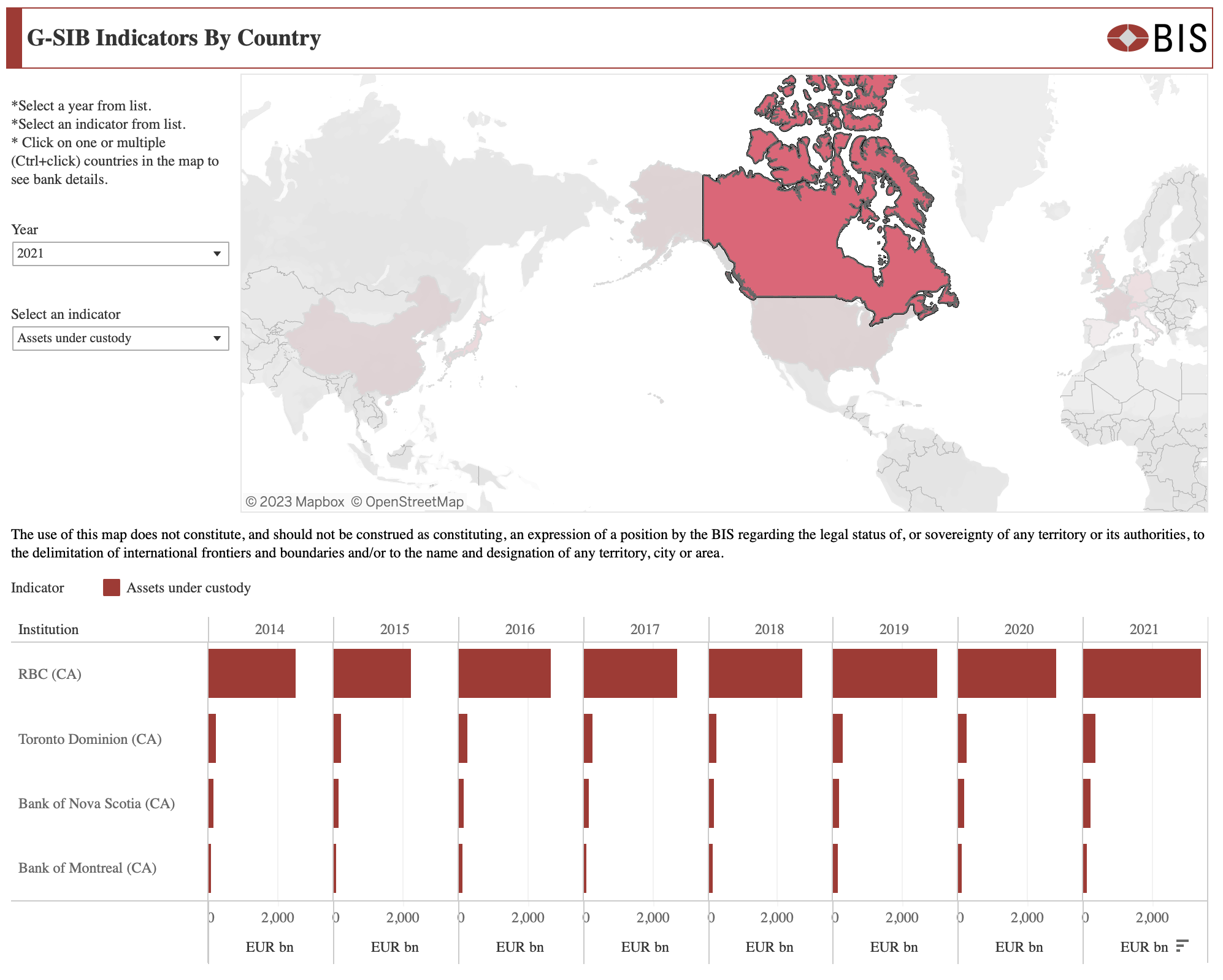
Here is data showing total assets under custody for the largest banks in several nations and how the value of these assets has changed since 2014:


1.) China:


2.) United States:


3.) Canada:


4.) United Kingdom:


5.) Japan:


6.) Switzerland:


It's very apparent that the collapse of even a single G-SIB in any nation could prove catastrophic to that nation's banking system and cause severe stress in the wider global banking ecosystem.


Given the global nature of the world's banking system means that it is only as strong as its weakest link.  While the recent collapse of smaller banks in the United States could prove to be contagious at some point, impacting the nation's G-SIBs, the implosion of Credit Suisse is of greater immediate concern given its importance to the global banking sector.  A house of cards indeed.


Monday, February 11, 2019

Venezuela's Socially Responsible Banking

Back in 2012, Rachael Boothroyd wrote an interesting article entitled "Venezuela Increases Banks' Obligatory Social Contributions, U.S. and Europe Does Not" which appeared on Venezuelanalysis.  This missive which was written three short years after Wall Street banks caused the near collapse of the global economy gives us a sense of yet another one of the reasons why Washington is moving against the democratically Maduro government, trying to replace it with one that is more palatable to their narrative.

As background, during the 2008 - 2009 crisis, paralleling the situation in the world's advanced economies, it became apparent that Venezuela's private banking sector was rife with "administration and managerial problems that left them in a situation of illiquidity that did not allow them to cover their obligations" and that some banks were guilty of fraudulent behaviour.  In November and December 2009, Venezuela's Superintendency of Banks and Other Financial Institutions (SUDEBAN) took over eight small private banks after a fraud scandal in the nation's banking sector with some of the banks being nationalized.  In addition, ten bankers and public functionaries were arrested as a result of the scandal and judicial orders were issued to prevent 28 banking executives from leaving Venezuela (although it was believed that 23 of the bankers had fled to the United States, Spain and Curacao.  In January 2009, SUDEBAN took over an additional three small banks in January 2009 and sanctioned ten other banks with fines for failing to comply with financing regulations in the agricultural sector.  Unlike the United States where the federal government (aka American taxpayers) bailed out the banking sector culprits, in Venezuela, to clean up the banking sector, the government continued to take over banks in 2010 and by the end of March 2011, Venezuela had only 37 private banks, down from 59 in November 2009.  By 2011, state-owned institutions held 35 percent of the banking sector's assets and foreign institutions held only 13.2 percent of assets.

Here is a current list of the top five banks in Venezuela:


Of the 31 current banks (June 2018), 24 were privately owned and seven are state-owned.  According to a listing by Global Banking and Finance, Citibank is the only American bank with a presence in Venezuela as shown here:


In Ms. Boothroyd's article, she opens by noting that most of the Western world was paying for the  banking sector-created global financial crisis with their jobs, homes, education and health at the same time that the bankers who caused the crisis continued to grant themselves multi-million dollar bonuses, stock options and salaries.  Such was not the case in Venezuela where federal laws were changed so that Venezuelan banks were obligated to contribute 15 percent of their yearly earnings to securing housing as a constitutional right.  This was part of the Venezuelan government's "Great Housing Mission" (GMVV) program where housing was declared a constitutional right.  As you can see here, the Great Housing Mission was recently declared to be successful:


According to Telesur, the Great Housing Mission planned to build five million homes by the end of 2019.  Here is a quote from current President Maduro:

"You can always do more to improve the country, to recover it. Commander Chávez set a goal of two million homes, but we went further (...) We are going to reach three million, towards the five million homes."

As of early February 2019, GMVV claims to have completed 2,554,254 housing units.

According to Ms. Boothroyd, the 15 percent levy on Venezuelan bank earnings was divided as follows; 66 percent towards granting credits for house building projects, 26 percent towards credit for house buyers and 8 percent towards credit for carrying out improvements and self construction projects on Venezuelans' first homes.  Of the 60 percent dedicated to house building projects, 55 percent went directly to the government's Housing and Environment Ministry for the Great Housing Mission and 40 percent went to the construction of houses for families with incomes no higher than 6 times the national minimum wage.

Venezuela's government also took other steps that impacted the nation's banking sector; banks are not allowed to participate in brokerage firms and insurance companies, they cannot form financial enterprises with other sectors of the economy, they must minimize financial risk-taking and speculation and they must also put 10 percent of their capital into a fund for wages and pensions that can be used in the event of a bankruptcy.  Banks are also obligated to grant loans to five industries on more beneficial terms than for any other sectors or industries; agriculture (up to 25 percent of the credit portfolio), mortgages (up to 20 percent), tourism (up to 4.24 percent), manufacturing (up to 10 percent), microloans (up to 3 percent) with the bank's total loan portfolio to account for no more than 62.24 percent of its entire portfolio.

Through the 2010 Law of the National Financial System and its banking sector restructuring and regulating, the Venezuela government is attempting to force the nation's banking sector towards the "public interest" to create a "social state of law and justice".  Can you imagine that happening in the West?

Let's close with this quote from Ms. Boothroyd:

"Right now in the U.S. and Europe, it is painfully clear that the banks are firmly back in control, with no concrete measures having been adopted to curb their autonomy. In financial hotspots such as New York and London, banks are what continue to make the world go round for the movers and shakers of the city, who continue to perpetuate the myth that banking institutions are great wealth creators and are as such untouchable.

In the midst of the human fallout from the banking crisis, it is hard to maintain this mantra. The movement of banks into speculation and stock broking has turned the international banking system into a global casino which has everything to do with the uninhibited flow of great sums of capital but nothing to do with the creation of wealth; much less to do with human development. In Venezuela, this vision is being reconceptualised so that banks have a socially productive role, as opposed to a parasitic one.

Evidently, it is the lack of initiative on the part of governments in the U.S. and Europe to bring banks back under the control of the state through regulation and legislation, and not the lack of an alternative, which has meant that the autonomy of the banks has gone virtually unchallenged in wake of the financial crisis. Because Venezuela has proved that, despite the globalised nature of the banking system, these changes can be implemented when the government is on the side of the people and not the financial institutions.

Whilst funds from banks in Venezuela are going towards the construction of free housing and the maintenance of social programs for the benefit of the country, paradoxically people in the U.S. and Europe are being forced out of their overly priced housing in order to maintain a defunct financial system. Not because there is no alternative, but because their governments continue to be wedded to the great wealth creators for the 1%." (my bold)

Venezuela has taken a rather unique approach to the problems that affected its private banking sector during the aftermath of the Great Recession, forcing the banks into backing social programs.  I think that we can pretty much assure ourselves that this will never happen in the United States particularly given this:


Nonetheless, the implementation of socially responsible banking by Venezuela is something that is  viewed by Washington as yet another particularly unpalatable aspect of doing business in a nation that would surely welcome several of America's commercial banks should its current banking regulations be rolled back.  Given the nation's massive economic potential, America's bankers  must be excited about the prospect of even higher profitability based on business opportunities in Venezuela.

Thursday, May 24, 2018

The Economic Growth, Regulatory Relief and Consumer Protection Act and How America's Banks Got Their Way

With very little fanfare or attention from voters, the House has now passed S.2155, the misleadingly named "Economic Growth, Regulatory Relief and Consumer Protection Act" which is now headed to the President for a quick "pencil-whipping".  Most Americans have no idea that this legislation could have a very significant impact on the federal government debt/deficit situation and that, thanks to Congress and both sides of the political divide, the banking sector is far more vulnerable to a repetition of what happened at the dawn of the Great Recession and the home buying public is more vulnerable to abusive banking practices.

While Congress likes to tout S.2155 as a "community bank bill", any benefits to Main Street America are far outweighed by the benefits to Big Banks.  This bill seeks to roll back some of the safeguards that were put in place with the Dodd-Frank Wall Street Reform and Consumer Protection Act aka the Dodd Frank Act.  The bill would alter the regulatory framework for two types of banks; banks will assets exceeding $50 billion and small community banks with assets under $10 billion.  Let's look at an analysis of S.2155 by Americans for  Financial Reform, looking at the sections of the bill that can best be described as a gift to America's banking sector and a negative for Main Street's homebuyers.

1.) The impact on banks:  

Let's start by looking at the pluses to the America's banking sector.  Under Section 401, the bill eliminates most of the requirements for special risk controls that were put in place after the 2008 - 2009 crisis for banks that range in size from $50 billion to $250 billion.  These banks are among the largest banks in the United States and include 25 out of 38 of the biggest banks in America.  In case you've forgotten, Countrywide and Golden West, contributors to the 2008 - 2009 crisis, had assets that fell into this range, requiring nearly $50 billion in taxpayer-funded bailouts.  As well, the Trump Administration has announced that it will use S.2155 to deregulate the operations of giant foreign-based megabucks like Barclays, Deutsche Bank and Credit Suisse, banks that also played a role in the 2008 - 2009 crisis.  It is important to note that, while these banks fall under the $250 billion asset limit in the United States, they have multi-trillion dollar global operations and, as such, pose a major risk to the U.S. economy.

Under Section 402, the bill would allow two of the largest and systemically significant banks to reduce their loss-absorbing capital levels.  BNY Mellon and State Street, banks that received $5 billion in taxpayer-funded bailout funds, would significantly reduce the level of their ability to protect themselves against insolvency.

Under Section 214, the bill would prevent regulators from requiring that banks, even the largest of Wall Street's megabanks, accumulate additional capital to absorb potential losses in commercial real estate loans (i.e. the supplementary leverage ratio).  It was risky investments in commercial real estate lending that drove the implosion of Lehman Brothers in September 2008, giving support to the "Too Big to Fail" mantra.

2.) The impact on consumers:

Now, let's look at the provisions of S.2155 that will impact America's consumers of housing.  Under Section 107, the bill exempts key montage lending for sales of manufacturing homes, allowing the sellers of these homes to manoeuvre customers into overpriced loans, making the public more susceptible to the same types of lending practices that created the unsustainable mortgage/housing market in the period leading up to the Great Recession.

Under Sections 101 and 109, the bill would weaken protection for millions of Americans who borrow mortgage funds from banks with under $10 billion in assets.  The provisions would eliminate protection against overpriced and adjustable rate mortgages at these smaller banks and would eliminate the requirements that ensure that consumers can pay tax and insurance on their homes to prevent these non-payment  bills from resulting in foreclosure.

Under Sections 103 and 100, the bill would weaken protection against fraudulent practices in home sales, making it easier to misinform homebuyers about the terms of their mortgage loans and eliminating the need for homes sold in rural ares to have an appraisal.

Now, let's look at the bottom line.  Thanks to the Congressional Budget Office, we can see that the implementation of S.2155 will have an impact on the federal government's finances as shown here:


In total, over the decade between 2018 and 2027, S.2155 is expected to add $671 billion to the federal deficit, rating from $19 billion in 2019 to $100 billion in 2021.

Now, let's look at the legislative background of S.2155.  The bill was sponsored by Senator Mike Crapo (R-ID) on November 16, 2016 and here is a list of co-sponsors:


Here is a list of who voted for and against S.2155 in the Senate:


Here is a list of who voted for and against S.2155 in the House:


As you can see, S.2155 appealed to both sides of the political divide with and with 16 Democratic Senators voting in favour along with 51 Republican Senators and  33 Democratic House members voting in favour along with 225 Republican House members. 

Let's close this posting with a quick look at how much the commercial banking sector spent on lobbying in Washington over the past two decades:


Here is a breakdown of how much the commercial banking sector contributed to political candidates in the period 2017 to 2018:


I think that we now have a pretty good idea of who we can blame the next time that Washington is forced to, once again, bail out America's banking sector and why S.2155 was enacted in the first place.  As we already know Washington is for sale and America's commercial banks are buying.