Showing posts with label political polarization. Show all posts

Monday, January 31, 2022

Project for Good Information and the Disinformation Era

It is clear that we are living in a post-truth era where veracity is in the eye of the groups responsible for ensuring that we are not exposed to disinformation.  As I have posted in the past, the various organizations that have been brought to life to prevent the spread of so-called fake news all have their own agendas and filter the truth through the eyes of their financial backers.  In this posting, we'll look at another group that is receiving funding from one of the world's wealthiest, liberal individuals.


Project for Good Information aka PGI was founded by 35-year-old Tara McGowan, a Democratic strategist in 2021.  Good Information Inc., it's "subsidiary" was formed for the purpose of investing in local news companies to provide the world with "fact-based information".  McGowan was the former head and co-founder of ACRONYM, a Washington-based non-profit which is "committed to building power and digital infrastructure for the progressive movement".  It was founded in 2017 and, since then, has run dozens of targeted media programs to "educate, inspire, register and mobilize voters", obviously of the Democratic bent.  In 2018, ACRONYM and its affiliated PAC, PACRONYM helped to elect progressive (Democratic since they are the only progressive people in the United States) candidates across the United States.  In 2020, PACRONYM ran one of the largest digital campaigns to defeat Donald Trump, spending nearly $100 million to persuade swing state voters as shown here:


...and here:


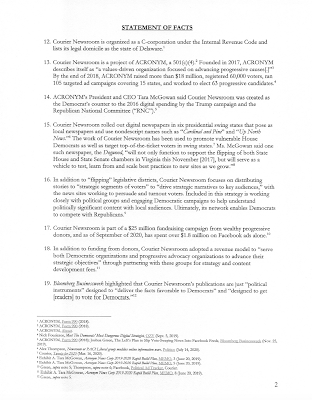
In 2019, ACRONYM launched Courier Newsroom, a for-profit online digital news property with the following aim:


"The media ecosystem in our country has changed and has led to rampant disinformation that has influenced millions of people, causing widespread distrust in our democratic institutions, in the facts — and in each other. 


Without trust, America’s future is under threat, including the ability to build a country, a government, and a society that works for everyone. 


Courier Newsroom is a civic media company that protects and strengthens our democracy through credible, fact-based journalism that seeks to create a more informed, engaged, and representative America. Under the direction of Courier Newsroom’s executive leadership team, our eight local newsrooms provide the communities we serve—including the people who live in information silos—with news centered on the people and policies affecting their lives. Our reporting is produced for the social media platforms and online channels our audiences spend their time on, with an emphasis on video, graphics, and skimmable newsletters to inform and engage our audiences in the ways they consume information today.


Here are their values:


1.) Our reporting will be rooted in facts, science, and the communities our newsrooms serve.


2.) We will strive to tell the truth and will tell you when we get it wrong, because we believe that good information is the lifeblood of democracy, and that democracy will fail when factual journalism is out of reach. 


3.) We will be intentional about centering the voices of the people in our communities, using our platforms to amplify their experiences and opinions, especially those who are most impacted by the issues being decided in their statehouses and in Washington. 


4.) As a civic news organization, our journalists will focus their reporting around efforts to strengthen communities, rebuild struggling economies, expand access to health care and child care, address the climate crisis, and reduce inequality in all forms—and covering the leaders championing those efforts.  We will be relentless in our coverage of attempts or actions to undermine democratic institutions, especially voting rights, and ballot access, and we will make a special effort to report on public actors who are advancing those efforts.


5.) We will never manufacture “both sides” to our stories, giving equal weight to conspiracy theories or junk science. We will always provide proper context in our reporting to help ensure we don’t continue the spread of misinformation or disinformation.


6.) We will be committed to holding accountable elected officials or politicians who betray our values, cause harm, or seek to cause harm to the communities we serve. 


7.) We will not use political jargon; instead, we will work to break down inaccessible political language for our audiences.


8.) We will publish our work where our audiences are: When they move to new platforms or technologies, our brands and journalists will follow.


9.) We will prioritize hiring and contracting reporters, editors, and producers who live in the communities we serve, and we will remain committed to staffing our teams and sourcing our stories with the people who reflect the diverse and inclusive country in which we reside.


Here is the team behind Courier Newsroom:


It's pretty obvious from this background that, given McGowan's history with Courier Newsroom that the Project for Good Information is leaning hard to the left side of the political theatre that is Washington.  Interestingly, Courier Newsroom found itself the target of a complaint to the FEC over its violations of the Federal Election Campaign Act as shown here:


...largely because its activities were seen to be more like a Political Action Committee (PAC) than a media outlet, acting as an informal arm of the Democratic Party.


Let's go back to Project for Good Information.  According to information seen by VOX, this new entity consists of two separate entities: 


1.) a 501(c)(3) public foundation called the Good Information Project which exists to grant funding to nonprofit media companies although, according to AXIOS, McGowan denies the formation of a non-profit arm.


2.) a public benefit or B Corp called Good Information Inc. which will invest in for-profit media companies.


As part of the new deal, Good Information Inc. has acquired Courier Newsroom and For What It's Worth or FWIW, .  PGI plans to raise a total of $65 million with $35 million going to the B Corp, $25 million for the 501(c)(3) and $5 million dedicated to a two-year operating budget accordant to a promotional memo seen by Vox.


To close, here is a screen capture from Influence Watch with background on Project for Good Information:


And, last but not least, according to Politico and Axios, two of PGI's backers are billionaire Reid Hoffman, co-founder of LinkedIn and none other than George Soros, billionaire "philanthropist" who describes himself as an "international supporter of democratic ideals and causes".


Given McGowan's history and political bias and the political bent of two of her financial backers as I noted above, if it's good information that you're looking for, then perhaps you'd better look elsewhere.


Tuesday, May 11, 2021

Support for a Third Party Option in a Politically Divided America

With the United States 2020 election theatrics more-or-less behind us, it is clear that the "Untied States" is as politically polarized as it has been for generations.  Republicans are clearly unhappy with the results of the latest presidential election and, as you will see in this posting, are increasingly looking to an option that has rarely been given much thought in the United States.


A Gallup poll taken in February 2021 was conducted with a random sample of 906 adults living in all 50 states and the District of Columbia.  Of these, 420 were Democrats and Democratic-leaning independents and 412 were Republicans and Republican-leaning independents.  Individuals were asked the following questions:


1.) In your view, do the Republican and Democratic parties do an adequate job of representing the American people, or do they do such a poor job that a third major party is needed?


2.) (Asked of Democrats and Democratic leaning independents) If you had to choose, would you rather see the Democratic Party –[ROTATED: become more liberal, stay the same, (or) become more moderate]?


3.) (Asked of Republicans and Republican leaning independents) If you had to choose, would you rather see the Republican Party – [ROTATED: become more conservative, stay the same, (or) become more moderate]?


4.) (Asked of Republicans and Republican leaning independents) Would you rather Donald Trump continue to be the leader of the Republican Party, or for the Republican Party to have a new leader?


Here are the results:


1.) The perceived need for a third U.S. political party:


Only 33 percent of Americans believe that the two main political parties are doing an adequate job, the smallest percentage since October 2013 (26 percent).  This compares to 62 percent of Americans who believe that the parties are doing such a poor job of representing American voters that a national third major party is needed, the highest level since the poll began in 2003 when only 40 percent of Americans believed that a third party option was needed.


Here is a graphic showing the percentage of Republicans, Democrats and Independents that believe that a third major political party is needed:


Republican support for a third party option has risen from its pre-2020 election level of 40 percent to its current level of 63 percent, the highest on record since the poll began in 2003.  This compares to 70 percent of Independent voters and only 46 percent of Democrats.


2.) Donald Trump's leadership: When it comes to Donald Trump's leadership, 68 percent of Republicans would prefer that Trump remain the party leader compared to 31 percent that want a new leader.  When it comes to Republican-leaning independents, 47 percent would prefer that Trump remain party leader compared to 51 percent that want a new leader.  


3.) Republicans' political direction: When it comes to the direction of their party, 40 percent of Republicans and Republican-leaning independents want the party to become more conservative, 34 percent want it to stay the same and 24 percent want it to become more moderate.


4.) Democrats' Political Direction: When it comes to the direction of their party, 34 percent of Democrats and Democrat-leaning independents want the party to become more conservative, 34 percent want it to stay the same and 31 percent want it to become more moderate.


Given the obvious political divide that plagues American politics and the fact that most Americans believe that the nation's partisan divisions are increasing as shown here:


...it should not come as a surprise that a record percentage of Americans believe that the United States needs a viable third party option.


Monday, January 11, 2021

How Americans Perceive the Events on Capitol Hill

An interesting poll by YouGov looks at how Americans felt about the assault on the seat of their government in early January 2021.  Here are the results.


YouGov polled 1,397 registered voters who had heard about the events on Capitol Hill and, not surprisingly, voters' sentiment toward the events are divided along party lines.  Of all voters, 62 percent perceived that the actions taken by the protestors were a threat to democracy with 63 percent saying that they "strongly oppose" the actions taken by "President Trump's supporters" with an additional 8 percent saying that they "somewhat oppose" what has happened.  Overall, 21 percent of voters stated that they supported the actions at the Capitol and, among those who believe that voter fraud took place during the 2020 Presidential election, 56 percent felt that the actions of the demonstrators was justified.


These results can be broken down further as follows:


1.) 93 percent of Democrats perceived the actions as a threat with only 4 percent perceiving the actions as not a threat to democracy.


2.) 55 percent of Independents perceived the actions as a threat with 32 percent perceiving the actions as not a threat to democracy.


3.) 27 percent of Republicans perceived the actions as a threat with 68 percent perceiving the actions as not a threat to democracy.


Among Republicans, 45 percent actively supported the actions of the demonstrators at Capitol Hill with 43 percent being opposed.


Here is a graphic showing the results:


There are also additional perceptions that are affected by respondent's political persuasion:


1.) 59 percent of all respondents believed that the events were more violent than peaceful with 28 percent believing that events were more peaceful than violent.


2.) 58 percent of Republicans beloved that the events were more peaceful than violent with 22 percent believing that events were more violent than peaceful.


When it comes to placing blame for the events, among all voters, 55 percent believe that Donald Trump was to be blamed "a great deal", 11 percent believe that he is "somewhat to blame", 9 percent believe that he is "not much to be blamed" and 22 percent believe that he was "not at all to be blamed".  Not surprisingly, there is a significant difference in viewpoint based on political affiliation:


1.) Democrats - 90 percent believe that Donald Trump was to be blamed "a great deal", 6 percent believe that he is "somewhat to blame", and only 4 percent believe that he is either "not much to be blamed" or "not at all to be blamed".


2.) Republicans - 13 percent believe that Donald Trump was to be blamed "a great deal", 15 percent believed that he is "somewhat to blame", 16 percent believe that he is "not much to be blamed" and 53 percent believe that he was "not at all to be blamed".


YouGov also looked at how voters felt about Joe Biden's role in the events.  To summarize, 5 percent of Democrats felt that he was either "a great deal to blame" or "somewhat to blame" compared to 35 percent of Republicans who felt that he was "a great deal to blame" or "somewhat to blame".


Here is a graphic showing the results:


Lastly, and given that it is becoming an increasingly heard narrative, let's look at how voters viewed the protestors noting that respondents were allowed to choose more than one option:


1.) All voters - 52 percent view them as extremists, 49 percent view them as domestic terrorists, 41 percent viewed them as criminals and only 15 percent viewed them as patriots.


2.) Democrats - 74 percent view them as extremists, 78 percent view them as domestic terrorists, 63 percent viewed them as criminals and only 2 percent viewed them as patriots.


3.) Republicans - 26 percent view them as extremists, 17 percent view them as domestic terrorists, 16 percent viewed them as criminals and 30 percent viewed them as patriots.


While the results of this poll are not terribly surprising, they show us just how politically polarized and paralyzed the United States (or Untied States) has become.  Neither side is willing to see the other side's viewpoint and politicians who know this only too well are using this reality to divide and conquer America and play voters for fools.


Thursday, November 21, 2019

The Two Americas - Our New Reality

No it's not your imagination, there really are two Americas....at least according to a new study by the Brookings Institute entitled "America has two economies - and they're diverging fast" by Mark Muro and Jacob Whiton.

The authors open with this observation:

"We’ve been harping for a while on the stark economic divides that define American life in the Donald Trump years.

To be sure, racial and cultural resentment have been the prime factors of the Trump backlash, but it’s also clear that the two parties speak for and to dramatically different segments of the American economy. Where Republican areas of the country rely on lower-skill, lower-productivity “traditional” industries like manufacturing and resource extraction, Democratic, mostly urban districts contain large concentrations of the nation’s higher-skill, higher-tech professional and digital services."

Based on a new data analysis that was developed with the Wall Street Journal's Aaron Zitner and Dante Chinni, the authors suggest that the change being experienced in the red and blue United States  is happening very quickly and in real time, transforming the economies of the Democrats and Republicans.

Let's start by looking at how voting patterns have changed over the past decade by examining several metrics:

1.) Land Area:   This map shows that the Democrats are far more reliant on urban, coastal districts than they were in 2008:


In 2008, Democratic-voting, urban districts encompassed 39 percent of America's land area compared with 61 percent the land area voting Republican.  By 2018, the Democrat's share of America's land area had fallen to 20 percent with the Republican's share rising to 80 percent.  

2.) Median household income and GDP per seat:  GDP per seat and median household incomes have changed drastically for Democratic and Republican districts:

Democratic districts GDP per seat:

2008 - $35.74 billion
2018 - $48.50 billion

Republican districts GDP per seat:

2008 - $33.25 billion
2018 - $32.60 billion

Democratic districts median household income:

2008 - $54,000
2018 - $61,000

Republican districts median household income:

2008 - $55,000
2018 - $53,000

Here is a graphic showing the aforementioned data which clearly shows how Republican-leaning districts have seen declines in both GDP per seat and median household income over the past decade:


3.) Productivity:  Productivity has varied greatly over the past decade with Democratic districts showing marked improvement and Republican districts productivity remaining stagnant:

Democratic districts productivity:

2008 - $118,000
2018 - $139,000

Republican districts productivity:

2008 - $109,000
2018 - $110,000

4.) Share of adults with at least a Bachelor's degree: Over the past decade, the percentage of people living in Democratic districts have seen a significant increase in the percentage of people attaining a Bachelor's degree or greater compared to a very small increase in Republican districts:

Democratic districts share with Bachelor's degree:

2008 - 28.4 percent
2018 - 35.6 percent

Republican districts share with Bachelor's degree:

2008 - 26.6 percent
2018 - 27.8 percent

5.) Metro area population share: Over the past decade, the Democratic Party represents an increasingly urban population while the Republican Party represents a more rural and exurban population:

Democratic districts metro population share:

2008 - 86.7 percent
2018 - 94.6 percent

Republican districts metro population share:

2008 - 82.7 percent 
2018 - 75.6 percent

6.) Basic manufacturing job share: Over the past decade, the percentage of people involved in the manufacturing sector has increased for Republican districts and decreased for Democratic districts as workers in Democratic districts increasingly took jots in professional and digital services:

Democratic districts manufacturing job share:

2008 - 53.8 percent
2018 - 43.6 percent

Republican districts manufacturing job share:

2008 - 46.2 percent 
2018 - 56.4 percent

With this data in mind, let's look at what the authors' conclude:

"...there are few signs of any coming reversal of the decade’s divergence. Instead, the current economic trends underlie the current party divide and reinforce it. For at least the foreseeable future, therefore, the nation seems destined to struggle with extreme economic, territorial, and political divides in which the two parties talk almost entirely past each other on the most important economic and social issues, like innovation, immigration, and education because they represent starkly separate and diverging worlds. Not only do the two parties adhere to very different views, but they inhabit increasingly different economies and environments."

Election results in the United States are increasingly showing that the United States of America is becoming the Untied States of America.  From all appearances,  a commentary by Ronald Brownstein in "The Atlantic" which stated the following:

"Today, the two parties represent no only different sections of the country, but also, in effect, different editions of the country....The parties' ever-escalating conflict represents not only an ideological and partisan stalemate.  It also encapsulates our collective failure to find common cause between what America has been, and what it is becoming."

Friday, November 8, 2019

Christianity in America

With the Republican Party relying heavily on America's Evangelical Protestant Christians for support as shown here:


...recent research by Pew would suggest that American politics is headed for a sea change. 

First, let's look at Pew's research which shows dropping regular (i.e. once a month or more) church attendance:


Over that past decade, the percentage of American who say that they attended church more than once monthly has dropped by 7 percentage points to 45 percent while the percentage of Americans who stated that they attended church less than once monthly if at all has also risen by 7 percentage points to 54 percent.  In the early 1970s, only 11 percent of American adults stated that they never attended religious services; by the late 2010s, this had risen to 27 percent, an increase of 16 percentage points or 145 percent.

Here is a graphic showing how the share of Protestants and Catholics have been shrinking and the percentage of "nothing" (i.e. no religious affiliation) has risen:


As well, over the past decade, there has been a broad-based decline in the share of Americans who identify as Christians and a corresponding rise in Americans who identify as unaffiliated, particularly among Generation X (born 1965 to 1980) and Millennials (born 1981 to 1996):


Not surprisingly, there is a very significant generation gap in American religious identity:


Data shows that there were 233 million adults in the United States in 2009 of which 77 percent identified as Christian resulting in approximately 178 million American Christians.  Today, there are roughly 256 million adults in the United States with only 65 percent identifying as Christian resulting in approximately 167 million American Christians, down 12 million over the decade.

One thing that will have an impact on future voting patterns is the share of white American Protestants who describe themselves as "born-again or evangelical" Christians as shown on this graphic:


Some of the drop of the number of white Protestant born-again or evangelical Christians from 19 percent to 16 percent over the decade can be attributed to the declining share of whites in the overall population and the dropping share of adults that describe themselves as Christians.

There is no doubt that the political landscape in the United States which is strongly influenced by the religious identity of voters is undergoing a massive change, a change that will have a significant impact on the voters that the Republicans have counted on for decades.  Religion also goes a long way to explaining the growing political divide in America as the left leans away from formal religion and the right clings to its belief system.

Thursday, February 28, 2019

The Roots of America's Political Polarization

While we might draw a reasonable conclusion that the political divide in America is the worst that it has been in our collective lifetimes and that much of the divisive hysteria began with the 2016 election of Donald Trump, history shows us that this conclusion isn't entirely valid.  If we look back 25 years, we can track the genesis of the partisan hyperbole that infects Washington and the greater United States.

Back in 1990, then Republican Whip and future Speaker of the House Newt Gingerich was the general chairman (with former president Gerald Ford as Honorary Chairman) of a conservative Republican group, GOPAC, a combination of G.O.P. for the Grand Old Party and P.A.C. for political action committee even though it was not legally a political action committee and, under law, was not supposed to be engaging in federal election campaigns. GOPAC was touted as a "new citizens' movement in America" and took significant steps to ensure that Republican members would be elected in the next general election, resulting in a governing majority that would result in a United States that was formed around conservative principles.

Here is letter dated May 31, 1990 from Newt Gingrich to Tim Robertson of the Family Channel, then owned by Pat Robertson of the conservative Christian ideology, who was donating one hour of airtime per month to GOPAC under the auspices of the "American Citizens' Television" or ACTV, a project of the Abraham Lincoln Opportunity Foundation (a 501(c)3 organization):


Here is a copy of a mailout that explains ACTV and how American voters could get involved:


Here is a copy of a letter from Newt Gingerich drumming up support for GOPAC:


Here is an excerpt from a GOPAC focus group research project from July 1990:


The conclusion of the focus group stated that younger voters are the right target group for a majority strategy and that "political theory and language needs to be effective with them if it is to be effective at all".

In 1992, GOPAC started a project called "Change Congress NOW!"  Here is an excerpt from a memo dated October 26th, 1993 from Newt Gingerich regarding GOPAC, addressed to new members of his staff:

We are going to renew American civilization

We are going to replace the welfare state

We are going to elect a Republican majority in the House.

Here are the notes for a speech that Newt Gingerich gave to the National Review Institute on January 23, 1993:


Now, most importantly and the main point of this posting, here is an excerpt from a GOPAC memo entitled "Language: A Key Mechanism of Control" that was distributed to Republican candidates across the nation for the 1996 election:

"As you know, one of the key points in the GOPAC tapes is that "language matters." In the video "We are a Majority," Language is listed as a key mechanism of control used by a majority party, along with Agenda, Rules, Attitude and Learning. As the tapes have been used in training sessions across the country and mailed to candidates we have heard a plaintive plea: "I wish I could speak like Newt."

   That takes years of practice. But, we believe that you could have a significant impact on your campaign and the way you communicate if we help a little. That is why we have created this list of words and phrases.

  This list is prepared so that you might have a directory of words to use in writing literature and mail, in preparing speeches, and in producing electronic media. The words and phrases are powerful. Read them. Memorize as many as possible. And remember that like any tool, these words will not help if they are not used.

  While the list could be the size of the latest "College Edition" dictionary, we have attempted to keep it small enough to be readily useful yet large enough to be broadly functional. The list is divided into two sections: Optimistic Positive Governing words and phrases to help describe your vision for the future of your community (your message) and Contrasting words to help you clearly define the policies and record of your opponent and the Democratic party.

  Please let us know if you have any other suggestions or additions. We would also like to know how you use the list. Call us at GOPAC or write with your suggestions and comments. We may include them in the next tape mailing so that others can benefit from your knowledge and experience."

Let's focus on the words (i.e the "contrasting words" that were recommended to define Democrats, their legislative record, their proposals and their party as a whole:

abuse of power
anti- (issue): flag, family, child, jobs
betray
bizarre
bosses
bureaucracy
cheat
coercion
"compassion" is not enough
collapse(ing)
consequences
corrupt
corruption
criminal rights
crisis
cynicism
decay
deeper
destroy
destructive
devour
disgrace
endanger
excuses
failure (fail)
greed
hypocrisy
ideological
impose
incompetent
insecure
insensitive
intolerant
liberal
lie
limit(s)
machine
mandate(s)
obsolete
pathetic
patronage
permissive attitude
pessimistic
punish (poor ...)
radical
red tape
self-serving
selfish
sensationalists
shallow
shame
sick
spend(ing)
stagnation
status quo
steal
taxes
they/them
threaten
traitors
unionized
urgent (cy)
waste
welfare

In case you were curious, here are screen captures showing all four pages of the original GOPAC document


GOPAC was quite aware that language, particularly inflammatory language, had a significant impact on the voting public.  As you can see, many of these words are divisive, particularly a word like "traitor".  Mr. Gingerich's goal was to characterize his political opponents as enemies, a strategy that ultimately ended up undermining public trust in Congress and making it difficult for both sides of the political spectrum to meet in the middle and actually accomplish important legislative matters.

In today's "win at any cost" politics, Mr. Gingerich and GOPAC's tactics look positively tame.  That said, the political tactics adopted in the early- and mid-1990s set the stage for the political polarization, partisan divisions and hyperbole that are plaguing American political theatre today.