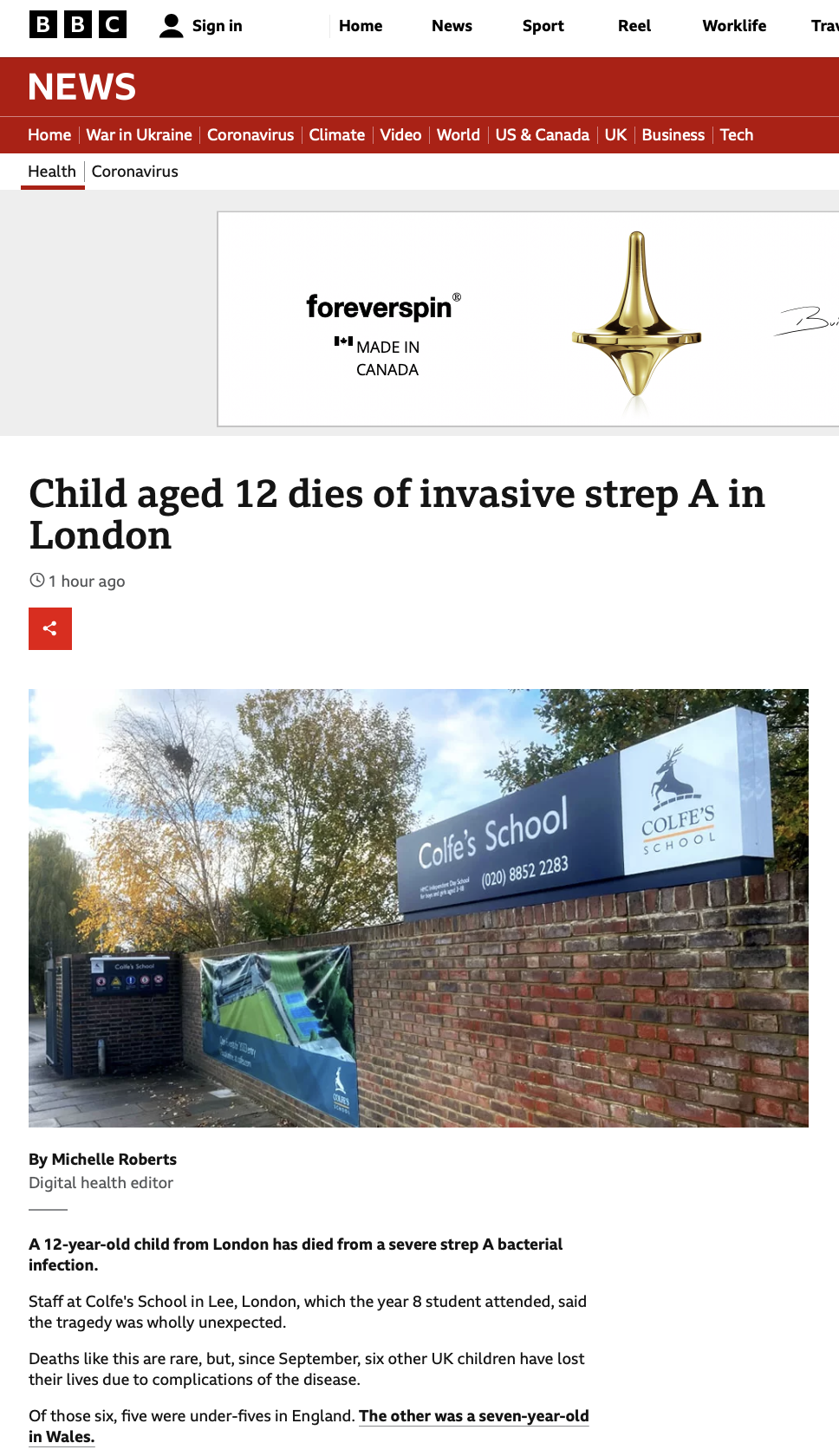
...along with this press release from the United Kingdom Security Agency:
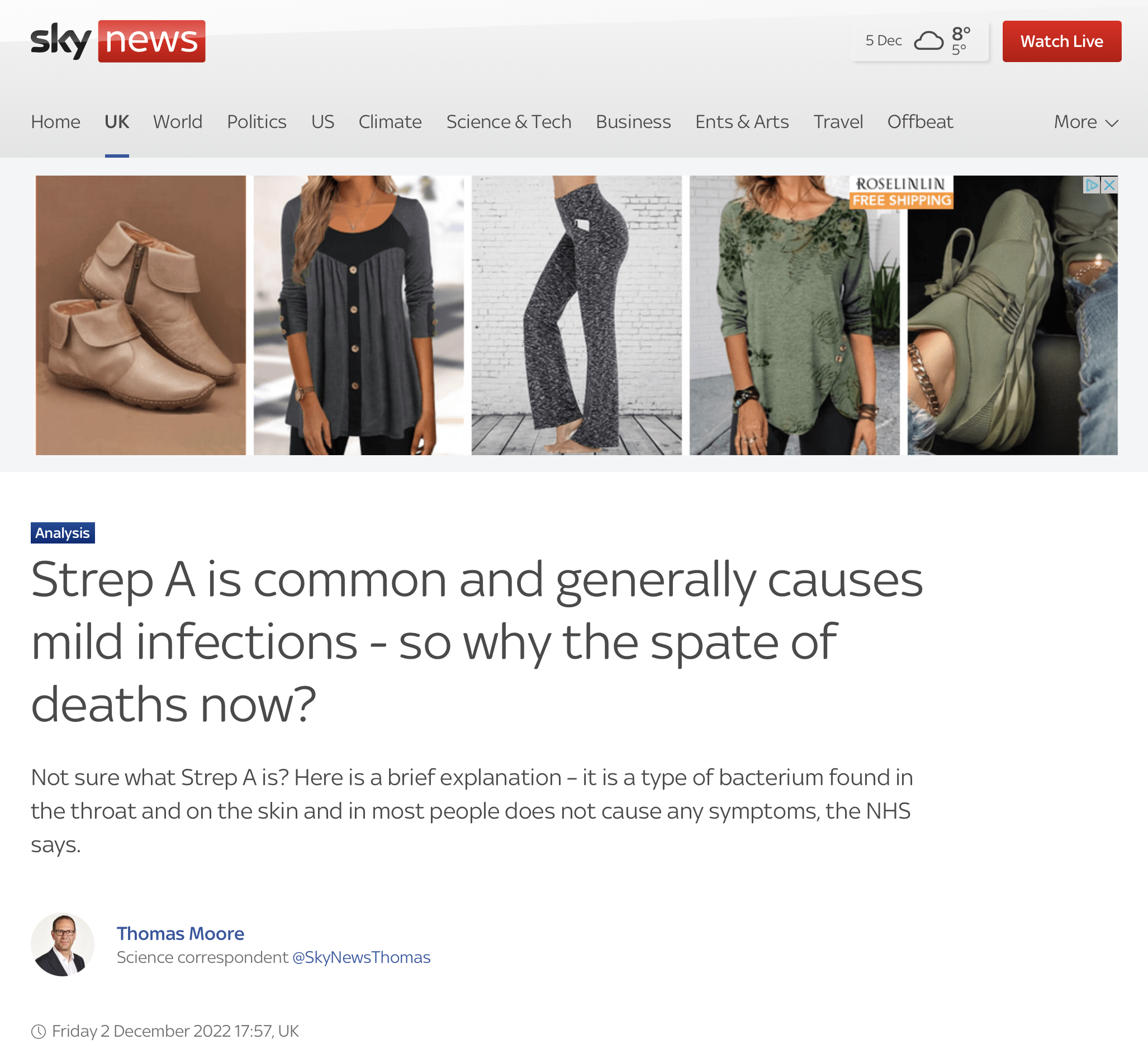
Here's where the pharmaceutical industry enters into the picture. Here is an announcement from the University of Alberta in Canada:
According to the press release:
"Group A streptococcus bacteria, more commonly known as strep A, kills more than 500,000 people a year, and there’s currently no vaccine. Strep A can trigger a variety of severe diseases and conditions including rheumatic fever and necrotizing fasciitis (flesh-eating disease). It can also cause a handful of neurological conditions, explains Lawrence Richer, including Sydenham chorea, a disorder typically affecting children that is characterized by constant movement and can be extremely debilitating. Children and marginalized populations are disproportionately affected by strep A infections."
Researchers at Griffith University in South East Queensland, Australia created the vaccine by combining two of the molecules found on every strain of strep A which they hope will enhance the body's immune response against all strains of the bacteria.
The current trial at the University of Alberta builds on many years of investments in early-phase clinical trials. A prototype vaccine was trialled in Australia in a pilot study and no adverse events were recorded. This trial will include 10 to 20 patients and will first demonstrate safety and then demonstrate efficacy. If the trial is successful, the Li Ka Shing Applied Virology Institute at the University of Alberta, the translation and commercialization arm of the Li Ka Shing Institute of Virology, will support a larger number of patients in Phase 2 trials.
If you are interested in signing up, here is a link that you can use to volunteer if you are healthy and are between the ages of 18 and 45 years:
Volunteers will make a total of six one-hour visits to the testing facility at the University of Alberta, have blood drawn at each visit, receive three total vaccine injections over ten months, agree to be monitored for 10 months and receive a massive payment of $50 for each visit!
And, once again and when the hard work of research is done, it will eventually be Big Pharma to the rescue when they buy the patents and then sell the vaccine to a vulnerable public at some highly inflated price! Given the current headlines, it will be fascinating to watch the progress of the trials for this vaccine to see if it is rolled out to the public as quickly as the COVID-19 vaccines.
A recent study by researchers at the University of Toronto and other institutions provides us with a clear picture of the effectiveness of the current COVID-19 vaccines against both the Omicron and Delta variants of the SARS-CoV-2 virus.
Here is a page showing the authors of the study and their affiliations:
The object of the study was to estimate vaccine effectiveness or VE against infections caused by both Delta and Omicron variants.
The authors looked at data from the Province of Ontario in Canada (Canada's most populous province) and estimated the effectiveness of the vaccine against infection irrespective of symptoms and severity caused by the Delta and Omicron variants between November 22 the day when the first case of Omicron was identified in Ontario and December 19, 2021. Individuals with at least 2 COVID-19 vaccine doses with at least one dose being an mRNA vaccine were included and the effectiveness over time of the two or three doses was estimated using multivariable logistic regression which establishes the relationship between a dependent variable (the outcome of interest) and more than one independent variable. At the time of the study, 88 percent of Ontarians aged 12 and older had received two doses of COVID-19 vaccine. Long-term care residents were excluded from the study as were individuals who had received only 1 dose of COVID-19 vaccine or who had received their second dose 7 days or less prior to being tested as well as individuals who had received two doses of the AstraZeneca or Johnson& Johnson vaccines. It is also important to note that Ontario began to roll out its third dose (i.e. booster) program in August 2021 primarily to residents of long-term care and retirement homes with individuals 70 years and older qualifying on November 6 followed by individuals aged 50 years and older on December 13 and individuals aged 18 and older on December 18.
The final data base used by the researchers included 9,201 Delta positive cases and 3,442 Omicron positive cases with Omicron cases being more common among younger males (mean age of 34.9 years compared to 45.0 years) and were less likely to have comorbidities.
After 2 doses of COVID-19 vaccines (with at least one being an mRNA vaccine), the vaccine effectiveness against the Delta variant waned as follows:
84% - 7 to 59 days after second dose
71% - greater than or equal to 240 days after second dose
After the third dose, the vaccine effectiveness rose to 93 percent 7 days or longer after receiving an mRNA vaccine.
After two doses of COVID-19 vaccines, the vaccine effectiveness against the Omicron variant was as follows:
38 percent - 120 to 179 days after the second dose
42 percent - 180 to 239 days after the second dose
After the third dose, the vaccine effectiveness against Omicron was only 37 percent 7 days or longer after receiving an mRNA vaccine.
This finding is similar to the findings of a study in Denmark where the vaccine effectiveness against Omicron was only 55.2 percent in the first 30 days after receiving a third dose and waned quickly.
In closing, here is the authors' conclusion:
"Two doses of COVID-19 vaccines are unlikely to protect against Omicron infection. While VE against Omicron infection is substantially lower than against Delta infection, a third dose of mRNA vaccine affords some level of protection against Omicron infection in the immediate term. However, the duration of this protection and effectiveness against severe disease are uncertain. Additional tools beyond the currently available vaccines, such as public health measures, antivirals, and updated vaccines, are likely needed to protect against Omicron infection."
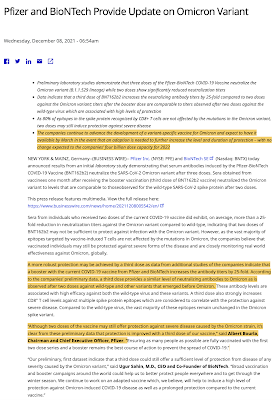
Let's take a brief detour and look at a press announcement from Pfizer dated December 8, 2021 with the pertinent sections highlighted:
While Pfizer touts that a third dose of its COVID-19 vaccine may provide "more robust protection" against Omicron using its current vaccine, it is still hoping to roll out a variant-specific version of the vaccine designed for Omicron by March 2022. As an aside, you will also note that Pfizer's Chairman and Chief Public Officer Albert Bourla claims that "ensuring as many people as possible are fully vaccinated with the first two dose series and a booster remains the best course of action to prevent the spread of COVID-19" even though it hasn't so far. He forgot to mention that the three dose course is guaranteed to improve Pfizer's profitability.
We have to question why governments are pushing so hard to get their "subjects" to accept a third dose of the same vaccines that have been less than a stellar success over the short- to medium-term when studies are showing that these vaccines do not appear to be terribly effective against the Omicron variant even when initially administered, a factor that has led to Pfizer "tweaking" the current formulation of its BNT162b2 vaccine?
That said, remember that this "war" was never about a virus.
Addendum:
In the December 31, 2021 edition of the United Kingdom's Health Security Agency's Technical Briefing which looks at the vaccine effectiveness for Omicron (among other issues) we find this fascinating graph:
Notice how the effectiveness of Pfizer's BNT162b2, the gold standard of COVID-19 vaccines, against Omicron wanes very quickly, starting at just under 70 percent reaching roughly 50 percent within ten weeks of a third dose. Does this mean that a fourth (or fifth) dose will be necessary and that governments will continue to push the third dose mantra in spite of the data?
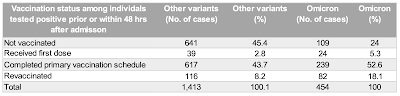
While some of my readers will say that the third dose will prevent or reduce hospitalizations, recent data from Denmark dated January 3, 2021 shows the following:
Only 24 percent of hospitalizations of Omicron-infected patients were unvaccinated compared to 52.6 percent who were fully vaccinated (under the old definition of two doses) and 18.1 percent were triple vaccinated, roughly the same percentage as those who remain unvaccinated give or take 6 percentage points.
And, in closing the addendum, here is a final study from Denmark looking at vaccine effectiveness against both Delta and Omicron. In the case of Omicron, VE drops from 36.7 percent between 1 and 30 days after vaccination to 4.2 percent 61 to 90 percent after vaccination. When the Pfizer vaccine is used as a booster, VE against Omicron is only 54.6 percent between 1 and 30 days after vaccination.
I remain open to any explanations that my readers may offer to explain this data.
First, here is a list of the authors of the study noting that the vast majority of the researchers work for the Centers for Disease Control and Prevention:
That said, the authors include this disclaimer:
"The findings and conclusions in this report are those of the author(s) and do not necessarily represent the official position of Centers for Disease Control and Prevention (CDC)."
Now there's a shock!
Let's start with some background information to put the study into perspective. In a recent outbreak which began on July 12, 2021 involving the Delta variant of the SARS-CoV-2 virus within a federal prison in Texas, the cumulative incidence of infection in two affected housing units was 74 percent with a rate of 93 percent among unvaccinated inmates and 70 percent among vaccinated individuals. Inmates were considered to be vaccinated if their primary vaccine series had been completed 14 or more days prior to the outbreak. Inmates were considered to be unvaccinated if they had not received any doses of a vaccine or had not completed all doses of a vaccine series. Among fully vaccinated inmates, 73 percent had received the Pfizer vaccine, 18 percent had received the Moderna vaccine and 9 percent had received the Janssen vaccine. In addition, 60 percent of the fully vaccinated inmates had received their full series of vaccines more than 120 days (range 81 to 140 days) before the outbreak.
Inmates were eligible to enrolled in the study if they had tested positive for SARS-CoV-2 between July 12, 2021 and August 4, 2021. The final study group consisted of 95 participants of which 78 or 82 percent were fully vaccinated and 17 or 18 percent were not fully vaccinated. These participants supplied the researchers with a total of 978 specimens for analysis between July 18, 2021 and August 9, 2021.
The purpose of the study was to examine the extent to which vaccinated persons who become infected with the SARS-CoV-2 virus contribute to transmission of the virus. To better understand this mechanism, the authors assessed markers of viral shedding in both vaccinated and unvaccinated consenting incarcerated persons with confirms SARS-CoV-2 infections. For ten consecutive days, the researchers took mid-turbinate nasal swabs from the subjects and used RT-PCR test, viral whole genome sequencing and viral cultures on these specimens.
Here are some of the highlights of the researchers' findings:
1.) the median duration of RT-PCR test positivity was the same at 13 days for both vaccinated and unvaccinated inmates.
2.) the median duration of RT-PCR test positivity was 10 days among Moderna vaccine recipients versus 13 days among both Pfizer and Janssen vaccine recipients.
3.) no statistical difference was detected in the median duration of viral culture positivity between inmates who were fully vaccinated and inmates that were unvaccinated with both groups having a median duration of 5 days.
The authors do note that there are several limitations to the study including the small number of inmates that were not fully vaccinated.
Here is the conclusion of the study with my bold:
"In this investigation, we found no statistically significant difference in transmission potential between vaccinated persons and persons who were not fully vaccinated. Therefore, our findings indicate that prevention and mitigation measures should be applied without regard to vaccination status for persons in high-risk settings or those with significant exposures. In congregate settings, and correctional and detention facilities in particular, post-exposure testing and quarantine remain essential tools to limit transmission when cases are identified, in addition to other recommended prevention measures.
Our data add to a growing body of evidence characterizing transmission potential from vaccinated persons. Future studies of transmission potential from vaccinated persons with infection, incorporating similar laboratory-based markers as well as evidence of transmission from secondary attack rates and network analysis, may help to further describe the contributions of vaccinated persons in chains of transmission as the pandemic evolves and new variants emerge."
All of this just in time for the Omicron variant as shown here:
This research is not particularly good news for the ending of government restrictions on our behaviour. Universal lockdowns here we come yet again.
New Zealand, like its south Pacific neighbour, Australia, has been one of the nations that has imposed the strictest lockdown regimes among its developed and somewhat less developed economy peer group. New Zealand has also been quite efficient at vaccinating its population when compared to its peers as shown on this graphic:
New Zealand with its population of of 4.873 million is small by global standards and, as such, has seen relatively few COVID-19 deaths as shown here:
New Zealand has had a total of 28 deaths from/with COVID-19 since the beginning of the pandemic and, at its peak, had a peak daily new confirmed COVID-19 death rate per million people of 0.27 back in April 2020 with the death rate being essentially zero for most of the remainder of the pandemic.
With New Zealand having so few COVID-19-related deaths, it is interesting to see what the impact of the nation's vaccination program has been, particularly adverse events related to the administration of the vaccine. Through the New Zealand Medical Devices Safety Authority or MEDSAFE, the New Zealand government has been issuing Safety Reports outlining adverse events following immunization or AEFIs with COVID-19 vaccines. In Report #31 dated October 21, 2021, MEDSAFE notes the following AEFIs by reporter types so that the public is able to ascertain the validity of the reporting:
The Safety Report also notes the following:
Up to and including 2 October 2021, a total of 86 deaths were reported to CARM (the Centre for Adverse Reactions Monitoring) after the administration of the Comirnaty vaccine. Following medical assessments by CARM and Medsafe it has been determined that:
31 of these deaths are unlikely related to the COVID-19 vaccine
26 deaths could not be assessed due to insufficient information
28 cases are still under investigation.
1 death was likely due to vaccine induced myocarditis (awaiting Coroner’s determination)
In the week ending October 2, 2021, there were 11 additional deaths reported.
While the administration of Pfizer's Comirnaty vaccine is, in the words of the New Zealand government "unlikely" (but not with 100 percent certainty) to be related to the vaccine in 31 deaths or 36 percent of the total, it is interesting to see that there have been 3.1 times as many deaths coincidental to the administration of the vaccine as died from the SARS-CoV-2 virus itself. At this point, the data does not necessarily point to the vaccine causing the deaths but given the thousands of deaths that have been reported in conjunction with the COVID-19 vaccines on both the VAERS and Eudravigilance databases in the United States and Europe respectively, it doesn't seem to be unreasonable that New Zealand could well be experiencing more deaths from the vaccine than from the virus itself.
Governments keep assuring us that it is safe to get vaccinated with the "fully tested COVID-19 vaccines" that were developed in record time to beat back the pandemic. Without thinking too deeply about it, one might believe their anti-unvaxxed rhetoric if it weren't for the fact that information which can be gleaned from various government and scientific websites showing this to be at least questionable and, at the worst, a complete fabrication. In this posting, we'll look at several different sources showing the timelines for the development of vaccines throughout history and compare it to the current situation for the vaccines being administered during the pandemic.
Let's start with this video from Canada's federal government about the COVID-19 vaccines and why you should trust the government's approval of the products:
Here's Canada's taxpayer funded CBC (aka the Coronavirus Brainwashing Corporation) weighing in on the subject of mixing and matching COVID-19 vaccine doses:
Note the comment by Canada's Chief Public Health Officer, Theresa Tam, that "...recommendations undergo evolution over time and this is the next stage of the increased understanding of our vaccines."
Let's look at several different sources which will clearly show us just how novel the process has been for the rollout of the COVID-19 vaccines.
1.) Here's what the Canadian government has to say about the development of vaccines (in general) as found on the nation's Library of Parliament HillNotes website which was posted in June 2020 and revised in November 2020:
Notice that according to the Canadian government it can take between 9 and 15 years to complete all three phases of a clinical trial.
Here is the key quote:
"Once an appropriate immune response is detected, the candidate vaccine moves into three phases of human clinical trials to test its safety and efficacy. Each clinical trial phase for a vaccine can still take several years or more to complete."
2.) Here is a graphic from Pfizer showing how pharmaceutical trials work:
What is important to note in this graphic is that Phase 3 trials involve between several hundred to three thousand people and Phase 4 trials involve several thousand people. Such is not the case in the current "trials" of the COVID-19 vaccines where hundreds of millions of test subjects have been given up to three doses of the newly minted vaccines.
3.) A paper that appeared in Nature back in September 2020 entitled "Traditional and accelerated vaccine-development pipelines" by Florian Krammer provides an interesting comparison of normal vaccine development timelines and the timeline for development of the COVID_19 vaccines as shown here:
4.) Here is a graphic from the Centers for Disease Control and Prevention showing the "Vaccine Life Cycle" which doesn't show the actual time periods required for each phase of the trial but does show Phase 4 which takes place after FDA approval:
The CDC does state this about the development of vaccines:
5.) A paper entitled "Developing COVID-19 Vaccines at Pandemic Speed by Nicole Lurie et al which appeared in the New England Journal of Medicine in March 2020 actually provides us with an interesting comparison of the traditional vaccine development paradigm and the paradigm used during a pandemic which clearly shows where changes to the normal process occur:
Here is a quote from the paper:
"Vaccine development is a lengthy, expensive process. Attrition is high, and it typically takes multiple candidates and many years to produce a licensed vaccine. Because of the cost and high failure rates, developers typically follow a linear sequence of steps, with multiple pauses for data analysis or manufacturing-process checks. Developing a vaccine quickly requires a new pandemic paradigm (see diagram), with a fast start and many steps executed in parallel before confirming a successful outcome of another step, hence resulting in elevated financial risk. For example, for platforms with experience in humans, phase 1 clinical trials may be able to proceed in parallel with testing in animal models."
One thing that the authors of the paper do not mention is that the current crop of COVID-19 vaccines still could prove to be failures at stopping the transmission of the virus as well as reducing hospitalizations and the occurrence of serious cases. While some researchers are stating that the vaccines are reducing serious cases, the data is still incomplete and with the rise of the Delta variant, all bets are off.
Now, let's look at the facts as they currently stand. According to the manufacturers of the current COVID-19 vaccines, the trials are not even close to being completed:
1.) PfizerBioNTech - Phase 3 to be completed on May 2, 2023 (estimated)
2.) Moderna - Phase 3 to be completed on October 27, 2022 (estimated)
4.) AstraZeneca - Phase 3 to be completed on February 14, 2023 (estimated)
Now, let's look at Canada's "mix and match" vaccine strategy. Actually, there are plans to study this issue as shown here:
...however, the trial status is "pending" and the study only started on May 3, 2021 so, despite what Theresa Tam says, Canadian researchers still have no idea of whether this mixing of vaccines could result in adverse events or whether it will provide immunity to the COVID-19 virus.
As far as administering a third dose of a COVID-19 vaccine (booster dose), here is the plan to study that issue using residents of long-term care facilities, noting that the study has not even commenced:
Given the fact that proper vaccine testing can take up to a decade and a half to complete through to the end of Phase 3 or Phase 4 trials as I have outlined in this posting and that we still have between 13 and 20 months to complete Phase 3 trials for the Pfizer, Moderna, Johnson & Johnson and AstraZeneca vaccines, how can governments around the world allow Phase 3 trials for the COVID-19 vaccines to be taking place using hundreds of millions of their citizens rather than the several hundred to several thousand participants as would be typical for a Phase 3/Phase 4 trial?
A recent brief article which appeared in the British Medical Journal does a rather neat job of summarizing the effectiveness of the COVID-19 vaccines sourced from research in the United Kingdom which has not yet been peer reviewed. Since the BMJ is allowing for free usage of the article during the pandemic, I will simply quote it in its entirety for accuracy's sake. Please note that all bolds are mine.
"Adults who have been fully vaccinated against SARS-CoV-2 can carry the same viral load of the delta variant as those who are unvaccinated, a preliminary analysis of UK data suggests.
The latest results from the UK’s national covid-19 infection survey show that having two vaccine doses remains the most effective way to ensure protection against delta. But, although people who are fully vaccinated have a lower risk of becoming infected, those infected with the delta variant can carry similar virus levels as unvaccinated people, the data show. The authors said the implications for transmission were not yet clear but suggested that the potential for fully vaccinated individuals to transmit the virus to others would make achieving herd immunity more of a challenge.
Sarah Walker, professor of medical statistics and epidemiology at the University of Oxford and chief investigator of the survey, said, “We don’t yet know how much transmission can happen from people who get covid-19 after being vaccinated—for example, they may have high levels of virus for shorter periods of time.
“But the fact that they can have high levels of virus suggests that people who aren’t yet vaccinated may not be as protected from the delta variant as we hoped. This means it is essential for as many people as possible to get vaccinated—both in the UK and worldwide.”
The analysis, published as a preprint and not yet peer reviewed, found that the Oxford-AstraZeneca and Pfizer-BioNTech vaccines both offered good protection against new infections but that performance was less good against delta than with the previously dominant alpha variant.
The researchers analysed 2 580 021 results from swabs taken from 384 543 adults between 1 December 2020 and 16 May 2021, when the alpha variant predominated, and 811 624 results from 358 983 adults between 17 May and 1 August 2021, when delta prevailed. Two doses of either vaccine provided at least the same level of protection as that afforded through natural infection with the virus. For example, when delta prevailed, efficacy of the Pfizer vaccine was 80% (95% confidence interval 77% to 83%) at 14 or more days after two doses, higher than after two doses of the AstraZeneca vaccine (67% (62% to 71%)) but not significantly different from the protection afforded by natural immunity in non-vaccinated people who had tested positive for SARS-CoV-2 (72% (58% to 82%)).
The effectiveness of the two vaccines did not depend on the time between first and second doses. But people who were vaccinated after they had had covid-19 had more protection from vaccination than those who were vaccinated without a previous natural infection. For example, 14 days after a second AstraZeneca dose, on average the rates of all new covid-19 infections had dropped by 88% among those with prior infection, which compared with 68% in those without prior infection. The percentages were 93% and 85%, respectively, for the Pfizer vaccine.
Speaking at a Science Media Centre briefing, Koen Pouwels, of Oxford University’s Nuffield Department of Population Health and the report’s lead author, emphasised the protective effect of vaccination in people with a high SARS-CoV-2 viral burden. He said that vaccine protection was 90% higher than in unvaccinated people one month after a second Pfizer vaccine, declining to 85% after two months and 78% after three months. For the AstraZeneca vaccine the equivalent protection was 67%, 65%, and 61%, respectively.
“Even with these slight declines in protection against all infections and infections with high viral burden, it’s important to note that overall effectiveness is still very high, because we were starting at such a high level of protection,” Pouwels said.
The study also showed that viral burden was lower immediately after two Pfizer doses but that it increased faster with time than after the AstraZeneca vaccine, leading to similar levels of viral burden around three months after second doses of both vaccines.
Commenting on the findings, the University of East Anglia’s Paul Hunter noted, “There is now quite a lot of evidence that all vaccines are much better at reducing the risk of severe disease than they are at reducing the risk from infection. We now know that vaccination will not stop infection and transmission, [but it does] reduce the risk. The main value of immunisation is in reducing the risk of severe disease and death.”"
Given that many lay people believe that the COVID-19 vaccines provide long-term and full immunity against the SARS-CoV-2 virus, this research is rather illuminating since it shows that, three months after vaccination, the protection wanes to 78 percent for the Pfizer vaccine and only 61 percent for the AstraZeneca vaccine. Since the researchers only looked at the effectiveness of the vaccine for the first three months after the second dose, it is clear that longer term studies are needed to see if the protection afforded by the COVID-19 vaccines wanes even further with time. For all of those wishing death upon the unvaccinated, it is also interesting to see that the vaccines will not stop transmission but, at this point in time, it appears that they do reduce the risk of severe disease and death although the science on that issue is not yet complete.
Let's close with this thought. Sincegovernments are implementing vaccine passports to prevent the "unclean" unvaccinated among us from transmitting the SARS-CoV-2 virus to the "clean" vaccinated, it would certainly appear that this research would imply that such measures are meaningless since the vaccines do not stop infection and transmission, rather, the injections will only provide a reduction in the risk of severe disease and death (which also have not been proven and may be difficult to quantify) which is not what governments and their mainstream media lackeys would have us believe.
I have been an avid follower of the world's political and economic scene since the great gold rush of 1979 - 1980 when it seemed that the world's economic system was on the verge of collapse. I am most concerned about the mounting level of government debt and the lack of political will to solve the problem. Actions need to be taken sooner rather than later when demographic issues will make solutions far more difficult. As a geoscientist, I am also concerned about the world's energy future; as we reach peak cheap oil, we need to find viable long-term solutions to what will ultimately become a supply-demand imbalance.







 Posts


