One aspect of the recent Iran-United States-Israel hostilities is a key issue that could have significant negative impacts on the global economy. Thanks to the geography of the Persian Gulf, there is a choke point which could be used by the Iranians to reduce the supply of hydrocarbons to the world's markets.
As shown on this map, the Strait of Hormuz lies between Oman and Iran, a very narrow body of water that provides passage from the Persian Gulf and the Gulf of Oman:
The Strait is between 47 and 95 kilometres (29 to 60 miles) wide and has an inbound and outbound shipping lane which are both only 3 kilometres (2 miles) wide with a 3 kilometre buffer zone separating the two lanes.The shipping lanes are located mainly in Omani waters however they are governed by international maritime law with Iran controlling the waters to the north of the shipping lanes and Oman controlling the waters to the south of the shipping lanes.The Strait is deep with a minimal number of marine hazards and reaches depths of up to 650 feet in the shipping lanes however, there are zones which are unsafe for tankers because water depths are less than 25 metres as shown here in red:
Given its proximity to the hydrocarbon producing regions immediately adjacent to the Persian Gulf, it's clear that the Strait of Hormuz is a choke point for the flow of oil.Here is a graphic from the EIA showing how much oil and other liquid petroleum products have passed through the Strait since 2020:
Approximately 20 percent of global liquids production flows through the Strait every day however it is important to keep in mind that an even higher percentage of total globally exported hydrocarbon liquids pass through this choke point. An estimated minimum of 30 percent of total exported seaborne oil and nearly 40 percent of global crude oil trade exits the Persian Gulf through the Strait. While the Abu Dhabi crude oil pipeline running from the UAE to the Gulf of Oman could offset some of the lost oil exports should the Strait be closed, it has a capacity of only 4.2 million barrels per day. The East-West crude oil pipeline that runs across Saudi Arabia from Abqaiq on the Persian Gulf to Yanbu on the Red Sea has a total design capacity of 5 million barrels of oil per day with roughly 3.3 million barrels of daily spare capacity as shown on this graphic:
Here is a table showing which nations exported oil and liquids through the Strait of Hormuz for the period between January and October 2023:
Here is a graphic showing the destination of the exported crude oil that transits the Strait of Hormuz:
It is estimated that 84 percent of the crude oil and condensate that moved through the Strait went to Asian markets in 2024.
Not only is the Strait of Hormuz a choke point for oil and associated liquids, it is a choke point for Liquified Natural Gas or LNG, primarily produced by Qatar. In 2024, approximately 20 percent of global LNG trade passed through the Strait with Qatar exporting about 9.3 billion cubic feet of LNG per day through the Strait in 2024. The EIA estimates that 83 percent of the LNG that passed through the Strait in 2024 went to Asian markets, primarily China, India and South Korea. Here is a map from the EIA showing the LNG infrastructure in the Persian Gulf:
Here is a graphic showing the origin and destination of LNG that is transported through the Strait of Hormuz:
The Strait of Hormuz is an extremely important and vulnerable geographic feature that has the potential to throw the world's economy into chaos. Should Iran choose to hinder or harass maritime traffic passing through the Strait, it could have significant ripple effects through the global economy by pushing oil prices to record levels.
At the recent Eastern Economic Forum held on Russky Island in Russia's Far East, Vladimir Putin made some very interesting comments at a plenary session on the current situation in Europe which was formerly one of the largest consumers of Russian natural gas.
The Forum was attended by the following world leaders:
Chairman of the State Administration Council, Prime Minister of the Caretaker Government and Commander-in-Chief of the Armed Forces of Myanmar Min Aung Hlaing, Prime Minister of Armenia Nikol Pashinyan, Prime Minister of Mongolia Oyun-Erdene Luvsannamsrain, and Chairman of the Standing Committee of the National People's Congress of China Li Zhanshu. Additionally, the Prime Minister of India Narendra Modi, the Prime Minister of Malaysia Ismail Sabri Yaakob and the Prime Minister of Vietnam Pham Minh Chinh addressed the audience via video linkup.
The theme of this year's Forum was "On the Path to a Multipolar World", a rather timely theme given the rapidly changing global reality...unless you happen to be a denizen of Washington. The Forum included discussions on the projects that are important for Russia's Far East region and for strengthening the ties between Russia and its fellow Asia Pacific nations.
Here are some of Vladimir Putin's comments on the West in general and Europe in particular, keeping in mind that Europe's leadership has made some rather bold moves to punish Russia since the Ukraine operation began in early 2022 with all bolds being mine:
"Europe is about to throw its achievements in building up its manufacturing capability, the quality of life of its people and socioeconomic stability into the sanctions furnace, depleting its potential, as directed by Washington for the sake of the infamous Euro-Atlantic unity. In fact, this amounts to sacrifices in the name of preserving the dominance of the United States in global affairs.
Back in spring, many foreign corporations rushed to announce their withdrawal from Russia, believing that our country will suffer more than others. Today, we see one manufacturing site after another shutting down in Europe itself. One of the key reasons, of course, lies in the severed business ties with Russia.
The competitive ability of European companies is in decline, for the EU officials themselves are essentially cutting them off from affordable commodities and energy, as well as trade markets. It will come as no surprise if eventually the niches currently occupied by European businesses, both on the continent and on the global market in general, will be taken over by their American patrons who know no boundaries or hesitation when it comes to pursuing their interests and achieving their goals.
With Russia's exports of its massive natural gas reserves to Europe rapidly declining as a response to Europe's anti-Russia sanctioning, it is interesting to note the following development as quoted from Putin's address:
"I want to note here that yesterday, Gazprom and its Chinese partners decided to switch to 50/50 transactions in rubles and yuan with respect to gas payments."
As a response to the European and American sanctions, Russia is moving to shift its contracted natural gas sales to China out of euros and into a combination of yuan and rubles, yet another way of reducing the American dollar's hegemony, as shown in this article from Bloomberg:
Gazprom supplies natural gas to China through the Power of Siberia pipeline in a deal estimated to be worth $400 billion over its 30 year life. Natural gas exports to China have grown to at least 15 billion cubic metres in 2022 from 10.4 billion cubic metres in 2021. Additionally, Gazprom has signed two additional deals with China for a further 10 billion cubic metres over a 25 year contract using a new pipeline as well as a contract to design and build the Soyuz Vostok link through Mongolia which would supply 50 billion cubic metres per year. as shown here:
These developments clearly shows that Russia does not need to sell its natural gas to Europe as it has willing buyers elsewhere.
Let's go back to Putin's comments on Europe and how it is benefitting from current grain exports from Ukraine:
"If we exclude Turkiye as an intermediary, all the grain exported from Ukraine, almost in its entirety, went to the European Union, not to the developing and poorest countries. Only two ships delivered grain under the UN World Food Programme – the very programme that is supposed to help countries that need help the most – only two ships out of 87 – I emphasise – transported 60,000 tonnes out of 2 million tonnes of food. That's just 3 percent, and it went to the developing countries.
What I am saying is, many European countries today continue to act as colonisers, exactly as they have been doing in previous decades and centuries. Developing countries have simply been cheated yet again and continue to be cheated."
You certainly won't hear that in the dinosaur media which has made great efforts to praise everything that Ukraine has done and condemn everything that Russia has done in the past seven months.
Here are Putin's comments on the importance of Russian energy sources, how they have benefitted Europe and how Russia can choose to sell its resources to nations which co-operate with the Kremlin:
"First of all, our energy resources should be used to move our country forward. This includes all primary energy sources and all mineral resources. But we have these in ample supply and can meet the growing demand of everyone who is willing to work with us. This is good and lucrative cooperation for our partners and very beneficial, too, including for the European countries, because our pipeline gas is by orders of magnitude more competitive than the liquefied natural gas brought in from across the ocean. This is clearly so.
Using natural gas from the Russian Federation for decades, the leading European economies clearly had advantages of a global dimension. If they believe they have no use for these advantages, that’s okay with us and does not bother us in any way, because the demand for energy around the world remains high. It is not just about our friends from the People's Republic of China, whose economy is growing fast, as I said and everyone in the world is well aware of, the demand for energy is growing. We are ready to cooperate with any country. There are many such countries around the world.
Of course, the European market has always been considered a premium market, but the international situation is rapidly changing, and it recently lost its premium status with the onset of the Ukraine crisis. Even the Europeans’ US partners have redirected their LNG tankers to Asian countries...
We will also engage in liquefying gas and selling LNG all over the world. As you see, I have already cited an example of the first Arctic LNG-1 tanker (from a deposit in the Arctic, of course). Everybody is buying it. They will buy it, it will be profitable for them. So we have no problems at all. If European countries want to give up on that, losing their competitive advantages, this is up to them. Let them do it."
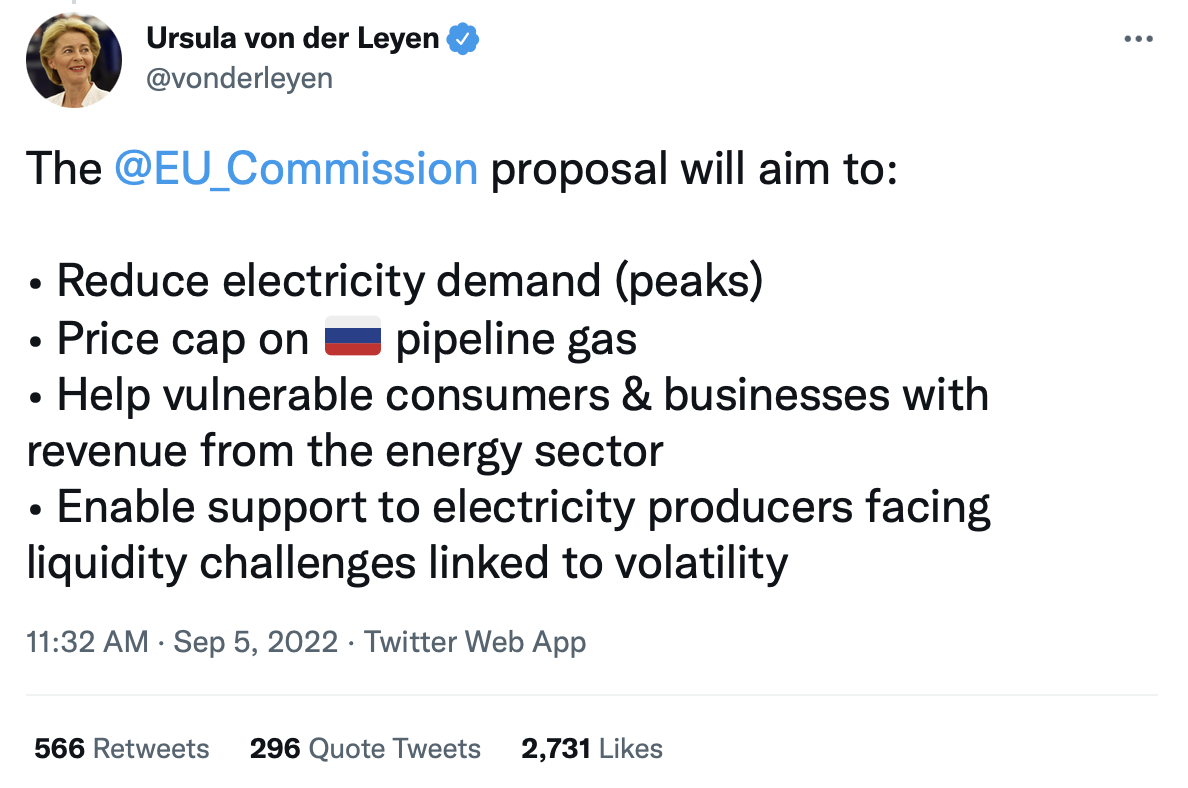
Further to Europe's energy relationship with Russia, on September 5, 2022, Ursula von der Leyen, the EU's ++++ tweeted the following:
...and here on September 7 which shows just how desperate the situation in Europe could become this fall and winter as energy supplies do not meet demand:
Europe's ridiculous and ill-conceived plan to put a price cap on Russia's natural gas got this response from Putin when asked this question by the moderator:
"Ilya Doronov: Will price caps on gas be a heavy blow on us?
Vladimir Putin:Well, this is yet more stupidity, one more non-market decision without any prospects. All administrative restrictions in global trade lead only to disproportions and price hikes. What is happening now in European markets is the result of the work done by European specialists and the European Commission. We always insisted that prices be formed based on long-term contracts and be tied to the same market category as prices on oil and oil products, to the same basket. Prices on oil and oil products are formed by the market and the price of gas in long-term contracts is linked to this price. Why? Because this production requires big investments and those who invest in production must be sure that the product will be sold. This is why Gazprom is generally interested in long-term contracts.
They kept telling us: “No, this isn’t market-based. You should use prices in the spot market as a benchmark.” We tried to change their mind – I personally was doing this in Brussels. I said: “Don’t do this because natural gas trade is a special segment of the world market. Those who produce and sell it and those who buy it must be confident that their relationship is reliable.” “No,” they said, believing the price at the time was too high. A hundred dollars per 1,000 cubic metres seemed to them to be an extremely high price at the time and later they said the same about the price of US$300. That is what prices were like back then. Today, let’s see, the price has exceeded 3,000 euros. We kept saying: “Don’t do this.” Yet, they practically forced their companies to opt for pegging to spot [prices] and imposed the same on us – imposed! Now a large part of the gas price is determined by spot [transactions].
We did not ask for this – the Europeans imposed this on us. First, they imposed these truly idiotic decisions regarding gas trade, and after seeing what is happening now, they started thinking how to get out of it. So, how? They want to cap the price, resorting to administrative measures. More absurdity and nonsense that will send prices skyrocketing in world markets, including the European market. Nothing can be achieved in the economy and global trade using administrative measures."
To put Putin's comments into perspective,here's what has happened to the price of Russia's natural gas over the past year:
Futhermore:
"You asked about someone making some decisions to limit prices for our oil and gas which is an absolutely dumb thing to do. Should someone try to move it forward, it will do no good for the decision-makers.
There are contractual obligations and contracts for delivery. Will there be any political decisions that run counter to contract clauses? We will ignore them and suspend deliveries if these decisions are inconsistent with our interests, our economic interests in this case. We will then stop supplying gas, oil, coal, or fuel oil, suspend all our deliveries and fully comply with our contractual obligations. Notably, the people who are trying to impose things on us are not in a position to dictate their will to us. Let them come to their senses. This is how the economy, including the domestic economy, works."
What Putin is saying is that the owner of the resource sets the terms.
And, here's the key:
"Following up on those who we talked about earlier, we will not be supplying anything outside of contracts. We will not do anything they are trying to impose on us. What we will do instead is just sit there and keep saying a famous line from a Russian fairy tale, “Freeze, freeze, the wolf’s tail.”
Putin is referring to "The Fox and Wolf" Russian fairy tale of which one version includes this:
By and by the Wolf came running up.
"Hello there, Sister Fox!" he called.
"Hello yourself, Brother Wolf!"
"What are You doing, Sister Fox?"
"Eating fish."
"Give me some!"
"Go catch them yourself."
"I can't, I don't know how to do it!"
"Well, that's your business, You won't get as much as a bone from me.'-
" Won't You at least tell me how to do it"
And the Fox said to herself:
"You wait, Little Brother! You ate my little bull and now I'll pay You back for it!"
Then she turned to the Wolf and said:
"Go to the river, put your tail into an ice hole, move it slowly back and forth and say: 'Come and be caught, fish, big and small!' That way you'll catch all the fish You want."
"Thank You for telling me," said the Wolf.
He ran to the river, let down his tail into an ice hole, moved it slowly, back and forth and said:
"Come and be caught, fish, big and small!"
And the Fox looked out at him through the reeds on the bank and said:
"Freeze, freeze, Wolf's tail!"
Now, there was a bitter frost out, and the Wolf kept moving his tail back and forth and saying:
"Come and be caught, fish, big and small!"
And the Fox kept repeating:
"Freeze, freeze, Wolf's tail!"
There the Wolf stayed catching fish till his tail was frozen fast to the ice, and when that happened the Fox ran to the village and cried:
"Come, good people, and kill the Wolf!"
And the villagers came running with pokers, prongs and axes. They fell on the poor Wolf and killed him.
And as for the Fox, she still lives in her hut as snug as You please.
Putin does note that European leaders could subsidize consumers for the high prices that they are paying for energy, however, this will ultimately be problematic given that consumers will continue to consume as they did prior to the shortages which will lead to even higher prices and shortages. There is also the option to cut consumption but, Putin states that this is "a dangers proposition from the social point of view, since it can lead to a rupture", already in evidence from the large number of demonstrations in Europe, and that the only way to navigate this situation is to follow the letter of the contracts that have been signed.
Europe's leadership would appear to be completely useless in the face of the oncoming energy crisis, defining the very concept of kakistocracy. It would appear that their agenda is being driven by Washington and its corporate partners who would love nothing more than to expand Europe's imports of American LNG. European decision makers will find themselves experiencing greater and greater levels of anger from Europeans who are being forced to reduce their energy consumption just as the cold weather of late fall and winter are looming. Eventually, I predict that Europeans will tire of their governments' support of Ukraine once the pain becomes too bear.
If you are interested, here is Putin's speech at the Eastern Economic Forum in its entirety:
While the Western media has already stated that Vladimir Putin is either dead and being replaced by a body double or is deathly ill with cancer, a Vladimir Putin-like figure recently spent time with Iran's leadership, accomplishing a great deal in a short period of time.
Let's start by looking at the Kremlin's official transcript from the initial meeting between Putin and the President of the Islamic Republic of Iran, Sayyid Ebrahim Raise:
Here are some brief quotes from Iran's President:
"Thank you very much for accepting our invitation to come here for bilateral and then trilateral talks in the Astana format.
After our visit and the meeting in Moscow and then in Ashgabat, everything has been developing very quickly, including our bilateral relations. Both sides have the political will needed to develop our ties and to put them into practice...
I very much hope that your official visit to the Islamic Republic of Iran will become a turning point in upgrading our relations on the regional and international agenda."
...followed by brief quotes from Vladimir Putin:
"I am very pleased to be here today with our friends on hospitable Iranian land.
Our relations have been developing at a good pace, indeed. We boast record figures in trade growth. We are strengthening our cooperation on international security and making a tangible contribution to settling the Syrian conflict."
Now, let's look at what was accomplished, focusing on the issue of binational trade. To set the stage, we need to understand the economic importance of these two nations to the global economy. As such, here is a table from the 2021 edition of BP's Statistical Review of World Energy showing global natural gas reserves by nation:
Between Iran and Russia, they control 2454.1 trillion cubic feet of natural gas or 36.95 percent of the world's total natural gas reserves. By way of comparison, in all of Europe, there are only 111.9 trillion cubic feet of natural gas or 1.68 percent of the world's total natural gas reserves and the United States, Canada and Mexico have only 535 trillion cubic feet of natural gas or 8.06 percent of the world's total natural gas reserves. At some point, whether Western leaders like it or not, the world is going to be highly dependent on natural gas from Russia and Iran.
Here is a map showing Russia's natural gas fields (in red) and pipeline infrastructure:
Here is a map showing Iran's natural gas fields (in red) and pipeline infrastructure:
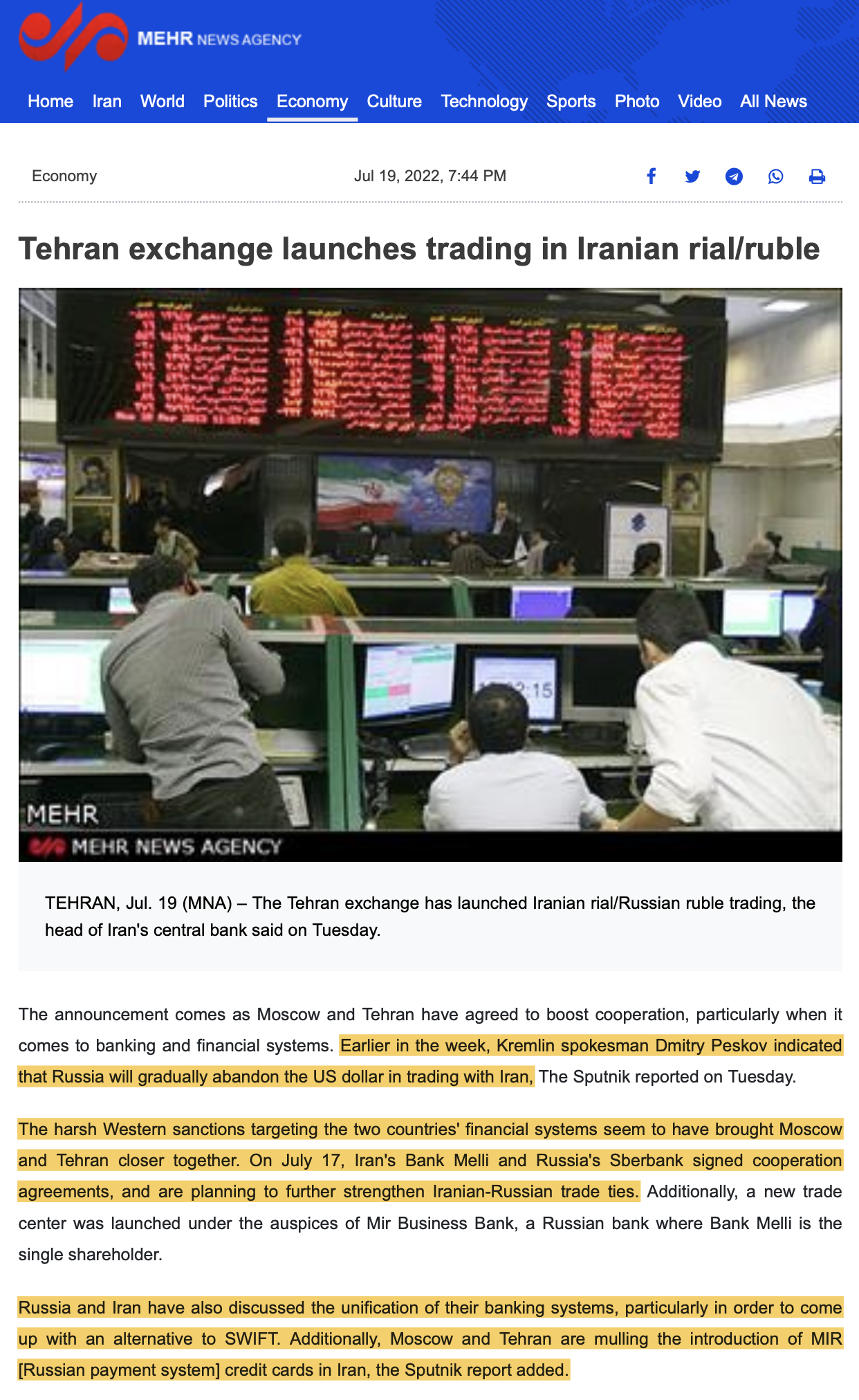
Now, let's look at news from the Russia-Iran summit as reported in Iran:
Lastly, here is one of the most interesting developments which is clearly designed to punish Washington:
This is a direct threat to the hegemony of the United States dollar in international trade. Nations that are subject to the whims of Washington's sanctions are exploring alternatives to further blunt the effectiveness of America's non-military punishments.
Just for fun and very slightly off topic, this is what appeared on the PressTV website after the high level meeting:
Here is a key quote with my bold:
"Iran and Russia share a common perspective concerning the sanctions that the United States has leveled against both the countries, Iran’s nuclear agreement, revisionism in the current order, and the international unilateralism. This common perspective paves the way for the countries’ cooperation. These areas [of commonality] are of such importance in the Kremlin foreign policy apparatus’ assessments that have seen Putin meet with the Iranian president on three occasions in Moscow, Ashgabat, and Tehran over the past six months."
Let's close with some excerpts from a media question and answer session that was held on July 19, 2022 as Putin was about to depart from Iran, showing the growing economic relationship between two of Washington's most reviled enemy states:
"For example, as I said at the news conference, in my press statement, the main theme at the meeting with the Spiritual Leader of Iran was strategic issues, including developments in the region. This is natural, as it is the sphere of his activity. It was very important for me to hear his opinion, his assessment. I have to say that we have very similar views with Iran on many aspects. So, it was very important and very useful.
As for my meeting with President Raisi, we discussed primarily economic matters. I would like to note that Russian-Iranian trade has grown by 40 percent over the past six months. This is a very good indicator.
There are promising spheres for our cooperation, and there is a great variety of them, like infrastructure development. You may know that a deputy prime minister of the Russian Government chairs a group that is responsible for developing relations in the South Caucasus, including infrastructure projects in the South Caucasus, that is, in Azerbaijan, Armenia and Russia. A great deal can be achieved in this sphere in cooperation with Iran.
As you know, the first pilot train is travelling along the North-South Railway line. It is a short route to ports in the south of Iran, which further leads to the Persian Gulf and India.
There is a practical project: the Rasht-Astara railway is a short 146-kilometre line across Iran. Azerbaijan is interested in its construction. I recently met with President Aliyev during the Caspian Summit, and we discussed this matter. Iran is interested in this as well, as our Iranian partners have told us just now. Russia is interested in this, because it will connect Russia’s northern region, St Petersburg, directly to the Persian Gulf. It is a very interesting and promising project. The task now is to build this line, which is only 146 kilometres. Russia is ready to do this."
Washington's sanctions against both Russia and Iran have accomplished very little other than driving two members of the "evil empire" closer together both philosophically and economically. With Russia and Iran controlling over one-third of the world's natural gas reserves that will be much-needed as the West attempts to transition to a low carbon future, it is clear that certain nations, particularly those in Europe, will be even more beholden and vulnerable to both nations for their energy security. There will be nothing like the lesson taught by a cold northern winter in 2023 to assist European consumers in seeing the tactical errors made by their elected rulers when it comes to Russia.
...the authors' belief is that Europe can immediately stop buying fossil fuels from Russia if, and this is key, the members of the European Union are:
"...prepared to implement a radical plan for fuel switching and continent-wide energy rationing...."
The authors state that "....with sufficiently ambitious actions by individuals, companies and governments, we can get rid of Russian fossil fuel imports - not by 2028, but immediately."
Here is the authors' open call to the leadership of Europe:
The report opens with this statement:
"The brutality of Vladimir Putin’s war on Ukraine has shocked the world. The Russian dictator is now formally accused of war crimes by the United States, and sanctions have been imposed by democratic countries across the world. However, even while condemning Russia’s actions - and sending military assistance to Ukraine - European countries are continuing to fund Putin’s war machine by buying fossil fuels from Russia. It is estimated that half a billion euros per day
flow back to the Kremlin in return for Russian gas, oil and coal. This financial support to Putin undermines the sanctions regime and is morally unjustifiable while Russian bombs and missiles rain down on Ukrainian schools and hospitals.
The Ukrainian government has asked Europe to stop buying Russian fossil fuels. We can and must answer this call."
The authors back their plans for Europe and its energy needs with the reasoning that the world is now experiencing a war that necessitates the implementation of a war economy and energy rationing approach, invoking the Berlin Airlift and the Marshall Plan as templates for what lies ahead if Europe wants to wean itself from Russian energy
Here is a graphic from the report which shows Russian energy imports into Europe for 2019:
While the authors examine Europe's use of natural gas, oil and coal, to keep this posting to a reasonable length, I will only examine the natural gas and liquified natural gas (LNG) aspect of the report.
According to the report, in total during 2021, Europe imported 155 billion cubic metres of natural gas from Russia which is broken down into 140 billion cubic metres by pipeline and 15 billion cubic metres in the form of LNG. In order to offset/replace this gas, the following actions will be required:
LNG diversification and pipeline switching: 30 bcm.
EU-wide energy saving; roughly 10 bcm per 1C reduction in buildings heat. With thermostats at 18C (reduced from 22C): total 40 bcm.
Fast-track deployment of additional solar PV and wind: 6 bcm.
Stop nuclear phase-out and restart recently closed reactors in Germany, Sweden and Belgium but without using Russian uranium: 14 bcm.
Emergency effort to better utilise French reactor fleet (i.e. restart the reactors that are currently shut down): 26 bcm.
Heat pumps to reduce gas demand in heating, and emergency energy efficiency measures in buildings: 4 bcm.
Gas to oil in power stations: 6 bcm.
Gas to coal in power stations: 22 bcm.
Curtailment to industry: 7 bcm.
The report notes that Russia supplies 40 percent of the EU's gas consumption and, that on March 2, 2022, the daily value of gas imports hit $755 million.
Here is a graphic showing the impact of each action during the first year (defined as 2022 aid the winter of 2022/2023):
You may have missed that fuel switching to punish Putin will require that natural gas be replaced with coal, however, the authors state that this can be done without an additional emissions burden to the climate during the first year of implementation since the switch from carbon-intensive gas to coal is outweighed by the overall reduction in emissions by using no Russian fossil fuels. They also note that it is inconceivable that Germany, which is highly dependent on Russia's hydrocarbons, could get through next winter without using coal if Russia's natural gas is not utilized. That said, the authors clearly state that any gas to coal and gas to oil fuel switching be allowed for one year only to avoid blackouts and a devastating economic collapse. The use of coal can be retired as so-called clean energy comes online.
Under the section of the report entitled "War Economy in Europe" we find the following with my bolds:
"Achieving these cuts will require a previously unimaginable level of cooperation and solidarity within Europe. We may need a state of emergency declared, and an explicit political recognition that European economies are now on a war footing in terms of the rapidity of the energy transition.In some ways the speed of the change will resemble the Covid lockdowns, but with a different trajectory in the longer term.
The measures we propose above should enable Europe to get through the rest of this summer and also next winter. However in order that the sacrifice is shared fairly - essential if social cohesion is to be maintained in a war economy - there must be an element of rationing which is not simply the price mechanism. Allowing sky- high prices to be the main instrument of rationing will be socially regressive and undermine the consensus needed to underpin the war effort, which will be agitated and magnified by pro-Putin actors both in Europe and in social media platforms.
Rationing via fair shares is the only alternative: governments will need to introduce price caps and guaranteed minimum supplies at the household levels so that everyone gets a basic amount and those with less ability to pay are not simply cut off. Turning down thermostats will be difficult to mandate and enforce, but with only a certain amount of gas allowed per household the incentive to stick to it will be substantial. As with Covid lockdowns, social pressure to abide by national restrictions will also play a big part."
Ah yes, yet another excuse for a society-wide lockdown and using psychological means (i.e. social pressure) to achieve the mandated goals imposed by the ruling class.
Let's look at the medium- to long-term recommendations:
1.) Large-scale solar PV installations (while minimizing competition with farmland and still protecting nature) aiming at 400 GW by 2025.
2.) Large-scale onshore and offshore wind, aiming at 400 GW by 2025.
3.) Reactor restarts wherever possible in more recently closed nuclear facilities and further improving capacity factors and doing power uprates across the continent.
4.) Electrification of transport and heating in order to permanently reduce oil and gas demand.
5.) New interconnectors with a higher capacity to share electricity between EU nations to balance intermittent renewables and facilitate export of nuclear-generated electricity from France
Here are some concluding comments from the report:
"Europe is not energy-dependent on Putin by accident. This is a trap the Russian dictator laid over many years for a generation of European politicians, a trap which he has now sprung. In his arrogance, Putin thinks we will lack the courage and strength to stand up to him. He thought the same about the Ukrainians. With their unity and bravery, they proved him wrong – and so can we."
Yes, that sneaky Putin has been up to no good for decades, deluding Europe's politicians into becoming dependent on Russia's hydrocarbons for their existence (sarcasm intended).
While all of this sounds just wonderful, the authors seem to have completely ignored this:
In March 2022 when Vladimir Putin visited China, Gazprom, which has a monopoly on Russian gas exports, signed a 30-contract to supply Chinese state energy major CNPC with 10 billion cubic metres of gas annually through a new pipeline which should be completed in two to three years with the contract to be settled in euros, another kick in the teeth for the U.S. dollar. Here is a map from Gazprom showing the company's pipeline infrastructure noting that there is currently only one pipeline into China which is known as Power of Siberia:
Here is another map showing Power of Siberia 2 which will unite natural gas transmission infrastructure across eastern and western Russia:
The Power of Siberia 2 pipeline will export up to 50 billion cubic metres of natural gas annually to China via Mongolia generating $400 billion in revenue for Russia over its 30 year life.
Power of Siberia was commissioned in 2019 as shown on this video:
Thanks to the pipeline, beginning in 2019, Russia exported 16.5 billion cubic metres of natural gas (2021 data) to China. The new natural gas pipeline for which a contract was signed in March 2022 would deliver up to 50 billion cubic metres. China is also a big importer of liquified natural gas (LNG) from Russia, importing nearly 401,000 tons from Russia in February 2022, twice as much as was imported in January 2022. When looking at natural gas overall, in 2021, Russia was China's third-largest supplier of natural gas when including both pipeline and LNG.
While these volumes don't make up for the losses in sales to Europe, China and its voracious appetite for energy will be only too happy to step in and make good use of the natural gas that Europe is weaning itself from all in the name of making a political point. One also has to wonder if this isn't just an end run around the ruling class' plan to have the useless eaters cut back on their use of hydrocarbons by capping usage all in the name of saving the planet from the ravages of anthropogenic climate change. Unfortunately, the only ones to suffer in the medium- and long-term will be Europe's serf class who will learn the hard lessons taught by the proposals to ration energy to punish Russia.
So, if the plan recommended by RePlanet is implemented, who will be getting the last laugh? Putin and Xi or Europe's political leaders? I think that the answer is very obvious and it isn't the people that will be forced to ration their use of hydrocarbons.
I have been an avid follower of the world's political and economic scene since the great gold rush of 1979 - 1980 when it seemed that the world's economic system was on the verge of collapse. I am most concerned about the mounting level of government debt and the lack of political will to solve the problem. Actions need to be taken sooner rather than later when demographic issues will make solutions far more difficult. As a geoscientist, I am also concerned about the world's energy future; as we reach peak cheap oil, we need to find viable long-term solutions to what will ultimately become a supply-demand imbalance.






 Posts
Posts


