Showing posts with label Europe. Show all posts

Thursday, March 20, 2025

The Digital Euro - The Next Step to a Cashless Surveillance State

As my long-term readers know, I have a fixation with digital currencies (aka central bank digital currencies) and the impending cashless society.  The European Central Bank (ECB) is taking additional steps toward implementing a digital euro through its work with all of the national central banks of Europe.

Here's how the ECB describes the digital euro:

"We are working with the national central banks of the euro area to look into the possible issuance of a digital euro. It would be a central bank digital currency, an electronic equivalent to cash. And it would complement banknotes and coins, giving people an additional choice about how to pay." 

Here are its key features:


The digital euro would be stored in an electronic wallet that was set up with a person's bank or other public intermediary such as a post office.  People will be able to deposit money into the digital wallet through a linked bank account or by depositing cash (until cash no longer exists).  Withdrawals from the wallet would be in the form of digital euros.

In this recent contribution from ECB Executive Board Member Piero Cipollone as found on the ECB's website:


....we find the following quote:

"Being a key player in digital payments and digital finance should be a priority for Europe." 

As Mario Draghi pointed out in his recent report, the productivity gap between the United States and the European Union is mostly explained by technology and finance.  If we take the information and communications technology (ICT) and financial sectors out, the gap disappears.  

If we want to close the productivity gap with the United States, we need to focus on these areas. Digital payments and digital finance stand at the intersection of these two sectors. And they are developing fast, driven by changes in habits and technology. This is both an opportunity and a risk for Europe. It is an opportunity to close the gap by developing innovative and competitive European solutions. But if we do not seize that opportunity, we run the risk of weakening our competitiveness, resilience and strategic autonomy....

We must move swiftly to counter the risks stemming from Europe’s current inability to secure the integration and autonomy of its retail payment system. This is one of the key reasons behind the digital euro project: to bring central bank money into the digital age. Doing so would provide firms and households with a digital equivalent to banknotes and would strengthen our monetary sovereignty....

Complementing banknotes, the digital euro would give all European citizens and firms the freedom to make and receive digital payments seamlessly.

The digital euro would provide a single, easy, secure and universally accepted public solution for digital payments in stores, online and from person to person. It would be available both online and offline, and would be free for basic use. 

For merchants, the digital euro would provide seamless access to all European consumers. Moreover, it would offer an alternative that would increase competition, thereby lowering transaction costs in a more direct way than is possible through regulations and competition authorities." 

Of course, the ECB is terribly concerned about privacy when it comes to its CBDC:

"Guaranteeing the privacy of digital euro users is an essential part of the project, and the proposed Regulation reflects this with strict provisions on data protection and privacy for both online and offline transactions. The offline functionality would offer users a cash-like level of privacy, both for person-to-person payments and payments in physical shops. The Eurosystem has indicated its readiness to explore the possibility of making a few improvements to the user experience of the digital euro, so that citizens with a stronger privacy preference can benefit from cash-like privacy for all their digital euro payments made in physical proximity. One possible improvement could be to give users the option (i) to make all their low value payments carried out in the proximity of the payee’s device offline payments by default and (ii) to decide on the amount they wish to regularly hold offline and benefit from automated funding, so they do not worry about their offline balance. In order to ensure that this improvement is convenient for users, the offline functionality should be available on mobile devices." 

According to the ECB, the digital euro is still in the preparation stage and the bank has called for applications, seeking potential providers of digital euro components and related services.  New user research and experimentation activities are now underway to gain insight into users' preferences and to inform decision-making for the digital euro; these include online surveys and interviews which will focus on special target groups such as small merchants and vulnerable consumers.  The findings of this phase will be published in mid-2025.  Following a call launched in November, the ECB will join with key stakeholders, including merchants, payment service providers, fintech companies and universities, to form innovation partnerships to test conditional payments (i.e. payments that are made automatically when predefined conditions are met) and explore other innovative use cases for a digital euro. An outcome report is expected to be published in July 2025. 

With the call for applications for providers of the components of a digital euro now underway, it's starting to look like a digital euro is more-or-less a given.  In fact, if you look at this graphic, you'll notice that the ECB's Governing Council will make a decision for the potential launch of the next phase of the digital euro project in October 2025:


In May 2024, eIDAS 2.0 (the European Digital Identity Regulation) entered into force, meaning that 400 million Europeans will now be eligible to soon avail themselves of an EU Digital Identity Wallet which will shift Europeans from physical documents to digital IDs.  This is a key step in the issuance of a European CBDC since digital euros will be stored in a digital wallet.  Here is a video showing the "benefits" of Europe's Digital Identity Wallet:


Let's close with this recent news from Reuters, a potential fly in the ointment for a digital euro and, for that matter, all CBDCs:


A late February 2025 unprecedented outage in the ECB's Target 2 (T2) payment system caused widespread chaos for ten hours, blocking payment for more than 15,000 elderly and poor Greeks, pensions and salaries in Austria and several financial trades thanks to malfunctioning hardware.  There was no backup system in place.

Here's more on the issue:


"
Representatives from four of the eight groups that make up the European Parliament said the incident raised some questions about the ECB’s ability to deliver on its digital euro project, a new payment system open to all euro zone residents.

"This instance is a blow to the ECB’s credibility," said Markus Ferber of the European People's Party, the largest group in the current parliament.

"People will ask legitimate questions how the ECB will be able to run a digital euro when they cannot even keep their day-to-day operations running smoothly."   

Despite this brief setback, the progress on the implementation of a digital euro continues to march forward and with end of the preparation phase of the payments ecosystem expected by October 31, 2025 and a potential development and rollout projected from November 2025 as shown here:


Unless the unforeseen should occur, it would appear that the implementation of the world's first advanced economy central bank digital currency is a sure thing.

Monday, September 12, 2022

Valdimir Putin on Europe's Natural Gas Crisis

At the recent Eastern Economic Forum held on Russky Island in Russia's Far East, Vladimir Putin made some very interesting comments at a plenary session on the current situation in Europe which was formerly one of the largest consumers of Russian natural gas.  


The Forum was attended by the following world leaders:


Chairman of the State Administration Council, Prime Minister of the Caretaker Government and Commander-in-Chief of the Armed Forces of Myanmar Min Aung Hlaing, Prime Minister of Armenia Nikol Pashinyan, Prime Minister of Mongolia Oyun-Erdene Luvsannamsrain, and Chairman of the Standing Committee of the National People's Congress of China Li Zhanshu.  Additionally, the Prime Minister of India Narendra Modi, the Prime Minister of Malaysia Ismail Sabri Yaakob and the Prime Minister of Vietnam Pham Minh Chinh addressed the audience via video linkup.


The theme of this year's Forum was "On the Path to a Multipolar World", a rather timely theme given the rapidly changing global reality...unless you happen to be a denizen of Washington.  The Forum included discussions on the projects that are important for Russia's Far East region and for strengthening the ties between Russia and its fellow Asia Pacific nations.


Here are some of Vladimir Putin's comments on the West in general and Europe in particular, keeping in mind that Europe's leadership has made some rather bold moves to punish Russia since the Ukraine operation began in early 2022 with all bolds being mine:


"Europe is about to throw its achievements in building up its manufacturing capability, the quality of life of its people and socioeconomic stability into the sanctions furnace, depleting its potential, as directed by Washington for the sake of the infamous Euro-Atlantic unity. In fact, this amounts to sacrifices in the name of preserving the dominance of the United States in global affairs.


Back in spring, many foreign corporations rushed to announce their withdrawal from Russia, believing that our country will suffer more than others. Today, we see one manufacturing site after another shutting down in Europe itself. One of the key reasons, of course, lies in the severed business ties with Russia.


The competitive ability of European companies is in decline, for the EU officials themselves are essentially cutting them off from affordable commodities and energy, as well as trade markets. It will come as no surprise if eventually the niches currently occupied by European businesses, both on the continent and on the global market in general, will be taken over by their American patrons who know no boundaries or hesitation when it comes to pursuing their interests and achieving their goals.


With Russia's exports of its massive natural gas reserves to Europe rapidly declining as a response to Europe's anti-Russia sanctioning, it is interesting to note the following development as quoted from Putin's address:


"I want to note here that yesterday, Gazprom and its Chinese partners decided to switch to 50/50 transactions in rubles and yuan with respect to gas payments." 


As a response to the European and American sanctions, Russia is moving to shift its contracted natural gas sales to China out of euros and into a combination of yuan and rubles, yet another way of reducing the American dollar's hegemony, as shown in this article from Bloomberg:


Gazprom supplies natural gas to China through the Power of Siberia pipeline in a deal estimated to be worth $400 billion over its 30 year life.  Natural gas exports to China have grown to at least 15 billion cubic metres in 2022 from 10.4 billion cubic metres in 2021.  Additionally, Gazprom has signed two additional deals with China for a further 10 billion cubic metres over a 25 year contract using a new pipeline as well as a contract to design and build the Soyuz Vostok link through Mongolia which would supply 50 billion cubic metres per year. as shown here:


These developments clearly shows that Russia does not need to sell its natural gas to Europe as it has willing buyers elsewhere.


Let's go back to Putin's comments on Europe and how it is benefitting from current grain exports from Ukraine:


"If we exclude Turkiye as an intermediary, all the grain exported from Ukraine, almost in its entirety, went to the European Union, not to the developing and poorest countries. Only two ships delivered grain under the UN World Food Programme – the very programme that is supposed to help countries that need help the most – only two ships out of 87 – I emphasise – transported 60,000 tonnes out of 2 million tonnes of food. That's just 3 percent, and it went to the developing countries.


What I am saying is, many European countries today continue to act as colonisers, exactly as they have been doing in previous decades and centuries. Developing countries have simply been cheated yet again and continue to be cheated."


You certainly won't hear that in the dinosaur media which has made great efforts to praise everything that Ukraine has done and condemn everything that Russia has done in the past seven months.


Here are Putin's comments on the importance of Russian energy sources, how they have benefitted Europe and how Russia can choose to sell its resources to nations which co-operate with the Kremlin:


"First of all, our energy resources should be used to move our country forward. This includes all primary energy sources and all mineral resources. But we have these in ample supply and can meet the growing demand of everyone who is willing to work with us. This is good and lucrative cooperation for our partners and very beneficial, too, including for the European countries, because our pipeline gas is by orders of magnitude more competitive than the liquefied natural gas brought in from across the ocean. This is clearly so.


Using natural gas from the Russian Federation for decades, the leading European economies clearly had advantages of a global dimension. If they believe they have no use for these advantages, that’s okay with us and does not bother us in any way, because the demand for energy around the world remains high. It is not just about our friends from the People's Republic of China, whose economy is growing fast, as I said and everyone in the world is well aware of, the demand for energy is growing. We are ready to cooperate with any country. There are many such countries around the world.


Of course, the European market has always been considered a premium market, but the international situation is rapidly changing, and it recently lost its premium status with the onset of the Ukraine crisis. Even the Europeans’ US partners have redirected their LNG tankers to Asian countries...


We will also engage in liquefying gas and selling LNG all over the world. As you see, I have already cited an example of the first Arctic LNG-1 tanker (from a deposit in the Arctic, of course). Everybody is buying it. They will buy it, it will be profitable for them. So we have no problems at all. If European countries want to give up on that, losing their competitive advantages, this is up to them. Let them do it."


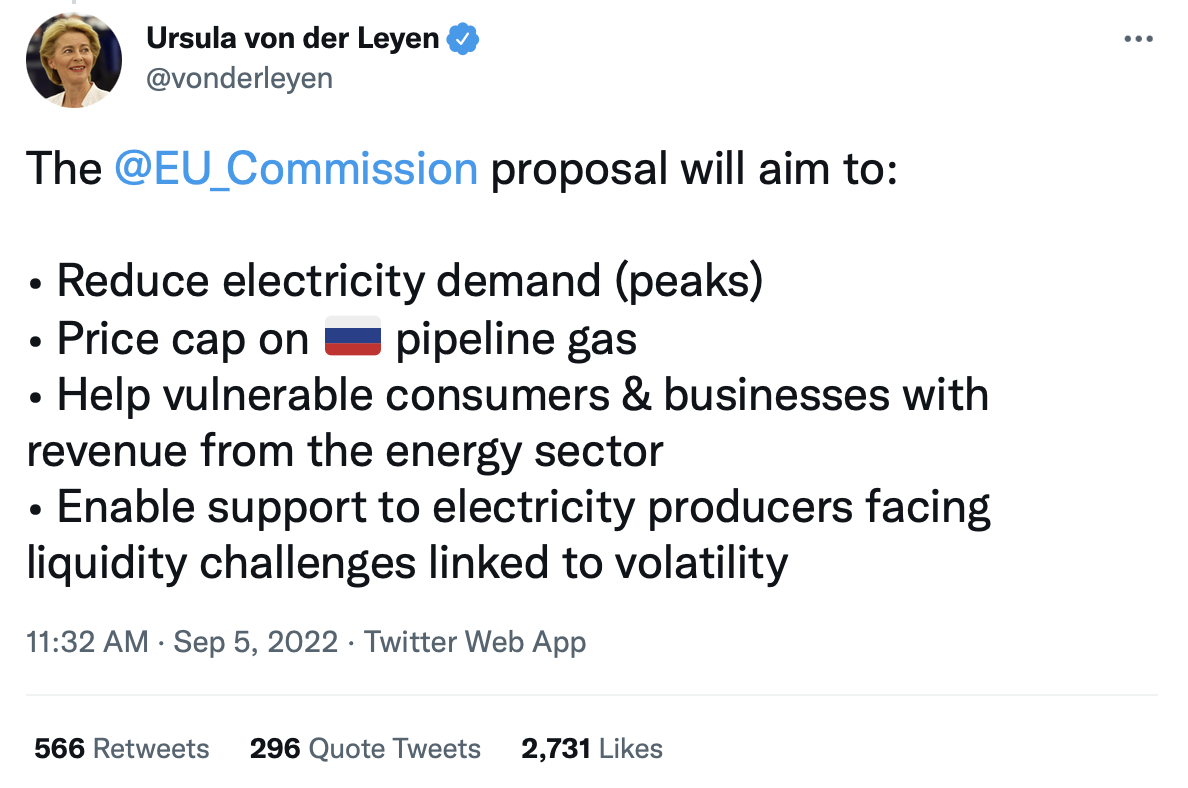
Further to Europe's energy relationship with Russia, on September 5, 2022, Ursula von der Leyen, the EU's ++++ tweeted the following:


1.) 


2.) 


...and here on September 7 which shows just how desperate the situation in Europe could become this fall and winter as energy supplies do not meet demand:


Europe's ridiculous and ill-conceived plan to put a price cap on Russia's natural gas got this response from Putin when asked this question by the moderator:


"Ilya Doronov: Will price caps on gas be a heavy blow on us?


Vladimir Putin: Well, this is yet more stupidity, one more non-market decision without any prospects. All administrative restrictions in global trade lead only to disproportions and price hikes. What is happening now in European markets is the result of the work done by European specialists and the European Commission. We always insisted that prices be formed based on long-term contracts and be tied to the same market category as prices on oil and oil products, to the same basket. Prices on oil and oil products are formed by the market and the price of gas in long-term contracts is linked to this price. Why? Because this production requires big investments and those who invest in production must be sure that the product will be sold. This is why Gazprom is generally interested in long-term contracts.


They kept telling us: “No, this isn’t market-based. You should use prices in the spot market as a benchmark.” We tried to change their mind – I personally was doing this in Brussels. I said: “Don’t do this because natural gas trade is a special segment of the world market. Those who produce and sell it and those who buy it must be confident that their relationship is reliable.” “No,” they said, believing the price at the time was too high. A hundred dollars per 1,000 cubic metres seemed to them to be an extremely high price at the time and later they said the same about the price of US$300. That is what prices were like back then. Today, let’s see, the price has exceeded 3,000 euros. We kept saying: “Don’t do this.” Yet, they practically forced their companies to opt for pegging to spot [prices] and imposed the same on us – imposed! Now a large part of the gas price is determined by spot [transactions].


We did not ask for this – the Europeans imposed this on us. First, they imposed these truly idiotic decisions regarding gas trade, and after seeing what is happening now, they started thinking how to get out of it. So, how? They want to cap the price, resorting to administrative measures. More absurdity and nonsense that will send prices skyrocketing in world markets, including the European market. Nothing can be achieved in the economy and global trade using administrative measures."


To put Putin's comments into perspective, here's what has happened to the price of Russia's natural gas over the past year:


Futhermore:


"You asked about someone making some decisions to limit prices for our oil and gas which is an absolutely dumb thing to do. Should someone try to move it forward, it will do no good for the decision-makers.


There are contractual obligations and contracts for delivery. Will there be any political decisions that run counter to contract clauses? We will ignore them and suspend deliveries if these decisions are inconsistent with our interests, our economic interests in this case. We will then stop supplying gas, oil, coal, or fuel oil, suspend all our deliveries and fully comply with our contractual obligations. Notably, the people who are trying to impose things on us are not in a position to dictate their will to us. Let them come to their senses. This is how the economy, including the domestic economy, works."


What Putin is saying is that the owner of the resource sets the terms.


And, here's the key:


"Following up on those who we talked about earlier, we will not be supplying anything outside of contracts. We will not do anything they are trying to impose on us. What we will do instead is just sit there and keep saying a famous line from a Russian fairy tale, “Freeze, freeze, the wolf’s tail.”


Putin is referring to "The Fox and Wolf" Russian fairy tale of which one version includes this:


By and by the Wolf came running up.

"Hello there, Sister Fox!" he called.

"Hello yourself, Brother Wolf!"

"What are You doing, Sister Fox?"

"Eating fish."

"Give me some!"

"Go catch them yourself."

"I can't, I don't know how to do it!"

"Well, that's your business, You won't get as much as a bone from me.'-

" Won't You at least tell me how to do it"

And the Fox said to herself:

"You wait, Little Brother! You ate my little bull and now I'll pay You back for it!"

Then she turned to the Wolf and said:

"Go to the river, put your tail into an ice hole, move it slowly back and forth and say: 'Come and be caught, fish, big and small!' That way you'll catch all the fish You want."

"Thank You for telling me," said the Wolf.

He ran to the river, let down his tail into an ice hole, moved it slowly, back and forth and said:

"Come and be caught, fish, big and small!"

And the Fox looked out at him through the reeds on the bank and said:

"Freeze, freeze, Wolf's tail!"

Now, there was a bitter frost out, and the Wolf kept moving his tail back and forth and saying:

"Come and be caught, fish, big and small!"

And the Fox kept repeating:

"Freeze, freeze, Wolf's tail!"

There the Wolf stayed catching fish till his tail was frozen fast to the ice, and when that happened the Fox ran to the village and cried:

"Come, good people, and kill the Wolf!"

And the villagers came running with pokers, prongs and axes. They fell on the poor Wolf and killed him.

And as for the Fox, she still lives in her hut as snug as You please.


Putin does note that European leaders could subsidize consumers for the high prices that they are paying for energy, however, this will ultimately be problematic given that consumers will continue to consume as they did prior to the shortages which will lead to even higher prices and shortages.  There is also the option to cut consumption but, Putin states that this is "a dangers proposition from the social point of view, since it can lead to a rupture", already in evidence from the large number of demonstrations in Europe, and that the only way to navigate this situation is to follow the letter of the contracts that have been signed.


Europe's leadership would appear to be completely useless in the face of the oncoming energy crisis, defining the very concept of kakistocracy.  It would appear that their agenda is being driven by Washington and its corporate partners who would love nothing more than to expand Europe's imports of American LNG.  European decision makers will find themselves experiencing greater and greater levels of anger from Europeans who are being forced to reduce their energy consumption just as the cold weather of late fall and winter are looming.  Eventually, I predict that Europeans will tire of their governments' support of Ukraine once the pain becomes too bear.


If you are interested, here is Putin's speech at the Eastern Economic Forum in its entirety:


Monday, June 20, 2022

Vladimir Putin and the End of the Obsolete Unipolar Order

At the recent St. Petersburg International Economic Forum, Russia's President Vladimir Putin or his body double as shown here and here:


...and here:


...has provided the world with some interesting insight on Russia's current view of the global geopolitical reality at the event's plenary session.  Let's look at some quotes as provided by the Kremlin's English language website.


Putin opens with this about the timing of the Forum noting that all bolds throughout are mine:


"It is taking place at a difficult time for the international community when the economy, markets and the very principles of the global economic system have taken a blow. Many trade, industrial and logistics chains, which were dislocated by the pandemic, have been subjected to new tests. Moreover, such fundamental business notions as business reputation, the inviolability of property and trust in global currencies have been seriously damaged. Regrettably, they have been undermined by our Western partners, who have done this deliberately, for the sake of their ambitions and in order to preserve obsolete geopolitical illusions.


Today, our – when I say “our,” I mean the Russian leadership – our own view of the global economic situation. I would like to speak in greater depth about the actions Russia is taking in these conditions and how it plans to develop in these dynamically changing circumstances."


He goes on to refer to his virtual appearance at the 2021 edition of the World Economic Forum's Davos clusterf@ck, reiterating his view of the new global reality and the passing of the old, American-dominated unipolar order, may it rest in peace:


"When I spoke at the Davos Forum a year and a half ago, I also stressed that the era of a unipolar world order has come to an end. I want to start with this, as there is no way around it. This era has ended despite all the attempts to maintain and preserve it at all costs. Change is a natural process of history, as it is difficult to reconcile the diversity of civilisations and the richness of cultures on the planet with political, economic or other stereotypes – these do not work here, they are imposed by one centre in a rough and no-compromise manner. 


The flaw is in the concept itself, as the concept says there is one, albeit strong, power with a limited circle of close allies, or, as they say, countries with granted access, and all business practices and international relations, when it is convenient, are interpreted solely in the interests of this power. They essentially work in one direction in a zero-sum game. A world built on a doctrine of this kind is definitely unstable."


This is one of the most interesting parts of Putin's speech which puts Washington's belief in itself as the leader of the rules based international order:


"After declaring victory in the Cold War, the United States proclaimed itself to be God’s messenger on Earth, without any obligations and only interests which were declared sacred. They seem to ignore the fact that in the past decades, new powerful and increasingly assertive centres have been formed. Each of them develops its own political system and public institutions according to its own model of economic growth and, naturally, has the right to protect them and to secure national sovereignty."


Here is the new reality and how the West has responded to the rise of competitor states:


"...the ruling elite of some Western states seem to be harbouring this kind of illusions. They refuse to notice obvious things, stubbornly clinging to the shadows of the past. For example, they seem to believe that the dominance of the West in global politics and the economy is an unchanging, eternal value. Nothing lasts forever.


Our colleagues are not just denying reality. More than that; they are trying to reverse the course of history. They seem to think in terms of the past century. They are still influenced by their own misconceptions about countries outside the so-called “golden billion”: they consider everything a backwater, or their backyard. They still treat them like colonies, and the people living there, like second-class people, because they consider themselves exceptional. If they are exceptional, that means everyone else is second rate.


Thereby, the irrepressible urge to punish, to economically crush anyone who does not fit with the mainstream, does not want to blindly obey. Moreover, they crudely and shamelessly impose their ethics, their views on culture and ideas about history, sometimes questioning the sovereignty and integrity of states, and threatening their very existence. Suffice it to recall what happened in Yugoslavia, Syria, Libya and Iraq."


Putin goes on to specifically discuss the impact of the new global reality on Russia and Russians:


"If some “rebel” state cannot be suppressed or pacified, they try to isolate that state, or “cancel” it, to use their modern term. Everything goes, even sports, the Olympics, bans on culture and art masterpieces just because their creators come from the “wrong” country.


This is the nature of the current round of Russophobia in the West, and the insane sanctions against Russia. They are crazy and, I would say, thoughtless. They are unprecedented in the number of them or the pace the West churns them out at.


The idea was clear as day – they expected to suddenly and violently crush the Russian economy, to hit Russia’s industry, finance, and people's living standards by destroying business chains, forcibly recalling Western companies from the Russian market, and freezing Russian assets.


This did not work. Obviously, it did not work out; it did not happen. Russian entrepreneurs and authorities have acted in a collected and professional manner, and Russians have shown solidarity and responsibility....


The dire forecasts for the prospects of the Russian economy, which were made in early spring, have not materialised. It is clear why this propaganda campaign was fuelled and all the predictions of the dollar at 200 rubles and the collapse of our economy were made. This was and remains an instrument in an information struggle and a factor of psychological influence on Russian society and domestic business circles."


Here are his thoughts on how the anti-Putin/anti-Russia sanctions have turned out for Europe and the United States:


"Once again, the economic blitzkrieg against Russia was doomed to fail from the beginning. Sanctions as a weapon have proved in recent years to be a double-edged sword damaging their advocates and architects just a much, if not more. 


I am not talking about the repercussions we see clearly today. We know that European leaders informally, so to say, furtively, discuss the very concerning possibility of sanctions being levelled not at Russia, but at any undesirable nation, and ultimately anyone including the EU and European companies. 


So far this is not the case, but European politicians have already dealt their economies a serious blow all by themselves. We see social and economic problems worsening in Europe, and in the US as well, food, electricity and fuel prices rising, with quality of life in Europe falling and companies losing their market edge.


According to experts, the EU’s direct, calculable losses from the sanctions fever could exceed $400 billion this year. This is the price of the decisions that are far removed from reality and contradict common sense.


These outlays fall directly on the shoulders of people and companies in the EU. The inflation rate in some Eurozone countries has exceeded 20 percent. I mentioned inflation in Russia, but the Eurozone countries are not conducting special military operations, yet the inflation rate in some of them has reached 20 percent. Inflation in the United States is also unacceptable, the highest in the past 40 years.


This is our main difference from the EU countries, where rising inflation is directly reducing the real incomes of the people and eating up their savings, and the current manifestations of the crisis are affecting, above all, low-income groups.


The growing outlays of European companies and the loss of the Russian market will have lasting negative effects. The obvious result of this will be the loss of global competitiveness and a system-wide decline in the European economies’ pace of growth for years to come. 


Taken together, this will aggravate the deep-seated problems of European societies. ...A direct result of the European politicians’ actions and events this year will be the further growth of inequality in these countries, which will, in turn, split their societies still more, and the point at issue is not only the well-being but also the value orientation of various groups in these societies."


Let's close with this chart showing how Russia's ruble, which was supposed to collapse under the punishing sanctions has actually performed very well compared to the U.S. dollar:


...and the euro:


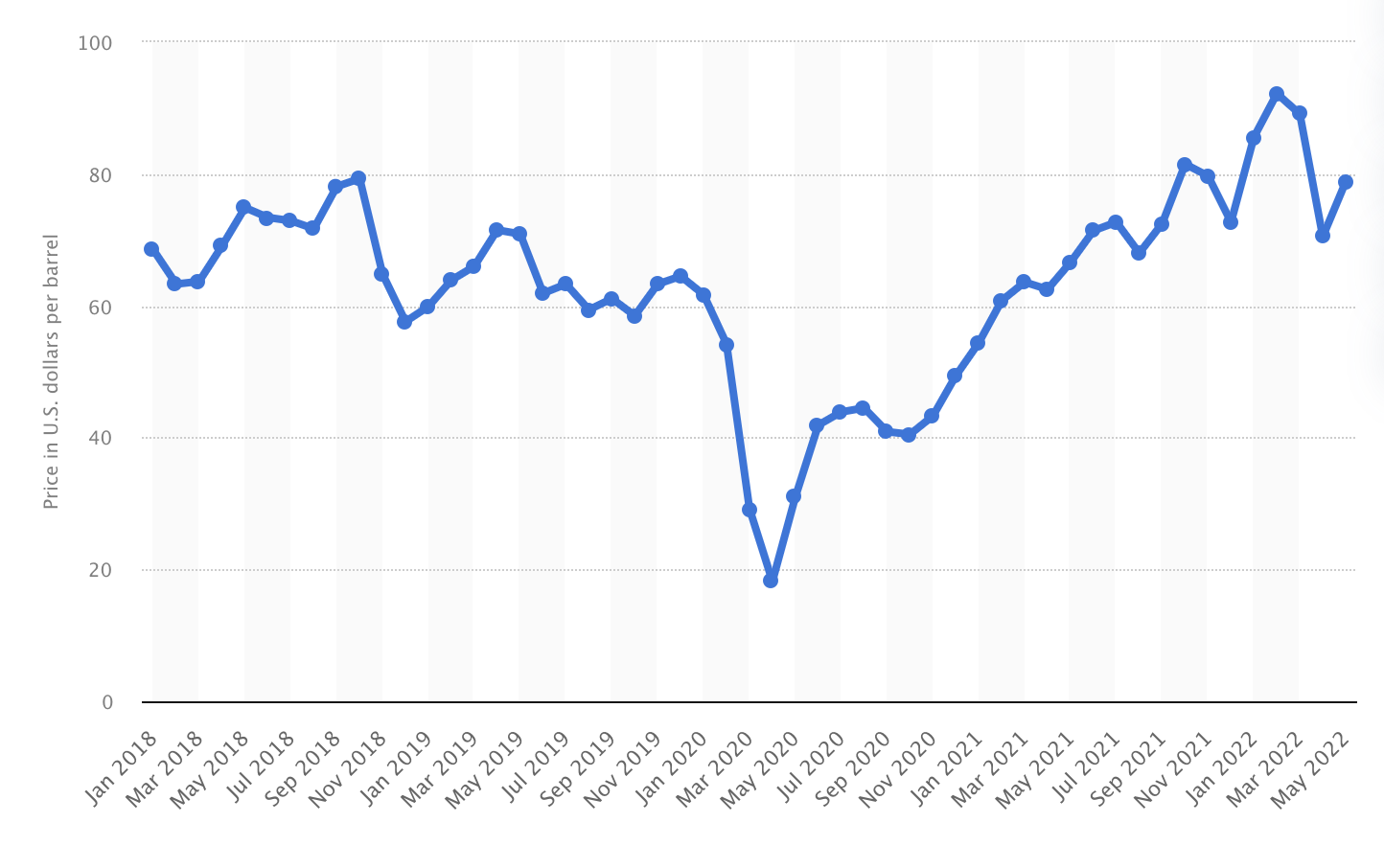
Here is a chart showing the rising price of Urals crude oil, Russia's major export oil brand (a mixture of heavy and high grade oil from the Urals and Volga with Western Siberian light oil):


...and here is a chart showing the price of Russian natural gas in U.S. dollars:


Lastly, here is a chart showing Putin's approval/disapproval rating among Russians:


...and a chart showing Joe Biden's approval/disapproval rating for comparison:


So, who is laughing now?


While the West loves to vilify Putin and claim that he is the new Hitler, in fact, Russia is doing very well under the current toothless sanctions regime and is quite pragmatic about its new role (and that of China) in the multipolar geopolitical reality.