Showing posts with label BIS. Show all posts

Friday, April 8, 2022

The Entrenchment of Inflation in the Global Economy - Our Painful New Reality

A recent speech by the General Manager of the Bank for International Settlements or BIS at the International Center for Monetary and Banking Studies gives us insight into where the central bank of central banks feels that the economy is heading.  This information is particularly pertinent given that governments and some central bankers have been insisting that inflationary pressures are merely transient and that prices increases will settle down over the short-term.


Let's start by looking at a brief video of Agustin Carstens from October 2020 so that we can get a sense of where his sentiments lie:


Frightening, isn't it? But at least now we know his agenda.


Now, let's look at some key excerpts from his speech given on April 5, 2022 with my bolds throughout:


"After more than a decade of struggling to bring inflation up to target, central banks now face the opposite problem. The shift in the inflationary environment has been remarkable. If you had asked me a year ago to lay out the key challenges for the global economy, I could have given you a long list, but high inflation would not have made the cut.


This evening, I will describe the rise in inflation over the past year and discuss why this came as a surprise to many. I will argue that the pandemic and the extraordinary policy response laid the groundwork for a rapid and goods-intensive bounceback in demand which supply has been unable to fully meet. The war in Ukraine has further disrupted supply, particularly for commodities. I will also draw some broader lessons about the inflationary process – in particular, the need to look “under the hood” of aggregate data and models to understand how the behaviour of individual firms and workers drives inflation outcomes.


A key message is that we may be on the cusp of a new inflationary era. The forces behind high inflation could persist for some time. New pressures are emerging, not least from labour markets, as workers look to make up for inflation-induced reductions in real income. And the structural factors that have kept inflation low in recent decades may wane as globalisation retreats."


In other words, central bankers don't have a clue about what lies ahead for the economy.


Here is a graphic from the presentation showing how the global economy is entering a new reality that has not been experienced for four decades:


Carstens notes that 60 percent of the world's advanced economies have experienced year-over-year inflation above 5 percent which is more than 3 percentage points above the 2 percent target set by many central banks.  He also notes that inflation has been rising in the world's emerging markets with more than half experiencing inflation rates that are above 7 percent.


Let's continue with his musings:


"At first, in early 2021, price increases were confined to a small number of items. Energy, food and durable goods, such as cars, are the most familiar examples. We tend to think of these as relative price changes resulting from shifts in demand and supply, many pandemic-induced. The items where supply and demand imbalances were concentrated had relatively flexible prices, allowing quick adjustments. Indeed, for a while it was possible to attribute all of the increase in inflation to these items, making it look transitory.


But higher inflation has become increasingly broad based. Since the start of 2021, the share of items in the consumption basket that have seen very large price rises has increased steadily. In particular, growth in service prices has accelerated. Because growth in service prices tends to be more persistent than that in goods, inflation may be becoming more entrenched."


Here is a graphic showing how inflation has broadened over time for both advanced and emerging economies:


Now, let's look at the three reasons why he believes that inflation has risen:


1.) The strong global rebound in aggregate demand: the global economy is expanding much more quickly than in the post-recession recoveries of recent decades.


2.) A persistent rotation in demand towards goods and away from services, particularly customer-facing ones.  This trend has continued with supply growth being unresponsive to the higher demand.  Staggered lockdowns and disrupted global value chains have revealed the fragility of the global "just-in-time" manufacturing systems. 


3.) unresponsive aggregate supply, which has found it hard to keep up with surging demand.


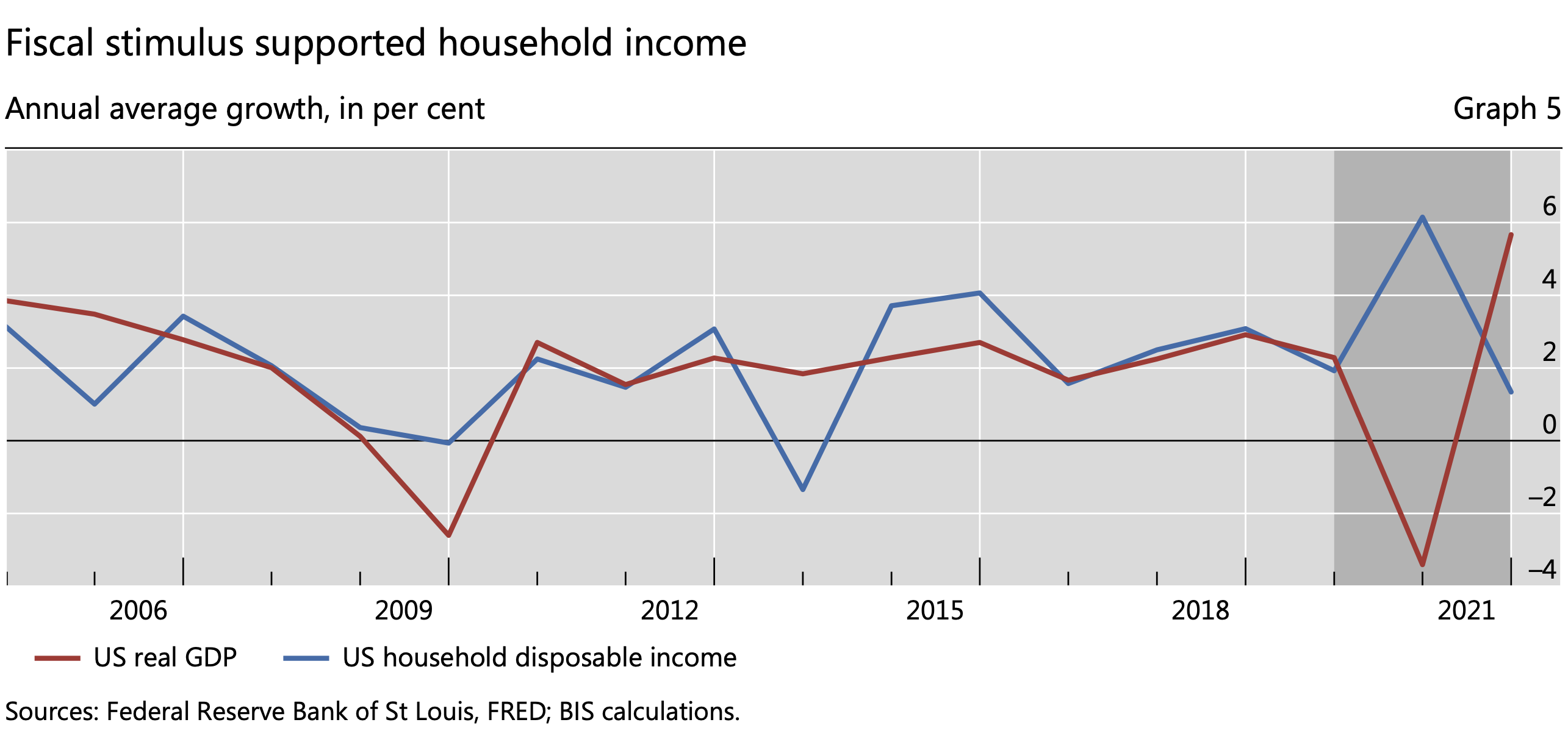
He states that the recovery from the pandemic was "remarkably fast", largely because economic activity was artificially repressed by government responses to the pandemic (i.e. lockdowns).  It was the "exceptional policy response" that is responsible for this because governments used fiscal stimulus to support demand and central banks used monetary policies (i.e. expanding the supply of money) both of which have served as a springboard for the rapid post-pandemic economic expansion over the past year in particular.  Here is a graphic showing how fiscal stimulus supported household disposable income:
 

Here, to me, is the key to the inflation dilemma, at least in the United States:


All of that new money has to have somewhere to go.


Carstens notes the following two lessons that need to be learned:


1.) "The distinction between relative price changes and inflation is critical, but not always clear-cut. In hindsight, it was too tempting to dismiss the initial rises in energy, food and car prices as a one-off adjustment to changed demand. We have learned once more that sector-specific shocks can spill into other sectors and become more persistent and pervasive.


This can happen directly or indirectly, through rising input costs that percolate down the value chain. Indeed, recent bottlenecks have been so keenly felt partly because they occurred in items at the start of production chains, which are needed to produce other goods and services downstream."


2.) "High- and low-inflation environments are very different. When inflation is high, price changes tend to be more aligned. Their common component explains a large share of the total variability of individual price changes. By contrast, in an environment of low and stable inflation, as in the last two decades, price changes in individual items – even large ones – percolate less into the prices of other items and, therefore, aggregate price indices. Put differently, when inflation is persistently low, much of what we measure as inflation is, in fact, the result of idiosyncratic price changes.


A consequence of this is that low-inflation environments tend to be largely self-correcting. Large price rises in individual items can increase inflation for a while. But if other prices don’t respond, inflation will eventually come down.


When inflation is less persistent, its influence on wage- and price-setting loses traction."


So, where to from here?  Carstens notes that measures of long-term inflation have increased as shown here as projected by economic forecasters, financial markets and households:


One concern is that some households' inflation expectations have risen a lot and if that tendency spreads, central bankers will find it much harder to bring inflation back down.  As well, as inflation starts to affect the cost of living, it is increasingly likely that a dangerous wage-price spiral could develop as consumers develop a mindset that they need significant wage increases to keep pace with price increases. 


Here are Carstens' final comments:


"The good news is that central banks are awake to the risks. No one wants to repeat the 1970s. It seems clear that policy rates need to rise to levels that are more appropriate for the higher- inflation environment. Most likely, this will require real interest rates to rise above neutral levels for a time in order to moderate demand.


The adjustment to higher interest rates will not be easy. In many countries, starting conditions complicate matters. Households, firms, financial markets and sovereigns have become too used to low interest rates and accommodative financial conditions, also reflected in historically high levels of private and public debt. It will be a challenge to engineer a transition to more normal levels and, in the process, set realistic expectations of what monetary policy can deliver.


Nor will the required shift in central bank behaviour be popular. But central banks have been here before. They are fully aware that the short-term costs in terms of activity and employment are the price to pay to avoid bigger costs down the road. And such costs represent an investment in central banks’ precious credibility, which yields even longer-term benefits.


The shifts do underscore that central banks cannot single-handedly ensure global growth by keeping an accommodative stance in all conditions. Amid low inflation, this perception became commonplace. It is one central banks must continue to fight against, even more so in an inflationary environment."  


In other words, get used to higher interest rates.  They are coming whether we like it or not and the resulting pain for highly indebted consumers among the serf class is going to be substantial.  We have been lulled into believing that the near-zero interest rate environment was permanent and have consumed with this as our reality. But, on the upside, the central bankers living among the sweaty masses will never have to worry about being unemployed no matter how pitiful the accuracy of their economic prognostications turn out.  


In conclusion and as an aside, I found it particularly interesting/concerning that Agustin Carstens used the word "surprise" (or a derivation of the word) ten times throughout this brief speech.  Doesn't that tell us everything that we need to know about central bankers and their understanding of the economy?


Thursday, July 13, 2017

The Global Debt Trap

Updated September 2017

In the 2017 edition of the Bank for International Settlements annual report, BIS outlines where the economy's Achilles heel lies - the accumulation of unprecedented levels of debt, a situation that could prove to be critical for several highly indebted nations as you will see in this posting.  While the bank for central bankers notes that the global economy has strengthened over the past year with economic growth rates approaching long-term averages, there are four risks that could threaten the sustainability of the expansion:

1.) a rise in inflation

2.) financial stress as financial cycles mature

3.) weakening consumption, demand and investment because of growing debt levels, particularly at the household and corporate levels

4.) a rise in protectionism

In this posting, I want to focus on point three; the risks to the global economy associated with what BIS terms "unusually high debt levels" and "unusually limited room for policy manoeuvre(s)", that being the room for central banks to raise interest rates.

Here is a graphic showing how global debt as a percentage of GDP has risen since the end of 2007 (i.e. the beginning of the Great Recession) for advanced economies (AE) and emerging economies (EME) broken into general government debt in yellow, non-financial corporate debt in blue and household debt in red:


Here is a graph showing how public and private non-financial corporate debt has soared as interest rates have plummeted since 1986:


One of the great dangers is the sharp increase in corporate debt among emerging economies, particularly where that debt is accrued in foreign currencies, a situation that leaves companies highly vulnerable to unfavourable changes in exchange rates. 

Here is a tell-all quote from the report:

"As markets have grown used to central banks' helping crutch, debt levels have continued to rise globally and the valuation of a broad range of assets looks rich and predicated on the continuation of very low interest rates and bond yields".  

One look no further than the highly overvalued real estate of two major centres in Canada, Vancouver and Toronto, where a crack shack will set you back over a million dollars, to see how central bank policies have completely distorted at least one aspect of the consumer marketplace.

Next, let's look at a graphic that shows us two measures which can be used as early warning indicators of future financial overheating and banking sector distress as follows:

1.) Credit-to-GDP gap - the deviation of the private non-financial sector credit-to-GDP ratio from its long term trend (i.e. how quickly debt has raced ahead of the long-term trend in economic growth).  A reading above 10 is considered dangerous and readings between 2 and 10 are considered risky.

2.) Debt service ratios (DSR) which are measured as the sector's principal and interest payments in relation to income.  Debt service ratios greater than 6 are considered dangerous and those between 4 and 6 are considered risky.

Now, let's look at which nations are in the debt trap danger zone, the key part of this posting.  Here is the graphic with danger zones highlighted in red, the risky zones highlighted in beige and includes a column which shows which economies will be in danger if interest rates rise by 250 basis points:


As you can see, the credit-to-GDP gap has reached levels signifying higher banking sector risks in Canada, Hong Kong, China and Thailand.  As well, if interest rates rise by 250 basis points, the rise in the debt service ratio suggest that the domestic banking system in Canada, China and Hong Kong are under threat. 

Let's look at the several examples showing what household debt servicing burdens looks like under different interest rate scenarios (in percentage points) for Canada, the United States, the United Kingdom, Spain, Australia and Norway:


It is interesting to see that Canadian and United Kingdom households are highly vulnerable to increases in debt servicing ratios when interest rates rise, yet not as bad as their peers in Australia and Norway, two nations  famous for their highly overheated housing market and growing household indebtedness.  Fortunately for households in both the United States and Spain, significant debt deleveraging after the Great Recession makes them somewhat more immune to interest rate increases.

So, what does the central bank for central banks think could happen when central banks begin to raise rates given the current debt inventory?  Here's a quote:

"Policy normalisation presents unprecedented challenges, given the current high debt levels and unusual uncertainty. A strategy of gradualism and transparency has clear benefits but is no panacea, as it may also encourage further risk-taking and slow down the build-up of policymakers’ room for manoeuvre." (my bold)

In other words, central banks are damned if they raise interest rates and damned if they don't, largely because their policies have resulted in both risk-taking (i.e. the creation of asset bubbles in stocks, bonds and real estate) and excess levels of debt.  Gradually raising interest rates could well prove to be no solution to the problem of asset bubbles and debt accumulation since a rate increase of 25 basis points here and there is relatively meaningless, particularly when compared to the interest rate increases of past economic cycles.

Here's a summary from the report which succinctly explains the potential debt crisis and how the world's central banks have painted themselves into a "monetary policy corner":

"Otherwise, over long horizons, failing to constrain financial booms but easing aggressively and persistently during busts could lead to successive episodes of serious financial stress, a progressive loss of policy ammunition and a debt trap. Along this path, for instance, interest rates would decline and debt continue to increase, eventually making it hard to raise interest rates without damaging the economy. From this perspective, there are some uncomfortable signs: monetary policy has been hitting its limits; fiscal positions in a number of economies look unsustainable, especially if one considers the burden of ageing populations; and global debt-to- GDP ratios have kept rising." (my bold)

The Federal Reserve and the world's other most influential central banks have borrowed from the future.  The long period of near-zero interest rates will prove, in the long run, to be extremely dangerous to the global economy, and could end up causing more economic pain than the Great Recession, largely because of the central bank fuelled "debt trap" that has been created since 2008.
  

Friday, December 23, 2016

A Paradigm Shift in the Global Bond Market

The December 2016 edition of the BIS Quarterly Review by the Bank for International Settlements has been released and actually provides readers with an interesting look at why there has not been a major "global bond market temper tantrum" with rising yields that have already led to a nearly $2 trillion loss in global fixed income investments.  Here is BIS' rationale for this unusual development which they term a "bond market sell-off with few ripples".

Let's start by looking at the opening paragraph of the Quarterly Review so we can get a sense of BIS' mindset:

"Global bond yields have continued to rise markedly in recent months. After core fixed income markets had plumbed new historical depths this summer, overall yields had jumped sharply by the end of November – in fact by a magnitude similar to that of the taper tantrum of May–September 2013. But despite record high duration risk, there were few signs of stress in credit markets as spreads remained tight and volatility was contained." (my bold)

Here is a graphic showing what has happened to the yield on key ten-year government bonds over the entirety of 2016 with the vertical line showing the date of the U.S. presidential election for reference:


As you can see, the yields on government bonds outside of Japan pretty much mirrored the performance of Treasuries.

Let's focus on Treasuries since they are the bond market bellwether sovereign debt security.  Prior to the November 8 election, ten-year Treasury yields had gained about 50 basis points from their historical lows seen in July as shown here:


In response to the election outcome, ten-year Treasury yields jumped by a very significant 20 basis points, the largest one-day jump in yield since the taper tantrum of 2013 and greater than all but one percent of one-day movements in yield over the last 25 years.  Since early July 2016, yields on ten-year Treasuries have jumped a very significant 85.4 percent; while the 1.17 percentage point jump may not seem significant thanks to the Fed's long experiment with ultra-low interest rates, the 85.4 percent jump certainly is and is above the 83 percent jump in yields during the taper tantrum of mid-2013.

The forward expectations of higher future interest rates from the Federal Reserve are also putting additional upward pressure on yields as shown on the yellow line in this graphic:


According to Reuters, the unexpected win by Donald Trump resulted in two day bond market losses of more than $1 trillion across the globe.  According to Bloomberg, November's bond market rout saw a total of $1.7 trillion disappear from the Bloomberg Barclays Global Aggregate Total Return Index. 

Normally, one would think that this situation would result in even more significant bond market volatility, however, as you will see, BIS has an explanation for that phenomenon.  The authors of the BIS Quarterly Review go on to look at one very interesting aspect of the recent bond market correction, explaining why bond market volatility remained "well contained".  Here is a quote:

"The limited market impact of higher yields may in part have reflected the capacity of major holders of government bonds to bear mark-to-market losses as well as limited evidence of negative feedback loops through hedging activities. For instance, around 40% of US Treasuries are owned by the Federal Reserve and the foreign official sector. Pension funds (the third largest holders of Treasuries) and insurance companies may even benefit from rising rates in the medium term, as a normalised yield environment would allow them to more easily meet promised returns. However, valuation losses in the short run may affect profits and capital depending on accounting standards. In addition, the hedging activities of the US government-sponsored enterprises (GSEs), which contributed to the bond market turbulence of 1994, are much lower now. This is because, as part of quantitative easing policies, GSEs sold a large share of their portfolios to the Federal Reserve, which does not hedge its securities."  (my bold)

As backup for this statement, here is a graphic that shows the top holders of U.S. Treasuries keeping in mind that the "U.S. monetary authority" is the Federal Reserve:


Basically, thanks in large part to the Federal Reserve and its massive holdings of U.S. sovereign debt and the fact that it doesn't have to implement mark-to-market losses like other "real world" entities, BIS feels that this factor explains a great deal of why the bond market volatility has remained relatively subdued compared to what would normally be expected in a situation where prices had fallen to the point where yields very nearly doubled.


Obviously, the brilliant minds at the Bank for International Settlements feel that there has been a paradigm shift in the bond market which has led to lower levels of global bond market volatility thanks to the changing ownership of sovereign debt when compared to past economic cycles.  Only time will tell whether the "new bond market reality" holds true during the next global economic contraction when central banks are forced to use new, imaginative monetary policies unless, of course, they find it desirable to own even more government debt.

Monday, July 13, 2015

No Room to Manoeuvre - Our Unhealthy Global Economy

The central bankers' central bank, the Bank for International Settlements or BIS, recently released its annual report on the worlds economy.  In this posting, I want to take a look at a few of the more interesting (and rather frightening) comments made by the authors in this year's edition.

The authors open the report with a chapter entitled "Is the unthinkable becoming routine?".  As shown on this graphic, real interest rates for Japan, the United States and Germany have never been this low for this long:


This has had a significant impact on bond rates; between December 2014 and the end of May 2015, on average, approximately $2 trillion in global long-term sovereign debt (particularly euro debt) was trading with negative yields as shown on this graphic:


Here is another graphic showing how widespread negative yields had become in the first half of 2015:


While that situation has corrected itself to some degree, at their trough, the yields on French, German and Swiss sovereign bonds were negative out to five, nine and fifteen years respectively.

These ultra-low rates are evidence of a broad malaise in the global economy.  The authors note that debt levels and financial risks are still exceedingly high despite the fact that we are 6 full years into the "recovery" and that the world's leading central banks have used the aforementioned extraordinary tactic of using near-zero interest rates and other non-conventional monetary policies to prop up the global economy which is growing, but at unbalanced rates.

The authors note that the current very low interest rates that have prevailed for such a lengthy period of time are not "equilibrium rates" that are conducive to sustainable global expansion, rather, the have contributed to the current global economic weakness by fuelling financial booms and busts.  The result is too much debt, too little growth and low interest rates that "beget lower rates".  This is quite apparent in this graphic that shows what has happened to the global public and private non-financial sector debt levels as a percentage of GDP as shown on this graphic: 


One point of concern is the credit that has been given to non-banks in emerging market economies.  Since early 2009, the level of this credit has almost doubled to more than $3 trillion.  Countries that export commodities are particularly at risk, including those in Latin America.  At the end of 2014, China was the world's eighth largest borrower in terms of cross-border bank claims, reaching $1 trillion or double the amount just two years prior.  

Ultra-low interest rates have an impact on the private economy; low rates reduce banks' interest rate margins and undermine the profitability of both pension plans and insurance companies.  Our current pervasive low rates have also resulted in severe misplacing in both equities and corporate debt markets (i.e. they create asset bubbles).  Low rates can also create problems for the broader economy; pension funding is less secure now than it has been in generations, increasing the need for individuals to save more for retirement which can weaken consumer demand.

Let's close with this excerpt from the report:

"The resulting picture is that of a world that has been returning to stronger growth but where medium-term tensions persist. The wounds left by the crisis and subsequent recession are healing, because balance sheets are being repaired and some deleveraging has taken place. Recently, the strong and unexpected boost from energy prices has helped too. In the meantime, monetary policy has done its utmost to support near-term demand. But the policy mix has relied too much on measures that, directly or indirectly, have entrenched dependence on the very debt-fuelled growth model that lay at the root of the crisis. These tensions manifest themselves most visibly in the failure of global debt burdens to adjust, the continued decline in productivity growth and, above all, the progressive loss of policy room for manoeuvre, both fiscal and monetary...Room for manoeuvre in macroeconomic policy has been narrowing with every passing year. In some jurisdictions, monetary policy is already testing its outer limits, to the point of stretching the boundaries of the unthinkable. In others, policy rates are still coming down. Fiscal policy, after the post-crisis expansion, has been throttled back, as sustainability concerns have mounted. And fiscal positions are deteriorating in EMEs where growth is slowing."


It is becoming increasingly apparent that the current environment of ultra-low interest rates have left the world's central bankers ill-equipped to fight the next economic crisis.  The long-term monetary experiment has left central bankers with little room to manoeuvre because, as the Federal Reserve is discovering, they have backed themselves into a very uncomfortable corner from which extrication will likely be extremely painful.