Showing posts with label CBDC. Show all posts

Friday, November 8, 2024

Backtracking on the Cashless Society and Strengthening the Right to Pay with Cash

With the vast majority of central banks around the world researching, experimenting with or implementing a new monetary reality as shown here


....recent developments in Norway are quite fascinating.


According to Norges Bank, Norway's central bank, in 2022, only 3 percent of Norwegians used cash when making a purchase at a point of sale (i.e. a physical store) as shown here:


In contrast, Norway has the second highest annual use of payment cards among selected nations with an average Norwegian using a credit card or equivalent 531 times in 2022 as shown here (graph data current to 2021):


Rather surprisingly, this was announced by Norges Bank on its website slated to take effect on October 1, 2024:


According to the Financial Contracts Act, consumers have the option to pay with legal tender (i.e. physical bank notes and coins) as long as the amount owing is not greater than 20,000 kroner ($1850 US).


This is being enacted for two reasons according to Justice Minister Emilie Enger Mehl:


1.) as a means of providing security for those consumers who are reluctant to used digital payment solutions.


2.) as a means for preparing Norwegian society for emergencies such as prolonged power outages, system failures or digital attacks against payment systems.


Here is a quote from Ms. Mehl's press release dated August 3, 2024 when the issue was being discussed (with my bolds):


"The government's task is to ensure society's preparedness. Relying exclusively on digital payment solutions increases the vulnerability of society, and in certain situations this can contribute to putting important social functions out of play. Preparedness is an investment to counteract vulnerability and safeguard important functions in society and the needs of the population.


If no one pays with cash and no one accepts cash, cash will no longer be a real emergency solution once the crisis is upon us


As a society, we need an alternative if it becomes necessary, and today cash is the only alternative that is easily available if digital payment systems fail. In addition, companies also make themselves vulnerable if they do not accept cash in the event of a crisis, says Mehl."


I find it interesting that Norway has taken the approach that cash is a necessary "evil" to ensure the inclusiveness of all of its citizens which is rather ironic given that CBCDs are being sold to us as a panacea for those who are not in the banking system.  As well, given the vulnerability of the digital payment grid as has been revealed time and time again as shown here:


....at least one nation is taking the approach that going completely cash-free is one of the stupidest things that a government and central bank can do.


Wednesday, January 10, 2024

The Next Moves Toward a Digital Dollar

At the end of November 2023, the Bank of Canada published a report that outlined the results of its public consultations on a central bank digital currency which I covered in this posting.  The Bank admitted the following:


1.) Canadians place a high value on holding cash that is backed by their central bank and want to maintain access to bank notes.


2.) Canadians value their right to privacy and many expressed concerns that a digital dollar could compromise that right.


3.) A digital dollar should be easily accessible and should neither add barriers nor worsen existing ones.


4.) A digital dollar should not add to financial stability risks.


...and, most importantly, stated this:


"Whether and when a digital dollar will become needed is uncertain. Ultimately, the decision to go ahead with a digital dollar belongs to Canadians, through their representatives in Parliament.


The Bank will continue to engage with stakeholders on the key issues and features that matter most to Canadians, such as privacy, accessibility and inclusion, security and technology, financial stability and the design of a business ecosystem. Canadians will have more opportunities to provide input on a potential digital Canadian dollar."


The report clearly showed that Canadians were not in favour of a digital currency now or in the future.


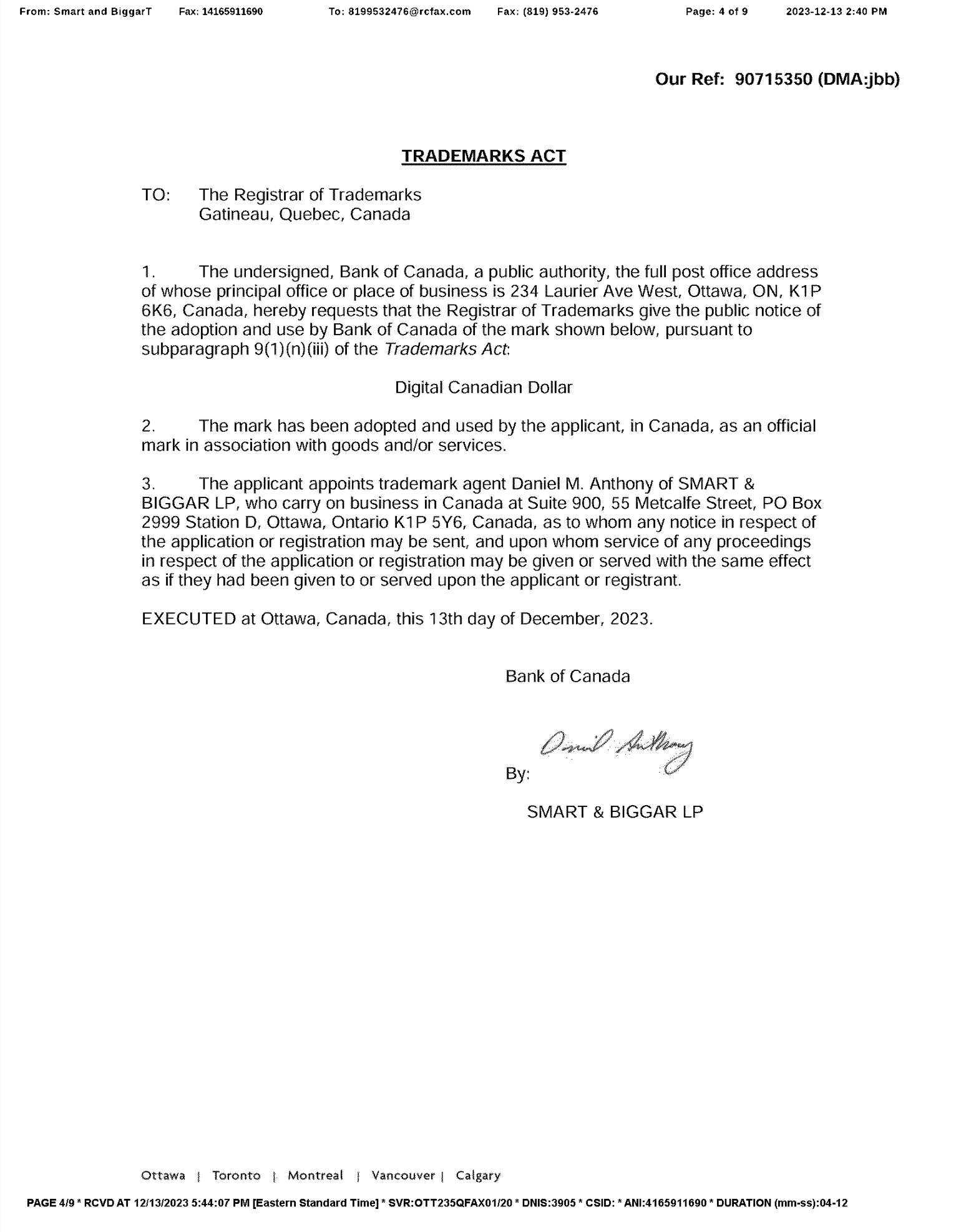
That said, recent developments would suggest that the Bank of Canada is preparing itself to issue a central bank digital currency with or without the approval of Main Street Canada.  On December 13th, 2023, the Bank of Canada filed applications with the Canadian government's Registrar of Trademarks under the Trademarks Act for the following "marks" that it wishes to protect for its own use:


1.) Digital Canadian Dollar:


2.) Digital Dollar:


3.) CENTRAL BANK DIGITAL CURRENCY which is defined as follows:


a.)  Programmable, exchangeable digital currency; programmable, exchangeable digital currency wallet; exchangeable central bank digital currency; portable, exchangeable digital currency.


b.) Issuance and distribution of digital currency; exchange of central bank digital currency asset from one entity to another; conversion to and from other forms of money; online platform for maintaining and using technology for financial transactions; offline platform for maintaining and using technology for financial transactions.


Now, you might think that this is just a central bank preparing for the possibility that, at some point in the future, the Canadian government may just approve the issuance of a Canadian central bank digital currency, however, you need to keep in mind that the Trudeau government is a world leader when it comes to following the diktats of the World Economic Forum, thanks to this individual who just happens to be Canada's Deputy Prime Minister, Finance Minister and a member of the World Economic Forum's Board of Trustees:


The World Economic Forum is heavily involved in the implementation of digital currencies through its Digital Currency Governance Consortium as you can read here:


...and here where it outlines the advantages to CBDCs:


One thing that Canadians can assure themselves of is that the bank account freezing Freeland will heavily favour the implementation of a digital currency that can be used to control the behaviour of Canadians should she happen to be in a position of political power when the digital Canadian dollar is brought into existence.


Friday, December 1, 2023

The Bank of Canada - How Canadians Feel about a Canadian Dollar CBDC

There is little doubt that the world is heading towards a central bank digital currency-dominated future, thanks to the efforts of organizations like the Bank for International Settlements, the World Economic Forum and like-minded organizations.  While the implementation of CBDCs may be unavoidable, one of the world's central banks, the Bank of Canada, undertook a survey of Canadians to understand their views on the development and rollout of CBDCs.  The results of the public consultation portion of this survey were just released and are rather eye-opening:


Let's look at some of the highlights.


A total of 89,432 responses were collected during the public consultation which took place from May 8 to June 19, 2023 which the Bank of Canada considers a "high level of engagement".  The survey was divided into five main sections:


1.) How you pay for things today 


2.) Design concepts and principles


3.) Design features and use cases


4.) Your advice


5.) About you


The individuals that took the time to complete the 30 question survey exhibited a high level of familiarity with the concept of a digital Canadian dollar with 87 percent having heard about a Bank of Canada CBDC.  Here is a map showing how respondents represented the vast geography of Canada:


Here is a graphic showing the payment types used by respondents in the last month before they completed the survey:


Here are the reasons for using these payment methods noting that cash was often used for "privacy", "safety" and "anonymity":


When asked about the importance of a universally accessible digital Canadian dollar, respondents answered as follows:


Note that nearly half of respondents felt that accessibility was very unimportant compared to only 29 percent who felt that it was very important.


When it comes to the design features of a digital Canadian currency, here are respondents' recommendations:


In Canadians' opinion, the most important feature is privacy (13 percent) followed by protection against government abuse or control (8 percent).


When asked if they would be interested in having a payment method in addition to cash that would work offline when the internet is not functioning or there is a power, outage, two-thirds of Canadians said that they were uninterested in such a feature:


When asked how often they would use digital Canadian dollars offline, here's what Canadians said:


Now let's get to the most important aspect of a central bank/government-controlled digital currency, the issue of privacy and trust in the Bank of Canada to issue a digital currency that is secure from fraud, cyberattack or theft:


The top privacy features of a Canadian digital dollar that would be expected are as follows:


Lastly, here's how much Canadians trust their own financial institutions, the Bank of Canada, the Government of Canada and Big Tech:


It is quite clear that Canadians have very little trust in their nation's financial system, particularly  the Bank of Canada, the Government of Canada and Big Tech, when it coms to protecting their personal information and spending habits.


Let's close with this graphic which shows the percentage of respondents that would use a digital Canadian dollar:


...and the percentage of Canadians who would use a digital Canadian dollar rather than their current form of payment:


To summarize, 86 percent of respondents responded negatively when commenting on the idea of a digital Canadian dollar with only 5 percent responding positively.  One commenter even noted the Trudeau government's attempts to freeze the bank accounts of Canadians who disagreed with their response to the COVID-19 pandemic during the Truckers' Protest of February 2022.


Let's close with a couple of comments from the Bank of Canada's summary of their own survey:


"Overall, the public consultation gathered a diversity of attitudes and concerns from Canadians regarding a digital Canadian dollar, underlining significant reservations related to privacy and security and a strong preference for existing payment methods....


Ultimately, it will be up to Parliament and the Government of Canada to determine if or when to issue a digital Canadian dollar."


Personally, I think that that the implementation of CBDCs in Canada is a done deal no matter what Canadian voters want but that's just my opinion.  All that it will take is some type of financial catastrophe to push the Bank of Canada and the Government of Canada to force CBDCs on Canadians or the perceived need to remain competitive with the central banks of other nations who implement their own central bank digital currencies.


Thursday, February 16, 2023

The Digital Pound

One would like to think that given the current high inflation rate in the world's advanced economies that the central banks controlling the monetary levers in these nations would have more important things to contemplate other than the looming imposition of central bank digital currencies but apparently not.  Such is the case with the Bank of England as you will see in this posting which updates the Bank's stance on CBDCs.


Here is the title page from a recent Consultation Paper from the Bank of England:


The paper opens by noting that banknotes are being used less frequently thanks to new technologies that are allowing for the development and use of new forms of digital money and new transactional devices.  To remain competitive, the UK government and the Bank of England state that the UK should remain at the forefront of innovation in payments, money and financial services and, as part of this effort, a central bank digital currency or "digital pound" would be implemented as a new form of digital money that would be used by households and businesses for their everyday payment needs.


Here is a graphic showing how cash payments have declined over the past decade:


In 2021, card payments accounted for nearly 60 percent of UK payment and 32 percent of payments were contactless compared to only 15 percent of payments that were made using cash.  Nearly one-third of retail sales were made online and 90 percent of UK adults own a smartphone, a necessary technology for the implementation of a digital payments ecosystem.  On the other hand, around 1.2 million UK adults do not have a bank account and 20 percent of people state that cash is their preferred form of payment.  The Bank of England states that there is a downside to this fragmentation of the payments system (my bolds throughout):


"If current trends continue, the public’s access to, or use of, central bank money (i.e. banknotes) will diminish and the monetary system could become fragmented, posing a risk to monetary and financial stability. The payments landscape could also become concentrated if firms’ use of new technologies in money issuance results in dominance by a small number of them. That would pose a risk to competition and diminish the incentives for longer-term innovation.


Considering these payment trends, we judge there is likely to be a benefit from the Bank issuing a digital form of retail central bank money. It would support the safety and interchangeability of money, as well as encourage choice, competition and innovation. The digital pound would complement banknotes and ensure that the Bank continues to provide money that is relevant to the way people choose to pay, both today and in the future. It would also coexist with and complement both existing and new forms of private digital money."


I would say that the greatest threat to financial stability is the very existence of central banks but, then again, my tinfoil hat is slightly tight today.


Here's another quote from the paper:


"As part of the wider landscape of money and payments it  (a digital pound) would sit alongside, not replace, cash – a digital counterpart to familiar, trusted banknotes and coins, subject to rigorous standards of privacy and data protection."


At least until they decide that banknote payments are just too difficult to track, right?


Here is the Bank of England's proposal:


"The Bank of England and HM Treasury judge it likely that a digital pound will be needed in the future. It is too early to decide whether to build the infrastructure for one, but we are convinced the next stage of preparatory work is justified.


A digital pound would be a retail central bank digital currency (CBDC) – digital money for use by households and businesses for their everyday payments, issued by the central bank, the Bank of England. The Bank of England (the Bank) and His Majesty’s Treasury (HM Treasury) plan to accelerate our work on the technology and policy architecture for a digital pound....


At this stage, we judge that it is likely that the digital pound will be needed in the future and that it would offer benefits. As set out in more detail in Part B, the digital pound would maintain public access to retail central bank money, thereby anchoring trust in the monetary system in a more digitalised world and underpinning monetary and financial stability. Also, as our lifestyles and the economy become ever more digital, it would, through partnership with the private sector, promote innovation, choice and efficiency in domestic payments, thereby boosting the UK economy, supporting growth and financial inclusion."


It pretty much sounds like a digital pound is a "done deal", doesn't it? 


Here is its model for the public-private partnership that would be required to development and issue the digital pound:


The bank claims the following:


"The Bank would issue the digital pound. This means it would be a direct claim on the Bank, as cash is today. It would be denominated in sterling, the currency of the UK, and £10 of digital pounds would always have the same value as, and be interchangeable with, a £10 banknote.


The Bank would provide the digital pound and the central infrastructure, including the ‘core ledger’. Private sector companies – which could be banks or approved non-bank firms – would be able to integrate into the central digital pound infrastructure and provide the interface between the Bank and users. They would do this by offering digital ‘pass-through’ wallets to end users. The wallets could be integrated into their other services. They are known as ‘pass-through’ wallets (hereafter referred to simply as ‘wallets’) because the user’sholdings of digital pounds are recorded anonymously on the Bank’s core ledger, in order to safeguard their privacy, and the wallet simply passes instructions from the user to the core ledger. End-users would interact with these wallets rather than directly with the Bank."


I noticed that the Bank emphasizes "privacy", in fact, protection of individual privacy is mentioned 49 times in the paper and, they even claim that a digital pound would be more private than the current system in some ways as quoted here:


"A digital pound would have the same (or stronger) privacy protections as bank accounts, debit cards or cheques. Individuals’ personal details would be known to their private sector wallet provider in the same way they are for bank account providers today (and subject to the same privacy protections). But individuals’ personal details would not be known by the Government or the Bank of England.


By providing the same privacy as most of the money we use, the digital pound would be designed to protect against fraud and counterfeiting, while not facilitating financial crime."


More private....until it isn't.  Just ask Canada's bank account-seizing Minister of Finance Chrystia Freeland how private Canadians' financial services are today.


Given all of this background information, what lies ahead in the planning process for the digital pound?  Here is a graphic showing the roadmap to a digital pound:


Phase 1 Research and Exploration Phases: The Bank and HM Treasury consider a digital pound is likely to be needed in the UK though no decision to introduce one can be taken at this stage. We will therefore step up development and move to the next stage of our work.


This Consultation Paper, and the Bank’s accompanying Technology Working Paper are the conclusion of the ‘research and exploration’ phase of our work on the digital pound – Phase 1 of our digital pound roadmap.


Phase 2 Design Phase: We will now move to Phase 2, to develop further, in both technology and policy terms, the model for the digital pound...upon which we are consulting.


This work in Phase 2, the ‘design’ phase, will enable us to respond to developments in the payments landscape and materially reduce the lead time if there is a future decision to introduce a digital pound in the future. It will involve investment in the Bank’s technology capabilities, and an ambitious approach to the technology roadmap and collaboration with the private sector.


By the end of the design phase, the bank will have evaluated the technological feasibility of a digital pound, optimized its design and technological architecture as well as:


1.) Cut lead-times on development and equip ourselves with the knowledge and capabilities to move into a ‘build’ phase, should there be a decision to introduce a digital pound.


2.) Determine the technological feasibility and investment needed to build a digital pound.


3.) Articulate, in detail, what the technology and operational architecture for a digital pound would look like.


4.) Assess and evaluate the benefits and costs of the digital pound architecture.


5.) Deepen the Bank’s knowledge of CBDC technology and the private sector’s understanding of our technology approach.


6.) Support the development of the broader UK digital currency technology industry through experimentation and proofs of concept.


7.) Provide the basis for a future decision on whether to introduce a digital pound and move to a ‘build’ phase.


The decision on whether to proceed with a digital pound will be made after the design phase is completed.  If the decision is made to proceed, a prototype digital pound will be developed first and will be used in a simulated environment before moving to live pilot tests.


Here are the key sentences in the document:


"A decision on whether or not to proceed to a build phase would be made at the end of the design phase, around the middle of the decade. This work will shorten the lead time for the introduction of a digital pound, which would be in the second half of the decade."


In other words, we'll have at least one central bank digital currency sometime between 2025 and 2030.


Let's close with these thoughts.  Despite what the Consultation Paper says, I think that we can pretty much assure ourselves that the Bank of England has every intention of issuing a digital pound.  While the Bank's CBDC will, at first, "circulate" alongside physical banknotes, given the societal evolution toward a more intrusive and universal surveillance/control state, I'm also postulating that physical banknotes which provide a modicum of transactional privacy will completely disappear sooner rather than later as the powers that be implement programable digital currencies as a key part of their societal control mechanisms.


Thursday, June 30, 2022

Retail Central Bank Digital Currencies - The Race for the Future of Money

In a recent Payments System Research Briefing, the braintrust at the Federal Reserve Bank of Kansas looks at the case of retail central bank digital currencies (CBDCs). 


Let's open by looking at the two types of CBDCs:


1.) Retail (or general purpose) CBDCs - these CBDCs will take on the attributes of physical cash and will be used by consumers and businesses.  This can be thought of most easily as a "cashless" system.


2.) Wholesale CBDCs - these CBDCs will be used by financial institutions and are intended for the settlement of interbank transfers and could reduce counterparts credit and liquidity risks.


The authors note that, while many central banks are exploring the use of retail CBDCs, only a few have actually taken the steps necessary to implement a retail CBDC as shown on this table:


In the briefing, the authors look at the motivations for issuing retail CBDCs.  They note that central banks in emerging and developing economies EMDE) are far more enthusiastic about issuing retail CBDCs compared to their counterparts in advanced economies.  Let's look at the motivations for each grouping of nations:


1.) Emerging and Developing Economies (EMDE) - promoting financial inclusion, enhancing payment system efficiency, competition, competition, security and/or resiliency, improving cross-border payments.


In these economies, many consumers have little access to financial services and, as such, rely heavily on cash payments in preference to less-developed electronic payment systems.  This results in higher operational costs which would be moderated once the dead for physical cash is reduced.  Access to the banking system (i.e. inclusion) seems to be all important to central bankers.  For example, in these less developed economies, many individuals are unbanked with about 60 percent of adults being unbanked in Mexico and Nigeria and 20 percent of adults being unbanked in China, India, Jamaica and the Bahamas.  The Central Bank of The Bahamas has taken the step of issuing a physical CBDC payment card to unbanked individuals that have no access to a smartphone or computer.  The authors state that a Retail CBDC may increase competition and result in lower transaction costs for both merchants and consumers.


2.) Advanced Economies - payment access, resiliency and competition.  


While no advanced economy has introduced a retail CBDC, this may reflect the limited potential to improve national payment systems.  Interestingly (and I might add ironically), Sweden's central bank claims that the priority policy goal of the "e-krona" is to ensure broad access to payments for those that will be adversely impacted by the move to a cashless society.  Central banks in Canada, Japan and Norway have stated that there is currently little motivation to move to a retail CBDC ecosystem, however, should the use of cash decline to the point where it can no longer be used in a wide range of translations or should a private cryptocurrency make significant inroads, these central banks could change their views and move toward a retail CBDC.  This is quite interesting given that over half of retailers in Sweden expect to stop accepting cash for payments by 2025 and the use of banknotes in the United Kingdom has fallen from 60 percent of payments by volume in 2008 to 28 percent 2018 and is expected to fall to just 9 percent of payments by 2028 so it looks like central bankers concerns about a decline in the use of cash has already provided them with the reason that they need to foist CBDCs on the globe's advanced economies.


In closing, here is the conclusion to the briefing with my bold:


"Several EMDEs have implemented CBDCs primarily to promote financial inclusion and improve their payments systems. Several advanced economies have made significant progress in assessing the case for a retail CBDC; though a few have identified motivations for implementing a CBDC, most have not found a compelling case to do so.


Many other central banks are still at an early stage in exploring motivations for a retail CBDC, including the Federal Reserve, which recently published a report aiming to foster a public discussion with CBDC stakeholders on the potential benefits and risks of CBDCs (Board of Governors of the Federal Reserve System 2022). Through research and public dialogue, these central banks may increasingly identify motivations for a retail CBDC or scenarios in which a retail CBDC may be warranted. The motivations and scenarios will likely vary across countries, as each country has a unique set of opportunities and challenges in its economy and payment system."


Let's close with this graphic showing the "race for the future of money:":


...and these graphics showing the rapid change in CBDC research and development since April 2021:


Given the changes in the global economy over the past few years, the advanced in blockchain technology, the moves toward a digital identity and the widespread growth of the surveillance state, in my opinion, the imposition of a central bank digital currency ecosystem is a given and that, with the majority of the world's central banks exploring the use of CBDCs, this is likely to be our "new normal" within the next five years.