Showing posts with label Cold War II. Show all posts

Monday, September 16, 2024

The Missions and Objectives of the Russian Armed Forces

While we may have a surficial understanding of the mission and objectives of the Russian military, much of which is communicated to us through the eyes of the biased Western media which seems quite certain that Russia's goal is to conquer the better part of Europe.


Using a VPN, I was able to access the website of the Ministry of Defence of the Russian Federation and the pertinent webpage which outlines the Objectives of the Russian Armed Forces as shown here:


The mission statement opens with this:


"Given the foreign policy shifts of recent years and new national security priorities, the Russian Armed Forces now have a totally new set of objectives..."


The four objectives are as follows:


1.) Deterring the military and political threats to the security or interests of the Russian Federation


2.) Supporting economic and political interests of the Russian Federation


3.) Mounting other-than-war enforcement operations


4.) Using military force


Note that "using military force" is not the first objective of the Russian Armed Forces, rather, deterrence, supporting the homeland and other-than-war operations would appear to be priorities.  You will also notice that their objectives do not include having 750 military bases in 80 nations around the world:


Let's look at each objective in turn.  Here are some of the tasks that Russia's Armed Forces will use to deter war and military-political threats and to provide for national security:


- tracking the rising military-political tensions and uncovering war preparations to attack the Russian Federation and/or its allies;


- sustaining the status, operational availability and mobilizational preparedness of the strategic nuclear forces and the relevant support capabilities to assure their functionality and usability; keeping the C2 systems ready to inflict the desired losses on the aggressor under any conditions;


- maintaining operational capabilities, war and mobilizational preparedness and training of the peacetime general purpose forces on the level high enough to beat back local aggression;

assuring readiness for strategic deployments as part of a state-run effort to put the nation on a war footing;


- making arrangements to put in place territorial defenses.


Here are some of the tasks that Russia's Armed Forces will use to support its economic and political interests:


- providing for security of Russian citizens in war zones and areas of political or other sort of instabilities;


- creating the friendly environment for Russian state or government-related economic activities;


- safeguarding Russian national interests in the territorial waters, continental shelf, exclusive economic zones and the World Ocean;


- staging and conducting information counter-balancing operations.


Here are some of the tasks that Russia's Armed Forces will use in other-than-war operations:


- living up to the commitments in keeping with the relevant international treaty obligations and inter-governmental agreements;


- fighting international terrorism, political extremism and separatism; preventing and putting in check sabotage activities and terrorist acts;


- undertaking a partial or full-fledged strategic deployment, maintaining operational availability of the nuclear deterrence capabilities;


- running UN/CIS-mandated peace-keeping/peace-enforcement operations while operating either as part of a coalition set up by an international Russian-participated organization or on an ad-hoc basis;

assuring a martial law/emergency regime in one or several constituent units of the Russian Federation pursuant to express directives from the National Command Authority;


- safeguarding the national borders of the Russian Federation in the air and underwater media;


Of most interest to us is the use of military force to assure the security of the Russian Federation.  According to the Russian government, Russia's Armed Forces are trained to engage in four types of war:


1.) Armed Conflict


A form of conflict waged to resolve political, ethnic, religious, territorial and other kind of difference through the use of arms, with the country (countries) involved in the relevant military operations coming short of letting the tensions be escalated to the special status generally known as war.


2.) Local War:


A war between two or more countries pursuing limited political goals, where combat operations are generally prosecuted within the confines of the warring sides. Under certain circumstances, local wars can escalate into a regional or large-scale war.  In my opinion, this is the type of war currently being fought in Ukraine and is on the brink of becoming a regional war given Washington's unfettered support for Ukraine's military.


3.) Regional War:


A war involving the given region’s two or more countries (groups of countries) operating through the use of either national or coalition armed forces commanding both conventional and nuclear capabilities within a single region confined by the waters of seas/oceans and aerospace, with the warring sides pursuing critical military and political goals. A regional war requires a full-fledged deployment of the armed forces and economic capacities, as well as the enhanced engagement of the material resources and moral courage available to the warring countries. Should any nuclear-have countries or their allies happen to participate in a regional war, such a war can feature the threat/risk of nuclear weapons being eventually employed.  In my opinion, this is the type of 


4.) Large-Scale War:


A war between coalitions of countries or larger world powers. It can be precipitated by escalation of an armed conflict, local or regional war by way of a significant number of countries from different world regions being effectively involved. In a large-scale war, the warring sides would pursue radical military and political goals. It would require that participating countries mobilize all of their available material resources and moral courage.


Modern Russian defense planning, while being reflective of the realistic grasp of Russia’s current resources and capabilities, is based on the assumption that the Russian Armed Forces together with other national troops should be prepared to repel aggression and rout the aggressor. Besides, the Russian Armed Forces should be ready to mount active (offensive and defensive) operations under any scenario of armed conflicts being unleashed and carried on in the conditions of the adversary resorting to massive use of modern and advanced lethal weapons, with assorted WMDs making no exception.


It is important to note that Russia's Armed Forces are trained to effectively wage two concurrent armed conflicts of any type in peacetime, during an emergency and to prosecute two local wars following completion of the full-fledged strategic deployment of the nation's Armed Forces.


Now you have some idea of how Russia's leadership views the missions and objectives of its armed forces.  Given the recent threats to the Russian homeland from overly and overtly aggressive Western politicians who wish to see their long-range weapons used to attack the fatherland, putting the missions and objectives of the Russian Armed Forces into perspective is important to understanding how they will respond to these provocations.

Monday, August 12, 2024

The 2024 United States National Defense Strategy - The High Cost of Rebuilding the American Military Machine

The Commission on the National Defense Strategy for the United States recently released its final report to Congress and the President of the United States (whoever they may be) and some of the conclusions are eye-opening.


Here is the cover page of the 2024 edition of the National Defense Strategy report:


The authors of the report found that, among the senior civilian and military leaders of the Department of Defense and other departments; congressional leaders from relevant committees; private sector representatives; former government officials; experts in the think tank, academic, and federally funded research and development centre communities; and foreign allies that they met with, there was "near-unanimous recognition of the significant challenges to U.S. national security and broad agreement on the need for substantial and wide-ranging change" and that the national security system was outdated, bureaucratic and too political to make the changes that are necessary to protect America's role as global "police force" quickly enough.  There is also a reliance on decades-old military equipment and a culture of risk avoidance that is handicapping the U.S. military's ability to maintain its current role in the current unipolar world that is under threat from two growing superpowers.


The report opens by observing that both China and Russia are the major powers that seek to undermine U.S. global interest and that, in many ways, China is outpacing the United States and has negated America's military advantage in the Western Pacific over the past two decades.  In both cases, the report states that military spending by the superpowers-in-waiting is rising;  in 2024, Russia is estimated to spend 35 percent of its federal budget or 7.1 percent of its GDP on national defense and China announced a 7.2 percent increase in its official defense spending bringing it to 1.6 percent of GDP (excluding very significant off-budget items).  This compares to roughly 3 percent or 12 percent of government spending for the United States.  As well, China and Russia's "no limits" partnership formed in February 2022 along with the joint military and economic partnership with Iran and North Korea presents a growing threat to U.S. interests.


The report goes on to note that all-out war with a peer or near peer would be devastating for several reasons:


1.) massive military and personnel costs which is problematic given that recent recruitment shortfalls have resulted in decreased size of the Army, Air Force and Navy. 


2.) risk of cyberattacks on America's critical infrastructure.


3.) global economic recession due to disruptions to supply chains, manufacturing and trade.


4.) denied access to critical minerals needed to run the American economy and build weapons systems.


5.) hold U.S. space assets at risk.


Here is a quote with my bolds:


"The U.S. public are largely unaware of the dangers the United States faces or the costs (financial and otherwise) required to adequately prepare. They do not appreciate the strength of China and its partnerships or the ramifications to daily life if a conflict were to erupt. They are not anticipating disruptions to their power, water, or access to all the goods on which they rely. They have not internalized the costs of the United States losing its position as a world superpower. A bipartisan “call to arms” is urgently needed so that the United States can make the major changes and significant investments now rather than wait for the next Pearl Harbor or 9/11. The support and resolve of the American public are indispensable."


The authors of the report recommend that the U.S. Joint Force be structured to simultaneously:


1.) defend the homeland, maintain strategic deterrence, prevent mass casualty terrorist attacks, maintain global posture, and respond to small-scale, short-duration crises.


2.) lead the effort, with meaningful allied contribution, to deter China from territorial aggression in the Western Pacific—and fight and win if needed


3.) lead NATO planning and force structure to deter and, if necessary, defeat Russian aggression


4.) sustain capabilities, along with U.S. partners in the Middle East, to defend against Iranian malign activities.


As I noted above, the authors have taken notice of the decreased ability of the U.S. military to recruit new personnel which you can clearly see on this graphic from RealClear Defense:


Here is another quote from the Commission's report that is rather sobering for young Americans (with my bold):


"Redoubled recruiting efforts, new incentives for service, and more flexible personnel systems are needed to offset a lack of propensity for and interest in military service among the eligible population. Military retention remains high, demonstrating that personnel in service largely choose to remain in uniform. The nation must also consider the possibility that future conflict could overwhelm the capacity of the active-duty force and should plan now to better prepare the reserve components and, potentially, a broader mobilization.  More broadly, we support calls for increased levels of public and civil service to help provide a renewed sense of engagement and patriotism among the American people."


Get ready for a full-fledged, Vietnam War-style draft which, as one might expect, will not impact the offspring of the ruling class.


Of course, the recommended solution to the problem is a greater level of funding.  According to the report, Department of Defense spending ranged from 4.9 percent to 16.9 percent of GDP during the Cold War as shown here:


Keep the 4.9 percent to 16.9 percent of GDP numbers in mind.  During the Cold War, it is important to remember that DoD spending relied on top personal marginal income tax rates of 70 percent and corporate tax rates averaging 50 percent.  As such, the Commission makes the following recommendations:


1.) DoD should immediately review all major systems against likely future needs, emphasizing battlefield utility and prioritizing agility, interoperability, and survivability.  DoD should invest more in cyber, space, and software, which have enabled warfighting for decades but are now central to conflict and have global reach.


2.) Congress should pass a supplemental appropriation immediately to begin a multiyear investment in the national security innovation and industrial base. Funding should support U.S. allies at war; expand industrial capacity, including infrastructure for shipbuilding and the ability to surge munitions production; increase and accelerate military construction to expand and harden facilities in Asia; secure access to critical minerals; and invest in a digital and industrial workforce.


3.) DoD should immediately begin making structural changes and prioritization adjustments to spend national security funds more effectively and more efficiently. DoD should address its recruitment challenges, rewrite regulations to speed defense procurement (and address cultural impediments and risk aversion), and shift the R&D paradigm to adopt technological innovation from outside the department for warfighting purposes. The U.S. government should review national security authorities for agencies other than DoD and look for ways to enable and facilitate information-sharing, coproduction, and export controls to better work with allies.


4.) Congress should revoke or override the caps in the 2023 Fiscal Responsibility Act that serve as the basis for the FY 2025 budget request.


a.) For FY 2025, real growth in defense and nondefense national security spending is needed and, at a bare minimum, should fall within the range recommended by the 2018 NDS Commission.  Increased spending should be allocated to emphasize near-term readiness demands to restore and reinforce deterrence.  


Here is a graphic showing the budgetary shortfall when compared to the 2018 NDS Commission:


b.) Given the severity of the threats, the FY 2027 and later budgets for all elements of national power will require spending that puts defense and other components of national security on a glide path to support efforts commensurate with the U.S. national effort seen during the Cold War.


c.) Larger amounts of defense spending should be accompanied by sufficient resources to build capacity at the departments of State, Commerce, and Treasury; intelligence, trade, and investment agencies; the U.S. Agency for International Development; and the Department of Homeland Security and focus these organizations on national security missions. The United States should continue to provide support to its allies, which it relies on to fight with (or for) it.


d.) The ballooning U.S. deficit (and I might add debt) also poses national security risks. 


And, here's the key to the last recommendation:  


"Therefore, increased security spending should be accompanied by additional taxes and reforms to entitlement spending."


In other words, U.S. taxpayers should get used to the idea of increased taxes and decreases in entitlement spending for things like Medicare/Medicaid and Social Security at the same time as the nation's military industrial intelligence complex sticks its snout in the seemingly endless trough of taxpayer dollars.


If we look at the budgets for America's military during the Cold War which ranged from 4.9 percent to 16.9 percent of GDP and use the same percentages with the current GDP of $28.63 trillion (current dollars), the Pentagon's budget would range from $1.403 trillion to $4.838 trillion.  This compares to Fiscal Year 2024 spending of $948.6 billion on defense, $1.2 trillion on Social Security and $1.2 trillion on Medicare.


In closing, you can bet that this list of individuals that testified at the National Defense Strategy Meetings certainly had an impact on the Commission's recommendations for a larger U.S. military:


When you ask the military and its insiders what they want, it's highly unlikely that they are going to say "a smaller military" or "peace", isn't it?  Another Cold War is a wet dream for these men and women not to mention the upper floor, corner office dwellers at the nation's defense contractors.


Thursday, February 24, 2022

Understanding Vladimir Putin's Agenda in Ukraine

While you won't see or hear most of this on the Western mainstream media, the recent address to  his fellow Russians by Russia's President Vladimir Putin very clearly lays out his plan for Ukraine and why he felt that the actions taken by Russia's military were necessary.  Here are some quotes with my bolds throughout:


"I consider it necessary today to speak again about the tragic events in Donbass and the key aspects of ensuring the security of Russia.


I will begin with what I said in my address on February 21, 2022. I spoke about our biggest concerns and worries, and about the fundamental threats which irresponsible Western politicians created for Russia consistently, rudely and unceremoniously from year to year. I am referring to the eastward expansion of NATO, which is moving its military infrastructure ever closer to the Russian border.


It is a fact that over the past 30 years we have been patiently trying to come to an agreement with the leading NATO countries regarding the principles of equal and indivisible security in Europe. In response to our proposals, we invariably faced either cynical deception and lies or attempts at pressure and blackmail, while the North Atlantic alliance continued to expand despite our protests and concerns. Its military machine is moving and, as I said, is approaching our very border.


Why is this happening? Where did this insolent manner of talking down from the height of their exceptionalism, infallibility and all-permissiveness come from? What is the explanation for this contemptuous and disdainful attitude to our interests and absolutely legitimate demands?


The answer is simple. Everything is clear and obvious. In the late 1980s, the Soviet Union grew weaker and subsequently broke apart. That experience should serve as a good lesson for us, because it has shown us that the paralysis of power and will is the first step towards complete degradation and oblivion. We lost confidence for only one moment, but it was enough to disrupt the balance of forces in the world.


As a result, the old treaties and agreements are no longer effective. Entreaties and requests do not help. Anything that does not suit the dominant state, the powers that be, is denounced as archaic, obsolete and useless. At the same time, everything it regards as useful is presented as the ultimate truth and forced on others regardless of the cost, abusively and by any means available. Those who refuse to comply are subjected to strong-arm tactics.


What I am saying now does not concerns only Russia, and Russia is not the only country that is worried about this. This has to do with the entire system of international relations, and sometimes even US allies. The collapse of the Soviet Union led to a redivision of the world, and the norms of international law that developed by that time – and the most important of them, the fundamental norms that were adopted following WWII and largely formalised its outcome – came in the way of those who declared themselves the winners of the Cold War."


Putin goes on to outlines history of how the West (i.e. the United States) has erred, in his opinion of course:


"First a bloody military operation was waged against Belgrade, without the UN Security Council’s sanction but with combat aircraft and missiles used in the heart of Europe. The bombing of peaceful cities and vital infrastructure went on for several weeks. I have to recall these facts, because some Western colleagues prefer to forget them, and when we mentioned the event, they prefer to avoid speaking about international law, instead emphasising the circumstances which they interpret as they think necessary.


Then came the turn of Iraq, Libya and Syria. The illegal use of military power against Libya and the distortion of all the UN Security Council decisions on Libya ruined the state, created a huge seat of international terrorism, and pushed the country towards a humanitarian catastrophe, into the vortex of a civil war, which has continued there for years. The tragedy, which was created for hundreds of thousands and even millions of people not only in Libya but in the whole region, has led to a large-scale exodus from the Middle East and North Africa to Europe.


A similar fate was also prepared for Syria. The combat operations conducted by the Western coalition in that country without the Syrian government’s approval or UN Security Council’s sanction can only be defined as aggression and intervention.


But the example that stands apart from the above events is, of course, the invasion of Iraq without any legal grounds. They used the pretext of allegedly reliable information available in the United States about the presence of weapons of mass destruction in Iraq. To prove that allegation, the US Secretary of State held up a vial with white power, publicly, for the whole world to see, assuring the international community that it was a chemical warfare agent created in Iraq. It later turned out that all of that was a fake and a sham, and that Iraq did not have any chemical weapons. Incredible and shocking but true. We witnessed lies made at the highest state level and voiced from the high UN rostrum. As a result we see a tremendous loss in human life, damage, destruction, and a colossal upsurge of terrorism.


Overall, it appears that nearly everywhere, in many regions of the world where the United States brought its law and order, this created bloody, non-healing wounds and the curse of international terrorism and extremism. I have only mentioned the most glaring but far from only examples of disregard for international law."


Here are his reasons/justification for the military actions taken by Russia and its future plans:


"...The people’s republics of Donbass have asked Russia for help.


In this context, in accordance with Article 51 (Chapter VII) of the UN Charter, with permission of Russia’s Federation Council, and in execution of the treaties of friendship and mutual assistance with the Donetsk People’s Republic and the Lugansk People’s Republic, ratified by the Federal Assembly on February 22, I made a decision to carry out a special military operation.


The purpose of this operation is to protect people who, for eight years now, have been facing humiliation and genocide perpetrated by the Kiev regime. To this end, we will seek to demilitarise and denazify Ukraine, as well as bring to trial those who perpetrated numerous bloody crimes against civilians, including against citizens of the Russian Federation.


It is not our plan to occupy the Ukrainian territory. We do not intend to impose anything on anyone by force. At the same time, we have been hearing an increasing number of statements coming from the West that there is no need any more to abide by the documents setting forth the outcomes of World War II, as signed by the totalitarian Soviet regime....


In 2014, Russia was obliged to protect the people of Crimea and Sevastopol from those who you yourself call “nats.” The people of Crimea and Sevastopol made their choice in favour of being with their historical homeland, Russia, and we supported their choice. As I said, we could not act otherwise.


The current events have nothing to do with a desire to infringe on the interests of Ukraine and the Ukrainian people. They are connected with the defending Russia from those who have taken Ukraine hostage and are trying to use it against our country and our people.


I reiterate: we are acting to defend ourselves from the threats created for us and from a worse peril than what is happening now. I am asking you, however hard this may be, to understand this and to work together with us so as to turn this tragic page as soon as possible and to move forward together, without allowing anyone to interfere in our affairs and our relations but developing them independently, so as to create favourable conditions for overcoming all these problems and to strengthen us from within as a single whole, despite the existence of state borders. I believe in this, in our common future."


And, finally:


"Those who aspire to global dominance have publicly designated Russia as their enemy. They did so with impunity. Make no mistake, they had no reason to act this way. It is true that they have considerable financial, scientific, technological, and military capabilities. We are aware of this and have an objective view of the economic threats we have been hearing, just as our ability to counter this brash and never-ending blackmail. Let me reiterate that we have no illusions in this regard and are extremely realistic in our assessments.


As for military affairs, even after the dissolution of the USSR and losing a considerable part of its capabilities, today’s Russia remains one of the most powerful nuclear states. Moreover, it has a certain advantage in several cutting-edge weapons. In this context, there should be no doubt for anyone that any potential aggressor will face defeat and ominous consequences should it directly attack our country.


At the same time, technology, including in the defence sector, is changing rapidly. One day there is one leader, and tomorrow another, but a military presence in territories bordering on Russia, if we permit it to go ahead, will stay for decades to come or maybe forever, creating an ever mounting and totally unacceptable threat for Russia.


Even now, with NATO’s eastward expansion the situation for Russia has been becoming worse and more dangerous by the year. Moreover, these past days NATO leadership has been blunt in its statements that they need to accelerate and step up efforts to bring the alliance’s infrastructure closer to Russia’s borders. In other words, they have been toughening their position. We cannot stay idle and passively observe these developments. This would be an absolutely irresponsible thing to do for us.


Any further expansion of the North Atlantic alliance’s infrastructure or the ongoing efforts to gain a military foothold of the Ukrainian territory are unacceptable for us. Of course, the question is not about NATO itself. It merely serves as a tool of US foreign policy. The problem is that in territories adjacent to Russia, which I have to note is our historical land, a hostile “anti-Russia” is taking shape. Fully controlled from the outside, it is doing everything to attract NATO armed forces and obtain cutting-edge weapons...."


To put Putin's comments into perspective, here is a map from Statista showing the eastward expansion of NATO member states toward Russia:


Here is a serious of graphics showing NATO's partnership arrangements showing its spread around the globe:


As you can see, from the Russian perspective, the geopolitical situation in Ukraine is very complex and has not been fully explained by the Western media.  Russia is concerned about protecting its flanks from further moves by NATO that it views as potential threats its existence, a reality that is not surprising given the extremely high human cost of the Second World War to the Soviet Union.  Both Russia and the United States are guilty of meddling in Ukraine's affairs, a reality that has resulted in considerable suffering for the people of Ukraine who, through no fault of their own, find themselves at the front lines of the first Cold War II battle.


Tuesday, February 1, 2022

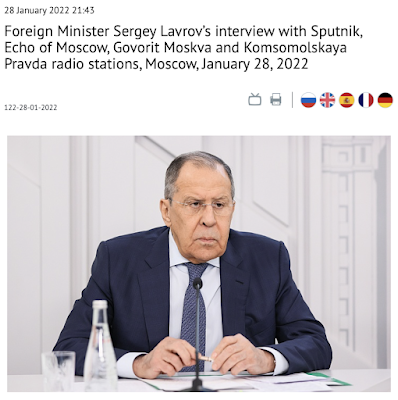
Sergey Lavrov on Russia and Ukraine

With Ukraine and Russia back on page one of the news cycle and with most of the West hearing only Washington's version of "the truth", a recent radio interview with Russia's Foreign Minister Sergey Lavrov provides us with additional insight regarding how the Russians feel about the current situation:


Let's look at some of the key questions and answers with all bolds being mine.


Question: Will there be a war? We sent them our proposals, we waited for their response, and we got their response. Their answer did not suit us, which was to be expected. Before that, we said and made clear through different representatives that if their response does not suit us, we reserve the right to respond and protect our interests forcefully. Can you explain what that means and what are we going to do? We aren’t going to make McDonald’s illegal after all, are we? If I may quote my subscribers, they frame this question as follows: “When are we going to hit Washington?”, “Will there be a war?”, “How long are we going to procrastinate?”, “Will there be a war?”


Sergey Lavrov: If it depends on the Russian Federation, there will be no war. We don’t want wars, but we won’t allow anyone to trample on our interests or ignore them, either. I cannot say that the talks are over. As you are aware, it took the Americans and their NATO allies more than a month to study our extremely straightforward proposals that are part of the draft treaty with Washington and the agreement with NATO. We received their response only the day before yesterday. It is written in that typically Western style. In many ways, they are confusing the issue, but also providing kernels of rationality on secondary issues such as intermediate- and shorter-range missiles which were quite important for us at some point.


Here is an exchange which clearly shows that Lavrov even has a sense of humour about how the Americans are handling the situation:


Question: If they give us the answer many experts are discussing, it will most certainly not suit us. Can it lead to a breakdown in relations? Everything we have been hearing recently from the Americans, and they are going to introduce sanctions against the leadership of our entire country, even against you…


Sergey Lavrov: What do you mean “even”? Are you saying I am not worthy of them?


Question: It has never happened in history. There has never been talk of sanctions against the Foreign Minister and the President. This is beyond the pale. Look at what is happening with our diplomats against this backdrop. Yesterday our Ambassador to the United States said that ultimately this might lead to something close to severing relations. As Anatoly Antonov said, our diplomats are simply being expelled although this is presented in a somewhat different way. What should we do? How will it look?


Sergey Lavrov: This is a multilayered question. I will start with the main point: What will we do if the West does not listen to reason? The President of Russia has already said what. If our attempts to come to terms on mutually acceptable principles of ensuring security in Europe fail to produce the desired result, we will take response measures. Asked directly what these measures might be, he said: they could come in all shapes and sizes. He will make decisions based on the proposals submitted by our military. Naturally, other departments will also take part in drafting these proposals....


Our reply will be prepared. The proposals contained in our reply will be reported to the President of Russia and he will make a decision. We are developing our line at this point, including the steps that I mentioned.


As for the threats of imposing sanctions, the Americans were told, including during the presidential meeting, that the package you have just mentioned, the one that includes completely cutting off Russia from the West-controlled financial and economic systems, will be equivalent to severing relations. This was said directly. I believe they understand this. I don’t think this is in anyone’s interests.


I found this question and answer particularly interesting given the mainstream media's fixation on how Russia meddles in the affairs of other nations (while, of course, Washington would never do such a thing):


Question: To follow up on our relations with the United States, you just said that we will continue to work with them. A meeting with Antony Blinken will take place soon. However, now that we have their answer, many analysts, in fact, almost all of them, are saying that the United States and the Alliance members are unlikely to change their position on the main issues. They are saying that “the ball is in Russia’s court now, and we are ready for any scenario.” You are saying our President said that we would respond, and that the response is in the works. The Foreign Ministry is involved in this. Can we have a sneak peek at the direction in which our Foreign Ministry is going to move in order to shoot the “ball” back at them? Is it Latin America? Cuba, Venezuela, Nicaragua? Could it be Europe? Serbia? Maybe we can do something with Iran? Can you give us a hint about what our response should be like for these guys to sit down, use their heads and try to give us different answers to our main questions, rather than secondary ones?


Sergey Lavrov: If they insist on not changing their position, we will not change ours, either. It's just that their position is based on false premises and a flat-out misrepresentation of the facts. Our position is based on things that everyone has signed onto. I don't see any room for a compromise here. Otherwise, what are we supposed to talk about if they openly sabotage and misrepresent previous decisions? This will be a key test for us.


As for the “ball,” we are playing different games. They may be playing baseball, while we may be playing tipcat. What matters is not to try to shirk responsibility, which is exactly what our American and other NATO partners are doing now....


Regarding our relations with Latin America, Serbia, Iran, China and many other states that act decently in the international arena, are not trying to unilaterally impose anything on anyone and are always willing to seek mutually acceptable solutions to any issues. Our relations are not subject to the vagaries of life. They are quite comprehensive and cover economic, cultural, educational, and sports contacts. They also include military and defence cooperation in full compliance with international law. I assure you that no matter how developments unfold with regard to European security, we will continue to consistently expand these relations.


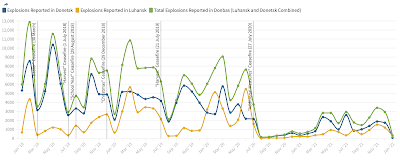
For this question and answer, I need to provide you with some background.  The Minsk agreement aka the Minsk Protocol was a peace plan for eastern Ukraine signed on September 5, 2014 by France, Germany, Ukraine and Russia.  It called for an Organization For Security and Cooperation in Europe (OSCE) monitored ceasefire, an exchange of prisoners, the withdrawal of armed formations, military equipment and fighters from Ukraine and the establishment of an OSCE-monitored security zone along the border as well as an economic reconstruction program for Donbas (eastern Ukraine consisting of Donetsk and Luhansk).  It was to be in force for three years and extended annually thereafter.  


Here is a graphic from Crisis Group showing the impact of the ceasefires on explosions in both Donetsk and Luhansk noting that prior to the July 2020 "Additional Measures" ceasefire, the ceasefires had little impact on the level of violence:


Question: A scandal is unfolding in the United States. CNN published a report citing its own sources. In it, they alleged that the United States and Ukrainian presidents talked on the phone, with Joe Biden supposedly yelling at Vladimir Zelensky in an attempt to explain to him in a raised voice that unless he changes his position on Donbass, Kiev will fall and be pillaged, etc. CNN published this report on its website, but later removed it. Still, the scandal lives on. Both Joe Biden and Vladimir Zelensky are getting questions about this. In this telephone conversation, the President of the United States allegedly requested that the President of Ukraine urgently resolve the special status issue for Donbass.


If Kiev does decide to amend its constitution and grant Donbass a special status, will this affect Russia’s policy on Ukraine in any way? To be honest, you cannot trust these people. There are 720,000 Russian nationals there today, and in the future there could be even more of them. We do understand the threats they may face after obtaining a Russian passport. Are we ready for these eventualities? What will be Russia’s policy on the people’s republics?


Sergey Lavrov: We have always stressed the need to fully implement the Minsk agreements in good faith and following the sequence it sets forth. As my colleagues and I have been saying in our public statements, during the Geneva summit meeting in June 2021 between the Russian and United States presidents, Joe Biden said at his own initiative that he wanted to facilitate the implementation of the Minsk agreements, including in terms of granting an autonomous (this was the word he used) status to Donbass. He understands everything....


The Americans are using Ukraine against Russia so openly and cynically that the Kiev regime itself is now scared. They are now saying there is no need to aggravate the discussion and are suggesting that the Americans keep down the rhetoric, and are also wondering why evacuate diplomats. Who is evacuating diplomats? The Americans and other Anglo-Saxons (Canada and the UK), meaning they know something others don’t. Perhaps, pending a provocation on their part, we should take precautionary measures with regard to our diplomats as well. We’ll see about that.


And, once again, we circle back to the prospect of war:


Question: The most popular question: will there be a war with Ukraine?


Sergey Lavrov: This is what we started off with. If it’s up to the Russian Federation, there will be no war. I do not rule out the possibility that someone out there would like to provoke hostilities.


According to the West, there are about 100,000 troops on the line of contact. The Kiev regime does not control most of these armed men. A significant portion of the units that are stationed there include the former volunteer battalions, current territorial defence units, and militia. MANPADS are already being handed out to them. The media are reporting this information. They are encouraged to bring along hunting rifles with them, because there aren’t enough MANPADS for everyone. This is a militaristic frenzy. I cannot rule out the possibility of someone losing it, just like that soldier who shot and killed five of his fellow servicemen.


And, here's a good place to close this posting:


Question: Are we going to evacuate our staff from Kiev as well?


Sergey Lavrov: We discussed this bout of insanity that is being fomented in Ukraine, primarily by the Anglo-Saxons (Canada, thanks to Chrystia Freeland in no small part, and the United Kingdom) and some Europeans. Dramatic claims that everyone must leave the place are part of this insanity. People who came there to tend to their business are urged to leave. Diplomats and their families are being taken home and non-core staff is being cut.


We cannot let it go unnoticed or turn a blind eye to it. If they are doing this (even though the Ukrainians haven’t asked them to), could it be that the Anglo-Saxons are up to something? The British particularly have a long track record in this area.


While you may not agree with everything that Sergey Lavrov has to say about the issues facing Ukraine, he at least deserves credit for having a full grasp of what the West is up to when it comes to fomenting conflict and doing its best to set the world up for the Cold War Part 2.  And, at the very least, he seems quite capable of second order thinking, that is, the less obvious consequences of any actions that Russia takes in Ukraine, unlike the first order thinkers in Washington.