Showing posts with label United Kingdom. Show all posts

Monday, January 13, 2025

Comparing Vladimir Putin's Popularity to Western Leaders

In a previous posting, I looked at how Canada's Ambassador to Russia, Sarah Taylor, viewed Russians' sentiment toward their leader, Vladimir Putin and how he was just a short step from being tossed out of office.  In this posting, I want to compare President Putin's popularity to that of some key Western leaders and see who is really admired by their citizenry. 


Recent polling from Russia's  non-politically aligned Levada Center shows us that Vladimir Putin is still highly regarded by Russians: 


In December 2024, Putin's approval rating among his fellow Russians was 87 percent.


Now, in sharp contrast, let's look at the popularity of Justin Trudeau, Canada's Prime Minister (for now) and Ambassador Taylor's boss:


Currently, only 22 percent of Canadians approve of Justin Trudeau's performance, an all-time low.  By party, Trudeau's Liberals would receive only 16 percent of votes, another all-time low which would result in the party garnering only 6 out of the 338 seats in Canada's House of Parliament.


Here's a summary of polls showing Joe Biden's approval rating:


Just over 37 percent of Americans approve of Biden's performance.


Here is a graphic showing the popularity of France's President Emmanuel Macron:


Only 23 percent of France's voters approve of Macron's performance, a near-record low.


Now, let's look at the approval rating of U.K. Prime Minister Keir Starmer:


Only 27 percent of Brits are satisfied with Starmer's performance and only 21 percent are satisfied with the performance of his government.


While I don't have a graphic to show, polling in September 2024 showed that only 18 percent of Germans were satisfied with the performance of their Chancellor Olaf Scholz as quoted here:


One might almost think that the nations leading the battle against Putin's Russia find themselves with leaders that they wish to rid themselves of on a permanent basis.  I'm guessing that many of the West's leaders, many of whom are of the Neo-liberal persuasion, would kill for the very high approval numbers that Vladimir Putin is receiving from his fellow Russians.


Wednesday, April 26, 2023

The Collapse of the Rules-based International Order

Let's open this posting with a definition from the United Kingdom's government:


"The rules-based international system (RBIS) is founded on relationships between states and through international institutions and frameworks, with shared rules and agreements on behaviour.  It works for UK interests in multiple ways: promoting peace and prosperity through security and economic integration; encouraging predictable behaviour by states; and supporting peaceful settlement of disputes. It also encourages states, and a wide range of non-state actors, to create the conditions for open markets, the rule of law, democratic participation and accountability."


The rules-based order is a shared commitment among states to conduct their affairs in accordance with an existing set of rules that are underpinned by a system of global government that has evolved since the end of the Second World War.  The United Nations is generally considered to be at the core of this "order".


Here is an additional summary of rules-based order noting that there are no specific rules:


1.) RBO seems to be a broader term than international law which is defined as legally binding rules that are based on, and require the consent of each individual State.


2.) It seems to include both traditional international law rules, and what is usually referred to as “soft law” – legally non-binding political commitments.


3.) The term “rules-based order” blurs the distinction between binding and non-binding rules, giving the impression that all States and international actors are subject to this order, irrespective of whether or not they have consented to these rules.


4.) While international law is general and universal, the “rules-based order” seems to allow for special rules in special cases.


With that in mind, let's look at some excerpts from recent comments made by Russia's Foreign Minister (and consummate diplomat) Sergei Lavrov at the United Nation's Security Council's open debates "Effective multilateralism through the Defense of the Principles of the UN Charter" with my bolds throughout:


"For a little less than 80 years of its existence, the UN has been carrying out the important mission entrusted to it by its founders. For several decades, a basic understanding by the five permanent members of the UN Security Council as regards the supremacy of the charter’s goals and principles guaranteed global security. By doing this, it created the conditions for truly multilateral cooperation that was regulated by the universally recognized standards of international law.


Today, our UN-centric system is going through a deep crisis. The main reason is a striving by some UN members to replace international law and the UN Charter with a certain “rules-based” order. Nobody has seen these rules. They have not been discussed in transparent international talks. They are being invented and used to counter the natural process of the forming of new independent development centres that objectively embody multilateralism. Attempts are made to curb them through illegal unilateral measures – by denying them access to modern technology and financial services, excluding them from supply chains, seizing their property, destroying their critical infrastructure and manipulating universally accepted norms and procedures. This leads to the fragmentation of global trade, a collapse of market mechanisms, paralysis of the WTO and the final – now open – conversion of the IMF into an instrument for reaching the goals of the US and its allies, including military goals.


In a desperate attempt to assert its dominance by way of punishing the disobedient, the United States has gone as far as destroying globalisation which it has for many years touted as a great benefit for humankind serving the needs of the global economy’s multilateral system. Washington and the rest of the obeisant West is using these rules as needed to justify illegitimate steps against the countries that build their policies in accordance with international law and refuse to follow the “golden billion’s” self-serving interests. Those who disagree are blacklisted based on the precept that “he who is not with us is against us....


By imposing a rules-based order, the quarters behind it arrogantly reject the UN Charter’s key principle which is the sovereign equality of states. The “proud” statement by the head of EU diplomacy Josep Borrell to the effect that Europe is a “garden” and the rest of the world is a “jungle” said it all about their world of exceptionality. I would also like to quote the Joint Declaration on EU-NATO Cooperation of January 10 which runs as follows: The United West “will further mobilise the combined set of instruments at our disposal, be they political, economic or military, to pursue our common objectives to the benefit of our one billion citizens.”


The collective West has set out to reshape the processes of multilateralism at the regional level to suit its needs. Recently, the United States called for reviving the Monroe Doctrine and wanted the Latin American countries to cut down on their ties with the Russian Federation and the People's Republic of China....


Since World War II, Washington has pulled off dozens of reckless criminal military operations without even trying to secure multilateral legitimacy. Why bother, with their set of arbitrary “rules?


And, Russia is not just pointing the finger at Washington:


"The Anglo-Saxons (i.e. the United Kingdom) who are at the helm of the West not only justify these lawless adventures, but flaunt them in their policy for “promoting democracy,” while doing so according to their own set of rules as well, where they recognised Kosovo’s independence without a referendum, but refused to recognise Crimea’s independence even though a referendum was held there; according to British Foreign Secretary James Cleverly, the Falklands/Malvinas are not an issue, because there was a referendum there. That’s amusing."


Here's Russia's solution to the dilemma:


"In order to avoid double standards, we call on everyone to follow the consensus agreements that were reached as part of the 1970 UN Declaration on Principles of International Law which remains in force. It clearly declares the need to respect the sovereignty and territorial integrity of the states that conduct “themselves in compliance with the principle of equal rights and self-determination of peoples as described above and thus possessed of a government representing the whole people belonging to the territory.” 


I would strongly suggest that you take the time to read Lavrov's entire commentary which you can find here


There is little doubt that the international order which was established by the victorious allies after the end of the Second World War is under threat.  Here is a quote from a paper entitled "Challenges to the Rules-Based International Order" which appears on the Chatham House website, again with my bolds:


"The framework of liberal political and economic rules, embodied in a network of international organizations and regulations, and shaped and enforced by the most powerful nations, both fixed the problems that had caused the war and proved resilient enough to guide the world into an entirely new era.


But given its antique origins, it is not surprising that this order now seems increasingly under pressure. Challenges are coming from rising or revanchist states; from unhappy and distrustful electorates; from rapid and widespread technological change; and indeed from the economic and fiscal turmoil generated by the liberal international economic order itself.


In general these challenges seem serious rather than catastrophic. There is little coherence or common interest among the challengers, except for discontent with aspects of the current order, and therefore little coordination. There is no sign of any integrated international opposition movement which might unite the discontented and advocate an alternative system, leading to the sort of ideological struggle that marked the last century. And, despite continuing conflicts around the world, war remains an exceptional and disreputable activity rather than, as in much of the past, a proper and attractive tool of international dispute resolution.


These are small mercies. The danger to the current order comes not from a single deathblow from a rival system, but from its gradual weakening in the face of widespread dissatisfaction among those it needs to serve. If the system is to survive, its weaknesses must be recognized and resolved, and it must adapt better and faster to the changing international situation."


Three interconnected problems must be resolved. The first is the problem of legitimacy. For a system based on rules to have effect, these rules must be visibly observed by their principal and most powerful advocates."


If you want a prime example of a breach of the rules-based international order, you need look no further than Washington's decision to invade Iraq in 2003, the failure to close the Guantanamo Bay detention facility, America's use of torture during the War on Terror, the use of presidential authority to carry out drone strikes and America's widespread use of surveillance technology which was pointed out by Edward Snowden.


The world is on the cusp of change.  Unless the ruling class in Washington and the West in general adapts quickly to the new global reality, it will be left behind as the new world moves ahead under the leadership of the BRICS nations and those who attach themselves to the growing influence of this group of nations who have been left out in the cold during the era of the rules-based international order.


Monday, May 2, 2022

Food, Farmers and Government Interference in the Agri-Food Sector

Over the past year, there has been a growing chorus of world leaders, economists and agricultural experts warning the world of a global shortage of food.  Those of us who are living in the world's so-called advanced economies are already seeing evidence of this with shelves in stores looking like this:


While the power brokers and mainstream media in the West are doing their best to blame food shortages and the accompanying rise in prices on Vladimir Putin and his military operation in Ukraine, in fact, as you will see in this posting, it is the leaders of these Western governments and their misguided policies that are and will be responsible for dropping agricultural output.


In this posting, we'll look at recent policies enacted by three governments around the world:


1.) The United Kingdom: On February 8, 2022, the following notice appeared on the U.K. government's website:


Farmers who wish to leave their farms will be supported by the new Lump Sum Exit Scheme which is part of the government's Agricultural Transition Plan which outlines plans for a new, fairer system of farming. The Lump Sum Exit Scheme is due to run from April to the end of September 2022 and the payment will be based on the average direct payments made to the farmers who apply for the 2019 to 2021 Basic Payment Scheme years.  The referent figure will be capped at £42,500 multiplied by 2.35 which means that farmers could receive up to £100,000, hardly a sum worthy of retirement.  In return for this payment, farmers will be expected to do two things:


1.) surrender their entitlements


2.) surrender their tenancy


Farmers who accept the payment will be expected to either rent or sell their land.  The government claims that this will create opportunities for new entrants to farming or will allow existing farmers to expand their businesses.


Unfortunately, there is a downside.  This will mean that farming could well become even more concentrated in the hands of Big Agriculture (think Bill Gates etcetera) as smaller family-run farms either are shut down or sold, a group that isn't necessarily known as environmentally conscientious, being driven by the profit motive rather than a "love for the land" as is typical in most small farming operations.


2.) The United States: Here is an announcement dated April 21, 2021 as found on the USDA website:


In this press release, the Biden Administration announced plans to add 4 million acres to the Conservation Reserve Program or CRP.  In January 2022, the USDA Farm Service Agency announced that farmers could sign up for the general program from January 31, 2022 to March 11, 2022 and for the grassland program between April 4, 2022 and May 13, 2022.  


Here is a quote from the announcement regarding the benefits of these programs:


"General CRP helps producers and landowners establish long-term, resource-conserving plant species, such as approved grasses or trees, to control soil erosion, improve water quality and enhance wildlife habitat on cropland.  


Meanwhile, Grassland CRP is a working lands program, helping landowners and operators protect grassland, including rangeland and pastureland and certain other lands, while maintaining the areas as working grazing lands. Protecting grasslands contributes positively to the economy of many regions, provides biodiversity of plant and animal populations and provides important carbon sequestration benefits to deliver lasting climate outcomes."


In 2021, producing farmers and landowners enrolled 4.6 million acres into the program , brining the total to 22.1 million enrolled acres.  The Farm Service Agency is aiming to reach the 25.5 million acre cap set for fiscal year 2022 and 27 million acres by 2023.


The program is being driven by the Biden-Harris Administration's efforts to address climate change and achieve other natural resource benefits.  Here is a quote from the April 2021 announcement with my bold:


"With CRP, the United States has one of the world’s most successful voluntary conservation programs. We need to invest in CRP and let it do what it does best—preserve topsoil, sequester carbon, and reduce the impacts of climate change...


CRP is a powerful tool when it comes to climate mitigation, and acres currently enrolled in the program mitigate more than 12 million metric tons of carbon dioxide equivalent (CO2e). If USDA reaches its goal of enrolling an additional 4 million acres into the program, it will mitigate an additional 3 million metric tons of CO2 equivalent and prevent 90 million pounds of nitrogen and 33 million tons of sediment from running into our waterways each year."


As you can see, it's all about retiring farmland as a response to reducing the environmental impact (i.e. climate change) of raising food.  While some of this land may be marginal, much of it is still capable of producing crops that are part of the current global food shortage.


In another example from the United States, California farmers have been given a financial incentive not to plant crops as a response to the ongoing drought in the Western United States.  Under the $2.9 billion plan,    thousands of acres would be left unplanted, all in the name of protecting and enhancing the state's watersheds.  The rice cultivation sector will be most impacted by the program with 35,000 acres of rice fields lying fallow, representing approximately 6 percent of the state's crop in a normal year.   The agreement was signed by state and federal officials as well as representatives of some of the state's largest water agencies without consulting with indigenous or environmental groups.  Only time will tell whether the program expands and becomes mandatory, further negatively affecting agricultural output from the nation's largest food producing state.


3.) Canada: In a recently released "discussion document", Canada's Agriculture and Agri-Food Canada entitled "Reducing emissions arising from the application of fertilizer in Canada's agriculture sector", the Trudeau government outlines its plans for the farming sector as part of its overall plan to achieve a greenhouse gas emissions reduction target of 40 to 45 percent below 2005 levels by 2030.  Under the plan, the government proposes to lower greenhouse gas emissions from the agricultural sector by implementing a "fertilizer target".  Here is a graphic from the document showing the growing emissions from mythic fertilizer applications:


According to the researchers, N2O emissions from fertilizer applications in Canada rose by 64 percent Here is a quote:


"Increased N2O emissions on cropland are driven by the combined effect of a continued increase in area under annual crop production (e.g., conversion of pasture to land for annual crop production), an increase in the area under fertilizer intensive crops, and an increase in soil degradation which has contributed to carbon (C) and N losses from soils. The area under more fertilizer-intensive crops such as canola and corn has expanded considerably since 2001, while the area of some crops requiring lower fertilizer rates, such as wheat, barley, oats and tame hay has decreased.


As well, the intensity of N2O emissions per hectare has nearly doubled since 1981. This is a result of increased fertilizer application rates coupled with only a minimal expansion of the total Canadian agricultural area. This intensification of production, supported through increased fertilizer use and improvements in breeding and pest and disease control, has resulted in higher yields on a per area basis."


Farmers grow crops that are the most profitable after their input costs.  That's why they plant what they do, a concept that seems beyond government.


The authors also note that, while Canada accounts for only 1 percent of global agricultural greenhouse gas emissions, Canadian cereal production "likely" has one of the highest levels of emissions intensity among major exporting nations as shown here:


The document also states that the European Union aims to achieve a 20 percent reduction in the use of fertilizer compared to 2020. 


The authors propose the following farming practices (4R) to reduce fertilizer emissions:


1.) Right source matches the fertilizer type to crop needs. This encompasses the use of synthetic versus organic fertilizers, as well as fertilizers with different nutrient compositions and different formats (liquid, granular, seed-banded, slow release, manure etc.) and products that include additives such as nitrification and urease inhibitors;


2.) Right rate matches the amount of fertilizer to crop needs. This entails only applying what can be taken up by the crop over the course of the growing season. This recommendation can include precision application technologies (including those that address in-field variability), and the use of soil tests to make nutrient management decisions accounting for existing soil nutrient levels;


3.) Right time means nutrients are available when crops need them. This could include practices such as split application (applying at seeding as well as later at critical crop growth stages) or avoiding applying fertilizer in the fall when there is a higher risk of loss through spring runoff; and,


4.) Right place means nutrients are placed where crops can use them. This recommendation includes practices such as banding whereby the fertilizer is applied in concentrated strips; side dressing whereby fertilizers are placed in a row adjacent to the crop, or seed-placed, where fertilizers are placed in the same furrow as the seed. This includes practices such as broadcasting where possible, whereby nutrients are spread on the surface of the soil (or growing crop) and which can lead to inefficiencies and losses to the broader environment.


According to their calculations, the 4R program could reduce fertilizer-related emissions at the same time as it improves crop yields although, given that much of Canada's soil has become little more than a sterile growing medium, without the application of significant volumes of chemical fertilizers, crop yields would certainly drop under the implementation of a Fertilizer Emissions Target.  Stakeholders who have already commented on the idea of a reduction in the use of fertilizers have noted that there are several issues which will be barriers to the implementation of this program including a decrease in crop yields (as I noted above) which means that the Government of Canada's export growth targets for the agricultural and agri-food sectors will not be met.  They also noted that Canada's diverse geography and resulting farming practices do not lend themselves to a single solution and, most importantly, that there is a lack of technology that can accurately measure the emissions associated with fertilizer use.


As is typical, when governments interfere in a sector of the economy, there are a series of unintended consequences that are unforeseen by the "chair jockeys" who imaginatively create solutions to what governments feel are critical issues.  Given that there is significant stress in the global agri-food sector, one would think that governments would take actions that would increase food output rather than creating additional, supposedly voluntary (at least for now) programs that have the potential to reduce agricultural output.  In addition, at least some of these programs are targeting agricultural greenhouse gas emissions, blaming farmers for practices that governments now see as "unsuitable for their needs".  One has to wonder how long it will be before these voluntary programs become mandatory.  


So, if you think that this is going to improve over the coming months and the situation gets worse:


...now you know that you can certainly can lay at least some of the blame for food price inflation at the feet of meddlesome  Western governments.


There are only a few sentences more frightening to business people than "I'm with the government and I'm here to help you."  The agri-food sector is no exception.


Thursday, February 3, 2022

Government Misspending During the Pandemic - A Primer from the United Kingdom

Very few people would doubt that governments have an innate ability to waste money.  It is particularly easy for this to occur since government departments don't actually have to work to receive your tax dollars.  During the pandemic, it has been my suspicion that there have been extremely high levels of government waste in the name of "protecting the public" including purchasing PPE and temporary hospitals among other items.  Thanks to the United Kingdom's Department of Health and Social Care's Annual Report and Accountability 2020-2021 report for the period ending March 31, 2021, we now have an idea of the size of waste during the pandemic for one major government:


The Department of Health and Social Care (DHSC) plays the following role in the United Kingdom:


"The Department of Health and Social Care (DHSC) supports the Government’s Health and Social Care Ministers in leading the nation’s health and care to help people live more independent, healthier lives for longer.


We support and advise our Ministers to shape policy and set direction, while remaining accountable for delivering the Government’s commitments, co- ordinating the legal, financial and policy frameworks in health and social care and, when necessary, we step in as troubleshooters to take action on complex issues, as can be seen in the Department’s response to the COVID-19 pandemic.  In doing all this, we work closely with our partners in the health and care system, our Arm’s Length Bodies (ALBs) and agencies, local authorities, across Government, and with both patients and the public. We are accountable for the health and care system to Parliament and the taxpayer."


As noted above, the DHSC works through Arm's Length Bodies including the National Health Service or NHS and Public Health England or PHE which are part of the nation's universal health care system.


Here is a diagram showing how funds flow through the UK health and care system noting that the total funding for fiscal 2020 - 2021 was £213.7.


Here is the special funding that was provided for the pandemic which totalled around £63 billion:


1.) £18 billion revenue and £0.6 billion capital for the NHS to support the frontline response to the pandemic.


2.) £23.1 billion for the Test and Trace programme.


3.) £14.8 billion for the procurement and supply of PPE.


4.) £4.2 billion for the deployment of the COVID-19 vaccine and other COVID-19 treatments.


5.) £1.3 billion for the infection control fund and other grants.


6.) £0.6 billion for ventilators and the Critical Care National Stockpile.


The annual report is 341 pages long and, of course, no one actually expects anyone to read through the entire document which is how governments hide their misspending.  If you take the time to look at the report, skip ahead to page 198 which is where you will find the most interesting part of the document.   In this section, the report from the Comptroller and Auditor General to the House of Commons outlines the areas where waste took place.  Let's start with the key finding with my bolds throughout:


"The COVID-19 pandemic put the Department under extraordinary pressure. It needed urgently to procure enormous volumes of goods and services in an overheated global market. The Department has stated that its priority was to ensure that it was able to meet the requirements of a reasonable worst case scenario. In order to do so, it rapidly increased its risk appetite and adapted its normal processes and procedures. The Department was not able to manage adequately some of the elevated risks, resulting in significant losses for the taxpayer. Nearly two years later, it has not fully restored effective control over some of the inventory purchased."


Here are the issues that the audit discovered:


1.) The Department estimates that there has been a loss in value of £8.7 billion of the £12.1 billion of PPE purchased in 2020-21. Of this £8.7 billion impairment, £4.7 billion relates to reductions in market prices since the goods were purchased.


Here are more detailed issues with the PPE:


a.) £0.67 billion of PPE which cannot be used, for instance because it is defective.


b.) £2.6 billion of PPE which is not suitable for use within the health and social care sector but which the Department considers might be suitable for other uses (although these potential other uses are as yet uncertain).


c.) £0.75 billion of PPE which is in excess of the amount that will ultimately be needed.


The Department’s inventory management systems were unable to cope with the significant, rapid increase in procurement and the Department did not maintain adequate records of the location or condition of £3.6 billion of inventory balances recorded in the accounts at the 31 March 2021. Since the year-end, the Department has made progress in improving its records, but significant work remains to be done.


The level of fraud risk has increased as a result of COVID-19 – related procurement. A significant increase in new suppliers, a lack of timely checks on the quality of goods received and poor inventory management all contributed to this heightened risk. In these circumstances and given the lack of physical checks on the inventory held by the Department, I have not been able to obtain assurance that there has not been a material level of losses due to fraud.


There are material levels of error and uncertainty in the accruals balance that has been recognised in the group account."


In fact, because it was so difficult to audit the Department's spending during the pandemic, the report could not be completed until ten months after the year-end of March 31, 2021.


Inventory management has been a significant issue as well as follows:


1.) The Department’s inventory management systems were unable to cope with the significant, rapid increase in COVID-related procurement. This left the Department with incomplete records of the PPE and LFTs it had purchased, what had been used and the location, condition and quality of the remaining items at the year-end.


2.) The weaknesses in its inventory records, combined with significant volumes of inventory being locked in containers at ports, other temporary locations or in storage in China, meant the Department was unable to complete its physical stock-counts at the year-end to verify the quantity and quality of the inventory it held. The Department’s records show that as at 31 March 2021, it held 7.5 billion items in 16,000 containers at UK ports plus a further 1.6 billion of items in storage in China; however, because it did not complete its year end stock counts it is unable to confirm this.


 Controls over spending were also an issue as follows:


1.) The Department’s changes to its normal procurement processes in the context of an overheated global market for PPE meant it was exposed to a heightened risk of fraud in 2020-21. A significant increase in new suppliers, a lack of timely checks on the quality of goods received and poor inventory management all contributed to this heightened risk.


It was confirmed that £1.3 billion of the Department's spending did not have proper authorization and was considered "irregular" because it was spent without approval.


There is no doubt that governments, particularly those in the so-called "advanced economies" were in a panic to mount some sort of a response to the pandemic but, as the United Kingdom's example is showing, significant errors in judgement were made which resulted in a very significant level of waste and mismanagement which will take years to correct.  We must remember that these wasted dollars were contributed to the Treasury by taxpayers who worked hard to earn the money that was then remitted to a government which seems to have thrown caution to the wind.  We can also assure ourselves that similar levels of waste will be discovered when other government's release details of their spending on the pandemic over the coming year(s)...just around the time that they start increasing taxes to cover their overspending ways.


Friday, December 10, 2021

The United Kingdom and its Looming Social Credit Score Program

A recent announcement/pronouncement from the government in the United Kingdom may help us to better understand what lies ahead once the "vaccine passports" are in place and can be used for other purposes.


Here's the announcement of the pilot project:


A contract has been awarded to HeadUP Systems to develop a new app with taxpayers forking over £3 million pounds for "rewards".  The project will fall under the direction of the Office of Improvement and Disparities and their "drive to use digital technology to improve physical health and prevent health conditions before they develop."  The pilot project will begin in January 2022, running for six months in a defined location yet to be announced and participants will wear devices on their wrists which can generate personalized health recommendations including increasing thee number of steps that they take, eating more healthy food including fruits and vegetables and decreasing the size of meal portions.  Users will collect points when they make healthy choices and these points can be used to unlock rewards which include passes to gyms, clothes and food vouchers as well as discounts for shops, theatres and theme park tickets.


Here is a quote from the news release:


"Evidence suggests that financial incentives can improve rates of physical activity and inspire healthier eating so HeadUp will work with a range of organisations to provide rewards such as vouchers, merchandise, discounts and gift cards.


The government is committed to helping people lead healthier, happier lives by making it easier for people to make healthy choices.


Health and Social Care Secretary, Sajid Javid said:


I want to ensure we’re doing as much as we can to tackle health disparities across the country, and this new pilot will pave the way for developing innovative ways to improve the lives of individuals, and also help to reduce strain on the NHS.


The Office of Health Improvement and Disparities is driving forward our levelling up agenda for health and ensuring prevention is a vital part of everything we do.


This pilot is an excellent opportunity to find how best to inspire people to make small changes to their daily lives that will have a lasting positive impact on their health....


Public Health Minister Maggie Throup said:


We are committed to improving the health of people across the country.


The HeadUp app pilot will help us better understand how appropriate rewards can motivate people to make positive changes to their diet and physical activity, supporting them to lead healthier lives."


The news release also notes that obesity-related illnesses cost the National Health Service £6 billion annually with almost three-quarters of adults in England living with either excess weight or obesity as shown here:


Here is some background information on HeadUP Systems:


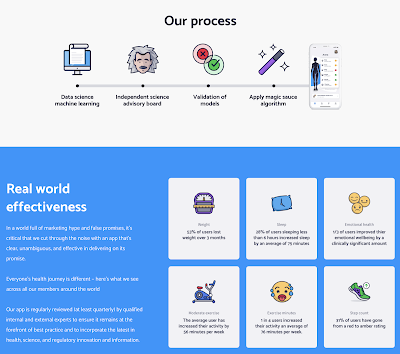
HeadUp states that they are "thought leaders" who are "re-engineering healthcare and that they have 20+ years of experience in health tech and "insurtech".  Here is a screen capture of their process and effectiveness:


Here is an interesting quote and screen capture regarding the company's use of data:


"The rise of wearables and connected devices has given rise to billions upon billions of data points – we are committed to leading the way in evidence-based and validated means of helping make sense of all this data and using it to truly help people live a longer, happier, and healthier life.


In 2021, we will be engaging in clinical trials which will compare a randomly chosen group of participants who will be distributed into a test and a control group. They will be assessed over a period of time to determine how their health behaviours and outcomes improve after using the HeadUp app.


The results will be published in a peer reviewed journal.


Obviously, should an app of this sort be rolled out nation-wide, one can only imagine the amount of data that HeadUp and any affiliated government will be able to collect about our location/movement, activity levels, key health parameters and shopping habits/diet.  But, not to worry, here's what the announcement from the United Kingdom says about those concerns:


"The new app will place user privacy and security at its core and will ensure all personal information is safe and secure at all times."


We all know just how well governments mishandle and misuse personal information, don't we?


Given how governments have massively expanded their powers of behavioural monitoring/manipulation and social shaming during the COVID-19 pandemic, this looks like yet another step toward an all-encompassing surveillance state being promoted as something that is "for our own good".  Please don't misunderstand my concerns about this project; I believe and have practiced a healthy lifestyle for my entire life.  Unfortunately, this project has a ring of a Chinese-style social credit system to it; for now, you just won't collect your "rewards" if you are "badly behaved" however, it is a short step to a society where your access to the health care system is contingent and rationed on the basis of accepting behaviours dictated by a wearable digital device which is directly connected to government's snooping technology.  Bad health decisions are personal and unless we resist this form of invasive government behaviour, we may well find ourselves living in a society that is more akin to living in China where socially unacceptable behaviours are punished without recourse.