Showing posts with label privacy. Show all posts

Friday, October 14, 2022

The World Economic Forum, Digital Identification and the Interlocking Social Credit Score

For anyone paying attention, it has become very clear that the world is headed toward a system of digital identification.  One proponent of this scheme is the World Economic Forum, the group of global rulers who seemingly has an answer to every negative issue facing humanity.  Back in February 2022 while the world was grappling with high inflation and the Omicron variant, the WEF released this document:


In this report, The WEF's Task Force on Data Intermediaries which is composed of these individuals:


....looked at what data privacy could look like in the future given the rapid changes in technology which have expanded data collection well beyond website cookies etcetera which are collected on our devices every time that we use them and are being used for commercial and/or public purposes.  For example, thanks to the Internet of Things (IoT) (i.e. screenless technology), data is collected unbeknownst to all of us every time we use smart devices in our homes.  The WEF suggests that data intermediaries could serve as a "police force" which would provide checks and balances for the use of our data.  These intermediaries could be private for-profit or public (i.e. a government agency).  


Here's what the report has to say about public data intermediaries:


"A public body or government agency could take on the role of an intermediary, especially as it relates to data coming from public bodies. Therefore, it can also act as an aggregator or gateway for such information. Such an intermediary could play an even greater role in making the data more easily accessible, identifiable, searchable and usable, including coordinating interoperable systems, especially across the public sector at least. Therefore, the role of a public body is arguably greater if it is an aggregator of multiple sources of public data. Another role it could play is to act as a super- intermediary, setting the national standard, data architecture and data standards for which all organizations would be required to comply. This will require deep expertise in privacy, data and technology, and therefore upskilling of the staff and/or hiring of a “data steward” with the required skillsets."


Here's what the report says about private for-profit data intermediaries:


"Whether and how a for-profit commercial entity can successfully serve its clientele under voluntary fiduciary duties of care and loyalty remain open to debate among stakeholders.29 A key driver of the success of this model is how the intermediary derives economic value to be able to perform and make this service available.  Without strict controls on the access, use and transfer of the underlying data provided by data ecosystem participants, this model could incentivize the intermediary to examine ways to profit from the data itself, unless prohibited by law or contractual arrangements. Where a participation fee may not generate sufficient profit, the provision of additional services could satisfy the economic argument without – requiring any service that involves or enables the intermediary to profit from the data itself, directly or indirectly. A hybrid of this approach and variation of cost models could bridge this issue. Various models could also co-exist, with a certification or trust mark for those that abide by certain agreed standards. On the other hand, however, is an immense opportunity for the most responsible organizations that could be incentivized to create or pay a trusted third-party intermediary to increase their independence and transparency with respect to their user base and thus commercial appeal with respect to offering services to their users."


Let's get to the "meat" (or insects) of this posting.  In the chapter entitled "Moving towards trusted digital agency", the authors look at the implementation of a digital identity scheme.  Here is a quote from the chapter:


"A digital ID is the electronic equivalent of an individual’s identity card. It is a way to provide verified personally identifying information of an individual for a software to read and process. Both online and offline environments can adopt digital identity. And it can also act as a key by storing and deploying permission.


Carefully designed and properly managed, digital ID can also enhance privacy protection and reduce the rise of identity fraud since each time only minimum information is needed for authentication for the specific purpose. Some of the biometric based digital ID systems have already been adopted in financial transactions and for a cash-free shopping experience. Such authentication and authorization processes can be completed in real time and free of hassle."


I always like how the WEF frames things in such positive terms as though, in this particular case, there is no nefarious aspect to the implementation of a digital identity.


As is typical of WEF publications, they provide this marvellous (and meaningless) graphic showing the importance of identity in the everyday lives of the servant class and how it can be wrapped into a digital identity:


Most importantly, this table shows the evolution of digital identities into the future:


And, there you have it.  According to the authors, the evolution of digital identities will become increasingly all-encompassing, particularly if/when Klaus Schwab's Fourth Industrial Revolution wet dream of implantable technology comes to fruition.  You will notice that the focus of digital identity will shift from "verified attributes and credentials" to "interferences about a person" .


If we got back to this graphic which is located just above the table, we find this clarification of "interferences" when looking at the evolving scope of digital identity:


This certainly would appear to suggest that your digital identity could be used as a form of social credit score with your online and offline behaviours being tracked and traced and used to infer your worthiness, interlocking your digital identity with your social credit score.  For example, your social behaviour which will be assessed through the analysis of your data which will be used to determine whether you are allowed to travel, make certain purchases of goods and services etcetera, similar to the system being used in China.  We saw the first tentative steps in the development of a social credit score ecosystem with the implementation of vaccine passports in many nations around the world which resulted in non-vaccinated individuals being stripped of their ability to travel, enter restaurants and pubs, play sports, retain their jobs etcetera.  This is even discussed in this report as shown here:


I'm quite certain that technology companies who are members of the World Economic Forum's inner circle are quite thrilled with the prospect of massive profits generated by the implementation of a data intermediary reality associated with a digital identity scheme.  Major shareholders of these companies stand to benefit personally just as the executives of certain Big Pharma companies benefitted during the pandemic, particularly when governments came on board to force their citizens to be vaccinated.  As well, if there is anything that we've learned in the post-September 11, 2001 era, it's that governments could care less about our privacy no matter what they may tell us and that the COVID-19 era has taught us that governments will use whatever means available to them, particularly virtual documents, to control our behaviours.  


Remember, your personal data is the next "golden asset" class.  The ruling class knows this and needs it to implement their dystopian plans for our futures.


Monday, August 8, 2022

The Known Traveller Digital Identity - Part of Our Dystopic Future

It is the opinion of many experts (at least among those who are outside of the dinosaur media) that the pandemic was and will be used as a reason to issue a worldwide digital identity scheme which will be used by governments.  Let's look at one scheme that was undertaken back in the pre-COVID-19 pandemic and its supporters.


The Known Traveller Digital Identity or KTDI was conceptualized by a "multi-stakeholder Working Group" which was launched in 2015.  The original group of stakeholders included a wide range of governments, industry and international organizations and now serve as an advisory group for the initiative.  The original stakeholders included the following:


Airports Council International, Amadeus, Google, International Air Transport Association, International Civil Aviation Organization, International Criminal Police organization (INTERPOL), Marriott International, Mexico National Migration Institute, NEC Corporation, SAP Concur, Sedicci, UK National Crime Agency - United Nations Counter Terrorism Executive Directorate, US Department of Commerce, US Department of Homeland Security, Visa Inc., World Travel & Tourism Council, World Tourism Organization and Zurich Insurance Group."


In January 2018, the Governments of Canada and The Netherlands committed formed a pilot group to drive and pilot the KTDI concept in collaboration with private sector partners.  We'll get back to the private sector partners shortly.


Here is a quote from the website which explains how KTDI works:


"The KTDI is based on decentralized digital identity which uses cryptography, distributed ledger technology and international standard to enable an individual to self-manage trusted and verified identity attributes.  Through KTDI travellers can collect and share attestations.  An attenuation is a verified claim issued by a trusted entity, such as a government passport agency or border authority."


Attestations will be added to each traveller's KTDI profile each time that a trusted entity verifies a claim pertaining to the traveller.  The more attestations that the traveller collects, the more "known" that they become to the system.  Travellers will securely manage all components of their KTDI identity in their mobile device (the KTDI Wallet) and will be able to share them with stakeholders in the travel ecosystem on a voluntary basis.  


The KTDI will provide security agencies with early, reliable and verified information on travellers before they arrive "in country".  This will allow for expedited airport processing for pre-screened, low-risk travellers and will allow border control officers to focus their efforts on less-known travellers who may be a higher risk.  According to KTDI, passengers will benefit by having a more convenient and frictionless travel experience at the same time as they will have greater control over their personal identity information.  It will allow travellers to share information, including biometric data, which will allow individuals to pass through border and boarding checks without a need to present a passport or boarding card. 


The timeline for the pilot project was scheduled for testing internally throughout 2019 with the goal of completing the first end-to-end journey during the first quarter of 2020, just as the pandemic decimated the travel industry.  At the time of its conception, the pilot project was quite limited, including up to 10,000 passenger end-to-end trips facilitated by KTDI and would have operated on Air Canada and KLM flights between Canada's Toronto Pearson and Montreal Trudeau International airports and Amsterdam's Schiphol Airport.


As is typical when discussing digital identification schemes, in this case, KTDI is being sold to the world as a convenience for travellers since it is such a waste of time to stand in line for a few minutes while awaiting a border official to examine and stamp a passport (sarcasm intended).  It is also being heavily promoted as a system which will allow travellers to maintain control over all of their private data, sharing only what is necessary with government officials.  And, if you believe that, I have a bridge in the United Kingdom that I'd like to sell to you.


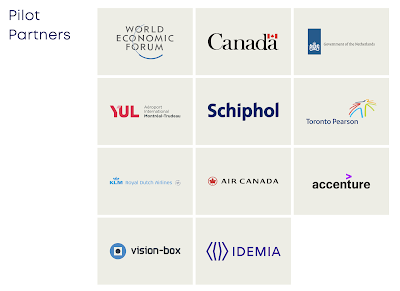
Now, as promised, let's look at the KTDI pilot project partners:


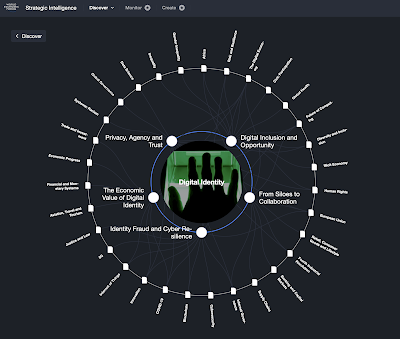
Isn't it interesting to see just how heavily involved Canada is in the KTDI initiative and that one of the partner groups is the World Economic Forum which has long been a proponent of digital identification technology as shown here:


...and quoted here:


"Having a trusted, verifiable identity is essential. As digital interaction increases at unprecedented rate, not least due to the COVID-19 crisis, the information comprising our identities is being widely shared in ways that create both opportunities and risks. If designed right, digital identities can provide countries with economic value equal to as much as 13% of their GDP, save hundreds of billions of hours through streamlined e-government, and cut trillions of dollars in costs for businesses by 2030, according to one estimate. For the roughly one billion people going without official proof of identity (and the more than three billion people unable to effectively use an identity on digital channels), collaborative and user-centric digital identity models guided by shared principles can be empowering."


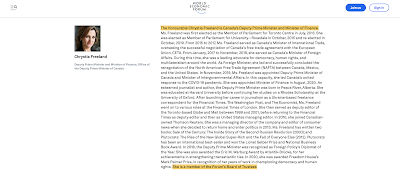
It is also pretty interesting to remember that this individual is a member of the World Economic Forum's Board of Trustees at the same time as she is supposedly serving Canadians as the Trudeau government's Deputy Prime Minister and Minister of Finance:


Given Freeland's February 2022 moves to lock down the bank accounts of "misbehaving" Canadians during the truckers' protest, it should be of concern to Canadians that her masters at the Kult of Klaus are playing a key role in the issuance of a digital identification system which seems to be focussed on using Canada as a technological playground.  I would suggest that the Trudeau government's implementation of the ArriveCan app is just the tip of the digital identity iceberg, particularly given their insistence that the app is here to stay.


If you have a few minutes to spare, here is a promotional video touting the need for and advantages of the KTDI:


In my mind, there is very little doubt that one of the key aspects of the Great Reset/Fourth Industrial Revolution or whatever you want to call our dystopic future will be the issuance of a digital identity which will be used as a key part of the upcoming social credit score program.  Once these digital identities are mandatory, we can kiss our privacy as well as the control that we currently have over our lives goodbye.


Tuesday, July 5, 2022

Paying With Your Face - Our Digital Identity Future

A recent press release on Mastercard's corporate Newsroom takes the world one step closer to the future of digital identities, a key part of the Great Reset/Build Back Better global reality.


Here is a screen capture of the press release:


Here are some excerpts from the press release:


"No more fumbling for your phone or hunting for your wallet when you have your hands full – the next generation of in-person payments will only need a quick smile or wave of your hand. The trusted technology that uses your face or fingerprint to unlock your phone can now be used to help consumers speed through the checkout. With Mastercard's new Biometric Checkout Program, all you will need is yourself."


Amazing!  Just think of all of the wasted seconds that we'll save!


"As part of a global launch announced earlier today, the program represents a first-of-its-kind technology framework to help establish standards for new ways to pay at stores of all sizes, from major retailers to mom-and-pop shops. The program outlines a set of standards that banks, merchants and technology providers adhere to, helping to ensure the security and privacy of personal data when people pay biometrically....  


“The way we pay needs to keep pace with the way we live, work and do business, offering choice to consumers with the highest levels of security,” said Ajay Bhalla, president, Cyber & Intelligence at Mastercard. “Our goal with this new program is to make shopping a great experience for consumers and merchants alike, providing the best of both security and convenience.”"


So, how do consumers participate in this unprecedented miracle of modern technology?


"Participants in Mastercard’s Biometric Checkout Program offer consumers the option to conveniently enroll into their biometric checkout services, in store or at home, through a merchant or identity provider app.


What are the benefits to consumers?


"Once enrolled, there is no need to slow down the checkout queue searching through their pockets or bag. Consumers can simply check the bill and smile into a camera or wave their hand over a reader to pay. The new technology ensures a fast and secure checkout experience, whilst also empowering consumers to choose how they want to pay."


What are the benefits to merchants?


"For merchants, the benefits are also considerable, from faster transaction times and shorter lines to greater hygiene and heightened security. The payments system can be integrated with loyalty programs and personalized recommendations to help consumers find products they might be interested in based on previous purchases."


Here is a graphic which outlines how this biometric payment solution will benefit all of us:


Mastercard is working with NEC, Payface, Aurus, PaybyFace, PopID and Fujitsu as they rollout this new technology and to ensure that the system adheres to security standards including biometric performance level and data protection.  The first pilot project was rolled out in mid-May 2022 across five St. Marche supermarkets in Sao Paulo, Brazil.  Future pilot projects are planned for the Middle East and Asia.


Here's a nice graphic from Mastercard which summarizes its biometric checkout program:


Think about it for a moment.  Mastercard is telling us that the company is doing what it can to make our lives simpler.  They are promoting this as a way to prevent its customers from "fumbling for their phones" or "hunting for their wallets".  Isn't that nice of them?  I think that we can all agree that the few seconds that it takes to fumble for our phones or hunt for our wallets would make our lives so much less complex and that, over a lifetime of consumerism, we will able to accumulate several hours (if that) of leisure time thanks to Mastercard's beneficence.  And, as an added benefit, thanks to the ruling class which is making significant efforts to roll out universal digital identification technology, now we know how our biometric data will linked to everything that we purchase and, for that matter, do.  As for our privacy, no need to worry, Big Tech has it all under control.


George Orwell was just a four decades off on his "Big Brother is watching everything that you do" mantra.


Wednesday, June 22, 2022

Canada's COVID-19 Antibody Survey

During the pandemic, it has been a race among nations to see which can impose the most draconian measures on their unwitting citizens.  Among the top ten finishers in the advanced economy classification throughout the past two years has been Canada, Australia and New Zealand.  A recent development in Canada takes government overreach to a whole new level.


Let's open by looking at some background information on Statistics Canada (aka StatsCan), the Canadian government agency responsible for the accumulation of national statistics.  Under Canada's Statistics Act, the Chief Statistician of Canada has the right to determine whether a request for information from the public is mandatory or voluntary under Section 8 (1) of the Act.  For example, participation in the census of population and labour force participation are all mandatory.  


Back in March 2022, Statistics Canada announced the following survey:


The study consists of two parts as follows:


The first part of the survey is an electronic questionnaire about general health, chronic conditions and symptoms, access to care and exposure to COVID-19. The questionnaire must be completed prior to moving on to the second part as it is necessary to collect your personal information so we can send the results to you, and to obtain your written consent to complete the second part. 


The second part is an at-home finger-prick blood test which you will administer to yourself as soon as possible after completing the electronic questionnaire. You will then return the dried blood spot sample using the enclosed prepaid package.  The lab will analyze the sample to determine the presence of COVID-19 antibodies.”


Fortunately for Canadians, in this case, participation in the survey is voluntary.  As part of the survey, Canadians who participate will have to provide Statistics Canada with their provincial health card number to help link their antibody data with personal health information that provincial health departments, health registries and other health organizations already have on file.  In other words, participants are potentially releasing all of their most personal health information to Canada's federal government which normally does not have access to provincial health records.


Canadians were randomly selected to participate in the survey and must provide consent as follows:


While completing the electronic questionnaire, you will be asked for consent to:


1.) provide the dried blood spot sample


2.) receive your test results


3.) store your sample in a biobank


4.) share certain data with provincial and territorial ministries of health, Health Canada and the Public Health Agency of Canada and potentially McGill University.


By consenting, you confirm that:


you understand that even though you have agreed to some or all of the items above, you can still withdraw from any part of this survey or subsequent studies at any time


you understand what is involved in taking part in the survey."


Participants are also consenting to store the dried blood spot samples after antibody testing is complete.  These samples will be stored anonymously at the Statistics Canada biobank located at the Public Health Agency of Canada's National Microbiology Laboratories in Winnipeg.  It is important for participants to note the following:


"The samples will be used for future health research projects. Only researchers who submit projects that meet the strict conditions imposed by Statistics Canada, in particular those relating to confidentiality, will have access to these samples."


Here's a further quote on what consenting means in this survey:


You will also be asked if you consent to sharing the information you provide with Health Canada, the Public Health Agency of Canada, and provincial and territorial ministries of health (including l'Institut de la statistique du Québec for Quebec residents). Sharing data allows researchers to fully utilize the information we collect to improve health policies and, in turn, the health of Canadians. If you consent, your data will be shared under the following conditions:


Your name, address, telephone number and health card number could be shared.


The Institut de la statistique du Québec and provincial and territorial ministries of health may make this data available to local health authorities. Local health authorities will not receive any personal identifiers, only your postal code.


Your information will not be shared with any other party without your consent.


Health Canada and the Public Health Agency of Canada, and the ministries of health will use this information only for statistical and research purposes.


To avoid duplication of surveys, Statistics Canada might sign agreements to share the data from this survey with McGill University. McGill is the legal entity representing the COVID-19 Immunity Task Force (CITF). The CITF is a group of scientists and experts who use data to support decision-makers in their efforts to protect Canadians and minimize the impact of the COVID-19 pandemic.


With your consent, your survey responses and postal code will be shared with McGill and the CITF. Names, addresses, telephone numbers, email addresses and health card numbers will not be shared."


The website goes on in great detail on how to voluntarily donate your body tissues to the Trudeau government:


While some may think that my tinfoil hat is a bit tight today, I'm not particularly fond of supplying my DNA to any government anywhere and at anytime  What is particularly galling about this survey is that tests for SARS-CoV-2 antibodies were not considered as a justified reason for not accepting Canada's more-or-less mandatory COVID-19 vaccines which were required for employment and travel by train or airplane for example.  Now, all of a sudden, the Trudeau government is interested in how many Canadians have these antibodies and linking their presence to vaccination status.  Isn't that an interesting turn of events?  And, as far as privacy goes, we all know that the Canadian government has a poor track record when it comes to protecting Canadians’ confidential information as shown here:


In closing, ask yourself two questions:


1.) Would you trust the government with your body tissues?


2.) Should you trust the government with your body tissues?


Given that Canada's government froze the bank accounts and other financial instruments of Canadians who disagreed with their vaccine mandates, I really don't think that they can be trusted with any of our most personal information.


Friday, May 27, 2022

The Individual Carbon Footprint Tracker - Another Step Toward A Surveillance Society

At the recent WEF groupthink (aka a gathering of the Kult of Klaus) in Davos Switzerland, Alibaba Group president J. Michael Evans boasted that his company was developing an "individual carbon footprint tracker" that is just one additional step toward the universal surveillance that we know is coming (at least those of us that are paying attention to such things).


For those of my readers who aren't familiar with Alibaba Group, it was established in 1999 by Jack Ma, a former English teacher from Hangzhou, China.  The company was formed to allow small- and medium-sized enterprises to grow and compete in China's economy as well as the global market.  It has grown into a massive digital ecosystem (think a Chinese version of Amazon) with businesses including cloud computing, digital media, entertainment, commerce and innovation initiatives.  In December 2021, the Alibaba Group announced a "...pledge to achieve carbon neutrality in its own operations by 2030 as well as a pioneering initiative to facilitate 1.5 gigaton of decarbonization across its business ecosystem by 2035". 


Here is a graphic which outlines Alibaba's culture:


To give you some sense of the size of Alibaba, in the quarter ended March 31, 2022, it served one billion annual active consumers in China and 1.31 billion consumers globally.  Over the fiscal year ending March 31, 2022, the company had revenues of $US 134.567 million with net income of $US 9.774 billion.


Now that you have some sense of the massive size (and potential influence) of Alibaba, here are the comments from the company's president regarding the carbon footprint tracker that Alibaba is being developed:


Here is a transcript of his comments:


'We’re developing, through technology, an ability for consumers to measure their own carbon footprint.  What does that mean? That's where they are traveling? How they are traveling? What are they eating? What they are consuming on the platform? So, individual carbon footprint tracker. Hmmm, stay tuned.  We don't have it operational yet but this is something that we're working on.


Here is the news announcement of the "carbon ledger" as found on Alibaba's Alizila corporate news website dated March 21, 2022:


Here are some excerpts from the announcement:


"Alibaba Cloud launched the Energy Expert platform in February this year, allowing people to monitor their carbon footprint and receive credits worth money when making low-carbon choices.


Expect to earn 200 carbon credits when you lick your plate clean, and 554 credits if you take the subway, according to the measurement system devised by Guangzhou-based certification body CEPREI, in partnership with Alibaba Cloud.


“The platform is designed to encourage people to adopt low-carbon behaviors and be environmentally accountable,” Chen Lijuan, General Manager of Product and Solution at Alibaba Cloud, told Alizila.


The trick is to develop a model that translates individual activities into carbon credits and builds up a community that promotes a low-carbon lifestyle based on the carbon credits system."  


This will give you a sense of how the system will work:


"The neighborhood of Xinqiao Shiju, located in the southern city of Shenzhen, was one of the first to partner with Alibaba Cloud. Since piloting late last year, the community’s 589 residents have been able to save 37.77 tons of carbon emissions.


Every Xinqiao Shiju resident has a personal carbon account to monitor power use and carbon emissions. A household account combines the totals for everyone living in the same house.


The emissions are calculated based on electricity, water and gas use, which can be balanced by solar or wind energy use, with facilities available in the neighborhood.


After showing users their energy consumption, Energy Expert provides customized suggestions, such as installing solar panels to offset a high electricity bill or collecting rainwater to reduce water use.


To be sure, there is more at stake here than infrastructure upgrades. 


As individuals gain awareness of their environmental impact, they become more connected to the carbon neutrality cause, said Zhou Fanke, the project’s architect at Alibaba Cloud."


While all of this sounds just marvellous on the surface, what happens when this type of carbon footprint tracking is mandatory?  What if a similar individual carbon tracking system is used by governments to ration or cap hydrocarbon consumption, for example, limiting the amount of petrol/gasoline that you can purchase, setting limits for the use of both heating and cooling equipment in your homes and/or telling you that you can't purchase certain foods or items because the purchase is deemed too carbon intensive?


In closing, remember that the announcement of an individual personal carbon tracker was made at a World Economic Forum annual conference with the global ruling class in attendance, many of whom travelled to and within Switzerland (and elsewhere in the world) using private jets and limousines and who have lifestyles that are far more carbon intensive than anything that the lifestyles of the serf/useless eater class will ever emit.


Wednesday, March 2, 2022

Vehicle Kill Switches - Another Step in Government Overreach

Most of us, including politicians, pay little attention to the details that appear in the bills that eventually become law.  The Biden Administration's Infrastructure and Investment Jobs Act or H.R. 3684 is a prime example of how certain aspects of a bill can be used for what could be nefarious purposes under the guise of providing a benefit to Americans.  Please understand that I am not trying to condone certain illegal activities, rather, the purpose of this posting is help us all to better understand how governments are increasingly infringing on what little remains of our privacy and our rights.


We all know that impaired driving is a big problem and that governments address the issue through the implementation of impaired driving laws.  In H.R. 3684 the Biden Administration is throwing its hat into the ring as we find in Section 24220 quoted here (my bolds throughout):


SEC. 24220. ADVANCED IMPAIRED DRIVING TECHNOLOGY


(a)   Findings.--Congress finds that—


(1) alcohol-impaired driving fatalities represent   approximately \1/3\ of all highway fatalities in the United States each year;


(2) in 2019, there were 10,142 alcohol-impaired driving fatalities in the United States involving drivers with a blood alcohol concentration level of .08 or higher, and 68 percent of the crashes that resulted in those fatalities involved a driver with a blood alcohol concentration level of .15 or higher;


(3) the estimated economic cost for alcohol-impaired driving in 2010 was $44,000,000,000;


(4) according to the Insurance Institute for Highway Safety,  advanced drunk and impaired driving prevention technology can prevent more than 9,400 alcohol-impaired driving fatalities          annually; and


(5) to ensure the prevention of alcohol-impaired driving fatalities, advanced drunk and impaired driving prevention technology must be standard equipment in all new passenger motor vehicles.


(b) Definitions.--In this section:


(1) Advanced drunk and impaired driving prevention technology.--The term ``advanced drunk and impaired driving prevention technology'' means a system that--


(A) can-


(i) passively monitor the performance of a driver of a motor vehicle to accurately identify                       whether that driver may be impaired; and


(ii) prevent or limit motor vehicle operation if an impairment is detected;


(B) can-


(i) passively and accurately detect whether the blood alcohol concentration of a driver of a                       motor vehicle is equal to or greater than the blood alcohol concentration described in section                       163(a) of title 23, United States Code; and


(ii) prevent or limit motor vehicle operation  if a blood alcohol concentration above the legal                       limit is detected; or


(C) is a combination of systems described in subparagraphs (A) and (B).


Advanced Drunk and Impaired Driving Prevention Technology Safety Standard.  


Subject to subsection (e) and not later than 3 years after the date of enactment of this Act, the Secretary shall issue a final rule prescribing a Federal motor vehicle safety standard under section 30111 of title 49, United States Code, that requires passenger motor vehicles manufactured after the effective date of that standard to be equipped with advanced drunk and impaired driving prevention technology.


To allow for manufacturer compliance, the compliance date of the  rule issued under subsection (c) shall be not earlier than 2 years and not more than 3 years after the date on which that rule is issued."


There is the key; if the system interprets that your behaviour indicates that you are impaired, it can prevent or limit the operation of a vehicle.  Given the passive nature of the technology, it will always be "on" in the background, monitoring the operator's behaviour and their driving technique.  


How could this technology work?  The most likely technology at this point would be using an analysis of an in-vehicle video system which is focussed on the driver as quoted here from an ACLU commentary on the issue:


"1.) Video analytics technology (as we discussed in this report) has made great strides but continues to work poorly in many respects. In particular, a number of driver monitoring products are based on “emotion recognition” algorithms that are so problematic as to basically constitute snake oil. The visual detection of intoxication would seem to be an even harder problem.


2.) Would such a system falsely classify people with certain disabilities as being intoxicated?  Such a system would require every car to have a built-in camera focused on the driver. Would that video be stored, or processed in real-time? Would that camera be available for other applications? If so, would the data all flow to the same place?


3.) Would the system check the driver when they start their car, or continuously monitor them while they’re behind the wheel? The latter concept would involve the collection of far more data. It would also raise questions about how a car that is in motion — and potentially in the middle of merging onto a highway — could be safely disabled.


4.) Will the system minimize false negatives (allowing some people to drive even though they’re drunk) or false positives (missing fewer drunk people but preventing more sober people from starting their cars)? Every system has errors, but depending on how sensitive you make it you can tilt the balance between false positives and false negatives."


Basically, there are two questions to be answered:


1.) What will happen to all of the data that is collected by the system?


2.) If the system detects an impaired driver, how will it respond?  Will it involve the use of a kill switch to disable the vehicle?


There is little doubt that this technology raises significant privacy issues as well as reversing the "burden of proof", resulting in a guilty until proven innocent scenario.


While the Infrastructure and Investment Jobs Act does have the potential to address and repair the deteriorating state of America's infrastructure, there is a catch.  There is always a catch.  This technology being recommended in the Act is being sold to Americans as a safety measure, however, it could prove to be a tool in the hands of governments that want to control the sweaty masses.  If a government-mandated kill switch, for lack of a better term, is installed in every vehicle at some point in the future, it has the potential to allow governments to restrict access to privately owned vehicles at any time and for any reason (think reducing greenhouse gas emissions by limiting an individual from driving more than a prescribed distance over a period of time).  The all-knowing and all-seeing government is here and disguising itself as a force for good, selling us a product that may not be in our collective best interest.


In case you were wondering, H.R.3684 was signed into law by Joe Biden on November 15, 2021 as shown here: