Showing posts with label WHO. Show all posts

Tuesday, September 26, 2023

The World Health Organization's International Health Regulations and the Power of its Director-General

Do you trust this man to have your best interests at heart?


If not, you should be greatly concerned about the powers that are being granted to him under the World Health Organization's International Health Regulations (2005) (IHR).  While the drafting of an WHO instrument on pandemic prevention, preparedness and response also known as the pandemic accord/pandemic treaty gets the headline news, the redrafting of the IHR should cause us to ponder what lies ahead for all of us as this unelected body of "experts" seeks to solidify its power over the world. 


As background, the International Health Regulations (2005) (IHR) "....


"...provide an overarching legal framework that defines countries’ rights and obligations in handling  public health events and emergencies that have the potential to cross borders.


The IHR are an instrument of international law that is legally-binding on 196 countries, including the 194 WHO Member States. The IHR  grew out of the response to  deadly epidemics that once overran Europe. They create rights and obligations for countries, including the requirement to report public health events. The Regulations also  outline the criteria to determine whether or not a particular event constitutes a  “public health emergency of international concern”. 


At the same time, the IHR require countries to designate a National IHR Focal Point for communications with WHO, to establish and maintain core capacities for surveillance and response, including at designated points of entry. Additional provisions address the areas of  international travel and transport such as the health documents required for international traffic.


Finally, the IHR introduce important safeguards to protect the rights of travellers and other persons in relation to the treatment of personal data, informed consent and non-discrimination in the application of health measures under the Regulations."


Governments held a second meeting of the Working Group on Amendments to the IHR from February 20 to 24, 2023 during which the 307 proposed amendments to the "instrument" were discussed by the 194 Member States of WHO who are also State Partners to the IHR for the first time.  This is being done for the following reason as suggested by Dr. Ashley Bloomfield, the former Director-General of Health in New Zealand:


"The ongoing pandemic has underscored the importance of countries working together collaboratively, and supporting WHO in its vital work, to make the world safer. The tone of the discussions and progress made during this week’s meeting clearly show that countries understand the responsibility they have to ensure this process is successful.” 


Bloomfield also claims that:


"The efforts to update the International Health Regulations and draft a pandemic accord share a number of common themes, including the importance of equity in access to health, collaboration and capacity building.  It is important that there is consistency and alignment across the two processes.”.  This is being done under the guise of making the world safer from communicable diseases and ensuring equitable responses to public health threats."


Let's look at some key excerpts from the proposed changes to the IHR which are now under consideration in which I have highlighted the term "Director-General", Tedros Adhanom Ghebreysus'

position, thanks in no small part to the influence of Bill Gates and his billions of dollars on the WHO, noting the following:


The proposed amendments are presented as follows:


Strikethrough = proposal to delete existing text


Underlined and bold = proposal to add text


(...): existing text in the IHR (2005) in relation to which no proposals for amendments were submitted and which is therefore omitted from the compilation


Here are screen captures of pages 9 and 10 which outline what happens if a public health emergency of regional concern or intermediate health alert is determined to be taking place by the Director-General:


Basically, under the new draft of the IHR, all power to determine whether a public health emergency or an intermediate public health alert (i.e. not an emergency but an event that required heightened international awareness and potential international public health response) is occurring and the response to an emergency is ultimately dictated by one individual, the World Health Organization's Director-General.  Elected governments who are State Parties to the IHR must then follow the orders that are dictated to them by the World Health Organization.  And there went what little remains of national sovereignty.


So, in light of these changes to the World Health Organization's International Health Regulations, we had better learn to trust these two because they hold all of the "pandemic cards":


Let's close with this video from a recent tweet by Tedros Adhanom Ghebreyesus:


Yes indeed, meaningful and lasting changes that will give him all of the power over all of us.  It's all part of an unprecedented power grab by an organization that is increasingly proving itself to be corrupted by private money.


Friday, December 9, 2022

The World Health Organization's Pandemic Treaty - Surveillance in the Time of a Pandemic

During the COVID-19 pandemic, governments around the world took unusual measures to surveil their citizens, in particular, the use of contact tracing through the use of mobile apps which allowed governments to identify people's movements and who they associated with as well as enforcing quarantine orders, all with the alleged purpose of tracking infections.  While most people were so frightened by the spectre of contacting an infected person, there was concern in some quarters that personal privacy was being breached as governments collected and processed ever larger volumes of personal data.


This surveillance template is not going to disappear in the future if the World Health Organization gets its way.  In a conceptual zero draft copy of this document which is part of the WHO's plans to "...draft and negotiate a convention, agreement or other international instrument on pandemic prevention, preparedness and response...":


This conceptual zero draft of a potential international pandemic treaty is being considered by the Intergovernmental Negotiating Body (INB) as shown here:


The conceptual zero draft was discussed in the meeting held during the three day period from December 5, 2022 to December 7, 2022 the zero draft will be ready for negotiation at the fourth INB meeting which is scheduled to start on February 27, 2023 as shown here:


Here is the surveillance part of the draft document:


Here is the updated timeframe for implementation of the World Health Organization's pandemic treaty:


If the treaty passes (and you can pretty much assure yourself that it will), it will be adopted under Articles 19, 20 and 21 of the World Health Organization Treaty which read as follows:


This means that the World Health Assembly (WHA) will be allowed to impose legally binding pandemic conventions on the WHO's member states if two-thirds of the WHA members vote in favour of the agreement.


So there you have it.  The global future response to a pandemic will be driven by a non-elected group of individuals who are largely under the control of this man, the world's foremost untrained virologist, vaccinologist and self-appointed expert on pandemics:


Monday, May 16, 2022

The World Health Organization's Pandemic Treaty - Reliniquishing Our Health Sovereignty

Back in December 2021 when everyone was distracted with the first appearance of the Omicron variant, yet another SARS-CoV-2 variant, the World Health Organization (aka the Bill Gates Health Organization) made an announcement regarding a decision that was made to protect the world from future infectious disease crises as announced here:


On December 1, 2021, the 194 members of the WHO's World Health Assembly met in its second-ever Special Session (WHASS) where it adopted a sole decision entitled "The World Together" which established an intergovernmental negotiating body or INB to:


"...negotiate a WHO convention, agreement or or other international instrument on pandemic prevention, preparedness and response ..."


The convention was initially proposed by Chile and the European Union in 2020.


This decision was made with a view to the adoption under Article 19 of the WHO Constitution, or other provisions of the Constitution as may be deemed appropriate by the INB what can best be described as a "pandemic treaty" which, on the surface, sounds delightfully proactive since the underlying logic is to correct the problems of global governance that failed during the COVID-19 pandemic.  


As background, article 19 of the WHO Constitution provides the World Health Assembly with the authority to adopt conventions or agreements on any matter within WHO’s competence. The sole instrument established under Article 19 to date is the WHO Framework Convention on Tobacco Control, which has made a significant and rapid contribution to protecting people from tobacco since its entry into force in 2005."


The INB held a second meeting on February 24, 2022 where two committee co-chairs reflecting a balance of developed and developing economies were elected along with four vice-chairs, one from each of WHO's six regions. Here is a list of those elected:


Co-chair:  Mr Roland Driece of the Netherlands

Co-Chair:  Ms Precious Matsoso of South Africa

Vice-chair: Ambassador Tovar da Silva Nunes of Brazil

Vice-chair:  Mr Ahmed Soliman of Egypt

Vice-chair: Dr Viroj Tangcharoensathien of Thailand

Vice-chair: Mr Kazuho Taguchi of Japan 


The Method of Work for the establishment of a WHO pandemic treaty was also established in which the six chairs as noted above were to begin the development of a working draft for the treaty which is to be presented for consideration of the INB at its second meeting which is to be held no later that August 1, 2022.  At this point, the INB will identify the provision of the WHO Constitution under which the instrument should be adopted.


The INB held an additional meeting (resumed session) on March 14 and 15, 2022 with the Bureau members proposing the following five ways to bring about a world that is better equipped to prevent and respond to future pandemics:


1.) building national, regional and global capacities based on a whole-of-government and whole-of-society approach; 


2.) establishing global access and benefit sharing for all pathogens, and determining a global policy for the equitable production and distribution of countermeasures; 


3.) establishing robust systems and tools for pandemic preparedness and response; 


4.) establishing a long-term plan for sustainable financing to ensure support for global health threat management and response systems; 


5.) empowering WHO to fulfil its mandate as the directing and coordinating authority on international health work, including for pandemic preparedness and response.


Here is a screen capture showing the recommendations by the INB's chairs and co-chairs:


Note that under the fifth recommendation, the WHO will be the directing and coordinating authority on pandemic preparedness and response, a rather frightening prospect.


According to a 2022 paper entitled "The futility of the pandemic treaty: caught between globalism and statism" by Clare Wenham, Mark Eccleston-Turner and Maike Voss, the following are also part of the proposed issues that should be covered by the treaty:


"...access to medical equipment and countermeasures, including vaccines, diagnostics and treatments; capacity-building and standard-setting of health care systems; cooperation in research and technology; a ‘one health’ approach; data-sharing; reform of the WHO alarm mechanism, the public health emergency of international concern declaration process and travel restrictions; and cross-cutting issues, such as accountability, investment in health systems, increased power for the WHO and increased global coordination. Issues beyond the typical boundaries of health, such as trade and supply chains and international travel, have also been raised as potential substantive topics for the treaty to address.  Finally, many member states framed the development of a treaty in terms of human rights, solidarity and equity, including redressing failures that have occurred during COVID-19."


The authors also note that non-compliance has been a WHO problem for more than 50 years meaning that any treaty would have to use incentives or sanctions to ensure adherence to a pandemic treaty as quoted here:


1.) "Incentives could be designed to ensure that governments adhere to the pandemic treaty, whatever the content might be. For example, if a barrier to implementing effective surveillance systems is financing, a ‘carrot’ would be to ensure that funds are available to help with system-wide development. Similarly, if prompt reporting and sharing epidemiological data is seen as counterproductive to national (economic) security, financial or human resources could be made available upon the submission of such reports, mitigating the sting of any trade challenges."


2.) "Sanctions for non-compliance are the alternative, yet these seem politically unsellable in the present climate. Moreover, sanctions may lead to greater concealment of outbreaks by states not wishing to be punished. Given the WHO's current lack of enforcement power, coupled with a lack of financing, it appears that a pandemic treaty under the aegis of the WHO would merely maintain the status quo in compliance." 


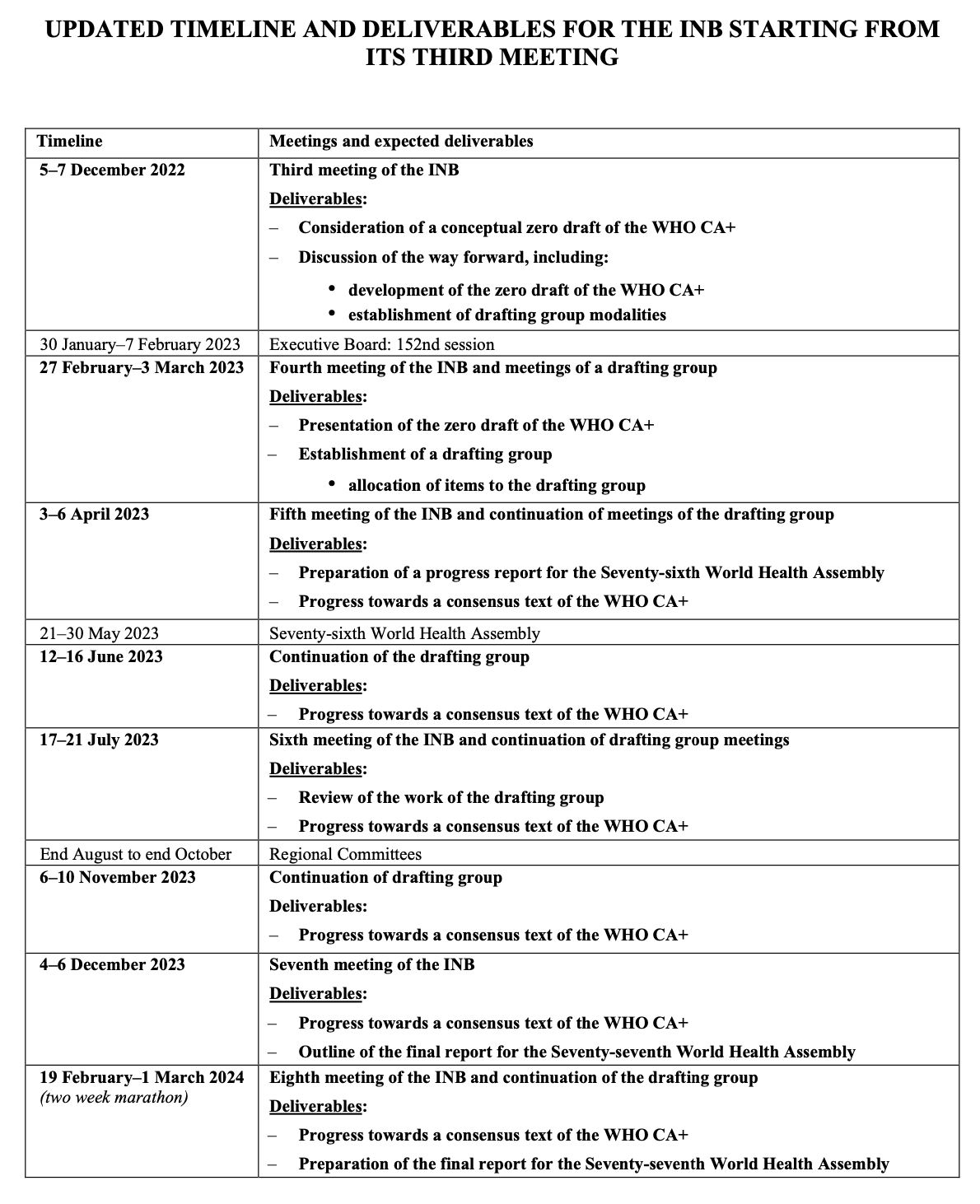
The INB will be holding an additional resumed session between June 6 and 8, 2022.  Here is a complete timeline and list of deliverables for the INB through to 2024:


Let's close with this posting with a couple of points that we should be considering:


1.) Do we want a non-elected body (WHO) to be in charge of forcing governments to implement its agenda during the next pandemic?  Since WHO seems very closely tied to China, what if WHO's recommendation during the next pandemic is a "Shanghai-style lockdown" where people are basically locked into their homes, forced into internment camps and have their pets inhumanely disposed of by the state?  Do we want WHO dictating policies that will have a significant impact on our economies given that their recommended response to the COVID-19 pandemic resulted in significant economic losses for individuals and states?


2.) Given this:


...and this, showing that the Bill & Melinda Gates Foundation is also a key donor to GAVI which itself is also a donor to WHO:


...and the fact that Bill Gates has never seen a vaccine that he didn't like (a fact that has been proven time and time again during the current pandemic), do we really want to put our future into the hands of man who is best known as a purveyor of virus-prone software and who is profiting from the COVID-19 vaccines?


Unfortunately, the mainstream media has paid very little attention to the ongoing story behind what could turn out to be a very significant development in the global response to the next pandemic, one that would see an elected body of questionably qualified individuals dictating how our governments will respond to the next edition of a "COVID-xx" virus, resulting in nations completely relinquishing their sovereignty to an organ of the United Nations.


One last thing - do you remember electing either of these men to rule the world? I didn't think so.


Monday, September 13, 2021

How the CDC Cancelled the Definition of Vaccination

Like many other things during the pandemic, even the most basic premises of science find themselves undergoing what can only be described as the "cancel culture."


Thanks to the Wayback Machine, let's look at how the CDC defined "vaccination" prior to September 1, 2021:


Note that prior to September 1, 2021 vaccinations were introduced to "produce immunity".


Here is the newly minted CDC definition of vaccinations which became effective on September 1, 2021:


Now, vaccinations are introduced to "provide protection".  


Undoubtedly, there seem to be a lot of "coincidences" during the COVID-19 pandemic.  Here is another one that also just happened to take place on September 1, 2021:


As you can see and as I posted here, Israelis who received the two-dose Pfizer BNT162b2 vaccine regimen and who had not previously suffered from COVID-19 (i.e. are SARS-CoV-2 naive) have a far greater chance of experiencing a breakthrough infection with the Delta variant than those who had been infected previously and had not been vaccinated.  This study shows that natural immunity provides a longer lasting and stronger protection against infection, symptomatic disease and hospitalization caused by the Delta variant of the SARS-CoV-2 variant than those who had two doses of Pfizer's BNT162b2 vaccine.  In other words, not only does the Pfizer COVID-19 vaccination not "produce immunity" even over the short-term (as defined by the pre-September 1, 2021 definition of vaccination), it doesn't appear that it "provides protection" (as defined by the post-September 1, 2021 definition of vaccination) against the Delta variant either.


Ins't it interesting to see how the CDC has changed the definition of vaccination to fit the limitations of at least one of the COVID-19 vaccines?  There's nothing like cancelling what doesn't fit the mainstream pandemic narrative.


Wednesday, July 29, 2020

Challenge Trials - The Ethics of Human Trials for a COVID-19 Vaccine

While it received almost no coverage in the mainstream media, a publication by the World Health Organization dated May 2020 is particularly frightening given the unprecedented rush to create a vaccine for the SARS-CoV-2 virus.

Here are quotes from an article that appeared on the Financial Times website on May 9, 2020:

"Francis Collins, director of National Institutes of Health, has asked the NIH vaccines working group to “write a perspective on the scientific and practical considerations for a Covid-19 human challenge model”.

The group, which includes senior vaccine developers from universities and industry, will meet on May 11 to discuss the issue.

Challenge trials have a long history in medicine because deliberately infecting volunteers gives results more quickly than waiting for them to be infected in the community, but they are inevitably risky. 

A growing number of scientists say the world needs a Covid-19 vaccine so urgently that regulators and research funders should make preparations now, enabling human infection studies to begin after potential vaccines have completed their initial safety testing.

Around 100 Covid-19 vaccines are currently in development worldwide, with several in the early stages of clinical trials." (my bold)

While you may think that actually using the virus to deliberately infect volunteers is an unrealistic idea, here is a recent letter from several members of the United States Congress to  the Secretary of Health and Human Services and the Commissioner of the Food and Drug Administration dated April 20, 2020 with the pertinent sections regarding human trials of deliberately infected people highlighted:


Now, let's look at what the World Health Organization has to say about human trials using deliberately infected human test subjects.  The paper, entitled "Key criteria for the ethical acceptability of COVID-19 human challenge studies" (i.e. the deliberate infection of test subjects) dated May 6, 2020, again, with the pertinent sections highlighted:


The World Health Organization states that there are four benefits to challenge studies:

1.) acceleration of vaccine development.

2.) increased likelihood of selecting the most effective vaccine.

3.) validation of immunity testing.

4.) improved knowledge of SARS-CoV-2 infection and transmission.

It is also important to note that WHO recommends using healthy young adults between the ages of 18 to 30 since they are less likely to die from COVID-19.  This is actually of relatively little use since the vast majority of the people dying from COVID-19 are the elderly, particularly those in their late seventies and early eighties.

The World Health Organization also notes that challenge studies have been used in the past to accelerate the development of vaccines against typhoid and cholera, however, they neglect to note that the case-fatality rate for typhoid fever ranged from 10 percent and 30 percent and the case-fatality rate for cholera ranged from 54 percent to 68 percent, far in excess of the case-fatality rate for COVID-19.

Given this graphic which shows that the daily number of new cases of coronavirus ranges from 250,000 to nearly 300,000:


...one has to wonder exactly why members of the United States Congress and the World Health Organization feel that it is necessary to deliberately infect human subjects with the SARS-CoV-2 virus.  Surely, the number of infected humans around the world should be sufficient for a reliable field trial of an experimental coronavirus vaccine.

While the very thought of medical experimentation on humans should send shudders down the spines of all of us, in the name of a government-ordered rush to create an unprecedented vaccine for a coronavirus, all caution is being tossed to the wind.  The rush to create a "medical COVID-19 miracle" has created an atmosphere where ethics no longer apply and human lives really don't matter.

Wednesday, June 10, 2020

The World Health Organization's Consistent Inconsistencies

The World Health Organization has repeatedly revising its narrative during the COVID-19 pandemic, first being reluctant to declare a pandemic as shown here:


...then changing its mind on the use of masks as shown here:


...and on the spread of the coronavirus from asymptomatic people as shown here:


...and then walking back what they had said one day earlier as shown here (starting at the 1 minute 15 second mark, particularly the 2 minute 30 second mark):


...one can't help but notice WHO's consistent inconsistencies despite their insistence that the "science" is changing.

While part of this constant changing of the narrative can be attributed to an incomplete understanding of the SARS-CoV-2 virus, there is more at play here.

Let's go back to a World Health Organization publication entitled "Non-pharmaceutical public health measures for mitigating the risk and impact of epidemic and pandemic influenza" as shown here:


Here is part of the Executive Summary of the publication:

"Influenza pandemics occur at unpredictable intervals, and cause considerable morbidity and mortality. Influenza virus is readily transmissible from person to person, mainly during close contact, and is challenging to control. In the early stage of influenza epidemics and pandemics, there may be delay in the availability of specific vaccines and limited supply of antiviral drugs. Non-pharmaceutical interventions (NPIs) are the only set of pandemic countermeasures that are readily available at all times and in all countries. The potential impacts of NPIs on an influenza epidemic or pandemic are to delay the introduction of the pandemic virus into a population; delay the height and peak of the epidemic if the epidemic has started; reduce transmission by personal protective or environmental measures; and reduce the total number of infections and hence the total number of severe cases.

This document provides recommendations for the use of NPIs in future influenza epidemics and pandemics based on existing guidance documents and the latest scientific literature.  The specific recommendations are based on a systematic review of the evidence on the effectiveness of NPIs, including personal protective measures, environmental measures, social distancing measures and travel-related measures. The information provided here will be useful for national authorities that are developing or updating their plans for mitigating the impact of influenza epidemics and pandemics."

The document methodology is as follows:

1.) Identify a list of NPIs that have the potential to contribute to pandemic mitigation for further review and evaluation.

2.) Identify and evaluate existing systematic reviews of the NPIs listed in Step 1, and perform new systematic reviews for each NPI if recently published reviews were not available.

3.) Assess the body of evidence on the effectiveness of each of the NPIs.

4.) Determine the direction and strength of recommendations.

5.) Draft the guideline document based on evidence and planning for strategy implementation.

As we all know, with rare exceptions (Sweden and, Belarus among others), the vast majority of the world's advanced economies have adopted the lockdown/quarantine model to control the spread of the SARS-CoV-2 virus.  Given the massive media coverage of this mode and the World Health Organization's influence over government policy during the COVID-19 pandemic, you might think that WHO is backing the concept of a society-wide quarantine.  in fact, here is what WHO has to say about managing various severity levels of a pandemic/epidemic in the aforementioned publication with the pertinent section "Not recommended in any circumstances" highlighted:


Note that even in the case of the most extraordinarily severe pandemic, contact tracing, quarantining of exposed individuals, entry and exit screening and border closures are NOT recommended.

This begs the question; exactly who is controlling WHO's response to the COVID-19 pandemic?  Why has WHO completely ignored its own advice issued during 2019 when it comes to managing the spread of the SARS-CoV-2 virus? Given his penchant for vaccinations, his financial support of the World Health Organization and WHO's supportive stance on vaccines as shown here:


....I think this might be the answer to that question:


One thing is becoming readily apparent during the current pandemic; medical research is more art than science and more political than scientific.  The World Health Organization is proof of the problem that exists in today's global medicine, a reality that is particularly evident when it doesn't even follow its own recommendations for pandemic control.