Showing posts with label surveillance. Show all posts

Monday, June 12, 2023

The American Surveillance State - A Government Camera in Every Home

The Cato Institute recently released the results of its 2023 Central Bank Digital Currency National Survey.  While the CBDC part of the study is interesting and will be the subject of a future posting, what I found interesting was the question in the study that examined Americans views on the surveillance state.  The survey was collected from 2000 respondents between February 27 and March 8, 2023 with the sampling frame based on a "modelled frame" of American adults based on the American Community Survey, voter records, the 2020 Current Population Survey Voting and Registration supplements, the 2020 National Election Pool exit polls and the 2020 Cooperative Election Study surveys.


Let's look at the question and responses regarding government surveillance of its citizens:


Would you favour or oppose the government installing surveillance cameras in every household to reduce domestic violence, abuse, and other illegal activity?


Responses:


Strongly favour - 6% 


Somewhat favour 8% 


Neutral - 10% 


Somewhat oppose - 7% 


Strongly oppose - 68%


Isn't it interesting to see that a total of 14 percent of Americans favour the installation of government surveillance cameras in every household with an additional 10 percent neither supporting nor opposing the issue, totalling nearly one in every four Americans.


Let's break down the demographics of those who favour the installation of government surveillance cameras in every home:


1.) Democrat/Lean Democrat - 17 percent with 21 percent of strong Democrats approving


2.) Republican/Lean Republican - 11 percent


3.) Independent - 14 percent


4.) Race - 9 percent White, 33 percent Black, 25 percent Latino, 11 percent Asian


5.) Age - 29 percent 18 to 29, 20 percent 30 to 44, 6 percent 45 to 54, 6 percent 55 to 64, 5 percent 65 plus 


6.) Education - 18 percent high school or less, 11 percent some college, 10 percent college degree, 16 percent post-graduate degree


7.) Household Income -16 percent less than $50,000, 15 percent $50,000 to $100,000, 12 percent $100,000 plus


Let's break down the demographics of those who oppose the installation of government surveillance cameras in every home:


1.) Democrat/Lean Democrat - 72 percent with 85 percent of strong Republicans opposing


2.) Republican/Lean Republican - 83 percent


3.) Independent - 67 percent


4.) Race - 84 percent White, 51 percent Black, 58 percent Latino, 66 percent Asian


5.) Age - 53 percent 18 to 29, 68 percent 30 to 44, 84 percent 45 to 54, 88 percent 55 to 64, 89 percent 65 plus


6.) Education - 68 percent high school or less, 80 percent some college, 81 percent college degree, 78 percent post-graduate degree


7.) Household Income -70 percent less than $50,000, 79 percent $50,000 to $100,000, 82 percent $100,000 plus


To summarize, younger, non-white, strongly leaning Democratic Americans with either high school or less or post-graduate degrees and incomes under $100,000 per year tend to support government in-home surveillance.


The additional link between those who approve and those who oppose in-home government surveillance is the link between those who support and those who oppose a Federal Reserve central bank digital currency:


1.) Favour installation of government surveillance cameras in every home:


Strongly support CBDC - 56 percent


Somewhat support CBDC - 51 percent


Neutral - 11 percent


Somewhat oppose CBDC - 3 percent


Strongly oppose CBDC - 2 percent


2.) Oppose installation of government surveillance cameras in every home:


Strongly support CBDC - 35 percent


Somewhat support CBDC - 371 percent


Neutral - 73 percent


Somewhat oppose CBDC - 93 percent


Strongly oppose CBDC - 95 percent


Those who support government installation of surveillance cameras in every home tend to be those who strongly support the issuance of CBDCs and vice versa.


While only one in seven Americans support in-home government camera surveillance, I am still shocked that anyone would trust the American government with all aspects of their most private lives but I suspect that some people take that attitude that "if you aren't doing anything wrong, you have no reason to be concerned about government intrusion".  While it is not terribly surprising that younger Americans have little issue with protecting their personal privacy given that they live significant portions of their lives in the online world where there is no privacy, what is of concern is that within the next decade, many of these younger Americans will be in positions of power where they will have the ability to implement a total surveillance state.


Tuesday, April 18, 2023

Unicoin or the Universal Monetary Unit - Another Step Toward a Surveillance State

A recent announcement following the International Monetary Fund's 2023 Spring Meeting held in Washington D.C. adds another dimension to the looming implementation of a worldwide digital central bank currency or CBDC.  


I need to provide my readers with background on the body responsible for the announcement since, like me, it quite likely that you have never heard of the Digital Currency Monetary Authority or DCMA.  On its website, the DCMA, a private organization, describes itself as:


"....a world leader in the advocacy of digital currency innovations for monetary authorities. Our mission is to enable trade globalization through the monetary integration of international payments and settlements while strengthening national economies monetary sovereignty.


The first wave of cryptographic cash was designed for public untrusted networks. The DCMA reimagines the next wave of cryptographic innovations engineered for adoption by central banks, retail and commercial banks, Fintech, governments, and cryptocurrency exchanges."


Membership in the DCMA includes commercial and retail banks, central banks, sovereign states and other financial institutions, none of which I have been able to specifically identify because the organization does not provide details about itself.


Here is the DCMA's LinkedIn page:


When you Google the organization's name, other than its recent announcement and its rather uninformative website appear among the results.  The only employee that I've been able to find is Darrell Hubbard, DCMA's Executive Director, the gentleman responsible for creating the next important step in the global move to CBDCs:


Now, at long last, here is the announcement made by the Digital Currency Monetary Authority (DCMA):


Here is a key quote:


"The DCMA introduces Universal Monetary Unit as Crypto 2.0 because it innovates a new wave of cryptographic technologies for realizing a digital currency public monetary system with a widespread adoption framework encompassing use cases for all constituencies in a global economy."


Basically, the DCMA has launched a Central Bank Digital Currency it calls the Universal Monetary Unit (UMU) also known as Unicoin which functions like a CBDC to enforce banking regulations and protect the integrity of the international banking system and has the capability to transact in any legal tender settlement currency.  DCMA claims that it is a new wave of cryptographic technologies for implementation of a digital currency public monetary system.  Under proposed UMU Model Law legislation which is being drafted by several sovereign states, Unicoin will function as a complementary money commodity for the store of value and will not be used as legal tender for negotiating international trade agreements or domestic prices.  It is being designed to assist the IMF achieve its mandate of providing economic and financial stability to its member states.


Here is a summary page from the DCMA's website about Crypto 2.0 aka Universal Monetary Unit aka Unicoin, noting that like all CBDCs, it touts the ability to prevent money laundering:


Here's what Tobias Adrian, Financial Counsellor and Director of the Monetary and Capital Markets Department of the IMF had to say about Unicoin:


"Cross-border payments can be slow, expensive, and risky. In today’s world of payments, counterparties in different jurisdictions rely on costly trusted relationships to offset the lack of a common settlement asset together with common rules and governance. 


“But imagine if a multilateral platform existed that could improve cross-border payments—at the same time transforming foreign exchange transactions, risk sharing, and more generally, financial contracting.


It's always about speeding up and making cross-border payments less expensive with these people, isn't it?


Unicoin/UMU/Crypto 2.0 would appear to be just another step taken toward our dystopic future where our every move will be watched and recorded and our behaviours controlled by those who ought not to be in control.  I must say, while I have been anticipating the implementation of a central bank digital currency ecosystem, this is all happening far more quickly than I would have guessed.


Friday, December 9, 2022

The World Health Organization's Pandemic Treaty - Surveillance in the Time of a Pandemic

During the COVID-19 pandemic, governments around the world took unusual measures to surveil their citizens, in particular, the use of contact tracing through the use of mobile apps which allowed governments to identify people's movements and who they associated with as well as enforcing quarantine orders, all with the alleged purpose of tracking infections.  While most people were so frightened by the spectre of contacting an infected person, there was concern in some quarters that personal privacy was being breached as governments collected and processed ever larger volumes of personal data.


This surveillance template is not going to disappear in the future if the World Health Organization gets its way.  In a conceptual zero draft copy of this document which is part of the WHO's plans to "...draft and negotiate a convention, agreement or other international instrument on pandemic prevention, preparedness and response...":


This conceptual zero draft of a potential international pandemic treaty is being considered by the Intergovernmental Negotiating Body (INB) as shown here:


The conceptual zero draft was discussed in the meeting held during the three day period from December 5, 2022 to December 7, 2022 the zero draft will be ready for negotiation at the fourth INB meeting which is scheduled to start on February 27, 2023 as shown here:


Here is the surveillance part of the draft document:


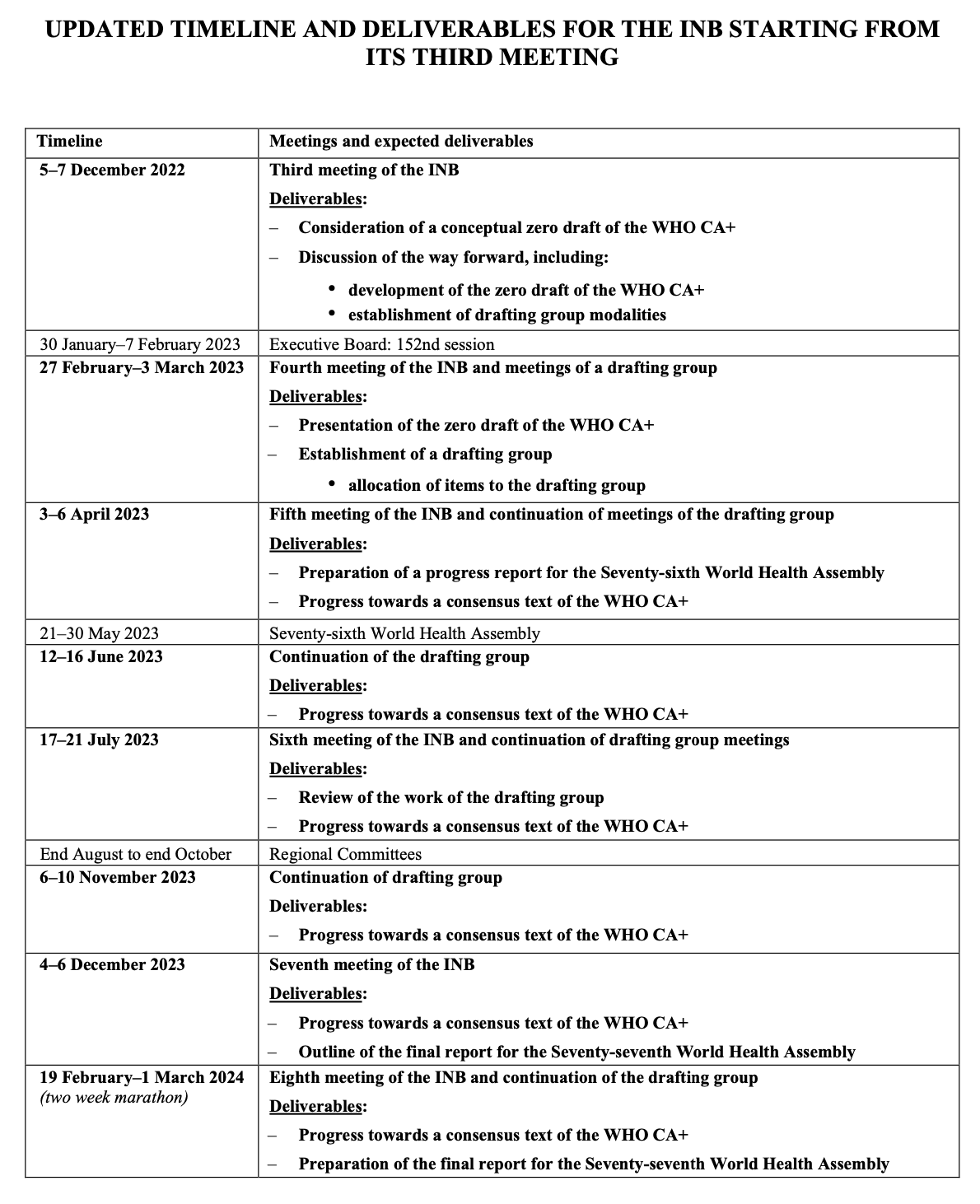
Here is the updated timeframe for implementation of the World Health Organization's pandemic treaty:


If the treaty passes (and you can pretty much assure yourself that it will), it will be adopted under Articles 19, 20 and 21 of the World Health Organization Treaty which read as follows:


This means that the World Health Assembly (WHA) will be allowed to impose legally binding pandemic conventions on the WHO's member states if two-thirds of the WHA members vote in favour of the agreement.


So there you have it.  The global future response to a pandemic will be driven by a non-elected group of individuals who are largely under the control of this man, the world's foremost untrained virologist, vaccinologist and self-appointed expert on pandemics:


Thursday, October 13, 2022

My Carbon - The World Economic Forum's Answer to Climate Change Surveillance

For those of us who have been paying attention, it appears that the global oligarchy has been subtly switched its "fear message" from COVID-19 to the existential horrors of global climate change.  One of the leaders in this field (outside of Bill Gates, a major point source of greenhouse gas emissions) is the World Economic Forum, that group which uses the subtleties of language to convince us that its backers only have our best interests at heart.  In a recent article on its website, the WEF looks at how technology can be used to control carbon emissions.


Here is the article which was written by Kunal Kumar, the Mission Director for the Smart Cities Mission at the Ministry of Housing and Urban Affairs of India:


While the article's disclaimer notes that the "views expressed in this article are those of the author and not the World Economic Forum", we can assure ourselves that, if the views in the article contradicted those of the WEF, the article would not have appeared on its website.


To help you put the author's comments into context, here is a screen capture of his LinkedIn Page showing his description of himself along with his work experience and education:


You will notice that the vast majority of his work experience and education has been in public management and not in climatology.


His musings open with this:


1.) While transport and buildings are the major drivers for emissions in cities, the share of individual emissions is significant.


2.) Personal carbon allowance programs have had limited success due to a lack of awareness and fair mechanism for tracking emissions.


3.) Yet there have been major developments in recent years that could help realise "My Carbon" initiatives.


He notes that cities around the world account for nearly 75 percent of total global carbon emissions even though the cover only 3 percent of the world's total surface area.  He also notes that while the major drivers for carbon emissions in urban areas are sourced from transportation and buildings, the share of individual emissions are roughly 40 percent of the total, meaning that "...inclusivity of citizens is becoming the most important element of success or failure in the journey toward sustainability..."


He states that there have been numerous examples of personal carbon allowance or PCA programs that have been discussed over the past two decades as shown in this article:


PCA policies would aim to link personal actions with global carbon reduction goals with all adults receiving an equal, tradable carbon allowance that is reduced over time to remain in line with national targets.  These allowances would cover around 40 percent of carbon emissions in advanced economies and would include emissions related to travel, space heating, water heating, electricity, food, services and consumption-related emissions..  People who find themselves short of credits would be able to purchase additional credits in the PCA market from those with excess credits to sell.


The author observes that there have been significant social, environment and technology developments that could help realize the "My Carbon" future.  These developments are described as follows:


1.) The COVID-19 pandemic formed a template for a test of social responsibility with citizens willingly (and I might add mindlessly in some cases) adopting "unimaginable restrictions" including social and personal distancing, masks, mask vaccinations and governments' use of contract-tracing applications.


2.) Thanks to the advancement of technology related to Klaus Schwab's Fourth Industrial Revolution (4IR), the use of AI, blockchain and digitization will allow the implementation of tracking personal carbon emissions.  The rapid development and adoption of smart technologies for home use (i.e. smart meters) will also provide individuals with the choice of reducing their energy-related emissions.  The development of personalized applications such as the Ohm Assistant will allow for individuals to track and reduce their energy consumption as shown in this video:


To me, these are three of the more sobering paragraphs in the article given the use of privacy invading technology and how it could ultimately be used to create a "climate social credit score" where energy consumption restrictions are no longer voluntary:


"There have been major advances in smart home technologies, transport choices with carbon implications, the roll-out of smart meters in providing individual choices to reduce their energy-related emissions, the development of new personalized apps to account for personal emissions, and better personal choices for food and consumption-related emissions. AI can also help strengthen circular economy business models like product as a service models, demand predictions, and smart asset management by combining real time and historical data from products and users.


There is a significant number of programs and applications enabling citizens to contribute towards carbon emissions by providing them in-depth awareness on the choices of personal carbon for food, transport, home energy and lifestyle choices.


These energy efficiency apps give suggestions and statistics regarding greenhouse emissions and offer ways to reduce your personal footprint. Keeping track of energy consumption in the home and motivating people to make lifestyle changes and to contribute your share towards the betterment of the environment."


Note that AI will be used to combine real time and historical data from users, in other words, your personal energy consumption data will be tracked and retained by the "powers that ought not to be" and could be used against you.


3.) There has been raised awareness and public concern about global climate change particularly among younger people.  


According to the author:


"The three trends provide strong evidence towards enabling a social movement for “My Carbon” initiatives by enabling public-private partnerships to help curate this program. It is suggested to drive a three-way approach to shape this movement.


Such economic action will need policy enablement from city leadership through extensive discussion between stakeholders to arrive at a fair and inclusive approach."


And there you have it.  While the author invokes the use of "city leadership", you can be assured that the global ruling class will ultimately decide what is your "fair share" of personal carbon emissions.


One thing that the author glossed over was the advancement of surveillance technology which will allow governments/the private-public partnership to enforce individual carbon emissions limits.  He has also ignored the fact that a great deal of carbon emissions is sourced from the global ruling class and its penchant for repeatedly travelling about the globe, using private jets, massive yachts and other intensive fossil fuel-consuming means of transportation as well as their ownership of multiple homes that dwarf the size of the homes being used by the serf class.


But, then again, it's all about "rules for thee but not for me", isn't it?


Tuesday, June 7, 2022

The Surveillance State - Using Technology to Track Your Grocery Purchases

Food has become one of the main stories in both the dinosaur and independent media sources with regular reporting on increasing food prices and decreasing supplies of some key food items.  One issue that has not been covered is how governments could well use technology to track our food purchases.  In this posting, we'll look at one governments latest efforts at unprecedented food surveillance.


This announcement recently appeared on the Norwegian government's Statistics Norway portal:


Here is the introduction:


"The assessment describes the need for collection and use of payment transactions via BankAxept from Nets Branch Norway (hereinafter Nets). Data will be used in established official statistics and for the development of new official statistics within the framework of the National Statistics Program 2021-2023.


The benefit is related to the fact that BankAxept transactions from Nets can be utilized as a new source in various official statistics that Statistics Norway produces and thus contribute to improving quality and timeliness in the production of statistics. Utilization of BankAxept transactions as a source of more statistics can at the same time help to reduce the workload for those required to do so because data collection becomes more efficient and coordinated. In addition, this will help to reduce Statistics Norway's use of resources related to data collection and processing of data.


The costs of collecting payment transactions from Nets are largely related to privacy consequences because some statistical purposes require that transaction data be compared with other personally identifiable information. Statistics Norway will therefore consider how data collection can be minimized, both in the short and long term, as well as implement justifiable privacy protection measures - and data security measures."


Norway's Department of Personal and Social Statistics is requiring BankAxept, the Norwegian national payments system which is used in 80 percent of payments to stores, to provide Statistics Norway with all of its customers' transactions with the goal of "contributing to improving quality and timeliness in the production of statistics".  BankAxept was launched in the early 1990s and is owned by Norwegian banks.  It can be used for both physical and digital transactions with payment approval in real time through the use of a mobile telephone, chip and PIN and contactless technology.  The amount of the purchase is immediately debited from the cardholder's account if sufficient funds are available. 


In the announcement, the Norwegian government is requesting data containing information on all payment transactions up to and including January 1, 2022 for the entire 2021 calendar year.  The data provided by BankAxept must include the following:


1.) Transaction date.


2.) Transaction type status.


3.) Card service.


4.) Organization number of the company where the card was used.


5.) Name of the company where the card was used.


6.) Name of card user, bank account number.


7.) Amount paid for items.


8.) Total amount paid.


Here is the raison d'être for the program:


1.) to produce official statistics according to the statistics program, more specifically statistics on consumption in Norwegian households.


2.) new official diet statistics - Statistics Norway is now developing the statistics on behalf of the Norwegian Directorate of Health. The development work is anchored in the letter of intent for a healthier diet , an agreement between the health authorities and the food industry (business organizations, food and beverage producers, the grocery trade and the catering industry)


3.) to study the use of transaction data for the production of other official statistics that use data on turnover and price development of goods and services in the production of statistics. This includes: retail trade and business services, transport and tourism, enterprises and accounting and the use of private health services.


Further, the Norwegian government claims that the main goals of the strategy is...


"... to collect, use and share the data for the benefit of society."


The Norwegian government states that, until 2012, data on household consumption was collected through sample surveys which led to sampling bias and underreporting which created data quality issues.  This was particularly the case for groceries where the volume of goods sold was very high, leading to a high risk of underreporting.  With this new mandate, Statistics Norway will link each of it citizens' payment transactions to grocery store receipts, allowing them to develop more accurate consumption statistics that are more relevant than those that can be achieved through sample surveys.  Specific grocery item purchases will now be directly linked to persons/households; this will allow the government to analyze socio-economic and regional differences in consumption and link it to income, education, health information and place of residence.


Here is another quote:


"Statistics Norway will be able to develop new and highly sought-after statistics on developments in the Norwegian diet. The statistics will have a much higher quality and degree of detail than before as a result of the access to transaction data from Nets, combined with e.g. receipt data from the grocery chains, data on nutrient content in the food and household information from Statistics Norway's administrative register. This applies, for example, to statistics that present how the diet of the Norwegian population varies with socio-economic background factors such as income, education and labor market affiliation, and how it varies with demographic and geographical dimensions. It is important to bring out regional, demographic and social differences in diet since this is a key dimension when the population's living habits are to be measured and quantified.


In sum, the statistics will contribute to a far better knowledge base on developments in the Norwegian diet with higher quality and level of detail than before. This is also in line with how it is expressed in the health authorities' action plans and in a letter of intent on a healthier diet entered into between the health authorities and the food industry.


The statistics must cover transactions throughout the calendar year. The statistics can be published with high relevance, but the starting point is to establish an annual statistic that can gradually be further developed both in terms of publishing content and frequency in close collaboration with the data sources and other partners."


Of course, the Norwegian government assures its citizens that the government has strict requirements for information security and any statistic that it releases will be confidential.  Here is a further quote;


"In order to address the privacy challenges ..., pseudonymisation of data will be an important measure. Among other things, connections at the personal level will be made with pseudonymous data. In addition, aggregation of data for the individual user location and payee, before further use in, for example, business cycle statistics for the business sector, will be relevant measures for data minimization."


To summarize, the Norwegian government has granted itself the right to know exactly what food items enter Norwegians' homes, all in the name of more accurate food consumption statistics.  Of course, this most personal data will remain private...at least until there is a security breach of the system.  While surficially, this appears to be a relatively benign government surveillance program, in fact, it could easily be used for nefarious purposes.  What if governments decide that certain individuals are prohibited from purchasing certain food items or that consumers can only buy a limited amount of certain foods, another form of rationing?  Given that a key part of the Great Reset is a reduction in the amount of meat consumed all in the name of saving Planet Earth from climate change, it really isn't much of a stretch to think that meat could be one of the items that is rationed or forbidden for the organ donor class.  It's also a great way to force consumers to eat foods like weeds, insects and manufactured "meat" as alternative sources of protein given that there is likely to be consumer reluctance to eat these "food items".


A question - do you really think that it is any of the government's business what you and your household eat? If there is anything that the past two years have taught us its that today's conspiracy theory is tomorrow's reality.  While Norway is currently on the leading edge of this invasive use of payment technology, you can assure yourself that other governments will follow their lead since all governments seem to be following each other's lead into the establishment of a surveillance state.


Friday, May 27, 2022

The Individual Carbon Footprint Tracker - Another Step Toward A Surveillance Society

At the recent WEF groupthink (aka a gathering of the Kult of Klaus) in Davos Switzerland, Alibaba Group president J. Michael Evans boasted that his company was developing an "individual carbon footprint tracker" that is just one additional step toward the universal surveillance that we know is coming (at least those of us that are paying attention to such things).


For those of my readers who aren't familiar with Alibaba Group, it was established in 1999 by Jack Ma, a former English teacher from Hangzhou, China.  The company was formed to allow small- and medium-sized enterprises to grow and compete in China's economy as well as the global market.  It has grown into a massive digital ecosystem (think a Chinese version of Amazon) with businesses including cloud computing, digital media, entertainment, commerce and innovation initiatives.  In December 2021, the Alibaba Group announced a "...pledge to achieve carbon neutrality in its own operations by 2030 as well as a pioneering initiative to facilitate 1.5 gigaton of decarbonization across its business ecosystem by 2035". 


Here is a graphic which outlines Alibaba's culture:


To give you some sense of the size of Alibaba, in the quarter ended March 31, 2022, it served one billion annual active consumers in China and 1.31 billion consumers globally.  Over the fiscal year ending March 31, 2022, the company had revenues of $US 134.567 million with net income of $US 9.774 billion.


Now that you have some sense of the massive size (and potential influence) of Alibaba, here are the comments from the company's president regarding the carbon footprint tracker that Alibaba is being developed:


Here is a transcript of his comments:


'We’re developing, through technology, an ability for consumers to measure their own carbon footprint.  What does that mean? That's where they are traveling? How they are traveling? What are they eating? What they are consuming on the platform? So, individual carbon footprint tracker. Hmmm, stay tuned.  We don't have it operational yet but this is something that we're working on.


Here is the news announcement of the "carbon ledger" as found on Alibaba's Alizila corporate news website dated March 21, 2022:


Here are some excerpts from the announcement:


"Alibaba Cloud launched the Energy Expert platform in February this year, allowing people to monitor their carbon footprint and receive credits worth money when making low-carbon choices.


Expect to earn 200 carbon credits when you lick your plate clean, and 554 credits if you take the subway, according to the measurement system devised by Guangzhou-based certification body CEPREI, in partnership with Alibaba Cloud.


“The platform is designed to encourage people to adopt low-carbon behaviors and be environmentally accountable,” Chen Lijuan, General Manager of Product and Solution at Alibaba Cloud, told Alizila.


The trick is to develop a model that translates individual activities into carbon credits and builds up a community that promotes a low-carbon lifestyle based on the carbon credits system."  


This will give you a sense of how the system will work:


"The neighborhood of Xinqiao Shiju, located in the southern city of Shenzhen, was one of the first to partner with Alibaba Cloud. Since piloting late last year, the community’s 589 residents have been able to save 37.77 tons of carbon emissions.


Every Xinqiao Shiju resident has a personal carbon account to monitor power use and carbon emissions. A household account combines the totals for everyone living in the same house.


The emissions are calculated based on electricity, water and gas use, which can be balanced by solar or wind energy use, with facilities available in the neighborhood.


After showing users their energy consumption, Energy Expert provides customized suggestions, such as installing solar panels to offset a high electricity bill or collecting rainwater to reduce water use.


To be sure, there is more at stake here than infrastructure upgrades. 


As individuals gain awareness of their environmental impact, they become more connected to the carbon neutrality cause, said Zhou Fanke, the project’s architect at Alibaba Cloud."


While all of this sounds just marvellous on the surface, what happens when this type of carbon footprint tracking is mandatory?  What if a similar individual carbon tracking system is used by governments to ration or cap hydrocarbon consumption, for example, limiting the amount of petrol/gasoline that you can purchase, setting limits for the use of both heating and cooling equipment in your homes and/or telling you that you can't purchase certain foods or items because the purchase is deemed too carbon intensive?


In closing, remember that the announcement of an individual personal carbon tracker was made at a World Economic Forum annual conference with the global ruling class in attendance, many of whom travelled to and within Switzerland (and elsewhere in the world) using private jets and limousines and who have lifestyles that are far more carbon intensive than anything that the lifestyles of the serf/useless eater class will ever emit.