Showing posts with label War on Terror. Show all posts

Friday, February 11, 2022

The Links Between Big Tech and the War on Terror - The Founding of Technology Capitalism

Crescendo, a project by the Action Center on Race and the Economy (ACRE), MPower Change and Little Sis focuses on research outlining the ways that America's Big Tech sector has benefitted from the War on Terror, thanks to the involuntary generosity of American taxpayers.  While the Military-Industrial-Intelligence community garners most of the headline news when it comes to what can only be described as obscene levels of government funding, Big Tech has experienced a very significant increase in the demand for their services by Washington.  Let's look at some details from the project entitled "Digital Destroyers".


The Global War on Terror or GWoT had its genesis following the attacks of September 11, 2001.  Since that time, Washington has made repeated and consistent policy decisions that target Muslim, Black and brown people through the increasing use of ever more advanced surveillance systems.  This has required the input of technological services from Big Tech and, is in large part, responsible for their massive growth from "garage and basement" businesses to the technological behemoths of today.  


Here is a timeline showing key events in the evolution of Big Tech as a beneficiary of the GWoT which seem like a lifetime ago with the key events for Big Tech in italics:


October 4, 2001 - the Bush II Administration authorizes the National Security Agency to collect communications data including telephone and internet records in bulk with at least one communicant being located outside of the United States.  This program known as STELLARWIND ended in 2011.


October 24, 2001 - The Patriot Act is passed in Congress with overwhelming support from both sides.  The Act authorizes sweeping powers for Washington to surveil Americans and became the open door for Big Tech to become the brokers of our personal data.


November 2002 - Congress passes the Homeland Security Act which creates the Department of Homeland Security with the mission to "protect the American homeland" against "invisible enemies".  DHS began operations in March 2003.


July 10, 2008 - George W Bush signs the FISA Amendments Act into law with Section 702 requiring technology and telecommunications companies to provide the U.S. government with access to personal emails and communications.  The NSA received access to Microsoft servers in September 2007, Google in  

January 2009, Facebook in June 2009, YouTube in 2010 and Apple in October 2012.  The Act was reauthorized in 2012 and 2018.


July 2010 - Google launches its cloud application suite which passes federal certification to handle sensitive material.


June 2011 - Amazon signs its first contract with the Department of Defense.


August 2011 - the Obama Administration introduces strategies for Countering Violent Extremism (CVE) which has been used to spy on Muslim communities.


January 2016 - Obama meets with Big Tech executives to address anti-terrorism measures on their platforms.


March 2016 - Alphabet Executive Chairman Eric Schmidt is appointed to chair the Defense Innovation Advisory Board to bring Silicon Valley innovation to the United States military.


2017 - Facebook, Microsoft, Twitter and YouTube form the Global Internet forum to Counter Terrorism.


October 2019 - Microsoft is awarded a $10 billion 10-year cloud computing contract with the Pentagon called Joint Enterprise Defense Infrastructure or JEDI, beating out Amazon.


May 2020 - the Department of Homeland Security launches its Targeted Violence and Terrorism Prevention program as a rebooting of pre-existing CVE programs.


March 2021 - Microsoft is awarded a $22 billion contract to supply the United States Army with augmented reality headsets.


May 2021 - the Department of Homeland Security launches the Center for Prevention Programs and Partnerships as a rebooting of the CVE program.  


July 2021 - the Pentagon cancels the $10 billion JEDI contract awarded in Microsoft (thanks to legal challenges by Amazon) and moves toward a contract which will include multiple Big Tech companies.


August 2021 - as United States forces abandon Afghanistan, the Biden Administration announces that they are developing "over-the-horizon" capabilities which will allow Washington to respond to any regional threats to its assets in area.


With this background, let's look at the bottom line, how much Big Tech benefitted from its close relationship with Washington over the GWoT.  According to the study, Amazon, Google, Microsot, Twitter and Facebook have made tens of billions of dollars from contracts signed with the Pentagon and the Department of Homeland Security.  Here are some details from the three largest beneficiaries with contract data being sourced from Tech Inquiry's U.S. government contracts explorer and subcontract data from Tech Inquiry's 2020 analysis:


1.) Amazon:


Department of Defense - $1,014,161,438.61


Department of Homeland Security - $77,907,156.72


Department of Justice - $27,606,234.89


Department of Justice FBI only - $415,305.25


Department of State - $4,757,563.17


2.) Google:


Department of Defense - $16,476,230.96


Department of Homeland Security - $2,090,692.69


Department of Justice - $27,606,234.89


Department of Justice FBI only - $3,366,115.88


Department of State - $4,712,221.83


3.) Microsoft:


Department of Defense - $42,719,199,701.48


Department of Homeland Security - $266,580,844.45


Department of Justice - $107,078,983.93


Department of Justice FBI only - $10,177,874.78


Department of State - $248,380,010.78


In closing, here is an interesting graphic showing federal contacts with all three of these companies:
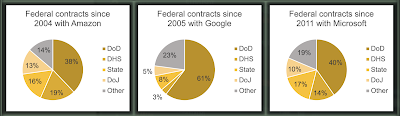


Thanks to the unfettered generosity of American taxpayers (after all, it is taxpayers who are funding these programs), a system of technology capitalism has been created.  It is very obvious that the Global War on Terror's reliance on data-intensive surveillance has paid off very well for the players in the Big Tech sector which has profited very nicely by collecting our personal data which is then sold to third parties including governments and police forces among others.  With the recent push to define and punish so-called "domestic terrorists", one can only imagine how much the Big Tech sector will benefit from this program which seeks to demonize just about any American with a pulse who should happen to fall on the wrong side of any given issue in the opinion of the powers that ought not to be.


Friday, October 8, 2021

The High Civilian Cost of the American Airwar on Terror

With the United States recently withdrawing its troops from Afghanistan after a 20-year-long nation-building exercise failure, a recent study by Airwars provides us with some interesting background on the War on Terror that has pretty much faded into the background, at least according to the mainstream media.


The Airwars study looks at the impact of 20 years of war on the civilian populations of Iraq, Syria, Afghanistan, Somalia, Yemen, Pakistan and Libya.  Data for the study was gleaned from the United Nations Assistance Mission in Afghanistan (UNAMA), the NGO Iraq Body Count, the Buruea of Investigative Journalism and Airwars own data.


The war was fought (and is still being fought) on several fronts and has used different tactics:


1.) Full invasions and occupations - Afghanistan from 2001 to 2021 and Iraq from 2003 to 2009.


2.) Major bombing campaigns against the Islamic State - Iraq from 2014 to 2021, Syria from 2014 to 2021 and Libya in 2016.


3.) Targeted United States drone and airstrike campaigns against terrorist and militant groups - Somalia from 2007 to 2021, Yemen from 2002 to 2021, Pakistan from 2004 to 2018 and Libya from 2014 to 2019.


Based on official United States military data, the authors of the report concluded that the United States military carried out a minimum of 91,340 airstrikes throughout the 20 years of the "Forever Wars".


Here is a summary of the minimum and maximum civilian body counts for each nation along with the peak year or years) and the minimum and maximum for those years (excluding Afghanistan):


1.) Iraq - between 11,474 and 24,136 total civilian deaths


a.) peak year 2003 - 5,494 to 6,677 civilian deaths


b.) peak year 2017 - 1,423 to 9,967 civilian deaths


2.) Syria - between 5,731 and 15,573 total civilian deaths


a.) peak year 2017 - 3,279 to 9,318 civilian deaths


3.) Afghanistan - between 4,815 and 6,799 civilian deaths


a.) peak year 2008 - 552 civilian deaths


b.) peak year 2019 - 546 civilian deaths


4.) Somalia - between 72 and 333 total civilian deaths


a.) peak year 2019 - 6 to 64 civilian deaths


5.) Yemen - between 156 and 412 total civilian deaths


a.) peak year 2017 - 48 to 147 civilian deaths


6.) Pakistan - between 424 and 969 total civilian deaths


a.) peak year 2009 - 100 to 210 civilian deaths


7.) Libya - between 7 and 86 total civilian deaths


a.) peak year 2016 - 7 to 68 civilian deaths


In total, Airwars' calculations show that between 22,679 and 48,308 civilians lost their lives thanks to America's airstrikes in the War on Terror.  Based on U.S. military data, the authors of the report concluded that the United States carried out a minimum of 91,340 airstrikes throughout the 20 years of the war with a maximum of 18,695 strike sorties in 2003 during the invasion of Iraq alone.


Let's close this posting with this summary video:


There is no doubt that the cost of the War on Terror has been particularly high for civilians in the 7 nations that have been involuntary participants in the 20 year exercise.  Innocent men, women and children have paid a high price because they happened to live in an area that was being targeted by the United States and its allies in the 7 theatres of military operations.


Tuesday, September 14, 2021

The Human and Budgetary Costs of the War on Terror

With the 20th anniversary of September 11th, 2001 now behind us, let's take a look at the cost of the twenty year-long War on Terror as calculated by the Watson Institute at Brown University.


1.) Human Costs of the War on Terror:


Here is a table showing the human costs directly related to the war in the five main theatres:


The Watson Institute notes that several times more people have been killed in the nations listed in the table thanks to unintended consequences like the destruction of infrastructure (i.e. hospitals, water and sewage) which have led to increases in deadly diseases which cannot be treated.


2.) The Budgetary Costs of the War on Terror:


Here is a graphic which breaks down the post-September 11, 2001 costs of the War on Terror from fiscal 2002 to fiscal 2022:


Here is a table showing the same information for those of my readers that would prefer data in table form:


Note that federal spending on future medical care for veterans of the post-September 11, 2001 wars is estimated at roughly $2.2 trillion.


This cost data does not include all of the funding that was provided for humanitarian assistance and economic development aid in both Afghanistan and Iraq.  It also does not include the future costs of interest payments on the funds borrowed to pay for the War on Terror after fiscal year 2023 since the war was funded by taking on additional federal debt, not by selling war bonds as was the case during World War II.  It is also important to note that the cost data does not include the funding by U.S. allies in the war including Australia, Canada, Denmark, the United Kingdom, Denmark, Italy, the Netherlands, Germany and France among others.  Had allies not borne part of the cost of the war, the financial costs of the War on Terror would be far higher for American taxpayers.


If we look at the United States Department of Defense Base Budget and the Emergency Overseas Contingency Operations (OCO) Appropriations, this is what we find: 


The DoD's base budget has continued to rise for four reasons that are directly and indirectly related to the War on Terror:


1.) the U.S. military has devoted an increasingly large share of its military spending on contractors with the use of contractors with the cost of contractors having more than doubled during the War on Terror.


2.) the modernization of the U.S. military and replacement of equipment that was destroyed, damaged or used during the wars requiring replacement or repairs, sometimes with more expensive equipment.


3.) increased cost of personnel costs over the two decades of the War on Terror thanks to increases in cash payments, allowances for food and housing which grew by 20 percent between 2002 and 2018.  As well, the use of bonuses for recruitment and retention increased as enlistment rates were negatively effected as casualties rose in Afghanistan and Iraq.  In addition, total Defense Health Program spending rose significantly as shown here:


4.) the dividing line between direct DoD and OCO direct war spending at the base budget became "fuzzy" with OCO money being used to supplement the base budget and with some activities in major war zones being classified as enduring requirements and were then institutionalized into the base budget.


As you can see from this data, over the past twenty years, the human and monetary costs of the War on Terror have been punitive, both for the citizens of the nations where the U.S. was militarily active and for American taxpayers who will be paying for this war through taxation for the foreseeable future.


Let's close with this quote from the conclusion of the Watson Institute's report with bolds being mine:


"The U.S. responded to the 9/11 attacks through a military mobilization of unprecedented scope, scale, and duration. The costs of such a response will not end after U.S. troops withdraw from Afghanistan and Iraq. The U.S. continues to invest in war in other areas around the globe, devote a great deal of resources to counterterrorism at home, and must pay future costs—including for veterans’ disability and medical care and interest on borrowing to pay for the post-9/11 wars.


Every country goes to war believing that they can win, that the fighting and its consequences will be controllable, that the costs of war will be less expensive than diplomatic efforts or sanctions, and that there will be few casualties because they will take great care to protect their own soldiers and the lives of innocent civilians. But war rarely goes as planned. When things don’t go as planned, new increments of force are added—or surged—to the war zone on the theory that just a bit more force will make the difference. The costs in lives and treasure goes up as the level of force is ratcheted up. And war continues.


Democracy can sometimes take a beating during war. Operations may be shrouded in well-intentioned but perhaps unnecessary secrecy, and mistakes are generally swept under the rug or downplayed. Voices of caution or those who ask for more details about plans and alternatives are often ignored, derided, or silenced as citizens and decisionmakers rally around the flag and defer to generals in an atmosphere of fear and urgency. The Costs of War Project hopes that this accounting, and our other work, promotes transparency and facilitates informed conversations about current and future wars.


Tuesday, July 27, 2021

Death from the Skies - America's Counterterrorism Drone War

While it almost never makes the mainstream/drive by media today, America's counterterrorism war continues unabated after nearly 20 years.  Thanks to research by New America, we can track Washington's actions in Pakistan, Yemen, Somalia and Libya.  In this posting, we'll look at the operations in Pakistan, Yemen and Libya, how many people were killed and how each presidential administration was involved.


1.) The drone war in Pakistan:  The first known American drone strike in Pakistan took place on June 19, 2004, killing Taliban leader Nek Muhammad.  Under the Bush Administration, the drone war was limited until 2008 when strikes escalated, continuing until they peaked in 2010 and slowly declined until May 21, 2016, the date of the last attack during the Obama Administration which killed Taliban leader Mullah Akhtar Mansour.  On March 2, 2017, the Trump Administration conducted its first strike in Pakistan after a 9 month pause.  Thus far, no attacks have taken place under the Biden Administration.


Here is a graphic showing the U.S. air and drone strikes in Pakistan by Administration and year:


Here is a graphic showing the deaths of militants, civilians and people of unknown status from these strikes by year:


Here are the total strikes and deaths by Administration:


Bush - 48 strikes killing 399 to 540 people (116 to 137 confirmed civilians)


Obama - 353 strikes killing 1,934 to 3,094 people (129 to 162 civilians)


Trump - 13 strikes killing 33 to 68 people (0 to 4 civilians)


Only 3.1 percent of the total people killed by U.S. drone strikes in Pakistan were militant leaders.


2.) Yemen:  The first known American drone strike in Yemen took place on November 3, 2002, killing Qaed Salim Sinan Al-Harithi who was believed to have devised the attack on the USS Cole which killed 17 American military personnel.  This was the sole drone attack on Yemen under the Bush Administration.  Under the Obama Administration, a further 185 drone attacks took place followed by 106 confirmed strikes under the Trump Administration (with an additional 82 attacks with insufficient detail).  In 2017, the United States conducted more individually identifiable strikes than in any other year except 2012.  Over the period between March 2 and 6, 2017, the U.S. military undertook between 25 and 40 attacks using a combination of drones and air attacks.  Thus far, no attacks have taken place under the Biden Administration.


Here is a graphic showing the U.S. air and drone strikes in Yemen by Administration and year:


Here is a graphic showing the deaths of militants, civilians and people of unknown status from these strikes by year:


Here are the total strikes and deaths by Administration:


Bush - 1 strikes killing 6 militants (no confirmed civilians)


Obama - 1853 strikes killing 1,094 to 1,394 people (88 to 101 civilians)


Trump - 106 strikes killing 278 to 375 people (27 to 48 civilians)


Only 6 percent of the total people killed by U.S. drone strikes in Pakistan were militant leaders.


Here is a map of Yemen showing how geographically widespread the American air, drone and ground operations are in Yemen:


3.) Libya: Libya is one of the many nations that have "benefitted" from the extension of America's armed drone program outside of the two main conventional war zones of Afghanistan and Iraq.  The Obama Administration's Presidential Policy Guidance (PPG) authorized drone and air strikes between August 2016 and December 2016 under Operation Odyssey Lightning with the goal of destroying ISIS' stronghold in Sirte.  Under the Trump Administration, PPG was replaced with Principles, Standards and Procedures (PPS) in 2017.


Libya's first civil war began on February 15, 2011 with backing from NATO, United States and the United Kingdom (among other members of the international coalition) and its replacement government was officially recognized by the United Nations on September 16, 2011 with the official end of the war being declared on October 23, 2011.  A second civil war began on May 16, 2014 between various militias  and ended on October 23, 2020 when a permanent ceasefire was signed and ratified between the opposing forces.


After NATO's intervention in 2011, various nations have undertaken a lengthy series of air, drone and artillery strikes in Libya since the end of the United Nations-sanctioned campaign on October 31, 2011.  Estimates show that 4517 attacks took place with between 624 and 915 civilians being killed between September 2012 and March 15, 2020 as shown on this table:


Here is a graphic which shows monthly strikes by each of the belligerents in Libya with LNA being the Libyan National Army, GNA being the Government of National Accord and GNC being the General National Congress which controlled Libya between 2012 and 2014, noting that the United States has been involved intermittently throughout the war:


Here is a graphic showing the U.S. air and drone strikes in Libya by Administration and year:


Here is a graphic showing the deaths of militants, civilians and people of unknown status from these strikes by year: 


Despite the fact that the ongoing War on Terror has received almost no coverage over the past year and a half, data from this study by New America would suggest that drone and airstrikes launched by Washington are still claiming innocent civilian lives in regions of the world outside of the conventional war zones in Afghanistan and Iraq.On the upside, the continued use of these high tech weapons is making the corner office dwellers in the defense industry very, very happy despite the fact that these operations are negatively impacting thousands of innocent civilians who just happen to be in the wrong place at the wrong time.


Friday, March 19, 2021

Peace in Afghanistan - A Roadmap for Ending the Quagmire

On March 18, 2021, Russia hosted a meeting of the extended "Troika"on the progress of a negotiated settlement and permanent ceasefire in Afghanistan which is now in its 20th year of war.  Representatives from Russia, China, the United States and Pakistan met with representatives of the Government of the Islamic Republic of Afghanistan, Afghanistan's High Council for National Reconciliation along with representatives of the Taliban and other high-profile Afghani political figures.  The extended Troika came up with a series of ten issues on which they agreed as follows:


1.) We acknowledge the widespread and sincere demand of the Afghan people for a lasting and just peace and an end to the war and confirm that a sustainable peace can only be achieved through a negotiated political settlement.


2.) We call on all parties to the conflict in Afghanistan to reduce the level of violence in the country and on the Taliban not to pursue a Spring offensive, so as to avoid further casualties and to create an environment conducive to reaching a negotiated political settlement.


3.) As stated in the UNSC resolution 2513 (2020), we do not support the restoration of the Islamic Emirate and we call on the Government of the Islamic Republic and the High Council for National Reconciliation to engage openly with their Taliban counterparts regarding a negotiated settlement.


4.) We urge participants in the intra-Afghan negotiations to engage immediately in discussions on fundamental issues to resolve the conflict, including the foundations of the future peaceful and stable Afghan State, the content of a political roadmap leading to an inclusive government, and the modalities of a permanent and comprehensive ceasefire. At this pivotal moment, our four states call on the parties to negotiate and conclude a peace agreement that will bring an end to over four decades of war in Afghanistan.


5.) We strongly advocate a durable and just political resolution that will result in the formation of an independent, sovereign, unified, peaceful, democratic and self-sufficient Afghanistan, free of terrorism and an illicit drug industry, which contributes to the creation of pull factors for the voluntary, sustainable and expeditious return of Afghan refugees, stability and global security. 


6.) We call on all Afghans including the Government of the Islamic Republic and the Taliban to ensure that terrorist groups and individuals do not use Afghan soil to threaten the security of any other country.


7.) We reaffirm that any peace agreement must include protections for the rights of all Afghans, including women, men, children, victims of war, and minorities, and should respond to the strong desire of all Afghans for economic, social and political development including the rule of law.


8.) We encourage all concerned countries to support the Afghan people and contribute to a lasting peace in the interest of all. We reaffirm our commitment to mobilize international political and economic support for a post political settlement Afghanistan.


9.) We appreciate the long-standing support of the State of Qatar to facilitate the peace process, and we support the continuation of discussions between the parties’ negotiating teams in Doha, which began in September 2020 and which have resulted in meaningful progress toward a political settlement.


10.) We recognize and welcome all international efforts that are underway to facilitate and support a negotiated settlement as soon as possible. We note that the UN Secretary General Gutteres’ appointment of Mr. Jean Arnault as his personal envoy on Afghanistan and regional issues. We welcome the UN playing a positive and constructive role on the Afghan peace and reconciliation process.


Let's look at the current situation in Afghanistan as well as some historical information.  Here is a map showing which parts of Afghanistan are controlled by government and Taliban and the significant areas that are still contested:


Currently, the Taliban controls 19 percent of the nation and Afghani government forces control 33.7 percent of the nation with the remainder (47.3 percent) being contested.


According to a December 2020 paper by the Watson Institute of International and Public Affairs at Brown University, the 2017 relaxation of its rules of engagement and air strikes in an effort to gain the advantage at the bargaining table, civilian deaths in Afghanistan have dramatically increased.  Here is a graphic showing the number of U.S. Central Command air strike sorties and weapons releases from 2011 until the February 2020 peace accord between the United States and the Taliban:


Note that the U.S. Central Command stopped publishing its monthly summaries of air strikes in Afghanistan in March 2020.


Here is a graphic showing the number of Afghani civilians killed by pro-government airstrikes between 2006 and 2020:


Here is a table showing the casualties to October 2019 (the latest analysis available):


Notice that the number of civilian casualties that have been killed in the conflict has now exceeded the number of opposition fighters killed.   According to the United Nations Assistance Mission in Afghanistan (UNAMA), here is the total number of civilians killed and injured between 2009 and 2020:


Here is the latest civilian casualty data for 2020:


During 2020, 43 percent of Afghani civilian casualties were women and and children, up by 13 percent on a year-over-year basis.  As well, in 2020, the Afghan National Army including the Afghan Air Force was responsible for the highest number of civilians casualties attributed to their actions since UNAMA began to document civilian casualties in 2009.


While the extended Troika has made proclamations on the future of Afghanistan, it is quite clear that the beleaguered Afghani civilian population is unlikely to experience significant improvements in their lives and livelihoods over the short- and medium-term, particularly given the Taliban's ability to retain and retake territory.  With over 40 years of on-again, off-again war, the war-torn quagmire that is Afghanistan is a long way from any semblance of stability.


Tuesday, March 9, 2021

Will Congress Repeal the Forever War in the Middle East?

The United States has continuously been at war since September 11, 2001 when George W. Bush declared the war on terrorism on September 16, 2001 as shown in this quote:


"As President Bush returned to the White House from a weekend war council, he and top Cabinet members made the case for a sustained battle against the terrorists responsible for last week's attack on America.


One by one, Vice President Cheney, Secretary of State Powell and Defense Secretary Donald Rumsfeld appeared on the Sunday morning talk shows to dole out the same tough talk.


Each cast the terrorists responsible for the suicide hijack attacks on the World Trade Center and the Pentagon as "evil."


But they also urged patience, warning that this was a war unlike any America had ever fought, against a completely new kind of enemy....


Hours later, Bush - with his wife, Laura, at his side - also counseled patience as he returned from meetings over the weekend with his top foreign policy and military advisers at Camp David.


"This crusade - this war on terrorism - is going to take a while," Bush said. "And the American people must be patient. I'm going to be patient. But I can assure the American people I am determined."


 ...and has been involved in military actions in the Philippines, Cameroon, Yemen, Iraq, Syria, Libya and Afghanistan since operations first began in Afghanistan on October 7, 2001, nearly 20 years ago.  In the latest development on the longest war in American history, the Biden Administration invited itself to the "party" in Syria by using airstrikes on February 25, 2021 to target "Iranian-backed Shia militias" that had allegedly used rockets to attack American forces in the region.


Many of these military operations have been undertaken under the umbrella of the Authorization for Use of Military Force Against Terrorism or AUMF which was hastily passed into law on September 14, 2001. Here is the text of S.J.Res. 23 of the 107th Congress with the key point highlighted:


"Begun and held at the City of Washington on Wednesday,


the third day of January, two thousand and one


Joint Resolution


To authorize the use of United States Armed Forces against those responsible for the recent attacks launched against the United States.


Whereas, on September 11, 2001, acts of treacherous violence were committed against the United States and its citizens; and


Whereas, such acts render it both necessary and appropriate that the United States exercise its rights to self-defense and to protect United States citizens both at home and abroad; and


Whereas, in light of the threat to the national security and foreign policy of the United States posed by these grave acts of violence; and


Whereas, such acts continue to pose an unusual and extraordinary threat to the national security and foreign policy of the United States; and


Whereas, the President has authority under the Constitution to take action to deter and prevent acts of international terrorism against the United States: Now, therefore, be it


Resolved by the Senate and House of Representatives of the United States of America in Congress assembled,


SECTION 1. SHORT TITLE.


This joint resolution may be cited as the ‘Authorization for Use of Military Force’.


SEC. 2. AUTHORIZATION FOR USE OF UNITED STATES ARMED FORCES.


(a) IN GENERAL- That the President is authorized to use all necessary and appropriate force against those nations, organizations, or persons he determines planned, authorized, committed, or aided the terrorist attacks that occurred on September 11, 2001, or harbored such organizations or persons, in order to prevent any future acts of international terrorism against the United States by such nations, organizations or persons.


(b) War Powers Resolution Requirements-


(1) SPECIFIC STATUTORY AUTHORIZATION- Consistent with section 8(a)(1) of the War Powers Resolution, the Congress declares that this section is intended to constitute specific statutory authorization within the meaning of section 5(b) of the War Powers Resolution.


(2) APPLICABILITY OF OTHER REQUIREMENTS- Nothing in this resolution supercedes any requirement of the War Powers Resolution.


Speaker of the House of Representatives.


Vice President of the United States and


President of the Senate.


It is this nearly two-decade-old bill that is still being used to justify America's endless wars.


Another AUMF was passed in October 2002, authorizing the use of force against Iraq as shown here:


...and quoted here:


"The President is authorized to use the Armed Forces of the United States as he determines to be necessary and appropriate in order to—


(1) defend the national security of the United States against the continuing threat posed by Iraq; and


(2) enforce all relevant United Nations Security Council resolutions regarding Iraq."


Recently, a Senate Joint Resolution was introduced by Senators Tim Kain (D-VA) and Todd Young (R-IN) repelling the 1991 and 2002 AUMFs against Iraq but, oddly enough, leaving the 2001 AUMF still in place.  


Here is the resolution:


Here is a comment by Tim Kaine regarding his proposal:


Last week’s airstrikes in Syria show that the Executive Branch, regardless of party, will continue to stretch its war powers.  Congress has a responsibility to not only vote to authorize new military action, but to repeal old authorizations that are no longer necessary. The 1991 and 2002 AUMFs that underpinned the war against Iraq need to be taken off the books to prevent their future misuse. They serve no operational purpose, keep us on permanent war footing, and undermine the sovereignty of Iraq, a close partner. I call on Congress to promptly take up this measure and for the Biden Administration to support it to finally show the American people that the Article I and II branches can work together on these issues.”


For years there have been clear dissent with the current legislation and that a new, improved version of the AUMF is needed.  In an article on the Just Security website by Tess Bridgeman et al, the following recommendations are made for a new AUMF:


1.) A new AUMF must authorize force against a specific group or groups with a specific objective.


2.) A new AUMF must explicitly preclude the use of force against countries or armed groups other than those that are specifically named.


3.) A new AUMF must have a sunset clause of 3 years which would allow every other Congress to vote on whether the AUMF should be wound up, changed or renewed.


4.) A new AUMF should specify that the use of force is permitted when military action is the only option to protect the United States.


5.) A new AUMF must require that authority be in compliance with international laws including human rights laws.


6.) A new AUMF should contain reporting requirements that keep Congress and the public informed every two months or less.


7.) The 2001 AUMF and the 1991 and 2002 AUMFs regarding Iraq should be repealed to prevent further misuse.


Let's close with this tweet from Barbara Lee (D-CA), the only member of Congress who presciently voted against the AUMF as shown here:


Here is her tweet: