Showing posts with label Big Tech. Show all posts

Friday, July 12, 2024

Big Tech, AI and the Global Electricity Conundrum

While the ruling technocracy loves to tout its record and promote the anti-greenhouse gas mantra when it comes to their own operations, a recent release from Google (the host company of this blog) shows us that the rubber does not always meet the road when it comes to environmental stewardship.


In its 2023 Environmental Report:


...Google's Chief Sustainability Officer Kate Brandt and Senior Vice President of Learning and Sustainability Benedict Gomes state the following in the introductory Executive Letter:


"Our annual Environmental Report offers a deep dive into our efforts to harness technology—particularly AI—to drive positive environmental change and operate our business sustainably. This year, we’re also offering a new experimental AI chatbot, powered by NotebookLM, to help summarize key findings, clarify complex topics, and explore the details about our environmental work."


In fact, one section in the report outlines Google's use of "AI for sustainability":


"We know that scaling AI and using it to accelerate climate action is just as crucial as addressing the environmental impact associated with it."


...and in these graphics:


Google boldly claims that AI has the:


"…potential to help mitigate 5–10% of global greenhouse gas (GHG) emissions by 2030. "


Google also claims the following:


"We have a bold goal to reach net-zero emissions across all of our operations and value chain by 2030, supported by a goal to run on 24/7 CFE (carbon-free energy) on every grid where we operate. In addition, we’re working to advance water stewardship, build a circular economy, and restore and enhance nature and biodiversity. This year’s report shows how we continue to make progress across all of these areas:


1.) Ten of our grid regions 10 achieved at least 90% CFE, and even with our total electricity load increasing across our data centers, we maintained a global average of 64% CFE. We also celebrated a first-of-a-kind enhanced geothermal project now delivering CFE to the grid


2.) We signed contracts to purchase approximately 4 gigawatts of clean energy generation capacity 11 in locations such as Texas, Belgium, and Australia—more than in any prior year."


All of this sounds just magical, doesn't it.  Unfortunately, this is where reality doesn't meet expectations.  Google's target is to "reduce 50% of its combined Scope 1, 2 (market-based), and 3 absolute greenhouse gas (GHG) emissions by 2030."  Unfortunately, that goal looks increasingly unlikely as shown on this graphic from the report:


Google's total GHG emissions in 2023 increased by 13 percent on a year-over-year basis and a 48 percent increase when compared to 2019.  The company's total emissions of 14,314,800 tonnes of CO2 equivalent consists of the following:


Notice the large Scope 2 emissions.  The main source of these emissions is purchases of electricity for the company's data centres and offices despite the fact that the company claims that its data centres are among the most efficient in the world.  The company will procure carbon-free energy to reduce its Scope 2 emissions with the goal of running on carbon-free energy 24 hours a day, seven days a week by 2030.  In 2023, the company's data centres and offices ran on carbon-free energy for 64 percent of its electricity use on an hourly basis, the same percentage as in 2022 ranging from 0 percent in Qatar and Saudi Arabia and 4 percent in Singapore to 100 percent in Canada (thanks to Hydro-Quebec) and 98 percent in Finland. 


While artificial intelligence is being touted as the panacea to the global climate crisis, as Google is finding out, such is not the case.  Here is a graphic from my favourite globalists at the World economic Forum have observed the conundrum between AI and energy usage as shown here:


Here's an example of the AI/global environment conundrum from Tom’s Hardware:


"Nvidia's H100 GPU is projected to consume approximately 3,740  kilowatt-hours (kWh) of electricity annually. Assuming that Nvidia sells 1.5 million H100 GPUs in 2023 and two million H100 GPUs in 2024 and that there is a 61 percent annual utilization, there will be 3.5 million such processors deployed by late 2024. In total, they will consume a whopping 13,091,820,000 kilowatt-hours (kWh) of electricity per year, or 13,091.82 GWh."


This is roughly the annual power consumption of entire nations like Georgia, Guatemala and Lithuania and that the 3.76 million Nvidia GPU shipments could consume as much as 14.38 TWh, the same annual power needs as 1.3 million American households...for one model of a GPU.


The International Energy Agency projects that global electricity demand from AI, data centres and cryptocurrencies could reach more than 1000W TWh in 2026, a 217 percent increase from 2022, equivalent to the electricity consumption of Japan and you can assure yourself that much of this growth in demand will NOT be fulfilled with renewable sources.


With Big Tech and Google in particular spending untold hundreds of billions of dollars on accelerating AI development and increasing both the speed and power consumption of GPUs, it's increasingly looking like the move to AI is going to be the global energy/environment canary in the coal mine and most certainly not the solution to the problem (that they are creating). 


Friday, July 21, 2023

The Greenhouse Gas Emissions of the Information and Communications Technology Sector

While the powers that be are all over the use of petroleum products for transportation (except when it comes to their use of jets to fly about the globe), there is one use of energy that creates significant greenhouse gas emissions that gets almost no attention from the media or politicians.


In a publication entitled "The Worm in the Rose" by Gwythian Prins:


..the author examines the "green growth" fallacy, observing that a transition to green energy through a net zero approach is a "Veblen good", that is, a good that is consumed in increasing amounts as price increases, contradicting the law of supply and demand.  Veblen goods are often viewed as a status symbol and are consumed as part of a conspicuous consumption/virtue signalling lifestyle.


In reading through the document, I found one section in the chapter entitled "Energy is like other commodities" particularly compelling, especially in light of the World Economic Forum's Fourth Industrial Revolution narrative which heavily relies on the Internet of Things (IoT) for its fulfillment.  


Here is a quote with my bolds:


"Enthusiastic senders of emails and social media messages – including those using them as tools to aid protests about climate change – may believe that the internet behind their screens is saving energy in some way. However, although they travel through cyberspace rather than in planes or on trains, they stand in lineal descent from users of steam railways, ocean liners and jet aircraft as major energy users. The power demands of the internet’s nodal data centres and of the information and communications technology backbone of the modern, advanced global economy may not be obvious to users, but they are enormous."


This is an aspect of global climate change remediation that receives no attention from the vast majority of climate change "experts".   With Prinns' comments in mind, let's look at research into the issue of Information and Communications Technology (ICT) sector-related greenhouse gas emissions.  In a 2021 paper by Charlotte Freitag et al entitled "The climate impact of ICT: A review of estimates trends and regulations" we find the following:


"In this report, we examine the available evidence regarding ICT's current and projected climate impacts. We examine peer-reviewed studies which estimate ICT's current share of global greenhouse gas (GHG) emissions to be 1.8-2.8% of global GHG emissions. Our findings indicate that published estimates all underestimate the carbon footprint of ICT, possibly by as much as 25%, by failing to account for all of ICT's supply chains and full lifecycle (i.e. emissions scopes 1, 2 and fully inclusive 3). Adjusting for truncation of supply chain pathways, we estimate that ICT's share of emissions could actually be as high as 2.1-3.9%."


To put this share into context, it is important to keep in mind that emissions from the civil aviation sector make up 1.9 percent of total global emissions and the much beleaguered agriculture (and fishing) sectors make up 1.7 percent of the total as shown here:


The authors have three reasons why ICT's emissions are likely to increase unless there is a targeted intervention:


1.) historically, ICT-enabled efficiency improvements have gone hand in hand with increases in energy consumption and GHG emissions both within the ICT sector and in the wider economy. While it cannot be proven that ICT efficiency gains lead to rebounds in emissions that outweigh any savings, there are so many circumstances in which reductions in inputs per unit of output lead to a net increase in inputs that this has to be a significant risk; and one that is often underappreciated.


2.) current studies make several important omissions surrounding the growth trends in ICT. Blockchain is generally excluded from calculations, and Internet of Things (IoT) devices are sometimes partly included but their effect on complementary growth in energy consumption by data centres and networks is not. These trends alongside Artificial Intelligence (AI) do offer opportunities for efficiency gains, but there is no evidence to suggest these create GHG savings that outweigh the additional emissions these technologies would cause.


3.) there is significant investment in developing and increasing uptake of Blockchain, IoT and AI. All three represent key market opportunities, provide a range of claimed public benefits and are further believed by some to enable up to 15% reductions in global emissions. While significant if achieved, this falls well short of the reductions needed to meet climate change targets. There is a risk that these technologies might also contribute to increases in emissions through stimulating increased carbon- intensive activities such as ‘Proof of Work’ algorithms and training ever more complex machine learning models.


Here is a graphic from the paper showing global ICT's carbon footprint in both 2015 and 2020:


Here is a graphic showing projected growth in greenhouse gas emissions from ICT between 2020 and 2040:


If the ICT sector would reduce its emissions in line with other sectors of the economy, it would have to reduce emissions by 42 percent by 2030, 72 percent by 2040 and 91 percent by 2050 as shown here:


The authors have three reasons why ICT's emissions are going to increase:


1.) even if there are improvements in efficiency in the ICT sector, the improvements are likely to be counterbalanced by increased growth in demand for ICT technology.  While renewable energy will help decarbonize ICT, it is not a complete solution.


2.) current studies of ICT's carbon footprint are omitting key sources of emissions, most particularly Blockchain and the Internet of Things.


3.) there is significant investment in the development and adoption of Blockchain, the Internet of Things and Artificial Intelligence, all of which will lead to only marginal reductions in emissions from the ICT sector which will not allow the sector to meet climate change targets.


We also have to keep in mind that vast and growing amounts of data are being collected on all of us as the surveillance state expands its hold on society.  The storage and processing of this data, much of which is being accomplished using AI, will require increased energy usage.  This is likely to worsen over the decades, particularly once we are living in a Central Bank Digital Currency ecosystem, making it very difficult for the ICT sector to reduce its impact on greenhouse gas emissions.


Let's close with this thought.  Isn't it interesting that emissions from the information and technology sector receive only passing attention from the ruling class given that the sector is key to the imposition of the surveil and control agenda that they have for the peasant class?  Perhaps this is just another fine example of "do what I say, not what I do" that has become so pervasive over the past few years; they need the energy to watch and dominate us while we live in our squalid 15 minute city hovels with our small rations of energy.


Wednesday, April 13, 2022

How Google is Controlling the Russia - Ukraine Narrative

I just received this email from Google which hosts my blog on its Blogger platform:


It would appear that I'm not allowed to think for myself, Google will do the heavy lifting for me because I'm incapable of right think when it comes to the bad Russia/good Ukraine narrative.  Those of us who have not subscribed to the Big Tech-approved narrative have been facing this sort of censorship since 2020 when we were told what was acceptable thinking during the COVID-19 pandemic.


George Orwell was prescient.  Sadly, we need to make 1984 fiction again.


Friday, February 11, 2022

The Links Between Big Tech and the War on Terror - The Founding of Technology Capitalism

Crescendo, a project by the Action Center on Race and the Economy (ACRE), MPower Change and Little Sis focuses on research outlining the ways that America's Big Tech sector has benefitted from the War on Terror, thanks to the involuntary generosity of American taxpayers.  While the Military-Industrial-Intelligence community garners most of the headline news when it comes to what can only be described as obscene levels of government funding, Big Tech has experienced a very significant increase in the demand for their services by Washington.  Let's look at some details from the project entitled "Digital Destroyers".


The Global War on Terror or GWoT had its genesis following the attacks of September 11, 2001.  Since that time, Washington has made repeated and consistent policy decisions that target Muslim, Black and brown people through the increasing use of ever more advanced surveillance systems.  This has required the input of technological services from Big Tech and, is in large part, responsible for their massive growth from "garage and basement" businesses to the technological behemoths of today.  


Here is a timeline showing key events in the evolution of Big Tech as a beneficiary of the GWoT which seem like a lifetime ago with the key events for Big Tech in italics:


October 4, 2001 - the Bush II Administration authorizes the National Security Agency to collect communications data including telephone and internet records in bulk with at least one communicant being located outside of the United States.  This program known as STELLARWIND ended in 2011.


October 24, 2001 - The Patriot Act is passed in Congress with overwhelming support from both sides.  The Act authorizes sweeping powers for Washington to surveil Americans and became the open door for Big Tech to become the brokers of our personal data.


November 2002 - Congress passes the Homeland Security Act which creates the Department of Homeland Security with the mission to "protect the American homeland" against "invisible enemies".  DHS began operations in March 2003.


July 10, 2008 - George W Bush signs the FISA Amendments Act into law with Section 702 requiring technology and telecommunications companies to provide the U.S. government with access to personal emails and communications.  The NSA received access to Microsoft servers in September 2007, Google in  

January 2009, Facebook in June 2009, YouTube in 2010 and Apple in October 2012.  The Act was reauthorized in 2012 and 2018.


July 2010 - Google launches its cloud application suite which passes federal certification to handle sensitive material.


June 2011 - Amazon signs its first contract with the Department of Defense.


August 2011 - the Obama Administration introduces strategies for Countering Violent Extremism (CVE) which has been used to spy on Muslim communities.


January 2016 - Obama meets with Big Tech executives to address anti-terrorism measures on their platforms.


March 2016 - Alphabet Executive Chairman Eric Schmidt is appointed to chair the Defense Innovation Advisory Board to bring Silicon Valley innovation to the United States military.


2017 - Facebook, Microsoft, Twitter and YouTube form the Global Internet forum to Counter Terrorism.


October 2019 - Microsoft is awarded a $10 billion 10-year cloud computing contract with the Pentagon called Joint Enterprise Defense Infrastructure or JEDI, beating out Amazon.


May 2020 - the Department of Homeland Security launches its Targeted Violence and Terrorism Prevention program as a rebooting of pre-existing CVE programs.


March 2021 - Microsoft is awarded a $22 billion contract to supply the United States Army with augmented reality headsets.


May 2021 - the Department of Homeland Security launches the Center for Prevention Programs and Partnerships as a rebooting of the CVE program.  


July 2021 - the Pentagon cancels the $10 billion JEDI contract awarded in Microsoft (thanks to legal challenges by Amazon) and moves toward a contract which will include multiple Big Tech companies.


August 2021 - as United States forces abandon Afghanistan, the Biden Administration announces that they are developing "over-the-horizon" capabilities which will allow Washington to respond to any regional threats to its assets in area.


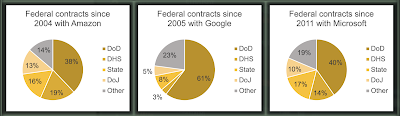
With this background, let's look at the bottom line, how much Big Tech benefitted from its close relationship with Washington over the GWoT.  According to the study, Amazon, Google, Microsot, Twitter and Facebook have made tens of billions of dollars from contracts signed with the Pentagon and the Department of Homeland Security.  Here are some details from the three largest beneficiaries with contract data being sourced from Tech Inquiry's U.S. government contracts explorer and subcontract data from Tech Inquiry's 2020 analysis:


1.) Amazon:


Department of Defense - $1,014,161,438.61


Department of Homeland Security - $77,907,156.72


Department of Justice - $27,606,234.89


Department of Justice FBI only - $415,305.25


Department of State - $4,757,563.17


2.) Google:


Department of Defense - $16,476,230.96


Department of Homeland Security - $2,090,692.69


Department of Justice - $27,606,234.89


Department of Justice FBI only - $3,366,115.88


Department of State - $4,712,221.83


3.) Microsoft:


Department of Defense - $42,719,199,701.48


Department of Homeland Security - $266,580,844.45


Department of Justice - $107,078,983.93


Department of Justice FBI only - $10,177,874.78


Department of State - $248,380,010.78


In closing, here is an interesting graphic showing federal contacts with all three of these companies:


Thanks to the unfettered generosity of American taxpayers (after all, it is taxpayers who are funding these programs), a system of technology capitalism has been created.  It is very obvious that the Global War on Terror's reliance on data-intensive surveillance has paid off very well for the players in the Big Tech sector which has profited very nicely by collecting our personal data which is then sold to third parties including governments and police forces among others.  With the recent push to define and punish so-called "domestic terrorists", one can only imagine how much the Big Tech sector will benefit from this program which seeks to demonize just about any American with a pulse who should happen to fall on the wrong side of any given issue in the opinion of the powers that ought not to be.