Showing posts with label climate change. Show all posts

Friday, April 25, 2025

The Evolving Narrative on Global Temperatures and the Danger of Solar Geoengineering

By now, many of my readers may have heard about the United Kingdom's plan to fund certain climate-based experiments through its Advanced Research + Invention Agency (ARIA).  According to the Agency's website, the group has the following core beliefs about "Future Proofing Our Climate and Weather":


The goal of ARIA is to "gather critical missing data and answer fundamental scientific questions on approaches that could help prevent humanity from experiencing climate tipping points" and to "explore whether approaches designed to delay, or avert, climate tipping points could be feasible, scalable, and safe."

ARIA claims that it is committed to responsible stewardship, transparency, accountailbilty and good governance and states the following about its funded research:

1.) Deliver valuable knowledge that can address the most pressing critical scientific questions surrounding these approaches

2.) Minimise risk by design

3.) Engage with, and respect local communities

4.) Be transparent, open and honest at programme and project level

5.) Communicate proactively

6.) Remain cognisant of the broader implications of research

7.) Be willing to adapt to lessons learned

8.) Adhere to our well-defined framework for responsible research.

The programme's independent oversight committee, made up of international experts, is designed to strengthen the governance of the programme. 

Basically, ARIA wants to fund geoengineering technologies that are designed to responsibly and artificially cool the earth.

According to the Guardian, the U.K. government through ARIA will fund £50 million ($66.65 million USD) of geoengineering, most particularly solar geoengineering also known as solar radiation management:


Here's a quote from the article with my bolds: 

"UK scientists are to launch outdoor geoengineering experiments as part of a £50m government-funded programme.

The experiments will be small-scale and rigorously assessed, according to Advanced Research and Invention Agency (Aria), the UK government agency backing the plan, and will provide “critical” data needed to assess the potential of the technology. The programme, along with another £11m project, will make the UK one of the biggest funders of geoengineering research in the world."

Here is a graphic showing five methods for solar radiation managemen from the National Oceanic and Atmospheric Administration or NOAA:


While the prospect of sun-dimming technology is rather frightening given that the negative repercussions could be catastrophic, a look back in time to 1975 shows us just how unscientific climate science really is:


As reported in Newsweek in 1975 (thanks to Tony Heller for the link), climate scientists were concerned about global cooling:

"There are ominous signs that the earth's weather patterns have begun to change dramatically.

The evidence in support of these predictions (drop in global temperatures that have led to a shortening of the growing season) has now begun to accumulate so massively that meteorologists are hard pressed to keep up with it.

The central fact is that after three quarters of a century of extraordinarily mild conditions, the earths climate seems to be cooling down.  Meteorologists disagree about the cause and extent of the cooling trend, as well as over its specific impact on local weather conditions.  But they are almost unanimous that the trend will reduce agricultural productivity for the rest of the century."

...a study released last month by two NOAA scientists noted that the amount of sunshine reaching the ground in the continental U.S. diminished by 1.3 percent between 1964 and 1972." 

My how things have changed over fifty years.  In the mid-1970s, apparently climate scientists were extremely worried about global cooling and were looking at solutions like melting the arctic ice caps to increase the world's temperatures and stated that if planners delayed, it would be more difficult to cope with that particular version of climate change.  Now, five decades later, climate scientists are grasping at technological straws in an attempt to cool the planet down by experimenting with the earth's atmosphere to reduce solar radiation. 

Perhaps, it would be best if mankind just let nature act as it always has; unpredictably and in cycles.  Rather than trying to control nature, it would be wise to let the climate change as it has for millennia (and much longer) without interfering with natural processes by using technology with unknown short-, medium- and long-term consequences.  Unfortunately, the decision makers that are funding these experiments with our tax dollars have no clue whatsoever about climate science...or any science for that matter.


Monday, March 11, 2024

The High Cost of Climate Change Mitigation for Developing Economies

What our politicians rarely mention is that there will be a very high cost to their drive to bring the net zero narrative to fruition.  A study by the United Nations Conference on Trade and Development (UNCTAD) outlines the high cost of the fight against climate change for developing economies, numbers which should cause concern for those often impoverished citizens living in these nations.


Let's start with some background first.  As noted above, the analysis looks at two main global economies, developed and developing economies which are shown on this map:


The estimates of this study calculated climate change mitigation costs for over 90 economies which represent 72 percent of the global population.  This includes 48 developing economies with 19 of these being classified as low- and lower-middle income and 29 being classified as upper-middle and high-income which, in total, covers 68 percent of people living in developing economies worldwide.  


UNCTAD looks at six "transition pathways" to achieve it 2030 Agenda for Sustainable Development as shown here:


For the purposes of this posting, we'll focus on the "Climate change, biodiversity loss and pollution" pathway which "includes strengthening commitments under the Paris Agreement, improving ecosystem management, reducing the effects of disasters and integrating climate and biodiversity actions."


The study covers several of the United Nations Sustainable Development Goals or SDGs related to climate change including the following indicators:


The United Nations measures progress on this SDG in several areas; safeguarding marine, freshwater and land biodiversity; bolstering the sustainability of fisheries; increasing forest coverage; preventing land degradation; and halting the extinction of threatened species.


Now, let's look at the numbers.  The total annual cost of accelerating climate change, biodiversity loss and pollution goals between 2023 and 2030 for developing economies is $5.536 trillion or 18 percent of their GDP.  The per capita cost ranges from $397 annually for low and lower-middle income developing nations and $2026 annually for upper-middle and high-income developing nations with an average of $1213 per person annually for all developing nations.


Here is a table summarizing the findings of the study:


What concerns UNCTAD is the spending gap on the climate change sustainable development goal by these nations; the authors of the study note that there is a $337 billion annual funding gap which would require a 6.5 percent increase in annual spending.  What's even more concerning to the United Nations is, that if all developing economies are included, the total annual spending on the climate change SDG would reach up to $7 trillion meaning that the annual gap would be $410 billion.


Fortunately for all of us, the United Nations has provided recommendations as quoted here:


"Government spending can be tailored to specific national circumstances. These might include enhancing environmental planning and regulation, building climate-resilient infrastructure, promoting clean technologies like carbon capture, developing early warning systems, or restoring and conserving forests and marine life."


Keeping in mind that the developing economies included in these calculations have some of the poorest people on earth, it boggles the mind that the United Nations would think that the indebted governments in these nations would have the funding to actually meet the United Nations' climate change sustainable development goals when they struggle to feed their own citizens.


Friday, February 16, 2024

A Globalist's Solution to Transportation Emissions

There is little doubt that Canada is a world leader when it comes to a kakistocracy and, it's government is also well known as a haven for globalists of the World Economic Forum-type.  This is readily apparent with one of Canada's most influential government ministers, Stephen Guilbeault, the Trudeau government's sad excuse as Minister of the Environment.  We'll start this posting with some recent comments by Guilbault at a conference held in Quebec followed by a look at his travel expenses which are paid for by Canadian taxpayers.


Here is a quote from Gilbeault's luncheon speech given at the Trajectoire Quebec conference, a group that focuses on public transit, held on February 12th, 2024 at the Westin Montreal in Montreal Quebec with my bolds:


"Our government has made the decision to stop investing in new road infrastructure. Of course we will continue to be there for cities, provinces and territories to maintain the existing network, but there will be no more envelopes from the federal government to enlarge the road network. The analysis we have done is that the network is perfectly adequate to respond to the needs we have. And thanks to a mix of investment in active and public transit, and in territorial planning and densification, we can very well achieve our goals of economic, social and human development without more enlargement of the road network....


The solution to mobility will not consist only of electrification. Electrification is a component but it’s not the only thing. There is the question of urban planning that is hyper important. … If you are a decision maker and you decide to build a government institution far from public transit systems, then by default you are inciting people to use their cars to access that public service. All of our planning practices have to be coherent with these mobility objectives, for the reduction of the ecological footprint of transportation and of greenhouse emissions."


So there you have it - the globalist's solution to transportation emissions is to eliminate funding for the building of vehicular transportation infrastructure.


Guilbeault went on to note that the money spent on "asphalt and concrete" would be better spent on projects that will help fight against and adapt to climate change 


Now, let's look at Guilbeault's transportation carbon footprint as a Member of Parliament and that of his office.  Here are screen captures from the Parliamentary Proactive Publication of Financial Information website showing his detailed travel expenditures for three fiscal quarters:


Given that the transportation costs are in the $200 range, I am suspecting that this is mileage charges (roughly 55 cents per kilometre which has increased to 58.5 cents per mile for 2024) for use of his vehicle to travel back and forth from Ottawa to his constituency office in Montreal (a distance of 200 kilometres one way) given that the cost of a return plane ticket is in excess of $500.  It is also possible that he used VIA Rail given that the cost of a two-way business class ticket with that routing ranges from $160 to $200 plus taxes however, given the lack of detail in his report, we cannot be certain.


Here is a screen capture from the Expenditures of Ministers' Offices webpage showing how much the Department of Environment and Climate Change spent on travel over the fiscal year from April 1, 2022 to March 31, 2023 with the travel expenses being highlighted:


Here are some more examples of his travel as Minister of the Environment:


For a fellow who is so concerned about the transportation carbon footprint of the serf class, he certainly gads about the globe with trips to India, Japan, Belgium, Columbia, Chile, Egypt, Ghana, Germany, the United States and Sweden since he took over the posting as Minister of Environment and Climate Change Canada in October 2021.


And, lastly, we have this:


Yes indeed, flying to Beijing for a two-day trip can only be defined as environmentally responsible!


So, while the sweaty masses continue to drive on more and more congested roadways, thanks to cuts in federal funding, the ruling class will continue to make ill-advised decisions on our behalf that will make it ever more uncomfortable to leave our allocated 15 minute city limits while they travel as though their much touted climate change narrative is fictional.


Remember the mantra of the globalist ruling class - do what I say, not what I do and you'll be happy to own nothing" and, might I add, go nowhere!


Thursday, February 1, 2024

The Climate Cost of Israel's War Against Gaza

With the global ruling class constantly invoking the spectre of boiling oceans, drowning coastlines and burning forests as they seek to create fear among the serf class, there is one aspect of the "toxic emissions that are supposedly the cause of global climate change that receives almost no coverage.


A recent paper entitled "A Multitemporal Snapshot of Greenhouse Gas Emissions from the Israel-Gaza Conflict" by Benjamin Neimark et al looks at the projected emissions from the first sixty days of the Israeli war against Gaza.  During the COP 28 meetings held in Dubai, the host nation prompted an examination of the links between conflict and climate change which were included on the United Nations Framework Convention on Climate Change agenda for the first time in history.  Since the Israeli military has never publicly reported its own emissions data, the authors created a heuristic (defined as involving or serving as an aid to learning, discovery, or problem-solving by experimental and especially trial-and-error methods) to provide context to their analysis.  From data from the top five European defense spenders in 2019, the authors estimated that Israel's 2019 military budget of US$20.34 billion would result in total emissions of 6.99 megatonnes of CO2, substantially higher than the total 2019 emissions from all of Palestine which are estimated at 4.8 tonnes CO2 equivalent. 


The authors looked at emissions during the first 60 days of the conflict.  They first calculated the following across three time horizons:


a.) emissions from the first 60 days of the war:


1.) Scope 1 emissions - tailpipe emissions


2.) Scope 2 and 3 emissions - manufacturing of bombs and rockets used by Israel, tanks and other vehicles, cargo flights and patrol flights by other aircraft


3.) emissions from the Qassam rockets used by Hamas


b.) emissions from the construction of security-related concrete infrastructure in both Israel and Gaza over the 16 years since Hamas was elected in Gaza.  This includes Hamas' Gaza tunnels and Israel's Iron Wall which separates Gaza from Israel.


c.) emissions from the costs of future reconstruction in Gaza given the destruction related to Israel's bombardment.


Here are their calculations:


1.) Immediate emissions from Israel:


a.) aircraft missions - total of 16,000 flight hours consuming 57.8 million litres of JP8 fuel - 121,000 tonnes CO2e


b.) United States supply flights from the United States - 4400 flight hours consuming 49.5 million litres of fuel -133,650 tonnes CO2e


c.) Israeli artillery - 8000 tonnes of steel and explosives uses - 13,600 tonnes CO2e


d.) Israeli bombs - 2300 tonnes used - 6689 tonnes CO2e


e.) Israeli tanks and vehicles - 1.85 million litres of fuel - 5663 tonnes C02e


Total Israeli immediate emissions – 280,602 tonnes CO2e


2.) Immediate emissions from Gaza:


a.) Hamas rockets - 475 tonnes of rockets - 713 tonnes CO2e


The total immediate emissions for 60 days of war is 281,315 tonnes CO2e or the equivalent of 75 coal-fired plants operating for a year.  This is greater than the annual emissions of 20 individual nations and territories combined.  It is also interesting to note that Hamas is responsible for only 0.25 percent of Israel’s total immediate emissions.


3.) Intermediate emissions from Israel:


a.) Israel Iron Wall - 65 kilometres in length - 140,000 tonnes of steel and iron above ground, 234,000 tonnes of concrete, 9750 tonnes of steel below ground - 274,232 tonnes CO2e


4.) Intermediate emissions from Gaza:


a.) Gaza tunnel system - 500 km tunnels - 176,000 tonnes CO2e


Total intermediate emissions from the building of war infrastructure are 450,232 tonnes CO2e which is greater than the total annual emissions of 30 individual nations and territories combined.


5.) Long Term emissions:


a.) Reconstruction of at least 100,000 destroyed buildings in Gaza - 30,000,000 tonnes CO2e


The total long-term emissions from reconstruction of Gaza is roughly equivalent to the annual emissions from the entire nation of New Zealand and is greater than the annual emissions of 130 individual nations and territories combined.


Keeping in mind that the war in Gaza has continued for nearly 2 months since the authors of this paper completed their calculations, we can see that the carbon cost of war is extremely high.  That said, the rulers would still prefer us to eat bugs and live in our 15 minute cities all in the name of saving the planet for them.  As an additional benefit, those of the global aristocracy who benefit from war will not experience any financial discomfort from peace in the Middle East.


Monday, July 17, 2023

Kamala Harris - Combatting Climate Change Through Population Reduction

Sometimes the "leaders" of the world say the quiet part out loud because they so strongly believe their own brand of bullshit that they actually delude themselves into believing that the rest of us share their vision for the world.  A prime example can be found here:


Here's an excerpt from this speech given by Kamala Harris on July 14, 2023 given in a speech entitled Combatting Climate Change and Building a Clean Energy Economy at Coppin State University in Baltimore, Maryland that sets the stage:


"So, every day, all across our nation, we feel and see the impact of the climate crisis.  I mean, if you watch the morning news, it will be the lead story.  It’s been every day for the last couple of weeks.  It is the lead story.  I think we finally, at least in our progress, come to the point that most people can no longer deny it because it is so obvious.


And we have seen, around our country, where communities have been choked by drought, have been washed out by floods, and decimated by hurricanes.  Here in Baltimore, you have seen your skies darkened by wildfire smoke.  And you have seen the waters of the Chesapeake Bay rise, threatening homes and businesses that have stood for generations.


It is clear that the clock is not only ticking, it is banging.  And we must act."


Yes Kamala, no matter what humanity does, seemingly we can't avoid weather.


So, from the transcript provided on the White House website, here's the slip:


Apparently, she meant to say "pollution" but "mistakenly" said "population", at least according to the White House.  In the real world, it's called a Freudian slip which is a verbal mistake linked to the unconscious mind.  It's also Klaus Schwab's wet dream come true.


And, if you believe the White House edit of Harris' speech, I've got some swampland in Florida that I'd like to sell to you.


Wednesday, October 26, 2022

Smart Thermostats - What Lies Ahead for Consumers

As part of the Great Reset under which the organ donor class will feel the overriding powers of the ruling class as they further attempt to control every aspect of our lives, particularly our use of energy, a program operated by Alliant Energy in Iowa and Wisconsin is, perhaps, a harbinger of what lies ahead.


Here is the lead webpage for the program:


Under the program, Alliant will be able to control eligible smart thermostats which include the following:


• Google Nest Thermostat

• Google Nest Learning Thermostat

• Google Nest Thermostat E

• ecobee3 Lite Thermostat

• ecobee4

• ecobee SmartThermostat with Voice Control

• Emerson Sensi Classic Smart Thermostat

• Emerson Sensi Touch Smart Thermostat with Color Touchscreen


Here is the justification for the program:


When Alliant Energy's customers sign up, they can choose to be enrolled one of three options: the summer program, the winter program or a program that combines both seasons.  Once signed up, Alliant will monitor the customer's smart thermostat to establish their regular heating and cooling settings "...so that we can be sure to keep you comfortable on event days...", i.e. days when demand for Alliant's energy is predicted to spike.  On those days, Alliant will schedule a "Smart Hours" event which will allow the company to adjust the customer's thermostat schedule by heating or cooling their home before the predicted energy spike followed by a reduction in energy use during the Smart Hours event. The company states that there will be a maximum of 15 Smart Hours events during the summer season (June 1 to September 30) and winter season (December 1 to March 31).  The company will rarely reduce a customer's energy use for more than four hours and never on weekends or weekdays.  If a customer's home fluctuates by more than a few degrees, their home air-conditioning or heating system will automatically kick in to return the dwelling to the customer's preferred temperature setting.   This will allow the company to flatten the energy spike, allegedly allowing the company to minimize energy price increases.


Of course, given the "everything is about climate change" age in which we are living, Alliant Energy states that its Smart Hours program will help the environment as quoted here:


"When demand for electricity is high, sometimes energy providers need to turn to more expensive power sources to accommodate everyone’s needs. Alliant Energy Smart Hours helps the environment by allowing us to avoid turning on less environmentally friendly energy sources to meet electricity demand on extra-hot or extra-cold days."


Remember, it's all about the environment and has absolutely nothing to do with increasing the company's profitability.  Really, trust them.


So, for essentially handing over control of their home heating and cooling systems, Alliant Energy's customers in Iowa receive a $50 enrolment bonus and those in Wisconsin will receive a $25 enrollment bonus plus an additional $25 when they sign up their water heater later in 2022  In addition, enrollees will receive a with a $25 virtual prepaid Mastercard for every season that they are eligible to participate in the program.


Of course, right now this scheme is voluntary but it sets the stage for a program that could become mandatory in the future when our personal energy consumption is fully controlled by the ruling class, all in the name of protecting the environment (so that they can use their limousines and personal jets to their heart's content) because the useless eaters are are simply too stupid to know how to control it without their assistance.


Wednesday, August 31, 2022

How Banks Will Force the Transition to Electric Vehicles

The powers that (ought not) to be are doing their best to force Western consumers into adopting new lifestyles to meet their greenhouse gas emissions targets.  Much of the burden of reducing carbon emissions will fall on the back of reducing the purchases of internal combustion engine (ICE) cars with many governments offering incentives to induce consumers into purchasing over-priced and under-tested electric vehicles (EVs) by insisting that these vehicles are zero emitters.  According to Efficient Manufacturing, there are an estimated 2 billion internal combustion engines in use around the world, making it very difficult to achieve the goal of zero ICE vehicle sales, particularly when EV prices are significantly higher than equivalent ICE prices.  As you will see in this posting, one bank has just announced how it will force its customers to adopt EV technology and you can assure yourself that this is just the first bank to take this drastic action.


Bank Australia is Australia's fifth largest customer-owned mutual bank when measured in terms of assets.  It is a relatively small bank when compared to its peers, however, it offers a wide range of services to its customers/shareholders:


Business loans

Home loans

Transaction accounts

Credit cards

Saving accounts

Term deposits

Personal loans including lifestyle and car loans

Insurance including home and contents, landlord, renter's, personal risk, business, travel and health insurance


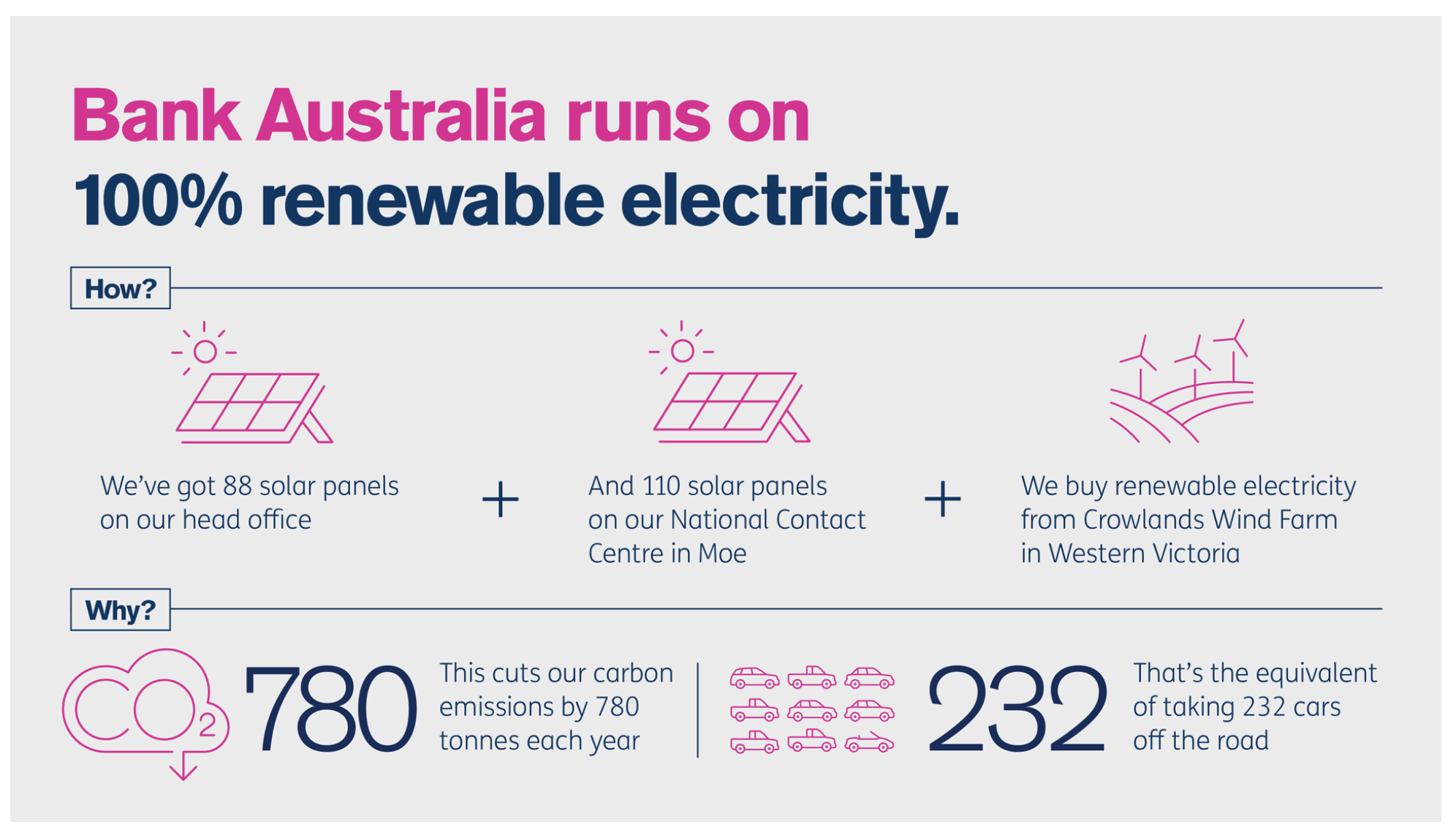
Given the push towards meeting Environment, Social and Governance or ESG targets as mandated by the United Nations, the bank has taken significant steps to reducing its own greenhouse gas footprint as shown here:


...here:


...and here


Let's look at a recent announcement from Bank Australia:


Here are some quotes with my bolds:


"Encouraging customers to think about their next vehicle purchase is an important part of Bank Australia’s climate action strategy and it aims to support them to make sustainable choices. Around 43% of Australia’s transport emissions are from passenger vehicles. Electric vehicles are a ready-to-deploy technology so they can be one of the fastest contributors to Australia meeting its climate goals. 


In announcing this commitment at the National Electric Vehicle Summit in Canberra, Bank Australia Chief Impact Officer Sasha Courville said that encouraging the shift to electric vehicles will be an important step in decarbonising the Australian economy. 


By ceasing car loans for new fossil fuel vehicles, we are sending a signal to the Australian market about the rapid acceleration in the transition from internal combustion to electric vehicles we expect to see in the next few years.” 


“We’ve chosen 2025 because the change to electric vehicles needs to happen quickly, and we believe it can with the right supporting policies in place to bring a greater range of more affordable electric vehicles to Australia."


Since 2018, the bank has offered discounted interest rates on lending for low emission vehicles since 2018.  Since EVs are not widely available largely due to supply chain stresses related to the COVID-19 pandemic, the bank will "continue to support customers who can't yet access an electric vehicle as quoted here:


"While we will cease car loans for new fossil fuel cars from 2025, we are deeply aware that we need to support people not yet able to afford an electric vehicle while the market grows. We’ll continue to offer loans for second hand fossil fuel vehicles until there is a viable and thriving market for electric vehicles."


The press release closes by noting the importance of electric vehicles for their positive impact on the climate.  Apparently, the bank's management hasn't considered the fact that the electricity needed to recharge EV batteries doesn't come from the burning of unicorn farts and that the mining of lithium and cobalt have significant negative environmental and social impacts as noted here:


...and in this paper:


Don't count on hearing about either of these issues from your local, first-order thinking politician.


Given that the infrastructure to needed to support the charging of EVs is completely inadequate, an issue recently experienced in China:


...a situation that will become significantly worse as governments force the switching from fossil fuel- and uranium-based electricity generation to solar and wind power which are, at best, inconsistent, the move by Bank Australia to force its customers into adopting electric vehicles is ill-advised.  That said, those of us who live in other nations should consider the fact that, under ESG guidelines, banks and other financial firms in Western nations are likely to adopt a similar philosophy to remain on the good side of the "ESG police".