Showing posts with label greenhouse gases. Show all posts

Thursday, February 1, 2024

The Climate Cost of Israel's War Against Gaza

With the global ruling class constantly invoking the spectre of boiling oceans, drowning coastlines and burning forests as they seek to create fear among the serf class, there is one aspect of the "toxic emissions that are supposedly the cause of global climate change that receives almost no coverage.


A recent paper entitled "A Multitemporal Snapshot of Greenhouse Gas Emissions from the Israel-Gaza Conflict" by Benjamin Neimark et al looks at the projected emissions from the first sixty days of the Israeli war against Gaza.  During the COP 28 meetings held in Dubai, the host nation prompted an examination of the links between conflict and climate change which were included on the United Nations Framework Convention on Climate Change agenda for the first time in history.  Since the Israeli military has never publicly reported its own emissions data, the authors created a heuristic (defined as involving or serving as an aid to learning, discovery, or problem-solving by experimental and especially trial-and-error methods) to provide context to their analysis.  From data from the top five European defense spenders in 2019, the authors estimated that Israel's 2019 military budget of US$20.34 billion would result in total emissions of 6.99 megatonnes of CO2, substantially higher than the total 2019 emissions from all of Palestine which are estimated at 4.8 tonnes CO2 equivalent. 


The authors looked at emissions during the first 60 days of the conflict.  They first calculated the following across three time horizons:


a.) emissions from the first 60 days of the war:


1.) Scope 1 emissions - tailpipe emissions


2.) Scope 2 and 3 emissions - manufacturing of bombs and rockets used by Israel, tanks and other vehicles, cargo flights and patrol flights by other aircraft


3.) emissions from the Qassam rockets used by Hamas


b.) emissions from the construction of security-related concrete infrastructure in both Israel and Gaza over the 16 years since Hamas was elected in Gaza.  This includes Hamas' Gaza tunnels and Israel's Iron Wall which separates Gaza from Israel.


c.) emissions from the costs of future reconstruction in Gaza given the destruction related to Israel's bombardment.


Here are their calculations:


1.) Immediate emissions from Israel:


a.) aircraft missions - total of 16,000 flight hours consuming 57.8 million litres of JP8 fuel - 121,000 tonnes CO2e


b.) United States supply flights from the United States - 4400 flight hours consuming 49.5 million litres of fuel -133,650 tonnes CO2e


c.) Israeli artillery - 8000 tonnes of steel and explosives uses - 13,600 tonnes CO2e


d.) Israeli bombs - 2300 tonnes used - 6689 tonnes CO2e


e.) Israeli tanks and vehicles - 1.85 million litres of fuel - 5663 tonnes C02e


Total Israeli immediate emissions – 280,602 tonnes CO2e


2.) Immediate emissions from Gaza:


a.) Hamas rockets - 475 tonnes of rockets - 713 tonnes CO2e


The total immediate emissions for 60 days of war is 281,315 tonnes CO2e or the equivalent of 75 coal-fired plants operating for a year.  This is greater than the annual emissions of 20 individual nations and territories combined.  It is also interesting to note that Hamas is responsible for only 0.25 percent of Israel’s total immediate emissions.


3.) Intermediate emissions from Israel:


a.) Israel Iron Wall - 65 kilometres in length - 140,000 tonnes of steel and iron above ground, 234,000 tonnes of concrete, 9750 tonnes of steel below ground - 274,232 tonnes CO2e


4.) Intermediate emissions from Gaza:


a.) Gaza tunnel system - 500 km tunnels - 176,000 tonnes CO2e


Total intermediate emissions from the building of war infrastructure are 450,232 tonnes CO2e which is greater than the total annual emissions of 30 individual nations and territories combined.


5.) Long Term emissions:


a.) Reconstruction of at least 100,000 destroyed buildings in Gaza - 30,000,000 tonnes CO2e


The total long-term emissions from reconstruction of Gaza is roughly equivalent to the annual emissions from the entire nation of New Zealand and is greater than the annual emissions of 130 individual nations and territories combined.


Keeping in mind that the war in Gaza has continued for nearly 2 months since the authors of this paper completed their calculations, we can see that the carbon cost of war is extremely high.  That said, the rulers would still prefer us to eat bugs and live in our 15 minute cities all in the name of saving the planet for them.  As an additional benefit, those of the global aristocracy who benefit from war will not experience any financial discomfort from peace in the Middle East.


Friday, July 21, 2023

The Greenhouse Gas Emissions of the Information and Communications Technology Sector

While the powers that be are all over the use of petroleum products for transportation (except when it comes to their use of jets to fly about the globe), there is one use of energy that creates significant greenhouse gas emissions that gets almost no attention from the media or politicians.


In a publication entitled "The Worm in the Rose" by Gwythian Prins:


..the author examines the "green growth" fallacy, observing that a transition to green energy through a net zero approach is a "Veblen good", that is, a good that is consumed in increasing amounts as price increases, contradicting the law of supply and demand.  Veblen goods are often viewed as a status symbol and are consumed as part of a conspicuous consumption/virtue signalling lifestyle.


In reading through the document, I found one section in the chapter entitled "Energy is like other commodities" particularly compelling, especially in light of the World Economic Forum's Fourth Industrial Revolution narrative which heavily relies on the Internet of Things (IoT) for its fulfillment.  


Here is a quote with my bolds:


"Enthusiastic senders of emails and social media messages – including those using them as tools to aid protests about climate change – may believe that the internet behind their screens is saving energy in some way. However, although they travel through cyberspace rather than in planes or on trains, they stand in lineal descent from users of steam railways, ocean liners and jet aircraft as major energy users. The power demands of the internet’s nodal data centres and of the information and communications technology backbone of the modern, advanced global economy may not be obvious to users, but they are enormous."


This is an aspect of global climate change remediation that receives no attention from the vast majority of climate change "experts".   With Prinns' comments in mind, let's look at research into the issue of Information and Communications Technology (ICT) sector-related greenhouse gas emissions.  In a 2021 paper by Charlotte Freitag et al entitled "The climate impact of ICT: A review of estimates trends and regulations" we find the following:


"In this report, we examine the available evidence regarding ICT's current and projected climate impacts. We examine peer-reviewed studies which estimate ICT's current share of global greenhouse gas (GHG) emissions to be 1.8-2.8% of global GHG emissions. Our findings indicate that published estimates all underestimate the carbon footprint of ICT, possibly by as much as 25%, by failing to account for all of ICT's supply chains and full lifecycle (i.e. emissions scopes 1, 2 and fully inclusive 3). Adjusting for truncation of supply chain pathways, we estimate that ICT's share of emissions could actually be as high as 2.1-3.9%."


To put this share into context, it is important to keep in mind that emissions from the civil aviation sector make up 1.9 percent of total global emissions and the much beleaguered agriculture (and fishing) sectors make up 1.7 percent of the total as shown here:


The authors have three reasons why ICT's emissions are likely to increase unless there is a targeted intervention:


1.) historically, ICT-enabled efficiency improvements have gone hand in hand with increases in energy consumption and GHG emissions both within the ICT sector and in the wider economy. While it cannot be proven that ICT efficiency gains lead to rebounds in emissions that outweigh any savings, there are so many circumstances in which reductions in inputs per unit of output lead to a net increase in inputs that this has to be a significant risk; and one that is often underappreciated.


2.) current studies make several important omissions surrounding the growth trends in ICT. Blockchain is generally excluded from calculations, and Internet of Things (IoT) devices are sometimes partly included but their effect on complementary growth in energy consumption by data centres and networks is not. These trends alongside Artificial Intelligence (AI) do offer opportunities for efficiency gains, but there is no evidence to suggest these create GHG savings that outweigh the additional emissions these technologies would cause.


3.) there is significant investment in developing and increasing uptake of Blockchain, IoT and AI. All three represent key market opportunities, provide a range of claimed public benefits and are further believed by some to enable up to 15% reductions in global emissions. While significant if achieved, this falls well short of the reductions needed to meet climate change targets. There is a risk that these technologies might also contribute to increases in emissions through stimulating increased carbon- intensive activities such as ‘Proof of Work’ algorithms and training ever more complex machine learning models.


Here is a graphic from the paper showing global ICT's carbon footprint in both 2015 and 2020:


Here is a graphic showing projected growth in greenhouse gas emissions from ICT between 2020 and 2040:


If the ICT sector would reduce its emissions in line with other sectors of the economy, it would have to reduce emissions by 42 percent by 2030, 72 percent by 2040 and 91 percent by 2050 as shown here:


The authors have three reasons why ICT's emissions are going to increase:


1.) even if there are improvements in efficiency in the ICT sector, the improvements are likely to be counterbalanced by increased growth in demand for ICT technology.  While renewable energy will help decarbonize ICT, it is not a complete solution.


2.) current studies of ICT's carbon footprint are omitting key sources of emissions, most particularly Blockchain and the Internet of Things.


3.) there is significant investment in the development and adoption of Blockchain, the Internet of Things and Artificial Intelligence, all of which will lead to only marginal reductions in emissions from the ICT sector which will not allow the sector to meet climate change targets.


We also have to keep in mind that vast and growing amounts of data are being collected on all of us as the surveillance state expands its hold on society.  The storage and processing of this data, much of which is being accomplished using AI, will require increased energy usage.  This is likely to worsen over the decades, particularly once we are living in a Central Bank Digital Currency ecosystem, making it very difficult for the ICT sector to reduce its impact on greenhouse gas emissions.


Let's close with this thought.  Isn't it interesting that emissions from the information and technology sector receive only passing attention from the ruling class given that the sector is key to the imposition of the surveil and control agenda that they have for the peasant class?  Perhaps this is just another fine example of "do what I say, not what I do" that has become so pervasive over the past few years; they need the energy to watch and dominate us while we live in our squalid 15 minute city hovels with our small rations of energy.


Wednesday, July 12, 2023

Private Jet Emissions in Europe - Lifestyle for Me But Not For Thee

While I'm no fan of Greenpeace, a recent study commissioned by the environmental activists examines an issue that should concern all of us given that the global ruling class insists that we are living in a climate emergency that requires those of us who sweat while we work to make unprecedented changes to our lifestyles.


Here is the cover page of the study:


The group that completed the study, CE Delft, built a database for the study which included information on all private flights departing from and arriving in the EU27 nations including Switzerland, Norway and the United Kingdom by year, route, type of aircraft and carbon dioxide emissions for each flight.  the following flights were excluded from the analysis:


1.) Flights using aircraft with less than 3 seats.


2.) Flights to and from airports without an IATA code.


3.) Flights that arrived at the same airport from which they departed.


These flights were excluded since many small aircraft are used for leisure flights, training purposes or parachute jumping rather than business.  Medical and military flights are included in the study but only if they used aircraft that are typically used in business aviation.


Let's look at the data by year keeping in mind that the carbon footprint of of an EU resident was equivalent to 6.8 tonnes of carbon dioxide per year per person in 2019:


1.) 2020 - 118,756 private flights emitting 354,690 tonnes of carbon dioxide


2.) 2021 - 350,078 private flights emitting 1,637,623 tonnes of carbon dioxide


3.) 2022 - 572,806 private flights emitting 3,385,538 tonnes of carbon dioxide


In total, private jet emissions exceed the annual per capita carbon dioxide emissions of 550,000 EU residents.


What is particularly interesting is the distribution of flight distances by year:


1.) 2020: the largest category of flights is between 251 and 500 kilometres with the second largest category being flights between 0 and 250 kilometres.  In 2020, 58 percent of all private flights were used for a distance of less than 500 kilometres:


2.) 2021: the largest category of flights at 26 percent of all flights is between 251 and 500 kilometres with the second largest category at 18 percent being flights between 0 and 250 kilometres.  The percentage of flights that exceeded 3001 kilometres rose from 3 percent in 2020 to 6 percent in 2021:


3.) 2022: the largest category of flights at 24 percent is between 251 and 500 kilometres with the second largest category at 16 percent of all flights being flights between 501and 750 kilometres.  In total, 55 percent of all flights were between 0 and 750 kilometres in 2022.  The percentage of flights that exceeded 3001 kilometres rose from 6 percent in 2021 to 9 percent in 2022:


Here are tables showing the most used flight routes in 2020, 2021 and 2022 along with their emission excluding routes that are mainly used for medical or military reasons or are being used by airlines offering scheduled flights aboard business jets:


It is interesting to see the huge number of private jet flights of less than 100 kilometres in length and their emissions as shown here:


1.) 2020 - 833 flights emitting 983 tonnes of carbon dioxide


2.) 2021 - 2178 flights emitting 3501 tonnes of carbon dioxide


3.) 2022 - 3093 flights emitting 4953 tonnes of carbon dioxide


In all three years, the most used flight route under 100 kilometres was London to Farnborough and return with a total of 2238 flights over the three year period.  For those of you who are not award, Farnborough Airport is "the largest and most pre-eminent business aviation airport in the United Kingdom". 


What we need to keep in mind is that Europe has an advanced passenger train infrastructure that covers many of these destinations multiple times per day.  For example, the Amsterdam to London and return route, one of the top ten private jet routes, has a 8 daily direct train connections that take around 4 hours one way.  A train journey between Basel and Zurich in Switzerland takes less than a hour, covers 74 kilometres and there are 78 trains daily.


If you wish to learn more about how the global ruling class lives and the impact of their private jet lives on the climate, I would suggest that you read the report which you can find by clicking here.  In the report, the authors provide a breakdown of business jet flights for each nation in Europe along with the accompanying impact on greenhouse gas emissions.


Let's summarize with this recent news:


If there's one thing that we've learned over the past three and a half years, it's that the ruling class adheres to the "do what I say, not what I do" and the "lifestyle for me but not for thee" philosophies.  Rules are made for the serfs, not for the rulers and they love nothing more than our complete and unthinking compliance and for the sacrifices that we are willing to make for their collective benefit.


Thursday, October 6, 2022

How the World Economic Forum Proposes to Solve the Carbon Impact of the Marine Shipping Industry

The World Economic Forum, the repository of solutions to absolutely everything that could go wrong on Earth (plus things that you didn't even realize could be improved) has come up with what can only be described as a step back in time.


For those that have been following the machinations of the world's foremost representative of the global ruling class and its mandate to convince us all that the world is about to end unless we are willing to take major steps to combat global climate change, this piece on the WEF website provides a roadmap for the global marine shipping industry:


In this article, written by Victoria Masterson who we will look at in more detail at the end of this posting, she opens by telling readers about a new electric ferry called the Candela P-12 which will start running a trial from Stockholm, Sweden to the nearby island of Ekero, a suburb of Stockholm.  The ferry is being manufactured by Candela, a Stockholm-based company with its American headquarters in Sausalito, California.  From the company's website we find this:


The company's ultimate purpose is to achieve "fossil fuel freedom" by speeding up the transition from fossil fuel to electricity in the maritime industry with their high-efficiency, all-electric propulsion system for both leisure boating and public transport.  


Here is a video showing Candela's C-8 model's maiden "flight":


The long-range all-electric C-8 is touted as the world's first flying boat and has a starting price of €330,000 (so it's obviously being built for the Davos crowd/parasite class and most definitely not for the organ donor class) and is now in full production.  It can seat 8 passengers including the driver and has a top speed of 30 knots.


Here is a video showing Candela's P-12, the electric ferry referred to in the WEF article:


The P-12 will have an average speed of 20 to 30 knots which is not that fast compared to other technologically advanced ferries and uses 80 percent less energy than conventional ICE-equipped ferries with its batteries charging from empty in one hour and has a capacity of 30 passengers.  If the trial is successful, Candela hopes that its electric ferries can replace Stockholm's fleet of 70 diesel ferries.


So, there's the "good news".  Now, for the "bad news".  The global shipping industry accounts for 3 percent of global emissions, a relatively small percentage, however, the author insists that the world cannot become carbon-neutral without removing these emissions which are "...thought to cause around 60,000 premature deaths a year, especially in coastal and port areas...".  Here is a graphic showing carbon dioxide emissions by vessel type for the past decade which shows that, despite the increase in marine shipping volumes, have not grown substantially over the past decade:


According to the author (and reality), deep-sea cargo vessels are unlikely candidates for electrification given the massive rechargeable battery banks that would be required. But, never let facts get in the way of dreaming.  Here is a video showing a zero-emission cargo ship that will run on liquified hydrogen:


You will notice that this cargo ship yields "no direct greenhouse gas emissions" however, it is pretty obvious to those of us with even a small amount of critical thinking ability that this is a scenario similar to electric vehicles which have no "tailpipe emissions" but which are indirectly responsible for the emission of significant volumes of greenhouse gas emissions throughout their entire life cycle since, for one, the electricity to charge EVs has to come from somewhere and the materials to build the batteries also has to be mined, processed and manufactured into batteries, using significant amounts of fossil-fuels.


According to the author, in 2018, the International Maritime Organization pledged to have the shipping sector's emissions by 2050.  More than 200 maritime industry leaders who are part of the Call to Action for Shipping Decarbonization are calling for even greater reductions to becoming entirely carbon-free by 2050 as shown here:


And, who is involved in the Call to Action for Shipping Decarbonization?  Here's list of supporting organizations with a key supporter being highlighted:


That's absolutely shocking, isn't it?


Now, let's take a brief look at Ms. Masterson's other suggestions for the shipping industry.  Here is a direct quote from the piece:


"The shipping industry is trialling alternative fuels, like biogas – a renewable fuel typically derived from organic waste. Other fuels that can be produced with no or low-carbon emissions, like ammonia and methanol, are also being tested.


For example, Danish ship owner and operator Maersk is developing eight large ocean-going container vessels that can be run on carbon-neutral methanol.


Wind, sun and other forms of renewable energy can be harnessed on ships to help propel them. Swedish shipbuilder Wallenius Marine and its partners are developing the “Oceanbird,” a cargo ship powered by wind that can carry 7,000 cars.


Hybrid systems that combine batteries and other fuels are also being developed. Precious Shipping, a ship owner and operator in Thailand, is working on developing a hybrid battery system that also uses wind and solar energy."


Given her reference to the Oceanbird, a wind-powered cargo ship, is not surprising given that this article appeared on the WEF website in December 2020:


One thing that none the advocates for battery-based transportation systems consider is the extremely high cost of replacing batteries once they have completed their life cycles and will no longer provide the capability to generate the power necessary for medium- or long-range shipping.


Let's take a brief look at marine transportation from another viewpoint.  I'm betting that there will be exemptions granted to certain marine craft including these vessels:


1.) The Lana super yacht:


2.) Oceanco Y721 owned by Jeff Bezos:


3.) The successor to the British Royal Family's Britannia:


...and this list of the world's 21 largest super yachts (among hundreds of thousands of other privately-owned yachts :


In closing, and now that we have her views on the subject of reducing the carbon impact of the global shipping industry, it would be wise to understand why Ms. Masterson's views on the subject should likely be taken with a grain of salt given that her formal training has a nearly complete lack of science education beyond her O-Level achievement in high school biology with her remaining degrees including a Master of Fine Arts at the Edinburgh College of Art, an Honours MA in English Literature and Language and Master of Science (if indeed you can call it "science" in Factual Television which includes developing content for broadcasting, filming and editing content and sound recording and most of her work experience has been as a business journalist/editor and, most importantly of course, a Senior Writer of Formative Content for the World Economic Forum for the past two years.  But, never let a lack of formal science and climate education get in the way of a good climate scare narrative, something that the content providers of the WEF seem to have in spades.


Once again, rules for thee but not for me says the ruling class to anyone who is listening and most of humanity is not.


Wednesday, August 31, 2022

How Banks Will Force the Transition to Electric Vehicles

The powers that (ought not) to be are doing their best to force Western consumers into adopting new lifestyles to meet their greenhouse gas emissions targets.  Much of the burden of reducing carbon emissions will fall on the back of reducing the purchases of internal combustion engine (ICE) cars with many governments offering incentives to induce consumers into purchasing over-priced and under-tested electric vehicles (EVs) by insisting that these vehicles are zero emitters.  According to Efficient Manufacturing, there are an estimated 2 billion internal combustion engines in use around the world, making it very difficult to achieve the goal of zero ICE vehicle sales, particularly when EV prices are significantly higher than equivalent ICE prices.  As you will see in this posting, one bank has just announced how it will force its customers to adopt EV technology and you can assure yourself that this is just the first bank to take this drastic action.


Bank Australia is Australia's fifth largest customer-owned mutual bank when measured in terms of assets.  It is a relatively small bank when compared to its peers, however, it offers a wide range of services to its customers/shareholders:


Business loans

Home loans

Transaction accounts

Credit cards

Saving accounts

Term deposits

Personal loans including lifestyle and car loans

Insurance including home and contents, landlord, renter's, personal risk, business, travel and health insurance


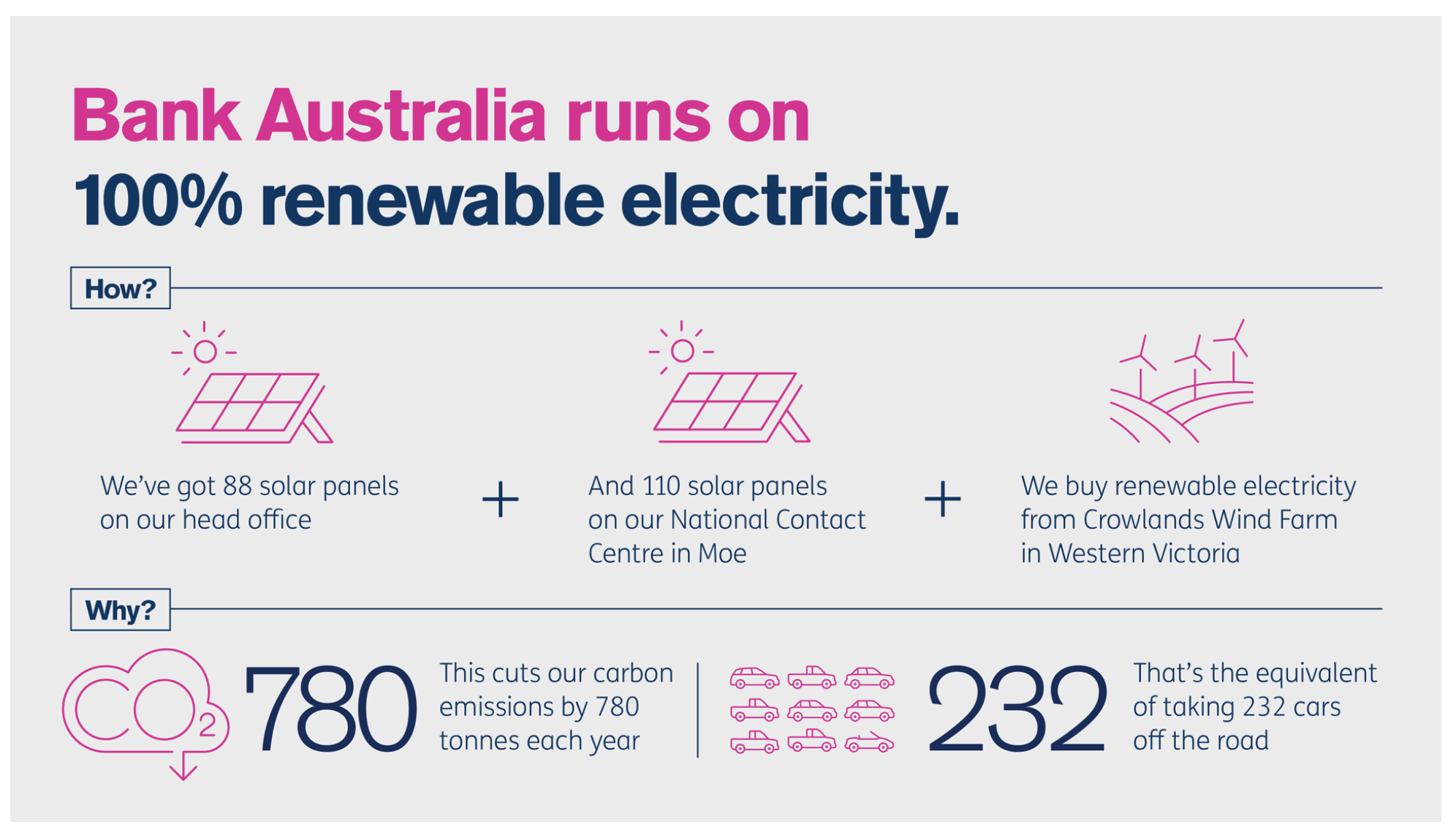
Given the push towards meeting Environment, Social and Governance or ESG targets as mandated by the United Nations, the bank has taken significant steps to reducing its own greenhouse gas footprint as shown here:


...here:


...and here


Let's look at a recent announcement from Bank Australia:


Here are some quotes with my bolds:


"Encouraging customers to think about their next vehicle purchase is an important part of Bank Australia’s climate action strategy and it aims to support them to make sustainable choices. Around 43% of Australia’s transport emissions are from passenger vehicles. Electric vehicles are a ready-to-deploy technology so they can be one of the fastest contributors to Australia meeting its climate goals. 


In announcing this commitment at the National Electric Vehicle Summit in Canberra, Bank Australia Chief Impact Officer Sasha Courville said that encouraging the shift to electric vehicles will be an important step in decarbonising the Australian economy. 


By ceasing car loans for new fossil fuel vehicles, we are sending a signal to the Australian market about the rapid acceleration in the transition from internal combustion to electric vehicles we expect to see in the next few years.” 


“We’ve chosen 2025 because the change to electric vehicles needs to happen quickly, and we believe it can with the right supporting policies in place to bring a greater range of more affordable electric vehicles to Australia."


Since 2018, the bank has offered discounted interest rates on lending for low emission vehicles since 2018.  Since EVs are not widely available largely due to supply chain stresses related to the COVID-19 pandemic, the bank will "continue to support customers who can't yet access an electric vehicle as quoted here:


"While we will cease car loans for new fossil fuel cars from 2025, we are deeply aware that we need to support people not yet able to afford an electric vehicle while the market grows. We’ll continue to offer loans for second hand fossil fuel vehicles until there is a viable and thriving market for electric vehicles."


The press release closes by noting the importance of electric vehicles for their positive impact on the climate.  Apparently, the bank's management hasn't considered the fact that the electricity needed to recharge EV batteries doesn't come from the burning of unicorn farts and that the mining of lithium and cobalt have significant negative environmental and social impacts as noted here:


...and in this paper:


Don't count on hearing about either of these issues from your local, first-order thinking politician.


Given that the infrastructure to needed to support the charging of EVs is completely inadequate, an issue recently experienced in China:


...a situation that will become significantly worse as governments force the switching from fossil fuel- and uranium-based electricity generation to solar and wind power which are, at best, inconsistent, the move by Bank Australia to force its customers into adopting electric vehicles is ill-advised.  That said, those of us who live in other nations should consider the fact that, under ESG guidelines, banks and other financial firms in Western nations are likely to adopt a similar philosophy to remain on the good side of the "ESG police".