Showing posts with label hegemony. Show all posts

Wednesday, July 20, 2022

Russia and Iran - The Energy Giants and the End of American Dominance

While the Western media has already stated that Vladimir Putin is either dead and being replaced by a body double or is deathly ill with cancer, a Vladimir Putin-like figure recently spent time with Iran's leadership, accomplishing a great deal in a short period of time.


Let's start by looking at the Kremlin's official transcript from the initial meeting between Putin and the President of the Islamic Republic of Iran, Sayyid Ebrahim Raise:


Here are some brief quotes from Iran's President:


"Thank you very much for accepting our invitation to come here for bilateral and then trilateral talks in the Astana format.


After our visit and the meeting in Moscow and then in Ashgabat, everything has been developing very quickly, including our bilateral relations. Both sides have the political will needed to develop our ties and to put them into practice...


I very much hope that your official visit to the Islamic Republic of Iran will become a turning point in upgrading our relations on the regional and international agenda."


...followed by brief quotes from Vladimir Putin:


"I am very pleased to be here today with our friends on hospitable Iranian land.


Our relations have been developing at a good pace, indeed. We boast record figures in trade growth. We are strengthening our cooperation on international security and making a tangible contribution to settling the Syrian conflict."


Now, let's look at what was accomplished, focusing on the issue of binational trade.  To set the stage, we need to understand the economic importance of these two nations to the global economy.  As such, here is a table from the 2021 edition of BP's Statistical Review of World Energy showing global natural gas reserves by nation:


Between Iran and Russia, they control 2454.1 trillion cubic feet of natural gas or 36.95 percent of the world's total natural gas reserves.  By way of comparison, in all of Europe, there are only 111.9 trillion cubic feet of natural gas or 1.68 percent of the world's total natural gas reserves and the United States, Canada and Mexico have only 535 trillion cubic feet of natural gas or 8.06 percent of the world's total natural gas reserves.  At some point, whether Western leaders like it or not, the world is going to be highly dependent on natural gas from Russia and Iran.


Here is a map showing Russia's natural gas fields (in red) and pipeline infrastructure:


Here is a map showing Iran's natural gas fields (in red) and pipeline infrastructure:


Now, let's look at news from the Russia-Iran summit as reported in Iran:


1.) Mehr News Agency:


2.) Islamic Republic News Agency (IRNA):


3.) PressTV:


Lastly, here is one of the most interesting developments which is clearly designed to punish Washington:
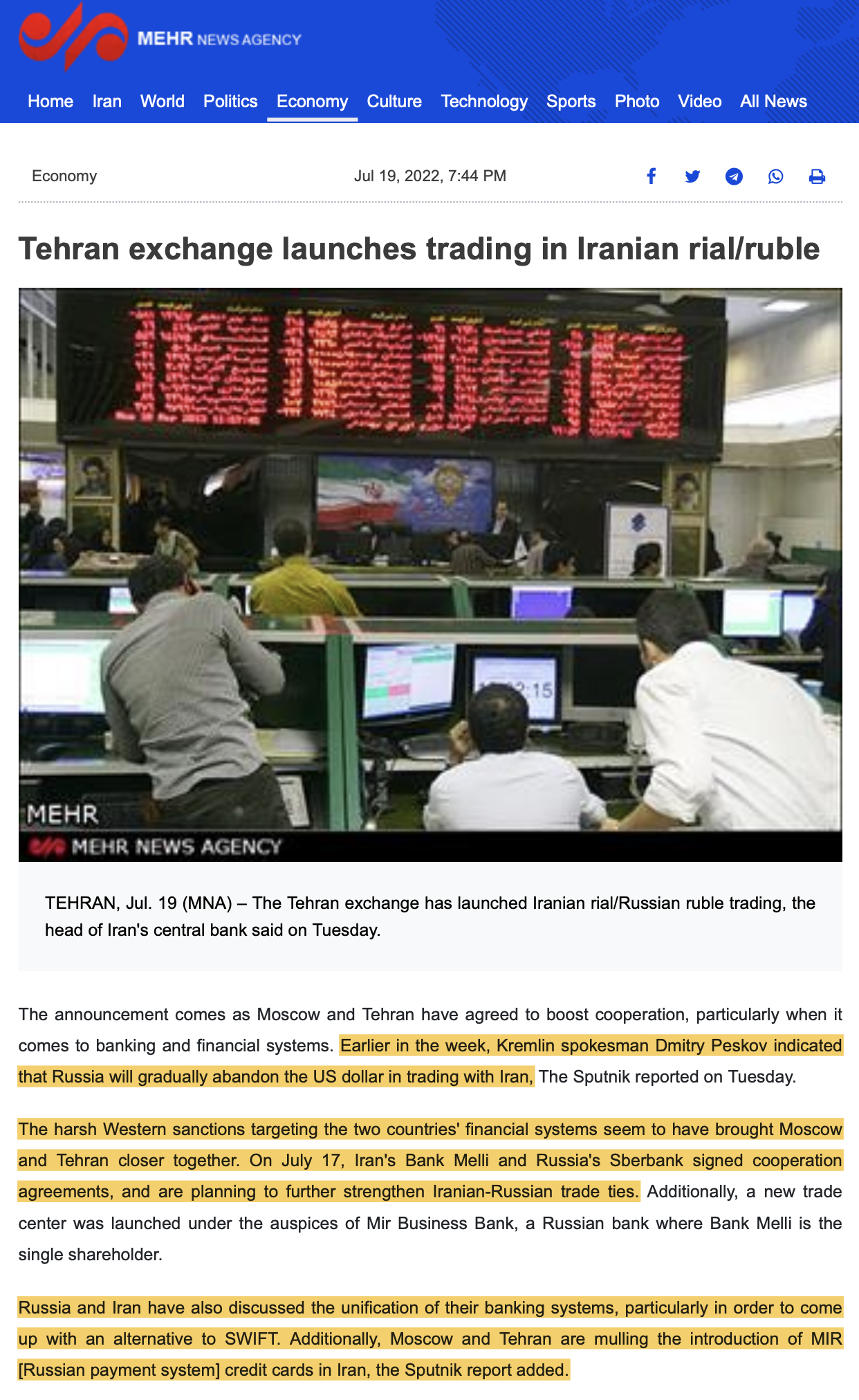


This is a direct threat to the hegemony of the United States dollar in international trade.  Nations that are subject to the whims of Washington's sanctions are exploring alternatives to further blunt the effectiveness of America's non-military punishments.


Just for fun and very slightly off topic, this is what appeared on the PressTV website after the high level meeting:


Here is a key quote with my bold:


"Iran and Russia share a common perspective concerning the sanctions that the United States has leveled against both the countries, Iran’s nuclear agreement, revisionism in the current order, and the international unilateralism. This common perspective paves the way for the countries’ cooperation. These areas [of commonality] are of such importance in the Kremlin foreign policy apparatus’ assessments that have seen Putin meet with the Iranian president on three occasions in Moscow, Ashgabat, and Tehran over the past six months."


Let's close with some excerpts from a media question and answer session that was held on July 19, 2022 as Putin was about to depart from Iran, showing the growing economic relationship between two of Washington's most reviled enemy states:


"For example, as I said at the news conference, in my press statement, the main theme at the meeting with the Spiritual Leader of Iran was strategic issues, including developments in the region. This is natural, as it is the sphere of his activity. It was very important for me to hear his opinion, his assessment. I have to say that we have very similar views with Iran on many aspects. So, it was very important and very useful.


As for my meeting with President Raisi, we discussed primarily economic matters. I would like to note that Russian-Iranian trade has grown by 40 percent over the past six months. This is a very good indicator.


There are promising spheres for our cooperation, and there is a great variety of them, like infrastructure development. You may know that a deputy prime minister of the Russian Government chairs a group that is responsible for developing relations in the South Caucasus, including infrastructure projects in the South Caucasus, that is, in Azerbaijan, Armenia and Russia. A great deal can be achieved in this sphere in cooperation with Iran. 


As you know, the first pilot train is travelling along the North-South Railway line. It is a short route to ports in the south of Iran, which further leads to the Persian Gulf and India.


There is a practical project: the Rasht-Astara railway is a short 146-kilometre line across Iran. Azerbaijan is interested in its construction. I recently met with President Aliyev during the Caspian Summit, and we discussed this matter. Iran is interested in this as well, as our Iranian partners have told us just now. Russia is interested in this, because it will connect Russia’s northern region, St Petersburg, directly to the Persian Gulf. It is a very interesting and promising project. The task now is to build this line, which is only 146 kilometres. Russia is ready to do this."


Washington's sanctions against both Russia and Iran have accomplished very little other than driving two members of the "evil empire" closer together both philosophically and economically.  With Russia and Iran controlling over one-third of the world's natural gas reserves that will be much-needed as the West attempts to transition to a low carbon future, it is clear that certain nations, particularly those in Europe, will be even more beholden and vulnerable to both nations for their energy security.  There will be nothing like the lesson taught by a cold northern winter in 2023 to assist European consumers in seeing the tactical errors made by their elected rulers when it comes to Russia.


Friday, February 5, 2021

NATO and the Unintended Consequences of Washington's Anti-Russia Sanctions

At a recent special briefing, NATO Supreme Allied Commander Tod Wolters revealed a key and new part of NATO's global strategy.


When asked this question:


“What would you say are the major emerging threats as opposed to ongoing traditional ones like Russia?”


...Wolters responds by noting that he has two concerns:


1.) International terror groups that still form a "tremendous danger to civilization>


2.) Let's quote directly from his comments:


"The other – the other concern that we have that’s very widespread and known is the growing cooperation between Russia and China, and it really does suggest an emergence of a partnership of convenience so that each one of those can advance their mutual interest, and that advancement could be to the detriment of Europe and corresponding and surrounding nations. So we are ever so vigilant with respect to that growing cooperation.


And with respect to China, as many know, they’re not an adversary to NATO yet. China presents a rising influence, and it poses challenges for our security, certainly in terms of value, military modernization, and resilience.


So our focus and our vigilance is sky-high with respect to China, the relationship between China and Russia, and certainly with respect to international terror groups."


So, basically, China has now been added to NATO's "watch list" even though Wolters states that they are "not an adversary to NATO yet".


With this in mind, let's look at one key relatively recent link between China and Russia.  In 2018, Russia and China conducted a massive joint military exercise Vostok-2018 as shown here:


The exercise involved over 300,000 Russian troops, 36,000 tanks and armoured vehicles, 1000 military aircraft and two naval fleets with more than 80 ships along with 3,200 Chinese troops, 900 tanks and 30 aircraft.  The military co-operation between the two fledgling superpowers was rather surprising given the fact that for decades, China has been viewed by Russia as a potential military threat, particularly along Russia's eastern flank.


Here is a quote from an analysis of the joint exercise by the German Institute for International and Security Affair with bolds being mine:


"Through the Vostok-2018 exercises, Russia and China sent a clear signal to the United States and its NATO partners. Their message was that, if the West continues to apply what they consider to be undue pressure, then they will increase their own level of bilateral cooperation – including defense coordination – in response. Although the two countries continue to stress that they have no intention to form a military alliance, some Russian analysts suggest that Vostok-2018 may have been partly an attempt to work out the technical details of an alliance in advance while leaving open the possibility of such an arrangement in the future. Even if it falls short of a formal military alliance, increased military co­operation by Russia and China could have significant implications for global politics.


Vostok-2018 is another in a series of mile­stones reflecting a strengthened Russia-China relationship, especially since the onset of the Ukraine crisis. After this crisis erupted, Russia and China increased their diplomatic coordination on a range of issues, including North Korea and cyberspace, and struck important deals in the arms and energy spheres. The downturn in US-China relations since the beginning of Donald Trump’s presidency has given China addi­tional reasons to strengthen its cooperation with Russia….


Growing defense coordination between Russia and China could, nevertheless, have significant implications for NATO. Even in the absence of a formal alliance treaty, the relationship could offer the two countries some of the benefits of an alliance. Al­though neither Russia nor China is likely to intervene directly in a military conflict involving the other’s regional disputes, the ongoing existence of tensions along both countries’ peripheries stretches US resources and strategic attention. This situation potentially gives both countries some additional room for maneuver. In a crisis, events in one region could offer opportunities for the other country to seize in its own neighborhood. In addition, Rus­sian arms sales strengthen China’s military capabilities, forcing the United States to expend additional resources to maintain its military advantage in the Asia-Pacific region."


The "undue pressure" that was applied to Russia is linked directly to the 2014 anti-Russia/anti-Putin sanctions imposed by Washington (and others) in response to Russia's "involvement" in Ukraine, as part of the Magnitsky Act and as a response to a series of other issues.  The sanctions result from both Obama-era executive orders and legislation and target specific companies, industries and individuals and have had an impact on Russia's economic growth but have had little impact on its overall agenda. 


Here is a summary of the U.S. sanctions on Russia from the Congressional Research Service:


It appears that Washington's approach to Russia under Joe Biden is unlikely to change if the highly influential Brookings Institution has its way.  Here is a quote from a December 2020 article entitled "Managing U.S. sanctions toward Russia" with all bolds being mine:


"First, the Biden administration should embed sanctions in a broader U.S. policy toward Russia.  If the Trump administration had an overall Russia policy, it never articulated it. Absent a broader framework, sanctions seemed to take on a life of their own.  An overall policy should include strong measures to deter and push back against Russian misbehavior. These measures include enhancing the NATO military posture in the Baltic region, support — including lethal military assistance — for Ukraine, and sanctions. 


Second, sanctions are not an end in themselves and should not be treated as such. They offer a means to achieve a policy goal and, thus, should be clearly linked to that goal, as in “this sanction will apply until Moscow does X” or “if Moscow does X, Washington will respond with this sanction.” The aim of sanctions should be to affect Kremlin calculations of the benefits and costs of its actions, hopefully tipping the balance against those actions that threaten key Western interests….The Kremlin should also have clarity on what it must do to get the sanctions lifted. 


Third, sanctions should seek to deter, if possible. It is easier to deter and dissuade an adversary from taking an unwanted action than compel the adversary to reverse an action it has already taken. Specifying the sanction(s) that would result from a particular Russian action in advance could have a greater chance of affecting the Kremlin’s cost-benefit calculation.


Fourth, for sanctions to be effective in achieving their policy goal, Moscow has to believe that, if it takes the action desired by Washington, the sanction will be lifted….If the Kremlin concludes that the sanction will remain in place regardless of what it does, it will have no incentive to change its behavior.


Fifth, coordination with allies, particularly the European Union (EU), can dramatically enhance the impact of sanctions. Multilateral sanctions send a stronger political message. They also generate a greater economic impact." 


Given that Washington's approach to its sanctions environment against Russia is highly unlikely to change under a Biden Administration combined with Washington's seemingly innate hatred of all things Chinese, it is quite likely that Russia and China will increasingly co-operate with each other on key issues, particularly the creation of a fighting force that is capable of threatening America's global hegemony, the current unipolar world and NATO's growing presence in Greater Europe.


Sometimes Washington just doesn't seem to understand that there are unintended consequences to its foreign policies.


Thursday, November 14, 2019

China's Defense Strategy and Its Role in the New Multipolar Geopolitical Reality

The State Council Information Office of the People's Republic of China recently released a white paper entitled "China's National Defense in the New Era".  This paper, a counterpoint to the Pentagon's National Defense Strategy of the United States of America which had this to say about China:

"China is a strategic competitor using predatory economics to intimidate its neighbours while militarizing features in the South China Sea...It is increasingly clear that China (and Russia) want to shape a world consistent with their authoritarian model - gaining veto authority over other nations' economic, diplomatic and security decisions."

With those provocative statements in mind, let's see what the authors of the Chinese white paper have to say about China's role in the new global reality.

The white paper opens with the following preface:

"Today, with their interests and security intertwined, people across the world are becoming members of a community with a shared future. China is at a critical stage of completing the building of a moderately prosperous society in all respects and embarking on the new journey of building a modernized socialist country in an all-round way.Socialism with Chinese characteristics has entered a new era."

In response to the Pentagon's proclamation that China is attempting to intimidate the nations in its sphere of influence, China has this to say:

"The pursuit of peace, stability and development has become a universal aspiration of the international community with forces for peace predominating over elements of war. However, international security system and order are undermined by growing hegemonism, power politics, unilateralism and constant regional conflicts and wars.

International strategic competition is on the rise. The US has adjusted its national security and defense strategies, and adopted unilateral policies. It has provoked and intensified competition among major countries, significantly increased its defense expenditure, pushed for additional capacity in nuclear, outer space, cyber and missile defense, and undermined global strategic stability." (my bolds)

The authors also note that there are growing signs of a global arms race with the death of key arms treaties, that extremism and terrorism continue to spread despite nearly two decades of a war against terror and the growth of non-traditional security threats including cybersecurity and biosecurity.

The authors go on to observe that the Asia-Pacific region has remained relatively stable through the forging of the Shanghai Co-operation Organization which is giving birth to a new, non-confrontational partnership with the goal of creating a new model for regional security cooperation.  Despite the stability of the Asia-Pacific region, as the world economic centre shifts to the region, it has resulted in major country competition, particularly with the United States.  Here is a quote from the paper that outlines the key problem that is developing in this new era:

"The US is strengthening its Asia-Pacific military alliances and reinforcing military deployment and intervention, adding complexity to regional security. The deployment of the Terminal High Altitude Area Defense (THAAD) system in the Republic of Korea (ROK) by the US has severelyundermined the regional strategic balance and the strategic security interests of regional countries.In an attempt to circumvent the post-war mechanism, Japan has adjusted its military and security policies and increased input accordingly, thus becoming more outward-looking in its military endeavors. Australia continues to strengthen its military alliance with the US and its military engagement in the Asia-Pacific, seeking a bigger role in security affairs."

The authors outline the following security risks to China:

1.) Fight against the growth of the independent Taiwan movement and the growth of the separatist movement which seeks to end any hope of the "One China" solution.  Here's what the paper says about China's approach to Taiwan: "Aiming at safeguarding national unity, China’s armed forces strengthen military preparedness with emphasis on the sea. By sailing ships and flying aircraft around Taiwan, the armed forces send a stern warning to the “Taiwan independence” separatist forces."

2.) Tibet independence.

3.) Territorial sovereignty of islands and reefs in the South China Sea and the entry of ships and aircraft from "countries outside the region" for reconnaissance purposes.  The paper clearly states that "China’s armed forces defend important waters, islands and reefs in the East China Sea, the South China Sea and the Yellow Sea, acquire full situation awareness of adjacent waters, conduct joint rights protection and law enforcement operations, properly handle maritime and air situations, and resolutely respond to security threats, infringements and provocations on the sea."

Here are the fundamental goals of China's national defense in the "new era" (i.e the multipolar world order):

1.) to deter and resist aggression

2.) to safeguard national political security, the people’s security and social stability

3.) to oppose and contain “Taiwan independence”

4.) to crack down on proponents of separatist movements such as “Tibet independence” and the creation of “East Turkistan” 

5.) to safeguard national sovereignty, unity, territorial integrity and security

6.) to safeguard China’s maritime rights and interests 

7.) to safeguard China’s security interests in outer space, electromagnetic space and cyberspace

8.) to safeguard China’s overseas interests

9.) to support the sustainable development of the country

In order to accomplish these goals, China will utilize the following strategy, the key to their success in the new world order thus far:

"Though a country may become strong, bellicosity will lead to its ruin. The Chinese nation has always loved peace. Since the beginning of modern times, the Chinese people have suffered from aggressions and wars, and have learned the value of peace and the pressing need for development. Therefore, China will never inflict such sufferings on any other country. Since its founding 70 years ago, the People’s Republic of China (PRC) has never started any war or conflict. Since the introduction of reform and opening-up, China has been committed to promoting world peace, and has voluntarily downsized the PLA by over 4 million troops. China has grown from a poor and weak country to be the world’s second largest economy neither by receiving handouts from others nor by engaging in military expansion or colonial plunder. Instead, it has developed through its people’s hard work and its efforts to maintain peace. China has made every effort to create favorable conditions for its development through maintaining world peace, and has equally endeavored to promote world peace through its own development. China sincerely hopes that all countries will choose the path of peaceful development and jointly prevent conflicts and wars.

China is committed to developing friendly cooperation with all countries on the basis of the Five Principles of Peaceful Coexistence. It respects the rights of all peoples to independently choose their own development path, and stands for the settlement of international disputes through equal dialogue, negotiation and consultation. China is opposed to interference in the internal affairs of others, abuse of the weak by the strong, and any attempt to impose one’s will on others. China advocates partnerships rather than alliances and does not join any military bloc. It stands against aggression and expansion, and opposes arbitrary use or threat of arms. The development of China’s national defense aims to meet its rightful security needs and contribute to the growth of the world’s peaceful forces. History proves and will continue to prove that China will never follow the beaten track of big powers in seeking hegemony. No matter how it might develop, China will never threaten any other country or seek any sphere of influence." (my bolds)

To put all of this information into perspective, let's look at two figures showing how much China has spent on its defense as a percentage of its GDP and as a ratio of total government expenditures going back to 1979:


Over the period from 2012 to 2017, China's average defense expenditure was 1.3 percent.  This compared to 4.4 percent for Russia, 3.5 percent for the United States, 2.5 percent for India, 2.3 percent for France and 2.0 percent for the United Kingdom and is the lowest among the permanent members of the United Nations Security Council.  When looking at the ratio of spending on defense to total government expenditures, over the period between 2012 and 2017, China's average ratio was 5.3 percent compared to 12.4 percent for Russia, 9.8 percent for the United States, 9.1 percent for India, 4.8 percent for the United Kingdom and 4.0 percent for France.

The fact that China has officially declared that it will never threaten any other nation or that it will not seek global hegemony is a rather interesting development in the world's evolution from a monopolar reality to a multipolar reality.  Whether Washington will take this proclamation seriously is yet to be seen however, it's constant meddling in the South China Sea and the affairs of Taiwan suggest that it is highly unlikely that it will pay heed to China's promise that it will not "seek any sphere of influence" nor will it interfere in the internal affairs of others, a lesson that most definitely has not taken root in Washington.