Showing posts with label hypersonic weapons. Show all posts

Monday, December 2, 2024

The United States Hypersonic Weapons Programs - A Backgrounder

With Russia now successfully fielding its Oreshnik medium range hypersonic missile, it is an appropriate time to take a closer look at how America's armed forces are doing with their own hypersonic missile programs.  


According to a 2023 report from the Congressional Budget Office, America's Army, Navy and Air Force are each developing their own hypersonic missiles.  These missiles have two key defining characteristics:


1.) they must be capable of achieving speeds in excess of Mach 5 (five times the speed of sound in the air at sea level i.e. within the earth's atmosphere) or 3836 miles per hour.  


2.) they must have aerodynamic control surfaces (i.e. wings or tail fins) that allow them to be maneuvered like an aircraft rather than using thrusters as in the case of most intercontinental ballistic missiles in use today.


The U.S. military is developing two types of hypersonic missiles both of which require air to operate for reasons outside of maneuvering:


1.) a hypersonic boost-like missile which consists of a rocket motor that accelerates the missile to a high altitude and speed and a glide body that detaches from the rocket once its fuel is spent.  The glue body uses lift generated by its movement through the air to extend its range and maneuver towards its target.


2.) a hypersonic cruise missile that accelerates to a high speed using a rocket motor.  Once the rocket booster is exhausted, the missile accelerates and maintains its speed using a supersonic combustion ramjet or scramjet, using oxygen from the atmosphere to burn its fuel.  Scramjets only being to operate at speeds above Mach 4 since they require supersonic airflow to function.


Here is a graphic showing the progress of the Department of Defense's hypersonic boost-glide missiles:


The original program from 1985 successfully designed and tested a design for a missile glide body.  The second track of hypersonic missile research began in 2003 when the Defense Advanced Research Projects Agency or DARPA started the Force Application and Launch From Continental United States or FALCON project which was designed to study technologies that would allow missiles to be launched from the United States rather than from locations closer to their targets.  In 2008, Congress established the Conventional Prompt Global Strike Program to advance some of the technology developed by FALCON, focusing on a concept for an intercontinental-range hypersonic glider.


In the case of hypersonic cruise missiles, research on supersonic ramjet engines began in the 1950s, however, the first American successful test flight of a scramjet did not occur until 2004 when NASA's X-43 successfully flew several tests in horizontal flight, reaching a speed of MACH 9.6.  A scramjet-powered X-51 aircraft was successfully flown at Mach 5.1 for 210 seconds in 2013.


As of 2023, the United States DoD had spend more than $8 billion since 2019 to develop hypersonic missiles through separate programs led by the Army, Navy and Air Force.  In the 2023 Future Years Defence Program, on behalf of the Army and Air Force programs, DoD is requesting an additional $13 billion between 2023 and 2027 for development of hypersonic missiles and an additional $2 billion for missile acquisition.


Here is a table showing the current U.S. hypersonic weapons programs and their funding:


Note that the Army's Long-Range Hypersonic Weapon (LRHW) aka Dark Eagle and the Air Force's Air-Launched Rapid Response Weapon (ARRW) were scheduled for fielding in 2023 however, that did not occur.


Let's look at the Army's LRHW program from Lockheed Martin's perspective going back to 2014:


On June 28, 2024, the DoD announced a flight test of the LRHW as shown here after a series of failed attempts during 2022 and 2023:


Problems with the launcher and launch sequencer have led the Congressional Budget Office to project act the first LRHW battery will not be "capable" until at least July 2025 as shown here:


Now, let's look at the Air Force's ARRW program, again from Lockheed Martin's perspective:


Here is a screen capture showing the company's planned hypersonic programs:


The AGM-183A ARRW was last tested on March 17, 2024 and is undergoing final analysis of its flight test data.  That said, Lockheed Martin claims that it is ready to deliver ARRW technology to the Air Force even though cancellation of the program appears to be quite possible.  On September 26, 2024, it was announced that Lockheed Martin's ARRW program would receive an additional $13 million in funding bringing the cumulative value of the contract to $1,319,270,400 as shown here:


Note that the work performed under the contract is supposed to be completed by August 31, 2025 suggesting that the ARRW will not be field-ready until at least that point in time.


In the aforementioned CBO report from 2023, the CBO estimated that purchasing 300 ground- or sea-launched hypersonic missiles intermediate-range ballistic missiles with maneuverable warheads and sustaining the missile system for 20 years would cost a total of $13.4 billion (in 2023 dollars). The same number of comparable hypersonic missiles would cost about one-third more, $17.9 billion excluding cost overruns that are often associated with technically challenging programs.


So, there you have it.  Russia is far, far ahead of the United States (as is China for that matter) when it comes to hypersonic warfare.  The United States military is so far behind the curve it is almost laughable particularly given that Russia has now tested its hypersonic missile technology in combat.  On the upside, however, Lockheed Martin has, once again, benefitted from the unfettered generosity of American taxpayers in its seemingly unending quest to develop hypersonic missiles which appear to be capable of far lower velocities than those of the Oreshnik missile at the very best.


Tuesday, November 19, 2024

China's GDF-600 Hypersonic Glide Platform - A Groundbreaking Development in Modern Warfare

China has recently unveiled its latest foray into the world of high tech weaponry.  At the Zhuhai Air Show 2024, China revealed its GDF-600 hypersonic boost glide concept vehicle that will have a wide range of capabilities as you will see in this posting.


The GDF-600 will be designed to have an operational range of between 500 and 1000 kilometres which could theoretically be extended to 6000 kilometres at speeds of between Mach 7 and Mach 10 (5369 mph to 7673 mph) at a maximum altitude of 40 kilometres.  Its design allows it to penetrate modern air defences and can be used for both anti-ship and land-attack purposes.  It has a launch mass of 5000 kilograms and a payload capacity of 1200 kilograms.  One of the key aspects of the GDF-600 is its sub-munition separation system which will give it the capability to release different payload types while in-flight.  These sub-payloads include:


1.) supersonic missiles with ranges of between 100 to 500 kilometres at speeds of between 2400 and 6000 kmph


2.) subsonic missiles with ranges of between 50 to 100 kilometres at speeds of between 730 and 1030 kmph


3.) cruise missiles with a ranges of between 10 and 80 kilometres at speeds of between 300 and 600 kmph


4.) aerial bombs with a range of 70 kilometres


5.) drones with an operating range of between 2 and 15 kilometres


These wide-ranging munitions will allow the GDF-600 to be used for multiple purposes including direct kinetic strikes against specific targets, reconnaissance missions and electronic warfare.  The fact that these munitions can be released at various points along the GDF-600s trajectory allow it to make simultaneous strikes on several targets at the same time which will complicate the defense response of its adversaries.


Here is a photo of the mockup GDF-600 showing its multiple payload capabilities:


Here is a video providing additional information about the GDF-600:


This very significant advancement in China's hypersonic weapons capabilities stands in sharp contrast to the United States troubled experience with hypersonic weaponry.  For example, the Air Force's AGM-183A ARRW which, as you can see here, is not operational at this point in time:


Additionally, the United States Army's Long-Range Hypersonic Weapon aka Dark Eagle is also not ready for deployment as shown here:


The addition of the GDF-600 to China's growing arsenal of high tech weapons will make any intervention against the nation in its ongoing tiff with Taiwan and its territorial claims in the South China Sea more complicated particularly given that the weapon will have a wide range of anti-ship capabilities.  As well, its ability to conduct electronic warfare could disrupt communications and radar which would significantly compromise the ability of the United States and its proxies to defend against the GDF-600.


Thursday, June 8, 2023

Fattah - Iran's Hypersonic Weapon

Recent news from Iran will prove to be a game changer in the Middle East.  Here is the report from Iran's Islamic Republic News Agency (IRNA):


Here is a brief video showing the Fattah:


According to IRNA, Iran's hypersonic missile named Fattah has a range of 1400 kilometres, putting them within striking distance of Israel, and can reach speeds of between Mach 13 and Mach 15 (i.e. 13 to 15 times the speed of sound).  Earlier claims by Iran suggest that the missiles could reach Israel within 400 seconds of launch.


In the case of traditional ballistic missiles, launched missiles travel into the atmosphere on an arc-shaped trajectory, returning to earth at potentially hypersonic speeds.  In contrast, hypersonic missiles which travel faster than Mach 5 eliminate the arc-shaped trajectory, remaining much closer to the surface of the earth where they can use aerodynamic design features to maneuvre.  This feature makes them much harder to track and detect and means that they can avoid traditional defensive countermeasures.  Their high speed means that they can reach far distant targets within 15 to 30 minutes of launching, another important feature which makes them difficult to defend against.


There are three main types of hypersonic weapons:


1.) hypersonic cruise missiles - these are similar to existing cruise missiles, using aerodynamic lift to remain in flight and are powered throughout their entire flight.  They are not as fast as a hypersonic glide vehicle but fly at low altitudes and high speeds making it difficult to defend against.


2.) maneuverable reentry vehicles/glide vehicles - these are launched like ballistic missiles but reenter the atmosphere fairly quickly before gliding hundreds or even thousands of miles to their target (i.e. boost-glide vehicles).


3.) aero-ballistic/air-launched missiles - these are launched from aircraft which allows the aircraft to remain at long distances from their target


Here is a video from the Carnegy Endowment outlining the hypersonic missile technology:


Iran has now joined the small group of nations that have developed hypersonic missile technology; Russia which has a very advanced hypersonic missile program that may have been used in Ukraine, China, the United States and North Korea.  Other nations are also developing hypersonic missile technology including Australia, India, France, Germany and Japan with Israel and South Korea having done preliminary research on hypersonic weapons.


The United States is relatively behind in its hypersonic weapons program.  Here is a press release from August 2022 from Raytheon bragging about how its hypersonic cruise missile passed its second consecutive flight test:


According to the Congressional Budget Office, hypersonic missiles cost one-third more to procure and field than ballistic missiles with the same range with maneuverable warheads.

If Iran is not exaggerating the capabilities of its Fattah hypersonic missile, Israel will be forced to respond with either significantly improved defensive capabilities or a hypersonic missile of its own.  At the very least, this development will prove to be a deterrent should Israel choose to attack its existential enemy.

Wednesday, October 20, 2021

China and Hypersonic Glide Vehicles - Resetting Washington's Global Hegemony

A recent article on the Financial Times website provides us with a glimpse of the evolving multipolar reality and how the United States is rapidly falling behind.  In this posting, we'll take a brief look at the event that triggered alarm in Washington and how Beijing views the American attitude toward its accomplishment.


Here is a screen capture of the article in FT:


Here are some brief quotes with my bold:


"China tested a nuclear-capable hypersonic missile in August that circled the globe before speeding towards its target, demonstrating an advanced space capability that caught US intelligence by surprise.


Five people familiar with the test said the Chinese military launched a rocket that carried a hypersonic glide vehicle which flew through low-orbit space before cruising down towards its target. 


The missile missed its target by about two-dozen miles, according to three people briefed on the intelligence. But two said the test showed that China had made astounding progress on hypersonic weapons and was far more advanced than US officials realised. 


The test has raised new questions about why the US often underestimated China’s military modernisation. “We have no idea how they did this,” said a fourth person."


Let's look at some background information on hypersonic missiles aka hypersonic glide vehicles as found on the Satellite Observation website:


1.) What is a hypersonic glide vehicle (HGV)? 


"Whereas a supersonic vehicle flies above the speed of sound (Mach 1, around 1000km/h or 650 knots), a hypersonic one flies above Mach 5. But it not only the speed that makes hypersonics attractive: indeed, ballistic missiles routinely achieve speeds of up to Mach 25 and are 1960s technology. The true appeal of hypersonics is the combination of speed and maneuverability, which makes them extremely difficult to defend against, and allows for compressed engagement timelines against elusive targets."


Here is a video on hypersonic glide vehicles/weapons from The RAND Corporation:


2.) How detectable are hypersonic glide vehicles/weapons?


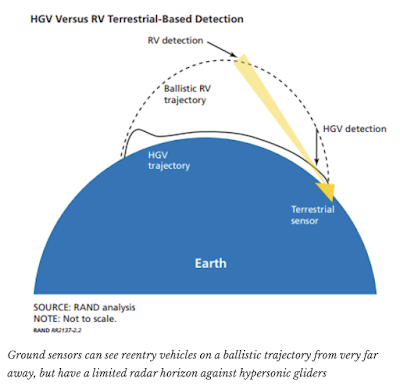
"Hypersonic glide vehicles are something entirely different (than ballistic missiles). They are launched by a ballistic missile and are completely unpowered after separation. However, instead of flying on a predictable ballistic arc like traditional reentry vehicles, they dive back in the atmosphere. There, they experience drag, which slows them down. However, due to their shape, they also experience aerodynamic lift, which allows them to glide on the atmosphere, and counterbalances their weight. Thus, they can fly as far if not further as a warhead on a ballistic trajectory launched on the same booster.  The first benefit of such a trajectory is that they stay closer to the ground, as their altitude is around 30km to 100km, so it is harder to detect them from the ground: radar and optical sensors being blocked by the curvature of the Earth, they can approach their target without being detected until the last moment, which makes defending against them much more complicated as shown on this graphic:


The maximum radar detection range against a vehicle flying at 30km is 700km. Also, because of they maneuverability, glide vehicles do not have to fly on a straight line: they can take the long route around radars or interceptors to avoid engagement, or to hide their true target."


Currently, China, Russia and the United States are involved in HGV research with China widely being viewed as the leader in the field as quoted here:


"China is one of those countries that is focused on both fields. It is widely acknowledged to be the leader in the field of hypersonic systems, having already fielded such weapons in the form of the DF-17 hypersonic glide vehicle.


The DF-17 HGV made its first public appearance at a military parade held in China’s capital Beijing in late 2019. The weapon appears to use a standard ballistic missile booster in its first stage for the initial boost of a glide vehicle, which is used to attack a target following reentry.


The DF-17s at the parade were mounted on a wheeled, five-axle transporter-erector-launcher. This makes the system road-mobile like much of the ballistic missile arsenal of China’s People’s Liberation Army. This could potentially complicate any attempt by an adversary to strike the systems prior to launch.


U.S. government sources have said China carried out several tests of HGVs, including the DF-17, since 2014. The DF-17 is the first system of its type known to be operational in the world, although several other nations including the U.S. are developing similar systems.


In addition, China is also believed to be developing an air-launched HGV, with a video briefly posted on Chinese social media in October last year showing a People’s Liberation Army Air Force Xi’an H-6N bomber landing at an air base carrying what appeared to be a boost-glide HGV — or at least a mock-up used for carriage and other flight tests."


Here is a video showing China's DF-17 from the aforementioned 2019 military parade:


With that background in mind, let's look at what China had to say about Washington's response to its latest test of its homegrown HGV as quoted from the Global Times, the Chinese Communist Party's mouthpiece with my bolds:


"The Financial Times (FT) quoted on Saturday several sources saying that "the Chinese military launched a rocket that carried a hypersonic glide vehicle" in August and judged it to be a "nuclear-capable hypersonic missile." According to the FT article, the missile "flew through low-orbit space" and could help China "negate" US missile defense systems which are designed to target the fixed parabolic trajectory of a ballistic missile. The progress of the Chinese military has "caught US intelligence by surprise," the report said.


The US generally has the ability to monitor global missile launches. If the FT report is to be believed, it means that there is a key new member in China's nuclear deterrence system, which is a new blow to the US' mentality of strategic superiority over China. According to the FT, the China Academy of Launch Vehicle Technology announced the 77th and 79th launches of the Long March 2C rocket, but there was no announcement of a 78th launch. The report believes the 78th "secret launch" may be to test the above-mentioned hypersonic missile.


It is meaningless to discuss the credibility of the FT report. But it is important to note the unstoppable trend that China is narrowing the gap with the US in some key military technologies as China is continuously developing its economic and technological strength. China doesn't need to engage in an "arms race" with the US - it is capable of weakening the US' overall advantages over China by developing military power at its own pace.


In the long term, the comparison between the military powers of China and the US will be in the following paradigmThe US' overall military advantage will be maintained, while its air force and navy have higher quality and its global deployment and projection capabilities will be unmatched by China's. Meanwhile, China won't have any will to globally challenge the US' dominant position in military sphere, and the US shouldn't worry about losing its military hegemony."


The op-ed piece goes on to note that China has no intention of launching a nuclear race with the United States and that it has no intention of building a nuclear force to rival that of the U.S. despite what American lawmakers would have us believe. China's military buildup will focus on the Taiwan Strait and the South China Sea as quoted here:


"It is inevitable that China will take an upper hand over the US military strength in these areas thanks to the geographical proximity and the continuous increase of China's input. Chinese society has not only strong expectations for this, but also strong determination and corresponding ability to realize this reversal. The US' conventional military superiority around the world will not translate into a guarantee of superiority in these regions."


Here is a closing quote from the op-ed:


"The future strategic balance between China and the US cannot be achieved by carrying out an extreme "arms race." The two sides need to rebuild a certain strategic mutual trust, which is the key to forming a security buffer zone between China and the US. Can't major powers with different political systems cooperate with each other to achieve a win-win result? Must one overwhelm the other? As China and the US prepare for the worst, we must not give up. Both sides must explore a political and security framework that can accommodate the major long-term interests of both countries for the benefit of both countries and the world at large and never yield in that."  


With China's latest test of its high tech weapons, it is clear that the global balance of power, particularly in the Far East, is shifting quickly and that any threats that the United States poses to the historical relationship with China and Taiwan and China's territorial claims in the South China Sea will be met with force.  While American educators and legislators squabble over political correctness in the education system, particularly when it comes to mathematics, China is using its superior science, technology, engineering and mathematics (STEM) educational framework to achieving its goal of military superiority with great success.


Addendum October 21, 2021


Just to keep my readers posted on the latest developments, here is a letter from Senator Lindsey Graham regarding China's test:


Thursday, December 19, 2019

The War of the Future Part 2 - China's Foray into Hypersonic Weapons

In part one of this two-part series, I examined the most recent advances in Russia's military technology; the development of its Zircon (Tsirkon) 3M22  hypersonic missile, an advancement that led Washington's Government Accountability Office to state this:

"China and Russia are pursuing hypersonic weapons because their speed, altitude and maneuverability may defeat most missile defense systems, and may be used to improve long-range conventional and nuclear strike capabilities.  There are no existing countermeasures." (my bold)

In the second part of this posting, I will outline China's foray into the futuristic world of hypersonic weapons, its DF-ZF Hypersonic Glide Vehicle also known as the WU-14.

Here is a summary of the DF-ZF's capabilities from the Missile Defense Advocacy Alliance (MDAA):


According to Deagel, the DF-ZF is capable of reaching speeds ranging from Mach 5 (5,978 kmph) and Mach 10 (12,000 kmph) and has a maximum cruising flight altitude of 62 miles or 99,758 metres).  The first flight test took place on January 9, 2014 and China reported that the maximum speed achieved by the DF-ZF was Mach 20 or 24,696 kmph.  The DF-ZF is nuclear-capable and its payload is launched as the final stage of an intercontinental ballistic missile.  Its flat trajectory makes it difficult for conventional air and missile defences to detect.

Here are three screen captures from a Chinese state media (CCTV) video showing the DF-ZF:


Here is a computer-generated rendering of the test flight of the DF-ZF:


Here is a video that reportedly shows the plasma trail left by the DF-ZF's flight:


Here's what the MDAA has to say about the strategic implications of the DF-ZF:

"The DF-ZF will bring a hypersonic capability to the PLARF (People's Liberation Army Rocket Force). Missiles carrying the DF-ZF will have shorter flight times and be capable of performing evasive maneuvers at hypersonic speeds, which will complicate the ability of current missile defenses to intercept it. The current missiles believed to be capable of carrying the HGV are short- and medium-ranged but could strike targets in South Korea and Japan, including U.S. carriers and bases in the region. It is also capable of carrying nuclear payloads as well as conventional." (my bold)

According to the United States Naval Institute news service, a panel of experts at the Hudson Institute claimed that China's hypersonic technology is now leading the world and impacting how the Pentagon operates in the South China Sea.  Here's what Roger Zakheim, the Washington Director of the Ronald Reagan Presidential Foundation and Institute had to say about China's hypersonic weapons at the panel held on March 11, 2019: 

"From a National Defense Strategy standpoint, you know, we have been struggling for some time with the A2/AD challenge. And that challenge of Anti-Access Area Denial is no clearer - there's no clearer case, no clearer challenge than in the Indo-Pacific theater and the challenges that China is imposing upon the United States as a Pacific power. And hypersonic weapons goes right to the heart of that challenge because it is the capability that will keep us out from carrying out our treaty obligations and other support we offer to our friends and allies, and really what make us a Pacific power. So whether it's our carriers, which are hypersonic weapon-based on our missile defenses and other capabilities today, essentially, we'll be pushed out and rendered kind of operationally useless, or our ability to shore up our allies because we have no response to the capability of hypersonic weapons is right at the heart of it. And then, of course, in terms of our ability to hold our adversaries' targets at bay, which is a key component of deterrence - this kind of one-on-one - yes, we can deter today. But in the era of hypersonic weapons, where we are right now, we may not be able to deter. So both in terms of defensive posture and then off - and then from an offensive standpoint, this is key." (my bold)

If you are interested, the entire panel discussion on China's hypersonic weapons program can be watched here:


As I stated at the conclusion of part one of this two-part series on hypersonic weapons, the growing threats from the development of hypersonic weapons by America's two leading adversaries must be of growing concern to the Pentagon given that there is no current defense strategy or technology that can be used to neutralize these leading-edge weapons.  That said, it is fortunate that Washington has a bottomless bucket of taxpayers' dollars to fund the technological advances that will be required to level the playing field in future wars.

Tuesday, December 17, 2019

The War of the Future Part 1 - Russia's Foray into Hypersonic Weapons

While detailed information is scarce, it is clear that Russia is testing and preparing to deploy its latest high tech weapon, the 3M22 Zircon (Tsirkon) or SS-N-33 (NATO codename) hypersonic cruise missile.  Some details of the capabilities of this weapon were announced by Russian President Vladimir Putin back in February 2019 when he stated that the Zircon hypersonic missile has a firing range of over one thousand kilometres, can accelerate to about Mach 9 (i.e. 9 times the speed of sound or 6905 miles per hour compared to 550 miles per hour for a Tomahawk Cruise Missile) and is capable of destroying both sea-going and land-based targets.  He also stated that the intended use for the Zircon is to arm sea-going platforms such as surface warships and submarines including those that are equipped with the Caliber cruise missile launching system.  

Here is a summary of the Zircon from the Missile Defense Advocacy Alliance (MDAA):


The Zircon's body length is estimated to be 10 to 11 metres, it can be equipped with a warhead weighing between 300 and 400 kilograms and its peak altitude during its trajectory is 30 to 40 kilometres or 100,000 to 130,000 feet.  

Here is a graphic showing the Zircon 3M22 that surfaced in a presentation by a Russian defense contractor around 2016:


Let's look at what MDAA has to say about the strategic implications of the Zircon:

"The Zircon missile is strategically valuable due primarily to its speed. In April 2017, it was reported that the Zircon had reached a speed of Mach 8 during a test.[iv] If that information is accurate, the Zircon missile would be the fastest in the world, making it nearly impossible to defend against due to its speed alone. Another valuable aspect of the missile is its plasma cloud. During flight, the missile is completely covered by a plasma cloud that absorbs any rays of radio frequencies and makes the missile invisible to radars. This allows the missile to remain undetected on its way to the target."

Russia's media has also reported that the baseline Zircon missile will be redesigned in a lighter weight version that will allow it to be deployed on strategic bombers, most likely the Tupolev Tu-160/MM2 (aka Blackjack as it's known by NATO).  According to TASS, the Russian Navy expects to accept the latest Zircon missile for service and deployment from 2023 as shown here:


As well, by the end of 2019, TASS also reports that the Russian Navy will launch a Zircon missile from a military ship for the first time as shown here:


Here is a video from Defense Updates revealing some additional background on the Zircon hypersonic missile and why it could be unstoppable:


Interestingly, in the December 2018 edition of the Government Accountability Office's National Security Report to Congressional Committees which outlines the long-range emerging threats facing the United States, we find the following comments about the hypersonic weapons that are being developed by both China and Russia:


To fight against this growing threat, the United States Space Development Agency is seeking to deploy up to 1200 low-orbit satellites to monitor and target enemy hypersonic weapons at a cost of more than $11 billion as you can see here.

The growing threat from Russia's rapidly developing hypersonic weapons capabilities is certain to have the Pentagon concerned considering that there is no current defense strategy or technology that can be used to neutralize these high technology weapons.  At the very least, it looks like America's military-industrial-intelligence community has its work cut out for it if it hopes to stay ahead of its enemies when it comes to the development and deployment of hypersonic weapons.  Fortunately, America's taxpayers are standing by with a blank cheque to fund the entire program.