Showing posts with label international trade. Show all posts

Friday, February 7, 2020

The United States vs. China - Dominating Global Trade

While the Trump administration has spent considerable energy trying to "fix" its long-term problem with a massive trade deficit as shown on this graphic:


...trade data shows that China is rapidly becoming the world's most important trade partner.  Thanks to Visual Capitalist, we have a graphic representation of China's growing importance to global trade and how it is replacing the United States as the nation to trade with.

Let's start by looking at some background data.  Thanks to Trading Economics, we have this graphic showing China's balance of trade going back to 1981:


In the latest month for which data is available (December 2019), China's trade balance was $46.79 billion, down from $56.80 billion in the same month one year earlier.

Here is a graphic representation of China's imports (in red) and its exports (in blue) to 2017:


Here are the top destinations for exports from China:


Here are the top nations exporting goods to China:


With that background, let's look at how trade with China and the United States, the world's two largest economies, have evolved since 1980 as shown on a series of graphics from Visual Capitalist.  When the United States is the larger trading partner, nations that trade the most with the United States are coloured in blue, when China is the larger trading partner, nations that trade the most with China are coloured in red and shades of purple/pink representing years where trade with the United States and China is more-or-less equal.  Here is the data in five year increment with the exception of 2001:

1.) 1980:


2.) 1985:


3.) 1990:


4.) 1995:


5.) 2001: this is a key year given that China became a member of the World Trade Organization on December 11, 2001:


6.) 2005:


7.) 2010:


8.) 2015:


9.) 2018:


In 1980, the United States heavily dominated global trade with 80 percent of nations trading more with the United States that they did with China.  As you can see, after 2001, China rapidly began to dominate global trade and, by 2018, was dominating trade in nearly all of Africa, Asia, Australia, Europe (particularly Eastern Europe) and South America; by 2018, only 30 percent of nations or 62 out of 190 nations trading more with the United States than with China.

Given the gutting of America's manufacturing sector since the early 2000s as shown here:


...and China's massive investment in its One Belt, One Road Initiative which could total between $1 trillion and $8 trillion and its financing of some of the world's megaprojects as shown here:


...no matter what Washington does in its quest to "fix" its trade problem with China, it is highly unlikely that the United States will ever regain its place at the pinnacle of world trade.

Thursday, January 30, 2020

The Ongoing Trade War with China

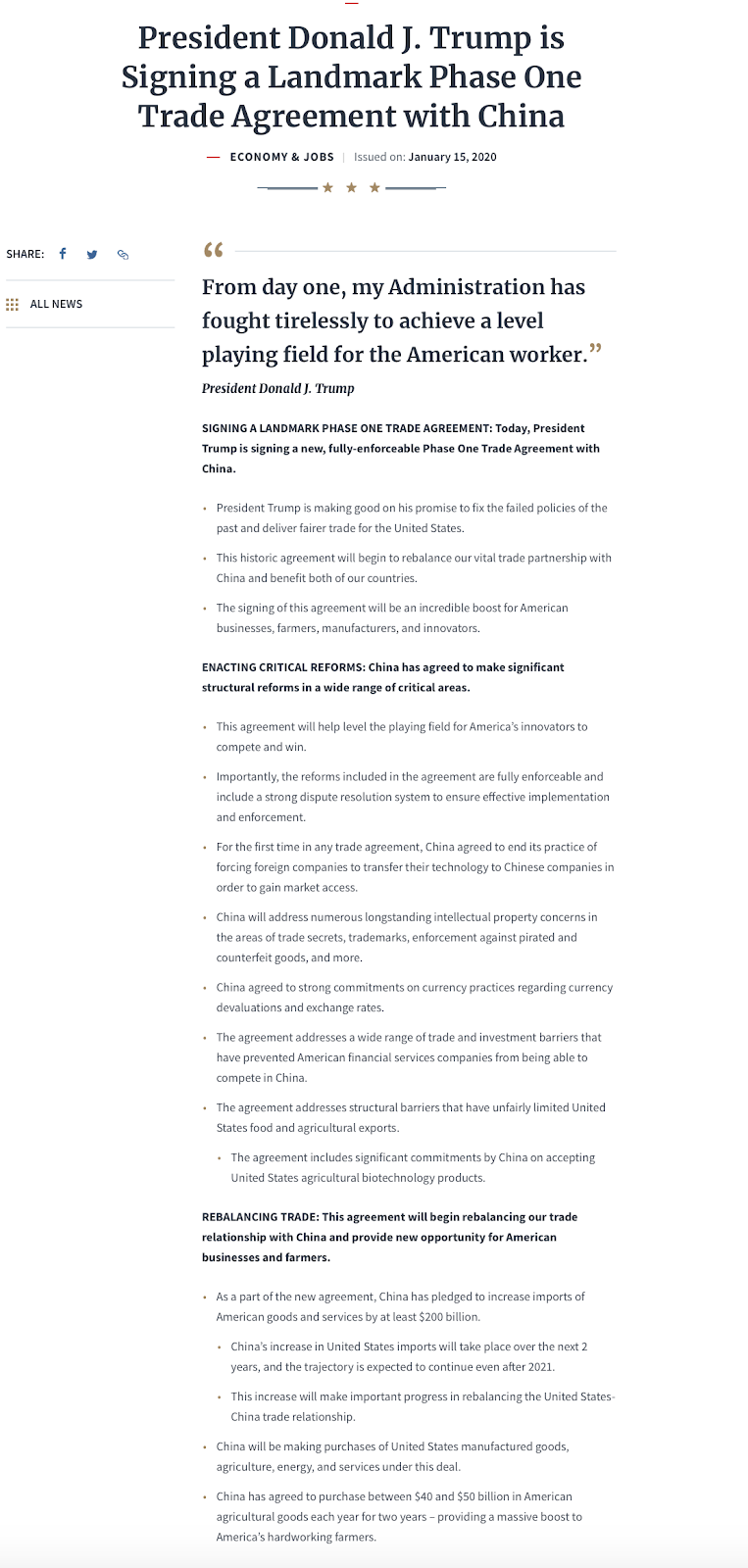
The signing of Phase One of the Trump Administration's trade deal with China on January 15, 2020 as shown here:


...suggests that at least some progress is being made, however, the deal still leaves most of the trade war-related tariffs that have created problems for both manufacturers and consumers.  A recent piece in the Global Times, the Communist Party of China's unofficial newspaper, suggests that China is well aware of the deal's shortcomings.

Let's start by looking at the comments made by Donald Trump at the signing ceremony:

"Today, we take a momentous step — one that has never been taken before with China — toward a future of fair and reciprocal trade, as we sign phase one of the historic trade deal between the United States and China. Together, we are righting the wrongs of the past and delivering a future of economic justice and security for American workers, farmers, and families….

So, for decades, American workers, farmers, ranchers, manufacturers, and innovators have been hurt by the unfair trade with China. Forced technology transfer and intellectual property theft have been huge problems. Since China joined the World Trade Organization two decades ago, we have racked up nearly $5 trillion — the Vice Premier, I hope he’s not listening to this — (laughter) — in trade deficits, lost millions and millions of manufacturing jobs, and saw tens of thousands of factories close. And that had to do, also, with Mexico, and, to an extent, Canada.

What they did to this country with trade and trade deals — NAFTA. We had no deal with China. I mean, we had no deal. And it was like just easy pickings.

For years, politicians ran for office, promising action to remedy these practices, only to do nothing but allow them to continue. And it was pillage.

As a candidate for President, I vowed strong action. It’s probably the biggest reason why I ran for President, because I saw it for so many years. And I said, “How come nobody is doing something about it?” In the meantime, immigration, and building our military — also important. But that’s probably the biggest reason.

In June of 2016, in the great state of Pennsylvania, I promised that I would use every lawful presidential power to protect Americans from unfair trade and unfair trade practices. Unlike those who came before me, I kept my promise. They didn’t promise too hard but — (applause) — they didn’t do anything. And I actually think I more than kept my promise.

Now our efforts have yielded a transformative deal that will bring tremendous benefits to both countries. We have a great relationship with China, we have a great relationship with the leadership of China, and China fully understands that there has to be a certain reciprocity. There has to be. It cannot continue like this. It would be dangerous for it to continue like it was.

The agreement we signed today includes groundbreaking provisions in an area of critical importance to the United States: protecting intellectual property. So the deal you’re seeing today is a much bigger deal than — we have it very much guarded…

This is an unbelievable deal for the United States. And, ultimately, it’s a great deal for both countries. And it’s going to also lead to even a more stable peace throughout the world.

And it’s all a very, very beautiful game of chess, or a game of poker, or — I can’t use the word “checkers” because it’s far greater than any checker game that I’ve ever seen. But it’s a very beautiful mosaic.

But China is giving us a lot of help, and we’re giving them a lot of help on things that we help them with. And one of the things that we are also talking about is fentanyl. And President Xi has already instituted very strong penalties and arrested large numbers of people who are sending fentanyl into our country. That never happened before. (Applause.)

So China has made substantial and enforceable commitments regarding the protection of American ideas, trade secrets, patents, and trademarks. This was not, according to most — they didn’t know we covered any of this. We’ve covered a lot of this. It’s phase one. But they’re doing many more things in phase one than anyone thought possible.

China has also pledged firm action to confront pirated and counterfeit goods, which is a big problem for many of the people in the room — the counterfeiting. We’ll make sure that this happens, and we have very, very strong protection.

In addition, the agreement addresses forced technology transfer policies that can require companies to give away their know-how and trade secrets. So now, when Boeing has some work done over in China or wants to sell planes over in China, they don’t have to give up every single thing that they’ve ever — you know, that they’ve worked so hard to — to develop and to come up with. Are you guys hearing that? You don’t have to give up anything anymore. Just be strong. Just be strong. Don’t let it happen. But you don’t have to do that.

It was a terrible — it was a terrible situation going on there. And a lot of it was because our co- — our companies, I have to say this, were very weak. You were very weak. You gave up things that you didn’t have to give up. But now, legally, you don’t have to give them up.

Under this deal, transfers and licensing of technology will be based on market terms that are fully voluntary and reflect mutual agreement.

Phase one will also see China greatly expand imports of the — to the United States. We want to buy a lot of their product inexpensively.

But we have an additional $200 [billion]. They are going to be what — what is, to me, very important. Number one, they’re going to be spending much more than $200 billion over the next two years, including up to $50 billion just on agriculture alone.

And some of the numbers that I wrote down — on manufacturing, they’ll be spending $75 billion. They’ll be putting into our country, okay? They’re going to be putting into our country $75 billion on manufacturing. Fifty billion dollars’ worth of energy. So that’s great for our energy people. We’re the number one in the world now; we weren’t. We’re now the number-one energy group in the world. We’re bigger than Saudi Arabia, and we’re bigger than Russia. We’re bigger than everybody. (Applause.)"

It all sounds great, doesn't it?

Now, let's see what China had to say in response one week after the signing of Phase One.  Here is a screen capture of the entire article:


Here are some key excerpts:

"He (Trump) touted that most tariffs on Chinese products would remain during talks for a phase two agreement and again falsely claimed that the US was being paid "billions and billions of dollars a year" because of the tariffs. At the forum, Trump renewed his threat to impose hefty tariffs on European cars if the EU does not agree to a trade agreement in favor of the US. If the US president might seem erratic and just wants to appear tough on the global stage for a partisan audience at home, US Treasury Secretary Steven Mnuchin, who was also in Davos, left no doubt that the US would continue on the same path. Echoing his boss, he threatened tariffs on Italy and the UK if the two US allies went ahead with taxes on US technology companies.

Mnuchin, who plays a major role in the US' trade negotiations with China, added that the US could maintain some tariffs on Chinese products even if the two countries reach a more comprehensive deal, according to the Wall Street Journal.

Needless to say, such comments are not at all helpful coming before Beijing and Washington even start talks on a phase two agreement. Laying out the US' stance ahead of the talks will definitely not bode well with Chinese officials, who have already shown reluctance in rushing into negotiations for a phase two deal." (my bold)

Here is the key:

"The warning lights are already flashing. Trump started the tariff war with China to drive down the US' trade deficit with China, but the tariffs have also contributed to significant declines in bilateral trade. …

Some in Washington might loath the massive trade between China and the US, but that has been a bedrock and stabilizer of China-US relations. What the bilateral relationship will be without it is simply unimaginable."

The Trump Administration seems possessed by the idea of America's trade deficits with any nation.  While the trade deficit with China is the largest among all of America's trading partners, it is far from the only nation with a negative merchandise trade balance as shown here:


Another issue with the current deal is China's obligation to increase its purchases of U.S. goods and services to $200 billion above 2017 levels (a 92 percent increase) over the next two years.  In order to fulfill this pledge, rather than relying on the open market to determine purchasing decisions, China will have to rely on its state-owned businesses to fulfill the obligation.  As well, while the bilateral or two-way trade relationship between China and the United States will be set in stone, there will be a ripple effect throughout the global economy since global trade does not just take place between two nations, it relies on the multilateral relationships between nations as shown on this graphic which shows the nations that China exports products to:


...and this graphic which shows the nations that China imports from:


As you can easily see, any impact that the new, incomplete trade agreement between the United States and China will ripple though the global economy, particularly the nations that export goods to China since China is now obligated to purchase more American goods and services.

Here is a quote regarding the importance of multilateral free trade from the Library of Economics and Liberty:

"The best possible outcome of trade negotiations is a multilateral agreement that includes all major trading countries. Then, free trade is widened to allow many participants to achieve the greatest possible gains from trade. After World War II, the United States helped found the General Agreement on Tariffs and Trade (GATT), which quickly became the world’s most important multilateral trade arrangement.

The major countries of the world set up the GATT in reaction to the waves of protectionism that crippled world trade during—and helped extend—the Great Depression of the 1930s. In successive negotiating “rounds,” the GATT substantially reduced the tariff barriers on manufactured goods in the industrial countries. Since the GATT began in 1947, average tariffs set by industrial countries have fallen from about 40 percent to about 5 percent today. These tariff reductions helped promote the tremendous expansion of world trade after World War II and the concomitant rise in real per capita incomes among developed and developing nations alike. The annual gain from removal of tariff and nontariff barriers to trade as a result of the Uruguay Round Agreement (negotiated under the auspices of the GATT between 1986 and 1993) has been put at about $96 billion, or 0.4 percent of world GDP."

If we think that the United States - China trade war is over simply because Phase One has been signed then I would suggest that we think otherwise.  China's leadership, through its media outlet, has made it quite clear that they are prepared for their bilateral trade relationship with the United States to remain on shaky ground, a reality that greatly concerns them.


Monday, December 16, 2019

Russia and the United States - Our Common Interests and How They Could Impact Trade

At the recent plenary session of the 11th VTB Russia Calling! Investment Forum, Vladimir Putin weighed in on the relationship between Washington and Russia and how Russia plans to repair the relationship between the two nations and how the sanctions environment has impacted Russia's economy.

Let's look at some background trade data.  Here is a graphic showing Russia's top ten trade partnerships:


Here is a table showing Russia's top ten exported and imported goods:


Now, let's focus on Russia's trade with the United States.  According to the United States Census Bureau database, here is a graph showing the trade deficit in goods between Russia and the United States:


Thus far in 2019 (to the end of September), the trade deficit between the two nations is -$11512.1 million.  

With this background, let's look at President Putin's comments on Russia's economy and its relationship with the United States in light of the ongoing sanctions regime.  Here is the question from Daniel Petruzzi of Dupont Capital:

"Mr President, how do you improve relations with the United States, where is the common ground? And what are the prospects for reduction or reduced sanctions? Thank you."

Here is Vladimir Putin's response:

"Well, as for the sanctions and the prospects for lifting them – you need to ask the US Administration. We did not impose sanctions on ourselves, you know. The US Congress did it for us, so you had better ask them.

But I would like to make a point in this connection. Firstly, the sanctions actually forced us to focus on import substitution, especially in industries we deemed critical for the country's security. This is a wide range of industries: agriculture, medicine, pharmaceuticals, and the defence industry. And in general, we have achieved very serious and positive results.

I will be honest with you, and I can already say this frankly and publicly: the first steps of the sanctions policy made me feel somewhat uneasy. I would like to thank all my colleagues, and the people I do not know, but who work, each at their workplace, in various industries, at plants, design bureaux, and research institutions. They have taken a huge step towards increasing our economic and technological sovereignty. In this sense, all these restrictions have benefited our economy.

But there is a downside of course, and that downside sours things for everyone. It cost billions of dollars. For example, for Europe, in my estimate, and according to the estimates of the Europeans themselves, their losses stand at about 50 billion. By the way, we have lost far less in our relations with Europe. The same holds true for the States. The restrictions that the Administration has introduced in recent years, I don’t remember how many, more than a dozen restrictions have been introduced, affecting more than 400 companies and almost 300 individuals – you know, it had a boomerang effect. For example, they forced their companies to discontinue their participation in offshore projects. What for?" (my bolds)

These are the most interesting sentences in the comments by Putin:

"These companies had invested certain funds in a particular project and were then forced to leave these projects and lose their money. Who was punished? They punished themselves, shot themselves in the foot, and that was it."

In case you were wondering, here is what has happened to U.S. exports to Russia over the past decade, particularly noting the decline in exports since anti-Russia sanctions were first implemented in 2014:


On a monthly basis, American goods exports to Russia peaked in May 2014 at $1.249 billion and fell to a low of $320.3 million in January 2017, a drop of $928.7 million or 74.3 percent.  While the  size of American exports to Russia is relatively small, the drop in American exports to Russia still hurts Corporate America and its workers. 

Now, let's look at what Mr. Putin's Russia's plans for its relationship with the United States:

"What plans do we have for our relations? I believe that we have many interests in common with the United States. The United States is a great country, and we have always respected it. We were allies in two world wars. It is our common history, and it is a positive history. Of course, we also want to maintain cooperation with it in technology and the economy in general. However, under President Obama – I think I have mentioned this before – our trade plummeted to $20 billion. Over the first two years of President Trump’s term, it increased to $25 billion. Is this a lot or a little? Our trade with Turkey is $25 billion, and we have the same volume of trade with the United States. This is little, of course.

We have common interests in the economy, not to mention energy. We have common interests in the field of international security, because Russia and the United States are the world’s largest nuclear powers. This is the case, for now. This factor must be taken into account. We are cooperating, one way or another, in the fight against terrorism, and we maintain operational interaction in Syria. The same is true about our fight against organised crime and in the field of environmental protection.

Our colleague just mentioned that the United States has withdrawn from the Paris Agreement. I believe that this is a mistake. But I can understand the logic behind this decision, because the previous US Administration assumed obligations regarding [carbon emission] limits that were difficult for the United States. The Paris Climate Accord is a framework arrangement that is not binding, and the US Administration could have adjusted its obligations within this framework. But the current US Administration has decided differently.

Nevertheless, we should try to involve the current US Administration in these matters. It is another area for our cooperation. I believe we can do this. President Trump has said more than once that he is not planning to destroy the global environment but that balanced solutions must be found, in the interests of the American economy. I believe this is something we can discuss as well.

In other words, there are many common platforms where we can work together. We are ready for this as long as our American partners are.

But we see what is still going on there. Thank goodness we are no longer being accused of interfering in US elections; they are accusing Ukraine now. Let them settle this matter between them. However, the factor of internal political struggle is still having a negative effect on Russian-US relations. I hope this will end at some point. We are ready for this." (my bolds)

It is interesting to see that, despite Washington's attempts to vilify Russia on every front, at least one of the two players in the "game" is willing to take a mature attitude toward the relationship between the two nations.  As President Putin stated, the two nations have common interests both historically and currently; it is these common interests that should be pulling the two nations together rather than thrusting them apart.
  

Wednesday, October 16, 2019

The Spillover Effects of the Trump Tariffs

Thanks to this posting at Howmuch.net, we have an idea of how much the Trump tariffs are costing American consumers.  While the tariffs are being imposed to punish China for this:


...and this:


...in fact, the escalating tariffs imposed by China, the source of much of America's consumer goods, is having a negative impact on American consumers.  Calculations by Howmuch.net show that the degree to which states will feel the greatest negative impact of the tariffs imposed by China states and which states will feel a relatively negligible impact.  Obviously, the level of impact varies with the degree to which that state's economy is reliant on exports to China.  The data for this analysis is sourced from the United States Chamber of Commerce (cost of tariffs), the Bureau of Economic Analysis (state GDP) and the International Trade Commission (value of state exports). 

Here is a list of the ten states which have the largest impact from the tariffs imposed by China along with data showing the value of exports as a percentage of the state's total GDP:

1.) California - $13.4 billion (6.00 percent)

2.) Texas - $10.6 billion (17.79 percent)

3.) Washington - $7.5 billion (13.85 percent)

4.) Louisiana - $7.1 billion (26.69 percent)

5.) Illinois - $5 billion (7.57 percent)

6.) South Carolina - $3.9 billion (15.03 percent)

7.) Alabama - $3.4 billion (9.69 percent)

8.) Ohio - $3.2 billion (8.05 percent)

9.) New York - $3.1 billion (5.05 percent)

10.) Pennsylvania - $2.7 billion (5.22 percent)

Here is a list of the ten states which have the smallest impact from the tariffs imposed by China:

1.) District of Columbia - $2 million (1.94 percent)

2.) Wyoming - $37 million (3.45 percent)

3.) North Dakota - $53 million (14.43 percent)

4.) South Dakota - $63 million (2.79 percent)

5.) Hawaii - $96 million (0.72 percent)

6.) Vermont - $112 million (8.66 percent)

7.) Montana - $117 million (3.40 percent)

8.) Rhode Island - $185 million (3.94 percent)

9.) Oklahoma - $200 million (3.05 percent)

10.) Maine - $223 million (4.41 percent)

Here is a map showing the export tariff impact on each state and the value of exports as a percentage of each state's GDP:


Obviously, the cost of tariffs imposed by China will, in one way or another, be borne by American consumers.  Studies suggest that the cost to individual households will be approximately $1000 per year, particularly given that the tariffs imposed on September 1, 2019 included a 15 percent tariff on $125 billion worth of Chinese goods including footwear, smart watches, flat-panel televisions and other items frequently purchased by American consumers.

If we want to know who is really to blame for China's ascendance and America's descent, we need look no further than this gentleman who proclaimed this while residing in the Oval Office:


His unceasing promotion of a global trade deal with China led directly to this:


Why is it that Main Street America always pays the price for Washington's agenda?  If we want someone to blame for the current situation we need look no further than Corporate America whose leadership transferred millions of jobs to overseas locations where the cost of labor was a fraction of what it cost in the United States, all in the name of higher profits, elevated stock prices and enriched compensation for executives.

Monday, September 23, 2019

The High Cost of the Trump Trade War

Donald Trump is proving to be one of the most virulent trade warrior that has occupied the White House in our lifetime.  This should come as no surprise to anyone given that Mr. Trump paid for this full-page advertisement about America's trade relationship with Japan which appeared in the New York Times, The Washington Post and The Boston Globe on September 2, 1987 when Japan (not China) was the world's most successful trading nation:


A recent analysis by Moody's Analytics shows that the current trade war between Donald Trump and China has entered a dangerous phase that could well impact the global economy.

The current Trump-China trade war began on April 6 and 7, 2017 when China's President Xi visited Trump's Mar-a-Lago estate in Florida.  At that meeting, the two nations agreed to set up a 100 Day Action Plan to resolve trade differences between the two nations.  As we now know, the differences between the two nations have worsened significantly over the past two and a half years.   Here is a graphic from the Peterson Institute for Economics (PIIE) showing what has happened to the average tariff rate on United States imports from China and the growing percentage of imports that will be covered under the new tariff regime:


Here is a graphic from PIIE showing how China has responded:


If you wish to read a complete timeline of the ongoing Trump-China trade war, this is an excellent and very complete analysis. You can also find another excellent summary by the Peterson Institute for International Economics here.

Now, let's look at Moody's analysis.  Let's look at two scenarios:

1.) Baseline Scenario - In its baseline scenario which has a 50 percent probability of occurring, the October and December tariff hikes will both take place.  By the end of the year, U.S. tariffs on $250 billion of Chinese imports will rise from 25 percent to 30 percent and tariffs of 15 percent will be placed on the remaining goods.  The economic impact of these (and other trade threats coming from Donald Trump) will prove costly to the economy as follows:

1.) Real U.S. GDP will be 1 percent lower by the end of 2020 than it would have been without tariffs on China.

2.) U.S. job growth slows to the point that unemployment begins to rise.   

3.) The Federal Reserve will lower rates by 50 basis points by the beginning of 2020 to support U.S. economic growth.

4.) Global real GDP outside of the United States is 0.5 percent smaller by the end of 2020 thanks to the trade war with China.

2.) Trade War Escalation Scenario - In in addition to the tariffs already proposed, non tariff barriers are also imposed by the Trump Administration.  Washington bans Chinese firms from participating in the technology sector and forbids exports of high-tech goods including microchips.   This raises the cost of critical inputs across Southeast's Asia which contributes to a global manufacturing slump. U.S. companies are banned from doing business with Chinese technology giants.  The Trump Administration also accuses China of predatory lending in its Belt and Road Initiative and announces actions against financial institutions that fund BRI projects.  In addition, in this scenario, Washington imposes a 25 percent tariff on vehicle imports beginning in 2020 and a divided Congress refuses to pass the new U.S.-Mexico-Canada Agreement.  The result will be as follows:

1.) The Federal Reserve will have to lower the fed funds rate to the zero lower bound and both major and developing economies adopt monetary stimulus packages.

2.) The U.S. dollar appreciates and emerging market currencies depreciate sharply.

3.) By the fourth quarter of 2021, in the United States, there will be 559,500 fewer non-farm jobs than there would have been under the baseline scenario.

4.) Real global GDP contracts by 0.3 percent from peak to trough with deep recessions in the United States, Europe and most emerging markets and China's economic growth falls to just short of recession as shown on this graphic:


As we can see, there is a high cost, particularly to Americans, to the Trump trade war, particularly if it escalates.  This is yet another prime example of an unintended consequence of an ill-conceived idea that has turned into a very high-stakes game of chicken or dare.