Here's the latest in "wokeness" from North Face, an American recreational/outdoor retailer owned by VF Corporation:
....and this from the 2022 season:
Apparently, nothing says mountaineering, camping and general outdoor sporting activities like a dude with a moustache wearing a rainbow-coloured dress or a tent dress, high-heeled boots and makeup.
Here's what they are talking about when referring to Salt Lake City and Atlanta in the first video:
In case you were wondering, Patti Gonia, the relatively new, fresh face of North Face's "out" movement who claims the following about herself/himself:
Recently, I posted this missive on who will benefit from Ukraine's post-conflict environment, a part of United States diplomacy for decades, most recently after the U.S.-led war in Iraq which saw many American corporations take advantage of the nation's rebuilding. As I noted in that posting, so-called "commercial diplomacy" will also play a key role in the reconstruction of Ukraine which became evident when Volodymyr Zelenskyy made it very clear that Ukraine was "open for business" at the World Economic Forum's 2022 Annual Meeting as quoted here:
"Our representatives here in Davos can inform all of you on the details of the prospects that Ukraine opens for your businesses. Ladies and gentlemen, we offer the world to set a precedent for rebuilding the country after the war which will show everyone who dreams of destroying the life of a neighbour that the war is not working. I invite you to take part in this rebuilding. The amount of work is enormous. We have more than half a trillion dollars in losses, tens of thousands of facilities that were destroyed. We need to rebuild entire cities and industries and we offer a special historically significant model of rebuilding, one each of the partner countries or partner cities or even partner companieswill have the opportunity to take patronage over a particular region. It could be a city or community or even and industry."
On January 23, 2023, Zelenskyy addressed the National Association of State Chambers by video. The National Association of State Chambers (NASC) "...is the national organization for state chamber CEOs and their executive leadership. The purpose of NASC is to promote cooperation among state chambers of commerce, strengthen existing state chambers, and promote the extensions of the state chamber of commerce movement throughout the country."
In other words, a lobby group for Corporate America.
NASC Partner's include (but are not limited to) the following:
Now, let's get to the main point of this posting. Here is the video of Zelenskyy's speech to the NASC:
Here is the transcript of the speech as it appears on the website of the President of Ukraine with my bolds, keeping in mind that this speech is being given to a highly influential group of Americans representing Corporate America and its profit-based agenda:
"Thank you for your attention to Ukraine and for this opportunity to address those who create the globally important economic strength of America!
Tomorrow is eleven months since the start of Russia’s brutal and predatory full-scale war against Ukraine. This is the time when Ukraine, the United States and all our allies and partners are united as never before.
What have we achieved together during this time?
We fight every day to defend our people, our borders and our values. And we managed to stop the spread of Russian aggression.
Today we can say with confidence that we can overcome this evil on Ukrainian soil. Even though Russia has found a terrorist ally in the face of the Iranian regime, which supplies weapons to the Kremlin.
Thanks to the courage of our soldiers holding back the occupiers, and thanks to the leadership of the United States of America, which has consolidated the world in defense of freedom, we see how to win this battle.
Yet to win, we must engage all our resolve and our strength.
It is like starting your own business and working every day from morning till night, every day, so that one day you can see how your dream is becoming true – when you finally have your own operating business.
Anyone who has such an experience – the experience of starting their own business and implementing their dreams – will never forget how much effort it takes. The same is defending freedom. As well as defending the basic values of any normal society.
At the beginning of this address, I called the Russian war against Ukraine a predatory one.
And this is not a random word. Perhaps this is exactly what connects the Kremlin with some anti-democratic regimes in various parts of the world, such as the Iranian regime, – what makes them accomplices.
On the entire territory, temporarily occupied by the Russian troops, robbery is reigning. Everything they have not destroyed, they are stealing and shipping to Russia. Everything…
Russians are stealing grain and agricultural machinery from Ukrainian farmers. The occupiers dismantle the factories and send the equipment to Russia. Warehouses, shops and people’s homes are being looted. And they kidnap people – they see people as a resource. About two million Ukrainians were forcibly taken to Russia – deported.
The fact that Russia tried to steal the part of our land by declaring an illegal annexation – is the finalization of their predatory policy.
This is why we so need your support now. Here, in Ukraine, we are defending not only independence and not only the international order.
Here in Ukraine, we are defending everything that made you, in particular, who you are.
We are defending freedom and property; everyone’s right to have their dream and everyone’s duty to live according to the law; the right of every family to stay safe and the happiness of every family to be part of their community.
All this cannot be granted. All this can only be won.
Global freedom has long been lacking global victories. Ukraine, together with the United States, along with our partners – is meeting this deficit.
However, we need to walk this path together – until the victory.
And – when we'll be able to end this war by throwing out the occupiers – in the same manner together we'll be able to start the difficult work of rebuilding Ukraine – our cities, our economy, our infrastructure.
It is already clear that this will be the largest economic project of our time in Europe. It is obvious that American business can become the locomotive that will once again push forward global economic growth.
We have already managed to attract attention and have cooperation with such giants of the international financial and investment world as Black Rock, J.P. Morgan and Goldman Sachs. Such American brands as Starlink or Westinghouse have already become part of our, Ukrainian, way. Your brilliant defense systems – such as HIMARS or Bradleys – are already uniting our history of freedom with your enterprises. We are waiting for Patriots. We are looking closely at Abrams.
Thousands of such examples are possible!
And everyone can become a big business by working with Ukraine. In all sectors – from weapons and defense to construction, from communications to agriculture, from transport to IT, from banks to medicine.
I believe that freedom must always win. And, I invite you to work with us right now.
Thanks to all American people – from leaders to every American! God bless our countries and our heroes!"
Why would anyone trust their economy with Goldman Sachs, one of the key players in the near collapse of the global economy in 2008, a feat which cost them significantly as shown here:
Interestingly, Ukraine does not particularly have a worker-friendly environment. Here is an article from August 2022 that appeared on the AFL-CIO Solidarity Center website:
On August 17, 2022, Zelenskyy ratified Law 5371 which removes rights for workers at companies employing up to 250 individuals, approximately 70 percent of all workers in Ukraine. These employees will no longer be covered under Ukraine's national labour code, rather, they will now be covered by contracts that they negotiate as individuals with management. Collective agreements which covered salaries and holidays (among other issues) that were previously negotiated by unions no longer apply. The law also removes unions' ability to veto workplace dismissals. In July 2022, another law was passed which allows employers to stop paying workers who have been called up to fight in the conflict with Russia and another legalizes zero-hours contracts where employers are not obligated to provide a minimum number of working hours to their employees. So much for defending Ukrainians' rights to dream and be happy.
Now we have a sense of what the end-game of the conflict in Ukraine will involve. Just like in the case of Iraq, the ultimate end-game is profits for the global capitalist class, particularly Corporate America. Zelenskyy's neo-liberal policies and his cozying up to the World Economic Forum provides us with a very clear blueprint of where Ukraine is heading after the conflict with Russia ends.
In closing and to put this posting into perspective, here is a video posted on the Twitter account of Mykhailo Fedorov, Ukraine's Vice Prime Minister and Minster of Digital Transformation:
That is Klaus Schwab's wet dream come true. As well, his merry band of technocrats/the Global Capitalist Class must be rubbing their hands together with glee at the thought of all of those profits that can be realized. Great Reset Ukraine-style here we come.
Let's open with this video from June 2011 starring then Secretary of State and President-elect (in her mind) Hillary Clinton at the Business Forum Promoting Commercial Opportunities in Iraq:
"Now, we are entering a new phase in our relationship with Iraq, and we are very committed to making a major civilian commitment to Iraq’s future. We’ll be opening, as you know, and running consulates in Irbil and Basra, we’ll have civilian experts available to work with not only Iraqi counterparts, but also Americans and to support American businesses in the years to come, as we do in our diplomatic – especially our commercial diplomatic work all over the world. And so it’s time for the United States to start thinking of Iraq as a business opportunity. And the sacrifice that the Iraqi people have made for your freedom is one that we highly respect...
According to the IMF, Iraq is projected to grow faster than China in the next two years. Now, let me repeat that, because when I read it I said, okay, are you sure because we always think of China as being the juggernaut? But no, indeed, Iraq is projected to grow faster than China...
But Iraq has one of the largest customer bases in the entire Arab world. It has one of the world’s largest supplies of oil, and it has one of the best educated workforces in the region....
Today, Turkish, Chinese, French, Jordanian, Iranian companies are lining up to do business. But very honestly, we see too few American companies alongside our soldiers and our diplomats. Iraqis are looking to rebuild every sector of their economy, not only their oil sector but agribusiness, transportation, housing, banking, and many others. For example, Citibank is now engaging with Iraqi financial institutions and working with corporations who wish to invest in Iraq. Now, I do not want to sugarcoat the difficulties. I think, among friends, we need to have an honest conversation about what is it we all need to do to realize these very positive projections....
Now, each company will make its own decisions about the costs and benefits, but we want to go on record unequivocally in encouraging American business to begin that process, and we will do everything we can to support you in it. Our embassies and consulates will be hubs that support commercial activity in every region of Iraq. The State Department will work hard to champion American companies, including through events like this one."
...so that American companies could profit from economic expansion into post-war Iraq.
Now, and, in case you've forgotten or didn't pay attention when it happened, Ukraine's President Volodymyr Zelenskyy extended an open invitation to the Corporate World (aka GloboCap) to come to Ukraine at the World Economic Forum's 2022 Annual Meeting back in May 2022 as shown here (30 minutes 30 seconds)
"We offer every company that leaves the Russian market to continue operating in Ukraine will have access not only to our market of 40 million consumers but also to the common market of Europe and your brand, your positions they will only increase because you would truly support the protection of freedom. Our representatives here in Davos can inform all of you on the details of the prospects that Ukraine opens for your businesses. Ladies and gentlemen, we offer the world to set a precedent for rebuilding the country after the war which will show everyone who dreams of destroying the life of a neighbour that the war is not working. I invite you to take part in this rebuilding. The amount of work is enormous. We have more than half a trillion dollars in losses, tens of thousands of facilities that were destroyed. We need to rebuild entire cities and industries and we offer a special historically significant model of rebuilding, one each of the partner countries or partner cities or even partner companies will have the opportunity to take patronage over a particular region. It could be a city or community or even and industry."
That open invitation had to get the upper floor corner office dwellers in Corporate America rubbing their collective hands together at the opportunity to take advantage of yet another war-torn nation.
With both Clinton's and Zelenskyy's comments in mind, let's look at a recent development in the world's ongoing war between NATO and Russia over Ukraine. As background, BlackRock is one of the United States three largest index fund managers with $8.594 trillion of assets under management which is more than the GDP of all nations in the world excluding China and the United States as shown here:
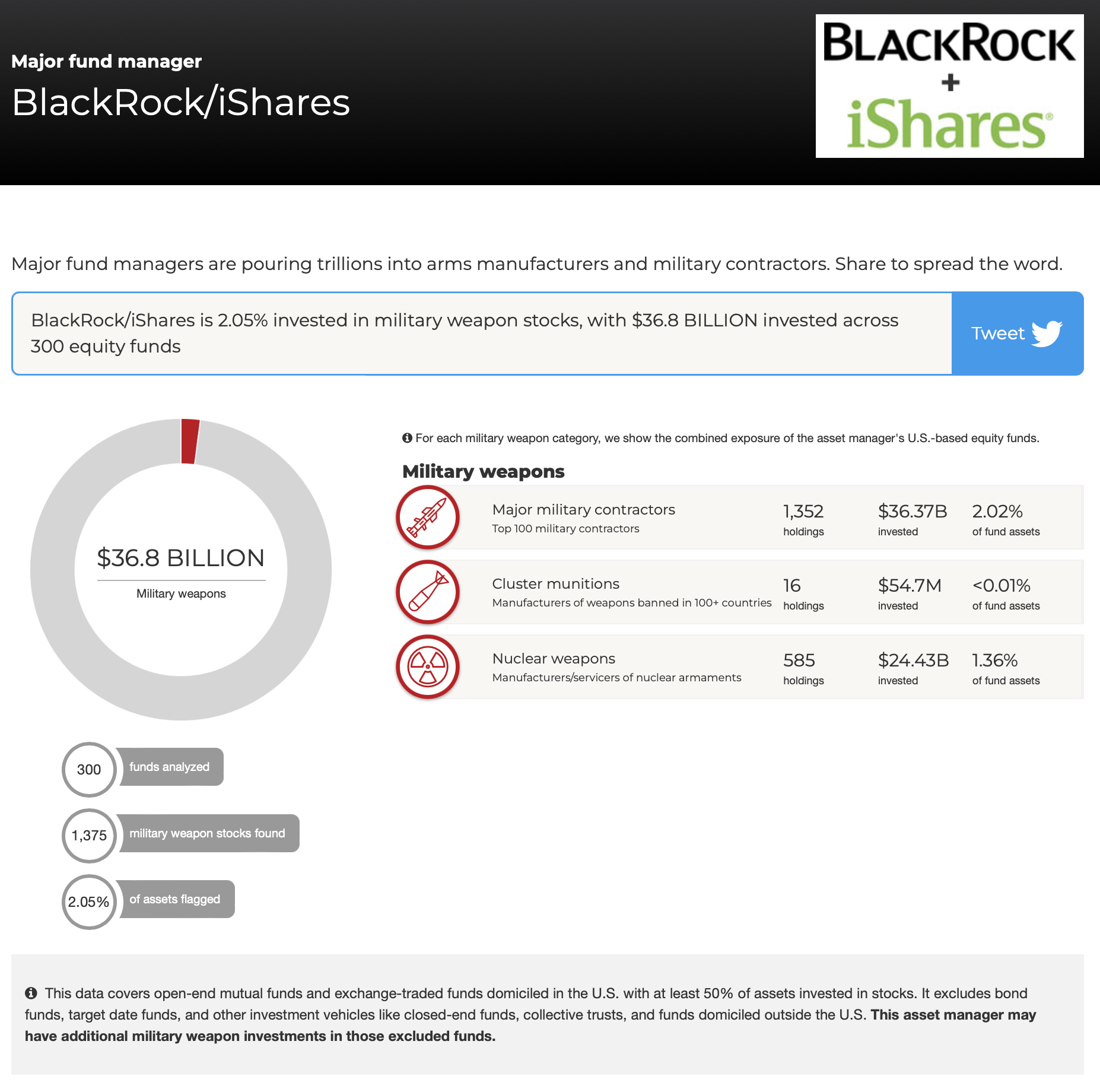
So, keeping Hillary Clinton's comments about commercial opportunities for Corporate America in the post-Iraq war era in mind, it's looking like BlackRock (as a highly influential representative of Corporate America) is already preparing itself to profit from the Ukrainian post-war era. And, as an aside, BlackRock is also benefiting from the war itself as shown here:
War, it's not what it appears to be. In the post-Second World War American-led global reality, war has never been about enemies fighting each other, it's always been about who benefits from the both the war itself (i.e. the defense industry) and those who step in to rebuild the targeted nation after it is destroyed. The rebuilding is also not about helping civilians, it's about helping the ruling class increase their already obscene levels of wealth.
In a recent interview with Lionel Barber, editor of the Financial Times, Russian President Vladimir Putin had some very interesting and accurate comments about the current political situation in the United States, particularly as it relates to America's middle class. Here are some of the key comments:
"Russia has been accused, and, strange as it may seem, it is still being accused, despite the Mueller report [on the investigation into allegations of Russian meddling in the 2016 presidential campaign], of mythical interference in the US election. What happened in reality? Mr Trump looked into his opponents’ attitude to him and saw changes in American society, and he took advantage of this.
You and I are talking ahead of the G20 meeting. It is an economic forum, and it will undoubtedly have discussions on globalisation, global trade and international finance.
The middle class in the US has not benefited from globalisation . . . The Trump team sensed this very keenly and clearly and they used this in the election campaign. Has anyone ever given a thought to who actually benefited and what benefits were gained from globalisation, the development of which we have been observing and participating in over the past 25 years, since the 1990s?
China has made use of globalisation, in particular, to pull millions of Chinese out of poverty.
What happened in the US, and how did it happen? In the US, the leading US companies — the companies, their managers, shareholders and partners — made use of these benefits. The middle class hardly benefited from globalisation. The take-home pay in the US (we are likely to talk later about real incomes in Russia, which need special attention from the government). The middle class in the US has not benefited from globalisation; it was left out when this pie was divided up.
The Trump team sensed this very keenly and clearly, and they used this in the election campaign. It is where you should look for reasons behind Trump’s victory, rather than in any alleged foreign interference. This is what we should be talking about here, including when it comes to the global economy." (my bolds)
Mr. Putin clearly lays the defeat of Hillary Clinton in 2016 at the feet of disillusioned American middle class voters. Let's look at some of the reasons for this disillusionment:
1.) Stagnant wages: Here is a graphic showing what has happened to median real wages for full-time workers aged 16 and over since 1979 (setting 1979 wages at 100):
Over the four decade period since the beginning of 1979, real wages for American full-time workers has only increased by 6.6 percent. If that isn't wage stagnation, I don't know what is.
Here is a graphic showing what has happened to the median weekly nominal earnings for American full-time workers aged 16 and over since 1979:
Over the four decade period, median nominal wages for the second quartile of American workers have increased by 293 percent.
Here is a graphic showing what has happened to nominal corporate profits since 1979:
Over the four decade period, profits for Corporate America have increased by 696 percent or 2.4 times that of its wage earners over the same period.
2.) CEO to worker wage disparity: Here is a table from the Institute for Policy Studies showing the most egregious examples of CEO-to-worker pay gaps:
Here is a graphic from the Economic Policy Institute showing how the CEO-to-worker compensation ratio has changed since 1965:
CEO compensation has even grown when measured against the top 0.1 percent of earners as shown on this graphic:
3.) Taxation: As shown on this graphic, Main Street America is paying a higher and higher share of Washington's total tax revenue:
...when compared to Corporate America as shown on this graphic, keeping in mind that corporate profits have grown at 2.4 times that of median nominal wages:
4.) Trade balance: Here is a graphic showing how the United States trade balance has changed since 1992:
Despite these comments made in May 2000 by then President Bill Clinton and former Federal Reserve President Alan Greenspan about the advantages of Permanent Normal Trade Relations (PNTR) with China:
...it is clear that admitting China to the World Trade Organization has had a massive negative impact on America's manufacturing industry and its accompanying negative impact on wages and salaries for American workers.
While drawing links from economic class to voting patterns is difficult given that education impacts voting rates, it is pretty clear that Vladimir Putin's observations about American society and the growing sense that middle class America is being left behind is accurate. It is becoming increasingly clear that globalization benefits the few at the top and leaves behind the vast majority of society who feel that their place in society is under threat.
In its recentFinancial Stability Report, the Federal Reserve looks at the resiliency of the American economy and the key financial vulnerabilities that increase the level of risk for the economy as a whole, most of which are, in some way, connected to higher interest rates. This "navel gazing" by the Fed is fascinating, particularly given that it was the central bank's policies that led to the financial crisis and near collapse of the global economy between 2007 and 2009. While the Fed touts its success at reviving the economy since that time through the use of imaginative and untested monetary policies, it notes the following vulnerabilities that may have or already have "built over time":
• Valuation pressures are generally elevated, with investors appearing to exhibit a high tolerance for risk-taking, particularly with respect to assets linked to business debt.
• Borrowing by households has risen roughly in line with household incomes . However, debt owed by businesses relative to gross domestic product (GDP) is historically high, and there are signs of deteriorating credit standards .
• The nation’s largest banks are strongly capitalized, and leverage of broker-dealers is substantially below pre-crisis levels. Insurance companies have also strengthened their financial position since the crisis.
• Funding risks in the financial system are low relative to the period leading up to the crisis . Banks hold more liquid assets, and money market mutual funds are less vulnerable to destabilizing runs by investors
In this posting, I will focus on the issue of business debt since it is my personal belief that this is the Achilles heel of the American economy.
According to data provided by the Fed, this is what has happened to corporate bond yields for both BBB rated and high-yield (i.e. junk debt) since the mid-1990s:
As you can see, corporate bond yields have been at historical lows since the Great Recession and have only begun to move up during the last half of 2018 as the Fed has pushed interest rates higher.
What is even more concerning is the fact that investors have been lulled into believing that corporate debt is a secure investment as shown on this graphic which measures the spread between corporate debt and supposedly risk-free Treasuries:
What this graphic does not show is the fact that corporate bondholders are willing to extend loans to Corporate America with fewer credit protections to high-risk borrowers, a factor that could prove to be extremely painful to corporate bondholders should corporations start to default on their debt.
Now, let's look at how much businesses have borrowed. Here is a table showing the breakdown of business credit as well as total private nonfinancial credit (i.e. including household debt of all types) and the growth rates from Q2 2017 to Q2 2018 and the annual growth rate from 1997 to 2018:
Business debt makes up 49.14 percent of all private nonfinancial debt in the United States. Business debt has grown at 4.5 percent over the past year (measured from Q2) and 5.7 percent annually since 1997. What is more concerning is the growth in business debt relative to the size of the economy as measured using GDP:
Unlike household debt, business debt is now at historically high levels when measured against GDP.
Here is a graphic showing the issuance of riskier forms of business debt (leveraged loans and high-yield or junk bonds) going back to 2005:
While the issuance of risky debt dropped during 2015 to 2017, it has since picked up substantially and now totals more than $2 trillion.
In addition, credit standards for some business loans have deteriorated over the past six months. The share of newly issued large loans to companies with high leverage (ratios of debt to EBITDA greater than 6) exceeds levels seen in both 2007 and 2014 as shown here (coloured light brown on the bar graph):
As of the second quarter of 2018, around 35 percent of all corporate bonds outstanding were at the lowest end of the investment-grade group, totalling $2.25 trillion. Here's what the Fed has to say about this looming problem:
"In an economic downturn, widespread downgrades of these bonds to speculative-grade ratings could induce some investors to sell them rapidly, because, for example, they face restrictions on holding bonds with ratings below investment grade. Such sales could increase the liquidity and price pressures in this segment of the corporate bond market."
Given that, over the past year, firms with high leverage, high interest expense ratios and low earnings and cash holdings have been increasing their debt loads the most as shown on this graphic:
...we can clearly see where the next debt crisis in the United States is likely to occur, particularly as interest rates continue to rise.
In large part, the looming business debt problem in the United States was created by the Federal Reserve through its extended experiment with ultra-low interest rates. Unfortunately, a decade of low interest rates have lulled investors who are desperately seeking yield into a false sense of security, believing that a repetition of the Great Recession will never happen and that their investments in junk corporate debt will always retain their value.
Let's start this posting with a question. Which would you rather receive from your employer:
1.) a ten percent raise?
2.) a one-time fifteen percent bonus?
Bonuses are a one time item for an employer. A ten percent raise will compound the next time that a raise is given whereas a one-time fifteen percent bonus will not. Employers know this and would much prefer to grant their employees a one time bonus than a ten percent raise. As for the employee's side of the equation, a ten percent raise will reach the same value as a fifteen percent bonus in 4.3 years, assuming that the raise is given only once. If a raise is given every year, the period of time taken to reach the value of the one-time bonus is reduced.
Let's start by looking at aquote from Gary Cohn, the National Economic Council Director and former President and Chief Operating Officer of Goldman Sachs:
"One of the real impetuses for our tax reform and tax cut plan was to get real wages to grow in the United States, we haven't had real wage growth in a long time in the United States."
After Washington passed the most recent tax cuts for Corporate America, dropping the headline corporate tax rate from 35 percent to 21 percent, a there was a rapid flurry of employers (up to 500 employers covering more than 5.5 million workers) announcing that they were giving bonuses to their employees with the individual one-time bonuses ranging from $1000 to $2000 as shown onthis list from CNBC. As well, according to CNBC's Global CFO Council, 20 percent of companies in a recent survey stated that they were granting one-time bonuses only because of the 2017 Tax Cuts and Jobs Act (TCJA) as shown onthis graphic:
Fortunately for those of us who sweat while we work, ablog posting by Lawrence Mishelat the Economic Policy Institute examines the veracity of the Trump Administration's claims that corporate tax cuts announced in the TCJA have led to widespread increases in employee compensation. By examining data from theBureau of Labor Statistics' Employer Costs for Employee Compensationfor the first two quarters of 2018, we can see the trend in non-production bonuses in both absolute dollars and as a percentage of compensation. The BLS data breaks quarterly compensation down into the following components:
1.) Wages and salaries
2.) Paid leave
3.) Vacation
4.) Holidays
5.) Sick leave
6.) Personal leave
7.) Supplemental pay
8.) Overtime and premium pay
9.) Shift differentials
10.) Non-production bonuses
11.) Insurance
12.) Life insurance
13.) Health insurance
14.) Short-term disability
15.) Long-term disability
16.) Retirement and savings
17.) Defined benefit pensions
18.) Defined contribution pensions
19.) Legally required benefits
20.) Social Security and Medicare
21.) Federal unemployment insurance
22.) State unemployment insurance
23.) Workers' Compensation
Over the period from the beginning of 2017 to the end of the second quarter of 2018,this is what happened to non-production bonusesin dollars per hour and as a percentage of total compensation for all private industry workers (see table 9):
Q1 2017 $0.85 2.6 percent
Q2 2017 $0.85 2.6 percent
Q3 2017 $0.86 2.6 percent
Q4 2017 $0.92 2.7 percent
Q1 2018 $0.96 2.8 percent
Q2 2018 $0.96 2.8 percent
Here is a graph showing what has happened to bonuses as a percentage of total compensation from 2008 to the second quarter of 2018:
The Tax Cuts and Jobs Act was signed into law on December 22, 2017. In the last full quarter of 2017, non-production bonuses were $0.96 per hour or 2.7 percent of total compensation. For both the first and second quarters of 2018 when Corporate America was announcing its employee bonus programs in response to the corporate tax cuts, non-production bonuses were $0.96 per hour or 2.8 percent of total compensation, an increase of $0.04 cents per hour or 0.1 percentage points. By the time the bonuses are adjusted for inflation, the bonuses supposedly connected to the TCJA added a whopping $0.03 cents per hour to employees' pay.
Here is a quote from the Economic Policy Institute's Lawrence Mishel:
"The White House contention that corporate tax cut-inspired widespread provision of bonuses that led to greater paychecks for workers is not supported by the BLS Employer Costs for Employee Compensation data. This is not surprising. Press releases—“a flurry of corporate announcements”—by a small group of administration-supporting firms do not create widespread bonuses or wage growth for workers. Neither do tax cuts, at least within the first six months."
Let's close with this graphic from CNBC showing how Corporate America really intended to spend its tax savings for the first half of 2018:
Given that one-time bonuses, particularly those of the thousand dollar variety, are a really inexpensive way for Corporate America to reward its workers, it is interesting to see that America's employers are still too cheap to help their workers make financial gains by bribing them with shiny baubles in light of the tax savings granted to them by Washington.
I have been an avid follower of the world's political and economic scene since the great gold rush of 1979 - 1980 when it seemed that the world's economic system was on the verge of collapse. I am most concerned about the mounting level of government debt and the lack of political will to solve the problem. Actions need to be taken sooner rather than later when demographic issues will make solutions far more difficult. As a geoscientist, I am also concerned about the world's energy future; as we reach peak cheap oil, we need to find viable long-term solutions to what will ultimately become a supply-demand imbalance.




 Posts
Posts


