Showing posts with label Cuba. Show all posts

Tuesday, November 12, 2019

Who are the World's Real Rogue Nations?

Three recent votes in the United Nations has once again set the tone for the world and more specifically, Washington and its relationship to Cuba and the Middle East.  Here is the background.

We are all aware that Washington and its lackey, the Western mainstream media, have spent a great deal of energy portraying both Russia and China as the greatest threat to world peace in this multipolar world and that they should be considered as rogue nations.  Such is not the case as you will see in this posting.

1.) United Nations General AssemblyNovember 7, 2019 vote to end the United States embargo against Cuba:  For the 28th year in a row, the United Nations took a vote on a resolution that called for and end to the economic, commercial and financial embargo imposed by the United States against Cuba.  Here's what the United Nations had to say about the vote:


Here is the result of the vote:

For - 187 Member States

Against - United States (29th year in a row), Brazil and Israel

Abstain - Columbia and Ukraine

Non-voting - Modova

The Cuba embargo is rooted in the darkest days of the Cold War; on March 14, 1958, the United States imposed an embargo against the sale of arms to Cuba during the Batista regime. This was followed by additional economic penalties after Fidel Castro seized power in 1959 and Cuba began to trade with the Soviet Union rather than with the United States.  Cuba was added to the State Department's lift of states sponsoring international terrorism in 1982 as shown on this Congressional Research Service report from 2005:


Since the embargo inception through to March 2016, Cuba estimates that the economic damages created have reached the $125.9 billion mark, a very significant penalty for a small economy.

2.) United Nations First Committee on Disarmament and International Security - November 1, 2019 vote on a draft resolution "Establishment of a nuclear-weapon-free zone in the region of the Middle East".  Here is the document:


Here is the key portion of the document (A/C.1/74/L.1):

"Urges all parties directly concerned seriously to consider taking the practical and urgent steps required for the implementation of the proposal to establish a nuclear-weapon-free zone in the region of the Middle East in accordance with the relevant resolutions of the General Assembly, and, as a means of promoting this objective, invites the countries concerned to adhere to the Treaty on the Non-Proliferation of Nuclear Weapons.

Calls upon all countries of the region that have not yet done so, pending the establishment of the zone, to agree to place all their nuclear activities under International Atomic Energy Agency safeguard."

Here is the result of the vote:

For - 172 Member States

Against - United States and Israel

Abstentions - Cameroon and the United Kingdom

3.) United Nations First Committee on Disarmament and International Security - November 1, 2019 vote on a draft resolution "The risk of nuclear proliferation in the Middle East".  Here is the document:


Here is the key portion of the document (A/C.1/74/L.2)

"Stressing the importance of taking confidence-building measures, in particular the establishment of a nuclear-weapon-free zone in the Middle East, in order to enhance peace and security in the region and to consolidate the global non-proliferation regime.

Emphasizing the need for all parties directly concerned to seriously consider taking the practical and urgent steps required for the implementation of the proposal to establish a nuclear-weapon-free zone in the region of the Middle East in accordance with the relevant resolutions of the General Assembly and, as a means of promoting this objective, inviting the countries concerned to adhere to the Treaty and, pending the establishment of the zone, to agree to place all their nuclear activities under Agency safeguards."

Here is the result of the vote:

For - 151 Member States

Against - Canada, Israel, Marshall Islands, Federated States of Micronesia, Palau and the United States

Abstentions - 22 Member States

With these votes in mind, ask yourself the following question - which nations really are the world's rogue states, particularly given the history of Israel's acquisition of its nuclear weapons and the current uncertainty regarding the actual size of its nuclear armoury?

Wednesday, February 27, 2019

Mike Pompeo on Latin America - Waging Peace?

In a recent interview with Christina Londono of Telemundo, Secretary of State Mike Pompeo clearly showed America's "cards" when it comes to Venezuela and Nicaragua, two nations that are part of John Bolton's Troika of Tyranny as outlined here:

"Yet today, in this Hemisphere, we are also confronted once again with the destructive forces of oppression, socialism, and totalitarianism.

In Cuba, Venezuela, and Nicaragua, we see the perils of poisonous ideologies left unchecked, and the dangers of domination and suppression.

This afternoon, I am here to deliver a clear message from the President of the United States on our policy toward these three regimes.

Under this administration, we will no longer appease dictators and despots near our shores.

We will not reward firing squads, torturers, and murderers.

We will champion the independence and liberty of our neighbors.

And this President, and his entire administration, will stand with the freedom fighters.

The Troika of Tyranny in this Hemisphere—Cuba, Venezuela, and Nicaragua—has finally met its match." (my bold)

Here are some key excerpts from the Telemundo interview with Mr. Pompeo:

"I truly hope that the Maduro regime is listening, that they’re going to allow the Venezuelan people to receive food – I mean, it’s just crazy to be talking about a government, a leader who would deny food for his own people and medical care, and I hope he changes his mind. I hope he permits this to move forward. It’s a desperate need, one that has now begun to be met by the world. And what happens if he doesn’t I think the Venezuelan people will ultimately decide." (my bold)

Here is a brief very recent video showing the propaganda being fed to us about Venezuela and the real world situation on the ground according to Max Blumenthal:


Here is another one showing a government subsidized market:


One might almost think that CNN has drunk deeply from Washington's special flavour of Koolaid.

When asked if the United States was ready to give Venezuela an ultimatum or a time table for getting rid of their democratically elected President Maduro, here is what he had to say:

"One of the things the Trump administration’s been very clear about is we don’t show our hand. We don’t tell others what we may do. But I think the Maduro regime completely understands that America is committed to supporting President Guaido and the popular will of the Venezuelan people, and we’re going to be hard at it, not only today and tomorrow as this aid begins to move across the borders, but in the days and weeks and months that follow. This is an objective that we have set to help the Venezuelan people succeed, and we’re determined to achieve that outcome." (my bold)

Actually, to me, that pretty much looks like "showing our hand".

When asked about American assistance for the other two nations in Bolton's Troika of Tyranny, here is the exchange:

"SECRETARY POMPEO: President Trump’s administration has done so and will continue to do so not just in Venezuela but certainly Nicaragua and Cuba as well. And you see that. You see that in the policies. They’re very different from the previous administration. They recognize that these governments are treating their people harshly, presenting real risks, security risks to the people, privacy risks, denying them basic liberties. And these are not the kind of things that ought to happen in the Western Hemisphere, and the United States under President Trump is working diligently in not just Venezuela but each of those two countries to achieve good outcomes for those people. The people need to lead those efforts. I’m convinced that they are determined to do it as well. The American people will support them.

QUESTION: So you’re hoping for a domino effect?

SECRETARY POMPEO: I hope that each of those countries, that the citizens of those countries understand that the yoke of authoritarianism that has been foisted upon them is not necessary, that the corruption of those regimes is not necessary, that the bad behavior and difficult living conditions that those people find themselves in today is not necessary, that they can have a different life and that they’ll contribute their efforts, their goodwill, and their humanity towards achieving a better political situation, both in Venezuela and Nicaragua and Cuba as well." (my bolds)

If you happen to be interested, here is the video of the interview in its entirety.

In a January 2019 speech at The American University in Cairo, Mike Pompeo proudly made the following comment:

"In my office, I keep a Bible open on my desk to remind me of God and His Word, and The Truth."

I guess he's conveniently forgotten this verse:

"Blessed are the peacemakers, for they will be called children of God."  Matthew 5:9

Interestingly, the word "peace" is found 91 times in the New Testament.  But then again, I guess it all depends on your definition of "peace", doesn't it.

Monday, August 17, 2015

The United States and Cuba - Operation Northwoods

Updated March 2017

With the United States flag now flying over its embassy in Havana, Cuba for the first time in more than 54 years and the thawing of diplomatic relations between the two nations, I thought that a brief look at a bit of Cuban-American history was in order.

Back in 1962, the U.S. Joint Chiefs of Staff (JCS) had outlined plans for a Cuba Project codenamed Operation Northwoods.   A document titled "Justification for U.S. Military Intervention in Cuba" was provided to then Secretary of Defense Robert McNamara on March 13, 1962.  Here is the cover letter signed by the Chairman of the JCS, General Lyman Lemnitzer who served as the JCS Chair from 1960 to 1962:

This set of plans was written in response to a request from the Chief of the Cuba Project, Colonel Edward Lansdale.  These plans included a series of covert proposals that the United States could use to justify an invasion of Cuba as part of America's secret anti-Castro program as you can see in this quote:

"The suggested courses of action appended to Enclosure A are based on the premise that US military intervention will result from a period of heightened US-Cuban tensions which place the United States in the position of suffering justifiable grievances.  World opinion, and the United Nations forum should be favourably affected by developing the international image of the Cuban government as rash and irresponsible, and as an alarming and unpredictable threat to the peace of the Western Hemisphere.  While the forgoing premise can be utilized at the present time it will continue to to hold good only as long as there can be reasonable certainty that US military invention in Cuba would not directly involve the Soviet Union."

The document goes on to list a series of scenarios that could be used to justify U.S. military intervention in Cuba as follows:

1.) Guantanamo Bay Area:  A series of options were listed that could be used in and around the Guantanamo base that would justify intervention by United States forces and the military response that would be utilized:


2.) A "Remember the Maine" incident:  The Maine Incident which took place in the harbour in Havana, Cuba in February 1898, was used to justify the short-lived Spanish - American war which ended up with Spain relinquishing its control of the Philippines, Puerto Rico and Guam to the United States.  This option that involves the destruction of a marine vessel in Cuban waters:


Notice that the JCS recommends the use of fake casualty lists associated with this action in United States newspapers to rally public support for military action against Cuba.

3.) Cuban Terrorism:  The JCS recommends developing a Communist Cuban terror campaign in the Miami area, other cities in Florida and in Washington.  This campaign could be pointed at Cuban refugees who were seeking asylum in the United States and could go as far as sinking a boatload of Cubans enroute to Florida or exploding a few plastic bombs in carefully chosen spots.

The following option seems almost prescient for those Americans who have strong beliefs in a conspiracy regarding what happened on September 11, 2001:

4.) Shooting down a Passenger Aircraft:


5.) Shooting down a USAF Aircraft:  In this option, it would appear that Cuban MIG fighters have shot down a USAF aircraft over international waters in an unprovoked attack:


In order to keep this document secret, the Joint Chiefs of Staff recommended that the document not be forwarded to :

1.) commanders of unified or specific commands.

2.) US officers assigned to NATO activities.

3.) Chairman, US Delegation, United Nations Military Staff Committee.


When you read the entire document, you realize how little things have changed over the last five decades.  By raising the spectre of terrorism and by using the deaths of innocent civilians, Washington has been able to continue its practice of geopolitical realignment and robbing us of our freedom through the invasion of our privacy, all in the name of "protecting us".

Wednesday, December 17, 2014

Cuba's Oil Potential - Is It a Motivating Factor For Ending the Embargo?

Updated August 2015

The thawing of relations between the United States and Cuba after fifty years of pointless embargo is interesting, particularly given that American business investments that were nationalized in 1959, may at some point be reopened to U.S.-based companies.  As a petroleum geoscientist and a world class cynic, my mind naturally turns to oil, the hydrocarbon that lubricates the world's economy.  As you will see in this posting, Cuba appears to have potential for significant hydrocarbon reserves.

Under the current embargo, Cuba cannot access U.S. oilfield equipment for both drilling and environmental protection.  The embargo prohibits the exporting and re-exporting of items that contain more than 10 percent American components under the De Minimus Rule under Sections 734.4 and 736.2 (b)(2) of the Export Administration Regulations (EAR).  What is particularly interesting about the embargo is the fact that Washington refued to allow an exemption for U.S. oil spill prevention and response companies even though the Obama Administration was very concerned about potential oil spills from drilling operations located relatively close to the U.S. - Cuba maritime boundary in 2012.   

Let's look at Cuba's hydrocarbon potential.  According to the Energy Information Administration, Cuba produced 51,000 barrels of oil per day (BOPD) in 2012 and consumed 151,000 BOPD; the shortfall is made up of imported crude from Venezuela.  Here is a graph showing Cuba's total daily oil production from 1980 to 2013:


Here is a graph showing Cuba's oil consumption from 1980 to 2013:


As of January 2013, Cuba had 124 million barrels of proven oil reserves.

Here is a map showing the main geological features and the current oil fields (current to 2002):


Here is a table showing Cuba's main oil fields, the year of discovery, the gravity of the crude and the production statistics for each: 


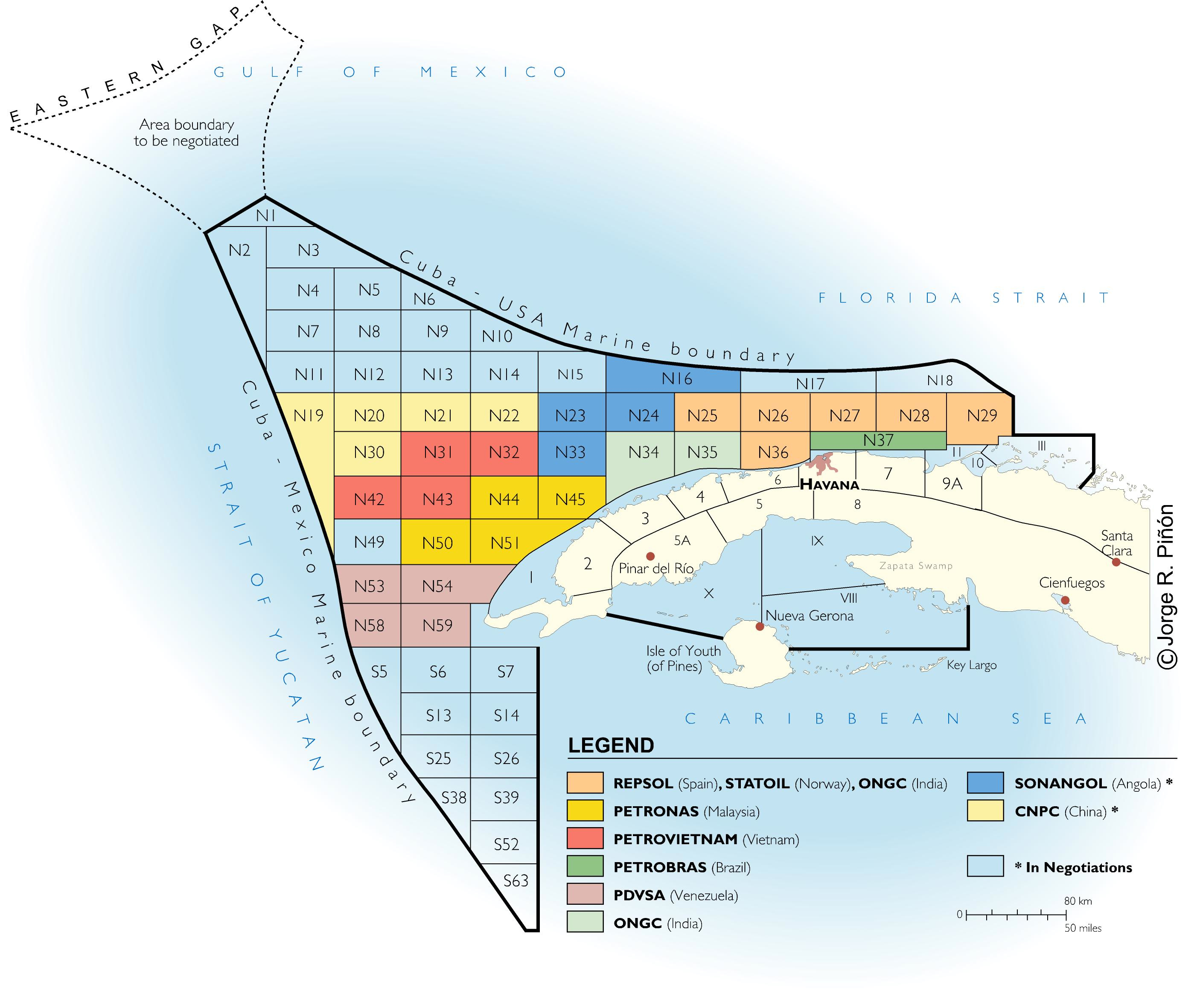
Here is a map showing the current areas under lease for oil exploration and the companies involved dated in 2012:


You will notice the conspicuous absence of any American multi-national oil companies.

The most prospective area for oil in Cuba is called the North Cuba Basin.  It is located in the Gulf of Mexico, along the north shore of the island.  The United States Geological Survey (USGS) has divided the basin into three parts or assessment units; the North Cuban Platform Margin Carbonate, the North Cuba Foreland Basin and the North Cuba Fold and Thrust Belt as noted on this map:


It is important to remember that the geology of the Caribbean area is very complex, making it difficult to ascertain the precise geological history of the region.

Petroleum was generated in the North Cuba Basin as a result of thrust loading (pushing rock layers laterally) of Jurassic and Cretaceous oil source rocks during the formation of the North Cuba Fold and Thrust Belt.  As the rocks of the Caribbean plate were thrust toward the north as the Yucatan Basin opened, they collided with the passive southern margin of the North American plate, creating a very complex series of structures into which petroleum fluids migrated.  This cross section (a slice cut through the earth with the surface located at the top of the diagram) will give you a sense of the geological complexity of the North Cuba Basin:


Here are two seismic lines showing the complexity of the faults in the North Cuba Basin with the seismic lines marked in red on the map:


 Let's look at each of the three assessment units in turn.

1.) The North Cuba Fold and Thrust Belt: This assessment unit is mainly located onshore.  This is the region that contains all of the known oil and gas fields currently producing in the North Cuba Basin.  The structural history of the area is very complex with many folds and faults often stacked on each other.  The oil in most of the current reservoirs is quite heavy (20 degrees API or less) probably due to biodegradation as a result of the shallowness of the reservoirs.  One of the biggest operators in this assessment unit is Canada's Sherritt International who has been operating in Cuba for more than 20 years.  Sherritt is currently producing 20,042 BOPD (100 percent basis - 2013 data) and has drilled more than 195 oil wells since 1992.

2.) The North Cuba Foreland Basin: This assessment unit is entirely located offshore.  At the time of the analysis by the USGS (2008), only one well had been drilled in this assessment unit by Repsol in 2004.  The well encountered high quality oil in non-commercial quantities.  Hydrocarbons are trapped in structural features and reservoirs are expected to have excellent porosity.  It is unknown whether the main hydrocarbons present will be oil or natural gas, however, estimates used suggest that new fields would be 90 percent oil fields and 10 percent gas fields.

3.) The North Cuba Platform Margin Carbonate: This assessment unit is smaller in area than the other two units, however, the reservoirs may be much more prolific with very high levels of porosity based on analogies from rocks of equivalent age elsewhere in the Gulf of Mexico.  At the time of the USGS assessment, there had been no drilling in this assessment unit.  It is estimated that reservoirs in this unit will be oil-charged.

Now, let's look at a table showing the potential resources of the North Cuba Basin:


The USGS estimates that there could be up to 4.6 billion barrels of oil and 9.8 TCF of natural gas in the North Cuba Basin.  The natural gas component is composed of 8.6 TCF of associated/dissolved gas (dissolved in oil) and 1.2 TCF of non-associated gas.  Most of the oil will be found in the North Cuba Foreland Basin and all of the non-associated gas will be found in the North Cuba Foreland Basin.


While the oil and natural gas resource assessment by the USGS is speculative, it suggests that with further drilling, Cuba could contain substantial (and valuable) reserves of hydrocarbons.    This is particularly interesting in light of the fact that Cuba approached Russia for assistance with their oil drilling program; in May 2014, Russia's Rosneft and Zarubezhneft signed an energy agreement with Cuba to explore for offshore oil.  Given that, once the embargo is lifted, it will be interesting to see how long it takes before major American oil companies are lining up to acquire drilling rights in Cuba.