Showing posts with label Kazakhstan. Show all posts

Friday, April 29, 2022

China's Colour Revolution Warning to the United States

While the world is distracted by the ongoing conflict in Ukraine, the global geopolitical theatre continues to involve.  On April 25th, 2022, Kazakh President Tokayev met with visiting Chinese State Councillor and Defense Minister Wei Fenghe in Nur-Sultan, the capital city of Kazakhstan.


As you can see on this map, Kazakhstan shares a lengthy border with both China and Russia:


Kazakhstan has a significant trade relationship with China as shown here:


Here is a graphic showing Kazakhstan's trading relationship with China in both exports and imports as shown here:


Exports from Kazakhstan to China rose by 58 percent between 2015 and 2019 and 13.6 percent of Kazakhstan's total exports end up in China.  Exports from China to Kazakhstan rose by 52 percent between 2015 and 2019.  Between 2016 and 2019, China became Kazakhstan's fastest growing export market, growing by 87 percent over the time period.


Here are China's top imported and exported goods from/to Kazakhstan in 2019 and the share of each:


Imported from Kazakhstan:


1.) Mineral fuels and oils and bituminous substances  $2.934 billion - 32 percent share


2.) Copper - $1.738 billion - 19 percent share


3.) Ores, slag and ash - $1.634 billion - 18 percent share


4.) Iron and steel - $908.7 million - 10 percent share


5.) Inorganic chemicals, precious metals, rare-earths - $869.3 million - 9 percent share


Exported from China:


1.) Machinery, mechanical appliances, nuclear reactors - $1.564 billion - 12 percent share


2.) Electrical machinery and equipment - $1.498 billion - 12 percent share


3.) Clothing and apparel not knitted - $1.438 billion - 11 percent share


4.) Footwear - $970.3 million - 8 percent share


5.) Clothing and apparel knitted - $897.4 million - 7 percent share


Since 2012, China has been the largest buyer of Kazakhstani uranium, an important element for China's growing nuclear reactor fleet.


Now, let's look at the most recent news that connects the two nations together as I noted above from the Ministry of National Defense of the People's Republic of China website keeping in mind the near coup/uprising that took place in Kazakhstan in early January 2022:


Here is a translation of the news release courtesy of Google Translate with my bolds:


"Tokayev (Kazakhstan's President) said that Kazakhstan and China celebrate the 30th anniversary of the establishment of diplomatic relations this year. Over the past 30 years, Kazakhstan and China have become permanent comprehensive strategic partners. The two countries have maintained high-level cooperation in the international political arena and achieved remarkable results in cooperation in various fields. In recent years, I have frequently interacted with President Xi Jinping, which has brought strong impetus to bilateral relations. I believe that bilateral relations will achieve greater breakthroughs and achievements. Kazakhstan attaches great importance to the military cooperation between the two countries, and hopes that the two militaries will continue to strengthen practical cooperation in peacekeeping operations, joint exercises, personnel training, military technology and other fields.


Wei Fenghe said that His Excellency the President is an old friend of the Chinese people and has made outstanding contributions to the establishment and development of China-Kazakhstan permanent comprehensive strategic partnership. This year marks the 30th anniversary of the establishment of diplomatic relations between China and Kazakhstan. Under the strategic guidance of the two heads of state, the bilateral relations have maintained a vigorous momentum of development with bright future prospects, becoming a model of good-neighborliness and friendship, mutual benefit and win-win results."


Here are the key sentences, aimed directly at Washington:


"China firmly opposes external forces deliberately instigating a "color revolution" in Kazakhstan, and supports Kazakhstan in taking effective measures to safeguard national security and social stability. We must be alert to some major powers interfering in Central Asia and disrupting the security of Central Asia. This visit reflects China's great importance and firm support to Kazakhstan. No matter what kind of risks and challenges they encounter, China and Kazakhstan will jointly safeguard regional stability and promote the building of a community with a shared future for mankind."


Here are the closing sentences of the press release:


"In recent years, the exchanges and cooperation between the Chinese and Kazakh militaries in various fields have been fruitful. The Chinese military is willing to continue to expand cooperation areas with the Kazakh side and promote the in-depth development of the relationship between the two militaries.


On the same day, Kazakh Defense Minister Zakserekov held a welcome ceremony for Wei Fenghe and held formal talks. The two sides exchanged in-depth views on the international and regional security situation, the situation in Ukraine, and the Afghan issue, and agreed to continue to strengthen strategic communication between the two militaries, conduct joint exercises and training, and carry out practical cooperation."


With Kazakhstan playing a very important part in China's ongoing economic development thanks to its abundant reserves of crude oil (the twelfth largest oil reserves in the world) and its world leading uranium production capabilities as shown here:


...it is very apparent why China is making diplomatic moves to strongly discourage Washington from further geopolitical maneuvering in Kazakhstan in its efforts to solidify America's position as the sole global superpower.  Kazakhstan stands to play a very important role in China's future, particularly its energy security, and the current leadership of China are not about to stand by while Washington meddles further in the affairs of Central Asia.


Tuesday, January 11, 2022

Kazakhstan - The Story Behind the Protests

While the mainstream media in the West is paying very little attention to anything that isn't COVID-19-related, recent events in Kazakhstan, a former republic of the Soviet Union, are quite interesting, particularly when put into context with Washington's moves against Russia.


Since many people have only fleeting knowledge about Kazakhstan, I thought I would open with this map showing the nation and its surrounding neighbours, particularly its strategic proximity to both Russia and China:


As Russia expanded its territory during the 19th century, Kazakhstan fell under the rule of Russia's royal family who essentially annexed the nation.  When the Russian Empire fell, in 1920, the area became an autonomous republic within Russia becoming a Soviet republic in 1936.  Kazakhstan finally declared its independence on December 16, 1991 after the collapse of the U.S.S.R.  The U.S.S.R. and Russia have  historically close ties with Kazakhstan, building the Soviet Union's Semipalatinsk Test Site, the nation's main nuclear weapon test site and Russia's Baikonur Cosmodrome space launch centre which is under lease until 2050.


Kazakhstan is a key player in the global resource business.  The nation is an important source of minerals, having the world's second largest zinc, lead, chromium and uranium reserves, the fifth largest copper reserves and has significant reserves of coal, petroleum and natural gas.  It is also a significant producer of gold, producing 100,000 kilograms of gold in 2020.


Let's start with hydrocarbons.  According to the IEA, Kazakhstan has the world's 12th largest proven crude oil reserves and is the largest producer of oil in Central Asia.  The nation's Kashagan field has the fifth-largest oil reserves in the world with projected production of 450,000 BOPD in 2025 and 955,000 BOPD by 2040.  It also is the world's 9th largest coal producer.  Kazakhstan total energy production is more than twice its energy demand.  


Now, let's look at uranium.  Kazakhstan has 12 percent of the world's uranium reserves and produced 43 percent of the world's uranium in 2019.  It has a major plant that manufactures nuclear fuel pellets.  Kazakhstan has signed joint ventures and other high-level agreements on energy cooperation with Russia, China, India and Japan for its nuclear industry. Canada has also signed an agreement with Kazatomprom to mine and refine uranium with plans to transfer Cameco oOrporation's proprietary unrainum refining technology to Kazakhstan.  Interestingly, in March 2017, Kazatomprom signed a contract to supply Iran with 950 tons of uranium concentrate to Iran over three years.


Obviously, Kazakhstan's massive natural resources are playing and will continue to play a key role in the nation's global standing.


At the beginning of 2022, Kazakhstan's government under President Kassym-Jomart Tokayev increased the price of liquid petroleum gas (LPG) in a bid to end subsidized fuels for consumers; the price was was recapped on January 4th after protests spread across the nation.  A two-week state of emergency was imposed and Tokayev called for military assistance from Russia and the Collective Security Treaty Organization or CSTO (an alliance of former Soviet states headed by Russia, Belarus, Kazakhstan, Tajikistan, Armenia and Kyrgyzstan which can be thought of in a similar fashion as NATO) on January 5th.  Under Article 4 of the Treaty, if one member state is subjected to aggression by an external force, it is considered aggression against all member states.  This is the first time that CSTO troops have been deployed in the group's history.


Here's what Russia's Foreign Ministry had to say about the deployment of the CSTO Collective Peacekeeping Forces:


...and here is what Russia's President Vladimir Putin had to say during the January 10th, 2022 video meeting of the heads of the CSTO member states with my bolds:


"We know that the current threat to Kazakhstan’s statehood is not rooted in the spontaneous protests over fuel prices but in the fact that destructive internal and external forces made use of this situation. The people who protested over the situation on the fuel market and their goals are different from the people who took up arms to attack the state and their goals.


Actively used were ‘Maidan’ technologies of armed and information support for the protests. There were organised and controlled groups of fighters, as President Tokayev has pointed out just now, including people who had apparently received training in terrorist camps abroad, and their attack on Kazakhstan, as President Tokayev has noted – and it was essentially an attack on the country, on Kazakhstan – amounts to an act of aggression. I fully agree with him in this regard....


We view our joint actions as extremely timely and absolutely legitimate. The CSTO forces arrived in Kazakhstan following a formal request from the republic’s leadership and strictly in keeping with Article 4 of the Collective Security Treaty of 1992. Under this article, in the event of aggression against any of the member states, all other countries shall immediately provide the affected member state, at its request, the necessary assistance and support, including military assistance. We have been witnessing an international terrorist aggression. Where did these armed groups come from? It is obvious that they were trained in foreign camps and acquired combat experience in hotspots around the world."


Let's look at Kazakhstan's current situation in another light.  The National Endowment for Democracy or NED was founded in 1983 as an independent (i.e. nongovernment), nonprofit foundation dedicated to the growth and strengthening of democracy   It claims the following:


"Since its founding in 1983, the Endowment has remained on the leading edge of democratic struggles everywhere, while evolving into a multifaceted institution that is a hub of activity, resources and intellectual exchange for activists, practitioners and scholars of democracy the world over."


Here's how it is funded and how it uses those funds:


"Funded largely by the U.S. Congress, the support NED gives to groups abroad sends an important message of solidarity to many democrats who are working for freedom and human rights, often in obscurity and isolation."


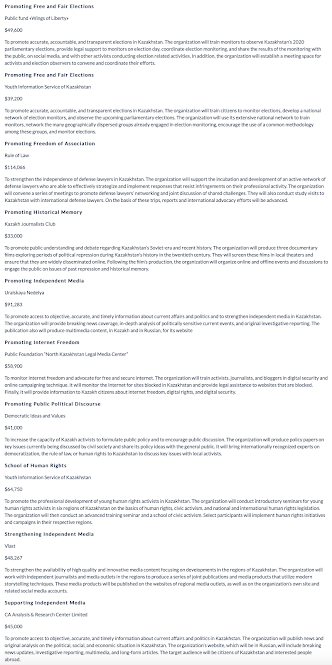
NED has been quite busy in Kazakhstan.  In its report for 2020 which was published on February 18, 2021, we find the following activities:


American taxpayers have spent substantial funds (given that the U.S. dollar goes a long way in Kazakhstan) on the promotion of "freedom, Washington-style" in Kazakhstan in 2020 (and most likely in 2021 although we haven't seen the data yet), in particular, for  "free and fair elections", "human rights" and "strengthening independent media" among other issues.  It's a good thing that Washington never interferes in the affairs of other nations, isn't it?


Let's close this posting with some thoughts, beginning with a recent address to the people of Kazakhstan on January 7, 2022 by President Tokayev with my bolds:


"The anti-terrorist operation continues in our country. The police, the national guard and the army are carrying out large-scale and well-coordinated efforts to restore law and order in accordance with the Constitution.


Yesterday, the situation in the cities of Almaty, Aktobe, and Almaty region was stabilized. The implementation of the state of emergency is ensuring results. Constitutional legitimacy is being restored across the country.


However, terrorists continue to cause damage to public and private property, and use weapons against citizens.


I have given orders to law enforcement agencies and the army to, where necessary, open fire without warning.


There are some calls abroad for the parties to hold talks to resolve problems peacefully. This is nonsense! What kind of negotiations can take place with criminals and murderers?


We have had to deal with armed and trained bandits, both local and foreign. They must be eliminated, and this will be done soon.


Law enforcement forces are morally and technically ready to perform this task.


As you know, based on the main provisions of the CSTO charter documents, Kazakhstan appealed to the heads of the participating states with a request to introduce a joint peacekeeping contingent to assist in restoring constitutional order.


This contingent has arrived in our country for a short period of time to perform supporting functions.


I would like to express my sincere gratitude to the Prime Minister of Armenia, who chairs the CSTO, as well as to the Presidents of Belarus, Kyrgyzstan, and Tajikistan.


I would like to express my special gratitude to Russian President Vladimir Putin. He very quickly and, most importantly, in a warm and friendly manner responded to my appeal.


I also express my gratitude to the Presidents of China, Uzbekistan, Turkey, the heads of the UN and other international organizations for their words of support.


The tragic events in our country highlight the problems of democracy and human rights in a new way....


It is critically important to understand why the state was not aware of the underground preparation of terrorist attacks by sleeper cells and militants. Almost 20 thousand bandits attacked Almaty.


Their actions showed a clear plan of attacks on military, administrative and social facilities in almost all areas, coordination of actions, high combat readiness and brutal cruelty.


In addition to the militants, there were specialists trained in ideological sabotage, skillfully using disinformation or “fakes” and capable of manipulating people’s moods.


Could he be referring to affiliates of the National Endowment for Democracy?  We will never know.


It shouldn't be surprising that Russia had to involve itself in the situation in Kazakhstan given that the two nations share a 7644 kilometre-long border, the longest continuous international border in the world and second longest by total length after the Canadian-United States border as well as Russia's commitments under the CSTO.  As Putin points out, it is a situation that is very similar to the long-term standoff along the Russia - Ukraine border where Russian troops are currently protecting the Motherland.  If the CTSO had not appeared on the scene to control the situation, one could quite easily imagine a repetition of the scenario that occurred and is still active in Ukraine.  


A cynic might think that Washington is trying to use its power in a similar fashion to what occurred in Ukraine in 2014 with Western-backed (i.e. NED-backed) NGOs and individuals encouraging protests against the sitting government, a situation that Vladimir Putin seems to have figured out.  Washington also appears to be doing its best to divide Russia's military along two fronts, both in the Ukraine and now in Kazakhstan.  Most importantly, with Kazakhstan having a significant portion of the world's energy resources, why would anyone be surprised that Washington wasn't trying to get a "friendly" government in place that it can control, giving it access to "the resource pot of gold at the end of the rainbow" with the added benefit of depriving both China and Russia of these important and massive resources.


Let's close with this quote:


"In politics, nothing happens by accident.  If it happens, you can bet it was planned that way."


Franklin D. Roosevelt