Showing posts with label National Endowment for Democracy. Show all posts

Tuesday, January 11, 2022

Kazakhstan - The Story Behind the Protests

While the mainstream media in the West is paying very little attention to anything that isn't COVID-19-related, recent events in Kazakhstan, a former republic of the Soviet Union, are quite interesting, particularly when put into context with Washington's moves against Russia.


Since many people have only fleeting knowledge about Kazakhstan, I thought I would open with this map showing the nation and its surrounding neighbours, particularly its strategic proximity to both Russia and China:


As Russia expanded its territory during the 19th century, Kazakhstan fell under the rule of Russia's royal family who essentially annexed the nation.  When the Russian Empire fell, in 1920, the area became an autonomous republic within Russia becoming a Soviet republic in 1936.  Kazakhstan finally declared its independence on December 16, 1991 after the collapse of the U.S.S.R.  The U.S.S.R. and Russia have  historically close ties with Kazakhstan, building the Soviet Union's Semipalatinsk Test Site, the nation's main nuclear weapon test site and Russia's Baikonur Cosmodrome space launch centre which is under lease until 2050.


Kazakhstan is a key player in the global resource business.  The nation is an important source of minerals, having the world's second largest zinc, lead, chromium and uranium reserves, the fifth largest copper reserves and has significant reserves of coal, petroleum and natural gas.  It is also a significant producer of gold, producing 100,000 kilograms of gold in 2020.


Let's start with hydrocarbons.  According to the IEA, Kazakhstan has the world's 12th largest proven crude oil reserves and is the largest producer of oil in Central Asia.  The nation's Kashagan field has the fifth-largest oil reserves in the world with projected production of 450,000 BOPD in 2025 and 955,000 BOPD by 2040.  It also is the world's 9th largest coal producer.  Kazakhstan total energy production is more than twice its energy demand.  


Now, let's look at uranium.  Kazakhstan has 12 percent of the world's uranium reserves and produced 43 percent of the world's uranium in 2019.  It has a major plant that manufactures nuclear fuel pellets.  Kazakhstan has signed joint ventures and other high-level agreements on energy cooperation with Russia, China, India and Japan for its nuclear industry. Canada has also signed an agreement with Kazatomprom to mine and refine uranium with plans to transfer Cameco oOrporation's proprietary unrainum refining technology to Kazakhstan.  Interestingly, in March 2017, Kazatomprom signed a contract to supply Iran with 950 tons of uranium concentrate to Iran over three years.


Obviously, Kazakhstan's massive natural resources are playing and will continue to play a key role in the nation's global standing.


At the beginning of 2022, Kazakhstan's government under President Kassym-Jomart Tokayev increased the price of liquid petroleum gas (LPG) in a bid to end subsidized fuels for consumers; the price was was recapped on January 4th after protests spread across the nation.  A two-week state of emergency was imposed and Tokayev called for military assistance from Russia and the Collective Security Treaty Organization or CSTO (an alliance of former Soviet states headed by Russia, Belarus, Kazakhstan, Tajikistan, Armenia and Kyrgyzstan which can be thought of in a similar fashion as NATO) on January 5th.  Under Article 4 of the Treaty, if one member state is subjected to aggression by an external force, it is considered aggression against all member states.  This is the first time that CSTO troops have been deployed in the group's history.


Here's what Russia's Foreign Ministry had to say about the deployment of the CSTO Collective Peacekeeping Forces:


...and here is what Russia's President Vladimir Putin had to say during the January 10th, 2022 video meeting of the heads of the CSTO member states with my bolds:


"We know that the current threat to Kazakhstan’s statehood is not rooted in the spontaneous protests over fuel prices but in the fact that destructive internal and external forces made use of this situation. The people who protested over the situation on the fuel market and their goals are different from the people who took up arms to attack the state and their goals.


Actively used were ‘Maidan’ technologies of armed and information support for the protests. There were organised and controlled groups of fighters, as President Tokayev has pointed out just now, including people who had apparently received training in terrorist camps abroad, and their attack on Kazakhstan, as President Tokayev has noted – and it was essentially an attack on the country, on Kazakhstan – amounts to an act of aggression. I fully agree with him in this regard....


We view our joint actions as extremely timely and absolutely legitimate. The CSTO forces arrived in Kazakhstan following a formal request from the republic’s leadership and strictly in keeping with Article 4 of the Collective Security Treaty of 1992. Under this article, in the event of aggression against any of the member states, all other countries shall immediately provide the affected member state, at its request, the necessary assistance and support, including military assistance. We have been witnessing an international terrorist aggression. Where did these armed groups come from? It is obvious that they were trained in foreign camps and acquired combat experience in hotspots around the world."


Let's look at Kazakhstan's current situation in another light.  The National Endowment for Democracy or NED was founded in 1983 as an independent (i.e. nongovernment), nonprofit foundation dedicated to the growth and strengthening of democracy   It claims the following:


"Since its founding in 1983, the Endowment has remained on the leading edge of democratic struggles everywhere, while evolving into a multifaceted institution that is a hub of activity, resources and intellectual exchange for activists, practitioners and scholars of democracy the world over."


Here's how it is funded and how it uses those funds:


"Funded largely by the U.S. Congress, the support NED gives to groups abroad sends an important message of solidarity to many democrats who are working for freedom and human rights, often in obscurity and isolation."


NED has been quite busy in Kazakhstan.  In its report for 2020 which was published on February 18, 2021, we find the following activities:

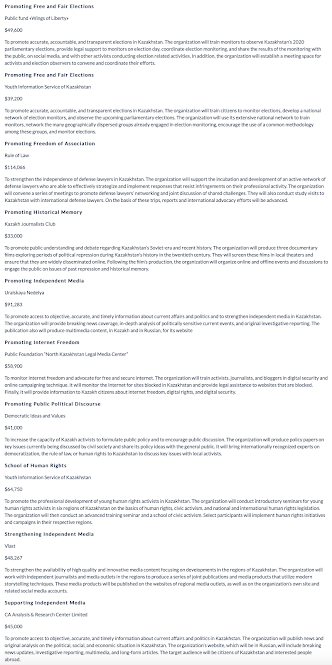


American taxpayers have spent substantial funds (given that the U.S. dollar goes a long way in Kazakhstan) on the promotion of "freedom, Washington-style" in Kazakhstan in 2020 (and most likely in 2021 although we haven't seen the data yet), in particular, for  "free and fair elections", "human rights" and "strengthening independent media" among other issues.  It's a good thing that Washington never interferes in the affairs of other nations, isn't it?


Let's close this posting with some thoughts, beginning with a recent address to the people of Kazakhstan on January 7, 2022 by President Tokayev with my bolds:


"The anti-terrorist operation continues in our country. The police, the national guard and the army are carrying out large-scale and well-coordinated efforts to restore law and order in accordance with the Constitution.


Yesterday, the situation in the cities of Almaty, Aktobe, and Almaty region was stabilized. The implementation of the state of emergency is ensuring results. Constitutional legitimacy is being restored across the country.


However, terrorists continue to cause damage to public and private property, and use weapons against citizens.


I have given orders to law enforcement agencies and the army to, where necessary, open fire without warning.


There are some calls abroad for the parties to hold talks to resolve problems peacefully. This is nonsense! What kind of negotiations can take place with criminals and murderers?


We have had to deal with armed and trained bandits, both local and foreign. They must be eliminated, and this will be done soon.


Law enforcement forces are morally and technically ready to perform this task.


As you know, based on the main provisions of the CSTO charter documents, Kazakhstan appealed to the heads of the participating states with a request to introduce a joint peacekeeping contingent to assist in restoring constitutional order.


This contingent has arrived in our country for a short period of time to perform supporting functions.


I would like to express my sincere gratitude to the Prime Minister of Armenia, who chairs the CSTO, as well as to the Presidents of Belarus, Kyrgyzstan, and Tajikistan.


I would like to express my special gratitude to Russian President Vladimir Putin. He very quickly and, most importantly, in a warm and friendly manner responded to my appeal.


I also express my gratitude to the Presidents of China, Uzbekistan, Turkey, the heads of the UN and other international organizations for their words of support.


The tragic events in our country highlight the problems of democracy and human rights in a new way....


It is critically important to understand why the state was not aware of the underground preparation of terrorist attacks by sleeper cells and militants. Almost 20 thousand bandits attacked Almaty.


Their actions showed a clear plan of attacks on military, administrative and social facilities in almost all areas, coordination of actions, high combat readiness and brutal cruelty.


In addition to the militants, there were specialists trained in ideological sabotage, skillfully using disinformation or “fakes” and capable of manipulating people’s moods.


Could he be referring to affiliates of the National Endowment for Democracy?  We will never know.


It shouldn't be surprising that Russia had to involve itself in the situation in Kazakhstan given that the two nations share a 7644 kilometre-long border, the longest continuous international border in the world and second longest by total length after the Canadian-United States border as well as Russia's commitments under the CSTO.  As Putin points out, it is a situation that is very similar to the long-term standoff along the Russia - Ukraine border where Russian troops are currently protecting the Motherland.  If the CTSO had not appeared on the scene to control the situation, one could quite easily imagine a repetition of the scenario that occurred and is still active in Ukraine.  


A cynic might think that Washington is trying to use its power in a similar fashion to what occurred in Ukraine in 2014 with Western-backed (i.e. NED-backed) NGOs and individuals encouraging protests against the sitting government, a situation that Vladimir Putin seems to have figured out.  Washington also appears to be doing its best to divide Russia's military along two fronts, both in the Ukraine and now in Kazakhstan.  Most importantly, with Kazakhstan having a significant portion of the world's energy resources, why would anyone be surprised that Washington wasn't trying to get a "friendly" government in place that it can control, giving it access to "the resource pot of gold at the end of the rainbow" with the added benefit of depriving both China and Russia of these important and massive resources.


Let's close with this quote:


"In politics, nothing happens by accident.  If it happens, you can bet it was planned that way."


Franklin D. Roosevelt


Monday, October 7, 2019

How Washington is Meddling in the Affairs of Taiwan

In a recent posting, I provided my readers with background information on the links between Washington's National Endowment for Democracy, a Congressionally-funded "non-profit" organization and Hong Kong and the connection to the recent protests against China.  In this posting, I would like to look at how Washington is further meddling in China's realm through its funding of the pro-democracy movement in Taiwan, a nation that China and the United States have been scrapping over for decades.  I apologize in advance for the length of this posting but I feel that it is important to understand Taiwan based on its history with mainland China and its post-Communist China relationship with the United States.

To put the Taiwan/China (aka Republic of China/People's Republic of China respectively) situation into context, it is important to understand the history between the two nations.  Taiwan was annexed by China's Qing dynasty in the late 1600s and was ceded to Japan as part of the post-Sino-Japanese War treaty in 1895.  Japan governed the island as colony until the end of the Second World War in 1945 when Japan surrendered to the Republic of China's (ROC) military forces led by Chiang Kai-shek.  The Republic of China came into existence in 1912 after the Qing dynasty was overthrown during the Xinhai Revolution and included the current territories of China, Taiwan and Mongolia and its government was headed by its president, Sun Yat-sen who handed over the presidency to Yuan Shikai who forced the last emperor to abdicate.  After short period of control after declaring himself the Emperor of China, he lost control of the territory and China returned to its warlord past.  Sun Yat-sen who had been in exile, returned to China and, along with the Communist Party of China and the rejuvenated Koumintang (KMT)and establ8isehd a rival government in the southern Chinese city of Guangzhou.  After his death in March 1925, the KMT was headed by his protege, Chiang Kai-Shek. By 1927, the KMT and Communists split, marking the beginning of the Chinese Civil War with each group claiming that they were the true heirs to Sun Yat-sen.  Prior to the Second World War, Japan's desire to control China's ample natural resrouces resulted in the seizure of Manchuria in 1931, culminating in the fall of Nanking, China's capital city, in 1937.  Despite the loss of territory to Japan, the KMT and communists continued to battle in an attempt to control larger geographic regions of the nation.  After the end of World War II, despite American interventions and attempts to arrange truces between the two parties, the battle between the KMT and Communist People's Liberation Army continued during the Chinese Civil War , with Beijing being capture by the PLA in January 1949 and Nanking being captured in April 1949. On October 1, 1949, the Communists, headed by Mao Zedong, founded the People's Republic of China.  Chiang Kai-Shek and his followers which included hundreds of thousands of troops loyal to him and two million refugees fled to Taiwan, declaring Taipei as its capital.  Chiang ruled Taiwan under martial law, banning opposition parties until 1989, and not holding its first free legislative elections until 1992 and its first presidential election in 1996.  Apparently, Washington preferred a non-Communist dictatorship over one that was part of the growing Red menace.   Backed by significant financial  aid from the United States who recognized Taiwan as the legitimate Chinese government, Chiang launched Taiwan on a path to economic growth.  In addition, in 1954, the United States and Taiwan signed the Sino-American Mutual Defense Treaty as part of America's move to stiffle the growth of global communism and prevent China from taking over Taiwan. This treaty was terminated in 1979 after the United States established official diplomatic relations with the People's Republic of China and replaced with the Taiwan Relations Act which pledged to continue commercial, cultural and other relations between Taiwan and the United States.

The United States has had a very long and close military relationship with Taiwan which was governed under the Sino-American Mutual Defense Treaty aka the Mutual Defense Treaty Between the United States and the Republic of China which was signed on December 2, 1954 as shown here:


The key phrase in this treaty reads like this:

"In order more effectively to achieve the objective of this Treaty, the Parties separately and jointly by self-help and mutual aid will maintain and develop their individual and collective capacity to resist armed attack and communist subversive activities directed from without against their territorial integrity and political stability." (my bold)

Obviously, the treaty is referring to the People's Republic of China which was formed under the leadership of Mao Tse-tung and his communist cohort in 1949.  This treaty has led to the selling of hundreds of millions of dollars worth of American military equipment to Taiwan over the past six decades. 

Now, let's look at the democracy movement in Taiwan and how Washington is involving itself in Taiwan's internal affairs.  In Juny 2003, the Taiwan Foundation for Democracy or TFD formally came into being after being initiated by Taiwan's former president Chen Shui-Bian and proactively promoted by Taiwan's Ministry of Foreign Affairs.  Here is what TFD says about itself:

"Taiwan's peaceful transition to democracy is not only a historical accomplishment for its twenty-three million people, but a landmark in the worldwide spread of democracy. Only after years of struggle and effort could this transformation take place. We must never forget this history, for it shapes the cornerstone of our continued commitment to the principles of democracy and human rights.

The Foundation was established with an inter-related, two-tracked mission in mind. Domestically, the TFD strives to play a positive role in consolidating Taiwan's democracy and fortifying its commitment to human rights; internationally, the Foundation hopes to become a strong link in the world democratic network, joining forces with related organizations around the world. Through the years, Taiwan has received valuable long-term assistance and stalwart support from the international community, and it is now time to repay that community for all of its efforts."

TFD is governed by fifteen trustees and five supervisors and represents Taiwan's political parties, its government, academia, non-governmental organizations and business sector.   It is primarily funded by the Taiwanese government but is independently incorporated as a non-profit organization.  One-fifth of its budget comes from Taiwan's political parties.  Its aims are as follows:

"1.) Building relationships with related institutions around the world.

2.) Participating actively in the global promotion of democracy and supporting the improvement of human rights conditions.

3.) Supporting democracy promotion activities of NGOs and academic institutions.

4.) Promoting research and publications on democratic developments at home and abroad.

5.) Organizing and sponsoring seminars, workshops, conferences, and other educational activities in the field of democracy and human rights."

In many ways, it very closely resembles Washington's National Endowment for Democracy.  In fact, as you will see, the two organizations are closely connected.  According to NFD's 2018 Annual Report, NED's President Carl Gershman gave a speech at NFD's 15th anniversary event:


Here is a quote about Gershman's address from the annual report:

"National Endowment for Democracy President Carl Gershman stated that Taiwan was not merely a “model country,” but “an inspiration for those who aspire to democracy, a partner for democracy advocates and practitioners around the world, and an agent for democratic change at a time when democracy is under assault and even its traditional leaders are beset by doubt.” As the rise of authoritarian China has become the biggest challenge to democratic values, Taiwan has been able to provide a unique voice and perspective. “That such a small and diplomatically beleaguered country is capable of playing such an important role...this enables all of us to take hope in democracy. Despite all the obstacles and adversaries, Taiwan makes us believe that democracy will in the end prevail,” he added." (my bold)

That message is pretty clear, isn't it?

Further along in the report we find this:


Notice that significant international funding for NFD was sourced from the United States.   Looking further through the annual report international funding section, we see that the United States plays a major role in NFD, particularly regarding "Human Rights in China" as shown on these pages:


In the 2017 NFD Annual Report we find that NED Vice President Louisa Greve had a talk expressing concerns about the contemporary trend in "...democratic recession, abuses in democratic systems, the suppression of civil society and the problem of corruption..." singling out Russia and China for attention.  NED President Carl Gershman was also in attendance at the Asia Young Leaders for Democracy program, also speaking about the global democratic recession as shown on this photo:


It is quite clear that, in the case of both Taiwan and Hong Kong, Washington is involving itself by foisting its pro-democracy agenda at mainland China through the "muscle" of the National Endowment for Democracy, the United States taxpayer-funded, non-profit, non-partisan arm of Congress.  Apparently, there's nothing like "democracy, American-style" and international meddling "Congressional-style".

Wednesday, August 14, 2019

How Washington is Meddling in the Affairs of Hong Kong

While there has been growing coverage of the unrest in Hong Kong, there has been minimal coverage of what may lie behind the pro-democracy protests.  Even Donald Trump has entered the fray with this tweet which clearly condemns China's actions against protestors in Hong Kong:


As you will see in this posting, it is entirely possible that a Washington-based and Congressionally funded institution is responsible, at least in part, for the lack of calmness in Hong Kong.

A few weeks ago, I wrote this posting on the National Endowment for Democracy or NED, America's instrument of democratic promotion around the world, that is, democracy American style.  NED was founded in 1983 during the Reagan Administration with the following Statement of Principles and Objectives:

"Democracy involves the right of the people freely to determine their own destiny.

The exercise of this right requires a system that guarantees freedom of expression, belief and association, free and competitive elections, respect for the inalienable rights of individuals and minorities, free communications media, and the rule of law."

While NED touts itself as a "private" foundation, in other words, it is independent of government. That could not be further from the truth.  Here's what NED has to say about itself that belies its true character:

"NED is a unique institution. The Endowment’s nongovernmental character gives it a flexibility that makes it possible to work in some of the world’s most difficult circumstances, and to respond quickly when there is an opportunity for political change. NED is dedicated to fostering the growth of a wide range of democratic institutions abroad, including political parties, trade unions, free markets and business organizations, as well as the many elements of a vibrant civil society that ensure human rights, an independent media, and the rule of law.

This well-rounded approach responds to the diverse aspects of democracy and has proved both practical and effective throughout NED’s history. Funded largely by the U.S. Congress, the support NED gives to groups abroad sends an important message of solidarity to many democrats who are working for freedom and human rights, often in obscurity and isolation....

From its beginning, NED has remained steadfastly bipartisan. Created jointly by Republicans and Democrats, NED is governed by a board balanced between both parties and enjoys Congressional support across the political spectrum. NED operates with a high degree of transparency and accountability reflecting our founders’ belief that democracy promotion overseas should be conducted openly." (my bolds)

Despite its proclamation that it has a "nongovernmental character", NED receives its funding through an annual appropriation from Congress through the Department of State making it little more than another mouthpiece for Washington's agenda.  NED promotes Washington's global agenda through direct grants to more than 1600 non-governmental groups that are working for "democracy" in more than 90 nations around the world.  

Let's look at NED's activities in Hong Kong for 2018 according to its website.  Here are the projects that were funded over the period from 2015 to 2018:


Notice that the 2018 funding to the National Democratic Institute for International Affairs was granted to "facilitate engagement on Hong Kong's growing threats to guaranteed rights".  That certainly sounds like promoting democracy to me. NED spent a total of $1,357,974 on grants to organizations that were promoting freedom, democracy and human rights in Hong Kong over the period from 2015 to 2018.  Unfortunately, we don't know what NED spent on promotingg democracy in Hong Kong in the timeframe prior to 2015.  While, in the grand scheme of what Washington spends this is not a great deal of money, it is the principle of what Washington is attempting to create in Hong Kong that is of concern.  This is a very clear example of meddling in the internal affairs of China and Hong Kong, actions that will only serve to anger China who is the also the recipient of a great deal of NED's attention.  It is also key to remember that there are likely other taxpayer-funded programs through which Washington is attempting to influence what happens in Hong Kong.  

In my opinion, this tweet by the conservative-leaning Washington Examiner is a dead giveaway to the source of the unrest:


While the ideals of democracy are admirable and desirable, Washington's version of democracy is tainted by big money and has developed into a system where politicians are for sale to the highest bidder.  This is not the democracy that most of the world wants.  Long-term Congressional meddling in other nations internal affairs through its funding of the National Endowment for Democracy is little better than the nation reengineering exercises undertaken by the Central Intelligence Agency since the end of the Second World War.

Tuesday, June 25, 2019

The National Endowment for Democracy - Supporting America's Democratic Agenda

Washington's non-stop blathering about Russian electoral interference seems to be unending and we can assure ourselves that it will continue ad nauseam as we enter the 2020 presidential election cycle.  While America's political leadership takes great pains to assure American voters that Russia is to blame for America's political woes, it doesn't take much digging to find that Washington is guilty of the same crimes that it is accusing Vladimir Putin of undertaking.

Let's start by looking at a key player in Washington, the National Endowment for Democracy or NED.  NED claims that it is a private, nonprofit foundation "dedicated to the growth and strengthening of democratic institutions around the world."  NED was founded in 1983 as you can see in this announcement from then-President Ronald Reagan:


NED's Statement of Principles and Objectives reads as follows:

"Democracy involves the right of the people freely to determine their own destiny.

The exercise of this right requires a system that guarantees freedom of expression, belief and association, free and competitive elections, respect for the inalienable rights of individuals and minorities, free communications media, and the rule of law."

As I noted above, NED touts itself as a "private" foundation, in other words, it is independent of government. That could not be further from the truth.  Here's what NED has to say about itself that belies its true character:

"NED is a unique institution. The Endowment’s nongovernmental character gives it a flexibility that makes it possible to work in some of the world’s most difficult circumstances, and to respond quickly when there is an opportunity for political change. NED is dedicated to fostering the growth of a wide range of democratic institutions abroad, including political parties, trade unions, free markets and business organizations, as well as the many elements of a vibrant civil society that ensure human rights, an independent media, and the rule of law.

This well-rounded approach responds to the diverse aspects of democracy and has proved both practical and effective throughout NED’s history. Funded largely by the U.S. Congress, the support NED gives to groups abroad sends an important message of solidarity to many democrats who are working for freedom and human rights, often in obscurity and isolation.

The Endowment is guided by the belief that freedom is a universal human aspiration that can be realized through the development of democratic institutions, procedures, and values. Democracy cannot be achieved through a single election and need not be based upon the model of the United States or any other particular country. Rather, it evolves according to the needs and traditions of diverse political cultures. By supporting this process, the Endowment helps strengthen the bond between indigenous democratic movements abroad and the people of the United States — a bond based on a common commitment to representative government and freedom as a way of life.

From its beginning, NED has remained steadfastly bipartisan. Created jointly by Republicans and Democrats, NED is governed by a board balanced between both parties and enjoys Congressional support across the political spectrum. NED operates with a high degree of transparency and accountability reflecting our founders’ belief that democracy promotion overseas should be conducted openly."

For an organization with a "nongovernmental character", it certainly is closely linked to Washington, isn't it?  In fact, NED receives its funding through an annual appropriation from the United States Congress through the department of State.  NED does state that it is NED's independent Board of Directors that controls how the appropriation is spent.  Here is the current board noting that Elliott Abrams, an American diplomat who is now Donald Trump's U.S. Special Representative for Venezuela is currently on leave:


The list reads like a who's who of Washington, doesn't it?  

NED claims that it works as follows:

1.) Helping democrats in closed societies by working with both democrats within the country in question and those in exile.

2.) Consolidating democracy boy strengthening institutions and procedures of electoral democracy to ensure fair elections.

3.) Applying a multi-sectoral approach through its four core institutions which represent America's two political parties, its labour movement and its business community.

4.) Co-operating with other democracy foundations to encourage all established democracies to create organizations that are similar to NED.

5.) Cultivating partner organizations in new democracies who will then share their democratic expertise with democrats in nations that are not currently democratic.

6.) Building a worldwide movement for democracy.

NED funds only organizations that are non-governmental, a rather ironic choice given its own ties to Washington.  Each year, NED makes direct grant to more than 1600 non-governmental groups that are working for democracy in more than 90 nations around the world.  An average grant lasts for 12 months and is around $50,000 in size.

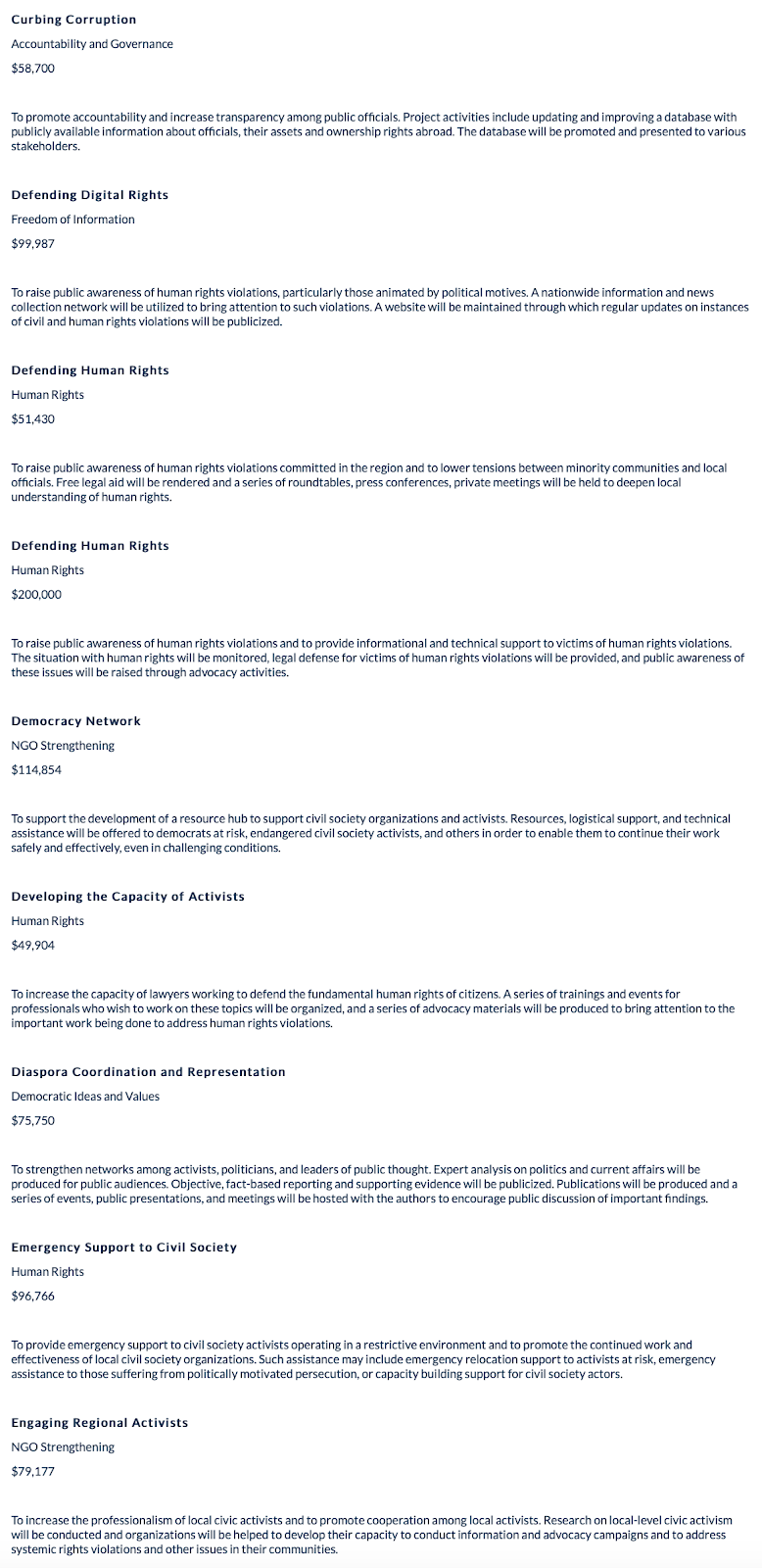
With the Russian 2016 election meddling narrative in mind, let's look at a sample of some of the projects that this so-called "private foundation" undertook in Russia in 2018 and how much was spent on each project:


This is just a small sampling of NED's activities in Russia.  IN case you happen to think that 2018 is a "one off", here is a partial listing of what NED did "for" Russia in 2016, the same year that Washington accuses Russia of meddling in the American electoral system:


In 2016, NED gave 108 grants totalling $6.8 million to influence Russia's political system.

It is very apparent that NED's overt actions in Russia and other nations around the world are very similar in scope and style to the Central Intelligence Agency's covert nation re-engineering operations.  While the spending of taxpayers' dollars by NED is insignificant compared to what is spent on the American intelligence community as a whole, the spending of any amount of money to influence democracy by funding groups that have parallel interests to Washington's agenda in other nations can only be viewed as meddling.

The National Endowment for Democracy - "Supporting Freedom Around the World".  That is, freedom and democracy "American-style".