Showing posts with label Taiwan. Show all posts

Sunday, June 23, 2024

How Washington is Begging for War with China

In the monthly archive of the foreign military sales which appear on the Defense Security Cooperation Agency's website for the month of June 2024, we find the following announcements of sales to Taiwan:


1.) Sale of Switchblade 300 Anti-Personnel and Anti-Armour Loitering Missile Systems:


Here is some background on the Switchblade 300 Block 20:


2.) Sale of Altius 600M-V Unmanned Aerial Vehicles:


Here is some background on the Altius 600M:


3.) Sale of F-16 Non-Standard Spare and Repair Parts:


4.) Sale of F-16 Standard Spare and Repair Parts:


These four sales of materiel to Taiwan in the month of June 2024 total $660.2 million.


All four of these sales fall under the proclamation that "the proposed sale of this equipment and support will not alter the basic military balance in the region".  If that was the case, why approve the sales?  As well, I'm sure that China's leadership would wholeheartedly agree that this is not a direct threat to their plans for the region.


Of the sales, the sale of 291 Altius 600m-V Unmanned Aerial Vehicles and 720 Switchblade 300 drones follow this speech by Deputy Secretary of Defense Kathleen Hicks' comments at a lunchtime speech in September 2023:


"Last week I gave a speech, you all may know, about our need to innovate with urgency in this enduring age of strategic competition with the PRC. And there I described, in some detail, much of what we have been doing to enable and unleash the potential of U.S. and partner innovators....


And we've been doing quite a lot: Mapping and debugging DoD's innovation ecosystem. Rapidly iterating and investing to be a data-driven and AI-empowered military now. Incentivizing more joint experimentation and concept development. Extending bridges and express lanes over the so-called valley of death; of course, there are many valleys of death. Accelerating software acquisition and procurement of innovative technologies. And so much more. 


Why the urgency? Because our main strategic competitor today, the PRC, has spent the last 20 years building a modern military carefully crafted to blunt the operational advantages we've enjoyed for decades....


Last week, I announced our Replicator initiative — the latest effort to overcome the production valley of death, beginning with accelerating the scaling of all-domain attritable autonomous systems.


First, let's be crystal clear: Replicator is not a new program of record. We're not creating a new bureaucracy. And we will not be asking for new money in FY24. Not all problems need new money; we are problem-solvers, and we intend to self-solve.


So, Replicator will use existing funding, existing programming lines, and existing authorities to accelerate production and delivery at scale — by exerting leadership focus and attention on a singular operational challenge and maturing solutions, because that's what ultimately delivers....


With Replicator, we're beginning with all-domain, attritable autonomy, or ADA2, to help us overcome the PRC's advantage in mass: more ships, more missiles, more forces....


Let me give you a window into the possibilities of all-domain, attritable autonomy.


Imagine distributed pods of self-propelled ADA2 systems afloat, powered by the sun and other virtually-limitless resources, packed with sensors aplenty, enough to give us new, reliable sources of information in near-real-time.


Imagine fleets of ground-based ADA2 systems delivering novel logistics support, scouting ahead to keep troops safe, or securing DoD infrastructure.


Imagine constellations of ADA2 systems on orbit, flung into space scores at a time, numbering so many that it becomes impossible to eliminate or degrade them all. 


Imagine flocks of ADA2 systems, flying at all sorts of altitudes, doing a range of missions, building on what we've seen in Ukraine. They could be deployed by larger aircraft, launched by troops on land or sea, or take off themselves.


Bigger-picture, ADA2 systems let us think and act differently in doing things we've always done. Recall in Ukraine, a Patriot battery intercepted a Russian hypersonic missile; that's how traditional platforms do missile defense — and it's an incredible accomplishment, underscoring why we need them. 


Elsewhere, ADA2 systems might counter missiles differently — perhaps like active protection systems on a tank, or other types of countermeasures. 


And those are just a handful of the use cases for ADA2 systems."


She refers to it as "the small, smart and cheap" philosophy of warfare through the use of thousands of drones which will be used to overwhelm the Chinese advantage in "mass".


Washington has taken the first steps toward its new "Replicator Initiative" by arming Taiwan with Switchblade 300 Anti-Personnel and Anti-Armour Loitering Missile and Altius 600m-V drone systems.  How the nation's ruling class can think that China won't view these sales as anything but a provocation over its stated goal of reunifying Mainland China and Taiwan is beyond my comprehension.


Sunday, August 14, 2022

China, Human Rights and American Repentance

Following the furor that was raised over Nancy Pelosi's controversial August 12th, 2022 visit to Taiwan and the fact that several members of Congress are about to follow in her footsteps as shown here:


....China has, once again, weighed into the issue during a recent press conference held by China's Foreign Ministry Spokesperson, Wang Wenbin.


On August 12, 2022, a representative from China's CCTV, a state-owned broadcaster controlled by the Chinese Communist Party, posed the following question to Wang Wenbin:


"US House Speaker Nancy Pelosi said at a recent press conference with the Congressional delegation to Asia that Taiwan is one of the freest “countries” in the world and their visit is to salute this democracy. She also noted that the visit signals no departure from the US government’s one-China policy and they are not trying to upset the status quo across the Taiwan Strait. What’s your comment?"


Here is the response from Wang Wenbin:


"Pelosi’s remarks are further proof that her visit to China’s Taiwan region shows connivance and support for “Taiwan independence” separatist forces. She openly referred to Taiwan as a “country”. This is a serious political provocation that violates the one-China principle and the three Sino-US joint communiqués. The DPP authorities have redoubled efforts within the island to remove the Chinese identity of Taiwan and push for “incremental independence”, and sought every means to create “two Chinas” and “one China, one Taiwan” in the international arena. Against such a background, Pelosi chose to visit Taiwan and claimed in a high-profile fashion that she was there on behalf of the US. The visit was clearly official in nature and aimed to provoke cross-Strait confrontation and interfere in China’s internal affairs. This is an extremely egregious move. To defend our sovereignty and territorial integrity, to uphold the basic norm in international relations of non-interference in other countries’ internal affairs, and to truly safeguard peace and stability in the Taiwan Strait, China has every right to take resolute countermeasures in response to the US’s provocations. Such measures are absolutely necessary under those circumstances."


Here is the key part of his response with my bolds:


"Pelosi will achieve nothing by using democracy as a pretext for her visit. Her visit has nothing to do with democracy. It was a political stunt that went against the will of the more than 1.4 billion Chinese people, including our compatriots in Taiwan, and challenged the one-China principle widely accepted by the international community. Her visit tramples on democracy and shows how the US puts its selfish interests above international justice. If Pelosi truly cares about democracy and human rights, she should visit Afghanistan, Iraq, Syria and Libya instead, where she could express repentance over the hundreds of thousands of innocent civilians killed by the US military and vow to prevent such atrocities caused by US violation of UN Charter and norms in international relations from happening again."


In a Google search, the only reference to this comment about American repentance was found on Iran's Press TV as shown here:


You have to admit that it's pretty hard to argue with China's logic, isn't it?  The members of Congress who are visiting Taiwan would do well to keep that in mind during their visit to Taiwan.


Tuesday, August 2, 2022

China's Response to Washington's Pro-Taiwan Moves - Crossing the Red Line in the Sand

Through its state-owned Global Times news service, China's leadership has made it very clear what it thinks of Nancy Pelosi's visit to Taiwan:


Here are some quotes with my bolds:


"The Chinese Foreign Ministry and the People's Liberation Army (PLA) are keeping up the pressure on the US over House Speaker Nancy Pelosi's potential visit to the island of Taiwan, urging the US to honor US President Joe Biden's promise to not support "Taiwan independence," while media outlets from the US and Taiwan reported that Pelosi is expected to visit the island shortly.


Citing "officials", Taiwan-based Next TV on Monday said Pelosi is expected to stay in Taipei overnight at the Grand Hyatt hotel in Xinyi district, but it's unclear exactly when she will arrive. CNN also released similar information, saying that "Pelosi is expected to visit Taiwan as part of her tour of Asia," according to a senior official from the Taiwan authorities and a US official. 


Chinese Foreign Ministry spokesperson Zhao Lijian also said at a routine Monday press conference, "If you play with fire, you will get burned. I believe the US is fully aware of the strong and clear message delivered by China."


If Pelosi visits the island of Taiwan, "the PLA will not sit idly by" and will take "resolute and strong countermeasures" to protect China's sovereignty and territorial integrity. As to what these measures are, Zhao said "if she dares to go, let's wait and see."...


Chinese analysts said this new warning is a clear signal that if Pelosi goes to Taiwan, China will see it as a provocative action permitted by the Biden administration rather than a personal decision made by Pelosi, and it would be a serious incident that means the US has violated its promise...."


It's no longer an "if" Pelosi visits Taiwan.


Washington violating a promise?  It's hard to imagine that would ever happen.  Here's CNN's coverage on the issue from November 2021 after a virtual meeting between Joe Biden and Xi Jinping:


Let's go back to the Global Times article:


"China's strategic view is far greater than just playing a game of hawk-and-chicken with Pelosi on her so-called surprise visit to the island, as China will use this provocative move by the US to irreversibly change the Taiwan Straits situation and speed up the reunification process, which is actually much more important than a US politician's visit, said experts."


As I've said before, unlike Western leaders, China's leadership plays the long game and, thanks to American failing role as the leader of the international global order, has partnered up with Russia on economic and military issues.


The article on Global Times also notes that the People's Liberation Army's Eastern Theater Command has released a video on social media with this message:


"We are fully prepared for any eventuality. Fight upon order, bury every intruder, move toward joint and successful operation!"


Here is the video as it appears on YouTube (at least for now):


I found the section of the video between 1 minute and 20 seconds and 1 minute and 30 seconds to be a sphincter puckering experience.  If anyone sees that many missiles heading their direction, life as the world knows it is finished.  Just in case this link should happen to disappear, here is another one.


All of this political intrigue begs the question; on how many fronts does Washington think that its military can fight wars given that American forces have not won a war since 1945 and that was only with the help of the Russians who are now on the other side of the battle?


Taiwan has long been the "red line in the sand" for China's leadership and it would appear that Washington is tempting fate by crossing that line at the peril of world peace.


Friday, November 12, 2021

Supporting Taiwan and Preparing for War

There is no doubt in my mind that Washington is ramping up its anti-China rhetoric, particularly in its recent moves toward Taiwan which it regards as a completely separate entity from China in complete contrast to China which regards Taiwan as part of itself.  Let's look at two recent moves that Washington has made which will only push the "war" agenda closer to reality.


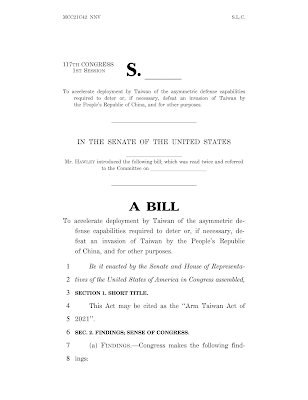
First, we have this bill from Senator Josh Hawley (Hawkley would be a better moniker), a member of the Senate Armed Services Committee:


The Arm Taiwan Act of 2021 would supply arms and training to "...accelerate deployment by Taiwan of the asymmetric defense capabilities required to deter or, if necessary, defeat an invasion of Taiwan by the People’s Republic of China, and for other purposes."


You may ask yourself why Washington has made this move.  Here is their raison d'être for proposing the bill:


"It is the sense of Congress (and we all know that they are NEVER wrong about anything") that:


"The Department of Defense has warned that the Government of the People’s Republic of China may conclude that it can successfully invade and seize control of Taiwan in the latter half of the 2020s."


Note that there is a significant condition in this first justification of the bill; that China "may" conclude that it can successfully invade and seize control of Taiwan in the latter half of the 2020s.  Then again, never let a possibility of war constrain Washington's pathological need to spend on its military.


Let's look at the additional Congressional findings being used to justify the bill:


"2.) In October 2021, the Minister of National Defense of Taiwan, Chiu Kuo-cheng, echoed these warnings when he stated that the People’s Republic of China—


(A) ‘‘is capable now’’ of invading Taiwan; and


(B) will have ‘‘lowered the costs and losses’’ associated with invading Taiwan ‘‘to a minimum’’ after 2025.


3.) If the People’s Republic of China were to invade and seize control of Taiwan, it would deal a severe blow to United States interests by—


(A) destroying one of the world’s leading democracies;


(B) casting doubt on the ability and resolve of the United States to uphold its security commitments;


(C) incentivizing other countries in the Indo-Pacific region to bandwagon with the Peo- ple’s Republic of China; and


(D) facilitating the formation of a regional order dominated by the People’s Republic of China in which the Government of the People’s Republic of China may—


(i) regulate or otherwise limit the abil- ity of individuals in the United States to trade in the Indo-Pacific region, which would have dire effects on the livelihoods and freedoms of such individuals; and


(ii) use the Indo-Pacific region as a secure base from which to project military power into other regions, including the Western Hemisphere.


(4) Taiwan’s proximity to the People’s Republic of China, coupled with investments by the People’s Republic of China in capabilities designed to delay intervention by the United States Armed Forces in support of Taiwan, means that Taiwan may be forced to delay, degrade, and deny an invasion by the People’s Republic of China with limited support from the United States Armed Forces for the initial days, weeks, or months of such an invasion.


(5) If Taiwan is unable to delay, degrade, and deny an invasion by the People’s Republic of China with limited support from the United States Armed Forces, especially in the initial period of war, then the People’s Republic of China may conclude that it 3  is, or may actually be, capable of -


(A) invading and seizing control of Taiwan before the United States or any other partner  country of Taiwan is able to respond effectively, thereby achieving a fait accompli; and 


(B) potentially rendering any attempt by the United States or any other partner country of Taiwan to reverse territorial gains by the People’s Republic of China prohibitively difficult, costly, or both."


The bill goes on to state that Taiwan needs asymmetric defense capabilities to "...improve the ability of Taiwan to defend itself, but also reduce operational risk to members of the United States Armed Forces under a Taiwan contingency."  As such, Congress is encouraging other nations to sell, lease or otherwise provide appropriate asymmetric defense capabilities to Taiwan so that they can defeat an invasion by the People's Republic of China.


So, what will Taiwan gain from this bill if it is passed?   Under the new "Taiwan Security Assistance Initiative", Congress will appropriate $3 billion annually over the period starting in fiscal 2023 and ending in fiscal 2027.  Congress believes that this will provide Taiwan with equipment, training and assistance necessary to defend, delay, degradation and deny attempts by China's People's Liberation Army from entering Taiwan by sea, seizing control of a population centre in Taiwan and from seizing control of the gGovernment of Taiwan.


The materiel to be supplied to Taiwan includes but is not limited to:


(1) Mobile, ground-based coastal defense cruise missiles and launchers.


(2) Mobile, ground-based short-range and me- dium-range air defense systems.


(3) Smart, self-propelled naval mines and coast- al minelaying platforms.


(4) Missile boats and fast-attack craft equipped with anti-ship and anti-landing craft missiles.


(5) Unmanned aerial and other mobile, resilient surveillance systems to support coastal and air defense operations.


(6) Equipment to support target location, tracking, identification, and targeting, especially at the local level, in communications degraded or denied environments.


(7) Man-portable anti-armor weapons, mortars, and small arms for ground combat operations.


(8) Equipment and technical assistance for the purpose of developing civil defense forces, composed of civilian volunteers and militia.


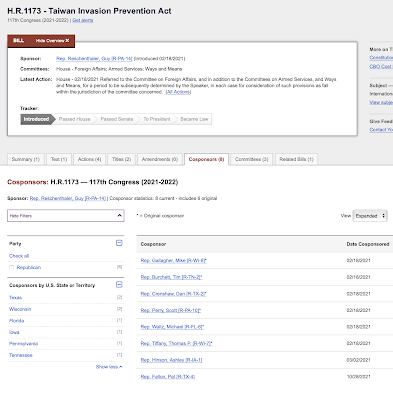
Now, as promised, let's look at another key development in the pending war with China.  In early 2021, Rep. Guy Reschenthaler (R-PA-14) introduced H.R. 1173 known as the "Taiwan Invasion Prevention Act" as shown here:


Under this bill which is now in the hands of the House Committee on Foreign Affairs, the President of the United States is authorized to use military force for the purpose of defending Taiwan against armed attack.  This is being done because, it is the sense of Congress that:


"(1) both the United States and Taiwan have made significant strides since 1979 in bolstering their defense relationship;


(2) the People’s Republic of China has dramatically increased the capability of its military forces since 1979;


(3) the People’s Republic of China has in recent years increased the use of its military forces to harass and provoke Taiwan with the threat of overwhelming force; and


(4) that it is the policy of the United States to consider any effort to determine the future of Taiwan by anything other than peaceful means, including by boycotts or embargoes, a threat to the peace and security of the Western Pacific area, and of grave concern to the United States."


Under the bill, the President is authorized to use the Armed Forces of the United States and take steps to protect Taiwan from the following:


"(1) Direct armed attack by the military forces of the People’s Republic of China against the military forces of Taiwan.


(2) The taking of territory under the effective jurisdiction of Taiwan by the military forces of the People’s Republic of China.


(3) The endangering of the lives of members of the military forces of Taiwan or civilians within the effective jurisdiction of Taiwan in cases in which such members or civilians have been killed or are in imminent danger of being killed."


So, basically, Congress and the Department of Defense are setting the stage for a war with China over Taiwan and are more than willing to sacrifice America's young men and women for yet another war without end just as the last war without end (nearly) has just wound down without a win.  A war with a very well-armed and motivated People's Republic of China in "their backyard" will be a far different war than America's experience in Afghanistan as you can see here:


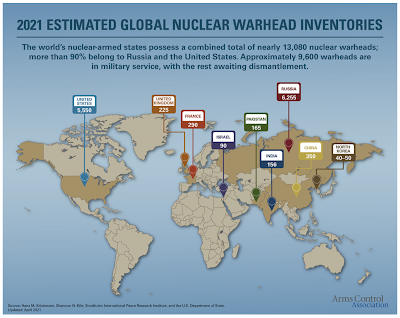
And, with China's possession of nuclear weapons, there is always a chance that these could be deployed in a desperate move to protect the homeland from a threat by American forces:


Monday, November 1, 2021

Priming the World for a War with China

In a recent interview on CNN, Taiwan's President Tsai Ing-wen revealed that there were a small number of United States military personnel located on the island nation, the first Taiwanese president to expose this information to the world and to China in specific.  


Here are some excerpts from the interview as broadcast on Formosa TV English News:


Here is additional coverage of the interview:


Interestingly, back in June 2020, the U.S. Army's 1st Special Forces Group posted a short motivational video entitled "Excellence" which shows Special Forces personnel training with their Taiwanese counterparts on its official Facebook page as shown here:


While the number of American military personnel is very small in the grand scheme of the U.S. military personnel deployed around the world, it is the message being sent to China and its leadership that is of concern.  All United States military personnel were removed from Taiwan in 1979 under the agreement wherein Washington recognized Beijing and the Chinese Communist Party as the only government of China, leaving the American relationship with Taiwan to fall under the Taiwan Relations Act (TRA) under which the U.S. government engages with and provides for Taiwan's defense as shown here:


"Taiwan Relations Act - Declares it to be the policy of the United States to preserve and promote extensive, close, and friendly commercial, cultural, and other relations between the people of the United States and the people on Taiwan, as well as the people on the China mainland and all other people of the Western Pacific area. Declares that peace and stability in the area are in the political, security, and economic interests of the United States, and are matters of international concern. States that the United States decision to establish diplomatic relations with the People's Republic of China rests upon the expectation that the future of Taiwan will be determined by peaceful means and that any effort to determine the future of Taiwan by other than peaceful means, including by boycotts or embargoes is considered a threat to the peace and security of the Western Pacific area and of grave concern to the United States. States that the United States shall provide Taiwan with arms of a defensive character and shall maintain the capacity of the United States to resist any resort to force or other forms of coercion that would jeopardize the security, or social or economic system, of the people of Taiwan. 


Reaffirms as a commitment of the United States the preservation of human rights of the people of Taiwan. 


Declares that in furtherance of the principle of maintaining peace and stability in the Western Pacific area, the United States shall make available to Taiwan such defense articles and defense services in such quantity as may be necessary to enable Taiwan to maintain a sufficient self-defense capacity as determined by the President and the Congress. Requires such determination of Taiwan's defense needs to be reviewed by United States military authorities in connection with recommendations to the President and the Congress. 


Directs the President to inform the Congress promptly of threats to the security or the social or economic system of the people on Taiwan, and any danger to the United States interests arising from such threats. Specifies that the President and the Congress shall determine the appropriate action in response to any such danger."


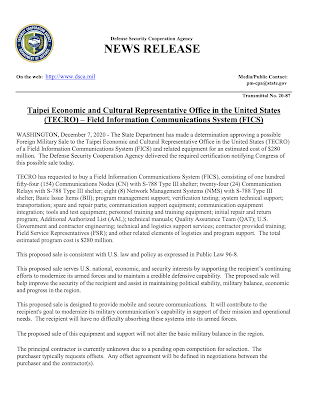
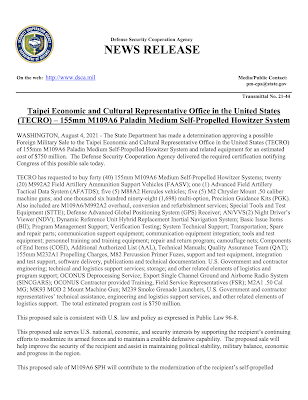
Not surprisingly, under the terms of the TRA, Washington continues to sell significant advanced military materiel to Taiwan as shown here:


...and here:


...and here, among others:


Obviously, these moves by Washington have not gone unnoticed.  Here is a recent article on China's relationship with Taiwan from the China Daily, an English language news service owned by the Chinese Communist Party:


In the Global Times, another media service with links to the Chinese Communist Party and its People's Daily newspaper, we find this fascinating op-ed from April 2021:


Here are some quotes with all bolds being mine:


"It would seem to some that a US war with China over the island of Taiwan appears imminent. 


Considering the congestion of hostile forces in, above, and below the Taiwan Straits and South China Sea, conflict could explode by accident or design. Once blood is drawn, the US will have few options. If the US elects to fight China over the island of Taiwan, then it will lose...


The US Congress' interests in Taiwan are deeply conflicted, better said corrupt. The reciprocal relationship between defense lobbyists, industry contributions, and a Caucus Member's reelectability is well documented. The bipartisan support for increasing arms sales to Taiwan and even larger defense expenditures on the US Indo-Pacific Command are logical and transparent as all parties profit from the tension and war. 


Many Americans assume China's citizenry longs for a liberal democracy like that on the island of Taiwan, and that war will trigger popular revolt. But the Taiwan question is not an ideological dispute. Rather it is a raw and painful open wound in China's civilizational identity. Today, US othering of Chinese only fuels a fierce nationalism in its 1.4 billion citizens. China has a traditional self-narrative wherein the preservation of face and enforcement of sovereignty are inseparable. 


All the while the balance of power has shifted fundamentally. The US would be wise to regard China as a peer superpower, if only due to her casualty-tolerance - China's decisive advantage in any fight with the US. China also shares a binding mutual defense treaty with North Korea, and the depths of its friendship and security bonds with Russia should never be underestimated....


The US has never paid an existential price for violating another nation's sovereignty, leading to our smug sense of military invincibility. However, with Taiwan being a core Chinese priority, that would be a fatal miscalculation. Still, the US counts on regional allies to share the pain. Yet some will have blood debts to pay if they engage in China's civil war...The US allies will definitely think twice before militarily intervening in China's unresolved civil war and internal affairs. 


In the end, the prosperous Taiwan people will make every effort to wag the American dog. But Taiwan's fate poses no existential threat to the US, and the US should not fall into the trap of paying for their hubris with American blood. However, in view of the violent political polarization of the US at home, an ill-advised foreign war with no path to victory would only serve to accelerate America's decline."


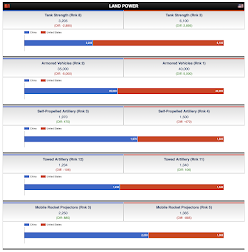
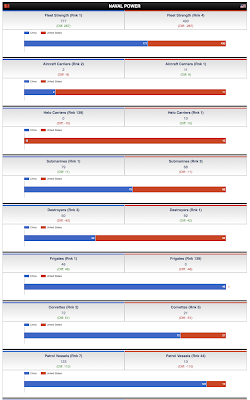
Through two of its English-language media outlets, China's leadership has made it very clear that any actions that Washington takes in defense of Taiwan will be viewed as an act of war by the Chinese Communist Party.  The Taiwanese President's admission that U.S. troops are on Taiwanese soil is nothing more than "poking the dragon with a stick".  Washington's ruling class with its Cold War mentality still believes that it can win a conflict anywhere in the world, however, China's massive and technically advanced military, its close links to both North Korea and Russia and its geographic proximity to any conflict in the East and South China Seas give it a significant advantage and may surprise the United States with its determination to protect the territory that it believes is part of the Chinese homeland.


Update November 2, 2021


Here is a recent article from Taiwan's Apple Daily along with a translation to English:


Exclusive | Taiwan-US military training exposed! 40 Marines are training in Guam to strengthen amphibious assault operations


Publication time: 2021/11/02 13:15

Update time: 2021/11/02 14:09


Forty Marines are currently being trained at the Guam base in the United States to enhance amphibious assault landing training. They will also "coordinate operations" with the U.S. Marine Corps to learn the latest tactics and tactics of the U.S. Marine Corps. composite picture


Taiwan-U.S. military training cooperation is exposed for the first time! The Marine Corps has selected a reinforced platoon of 40 troops to go to the newly-built US base in Guam to receive a one-month training for the Taiwan-US "Land Roar" amphibious joint landing operation to strengthen the amphibious assault and assault of our Marine Corps. The urban combat capability will also conduct "coordinated operations" with the US Marine Corps to learn the latest tactics and tactics of the US Marine Corps. The Department of Defense is quite low-key about this and does not want to influence the Marine Corps training plan.


It is understood that this "Lu Roo" project was signed by the two governments in Taiwan and the United States in 1958. The first "Lu Roo" amphibious joint landing operation exercise was held at Fangliao Beach in Pingtung. On the right wing of the beachhead, the U.S. Navy landed on the left wing and advanced inland to complete the tactical actions of the combat scenario. The purpose of the exercise is to develop Taiwan-U.S. joint operations planning and execution capabilities, promote and strengthen technical standards, and enhance the close cooperation between the Taiwan-U.S. Navy and Marine Corps.


However, after the termination of all military exchanges between Taiwan and the United States, it was not until 2017 that the small force exchanges between the Taiwan and the US Marines were resumed. For this reason, "The American Association in Taiwan (AIT) set up a special case team in Kaohsiung to be responsible for this. The personnel are the active US Marine Corps officers who are responsible for the contact, communication and execution of this project. Therefore, the US Marine Corps will also send "observers" to the training site every time the Marine Corps conducts major exercises. , Understand the training process and effectiveness of our Marine Corps, and write a report to provide our Marine Corps as a direction for improvement.