Showing posts with label Turkey. Show all posts

Tuesday, September 3, 2024

Turkey - The Next BRICS Member State?

The first NATO member state has applied to join the ever-growing and increasingly powerful global alliance.  Turkey, looking to increase its presence on the world stage and stepping away from the traditional geopolitical and economic alliances that have increasingly lost their power in the new multipolar reality, has formally requested membership in the BRICS alliance of the world's developing economies.


As background, BRICS currently consists of founding members Brazil, Russia, India, China and South Africa and, effective in 2024, have added Saudi Arabia, Iran, the United Arab Emirates, Egypt and Ethiopia to their full membership list with Algeria, Vietnam, Indonesia, Turkey, Pakistan, Malaysia, Nigeria, Thailand, Venezuela, Kazakhstan, Cuba, Palestine, the Democratic Republic of Congo, Gabon, Bangladesh, the Kingdom of Bahrain, Belarus, Kuwait, Senegal, and Bolivia also being in line to join.


BRICS advocates for the reform of the United Nations Security Council and, most importantly to the global economy, the abandonment of the "imperial currency", the United Sates dollar.  


Here is a quote from a recent article on the BRICS website:


"Joining the BRICS means accepting currencies other than the dollar and connecting to new international payment systems. It is about “addressing what we consider an unjust and costly payment system”, said South Africa’s Minister of Foreign Affairs earlier this year."


Interestingly, on September 1, 2024, Russia launched a platform that will allow large Russia companies to settle their export and import transactions in Bitcoin since it is an "absolute, stateless and uncensorable store of value that the world needs to trade on equal terms".


As it stands now, BRICS has a significant and growing advantage to the Western economic powerhouse, the G7.  Here is a comparison:


1.) Population - BRICS - 46 percent  G7 - 10 percent


2.) Global share of GDP (PPP) - BRICS - 35 percent   G7 - 30 percent


3.) 2050 share of GDP - BRICS - 50 percent  G7 - 20 percent


At a the recent sixth edition of the BRICS International Municipal Forum, held in Moscow on August 27th and 28th, 2024, 120 foreign countries met with 5000 participants from 500 cities in attendance to discuss cooperation between megacities and the BRICS framework:


As well, between October 22nd and October 24th, 2024, the BRICS Summit will be held in Kazan, Russia.  While Washington in specific and the leaders of the West in general would have us believe that Russia has been sanctioned and shunned by the global community into oblivion, in fact, their role in the BRICS alliance seems to be very strong. 


Let's go back to Turkey, a new potential member of BRICS.  Turkey is a founding member of the OECD and the G20.  Its economy is the 17th largest in the world according to the IMF and the nation had a GDP of $1.024 trillion in 2023.  In June 2024, Turkey exported $17.1 billion worth of goods and imported $22.7 billion resulting in a negative trade balance of $5.6 billion for the month.  Turkey's top exports for the month were cars, tractors, trucks & parts thereof ($2.22B), machinery, mechanical appliances, & parts ($1.53B), electrical machinery and electronics ($1.03B), iron & steel ($862M), and precious stones, metals, & pearls ($775M). Top imports for the month were mineral fuels, mineral oils and products  ($4.14B), machinery, mechanical appliances, & parts ($2.7B), cars, tractors, trucks & parts thereof. ($2.31B), electrical machinery and electronics ($1.78B), and iron & steel($1.58B).  In June 2024, Turkey exported mostly to Germany ($1.33B), United States ($1.19B), United Kingdom ($1.03B), Italy ($921M), and Iraq ($729M), and imported mostly from China ($3.14B), Russia ($2.96B), Germany ($1.72B), the rest of the world ($1.41B) and United States ($1.05B) 


Here are visualizations showing Turkey's trade data:


1.) Exports:


2.) Imports:


If you wish to see the visualizations in more detail, please click here.


Turkey's economy grew by 4.5 percent in 2023 and is projected to grow by 3.0 percent in 2024.  Turkey has a significant inflation issue; inflation decreased from 57.7% in January 2023 to 38.2% in June 2023. However, inflation escalated to 68.5% by March 2024, driven by factors including the lira's depreciation, significant minimum wage hikes, tax adjustments, and strong demand.  Public debt is around 30 percent of GDP. 


While Turkey certainly isn't one of the world's most influential economies, it still has a significant presence in the world's trading ecosystem and its interest in joining the BRICS alliance will certainly impact the economic power of the group.  What will be interesting to watch in the future is whether Turkey abandons its membership in the OECD and becomes part of the global anti-United States dollar "club" as a means of preventing Washington from influencing their domestic agenda.  It will also be fascinating to watch the machinations as NATO negotiates the new reality of having a partner state that currently forms a key part of its bulwark against the "Russian hordes" joining the "evil empire" as part of a move to reduce the power of the aging unipolar global alliance.


Monday, February 6, 2023

Explaining Turkey's February 2023 Earthquake

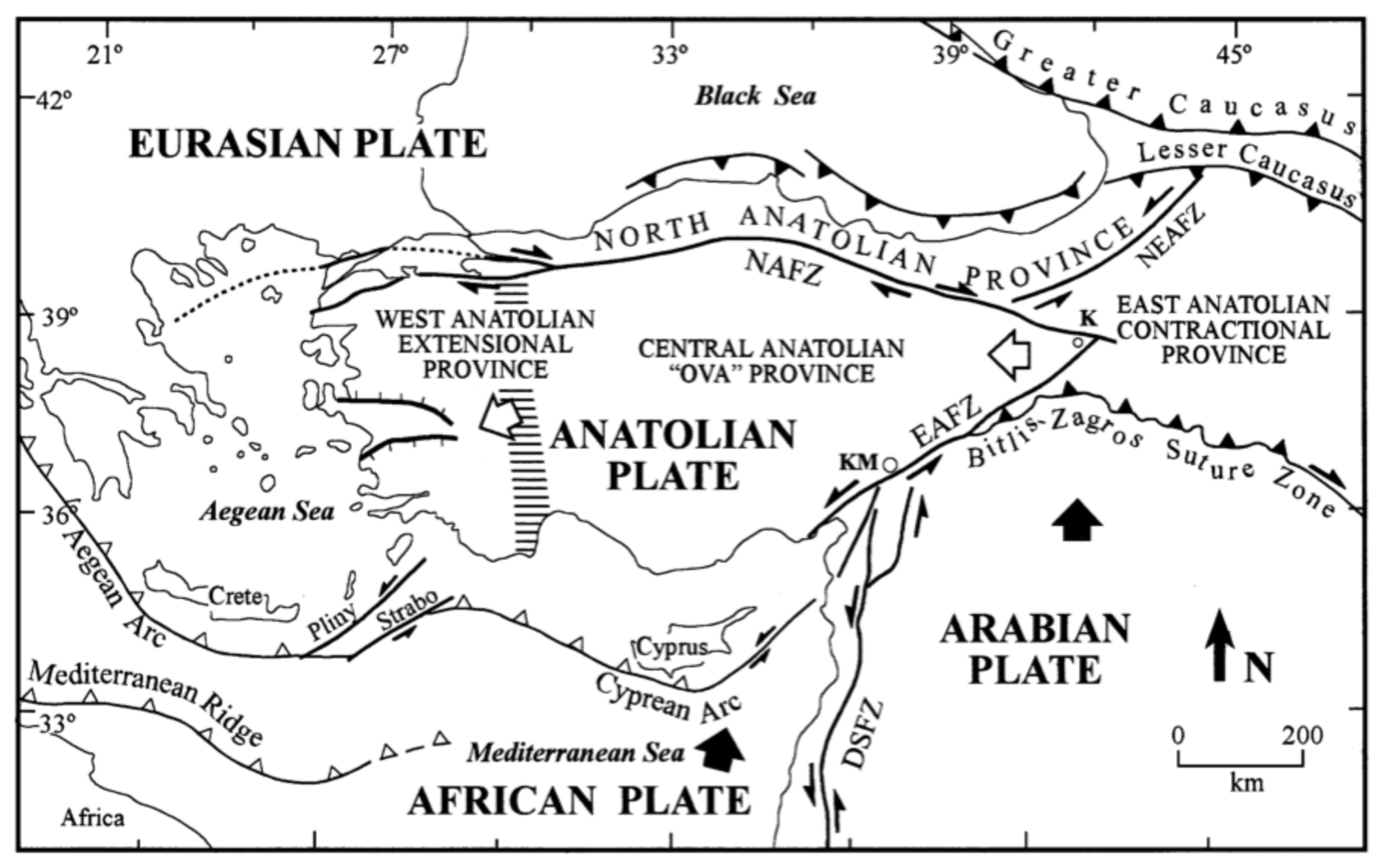
As you will see in this posting, the geology behind the recent earthquake in Turkey and Syria is rather complex although not surprising given that the area is prone to tectonic activity given its location where tectonic plates collide.


Here are two maps showing the basic geological setting of Turkey:


Here is a map which provides more detailed geological information:


Notice the two major faults labelled NAFZ and EAFZ which are located inside the borders of Turkey; the North Anatolian Fault Zone and the East Anatolian Fault Zone.  These two faults are strike-slip or transform faults which connect tectonic plates that are moving in opposite directions; in this case, the Arabian Plate, the Anatolian Plate and the Eurasian Plate.  Movement along the faults is horizontal as shown on this very basic block diagram:


As the plates try to slide past each other, energy builds up as a result of the horizontal shearing motion which is locked as a result of the friction between the plates.  This friction suddenly suddenly releases and results in an earthquake.  Earthquakes associated with transform faults are often shallow and have large lateral displacement.


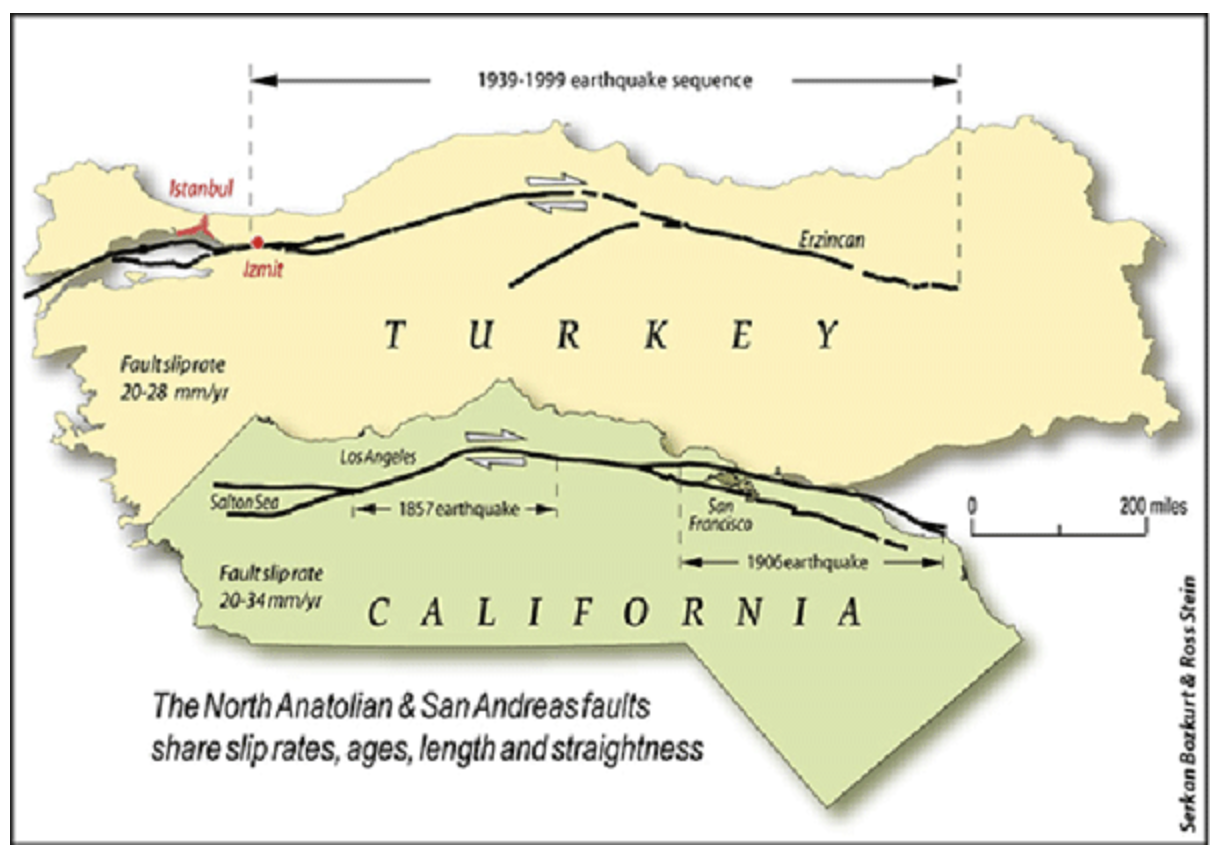
This is the same scenario as the San Andreas Fault in California, in fact, the two faults which are located along a continental margin (Pacific Ocean and Black Sea) are very similar in length as shown on this diagram:


In August 1999, movement along the North Anatolian fault (a right-lateral transform/strike-slip fault) resulted in the 7.4 magnitude Izmir earthquake and the deaths of 17,000 people and destroyed the homes of more than 250,000 people. The main earthquake was followed by a magnitude 7.2 earthquake in November 1999 which resulted in an additional 845 deaths.


The 2023 earthquake series is located along the East Anatolian Fault (a left-lateral transform/strike-slip fault).  Here is a more detailed map of the East Anatolian Fault Zone (EAFZ) which runs roughly northeast-southwest through the map area:


The East Anatolian Fault forms the boundary between the Anatolian Plate (located under most of Turkey) and the Arabian Plate.  As the Arabian Plate moves northward, it is squeezing out the Anatolian Plate which is colliding with the Eurasian Plate to the north as shown on these two diagrams:


The East Anatolian Fault Zone has a long history of earthquake activity as shown on this map from a study which analyzed the earthquake hazard for the fault zone:


This 2015 analysis calculated that there was a 90 percent probability of an earthquake with a magnitude of more than 6.0 in the next 43 years.


Let's close this posting with this map from the United States Geological Survey showing the earthquake activity (magnitude greater than 2.5) over the past day:


So far, there have been 76 earthquakes in the immediate area with the four largest as follows:


The largest earthquake, a 7.8 magnitude temblor, struck near Gaziantep at a depth of 18 kilometres followed 15 minutes later by a 6.7 magnitude quake near the site of the first event. There have been an additional 13 earthquakes/aftershocks with a magnitude of 5.0 or greater. 


I hope that this information helps you to better understand the geology behind the February 2023 earthquake in Eastern Turkey.


Wednesday, September 12, 2018

Syrian Self-Determination and the Final Push of the Civil War

While the United States may protest, the three main powers in the Syrian conflict recently released a joint statement on the future of the Syrian Arab Republic following their summit in Tehran.  Here is a summary of the full text of the summit as agreed up by Iran's President Hassan Rouhani, Russia's President Vladimir Putin and Turkey's President Recep Tayyip Erdogan which you can find here:

"Emphasized their strong and continued commitment to the sovereignty, independence, unity and territorial integrity of the Syrian Arab Republic as well as to the purposes and principles of the UN Charter and highlighted that they should be respected by all. They reiterated that no actions, no matter by whom they were undertaken, should undermine these principles. They rejected all attempts to create new realities on the ground under the pretext of combating terrorism and expressed their determination to stand against separatist agendas aimed at undermining the sovereignty and territorial integrity of Syria as well as the national security of neighboring countries. 

Reaffirmed their determination to continue cooperation in order to ultimately eliminate DAESH/ISIL, Al-Nusra Front and all other individuals, groups, undertakings and entities associated with Al-Qaeda or DAESH/ISIL, as they have been designated as terrorists by the UN Security Council. They underlined that, in the fight against terrorism, separation between the above-mentioned terrorist groups and the armed opposition groups that had joined or would join the ceasefire regime, would be of utmost importance including with respect to preventing civilian casualties. 

Reaffirmed their conviction that there could be no military solution to the Syrian conflict and that it could only end through a negotiated political process. They reaffirmed their determination to continue active cooperation with a view to advancing the political process in consistence with the decisions of the Syrian National Dialogue Congress in Sochi and the UN Security Council Resolution 2254. 

Reaffirmed their resolve to continue joint efforts aimed at advancing the Syrian-led and Syrian-owned process for reaching a political settlement and reiterated their commitment to help establish and launch the work of the Constitutional Committee. They expressed their satisfaction with the useful consultations between their senior officials and the United Nations Secretary General’s Special Envoy for Syria. 

Emphasized the need to support all efforts to help all Syrians restore their normal and peaceful life and to alleviate their sufferings. In this regard, they called upon the international community, particularly the United Nations and its humanitarian agencies, to increase their assistance to Syria by providing additional humanitarian aid, facilitating humanitarian mine action, restoring basic infrastructure assets, including social and economic facilities, and preserving historical heritage. 

Highlighted the need to create conditions for the safe and voluntary return of refugees and internally displaced persons (IDPs) to their original places of residence in Syria. To this end, they emphasized the necessity of coordination among all relevant parties, including the Office of the United Nations High Commissioner for Refugees (UNHCR) and other specialized international agencies." (all bolds mine)

There is an strong underlying theme of Syrian self-determination.  According to the joint statement, Syrians will retain their sovereignty and it will be Syrians that negotiate the ultimate process for reaching a political settlement.  This is obviously not going to sit well with the Americans who have now spread themselves over a brand area in northern Syria as shown on this map from Turkey's Andalou Agency:


Coincidentally (or perhaps not), some of these bases are immediately adjacent to Syria's oil producing region as shown on this map:


In mid-2017, approximately thirty to thirty-five thousand barrels of oil were being produced on a daily basis from nearly 350 oil wells controlled by the Kurds (PKK/PYD) and the Assad government.

What is even more concerning is the expansion of Russia's military might opposite U.S. military positions as shown on this map from Debka:


According to Debka, these four bases are being reconstructed and adapted for use by the Russian Air Force:

1.) The Tiyas Military Airbase (also known as T-4) in the Homs Governorate west of Palmyra, is the largest in Syria. The Russians are massively converting it into their main center of aerial operations in central Syria. Tyas will also provide backup as needed for Khmeimim, if drone, missile and mortar attacks recur.

2.) Palmyra (or Tadmor) Airport provides air support for operations in eastern Syria including the Deir ez-Zour province. Moscow has agreed to share it with Iran. The Revolutionary Guards Al Qods chief Gen. Qassem Soleimani is planning to make Palmyra the main assembly center for the transfer of pro-Iranian Iraqi Shiite militias from southern Iraq to Syria.

3.) From Hama Military Airport west of Hama, the Russians will exercise control from the air of central Syria and the northern and central highways to Damascus. Still more importantly, this airport’s location places it just 125km as the crow flies (173km by road) from Russia’s Tartus naval base on the Mediterranean coast.

4.) Shayrat, at Homs (which became notorious as the target of a massive US Tomahawk attack last year) is the main landing site for air transports which bring the Russian and Iranian forces troop reinforcements, weapons and spare parts.

As Russia and Syrian pro-government forces join to clean up Idlib, what is concerning about the current activities is the unthinkable scenario where Russians accidentally target American forces or Americans accidentally target Russian forces.  With the two sides occupying a relatively small battlefield, any errors that lead to multiple military deaths could feed the fires of the new Cold War.  While the Russians, Turks and Iranians have proposed a Syrian-driven agenda for the post-civil war Syria, the geopolitical repercussions of a battlefield error could put a sudden end to those plans, leaving millions of Syrian civilians in even deeper jeopardy than they already are.

Wednesday, September 5, 2018

The Next Steps in Syria - Establishing No-Fly Zones

With the conflict in Syria back in the 24 hour news cycle, a brief look at what could lie ahead for Syrians is in order, particularly given that it looks like Bashar al-Assad is not relinquishing power any time soon, a scenario that is unpalatable to both Israel and the United States.

The Syrian American Council (SAC) is a Washington-based 501(c)3 grassroots organization which was founded in 2005 and has the following mission:


SAC's role is to advocate on Syria's behalf with the United States government including presidents, Secretaries of State and both Congressional bodies.  SAC also released a research paper entitled "The Syrian Crisis: A Plan of Action"  in which it outlined steps that Washington could take to achieve a peaceful resolution to the civil war.  In that paper, SAC outlined why continued inaction by the United States was untenable as shown here:

"1.) The rapidly deteriorating humanitarian and political situations threaten to destabilize the Middle East, without mentioning its staggering cost in terms of lives ended or uprooted by the conflict.

2.) Permitting Iran, Assad, and Hezbollah to wage war against the people of Syria strengthens Iran, while defeating Assad and Hezbollah will deal Iran a severe blow.

3.) Defeating Hezbollah will decrease significant threats to America’s regional allies. It will also prove to Iran that the U.S. will not permit it to act freely throughout the region.

4.) Allowing Syria to continue down the path to state failure risks the country becoming a base for extremists and a launching pad for attacks against U.S. allies and assets throughout the region.

5.) America’s allies increasing frustration with U.S. inaction risks straining strategic relationships with them and prevents the U.S. from building similar relationships with the future leaders of Syria.

6.) A negotiated political settlement is ideal, but Assad remains unwilling to negotiate in good faith. Insufficient or weak action by the U.S and the international community will not pressure him to change his calculation.

7.) Permitting the crisis to escalate risks a major sectarian conflagration, turning Syria into a Jihadi battleground.

8.) Any conceivable outcome of an unaided revolution will produce a Syria indifferent or even hostile to U.S. interests, rather than a key geostrategic partner grateful that a helping hand was extended in its time of need."

SAC did have one solution of interest; the establishment of a no-fly zone, a tactic that was used by the United States in Iraq between the first and second Iraqi wars as a means to control Saddam Hussein.  It was also tactic used in Libya in 2011 as shown in this excerpt from a United Nations press release:

"Demanding an immediate ceasefire in Libya, including an end to the current attacks against civilians, which it said might constitute “crimes against humanity”, the Security Council this evening imposed a ban on all flights in the country’s airspace — a no-fly zone — and tightened sanctions on the Qadhafi regime and its supporters.

Adopting resolution 1973 (2011) by a vote of 10 in favour to none against, with 5 abstentions (Brazil, China, Germany, India, Russian Federation), the Council authorized Member States, acting nationally or through regional organizations or arrangements, to take all necessary measures to protect civilians under threat of attack in the country, including Benghazi, while excluding a foreign occupation force of any form on any part of Libyan territory — requesting them to immediately inform the Secretary-General of such measures.

Recognizing the important role of the League of Arab States in the maintenance of international peace and security in the region, and bearing in mind the United Nations Charter’s Chapter VIII, the Council asked the League’s member States to cooperate with other Member States in implementing the no-fly zone."

According to SAC, since October 2011, pro-democracy Syrians have sent a clear message to the world that no-fly zones are essential for the following reasons:

"1.) Regime air raids are the main killers of civilians in Syria.

Human Rights Watch director Kenneth Roth stated in August that barrel bombs "pose the greatest threat to Syrian civilians." According to Syrian Network for Human Rights, Assad is behind over 75% of civilian deaths since 2014.

Russian warplanes are even worse than Assad's. They regularly target hospitals, schools, bakeries, and markets with airstrikes that kill dozens of civilians. Russian warplanes also drop thermite, napalm, cluster bombs, and other internationally-banned weapons onto civilian areas.

2.) Regime air raids are largely responsible for the current displacement crisis.

New York Times reported that when the regime started barrel-bombing Aleppo heavily in early 2014, some 500,000 Syrian civilians left Aleppo within a month.

Human Rights Watch satellites in February 2015 picked up 1,000 distinct damage sites "strongly consistent with the detonation of large, air-dropped munitions," in Aleppo. There were also 450 such sites in Deraa. Barrel bombs have rendered much of Syria unlivable.

Russia in particular has sought to target facilities that sustain the civilian population in opposition-held areas. On August 16, a Russian air raid destroyed the only hospital serving 400,000 people. Previous air raids have left 1.4 million people without clean water."

 SAC claims that a no-fly zone would protect Syrian civilians and would allow displaced persons to gather in a safe zone rather than leaving Syria for Europe and would allow moderate rebels to attack ISIS without fear of air raid.

SAC notes that Russia's presence in the civil war (as an invited guest of Assad) does not "scuttle chances for a safe zone" for the following reasons:

"1.) If Russia violates the zone, the U.S. can bomb regime airfields when no Russian planes are present. This does not target Russia, but still greatly complicates future Russian bombing raids.

2.) Without shooting down Russian planes, the U.S. can also deter Russian violations of a zone through electronic warfare that forces Russian pilots to "fly blind."

3.) Even if Russia provides the regime more advanced anti-aircraft system, the U.S. can still enforce safe zones with PATRIOT missile batteries in Turkey and Jordan."

Somehow, I cannot see Russia standing by while the Syrian airfields used by its Air Force are bombed into uselessness, its pilots are blinded and the United States defends the no-fly zone with PATRIOT missiles located in other nations.

According to a recent article by Martin Berger in the New Eastern Outlook, the United States is already setting up a no-fly zone through the installation of radar stations throughout certain parts of Syria.  In late August, a radar installation was set up at the al-Shaddadi base, the United States base which is being constructed up in south Hasakah province as shown on this satellite image:


Coincidentally (or not), the alleged base with its eight helicopter landing pads is located in an area bordering the Ramilan and al-Shaddadi oil fields.  

In late August, the United States also set up advanced radar systems just south of the Syria/Turkey border with the alleged purpose of setting up no-fly zones to protect areas of Syria that are controlled by the YPJ/YPG, the armed wing of the Kurdish Democratic Union Party (PYD) (YPJ - Women's Defense Unit and YPG - People's Protection Unit (male)).  It is key to note that Turkey's President Erdogan has stated that it is Turkey's policy to exterminate the PYD since it is viewed by the Turkish government as a terrorist organization.  Here is a map from Syria Live showing the position of the new advanced radar systems within a few kilometres of the Turkey/Syria border:


If you click here, you can see a brief video on the setting up of the "Rojava Resistance" by United States forces. 

As you can imagine, there is also a geopolitical complexity to the setting up of a potential no-fly zone this close to the Turkish border; given that both Turkey and the YPJ/YPG are allies of the United States, one has to wonder what the eventual outcome will be when Turkey realizes that they are the party being watched while the United States acts to protect one of its avowed enemies and America's friends in the region.

Let's close with this brief quote from Martin Berger's article:

"Once a no-fly zone in Syria is declared, this step can followed by high precision weapons being used by the US-led coalition to destroy Syrian airfields, leaving Syrian armed forces without close air support. Should this plan come to fruition, any plane entering the no-fly zone will be detected and destroyed. Back in 2011, Washington was following the same exact path in Libya, first rendering Libyan airfield useless, before destroying radar installations and launch pads that could still prevent strikes on Libyan military facilities."

At this point, the United States is clearly acting outside of the United Nations as it sets up a radar network in the first steps in the establishment of no-fly zones in Syria.  Given that approval of the United Nations Security Council is required to take actions in a sovereign nation, it is becoming increasingly clear that Washington may be doing whatever it wants in Syria.  That should make the Syrian American Council happy but I can't imagine that either Turkey or Russia will be pleased.

Monday, January 25, 2016

The Biggest Threats to World Peace

Let's start with this video from RT showing an interview with Virginia state Senator Richard Black (R):


Search "Richard Black" and "Saudi Arabia" on Google and you'll find that no mainstream media outlet in the United States or Europe covered this interview.

Here's what he said:

"I believe that Saudi Arabia and Turkey are the two greatest dangers to world peace.  It is Saudi Arabia, through the Wahhabist doctrine, that is spreading terrorism across the globe. It’s not Iran, it’s not Syria it's not any other country, it emirates from Saudi Arabia.  Now, Turkey on the other hand, being led by President Erdogan.  Erdogan has a dream of becoming the new Ottoman Empire.  He wants to be the head of the Ottoman Empire.  He’s a very calculating, very vicious individual and, I think, a great danger. Erdogan won an absolute majority of the Turkish parliament, which will enable him to rewrite the constitution. Once he had that total power to impose an absolute dictatorship – which he intends to do – and he publicly said that his model is Adolph Hitler.  He envisions a government where his powers will be similar to those exercised by Adolph Hitler.

The United States has been so in bed with the Saudi Arabians for so long.  The Bush family, Herbert Walker Bush, George Bush, Jeb Bush, all of them are closely tied with the Saudi Royal Family, the dictatorship of Saudi Arabia.  The same thing with the Clintons; Bill Clinton, Hillary Clinton are very closely tied to the money from Saudi Arabia and because of that, Saudi Arabia is able to do the most outrageous things.  We tend to condemn various secular nations in the Mid East because they don't do this quite right or that quite right and yet we overlook the absolute barbarity of the Saudi Kingdom..." (my bold)

Richard Black was elected to the Virginia Senate in 2011.  He was born in Maryland and joined the Marines in 1963, rising to the level of Colonel.  He flew 269 combat missions in Vietnam and received the Purple Heart for wounds received in battle.  He earned a law degree in 1976 and accepted a commission as a Major in the U.S. Judge Advocate General's Corps.  After heading the Army's Criminal Law Division at the Pentagon, he retired from military service in 1994, becoming a partner in the law firm Taylor, Horbaly and Black.    

In case you hadn't had enough of Senator Black's commentary on the current situation in the Middle East, additional commentary can be found on the Syrian Arab News Agency (SANA) website.  In this article, SANA quotes a letter from November 2015 that was sent by Senator Black to Syria's President Bashar al-Assad.  Here is the text of the letter:

"Bashar al Assad President of Syria, Damascus, Syria.

Dear Mr. President:

I was pleased by the Russians' intervention against the armies invading Syria. With their support, the Syrian army has made dramatic strides against the terrorists.

I was delighted by Syria's resounding victory over ISIS at the Kuwairis Airfield. My compliments to those who heroically rescued 1,000 brave Syrian soldiers from certain death. I am convinced that many such victories lie ahead.

The Syrian War was not caused by domestic unrest. It was an unlawful war of aggression by foreign powers determined to force a puppet regime on Syria. General Wesley Clark, former Supreme Allied Commander Europe, revealed that by 2001, Western powers had developed plans to overthrow Syria. Yet after fifteen years of military subversion, NATO, Saudi Arabia and Qatar still cannot identify a single rebel leader who enjoys popular support among the Syrian people.

Foreign powers have no right to overturn legitimate elections and impose their will on the Syrian people. Syrians alone must determine their destiny, free of foreign intervention. I am disappointed that the UN has turned a blind eye to the unlawful interference in Syria's internal affairs.

Before the war began, Syrians had the greatest religious freedom and women's equality of any Arab people. Many Americans are surprised to learn that the Syrian Constitution provides for free elections, religious freedom, women's rights, and the Rule of Law. Before criticizing Syria, the U.S. might first insist that our allies Jordan, Saudi Arabia, Qatar, UAE and Kuwait grant similar freedoms to their own people.

I am disappointed that the U.S. has countered Russian assistance to Syria by forwarding shipments of TOW anti-tank missiles to the terrorists. This will only prolong bloodshed in Syria. And supplying weapons to "good terrorists" while denying them to "bad terrorists" is a fools game. The reckless dissemination of TOW missiles threatens worldwide civil aviation. Long-range anti-tank weapons can easily be targeted to destroy passenger jets taxiing for takeoff. As a Virginia Senator, I am concerned that such missiles might find their way to remote areas adjacent to Reagan National Airport, Dulles International Airport and others. I have corresponded with the United States President about these concerns.

Today, the Army of Conquest receives extensive U.S. military support. The Army of Conquest is formed around al Nusra, which has sworn allegiance to al Qaeda. This means that the U.S. supplies weapons to the same terrorists who murdered 3,000 Americans on 9-11. This is an obscene betrayal of the victims of 9-11.

People have begun realizing that the Syrian terrorists are militarily supported by our allies, Turkey, Saudi Arabia, and Qatar. Indeed, ISIS has no more loyal backer than Turkey, which serves as its main conduit for jihadists, weapons, medical support and trade. Although Turkey is included in the Coalition against ISIS, it has contributed nothing of significance toward the Coalition's lackluster performance.

It is apparent that the objective of the Turks and Saudis is to impose a murderous theocratic dictatorship on the Syrian people. If they succeed, Christians and other minorities will be slaughtered or sold into slavery. Many good-hearted Sunni and Shia Muslims will also be burned, drowned, crucified and beheaded.

But world opinion is turning against the terrorists and their supporters. The cruel mistreatment of captured Syrian soldiers by terrorists groups is appalling. Many Americans find the behavior of these so-called "moderates" morally abhorrent.

I bled, fighting to defend this nation's honor. I will oppose American support for terrorists, like the Army of Conquest and ISIS that threaten Syria. Many Virginians join in praying that the Syrian Arab Army and its allies will triumph over the forces of evil, and that peace will soon return to Syria.

Thank you for protecting the lives of Christians and of all good people of Syria.

Sincerely, Richard H. Black Senator of Virginia, 13th District."


Senator Black's candid views on Saudi Arabia and Turkey are well outside the norm for American politicians, or at least what they tell the mainstream media.