Showing posts with label election interference. Show all posts

Monday, March 13, 2023

The Trudeau Liberals - Manipulating China

For my readers who are Canadian or who have been paying attention to news from Canada, recent mainstream media coverage regarding alleged Chinese interference in Canada's 2019 and 2021 have been non-stop since mid-February 2023 as shown here:


This is not the first time that such allegations have appeared in Canada's mainstream media which has been bought and paid for by the Trudeau government/Canadian taxpayers as shown here:


...and here:


Not surprisingly, Justin Trudeau and his jolly band of clapping Liberal seals have insisted that the Chinese government's interference campaign did not impact the overall integrity of the 2019 and 2021 elections.  Why would they lend any credence to the possibility of successful electoral interference given that it appears that Liberal candidates were the ones who benefited from China's largesse.


What the Canadian mainstream media seems to have forgotten is this story that appeared in the South China Morning Post (SCMP) back in July 2019:


Let's put the following comments from the SCMP article into context.  These comments by Canada's former Ambassador to China were made after Huawei Technologies Chief Financial Officer Megan Wenzhou was arrested in Vancouver, British Columbia on December 1, 2018 at the behest of the United States government and that, in response, China had detained two Canadians, Michael Spavor and Michael Kovrig, facing charges of spying on national secrets and providing state secrets to entities.  Both men were finally released on September 24, 2021 in response to the suspension of charges and withdrawal of the American extradition request against Meng Wenzhou after she agreed to enter into a deferred prosecution agreement.


Here are some compelling quotes from Canada's former Ambassador to China, John McCallum, a former Liberal MP who served in Liberal governments from November 2000 to January 2017 under Prime Minister's Jean Chretien, Paul Martin and Justin Trudeau as Minister of National Defense, Veterans' Affairs, National Revenue and Immigration Refugees and Citizenship:


"Canada’s former ambassador to China, sacked because of remarks he made in the wake of Huawei’s high-profile extradition case, said he has warned former contacts at China’s Ministry of Foreign Affairs that any further “punishments” imposed on Canada’s exports could lead to a change of government that is unfavourable to Beijing.


“Anything that is more negative against Canada will help the Conservatives, [who] are much less friendly to China than the Liberals,” John McCallum, a veteran Liberal Party member, told the South China Morning Post in an interview in Hong Kong on Monday.


“I hope and I don’t see any reason why things will get worse, it would be nice if things will get better between now and [Canada’s federal] election [in October].”"


Basically, Justin Trudeau's former Ambassador to China made it very, very clear to China that any moves that appeared to cause negative issues for Canada's Liberal government would essentially lend support to Canada's Conservatives who would not be as friendly to China's Communist government as the Trudeau Liberals had been.  By supporting Trudeau and his merry band of Liberal MPs, China could assure itself that Canada would remain a friendly partner.  While McCallum didn't come right out and say that financial support would be most welcome, as we all know, political parties thrive on financial donations.  It's all part of political pay for play ecosystem that exists in today's world.


Could you imagine if this had scenario had occurred during Stephen Harper's time as Canada's Prime Minister?  Or during Donald Trump's tenure as the President of the United States, in this case, substituting Russia for China?


Wednesday, September 16, 2020

Protecting the 2020 Election - The Role of America's Technoplutocracy

Since the 2016 election, Americans have been subjected to a repeated diet of electoral interference by "outside bad actors", suggesting that significant steps need to be taken to control the spread of false information and narratives during the 2020 presidential election in particular.  While it receives almost no attention from the mainstream media, 


Let's open by looking at a quote from Chad Wolf, Acting Secretary for the Department of Homeland Security, during his September 2020 State of the Homeland address:


"We are identifying and preventing malign foreign actors and nation states from interfering in our elections and protecting our election infrastructure....


Our newest component – the Cybersecurity and Infrastructure Security Agency  (or CISA) – is at the forefront guarding against nation-state actors’ cyber-enabled espionage and malicious influence activity aimed at all levels of government and industry.


As we approach the 2020 election, we remain steadfast in protecting this essential American process. 


CISA has doubled down both on their efforts across the federal government and in partnering with local election leaders across the country to make sure our elections are safe and secure.


Elections are a bedrock of our Constitutional republic, and securing them is paramount to accurately expressing the will of the American people.


To protect the integrity of our representative government, our ultimate goal must be to ensure that American voters decide American elections.


In light of new levels of organized efforts by Russia in 2016 to disrupt and deceive, the Department strengthened U.S. efforts to rebuff the aggressive and meddlesome behavior of any nefarious state actor.


Signed into law by President Trump, CISA has made extraordinary and rapid strides bolstering the security of this most sacred democratic process.


CISA leveraged unique cybersecurity technical services by funding the Election Infrastructure Information Sharing and Analysis Center (or EI-ISAC) that deploys and monitors intrusion detection systems on election infrastructure across all 50 states.


The results were historic - 2018 was the most secure election in the modern era.


Not resting on its laurels, CISA has only increased its protection in scope and impact as it pursues the goal of an ever-more secure election in 2020."


Let's take a closer look at EI-ISAC, the Department of Homeland Security's frontline shield against electoral interference in the United States.  Here is the front page of EI-ISAC's website as found on the Center for Internet Security website (noting that CIS is the operator of EI-ISAC):


According to CIS, EI-ISAC is "supporting the rapidly changing cybersecurity needs of U.S. elections offices."


EI-ISAC provides the following cybersecurity tools and training resources to "help elections officials protect their systems and data":


Joining EI-ISAC is free for U.S. elections organizations as shown here:


Now, let's look at one of the products being used by EI-ISAC to protect American elections.  Here is the lead page of Protect Your Elections website:


Here is an introductory video about Protect Your Elections: 


Here is how Protect Your Election can help with the election process:


Here are the tools that Protect Your Election offers to protect the electoral process against digital attacks:


Most importantly in this age of censorship, here is how Protect Your Election can prevent the spread of false narratives and information during elections:


If you read carefully through the screen captures, you may have noticed this:


That's right, America's technoplutocracy is hard at work, protecting your election!


With the above information in mind, let's close this posting with some key information from Open Secrets.  Here are the 2020 and previous elections campaign contributions from affiliates of Alphabet Inc. (i.e. Google), noting that organization themselves cannot contribute to candidates and party committees:


Here is a further breakdown of how these funds were designated by political party:


As shown here, the top 25 recipients of these campaign contributions are all Democrats:


By way of comparison, the top Republican recipient, Donald Trump, has received a rather measly $29,021.  Given this donation information, do you really think that Protect Your Election is really going to provide a balanced product, particularly when it comes to fact-checking?


While companies like Google and its technoplutocracy sector peers are publicly stating that they are in the business of protecting America's democracy from the hostile disinformation tactics being used by America's enemies for the benefit of the sweaty masses, I think that we can pretty much assume that at least some of the most influential players are in it, to win it for their chosen party, the Democrats.  At the very least, we should make the assumption that products that are being touted by the technology tyrants to protect democracy are highly vulnerable to political bias.


Tuesday, July 23, 2019

Vladimir Putin's Observations on America's Democracy and Russia's Electoral Interference

Updated October 2019

The Kremlin recently published the transcript of an interview with American film producer and director Oliver Stone that took place on June 19, 2019.  In this interview, President Putin provides us with insight into Washington's narrative that Russia interfered with the 2016 presidential election.  One of his comments is particularly pertinent as you will see.

Here is the initial part of the exchange about the allegations of electoral interference in 2016 which may surprise you:

"Oliver Stone: Yes. So recently, you know Russia has been obviously accused and accused over and over again of interference in the 2016 election. As far as I know there is no proof, it has not turned up. But now in the US there has been an investigation going on about Ukraine’s interference in the election. It seems that it was a very confusing situation, and Poroshenko seems to have been very strongly pro-Clinton, anti-Trump.

Vladimir Putin: Yes, this is no secret.

Oliver Stone: Do you think there was interference?

Vladimir Putin: I do not think that this could be interpreted as interference by Ukraine. But it is perfectly obvious that Ukrainian oligarchs gave money to Trump’s opponents. I do not know whether they did this by themselves or with the knowledge of the authorities.

Oliver Stone: Where they giving information to the Clinton campaign?

Vladimir Putin: I do not know. I am being honest. I will not speak about what I do not know. I have enough problems of my own. They assumed Mrs Clinton would win and did everything to show loyalty to the future US administration. That is nothing special. They wanted the future President to have a good opinion of them. This is why they allowed themselves to make unflattering statements about Trump and supported the Democrats in every possible way. This is no secret at all. They acted almost in public.

Oliver Stone: You do not want to go any further on that because you do not have any information?

Vladimir Putin: You know, this would be inappropriate on my part. If I said something more specific, I would have to put some documents, some papers on the table." (my bolds)

If you want to read more about the emerging story of alleged collusion between Ukrainians and the Clinton campaign and the connections between the Biden family and Ukraine please click here and here.

Here is an exchange about why Donald Trump won the 2016 election, why Russia preferred Donald Trump to Hillary Clinton and the internal electoral interference that takes place:

"Vladimir Putin: ... If you want to return to US elections again – look, it is a huge country, a huge nation with its own problems, with its own views on what is good and what is bad, and with an understanding that in the past few years, say ten years, nothing has changed for the better for the middle class despite the enormous growth of prosperity for the ruling class and the wealthy. This is a fact that Trump’s election team understood. He understood this himself and made the most of it.

No matter what our bloggers – or whoever’s job it is to comment on the internet – might say about the situation in the US, this could not have played a decisive role. It is sheer nonsense. But our sympathies were with him because he said he wanted to restore normal relations with Russia. What is bad about that? Of course, we can only welcome this position.

Oliver Stone: Apparently, it excited the Clinton people a lot. The Clinton campaign accumulated the “Steele dossier.” They paid for it. It came from strange sources, the whole “Steele dossier” issue. Some of it comes from Ukraine. They also went out of their way, it seems to me, with the CIA, with Mr Brennan, John Brennan, and with Clapper, James Clapper, and Comey of the FBI. They all seem to have gotten involved, all intelligence agencies, in an anti-Trump way.

Vladimir Putin: They (the Clinton campaign) had levers inside the government, but there is nothing like that here. They applied administrative pressure. It always gives an advantage in countries such as the USA, some countries of Western Europe, about 2 percent on average, at a minimum.

Oliver Stone: Two percent? What are you talking about?

Vladimir Putin: Yes. According to experts, those with administrative pressure (i.e. the incumbent) they can apply always have a 2 percent edge (in an election). You can look at it differently. Some experts believe that in different countries, it can vary, but in countries such as the United States, some European countries, the advantage is 2 percent. This is what experts say, they can be wrong.

Oliver Stone: I do not know. I heard of the one percent, but it seems to get more like 12 percent.

Vladimir Putin: That is possible, depending on how it is used." (my bolds)

This observation by President Putin is quite interesting.  Here is a quote from Lumen Learning about the advantages of incumbency by members of Congress:

"Incumbents have structural advantages over challengers during elections. The percentage of incumbents who win reelection after seeking it in the U.S. House of Representatives has been over 80% for more than 50 years, and is often over 90%."

Here is a quote from a paper on the advantages of incumbency by James Druckman et al:

"Competition is fundamental to democracy – it ensures choice for citizens and facilitates electoral accountability. Substantial scholarship shows how institutions, particularly electoral systems, influence the nature of competition and can, at times, privilege certain office-seekers. One widely discussed manifestation concerns the “incumbency advantage” in United States congressional elections. This refers to the electoral benefit a candidate receives simply due to being an incumbent (holding all else constant), which is in the range of nearly 8% of votes. It derives, in part, from the incumbent’s personal experience in office, familiarity (i.e., ties to the district), and the provision of benefits for the district (e.g., casework, pork-barrel projects)."

There is no doubt that, during the 2016 election, the Clinton campaign had significant inside resources in Washington that stemmed from Bill Clinton's presidency and Hillary Clinton's term as Secretary of State that gave her an "administrative advantage".

In this part of the interview, Vladimir Putin discusses a very rarely discussed but key aspect of the 2016 election that is rarely discussed:

"Oliver Stone: Well, you are not disagreeing. You are saying that it was quite possible that there was an attempt to prevent Donald Trump from coming into office with a soft, I will call it a soft coup d’état?

Vladimir Putin: In the USA?

Oliver Stone: Yes.

Vladimir Putin: It is still going on.

Oliver Stone: A coup d’état is planned by people who have power inside.

Vladimir Putin: No, I do not mean that. I mean lack of respect for the will of the voters. I think it was unprecedented in the history of the United States.

Oliver Stone: What was unprecedented?

Vladimir Putin: It was the first time the losing side does not want to admit defeat and does not respect the will of the voters."

With that in mind, let's look at one of the key problems with American-style democracy as shown here:


Even going back to the 1960 election, while John F. Kennedy appeared to have a landslide by winning 303 electoral college votes to Richard Nixon's 219, Kennedy only had 34,226,731 votes to Nixon's 34,108,157 for a majority of only 118,574 votes or 0.17 percent of total votes cast.  This is the problem with America's electoral college system.

Let's close this posting with this final quote from President Putin:

"I did not interfere then, I do not want to interfere now, and I am not going to interfere in the future."

Tuesday, June 25, 2019

The National Endowment for Democracy - Supporting America's Democratic Agenda

Washington's non-stop blathering about Russian electoral interference seems to be unending and we can assure ourselves that it will continue ad nauseam as we enter the 2020 presidential election cycle.  While America's political leadership takes great pains to assure American voters that Russia is to blame for America's political woes, it doesn't take much digging to find that Washington is guilty of the same crimes that it is accusing Vladimir Putin of undertaking.

Let's start by looking at a key player in Washington, the National Endowment for Democracy or NED.  NED claims that it is a private, nonprofit foundation "dedicated to the growth and strengthening of democratic institutions around the world."  NED was founded in 1983 as you can see in this announcement from then-President Ronald Reagan:


NED's Statement of Principles and Objectives reads as follows:

"Democracy involves the right of the people freely to determine their own destiny.

The exercise of this right requires a system that guarantees freedom of expression, belief and association, free and competitive elections, respect for the inalienable rights of individuals and minorities, free communications media, and the rule of law."

As I noted above, NED touts itself as a "private" foundation, in other words, it is independent of government. That could not be further from the truth.  Here's what NED has to say about itself that belies its true character:

"NED is a unique institution. The Endowment’s nongovernmental character gives it a flexibility that makes it possible to work in some of the world’s most difficult circumstances, and to respond quickly when there is an opportunity for political change. NED is dedicated to fostering the growth of a wide range of democratic institutions abroad, including political parties, trade unions, free markets and business organizations, as well as the many elements of a vibrant civil society that ensure human rights, an independent media, and the rule of law.

This well-rounded approach responds to the diverse aspects of democracy and has proved both practical and effective throughout NED’s history. Funded largely by the U.S. Congress, the support NED gives to groups abroad sends an important message of solidarity to many democrats who are working for freedom and human rights, often in obscurity and isolation.

The Endowment is guided by the belief that freedom is a universal human aspiration that can be realized through the development of democratic institutions, procedures, and values. Democracy cannot be achieved through a single election and need not be based upon the model of the United States or any other particular country. Rather, it evolves according to the needs and traditions of diverse political cultures. By supporting this process, the Endowment helps strengthen the bond between indigenous democratic movements abroad and the people of the United States — a bond based on a common commitment to representative government and freedom as a way of life.

From its beginning, NED has remained steadfastly bipartisan. Created jointly by Republicans and Democrats, NED is governed by a board balanced between both parties and enjoys Congressional support across the political spectrum. NED operates with a high degree of transparency and accountability reflecting our founders’ belief that democracy promotion overseas should be conducted openly."

For an organization with a "nongovernmental character", it certainly is closely linked to Washington, isn't it?  In fact, NED receives its funding through an annual appropriation from the United States Congress through the department of State.  NED does state that it is NED's independent Board of Directors that controls how the appropriation is spent.  Here is the current board noting that Elliott Abrams, an American diplomat who is now Donald Trump's U.S. Special Representative for Venezuela is currently on leave:


The list reads like a who's who of Washington, doesn't it?  

NED claims that it works as follows:

1.) Helping democrats in closed societies by working with both democrats within the country in question and those in exile.

2.) Consolidating democracy boy strengthening institutions and procedures of electoral democracy to ensure fair elections.

3.) Applying a multi-sectoral approach through its four core institutions which represent America's two political parties, its labour movement and its business community.

4.) Co-operating with other democracy foundations to encourage all established democracies to create organizations that are similar to NED.

5.) Cultivating partner organizations in new democracies who will then share their democratic expertise with democrats in nations that are not currently democratic.

6.) Building a worldwide movement for democracy.

NED funds only organizations that are non-governmental, a rather ironic choice given its own ties to Washington.  Each year, NED makes direct grant to more than 1600 non-governmental groups that are working for democracy in more than 90 nations around the world.  An average grant lasts for 12 months and is around $50,000 in size.

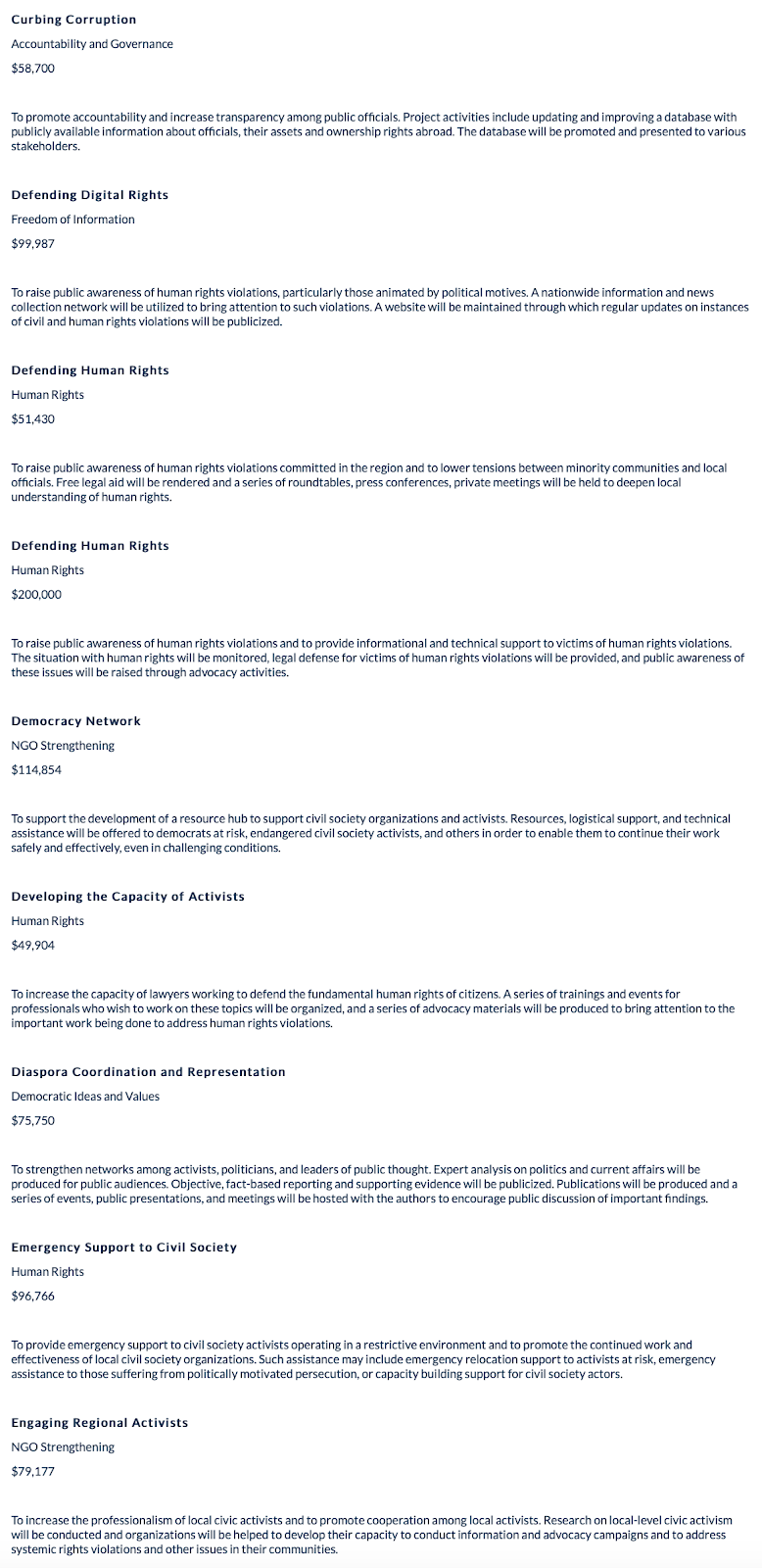
With the Russian 2016 election meddling narrative in mind, let's look at a sample of some of the projects that this so-called "private foundation" undertook in Russia in 2018 and how much was spent on each project:


This is just a small sampling of NED's activities in Russia.  IN case you happen to think that 2018 is a "one off", here is a partial listing of what NED did "for" Russia in 2016, the same year that Washington accuses Russia of meddling in the American electoral system:


In 2016, NED gave 108 grants totalling $6.8 million to influence Russia's political system.

It is very apparent that NED's overt actions in Russia and other nations around the world are very similar in scope and style to the Central Intelligence Agency's covert nation re-engineering operations.  While the spending of taxpayers' dollars by NED is insignificant compared to what is spent on the American intelligence community as a whole, the spending of any amount of money to influence democracy by funding groups that have parallel interests to Washington's agenda in other nations can only be viewed as meddling.

The National Endowment for Democracy - "Supporting Freedom Around the World".  That is, freedom and democracy "American-style".

Thursday, December 13, 2018

Google, Russia and $4700 in Advertising

Just prior to and following the 2016 Presidential Election, the technology sector led us to believe that the Russians had made a massive effort to sway American voters.  Given that the tech sector, particularly Google and Facebook have a business model that relies almost solely on advertising, one would think that state and non-state Russian actors would have spent untold millions of dollars on convincing us not to vote for Hillary Clinton.  Recent testimony on Capitol Hill by Google's Chief Executive Officer Sundar Pichai puts that myth to rest.

Here is a key excerpt from the testimony:

Rep. Jerrold Nadler (D - NY) - Now, according to media reports, Google found evidence that Russian agents spent thousands of dollars to purchase ads on its advertising platforms that span multiple Google products as part of the Russian agents' campaign to interfere in the election two years ago.  Additionally, Juniper Downs, Head of Global Policy for YouTube (a Google product) testified in July that YouTube had identified and shut down multiple channels containing thousands of videos associated with the Russian misinformation campaign.  Does Google now know the full extent to which its on-line platforms were exploited by Russia actors in the election two years ago?

Sundar Pichai - We have - we undertook a very thorough investigation and in 2016 we now know that there were two main ad accounts linked to Russia which, you know, advertised on Google for about $4,700 in advertising.  We also found other limited....

Rep. Jerrold Nadler - A total of $4,700?

Sundar Pichai - That's right.  Which was, you know, no amount is okay here.  But we found limited activity and improper activity.  We have learned a lot from that and we have dramatically increased the productions we have around our election offerings leading up to the current elections.  We again found limited activity from both the Internet Research Agency in Russia as well as accounts linked to Iran.

If you wish to see the exchange for yourself, please forward to the 43 minute mark in this video:


Given Google's global reach, the diversity of its platforms and its power to affect change, it is interesting to see that this company which touts "access and technology for everyone" benefitted from less than $5,000 in spending by Russia-linked accounts.  Keeping in mind that Google/Alphabet has had two years to "navel gaze" and in that time, found that Russian spending on advertising amounted to $4,700 out of $110.885 billion in revenues and $12.662 billion in profits (2017 data), one really has to question the entire notion of Russian interference in the election through the use of social media, particularly when we know this about Alphabet's former leader and his connections to the Clinton campaign of 2016.

Friday, August 17, 2018

Facebook and the Effectiveness of Election Engineering

Since November 8, 2016, we regularly hear the narrative about the Russians hijacking the presidential election through the use of fake news on social media platforms, a process that I am terming "election engineering".  Let's look at some background on election engineering from Facebook first followed by a very interesting case study showing how an election was successfully engineered using social media.

A 2017 study by Hunt Allcott and Matthew Gentzkow entitled "Social Media and Fake News in the 2016 Election" observed that social media users can share news content widely with no significant fact-checking, editorial judgement or third-party filtering.  This is particularly interesting given the following:

1.) 62 percent of U.S. adults get their news from social media

2.) the most popular fake news stories were more widely shared on Facebook than the most popular mainstream media news stories

3.) many people who see fake news satires report that they believe these stories

4.) the most discussed fake news stories tended to favour Donald Trump over Hillary Clinton

A list of fake new websites on which just over half of articles appear to be false received 159 million visits during the month of the 2016 election.

To put fake news into perspective, here is a graphic showing the percentage of Americans that believe a selection of historical partisan conspiracy theories:


Either we are a very gullible bunch of people or there are a lot of things (i.e. overwhelming government secrecy and a general distrust in politicians) that cause us to disbelieve Washington's narrative on a wide range of issues.

According to the New York Times, the bastion of media truthiness, during the 2016 election, Russians turned most often to Facebook to stir up discontent among American voters.  Here is a posting from the New York Times Facebook page regarding Russian financing of an ad linking Hillary Clinton to Satan:


Here's the ad in question:


In September 2017, Facebook disclosed that it had identified more than 3000 advertisements that had been purchased by a Russian company with alleged links to the Kremlin as shown here:


Approximately 470 inauthentic accounts were used with total ad expenditures of approximately $100,000.  In a deeper review which looked at advertising bought from accounts with American IP addresses but with the language set to Russian; in that search, they found roughly $50,000 in potentially politically-related ad spending on approximately 2200 ads.

In fact, Facebook's hunt for Russians continues as shown on this news item from July 31, 2018:


Here is a posting from one of the new fake accounts:


According to Facebook, the parties responsible for the recent fake accounts that are attempting to mold the minds of Americans have become much smarter than the Russian-based Internet Research Agency that was allegedly responsible for at least some of the 2016 election meddling violations.

Now, let's look at the surprising facts behind election engineering and social media, particularly Facebook.  Back in August 2011, a case study entitled "Reaching Voters with Facebook Ads" was released for public consumption.  In this case study, the authors looked at a ballot proposition which was held in Florida in November 2010.  The proposition itself would have seen class sizes in Florida increase.  A campaign sponsored by a group called "Vote NO on 8" focussed on defeating to proposition but had a very small budget and needed to maximize the effectiveness of its marketing to persuade voters to vote no on proposition 8.  Here's a quote from the article showing how the group got their message across to voters prior to the November 2010 election:

"The first goal of the Facebook Ads campaign was to use Facebook as a market research tool to hone the messages identified by a baseline poll specifically for each micro-audience of targeted voters in Florida and for each demographic group. The learnings from this market research would be used across all other media buys. The second goal was to saturate Facebook users in Florida with targeted messages in the month prior to the election. The third, and most important goal, was to measure the impact of the online ad program to assess its viability as a new model for voter persuasion.

Successful political campaigns often depend on repeating their message to voters often and convincingly during the period shortly before the election. Mindful of this trend, the “Vote NO on 8 in Florida” campaign ran for two months starting in September 2010. The month prior to the November election was when the campaign focused the majority of its impressions. Chong & Koster, a media firm specializing in digital communications, used Facebook’s targeting capabilities to serve a variety of ad messages to Floridians by age groups – 18 – 29; 30 – 44; 45 – 54; 55 – 63; 64 and over – separately for both males and females.

The agency relied on Facebook’s Location Targeting to reach people in two of the most populated counties in Florida, Dade and Broward, which have a combined population of 4.2 million. It chose to focus the impressions here because it wanted to be able to benchmark voter results against the rest of the state. “The methodology for using Facebook as a market research tool is really quite simple and incredibly efficient,” says Tyler Davis, Partner at Chong + Koster. “For each target audience identified by the poll, we ran a set of Facebook Ads that split-tested a variety of messages and imagery.

The agency also used Facebook to target people who liked politically oriented Facebook Pages or who listed relevant Likes & Interests or Education & Work. For example, it targeted people who listed terms like “teacher,” “pta” “math teacher” to reach educators. Because both the polling and Facebook research indicated that the issue carries special resonance with parents of school children, it even included interests like “I love my son” and “I love my daughter” (and layered them with demographic targeting.)…

Chong & Koster used Facebook’s real-time feedback capability to test multiple marketing messages with each target group. More importantly, it was able to test which images pair best with each message and audiences, which was essential in scripting the display ads. The agency broke down the response rates for each message and demographic group, and picked the most effective messages for each."

Here are the results of the Facebook political campaign:

1.) There was a 19 percent difference in the way people voted in areas where Facebook Ads ran versus areas where the ads did not run

2.) In the areas where the ads ran, people with the most online ad exposure were 17 percent more likely to vote against the proposition than those with the least

3.) Ad exposure had a greater impact on how voters voted than ideology: audiences exposed to the Facebook Ads outperformed even Democratic base voters

4.) Among people who voted against the proposition, there was a very high recall rate of the messages in the Facebook Ads, reaching as high as 45 percent or more

5.) The ads saw 75 million impressions among people in key geographic areas of Florida, likely resulting in the average Facebook user in the key areas of Florida seeing a targeted ad five times per day

Here's the conclusion:

"Chong & Koster found that achieving such dramatic results was very economical using Facebook. “The beautiful value in this is that we can actually move public opinion intentionally and cheaply. The amount spent on Facebook buys is the amount it would cost to put one mailer in 150,000 voters’ mailboxes,” says Josh Koster, partner at Chong and Koster. “If one-third of the voters read the mailer, that’s equivalent to 50,000 voters for the same amount of money that we used to reach to the two largest counties in Florida at frequency for months.” (my bold)

Isn't it interesting to see that, way back in 2010, Facebook was being used to sway public opinion during an election (in other words, election engineering).  You might ask, where did this study appear?  Here's a link to the case study and here are two screen captures showing the entire case study webpage (just in case Big Brother takes it down):


That's right, the Facebook election influencing case study appears on Facebook's own Government and Politics on Facebook page in a posting dated August 16, 2011.

This begs the question, did Facebook's own case study for election meddling form the basis for Russia's alleged election meddling in 2016?  In both cases, the possibility that social media platforms can be used to engineer elections says a lot about the current state of news literacy in the United States and its not particularly good news.