Showing posts with label universal lockdowns. Show all posts

Wednesday, June 15, 2022

Excess Deaths - The High Cost of America's COVID-19 Lockdowns

While I have pretty much sworn off posting missives on the pandemic, recent research released by the National Bureau of Economic Research (NBER) caught my attention since it clearly outlines the downside of governments' responses to the COVID-19 pandemic.


The paper by Casey B. Mulligan and Robert D. Arnott entitled "Non-Covid Excess Deaths, 2020 - 2021: Collateral Damage of Policy Choices?" opens by noting that the pandemic prompted governments to use extraordinary but untested responses to control the spread of the SARS-CoV-2 virus.  While governments willingly supplied their citizens with daily updates of cases and related COVID-19 deaths, there was little information provided on non-COVID deaths that were a direct consequence of their actions.


As a database, the authors used the online CDC-Wonder tools to tabulate every death certificate filed int he United States.  Each of these death certificates contains the following information:


1.) a single underlying cause of death


2.) up to twenty additional multiple causes of death


3.) demographic data including age


In 2020, a new code (U07.1) was added when COVID-19 was among the causes of death.


The authors looked at nine death cause groups including:


1.) alcohol-induced causes


2.) drug-induced causes


3.) diseases of the circulatory system


4.) diabetes and obesity


5.) homicide


6.) motor vehicle traffic


7.) respiratory


8.) COVID-19


9.) all other causes


The authors did look at cancer deaths but included them with residual causes since cancer deaths were not noticeably higher than normal up to the end of 2021.


Age and cause-group excess deaths were estimated by subtracting predicted deaths and unmeasured COVID-19 deaths from all deaths reported to the CDC.  Each month's deaths are expressed as an annual rate by dividing the number of days in the month and multiplying the result by 365.25.  The estimation period of predicted deaths is from January 1999 to December 2019 inclusive.


Here are the results expressed as annual rates over the period from April 2020 to December 2021 for four age groupings:


1.) Age zero to 17 - no excess non-COVID deaths


2.) Age 18 to 44 - excess non-COVID deaths - 29,000, 26 percent above baseline


3.) Age 45 to 64 - excess non-COVID deaths - 33,000, 25 percent above baseline


4.) Age 65 plus - excess non-COVID deaths - 35,000, 18 percent above baseline


The top causes of excess non-COVID-19 deaths for Americans 18 years of age and older are as follows:


1.) Circulatory diseases - 32,000 deaths or 4 percent excess above baseline


2.) Diabetes or obesity - 15,000 deaths or 10 percent excess above baseline


3.) Drug-induced causes - 12,000 deaths or 13 percent excess above baseline


4.) Alcohol-induced causes - 12,000 deaths or 28 percent excess above bascline


5.) Homicide causes - 5,000 deaths or 27 percent excess above baseline


6.) Traffic accidents - 4,000 deaths or 11 percent excess above baseline


7.) All others - 18,000 deaths or 1 percent excess above baseline


Total excess deaths are 97,000 above previous trends with more than half of excess non-COVID-deaths being among non-elderly adults, particularly caused by drugs, alcohol, homicides and traffic accidents.  Mortality from all causes for Americans aged 18 to 64 years during the pandemic was elevated by 26 percent compared to only 18 percent for Americans aged 65 years and older.


Here is a quote from the conclusions of the working paper with my bolds:


"Summing our estimates across causes and age groups, we estimate 171,000 excess non-Covid deaths through the end of 2021 plus 72,000 unmeasured Covid deaths. The Economist has assembled national-level mortality data from around the world and obtains a similar U.S. estimate, which is 199,000 (including any unmeasured Covid) or about 60 persons per 100,000 population (Global Change Data Lab 2022). For the European Union as a whole, the estimate is near-identical at 64 non-Covid excess deaths per 100K. In contrast, the estimate for Sweden is -33, meaning that non-Covid causes of death were somewhat low during the pandemic...."


While it the causes are currently undetermined, it is interesting to see that Sweden, a nation whose response to the pandemic was far less disruptive than that experienced in just about every other advanced economy, actually experienced lower than normal non-COVID-19 deaths during the pandemic. 


Let's close with this final quote from the authors which nicely summarizes their study, again with my bolds:


"Due to interest in the direct and indirect effects of the pandemic on public health, we express many of our findings in terms of deaths relative to pre-pandemic trends. For two or three cause groups, the previous trends themselves were already alarming, only to be surpassed during the pandemic. Given the pre-pandemic health situation, we find it especially notable that non-Covid health outcomes were not more closely monitored to, among other things, determine whether public or private Covid policies were aggravating them. Critics will likely suggest that the public policy choices did not lead to the large number of non-Covid excess deaths, that these excess deaths were a consequence of personal choices, driven by fear or boredom. We do not disagree that this may be a key driver of excess non-Covid deaths. But, we would point out that this is no excuse for ignoring this soaring death toll, or pushing an examination of these deaths to the back burner."


During the pandemic, governments were laser-focussed on case and death numbers rather than looking at the negative repercussions of their unprecedented and often heavy-handed response to the pandemic.  Even when independent research was showing that their mandates were failing to stem the spread of COVID-19, the ruling class insisted that they were following "the science".  Just ask Canadians how that is working for them and their twice-infected, fully-vaccinated and boosted Prime Minister.  In some cases, medicine is worse than the illness.


Tuesday, November 30, 2021

What Impact Did the Lockdowns Have on American Children and Obesity?

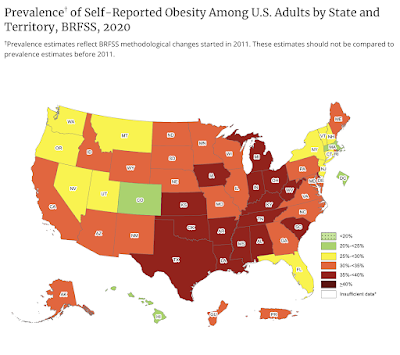
Americans are well known around the world for having a significant issue with obesity as shown on this graphic from the National Institutes for Health:


...and this graphic from the CDC:


...and this graphic which lists national obesity rates by nation:


When it comes to childhood obesity in the United States, we find this:


"For children and adolescents aged 2-19 years in 2017-2018:


The prevalence of obesity was 19.3% and affected about 14.4 million children and adolescents.


Obesity prevalence was 13.4% among 2- to 5-year-olds, 20.3% among 6- to 11-year-olds, and 21.2% among 12- to 19-year-olds. Childhood obesity is also more common among certain populations.


Obesity prevalence was 25.6% among Hispanic children, 24.2% among non-Hispanic Black children, 16.1% among non-Hispanic White children, and 8.7% among non-Hispanic Asian children.


With that background, let's look at the aforementioned research.  We are now well aware of how governments used lockdowns to prevent the spread of the SARS-0CoV-2 virus and the fact that these lockdowns had a significant negative impact on individuals' mental and physical health.  Let's look at a recent study on the CDC website which examines how the body mass index for children was impacted during the pandemic thanks to school closures, household income disruptions which resulted in changes to household food purchases, increased stress, increased screen time and fewer options for physical exercise:


The report opens by explaining the database used in the study.  Data were obtained from IQVIA's Ambulatory Electronic Medical Records database and were used to compare longitudinal trends in body mass index (BMI in kg/m2) among a cohort of 432,302 young Americans between the ages of 2 and 19 years.  Data from the pre-pandemic period from January 1, 2018 to February 29, 2020 was compared to data from March 1, 2020 to November 30, 2020.  To qualify, children had to have at least two BMI measurements including one from prior to the pandemic and one during the pandemic with the pandemic measurement falling after the first three months of the pandemic (i.e. after May 31, 2020).  Here is what the authors found:


1.) Prior to the pandemic, obesity prevalence was 16.0 percent including 4.8 percent with severe obesity.  The monthly rate of BMI increase nearly doubled during the pandemic period when compared to the prepandemic period and the rate of change in the proportion of children with obesity was 5.3 times as high during the pandemic (0.37 percenctage point increase per month) than before the pandemic (0.07 percentage point increase per month).  The estimated proportion of obese children rose from 19.3 percent in August 2019 and 22.4 percent in August 2020.


2.) Children in all BMI categories (excluding those who were underweight) experienced significant increases in the rate of BMI change, increase in body weight per month and over a six month period during the pandemic as follows:


a.) overweight - 2.13 times


b) moderately obese - 2.34 times - gain of 1.0 pounds per month with total gain of 6.1 pounds


c.) severely obese - 2.00 times - gain of 1.2 pounds per month with total gain of 7.3 pounds


This compares to a 2.7 pound weight gain over six months for a child with a healthy body weight prior to the pandemic.


3.) When looking at age ranges, children between the ages of 6 and 11 years saw the greatest increase in their rate of BMI increase at 2.5 times the prepandemic rate of increase.  As well, the more obese that a child was, the higher the increase in their rate of BMI increase.


While it may seem relatively insignificant, the fact that the response to the pandemic resulted in significant increases in body weight for American children is of great concern for the future state of their health since childhood obesity is likely to result in adults with obesity as shown here.  Accelerated weight gain among the already obese can put these children at risk for future health conditions including type 2 diabetes, hypertension, heart disease and depression.  Thanks to government responses to the lowest risk cohort for severe and deadly COVID-19 infection outcomes, public health and elected officials may have traded one health problem for another, yet another unintended consequence of government ineptitude.  Instead of being so fixated on getting every child vaccinated, public health should be concerned with childhood obesity which can lead to lifelong and serious health problems.


Thursday, July 22, 2021

Climate Change and Universal Lockdowns - Coming Soon to a Nation Near You?

Over the past year and a half, the powers that be have come to the realization that they really can lockdown the entire population of a nation without much pushback from their citizens.  This previously untried method of control has provided governments with the ability to use a similar tactic in the future; not for a future pandemic but rather as a means of controlling the emission of greenhouse gases.


While the world was distracted with all things COVID, Project Syndicate published a missive by Mariana Mazzucato, a professor in the Economics of Innovation and Public Value at University College London as shown here:


On her personal website, we find this quote about her:


Just what capitalism needs, another academic with an opinion.


Mazzucato is well connected as shown here:


...and here where we see her qualifications as a globalist and part of the ruling class:


...and here where she appears on a forum at the World Economic Forum "Solving the Green Growth Equation" on June 18, 2020, appearing with central banker and fellow globalist Mark Carney:


....and here where she speaks at Davos Agenda Week 2021 during Stakeholder Capitalism: Building the Future regarding government bailouts and building back better, the mantra of the Great Reset:


...and here where she discusses the need for government-funded innovation back in 2014, once again, on the WEF YouTube channel:


In her article "Avoiding a climate lockdown":


...Mazzucato opens by noting that governments introduced lockdowns to keep a health pandemic from "spinning out of control".  She follows that lead-in with these thoughts:


"In the near future, the world may need to resort to lockdowns again – this time to tackle a climate emergency.


Shifting Arctic ice, raging wildfires in western US states and elsewhere, and methane leaks in the North Sea are all warning signs that we are approaching a tipping point on climate change, when protecting the future of civilization will require dramatic interventions.


Under a “climate lockdown,” governments would limit private-vehicle use, ban consumption of red meat, and impose extreme energy-saving measures, while fossil-fuel companies would have to stop drilling."


That's a great idea, stop fossil fuel companies from drilling.  The implications of that are absolutely stunning; if we thought that the impact of the pandemic was hard on the economy, just imagine what the economic impact of a ban on drilling for oil and natural gas would be!


To avoid the spectre of yet another excuse for a society-wide lockdown, the author has a series of recommendations.  In an attempt to further scare us into submission, she goes on to state that the health and economic crises of the pandemic are interconnected with the climate crisis which she refers to as a "disease of the Anthropocene", claiming that climate change has exacerbated the social and economic problems that have been highlighted by the pandemic.  


But, being part of the global ruling class (or at least one of their spokespeople), she informs us that addressing this triple crisis requires the following:


"...reorienting corporate governance, finance, policy, and energy systems toward a green economic transformation. To achieve this, three obstacles must be removed: business that is shareholder-driven instead of stakeholder-driven, finance that is used in inadequate and inappropriate ways, and government that is based on outdated economic thinking and faulty assumptions."


She notes that corporate governance must now reflect stakeholders' needs rather than shareholders' whims and that building a sustainable economy requires the cooperation among civil society, the public sector and the private sector.


Here are additional quotes outlining her belief that the heavy hand of government is needed to avoid a climate catastrophe:


"Likewise, government assistance to business must be less about subsidies, guarantees, and bailouts, and more about building partnerships. This means attaching strict conditions to any corporate bailouts to ensure that taxpayer money is put to productive use and generates long-term public value, not short-term private profits.


In the current crisis, for example, the French government conditioned its bailouts for Renault and Air France-KLM on emission-reduction commitments....


These conditions are a start, but are not ambitious enough, either from a climate perspective or in economic terms. The magnitude of government assistance packages does not match firms’ requirements, and the conditions are not always legally binding: for example, the Air France emissions policy applies only to short domestic flights.


Far more is needed to achieve a green and sustainable recovery. For example, governments might use the tax code to discourage firms from using certain materials (which I assume means hydrocarbon-based materials)....


Because markets will not lead a green revolution on their own, government policy must steer them in that direction....


Governments should also take a portfolio approach to innovation and investment....


In conclusion, Mazzucato states the following:


"Finally, we need to reorient our energy system around renewable energy – the antidote to climate change and the key to making our economies energy-secure. We must therefore evict fossil-fuel interests and short-termism from business, finance, and politics. Financially powerful institutions such as banks and universities must divest from fossil-fuel companies. Until they do, a carbon-based economy will prevail."


You will note that she uses first order thinking when referring to renewable energy as the "antidote to climate change".  As examples, she would appear not to have allowed for the carbon footprint of the lithium mining process and its associated negative environmental issues, the fact that electric vehicles still use plastics in their construction which are sourced from hydrocarbons, the limited life of lithium batteries and their disposal, the fact that, in some cases, biomass energy production requires the input of millions of trees to create energy and the intermittent nature of renewable energy sourced from wind and the sun.


Let's look at the author's closing thoughts, keeping in mind that her alternative scenario includes climate lockdowns:


"The window for launching a climate revolution – and achieving an inclusive recovery from COVID-19 in the process – is rapidly closing. We need to move quickly if we want to transform the future of work, transit, and energy use, and make the concept of a “green good life” a reality for generations to come. One way or the other, radical change is inevitable; our task is to ensure that we achieve the change we want – while we still have the choice."


While I do agree that we need to wean ourselves from our carbon-based economy, the switch to a carbon neutral world will be fraught with difficulty.  The use of climate fear porn to justify the use of climate-related lockdowns should concern all of us, particularly given the events of the past 18 months.


Let's close with this quote from the United Nation's Special Envoy for Climate Action and Finance and former central banker, Mark Carney:


"Companies, and those who invest in them and lend to them, and who are part of the solution, will be rewarded. Those who are lagging behind and are still part of the problem will be punished."


God help us all when the ruling class gives themselves the right to tell us when we can leave home, where we can go, the type of transportation that we can use and buy, how warm or cool we can make our homes and where/if we can travel outside of our home nations.  All this in the name of controlling climate change and further controlling the masses of useless eaters.  Given society's willingness to be locked down during the pandemic, we can be assured that the oligarchy has considered this approach in their climate change arsenal.


Monday, March 15, 2021

Anthony Fauci on Lockdowns - Now and Then

This recent opinion piece in Newsweek:


...reminded me of many of the "missteps" that one of the lead characters in the COVID-19 soap opera has created for himself over the past year.


Way back in 2014 when there was an outbreak of Ebola in West Africa, Dr. Anthony Fauci, long-term Director of the National Institutes of Allergy and Infectious Diseases weighed in on the forced quarantining of medical personnel returning from the frontlines of the outbreak.


The 2014 to 2016 outbreak of Ebola was the largest Ebola outbreak in history.  The initial case (index patient) was reported in December 2013; an 18-month-old boy from Guinea was believed to have been infected by bats.  An official medical alert was issued on January 24, 2014 and with 49 confirmed cases and 29 deaths, the World Health Organization officially declared an outbreak of Ebolva Virus Disease.  The disease continued to spread to Liberia and Sierra Leone and on August 8, 2014, the World Health Organization declared a Public Health Emergency of International Concern, a designation used only for events that either require a co-ordinated international response or have a risk of spreading internationally.  Over the entire duration of the epidemic, EVD eventually spread to Italy, Mali, Nigeria, Senegal, Spain, the United Kingdom and the United States.


Here is a table showing the nations involved in the epidemic, the number of total cases, laborator confirmed cases and total deaths:


Here is a graph showing the frequency of new cases in Guinea, Liberia and Sierra Leone over the duration of the Ebola outbreak:


In total, there were 28,652 suspected, probable and confirmed cases with 11,325 deaths for an case fatality rate of 39.5 percent.  By way of comparison, the case fatality rate for the COVID-19 pandemic looks like this:


Ebola did spread to the United States as shown in this quote from the CDC's website:


"Overall, eleven people were treated for Ebola in the United States during the 2014-2016 epidemic. On September 30, 2014, CDC confirmed the first travel-associated case of EVD diagnosed in the United States in a man who traveled from West Africa to Dallas, Texas. The patient (the index case) died on October 8, 2014. Two healthcare workers who cared for him in Dallas tested positive for EVD. Both recovered.


On October 23, 2014, a medical aid worker who had volunteered in Guinea was hospitalized in New York City with suspected EVD. The diagnosis was confirmed by the CDC the next day. The patient recovered.


Seven other people were cared for in the United States after they were exposed to the virus and became ill while in West Africa, the majority of whom were medical workers. They were transported by chartered aircraft from West Africa to hospitals in the United States. Six of these patients recovered, one died."


With that background, let's look at what Dr. Fauci, the COVID-19 pandemic's chief public relations officer in the United States had to say about how the United States responded to the appearance of Ebola in the United States among people who had either travelled to the West Africa or volunteered as medical aides in West Africa during the epidemic:


Here are some quotes:


"A top health official helping to coordinate the government’s response to Ebola says quarantining healthcare workers returning from West Africa would be a “draconian” response to the crisis.


Dr. Anthony Fauci, director of the National Institute of Allergy and Infectious Diseases, said Sunday those returning healthcare workers should be treated like “heroes.”


“We need to treat returning people with respect ... they’re really heroes,” Fauci said on NBC’s “Meet the Press.”


“We’re being a little bit draconian,” he added….


His comments come after officials in New York, New Jersey and Illinois announced quarantines for healthcare workers returning from West Africa after a doctor tested positive for the deadly virus.


Fauci warned that overly aggressive quarantines could make healthcare workers "very, very uncomfortable” and discourage them from volunteering.


"The best way to protect us is to stop the epidemic in Africa, and we need those healthcare workers,” Fauci said on "Fox News Sunday.” "So we do not want to put them in a position where it makes it very, very uncomfortable for them to even volunteer to go."


So, in other words, in Anthony Fauci's world, a disease that had a case fatality rate of 39.5 percent did not warrant a quarantine of the infected but a disease with a case fatality rate of less than 5 percent (and an infection fatality rate of 0.2 percent) requires the lockdown of entire nations.  But, then again, given his flip-flopping on wearing masks during the COVID-19 pandemic, why should we be surprised?


Let's close with this 2009 interview with Fauci where he discusses 2009 H1N1 pandemic (start at the 5 minute 27 second mark):


Here's the key quote:


"You can't isolate yourself from the rest of the world for the whole flu season".  


We really are living in an age of stupid.


Tuesday, October 13, 2020

The Great Barrington Declaration - Universal Lockdowns vs. Focused Protection

Updated February 24, 2021 


With governments around the world implementing Phase II of their lockdowns as the number of COVID-19 cases grows (in tandem with the number of tests being completed), it is interesting to see that there is another narrative being promoted by a group of infectious disease epidemiologists and public health scientists who are growing increasingly concerned about the physical and mental health impact that these universal lockdowns are having on our society.  After a meeting at Great Barrington, Massachusetts between October 1st and 4th, 2020, three scientists have created the Great Barrington Declaration, a document that has been signed by thousands of scientists and hundreds of thousands of ordinary citizens who have become increasingly concerned about how their governments are handling the COVID-19 pandemic and how the current measures being utilized (i.e. lockdowns) are, in fact, causing irreparable damage to all of us.


Let's open this posting by looking at a video featuring three dissenting scientists who are responsible for issuing the Great Barrington Declaration:


The three imminently qualified scientists who originated this Declaration are as follows:


1.) Dr. Martin Kulldorff: 


2.) Dr. Sunetra Gupta:


3.) Dr. Jay Bhattacharya:


Here is a screen capture showing the lead page of the Great Barrington Declaration website:


Here is the entire text of the Great Barrington Declaration:


"As infectious disease epidemiologists and public health scientists we have grave concerns about the damaging physical and mental health impacts of the prevailing COVID-19 policies, and recommend an approach we call Focused Protection. 


Coming from both the left and right, and around the world, we have devoted our careers to protecting people. Current lockdown policies are producing devastating effects on short and long-term public health. The results (to name a few) include lower childhood vaccination rates, worsening cardiovascular disease outcomes, fewer cancer screenings and deteriorating mental health – leading to greater excess mortality in years to come, with the working class and younger members of society carrying the heaviest burden. Keeping students out of school is a grave injustice. 


Keeping these measures in place until a vaccine is available will cause irreparable damage, with the underprivileged disproportionately harmed.


Fortunately, our understanding of the virus is growing. We know that vulnerability to death from COVID-19 is more than a thousand-fold higher in the old and infirm than the young. Indeed, for children, COVID-19 is less dangerous than many other harms, including influenza. 


As immunity builds in the population, the risk of infection to all – including the vulnerable – falls. We know that all populations will eventually reach herd immunity – i.e.  the point at which the rate of new infections is stable – and that this can be assisted by (but is not dependent upon) a vaccine. Our goal should therefore be to minimize mortality and social harm until we reach herd immunity. 


The most compassionate approach that balances the risks and benefits of reaching herd immunity, is to allow those who are at minimal risk of death to live their lives normally to build up immunity to the virus through natural infection, while better protecting those who are at highest risk. We call this Focused Protection. 


Adopting measures to protect the vulnerable should be the central aim of public health responses to COVID-19. By way of example, nursing homes should use staff with acquired immunity and perform frequent PCR testing of other staff and all visitors. Staff rotation should be minimized. Retired people living at home should have groceries and other essentials delivered to their home. When possible, they should meet family members outside rather than inside. A comprehensive and detailed list of measures, including approaches to multi-generational households, can be implemented, and is well within the scope and capability of public health professionals. 


Those who are not vulnerable should immediately be allowed to resume life as normal. Simple hygiene measures, such as hand washing and staying home when sick should be practiced by everyone to reduce the herd immunity threshold. Schools and universities should be open for in-person teaching. Extracurricular activities, such as sports, should be resumed. Young low-risk adults should work normally, rather than from home. Restaurants and other businesses should open. Arts, music, sport and other cultural activities should resume. People who are more at risk may participate if they wish, while society as a whole enjoys the protection conferred upon the vulnerable by those who have built up herd immunity."


The proposals in this document are very pragmatic. Never before have healthy people been subject to universal quarantining, a measure that has caused great economic distress, particularly among the less economically well-to-do.  This is why the originators of the Declaration are promoting the idea of a "focused protection" method of protecting society's most vulnerable populations rather than a "shotgun" approach as is currently in favour. 


According to the Great Barrington Declaration website, the following medical and public health practitioners and scientists are among those that have signed the document:


Here is the current number of signatories of all types current to February 24, 2021:


I have taken the opportunity to submit my signature as support for this measured approach to controlling the pandemic.  If you wish to do the same, please click here and follow the instructions on the Great Barrington Declaration website.