Showing posts with label obesity. Show all posts

Tuesday, November 30, 2021

What Impact Did the Lockdowns Have on American Children and Obesity?

Americans are well known around the world for having a significant issue with obesity as shown on this graphic from the National Institutes for Health:


...and this graphic from the CDC:
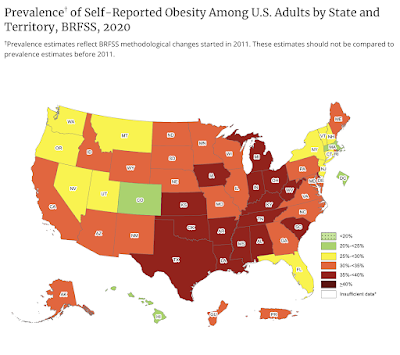
 

...and this graphic which lists national obesity rates by nation:


When it comes to childhood obesity in the United States, we find this:


"For children and adolescents aged 2-19 years in 2017-2018:


The prevalence of obesity was 19.3% and affected about 14.4 million children and adolescents.


Obesity prevalence was 13.4% among 2- to 5-year-olds, 20.3% among 6- to 11-year-olds, and 21.2% among 12- to 19-year-olds. Childhood obesity is also more common among certain populations.


Obesity prevalence was 25.6% among Hispanic children, 24.2% among non-Hispanic Black children, 16.1% among non-Hispanic White children, and 8.7% among non-Hispanic Asian children.


With that background, let's look at the aforementioned research.  We are now well aware of how governments used lockdowns to prevent the spread of the SARS-0CoV-2 virus and the fact that these lockdowns had a significant negative impact on individuals' mental and physical health.  Let's look at a recent study on the CDC website which examines how the body mass index for children was impacted during the pandemic thanks to school closures, household income disruptions which resulted in changes to household food purchases, increased stress, increased screen time and fewer options for physical exercise:


The report opens by explaining the database used in the study.  Data were obtained from IQVIA's Ambulatory Electronic Medical Records database and were used to compare longitudinal trends in body mass index (BMI in kg/m2) among a cohort of 432,302 young Americans between the ages of 2 and 19 years.  Data from the pre-pandemic period from January 1, 2018 to February 29, 2020 was compared to data from March 1, 2020 to November 30, 2020.  To qualify, children had to have at least two BMI measurements including one from prior to the pandemic and one during the pandemic with the pandemic measurement falling after the first three months of the pandemic (i.e. after May 31, 2020).  Here is what the authors found:


1.) Prior to the pandemic, obesity prevalence was 16.0 percent including 4.8 percent with severe obesity.  The monthly rate of BMI increase nearly doubled during the pandemic period when compared to the prepandemic period and the rate of change in the proportion of children with obesity was 5.3 times as high during the pandemic (0.37 percenctage point increase per month) than before the pandemic (0.07 percentage point increase per month).  The estimated proportion of obese children rose from 19.3 percent in August 2019 and 22.4 percent in August 2020.


2.) Children in all BMI categories (excluding those who were underweight) experienced significant increases in the rate of BMI change, increase in body weight per month and over a six month period during the pandemic as follows:


a.) overweight - 2.13 times


b) moderately obese - 2.34 times - gain of 1.0 pounds per month with total gain of 6.1 pounds


c.) severely obese - 2.00 times - gain of 1.2 pounds per month with total gain of 7.3 pounds


This compares to a 2.7 pound weight gain over six months for a child with a healthy body weight prior to the pandemic.


3.) When looking at age ranges, children between the ages of 6 and 11 years saw the greatest increase in their rate of BMI increase at 2.5 times the prepandemic rate of increase.  As well, the more obese that a child was, the higher the increase in their rate of BMI increase.


While it may seem relatively insignificant, the fact that the response to the pandemic resulted in significant increases in body weight for American children is of great concern for the future state of their health since childhood obesity is likely to result in adults with obesity as shown here.  Accelerated weight gain among the already obese can put these children at risk for future health conditions including type 2 diabetes, hypertension, heart disease and depression.  Thanks to government responses to the lowest risk cohort for severe and deadly COVID-19 infection outcomes, public health and elected officials may have traded one health problem for another, yet another unintended consequence of government ineptitude.  Instead of being so fixated on getting every child vaccinated, public health should be concerned with childhood obesity which can lead to lifelong and serious health problems.


Wednesday, November 10, 2021

China, Children and the Gaming Culture

A recent announcement on China's National Press and Publication Administration shows the nation's leadership's dedication to preventing video game addiction and other negative side effects of excessive gaming among China's children.


Here is the "Notice on Further Strict Management and Practically Preventing Minors from Indulging in Online Games" announcement from the NPPA translated into English using Google translate:


The announcement was also made on Xinhuanet as shown here:


Online games will now only be available to China's minors between 8:00 pm and 9:00 pm on Fridays, Saturdays and Sundays.  This is being done to "create a healthy environment for the growth of minors" and prevent gaming addictions.


This follows a 2019 move which sought to curb online gaming by limiting game play for minors to between 8 am and 10 pm daily as well as time limitations as shown here:


"It is stipulated that game services for minors shall not be provided from 22:00 to 8:00 of the next day every day, no more than 3 hours per day on statutory holidays, and no more than 1 day per day at other times The specific standards are mainly put forward from the perspective of the reasonable allocation of minors’ daily work and rest time, except for normal sleep, study, dining, and cultural and sports activities, and distinguish between holidays and other times, and limit the length of game time. This provision is not only a requirement for online game companies and platforms, but also a guide for guardians to perform their duty of guardianship for minors."


It also limits the provision of game payment services for minors under the age of 8 and limitations for users between the ages of 8 and 16 years as shown here;


"It is stipulated that online game companies shall not provide game payment services for users under the age of 8; the same online game companies provide game payment services for minors over 8 but under 16 years of age. For users, the single recharge amount shall not exceed RMB 50, and the cumulative monthly recharge amount shall not exceed RMB 200; for minor users over 16 years old, the single recharge amount shall not exceed RMB 100, and the cumulative monthly recharge amount shall not exceed 400 yuan."


At that time, Chinese authorities also made the following recommendation regarding age-appropriate warnings:


"It is important to note that age-appropriate prompts are not equivalent to Western grading systems, and harmful content such as pornography, blood, violence, and gambling is never allowed in games for adults."


 According to the Digital Wellness Lab, in the United States:


1.) 66% of tweens aged 8 to 12 play video games for an average of 2 hours per day


2.) 56% of teens ages 13 to 17 play video games for an average of 2.5 hours per day


3.) Over 80% of both tweens and teens have a gaming console


4.) Young children aged 2 to 4 play for 21 minutes per day, and those aged 5 to 8 play for 42 minutes per day


Statista has the following more specific gaming data for children 4 to 15 years of age:


...which may explain this:


"For children and adolescents aged 2-19 years in 2017-2018:


The prevalence of obesity was 19.3% and affected about 14.4 million children and adolescents.


Obesity prevalence was 13.4% among 2- to 5-year-olds, 20.3% among 6- to 11-year-olds, and 21.2% among 12- to 19-year-olds. Childhood obesity is also more common among certain populations.


Obesity prevalence was 25.6% among Hispanic children, 24.2% among non-Hispanic Black children, 16.1% among non-Hispanic White children, and 8.7% among non-Hispanic Asian children."


...and this:


Maybe China's leadership is on to something after all.


Friday, September 20, 2019

America's Biggest Health Problem

Updated December 2019

Thanks to the Centers for Disease Control (CDC) we have a complete picture of America's biggest (pardon the pun) health problem; obesity.  While the latest data is current to 2017, if past performance is an indicator, relatively little will have changed over the past two years.

Let's start with a definition of body mass index or BMI.  BMI is defined as the body mass (weight) divided by the square of the body height and is usually measured using mass in kilograms (2.2 pounds equals one kilogram) and height in metres (3.28 feet equals one metre).  According to the National Heart, Lung and Blood Institute, BMI scores can be categorized as follows:

Underweight - BMI below 18.5

Normal - BMI between 18.5 and 24.9

Overweight - BMI between 25.0 and 29.9

Obese - BMI above 30.0

Obesity Class 1 - BMI between 30.0 and 34.9

Obesity Class 2 - BMI between 35.0 and 39.9

Extreme Obesity - BMI above 40.0

The higher your BMI the higher your risk for heart disease, high blood pressure, type 2 diabetes, certain cancers and breathing difficulties.  The risk for disease relative to normal weight and height is also related to waist circumference.  Men with waists in excess of 40 inches and women with waists in excess of 35 inches have the following risks of disease; "increased" for overweight individuals, "high" for Obesity Class I individuals, "very high" for Obesity Class 2 individuals and "extremely high" for extremely obese individuals as shown on this table:


Let's now look at the data from the CDC showing the state-by-state percentage of adults aged 18 and older who were obese in 2017:


Note that the data does not include respondents who weighed less than 50 pounds or more than 650 pounds (not particularly an exceptional weight given the number of subjects in the "My 600 Pound Life" television series).

Here are the top ten most obese states:

West Virginia - 38.1 percent
Mississippi - 37.3 percent
Oklahoma - 36.5 percent
Iowa - 36.4 percent
Alabama - 36.3 percent
Louisiana - 36.2 percent
Arkansas - 35.0 percent
Kentucky - 34.3 percent
Alaska - 34.2 percent
South Carolina - 34.1 percent

Here are the top ten least obese states:

Colorado - 22.6 percent
District of Columbia - 23.0 percent
Hawaii - 23.8 percent
California - 25.1 percent
Utah - 25.3 percent
Montana - 25.3 percent
New York - 25.7 percent
Massachusetts - 25.9 percent
Nevada - 26.7 percent
Connecticut - 26.9 percent

It is interesting to see that nearly one in four Americans are obese in the states with the lowest percentage of obese individuals and that nearly four in ten Americans are obese in the states with the highest percentage of obese individuals.

Here is one of the most concerning factors; the percentage of adults between the ages of 18 and 24 that are obese:


Once a child or younger adult is significantly overweight, it is extremely difficult to reverse the trend.  According to the CDC, data from 2015 to 2016 shows that nearly one in five school age children are obese.  Here is a map showing the state-by-state statistics for the percentage of high school students that were obese in 2017:


In closing, let's look at a comparison of obesity rates (from 2016) for the top ten most obese OECD nations:


As you can see, the obesity rate in the United States is well above that of Canada, its most direct comparator.  From the CIA World Factbook we find the following highest obesity rates among all nations:


Once again, the United States has among the highest adult obesity rates in the world.

While there is constant noise in Washington about the cost of health care including prescription drugs and hospital care, one of the simplest ways to reduce health care costs at an individual level is to reduce caloric intake and increase activity levels.  It is only through the reduction of American obesity rates that total health care costs will show meaningful reductions.

If you are interested, here is a link that you can use to calculate your own BMI using either metric or imperial measurements.  

Thursday, August 3, 2017

Big America - The Growing Health Care Crisis

Updated February 2019

With healthcare regularly commanding the headlines in the American mainstream and non-mainstream media, there is one related topic that gets almost no attention - health, particularly health as it relates to body weight.  An analysis by the OECD looks at one key measure of health, that of obesity.  Here is a summary of their findings.

The study looked at the obesity rate in the 35 nations that make up the Organization for Economic Co-operation and Development and then compared the most recent obesity rates to those of the past.  The study found that, across the OECD, more than one in two adults and one in six children are either obese or overweight and that the "obesity epidemic" has spread further in the past five years with projections showing that all nations will experience a continuing increase in obesity.  That said, obesity rates for all 35 nations vary widely with a tenfold variation in obesity across the nations.

With that introduction, let us now look at obesity rates.  In 2015, on average across the OECD, 19.5 percent of adults were obese with the obesity rate varying from less than 6 percent in Korea and Japan to more than 30 percent in Hungary, New Zealand, Mexico and the United States.  Here is a graphic showing the obesity rates for all 35 OECD nations as well as the rates for some of the world's less-developed economies (i.e. the BRIC nations):


By a relatively wide margin, at 38.2 percent of the total adult population in the United States is considered obese followed by 32.4 percent in Mexico and 30.7 percent in New Zealand.  The least obese nations include Japan with 3.7 percent of its population considered obese followed by Korea at 5.3 percent and Italy at 9.8 percent.  In general, among OECD member nations, the obesity rate for women is slightly higher than the rate for men; this is particularly the case in Latvia, Turkey, Chile, Mexico and the United States.  If we look outside the OECD, in the case of South Africa, 37 percent of women are obese compared to only 16 percent of men.  That said, in general, male obesity has been growing more rapidly as the years have passed.

As was noted at the beginning of this posting, for many nations, the rate of obesity and the percentage of overweight persons has increased over the past few decades as shown on this graphic:


As you can see, the rate of overweight persons in the United States has risen from 43 percent in the late 1970s to 68 percent in 2013, a 58 percent increase.  Obviously, this should be of concern to policymakers since it is this trend that is has led to higher and higher health care cost burdens for American households. 

The future trend is not encouraging either.  Here is a graphic showing the percentage of self-reported overweight children aged 15, comparing the rate in 2001 - 2002 to that of 2013 - 2014 for each OECD nation:


As you can see, for every nation that has data for both years, the percentage of overweight children has increased over the decade with one exception; Denmark.

With all of this data in mind, let's look at the OECD's projections for the future rates of obesity going out to 2030:


Given the growing percentage of overweight children, it certainly appears that the global trend is not favouring a decrease in obesity rates.

Another interesting factor in the obesity equation is the relationship between educational level and obesity.  Less educated women are two to three times more likely to be overweight than those with a higher level of education in half of the eight nations for which that data is available.  In most nations, the rate of obesity has also been rising more rapidly in less-educated men and average-educated women with one exception; in the United States, obesity rates have been increasing most rapidly among highly educated people.

While Washington focuses on the partisan options for health care delivery, they are ignoring one of the most important factors in personal health; the maintenance of a healthy body weight.  Until politicians address this growing crisis, the health care situation in the United States is likely to reach the critical stage where the system simply cannot handle the growing numbers of people with weight-related illnesses.