Showing posts with label cashless society. Show all posts

Thursday, March 20, 2025

The Digital Euro - The Next Step to a Cashless Surveillance State

As my long-term readers know, I have a fixation with digital currencies (aka central bank digital currencies) and the impending cashless society.  The European Central Bank (ECB) is taking additional steps toward implementing a digital euro through its work with all of the national central banks of Europe.

Here's how the ECB describes the digital euro:

"We are working with the national central banks of the euro area to look into the possible issuance of a digital euro. It would be a central bank digital currency, an electronic equivalent to cash. And it would complement banknotes and coins, giving people an additional choice about how to pay." 

Here are its key features:


The digital euro would be stored in an electronic wallet that was set up with a person's bank or other public intermediary such as a post office.  People will be able to deposit money into the digital wallet through a linked bank account or by depositing cash (until cash no longer exists).  Withdrawals from the wallet would be in the form of digital euros.

In this recent contribution from ECB Executive Board Member Piero Cipollone as found on the ECB's website:


....we find the following quote:

"Being a key player in digital payments and digital finance should be a priority for Europe." 

As Mario Draghi pointed out in his recent report, the productivity gap between the United States and the European Union is mostly explained by technology and finance.  If we take the information and communications technology (ICT) and financial sectors out, the gap disappears.  

If we want to close the productivity gap with the United States, we need to focus on these areas. Digital payments and digital finance stand at the intersection of these two sectors. And they are developing fast, driven by changes in habits and technology. This is both an opportunity and a risk for Europe. It is an opportunity to close the gap by developing innovative and competitive European solutions. But if we do not seize that opportunity, we run the risk of weakening our competitiveness, resilience and strategic autonomy....

We must move swiftly to counter the risks stemming from Europe’s current inability to secure the integration and autonomy of its retail payment system. This is one of the key reasons behind the digital euro project: to bring central bank money into the digital age. Doing so would provide firms and households with a digital equivalent to banknotes and would strengthen our monetary sovereignty....

Complementing banknotes, the digital euro would give all European citizens and firms the freedom to make and receive digital payments seamlessly.

The digital euro would provide a single, easy, secure and universally accepted public solution for digital payments in stores, online and from person to person. It would be available both online and offline, and would be free for basic use. 

For merchants, the digital euro would provide seamless access to all European consumers. Moreover, it would offer an alternative that would increase competition, thereby lowering transaction costs in a more direct way than is possible through regulations and competition authorities." 

Of course, the ECB is terribly concerned about privacy when it comes to its CBDC:

"Guaranteeing the privacy of digital euro users is an essential part of the project, and the proposed Regulation reflects this with strict provisions on data protection and privacy for both online and offline transactions. The offline functionality would offer users a cash-like level of privacy, both for person-to-person payments and payments in physical shops. The Eurosystem has indicated its readiness to explore the possibility of making a few improvements to the user experience of the digital euro, so that citizens with a stronger privacy preference can benefit from cash-like privacy for all their digital euro payments made in physical proximity. One possible improvement could be to give users the option (i) to make all their low value payments carried out in the proximity of the payee’s device offline payments by default and (ii) to decide on the amount they wish to regularly hold offline and benefit from automated funding, so they do not worry about their offline balance. In order to ensure that this improvement is convenient for users, the offline functionality should be available on mobile devices." 

According to the ECB, the digital euro is still in the preparation stage and the bank has called for applications, seeking potential providers of digital euro components and related services.  New user research and experimentation activities are now underway to gain insight into users' preferences and to inform decision-making for the digital euro; these include online surveys and interviews which will focus on special target groups such as small merchants and vulnerable consumers.  The findings of this phase will be published in mid-2025.  Following a call launched in November, the ECB will join with key stakeholders, including merchants, payment service providers, fintech companies and universities, to form innovation partnerships to test conditional payments (i.e. payments that are made automatically when predefined conditions are met) and explore other innovative use cases for a digital euro. An outcome report is expected to be published in July 2025. 

With the call for applications for providers of the components of a digital euro now underway, it's starting to look like a digital euro is more-or-less a given.  In fact, if you look at this graphic, you'll notice that the ECB's Governing Council will make a decision for the potential launch of the next phase of the digital euro project in October 2025:


In May 2024, eIDAS 2.0 (the European Digital Identity Regulation) entered into force, meaning that 400 million Europeans will now be eligible to soon avail themselves of an EU Digital Identity Wallet which will shift Europeans from physical documents to digital IDs.  This is a key step in the issuance of a European CBDC since digital euros will be stored in a digital wallet.  Here is a video showing the "benefits" of Europe's Digital Identity Wallet:


Let's close with this recent news from Reuters, a potential fly in the ointment for a digital euro and, for that matter, all CBDCs:


A late February 2025 unprecedented outage in the ECB's Target 2 (T2) payment system caused widespread chaos for ten hours, blocking payment for more than 15,000 elderly and poor Greeks, pensions and salaries in Austria and several financial trades thanks to malfunctioning hardware.  There was no backup system in place.

Here's more on the issue:


"
Representatives from four of the eight groups that make up the European Parliament said the incident raised some questions about the ECB’s ability to deliver on its digital euro project, a new payment system open to all euro zone residents.

"This instance is a blow to the ECB’s credibility," said Markus Ferber of the European People's Party, the largest group in the current parliament.

"People will ask legitimate questions how the ECB will be able to run a digital euro when they cannot even keep their day-to-day operations running smoothly."   

Despite this brief setback, the progress on the implementation of a digital euro continues to march forward and with end of the preparation phase of the payments ecosystem expected by October 31, 2025 and a potential development and rollout projected from November 2025 as shown here:


Unless the unforeseen should occur, it would appear that the implementation of the world's first advanced economy central bank digital currency is a sure thing.

Tuesday, February 11, 2025

Central Bank Digital Currencies - A Primer on a Cashless Society

In recent weeks, it has become increasingly apparent to me that many people are completely unaware of the concept of a central bank digital currency or CBDC.  In this posting, I will outline the key aspects of CBDC, how it will be implemented and why and will encapsulate all of the things that I have learned about our looming cashless society for your illumination.


Let's start by looking at the definition of a CBDC.  


"A CBDC is a form of digital currency issued by a nation's central bank and is equivalent to its physical national fiat currency (i.e the bank notes that are circulated in an economy)."


There are two types of CBDCs:


1.) Retail CBDCs - these CBDCs will be used by consumers and businesses.  There are two types of retail CBDCs:


a.) Account-based retail CBDCs which will require a digital identification to access an account.  These CBDCs could cause disruption in the commercial banking sector and could lead to identifying, tracking and profiling of all end-user's transactions.


b.) Token-based retail CBDCs which will be accessible with private keys, public keys or both which will allow an individual to execute transactions anonymously, however, central banks could choose to implement specific identity requirements to access the network, negating anonymity. 


2.) Wholesale CBDCS - these CBDCs will be used for transactions by the financial/commercial banking sector.


Here is a quote from a study on CBDCs from the European Data Protection Supervisor regarding the definition of a CBDC:


"A CBDC consists of a digital representation of coins and banknotes in the form of digital tokens. It is an electronic file that embodies a specific value with a reference to its owner attached to it. By just changing that reference, the value is transferred and a payment is made. CBDC is usually presented by central banks as a complement to cash, equipped with similar features (notably, having regard to the legal tender status), but adapted to some functional needs and to the ‘digital’ nature referred to above."


Some central banks (i.e. the Bank of England) are selling the benefits of a CBDC by stating that while CBDCs will be implemented, bank notes will still remain in circulation (i.e. the payment system will not become entirely digital) however, they give no time frame for the implementation of a fully digital/cashless payments system which is certain to follow.


CBDCs could be administered in one of two main architectural ecosystems:


1.) the direct model where the central bank provides a direct service to the end user such as a reloadable card or online digital wallet.


2.) the indirect model where commercial banks provide the ledger for retail transactions with the central bank maintaining the wholesale ledger of CBDC transactions with the commercial banks.


Under a hybrid model of CBDC administration, commercial banks will provide retail services to its customers and the central bank retains a ledger of retail transactions.  According to the Bank for International Settlements (the central bank for central banks), this is currently the architecture that most central banks are currently considering.


Here is a graphic showing the two types of CBDC architecture and the resulting data flow:


Some people comment that we already have a digital payments system which consists mainly of debit and credit cards.  While this is true, there is a key difference between CBDCs and the current digital payments system.  CBDCs will be legal tender and must be accepted if offered as payment within the jurisdiction of its issue whereas other electronic means of payment (i.e. credit cards etcetera) can be refused.


There are at least two issues that will make the implementation of a CBDC ecosystem difficult:


1.) Resilience - the CBDC banking system must be resistant to cyber security threats and must operate when the power grid is unavailable.


 2.) Privacy - we will have to trust that central banks and governments will not use CBDCs to track and trace our behaviours.  Here is a quote about CBDC-related privacy from a study done by Payments Canada with my bold:


"A CBDC with the same level of privacy as traditional cash is highly unlikely. As with cash, privacy may be limited in the service of public safety priorities around money laundering, terrorist financing, tax evasion and parallel market activities, particularly for large CBDC transactions."


One might ask, why do we need CBDCs.  Here are some of the reasons given by central bankers:


1.) reinforcement of monetary sovereignty, strategic autonomy and monetary policy implementation


2.) creation of a more reliable form of payment than new form of private money by private actors (i.e. Bitcoin etcetera) that bypass the existing bank-based payment systems


3.) to stimulate competition and innovation in payments, removing barriers and avoiding closed payment

systems created by platforms (i.e. Meta's proposed Diem)


4.) to foster financial inclusion, rendering the process easier for people that currently do not have a bank account 


5.) to improve cross-border retail payments


6.) reduce or eliminate money laundering, tax evasion, fraud and terrorist financing since  CBDC contain features of identifiability of the end-user and traceability of their transactions


Banking inclusiveness is always part of the sales pitch for CBDCs but you wouldn't be the only person who thinks that central bankers really don't care about the unbanked since, in general, they contribute less to the economy than the banked.


Now, let's look at the downsides to CBDCs:


1.) lack of privacy - all transactions can be tracked and traced


2.) central banks could limit the amounts of digital currency that could be owned by each person/entity


3.) a tiering approach could be used where there are no limits to the amount of digital currency that can be held but that amounts above a certain threshold could receive a negative interest rate which would destroy the value of the individual's savings


To me, the most frightening aspect of a CBDC is the potential for a programmable digital currency which is defined as a "CBDC with built-in rules, imposing restrictions on the usage of that money."


By implementing a programmable money through a CBDC, a government could do the following:


1.) define a positive or negative interest rate to incentivise or disincentive the use of money 


2.) limit its use to a certain category of services for example placing limits on purchases of alcohol, tobacco, gasoline, meat or other items that the government deems unnecessary or unhealthy.  This could act as a de facto rationing system which would be particularly compelling during a "climate emergency".


3.) set a CBDC expiry date which could be used to incentive spending during economic downturns.


4.) CBDCs could be linked to an individual's social credit system by way of a digital identity.  If an individual has views or behaviours that are contrary to what the current government powers believe are acceptable, this could be considered when CBDCs are issued to an individual.  In this case, CBDCs could be used to promote or impede social and political changes. 


The development of CBDCs is being undertaken by many nations around the world and implementation is at various stages as shown on this CBDC tracker from the Atlantic Council:


Effective in September 2024, 134 nations and currency unions representing 98 percent of global GDP are exploring a CBDC with 66 nations currently at an advanced stage of development.  Three nations have launched a full-fledged CBDC with varying results; Nigeria and its e-Naira which launched in October 2021, the Bahamas and its Sand Dollar in October 2020 and Jamaica with its Jamaican Digital Exchange or JAM-DEX in May 2022.


Let's close with this commentary about CBDCs from Agustin Carstens, General Manager of the Bank for International Settlements, once again, the central bank for central bankers:


That tells you all that you need to know about CBDCs and how they will be used.


It is my belief that the "boiling frog" analogy is most apt when it comes to the issuance of CBDCs.  With the vast majority of the world currently exploring the development of a central bank digital currency, we are slowly but surely being led down the garden path to a cashless society where transactional privacy is non-existent and governments will have the ability to use a heavy-handed approach to curtailing what they believe is unacceptable behaviour by their citizens through the implementation of programmable digital currencies in conjunction with a digital identification program.   All that it will take is some sort of crisis in the world’s financial markets to give the powers that ought-not-to be the excuse that they need to send the sweaty masses down the road to monetary slavery.


Friday, November 8, 2024

Backtracking on the Cashless Society and Strengthening the Right to Pay with Cash

With the vast majority of central banks around the world researching, experimenting with or implementing a new monetary reality as shown here: 


....recent developments in Norway are quite fascinating.


According to Norges Bank, Norway's central bank, in 2022, only 3 percent of Norwegians used cash when making a purchase at a point of sale (i.e. a physical store) as shown here:


In contrast, Norway has the second highest annual use of payment cards among selected nations with an average Norwegian using a credit card or equivalent 531 times in 2022 as shown here (graph data current to 2021):


Rather surprisingly, this was announced by Norges Bank on its website slated to take effect on October 1, 2024:


According to the Financial Contracts Act, consumers have the option to pay with legal tender (i.e. physical bank notes and coins) as long as the amount owing is not greater than 20,000 kroner ($1850 US).


This is being enacted for two reasons according to Justice Minister Emilie Enger Mehl:


1.) as a means of providing security for those consumers who are reluctant to used digital payment solutions.


2.) as a means for preparing Norwegian society for emergencies such as prolonged power outages, system failures or digital attacks against payment systems.


Here is a quote from Ms. Mehl's press release dated August 3, 2024 when the issue was being discussed (with my bolds):


"The government's task is to ensure society's preparedness. Relying exclusively on digital payment solutions increases the vulnerability of society, and in certain situations this can contribute to putting important social functions out of play. Preparedness is an investment to counteract vulnerability and safeguard important functions in society and the needs of the population.


If no one pays with cash and no one accepts cash, cash will no longer be a real emergency solution once the crisis is upon us. 


As a society, we need an alternative if it becomes necessary, and today cash is the only alternative that is easily available if digital payment systems fail. In addition, companies also make themselves vulnerable if they do not accept cash in the event of a crisis, says Mehl."


I find it interesting that Norway has taken the approach that cash is a necessary "evil" to ensure the inclusiveness of all of its citizens which is rather ironic given that CBCDs are being sold to us as a panacea for those who are not in the banking system.  As well, given the vulnerability of the digital payment grid as has been revealed time and time again as shown here:


....at least one nation is taking the approach that going completely cash-free is one of the stupidest things that a government and central bank can do.


Thursday, June 30, 2022

Retail Central Bank Digital Currencies - The Race for the Future of Money

In a recent Payments System Research Briefing, the braintrust at the Federal Reserve Bank of Kansas looks at the case of retail central bank digital currencies (CBDCs). 


Let's open by looking at the two types of CBDCs:


1.) Retail (or general purpose) CBDCs - these CBDCs will take on the attributes of physical cash and will be used by consumers and businesses.  This can be thought of most easily as a "cashless" system.


2.) Wholesale CBDCs - these CBDCs will be used by financial institutions and are intended for the settlement of interbank transfers and could reduce counterparts credit and liquidity risks.


The authors note that, while many central banks are exploring the use of retail CBDCs, only a few have actually taken the steps necessary to implement a retail CBDC as shown on this table:


In the briefing, the authors look at the motivations for issuing retail CBDCs.  They note that central banks in emerging and developing economies EMDE) are far more enthusiastic about issuing retail CBDCs compared to their counterparts in advanced economies.  Let's look at the motivations for each grouping of nations:


1.) Emerging and Developing Economies (EMDE) - promoting financial inclusion, enhancing payment system efficiency, competition, competition, security and/or resiliency, improving cross-border payments.


In these economies, many consumers have little access to financial services and, as such, rely heavily on cash payments in preference to less-developed electronic payment systems.  This results in higher operational costs which would be moderated once the dead for physical cash is reduced.  Access to the banking system (i.e. inclusion) seems to be all important to central bankers.  For example, in these less developed economies, many individuals are unbanked with about 60 percent of adults being unbanked in Mexico and Nigeria and 20 percent of adults being unbanked in China, India, Jamaica and the Bahamas.  The Central Bank of The Bahamas has taken the step of issuing a physical CBDC payment card to unbanked individuals that have no access to a smartphone or computer.  The authors state that a Retail CBDC may increase competition and result in lower transaction costs for both merchants and consumers.


2.) Advanced Economies - payment access, resiliency and competition.  


While no advanced economy has introduced a retail CBDC, this may reflect the limited potential to improve national payment systems.  Interestingly (and I might add ironically), Sweden's central bank claims that the priority policy goal of the "e-krona" is to ensure broad access to payments for those that will be adversely impacted by the move to a cashless society.  Central banks in Canada, Japan and Norway have stated that there is currently little motivation to move to a retail CBDC ecosystem, however, should the use of cash decline to the point where it can no longer be used in a wide range of translations or should a private cryptocurrency make significant inroads, these central banks could change their views and move toward a retail CBDC.  This is quite interesting given that over half of retailers in Sweden expect to stop accepting cash for payments by 2025 and the use of banknotes in the United Kingdom has fallen from 60 percent of payments by volume in 2008 to 28 percent 2018 and is expected to fall to just 9 percent of payments by 2028 so it looks like central bankers concerns about a decline in the use of cash has already provided them with the reason that they need to foist CBDCs on the globe's advanced economies.


In closing, here is the conclusion to the briefing with my bold:


"Several EMDEs have implemented CBDCs primarily to promote financial inclusion and improve their payments systems. Several advanced economies have made significant progress in assessing the case for a retail CBDC; though a few have identified motivations for implementing a CBDC, most have not found a compelling case to do so.


Many other central banks are still at an early stage in exploring motivations for a retail CBDC, including the Federal Reserve, which recently published a report aiming to foster a public discussion with CBDC stakeholders on the potential benefits and risks of CBDCs (Board of Governors of the Federal Reserve System 2022). Through research and public dialogue, these central banks may increasingly identify motivations for a retail CBDC or scenarios in which a retail CBDC may be warranted. The motivations and scenarios will likely vary across countries, as each country has a unique set of opportunities and challenges in its economy and payment system."


Let's close with this graphic showing the "race for the future of money:":


...and these graphics showing the rapid change in CBDC research and development since April 2021:


Given the changes in the global economy over the past few years, the advanced in blockchain technology, the moves toward a digital identity and the widespread growth of the surveillance state, in my opinion, the imposition of a central bank digital currency ecosystem is a given and that, with the majority of the world's central banks exploring the use of CBDCs, this is likely to be our "new normal" within the next five years.

Monday, May 30, 2022

Central Bank Digital Currencies - Gaining Momentum

As my long time readers know, I have a fixation with the global move toward a cashless society, something that has fascinated me for decades although the technology needed for such a seismic shift in the economy has really only existed for roughly a decade.  A recent publication on what are now being termed central bank digital currencies or CBDCs by the Bank for International Settlements, the central bank for central banks given that it is owned by 63 central banks which account for 95 percent of global GDP provides the world with an update on the evolution of the technology which will prove to be a global game-changer.


To put all of the information in this posting into perceptive, we need to start by looking at the BIS definition of central bank digital currencies:


"A CBDC is central bank-issued digital money denominated in the national unit of account, and it represents a liability of the central bank."


There are two types of CBDCs as follows:


1.) Retail CBDCs: Retail CBDCs are intended for use by the general public and are referred to as a “general purpose” CBDC. As such, it offers a new option to the general public for storing value and making payments. A retail CBDC is different from existing forms of cashless payment instruments for consumers and businesses, such as credit transfers, direct debits, card payments and e-money, as it represents a direct claim on a central bank rather than the liability of a private financial institution.


2.) Wholesale CBDCs: Wholesale CBDCs are intended for use by financial institutions.  A wholesale CBDC is similar to today’s central bank reserves and settlement accounts in that it is intended for the settlement of large interbank payments or to provide central bank money to settle transactions of digital tokenised financial assets in new infrastructures


Here is the cover page of the report which, tellingly, is entitled "Gaining momentum":


The report outlines the results of a survey of 81 central banks which was conducted in the fall of 2021.  The survey asked central banks about their engagement in working toward CBDCs and their motivations and intentions regarding the implementation of CBDCs.  It is important to keep these developments in mind:


"After The Bahamas launched a live retail CBDC (the Sand Dollar) in 2020, Nigeria followed in 2021 with the issuance of eNaira, and the Eastern Caribbean and China released pilot versions of their respective DCash and e-CNY."


The central banks of the 81 jurisdictions that relied to the survey represent nearly 76 percent of the world's population and 94 percent of global economic output.  Twenty-five of the respondents are classified as advanced economies and 56 are in emerging markets/developing economies.


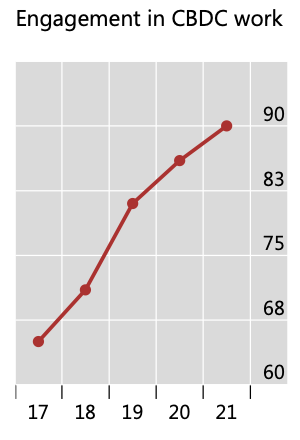
Here is a graph showing the very significant growth in the share of central banks that are actively engaged in some form of CBDC development over the past five years:


Here is a graph showing how the focus of the development by type of CBDCs has evolved over the past five years:


The development of retail CBDCs is significantly more advanced than the development of wholesale CBDCs with almost 20 percent of central banks developing or testing a retail CBDC, twice the share of central banks developing a wholesale CBDC.


Here is a graph showing the focus of the development of CBDCs in 2021:


In 2021, 26 percent of central banks are either currently developing a CBDC or running a pilot project, up from 14 percent in 2020.  In addition, 62 percent are conducting either experiments with or proofs-of-concepts of CBDCs. 


There are two mechanisms by which central banks can distribute CBDCs to the public as follows:


1.) One-tiered model: Central banks directly distribute CBDCs to the public, providing both the CBDC account and wallet services.


2.) Two-tiered model: Central banks work with trusted private sector intermediaries (i.e. retail banks) to distribute CBDCs to the public.  In this case, the private sector would be responsible for onboarding clients and performing know-your-customer and anti-money laundering/combating the financing of terrorism procedures.  The private sector would also record retail transactions and handle retail payments.


The report notes that 70 percent of central banks that are involved in some form of CBDC issuance are considering the implementation of a retail CBDC that involves the private sector.


In case you were wondering, there are several motivations for issuing a retail CBDC as follows:


1.) financial stability


2.) monetary policy implementation


3.) improving domestic payments efficiency


4.) improving cross-border payments efficiency


5.) payments safety and robustness


We might also add the following reason for implementing a retail CBDC right from the mouth of BIS General Manager Augsten Carstens:


Here's the punchline:


"The central bank will have absolute control on the rules and regulations that will determine the use of that expression of central bank liability and also we will have the technology to enforce that." 


The issuance of a CBDC requires that a nation have in place a legal framework which provides its central bank with the legal authority to do so.  On a year-over-year basis, the share of central banks with legal authority increased from 18 percent to 26 percent in 2021 and an additional 10 percent of jurisdictions are in the process of changing their laws to authorize CBDC issuance.  This means that in the near future, 36 percent of the world's central banks will soon have the legal authority to issue CBDCs.


To summarize, 68 percent of central banks consider that they are likely to or high possibly issue retail CBDC in the short- or medium-term.  The self-reported likelihood is higher among emerging market/developing economy nations than it is for advanced economies.  Here is a summary showing how the likelihood of issuing both a retail and wholesale CBCD has increased markedly over the past four years:


If you wish to educate yourself further on CBDCs, here is a video from BIS outlining the "uncharted waters of retail CBDCs":


Let's close with a few thoughts.  As I have stated in the past and given Augsten Carstens' comments and Chrystia Freeland, Canada's Deputy Prime Minister, recent moves to freeze the bank accounts of those that it deemed "wrong thinkers" as shown here:


...do you really think that retail CBDCs will work to the greater benefit of society as a whole?  Or, will it just give more power to the ruling class who will be able to record and control our every expenditure, particularly if a programable CBDC ecosystem is implemented?


CBDCs - gaining momentum indeed.