Showing posts with label India. Show all posts

Friday, December 6, 2024

Bill Gates and India - The Gates Foundation's Living Laboratory

In a recent interview, the world's foremost untrained virologist and vaccinologist "accidentally" said the quiet part out loud.  In an interview with Reid Hoffman, the co-founder of LinkedIn, Bill Gates waxed philosophically about his views on AI and how it will help transform all of Bill's favourite things including global health, climate change, energy and education.  Here is a quote from the lead-in to the Possible podcast:


"Reid and Aria sat down with Bill Gates to discuss his main areas of focus: climate change, energy, global health, and education—and how AI will help transform each of them. Taking a bird’s-eye view of society’s challenges, it’s easy to give in to pessimism. But as one of the most influential people in the world, Bill Gates has a unique perspective on how far humanity has come and what our potential—and timelines—for meaningful change really look like. He gets granular on everything from cows (5% of global emissions) to disease reduction and eradication (Guinea worm disease). At each turn, he has data at his fingertips to ground his beliefs. So, what current set of innovations is Bill most excited about? And what is realistically on the horizon for AI, climate change, energy, global health, and education?"


With that background, let's look at an excerpt from the hour-long interview.  Co-host Aria Finger, Hoffman's Chief of Staff, leads in with this when opening the discussion about Bill's fixation with global health:


"So I want to switch gears. Another area where I think you’re probably best known is global health. And I think as an area where AI can do so much, and my husband is a public health data scientist, so he’s particularly excited about this area of the interview. You have focused on the eradication of disease. And I think, but fact, check me, in 1980, the WHO declared that smallpox was eradicated. And that’s the first and only disease that we have eradicated. You’ve said let’s tackle polio, let’s tackle malaria. How do you pick, what is the next disease you’re going to tackle? Like what an amazing ambition and then how do you go after it?"


Gates responds with this with my bolds throughout:


"Yeah, so most diseases we’re going for a burden reduction. Only very few diseases should you try to go for eradication. because It’s very, very hard to get to zero. And right now with polio, you know, we’re in Afghanistan, we’re in Gaza, we’re in Somalia, we’re in DRC, and you know, we’re having to execute high coverage vaccination campaigns against misinformation and violence in the toughest places in the world. So it’s very, very hard. Polio’s close. There’s one called Guinea worm, which is confined to Africa where, you know, President Carter just got to a hundred, he’s been a, a champion of that. So we’re hoping he’ll be alive not only to vote in the election, but also to come to the Guinea worm celebration party. He’s going to, it’s going to take a couple years. So he’s going to have to hang on a little longer. So the magic thing that happened at the turn of the century was people got serious about global health, about really measuring, okay, kids die of diarrhea, but what caused that diarrhea?


They die of pneumonia, malaria, okay, it’s more clear what that is. But let’s, even though there’s no market, the people who die of malaria, half a million kids a year, they, it’s not like you can make a business case of, hey, go to Silicon Valley and do a malaria startup. And, you know, look at that spreadsheet the line that says life saved will look good, but the line that says profit will have a lot of red numbers because you, they can’t afford these tools. So medical science is very distorted towards rich world conditions and even amongst rich world conditions towards cancer and a few other things. So the incentive system is, you know, potentially could be improved. But the Gates Foundation, that’s our place we come to fill in, is that the things that aren’t market driven, like getting diarrhea vaccines cheap enough for all the kids of the world, not just the rich kids who don’t die of diarrhea, but the, the, that also used to be a half million now down to a hundred thousand.


So as we went from 10 million under five deaths per year in the, at the turn of the century to 5 million, diarrhea was one of our best. Pneumonia, we got a vaccine out for that, which was a very expensive vaccine that we worked with all the vaccine companies, Western and Asian, to get those prices down. And so we’re kind, we’re basically driven by the inequity where we say, why do mothers die in childbirth 20 times as much in Africa? Why do kids die 50 times as much in their first five years in poor countries, particularly Africa, but also Southeast Asia. And so we’re, you know, taking all of those and saying, okay, let’s find the best scientists. Let’s understand the field conditions, you know, is this stuff deliverable? Will it be accepted? You know, we have crazy ways of killing mosquitoes — that, that alone doesn’t get rid of malaria."


Crazy is right as you can see here:


...and here:


So now Bill's an entomologist too!  Absolutely nothing could go wrong by changing the mosquito ecosystem, could it?


Now, if we skip to the end of the interview, we find this gem during the rapid-fire question and answer section:


"REID:


Yeah, exactly. I love it. So where do you see progress or momentum outside of your industry — and of course that’s very broad — that inspires you?


BILL GATES:


Well, when India’s an example of a country where, oh, there’s plenty of things that are difficult there. The health nutrition education is improving, and they’re stable enough and generating their own government revenue enough that it’s very likely that 20 years from now people will be dramatically better off. And it’s kind of a laboratory to try things that then once you prove them out in India, you can take to other places. And so our biggest non-U.S. Office for the Foundation is in, is in India. And the most number of pilot rollout things we’re doing anywhere in the world are with partners in India. You know, if you go there and you’ve never been, you might think, whoa, this is a chaotic place. And you know, you’re not used to so many levels of income all being on the street at, at the same time, but you, you will get a sense of the vibrancy. Mm-Hmm."


Here it is as seen at the 1 hour and 1 minute mark of the video:


So, there you go.


As background, here's what the Bill and Melinda Gates Foundation has to say about its work in India:


If you search through the Foundation's committed grants database using India as a search term, you'll find that the Foundation has written 884 grants to India in total.  Here are a few examples from the month of November 2024:


In the month of November 2024 alone, the Foundation wrote 49 grants to various organizations and projects in India.  By year, we find that the Foundation has written 130 grants in 2024, 122 grants in 2023, 79 grants in 2022, 79 grants in 2021, 50 grants in 2020 and 61 grants in 2019 to various studies that appeal to Bill Gates' sense of what he wants the world to be.  


Bill Gates views India as a test tube for his health care agenda.  This can only be described as exploitation by the world's wealthy elite at the expense of the unwashed masses who are viewed as lesser forms of life to be used to enrich the ruling class.  Apparently, brown lives just aren't worth caring about when it comes to Gatesworld.  In the end, it's always about profiteering in the guise of philanthropy.


Monday, October 25, 2021

India's Experience with Ivermectin

Back in May 2021, a fascinating article appeared on the World Health Organization's website.  Given that WHO is more-or-less following Bill Gates' COVID-19 pro-vaccine narrative, this article is of particular interest.  Given a recent comment offered by a reader regarding my recent posting on the confusion surrounding the use of ivermectin as a solution to the COVID-19 pandemic , I felt that this information was particularly pertinent.


Here is the article:


As background, Uttar Pradesh is located in the far northeast corner of India and is located on the border with Nepal.  It has an estimated population of 241 million people (2021 estimate), roughly one-sixth of India's total population.  To help battle the COVID-19 pandemic, 141,610 Indian government teams circulated through 97,941 villages throughout Uttar Pradesh for a five day period beginning on May 5, 2021 as the pandemic seemed to be out of control with planning support and training for the effort being provided by the World Health Organization.  The members of each team tested everyone with COVID-19 symptoms using Rapid Antigen Tests. 


Here is the key sentence in the article:


"Those with symptoms are tested and given medicine kits and information on quarantining and isolation, both at home and in hospitals."


While the article does mention that people without COVID-19 were urged to get vaccinated to prevent transmission of the virus, it is interesting to note that those who were tested because they were showing symptoms of COVID-19 were given "medicine kits".  


Unfortunately, the WHO article doesn't tell us what is in these medicine kits, however, an article on MSN (Microsoft Network) dated May 12, 2021 which is sourced from The Indian Express, an Indian media company which publishes newspapers in a selection of major Indian cities, provides us with two of the contents of these kits as shown on this screen capture:


Here is the original article from The Indian Express:


Here are some quotes from the news article with my bolds:


"A year after the country’s first Covid-19 cluster, with 5 cases, was reported in Agra district, the Uttar Pradesh government has claimed that it was the first state to have introduced a large-scale “prophylactic and therapeutic” use of Ivermectin and added that the drug helped the state to maintain a lower fatality and positivity rate as compared to other states.


Citing the results from Agra in the month of May and June last year, following which the use of Ivermectin, a medicine to treat parasitic ailments, along with Doxycycline was introduced as a protocol across the state for both prophylactic as well as treatment purposes, the state Health Department said it would conduct a controlled study once the second wave of the pandemic subsides...


Uttar Pradesh was the first state in the country to introduce large-scale prophylactic and therapeutic use of Ivermectin. In May-June 2020, a team at Agra, led by Dr Anshul Pareek, administered Ivermectin to all RRT team members in the district on an experimental basis. It was observed that none of them developed Covid-19 despite being in daily contact with patients who had tested positive for the virus,” Uttar Pradesh State Surveillance Officer Vikssendu Agrawal said.


He added that based on the findings from Agra, the state government sanctioned the use of Ivermectin as a prophylactic for all the contacts of Covid patients and later cleared the administration of therapeutic doses for the treatment of such patients.


Claiming that timely introduction of Ivermectin since the first wave has helped the state maintain a relatively low positivity rate despite its high population density, he said, “Despite being the state with the largest population base and a high population density, we have maintained a relatively low positivity rate and cases per million of population”. 


He said that apart from aggressive contact tracing and surveillance, the lower positivity and fatality rates may be attributed to the large-scale use of Ivermectin use in the state, adding that the drug has recently been introduced in the National Protocol for Covid treatment and management. “Once the second wave subsides, we would conduct our own study as there has been an emerging body of evidence to substantiate our timely use of Ivermectin from the first wave itself,” Vikasendu told The Indian Express.


Isn't that interesting?  Given that ivermectin is almost never used in cases of COVID-19 in the developed world, India's experience with the anti-parasitic drug has been a great success as you can see on this graphic:


From a peak of 37,944 daily new cases of COVID-19 on April 24, 2021, Uttar Pradesh saw its daily new cases drop to 694 on June 7, 2021 and a further drop to only 11 new cases on October 20, 2021.


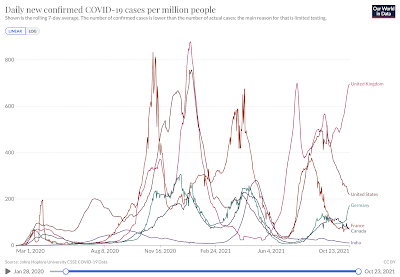
In closing, here is a graphic from Our World in Data showing how India's successful use of ivermectin has resulted in a daily new confirmed COVID-19 case per million load that is far lower that other major developed economies where ivermectin is not widely used as a treatment option:


Doesn't this make you wonder why the developed nations of the world are so reluctant to use ivermectin in the battle against COVID-19?  I suspect that some of you already know the answer to that question.  Given that Microsoft covered India's successful use of Ivermectin back in early May 2021, it simply must be true since they are part of the technocracy that is very carefully guarding the COVID-19 narrative so that the useless eaters are not exposed to disinformation of any type, particularly regarding treatments that do not involve experimental vaccines.


Wednesday, July 26, 2017

The Simmering Nuclear War

While the world focuses on the deteriorating geopolitical relationships between the United States and Russia and the United States and China and the potential for a conflict to accelerate into a nuclear exchange, a long-term simmering conflict between two populous nuclear powers has been pretty much ignored by the mainstream media.  Before you dive into this posting, I would like to apologize for its length, however, given the long history and complexity of the issue, a significant amount of background is necessary to put the conflict into context.

For decades, there have been tensions along the 4000 kilometre border between China and India.  After the 1962 Sino-Indian war in which the Chinese suffered 1400 casualties and India suffered 3120 dead, 3100 captured and 1000 wounded, China declared a unilateral ceasefire and withdrew from the front lines of the battle.  The war did, however, seal the fate of Tibet as a long-term source of tension between the two nations.  To this day, China claims the Indian state of Arunachal Pradesh and India claims the Chinese-controlled Aksai Chin territory as shown on this map:


While these two regions have proven to be a diplomatic nightmare, tensions over another border region located between Bhutan and Nepal have recently flared up. 

Let's now look at map to help us put the current events in another border region into perspective:


Sikkim, outlined in red, is bordered by Nepal to the west, Tibet to the north and Bhutan to the east and forms part of the Himalayas. 

Here is a closeup map of Sikkim:


As you can see, most of the state is mountainous and is quite remote with the closest major Indian city, Kolkata (aka Calcutta) being located 700 kilometres to the south.  Despite its relative remoteness from both China and the highly populated regions of India, this part of the border region remains as one of the long-term disputes between the two nations.  According to the Indian press (Hindustan Times), India is adopting a "patient and peaceful" approach to the problem whereas China is insisting that India withdraw its troops from Doklam (the narrow plateau in the  border junction of Bhutan, Tibet and India) and that the longer that India keeps its soldiers on "China's territory", the more likely that there will be a military confrontation.

Here is a summary of the military presence of the two nations along the disputed border regions from NDTV (New Delhi Television Limited):

"Defending the nearly 4,000 km-long Line of Actual Control (LAC) with India is the Lhasa-based Western Theatre Command of the Chinese army, a sprawling military formation spread across 4 provinces including the Tibetan Autonomous Region, where the drills were held. The command includes elements of the Chinese air force and its rocket (missile) forces.

In the event of an escalation, China can use its massive railway infrastructure to bring in additional troops. That has not happened. Since 2009, China has been training in Transregional Support Operations: shifting men and weapons between regions in training exercises.

Countering the Chinese presence along the de facto border are elements of the Northern, Western, Central and Eastern Commands of the Indian Army. Specifically, the Indian defense is centered around deployments made by the Leh-based XIV Corps, the Sukma-based XXXIII Corps, the Tezpur-based 4 Corps, the Dimapur-based III Corps and the Panagarh-based XVII Corps. The overall strength of the Indian Army here would be close to 2 lakh men and women. China's Western Theatre Command would have a similar number of soldiers though China doesn't deploy as many soldiers directly on the LAC but can, instead, use its superb road and rail network to surge troops to areas along the de facto border between the two countries. Despite the tension between the two countries, this has not happened.

NDTV has learnt that China cannot make any significant inroads with the present number of soldiers it has deployed in the region and would need to bring in soldiers from elsewhere, a move that would give Indian military planners a clear indicator of a potential attack. At the same time, India would be hard-pressed to deploy more soldiers along the LAC should that be required since several formations are busy defending the border and the Line of Control with Pakistan in addition to fighting terrorism in Jammu and Kashmir and in parts of the Northeast.

The Indian Air Force has 22 airfields and is developing a network of smaller air landing grounds in the Eastern sector. The Chinese air force has 15 air bases and 27 smaller airstrips but operates at a significant disadvantage vis-a-vis the Indian Air Force. This is because all of Chinese bases in the region are located high in the Tibetan plateau which makes it impossible for the jets to take off with a full weapon load because of the rarified atmosphere. The Indian Air Force, on the other hand, does not face any such constraints. All its major bases in the region are located in the plains and IAF fighters can take off with a full fuel and weapons load, a significant operating advantage in the event of a conflict between the two countries."

Here is a discussion about the ongoing border tensions between the two nations:


According to Firstpost, one of the main problems facing both nations was the poor surveying capabilities that were in existence when the Sikkim-Tibet border was surveyed back in the late 1800s and when the Anglo-Chinese Convention of 1890 was agreed upon.

Now, let's move to the present.  Here is what China has to say about the most recent flareup of the Sikkim border dispute through the Communist Party of China's outlet Global Times :

"On June 16, Indian border guards crossed over the Sikkim section of the China-India border to the Chinese side, triggering a face-off with Chinese troops. India's action this time is a blatant infringement on China's sovereignty.

As the confrontation goes on, China needs to get ready for the face-off becoming a long-term situation and at the same time, needs to maintain a sense of rationality. Within China, there are voices calling for the Indian troops to be expelled immediately to safeguard the country's sovereignty, while Indian public opinion is clamoring for war with China. However, the two sides need to exercise restraint and avoid the current conflict spiraling out of control.

One important reason that prompted India triggering the border dispute this time is its worry over China's development in recent years. As two big developing countries, India and China both had a history of past colonization, and now both are enjoying fast economic growth. But China has risen quickly to be the world's No.2 economy. As time is on China's side, New Delhi is deeply concerned with China's rapid rise. Provocation at the border reflects India's worry and attempt to sound out China.

China doesn't recognize the land under the actual control of India is Indian territory. Bilateral border negotiations are still ongoing, but the atmosphere for negotiations has been poisoned by India. China doesn't advocate and tries hard to avoid a military clash with India, but China doesn't fear going to war to safeguard sovereignty either, and will make itself ready for a long-term confrontation. 

According to the Indian media, Indian troops are stationed at the border area and have set up logistical support. They even claim that India will continue the confrontation with China at the Sikkim section of the China-India border until the Chinese troops withdraw. In response, China must continue strengthening border construction and speed up troop deployment and construction in the Doklam area. These are legitimate actions of a sovereign country. 

The 3,500-kilometer border has never been short of disputes. Since the 1962 border war, the Indian side has repeatedly made provocations. China must be prepared for future conflicts and confrontation. China can take further countermeasures along the Line of Actual Control (LAC). If India stirs up conflicts in several spots, it must face the consequence of an all-out confrontation with China along the entire LAC.  

If India plans to devote more resources in the border area, then so be it. China can engage in a competition with India over economic and military resources deployment in the border area. With growing national strength, China is capable of deploying resources in remote border areas. It is conducive to the economic growth of these regions, as well as to safeguarding integration of China's territory. Road and rail in the Tibetan area have been extended close to the border area with India, Nepal and Bhutan. It's a competition of military strength, as well as a competition of overall economic strength." (my bold)

In closing, let's look at a graphic which shows the total estimated global nuclear weapons inventory:


As you can see, India has an estimated 130 nuclear weapons compared to China's 270.  According to Global Firepower, China has 2.26 million active military personnel compared to India's 1.363 million and China has a total of 3.713 million military personnel compared to India's 4.207 million when reservists are included. 

A ramping up of the current tensions across the disputed India-China border could prove to be quite different than it was in the early 1960s; this time, both nations have nuclear weapons.  This decades-long simmering nuclear war could well have a far less palatable ending than the 1962 hostilities.   


Wednesday, August 21, 2013

The Next Asian Crisis - Waiting for the Other Shoe to Drop


Updated September 17th, 2013

One set of issues facing the world's economy that is getting cursory coverage on the west side of the Atlantic Ocean are the recent problems in India.  India's currency, bonds and stock market are all getting hammered and not in the "fun way".

Here is a look at what has happened to India's rupee against the United States dollar over the past five years:


Here's what has happened to the rupee since the mid-June 2013:


Over the past year, the conversion from rupees to dollars hit a low of 51.38.  Today, it is at 63.41 rupees to the dollar, just off its recent record lows.  That's a depreciation rate of 23.4 percent on a year-over-year basis.

This is what has happened to the yield on India's 10 year bonds over the past year:


That chart is reminiscent of bond yields in Europe during the depths of Europe's crisis, isn't it?  On August 19th, yields spiked to a high of 9.25 percent and thanks to intervention by India's central bank who bought $1.2 billion (Rs 8,000 crore - one crore is 10,000,000) worth of their own long dated bonds on August 23, 2013 to stem the flood of investors out of the rupee, yields dropped slightly to just over 8.2 percent and now sits at 7.97 percent.  Once again, central bank intervention was required to prod the "free market".

India is considered by many economists as one of the world's key economies, earning the nation a place in the BRIC nations.  It is growth in these economies that has kept the world's economic engine firing on at least some of its cylinders.  As background information, in 2012, India's GDP (purchasing power parity) reached $4.761 trillion, putting it in fourth place in the world.  It's real GDP growth rate in 2012 was estimated at 6.5 percent, down from 7.7 percent in 2011 and 11.2 percent in 2010.  This real growth rate puts India's economy at 34th place overall.  India has the world's second largest labor force of 486.6 million people and had an estimated unemployment rate in 2012 of 8.5 percent.  As you can see, India is very important to the world's economy, particularly because it has a burgeoning middle class that loves to consume.

What caused India's problem?  India need look no further than the esteemed Mr. Bernanke of the Federal Reserve.  His long-term experiment with bond-buying and low interest rates has flooded the world's currency markets with cheap money that found a new home in the world's emerging markets in a search for a reasonable yield.  As I posted here over a year ago, central banks in Asia have intervened heavily in foreign exchange markets to keep the value of their currencies from rising too quickly which would affect their ability to export cheap goods.  As such, Asia's central banks, including that of India, have seen their balance sheets balloon with foreign reserve assets as shown on this bar graph:


As the Fed begins to taper its purchases of securities, this cheap money will be withdrawn from the system, adding further misery to India, putting additional downward pressure on its currency and upward pressure on its interest rates as the Fed allows interest rates to rise once again.  This will push up the yields on Treasuries which are generally viewed as a more secure investment than India's bonds.  As the demand for India's bonds drops, the price will rise and since bond prices act inversely to yields, the yield on India's bonds could well continue to be under upward pressure as they are now.

Unfortunately, India is not the only developing nation with a problem related to the Fed's withdrawal of its special brand of stimulus.  Indonesia's currency, the rupiah, has fallen to a four year low against the U.S. dollar and its stock market is also undergoing a significant correction.

If the rupee stays at its current low value, India's economy is likely to experience an increased level of inflation as the price of imports rises.  As the world found out in 1997 during the Asian crisis, when Asia catches the "fiscal flu", the entire world feels its effects.  In 1997, the crisis cascaded through Asia and ended up affecting most of the major and minor economies in the area.  At this point in time,    India, in particular, is already "sneezing" and the supposed cause of its ills are related to the conjecture that the end of easing is set for some point in the future.  How bad will it be when the Fed really does taper?

I've long termed the implementation of quantitative easing by the world's key central bankers as an "experiment".  This "experiment", previously untested on such a massive scale, is about to reveal the true nature of its efficacy on the world's economy.  Unfortunately, the end result could well be very, very ugly.  We may find that India is just the tip of the iceberg.