Showing posts with label Bill Gates. Show all posts

Friday, December 6, 2024

Bill Gates and India - The Gates Foundation's Living Laboratory

In a recent interview, the world's foremost untrained virologist and vaccinologist "accidentally" said the quiet part out loud.  In an interview with Reid Hoffman, the co-founder of LinkedIn, Bill Gates waxed philosophically about his views on AI and how it will help transform all of Bill's favourite things including global health, climate change, energy and education.  Here is a quote from the lead-in to the Possible podcast:


"Reid and Aria sat down with Bill Gates to discuss his main areas of focus: climate change, energy, global health, and education—and how AI will help transform each of them. Taking a bird’s-eye view of society’s challenges, it’s easy to give in to pessimism. But as one of the most influential people in the world, Bill Gates has a unique perspective on how far humanity has come and what our potential—and timelines—for meaningful change really look like. He gets granular on everything from cows (5% of global emissions) to disease reduction and eradication (Guinea worm disease). At each turn, he has data at his fingertips to ground his beliefs. So, what current set of innovations is Bill most excited about? And what is realistically on the horizon for AI, climate change, energy, global health, and education?"


With that background, let's look at an excerpt from the hour-long interview.  Co-host Aria Finger, Hoffman's Chief of Staff, leads in with this when opening the discussion about Bill's fixation with global health:


"So I want to switch gears. Another area where I think you’re probably best known is global health. And I think as an area where AI can do so much, and my husband is a public health data scientist, so he’s particularly excited about this area of the interview. You have focused on the eradication of disease. And I think, but fact, check me, in 1980, the WHO declared that smallpox was eradicated. And that’s the first and only disease that we have eradicated. You’ve said let’s tackle polio, let’s tackle malaria. How do you pick, what is the next disease you’re going to tackle? Like what an amazing ambition and then how do you go after it?"


Gates responds with this with my bolds throughout:


"Yeah, so most diseases we’re going for a burden reduction. Only very few diseases should you try to go for eradication. because It’s very, very hard to get to zero. And right now with polio, you know, we’re in Afghanistan, we’re in Gaza, we’re in Somalia, we’re in DRC, and you know, we’re having to execute high coverage vaccination campaigns against misinformation and violence in the toughest places in the world. So it’s very, very hard. Polio’s close. There’s one called Guinea worm, which is confined to Africa where, you know, President Carter just got to a hundred, he’s been a, a champion of that. So we’re hoping he’ll be alive not only to vote in the election, but also to come to the Guinea worm celebration party. He’s going to, it’s going to take a couple years. So he’s going to have to hang on a little longer. So the magic thing that happened at the turn of the century was people got serious about global health, about really measuring, okay, kids die of diarrhea, but what caused that diarrhea?


They die of pneumonia, malaria, okay, it’s more clear what that is. But let’s, even though there’s no market, the people who die of malaria, half a million kids a year, they, it’s not like you can make a business case of, hey, go to Silicon Valley and do a malaria startup. And, you know, look at that spreadsheet the line that says life saved will look good, but the line that says profit will have a lot of red numbers because you, they can’t afford these tools. So medical science is very distorted towards rich world conditions and even amongst rich world conditions towards cancer and a few other things. So the incentive system is, you know, potentially could be improved. But the Gates Foundation, that’s our place we come to fill in, is that the things that aren’t market driven, like getting diarrhea vaccines cheap enough for all the kids of the world, not just the rich kids who don’t die of diarrhea, but the, the, that also used to be a half million now down to a hundred thousand.


So as we went from 10 million under five deaths per year in the, at the turn of the century to 5 million, diarrhea was one of our best. Pneumonia, we got a vaccine out for that, which was a very expensive vaccine that we worked with all the vaccine companies, Western and Asian, to get those prices down. And so we’re kind, we’re basically driven by the inequity where we say, why do mothers die in childbirth 20 times as much in Africa? Why do kids die 50 times as much in their first five years in poor countries, particularly Africa, but also Southeast Asia. And so we’re, you know, taking all of those and saying, okay, let’s find the best scientists. Let’s understand the field conditions, you know, is this stuff deliverable? Will it be accepted? You know, we have crazy ways of killing mosquitoes — that, that alone doesn’t get rid of malaria."


Crazy is right as you can see here:


...and here:


So now Bill's an entomologist too!  Absolutely nothing could go wrong by changing the mosquito ecosystem, could it?


Now, if we skip to the end of the interview, we find this gem during the rapid-fire question and answer section:


"REID:


Yeah, exactly. I love it. So where do you see progress or momentum outside of your industry — and of course that’s very broad — that inspires you?


BILL GATES:


Well, when India’s an example of a country where, oh, there’s plenty of things that are difficult there. The health nutrition education is improving, and they’re stable enough and generating their own government revenue enough that it’s very likely that 20 years from now people will be dramatically better off. And it’s kind of a laboratory to try things that then once you prove them out in India, you can take to other places. And so our biggest non-U.S. Office for the Foundation is in, is in India. And the most number of pilot rollout things we’re doing anywhere in the world are with partners in India. You know, if you go there and you’ve never been, you might think, whoa, this is a chaotic place. And you know, you’re not used to so many levels of income all being on the street at, at the same time, but you, you will get a sense of the vibrancy. Mm-Hmm."


Here it is as seen at the 1 hour and 1 minute mark of the video:


So, there you go.


As background, here's what the Bill and Melinda Gates Foundation has to say about its work in India:


If you search through the Foundation's committed grants database using India as a search term, you'll find that the Foundation has written 884 grants to India in total.  Here are a few examples from the month of November 2024:


In the month of November 2024 alone, the Foundation wrote 49 grants to various organizations and projects in India.  By year, we find that the Foundation has written 130 grants in 2024, 122 grants in 2023, 79 grants in 2022, 79 grants in 2021, 50 grants in 2020 and 61 grants in 2019 to various studies that appeal to Bill Gates' sense of what he wants the world to be.  


Bill Gates views India as a test tube for his health care agenda.  This can only be described as exploitation by the world's wealthy elite at the expense of the unwashed masses who are viewed as lesser forms of life to be used to enrich the ruling class.  Apparently, brown lives just aren't worth caring about when it comes to Gatesworld.  In the end, it's always about profiteering in the guise of philanthropy.


Tuesday, January 18, 2022

Autonomous Tractors and Farmer-Free Farming

John Deere, one of the companies that has long been associated with the mechanization of farming and the world's second largest manufacturer of agricultural equipment, has now unveiled its latest game-changing farming technology with the revealing of its 8R autonomous tractor.


Here is the announcement from the John Deere website:


According to John Deere, the 8R is the first fully autonomous tractor.  The tractor has been in trial since 2018 and will now be released to farmers who will be able to rent the 8R until the company allows farmers to retrofit their existing sub-autonomous 8R tractors.    It is equipped with six pairs of stereo cameras which enable the tractor to detect obstacles over a. 360 degree horizon.  The images that are captured by the stereo cameras are passed through a deep neural network, the standard tool for solving computer vision issues using artificial intelligence techniques.  Each pixel that is captured by the cameras is classified in approximately 100 milliseconds and determines whether the tractor continues to move or stop if an obstacle is detected.  The 8R also checks its position relative to a geofence to ensure that it is operating where it is supposed to with an accuracy of less than one inch.


To use the 8R, farmers will transport the tractor to a field and, using John Deere Operations Center Mobile app, will be able to control and monitor the tractor using their mobile device. The app will also let the farmer control the tractor's speed, depth adjustments and other critical operations from the comfort of their couch or while they are busy with other tasks.  The first autonomous system will allow the farmer to till fields and additional tasks that could be undertaken without an onboard operator are currently under consideration.


Here is a video showing the 8R in operation:


According to John Deere, autonomous tractors have the potential to save farmers money by automating work that is now done by humans, an issue that is becoming increasingly problematic given the shortage of agricultural labourers.  That said, as car manufacturers like Tesla are finding, autonomous vehicles are not always functioning properly and John Deere's Chief Technology Officer, Jahmy Hindman has admitted that the 8R could have difficultly navigating on its own in snow and rain.  As well, the price of these tractors has not yet been released, however, with prices for its other farm equipment being stratospheric, it is likely that only the biggest farming operations (i.e. corporate farms) will be able to afford this technology.  With the list price of a base model 8R 410 (non-autonomous version) running at $517,548 (U.S. dollars), you can be assured that not every farmer in America and around the world will be purchasing the latest in John Deere's technological inventory.  To upgrade to the autonomous version, consumers will add the three camera equipment pods to the front and rear of the tractor and an Nvidia GPU to the 8R 410.  Hindman estimates that the cost for the automous version could add as much as 10 percent to the total cost of the 8R 410.


Nonetheless, this development is playing right into the hands of the largest owner of American farmland.  Not only is Bill Gates a self-proclaimed expert on vaccines and epidemics, he is also a "farmer".  John Deere's 8R autonomous tractor is, most definitely, Farmer Bill Gates' wet dream come true.  No need for farmers on a farm when you have a robot to do all of the dirty work for you!  Farmer-free farming here we come.


Friday, December 31, 2021

The World Health Organization and the Next Global Pandemic

With 2021 having been the year of the COVID-19 pandemic, let's close out this rather dystopic year with a look at what lies ahead for the world if the World Health Organization (aka the Bill Gates Health Organization) gets its way.


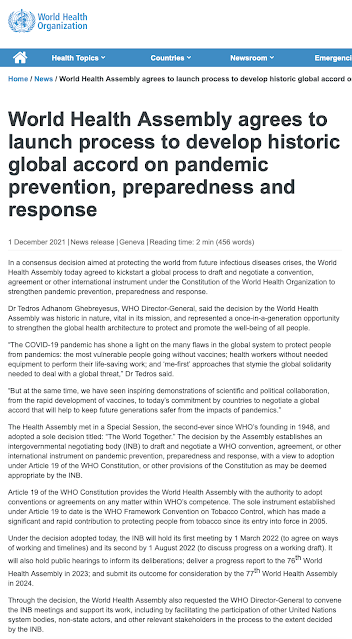
To very little fanfare, on November 28, 2021, the World Health Organization announced that a Special Session of the World Health Assembly had begun the process of establishing an intergovernmental body also known as an INB with the goal of addressing the gaps in preventing, preparing for and responding to health emergencies.  This was only the second time that the Health Assembly had met in a Special Section since the WHO was founded in 1948.   Here is the announcement:


Here's what the World Health Organization's Director-General had to say about the announcement:


"The COVID-19 pandemic has shone a light on the many flaws in the global system to protect people from pandemics: the most vulnerable people going without vaccines; health workers without needed equipment to perform their life-saving work; and ‘me-first’ approaches that stymie the global solidarity needed to deal with a global threat.


But at the same time, we have seen inspiring demonstrations of scientific and political collaboration, from the rapid development of vaccines, to today’s commitment by countries to negotiate a global accord that will help to keep future generations safer from the impacts of pandemics.


He also stated in his opening remarks to the meeting that:


"COVID-19 has exposed and exacerbated fundamental weaknesses in the global architecture for pandemic preparedness and response: Complex and fragmented governance; Inadequate financing; and insufficient systems and tools. Voluntary mechanisms have not solved these challenges.


The best way we can address them is with a legally binding agreement between nations; an accord forged from the recognition that we have no future but a common future."


The agreement or convention will be adopted under Article 19 of the WHO Constitution which reads as follows:


"The Health Assembly shall have authority to adopt conventions or agreements with respect to any matter within the competence of the Organization. A two-thirds vote of the Health Assembly shall be required for the adoption of such conventions or agreements, which shall come into force for each Member when accepted by it in accordance with its constitutional processes..."


The only instrument established to date under Article 19 is the WHO Framework Convention on Tobacco Control which is dated in 2003 as shown here:


Let's now look at the Provisional Agenda from the World Health Assembly's Second Special Session as noted at the beginning of this posting:


Given the draconian response to the pandemic by certain nations, it isn't terribly surprising to see Australia, Canada, New Zealand, the United Kingdom and the United States among the nations proposing the establishment of an intergovernmental negotiating body for pandemic prevention, preparedness and response.  It also is not surprising to see that the United Nations is using its World Health Organization to further promote its agenda of a global parliamentary body where national governments take a back seat to the diktats issued by a United Nations-led global government.


The INB will hold its first meeting by March 1, 2022 and its second by August 1, 2022 and will deliver a progress report to the 76th World Health Assembly in 2023


Here are some key excerpts from the establishing document:


1.) Acknowledging the need to address gaps in preventing, preparing for, and responding to health emergencies, including in development and distribution of, and unhindered, timely and equitable access to, medical countermeasures such as vaccines, therapeutics and diagnostics, as well as strengthening health systems and their resilience with a view to achieving UHC (universal health care).


2.) Emphasizing the need for a comprehensive and coherent approach to strengthen the global health architecture, and recognizing the commitment of Member States to develop a new instrument for pandemic prevention, preparedness and response with a whole-of-government and whole-of-society approach, prioritizing the need for equity.


3.) Stressing that Member States should guide their efforts to develop such an instrument by the principle of solidarity with all people and countries, that should frame practical actions to deal with both causes and consequences of pandemics and other health emergencies.


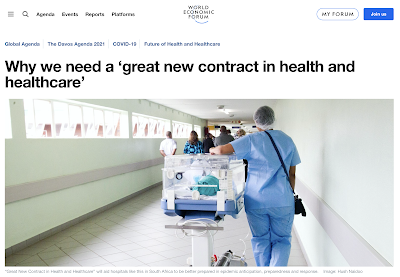
This legally binding treaty will give the World Health Organization unfettered powers during an outbreak of infectious disease.  We need to remember that the WHO is substantially funded by Bill Gates, the world's self-annointed czar of vaccines (not to mention purveyor of flawed and virus-prone software) as well as its close links to the World Economic Forum, the purveyor the Great Reset and promoter of a "great new contract in health and healthcare" and its mantra of "building a new immune system for the world", another version of the WHO's global health accord as announced here:


...and quoted here which looks very much like the aims of the WHO's health accord (my bold):


"We count on the commitment of all Forum stakeholders to embrace the Great New Contract for Health and Healthcare and join the collaborative platform we will remember years from now for the positive impact it will make in the fields of epidemic anticipation, preparedness and response."


Under the new global health reality proposed by the WHO, the world's response to a future pandemic will be dictated to the world by a group of unelected health bureaucrats who do not necessarily hold the best interests of humanity at the forefront.  It will be this group that will ultimately have control over the  response to a future pandemic including the shuttering of businesses and schools, preventing us from socializing with family and friends, restricting travel and, perhaps most frightening of all, be responsible for the issuance and further implementation of a digital identification which will be used to control every aspect of our lives.


Happy 2022!


Monday, November 15, 2021

Bill Gates, the World Economic Forum and the Prescient Pandemic Roadmap

Over the past 18 months, it has become increasingly clear that a cabal including the World Economic Forum and its leader Klaus Schwab and Bill Gates, purveyor of virus-prone software are key links in the COVID-19 "chain".  While you, like me, may be thinking that this is a recent occurrence, in fact, a rather obscure document from 2016 shows something quite different and gives us a sense of how Gates and his cronies have been planning for a global pandemic for years.


To put everything into perspective, we need a bit of background.  A group called the Coalition for Epidemic Preparedness or CEPI was launched in 2017 with this mission:


CEPI is a Norwegian Association which has 12 voting board member with eight representing various competencies including industry, global health, science, resource mobilization and four investors.


Speaking of investors, here are CEPI's original and current financial backers:


And, like a steaming dog turd on a cold sidewalk, we find Bill Gates.  This is not terribly surprising given this world-renowned untrained vaccinologist's fixation with all things vaccine-related. 


Here are the Gates Foundation's funding pledges to CEPI for the period from 2017 to 2022:


With that background into CEPI, let's look at the document that I referred to at the beginning of this posting, CEPI's Preliminary Business Plan 2017 - 2021:


Here is a key quote about CEPI's pandemic business plan:


"CEPI – the Coalition for Epidemic Preparedness Innovations – will tackle the barriers to epidemic vaccine development, advancing safe, effective, and affordable vaccines to contain outbreaks at the earliest possible stage. It will give us the joint global insurance policy we need, helping the populations most at risk and making us all safer."


Here's what CEPI will offer the world keeping in mind that EID stands for Epidemic Infectious Diseases:


"CEPI will stimulate, finance and co-ordinate vaccine development against emerging infectious diseases with epidemic potential, especially in cases where market incentives alone do not achieve this.


CEPI will coordinate resources from industry, academia, governments, philanthropies, and NGOs to facilitate the advanced development of vaccines for emerging infectious diseases with epidemic potential (EIDs). CEPI will focus on development and manufacturing platforms that can be used against a range of known and unknown EIDs.


CEPI takes an end-to-end approach to vaccine development, with an initial focus on two priorities: 1. moving new vaccines through late preclinical studies to proof of concept and safety in humans, and 2. supporting vaccine platforms that can be rapidly deployed against known and unknown pathogens.


CEPI will assess the feasibility of vaccine development against priority pathogens identified by the WHO R&D blueprint and other processes and fund vaccine preparedness efforts accordingly. CEPI will fund and coordinate activities including late-stage preclinical development, clinical Phase I and II safety and efficacy trials with pilot stockpiles and regulatory pathway and Phase III clinical trial planning for outbreaks. CEPI will also coordinate with independent early discovery groups, R&D funders, and vaccine procurement and delivery organizations such as Gavi."


Here are CEPI's strategic pandemic objectives and outputs:


Here is a graphic showing the current technologies that CEPI believes will provide future vaccines, noting in particular the DNA technology:


...and here:


Here is the role that CEPI believes it will play in the "next pandemic" and how it links to other key players in the process of discovering, developing, manufacturing and stockpiling a new vaccine, noting that GAVI is another playground for Bill Gates' funding:


This next graphic is one of the more interesting graphics in the report.  It shows the research and development and regulatory pathway for a new vaccine:


It is quite interesting to note that, back in 2016, CEPI stated that during a pandemic, a new vaccine was to receive "Conditional approval for emergency use", was to be stockpiled after Phase IIa studies and was to be used during an outbreak under Emergency Use Assessment Listings at the same time as fast-tracked Phase III trials were being undertaken, mimicking very closely what has happened during the COVID-19 pandemic.


Now, let's look at the all-important bottom line.  Of course, being Bill Gates, you never do anything without a return on your investment:


...and again here:


...and, once again, here:


Nothing is ever given away for free in Bill Gate's world, not even what passes for "charity/philanthropy".


It is fascinating to see that, way back in 2016, Bill Gates and his ruling class peers including the World Economic Forum, had a plan in place for the next global pandemic.  It is also quite interesting to note that the response to the current pandemic has quite closely followed the response proposed by CEPI, the WEF and Bill Gates and that a return on investment for CEPI's/his efforts was a requirement of CEPI's participation.


As I have repeatedly said, particularly during the pandemic, just follow the money and the story behind the story will come into view.  Ask yourself this one simple question:


"Who is benefitting from the global response to the pandemic?"  


As you can see from this posting, it's almost as though CEPI, the World Economic Forum and Bill Gates were dictating the response to the current pandemic to benefit themselves and the global elite, isn't it?


Monday, October 18, 2021

How Bill Gates' Investment Portfolio Shows His Climate Hypocrisy

Bill Gates, the world's foremost untrained climatologist (among other skills) has made it quite clear to the useless eaters that the world will not survive if we don't wean ourselves from fossil fuels and transfer the economy to a green energy future.  That said and as is often the case, Bill Gates says one thing and does quite another as you will see in this posting.


Let's start out with some background.  While Bill Gates is now not officially linked to Microsoft, having retired from his position on the company's Board of Directors in March 2020, he is still a substantial shareholder, holding a greater percentage of the company's stock than key insiders as shown here:


With Gates' historical links to Microsoft in mind, let's look at one of their products, Microsoft Azure.  Azure  was originally known as Windows Azure and was release to the pubic in February 2010.  Here is the lead page from Azure's website:


Customers innovating with Azure included Chevron, ExxonMobil and Royal Dutch Shell as shown here:


...and here:


Now, let's switch to another aspect of Bill Gates.  Cascade Investments LLC is a Washington-based holding company which is controlled by Gates and contains the assets outside of his Microsoft holdings.  Here are the holdings currently held by Cascade Investments:


In his latest Schedule 13D SEC Filing for Cascade, we find this:


Gates currently owns 77,787,431 shares of Canadian National Railway or 11 percent of the company's total shares issued after apparently transferring 14.1 million shares to ex-wife in early May 2021 as part of their divorce settlement.  In addition, the Bill & Melinda Gates Foundation holds an additional 13,907,283 CN shares as shown here:


Now, let's take a closer look at Canadian National Railway. This is one of CN's core businesses:


Note that one of the products being shipped by CN is oil from Canada's tar sands which are widely regarded as some of the dirtiest oil in the world by climate change promotors.


Here's more about CN and its links to tar sands products:


Here is an excerpt from the company explaining what Canapux are:


"CanaPux™ technology is an innovative and safe way to transport extra-heavy crude, also known as bitumen in Canada. The extra-heavy crude is blended with polymer to form a solid pellet that can be transported to global markets using the same infrastructure as coal or petroleum coke. At the end of their journey the pellets can be re-liquified and the polymer can be separated and reused."


Here is an excerpt from its most recent investor presentation from July 2021 showing the company's heavy involvement in fossil fuels:


So, given Gates' very significant investment in a company whose business model is heavily reliant on the transportation of those nasty greenhouse gas-creating substances and his investment in Microsoft and its Azure product which is designed to help oil companies become more efficient, we can clearly see another case of hypocrisy when it comes to Gates' public views on global climate change that he is trying to foist on those of us who should be eating weeds and insects so that there is plenty of beef for him to partake of without further damaging Planet Earth.