Showing posts with label World Health Organization. Show all posts

Sunday, January 14, 2024

Davos 2024 and Disease X - Raising the Spectre of the Next Pandemic

At this year's edition of the ruling class's love fest (aka the Davos circle jerk), there is one fascinating session that is taking place on January 17th under the WEF's "A Long-term Strategy for Climate, Nature and Energy" group of sessions.  It is particularly interesting given what the world has been through after the Event 201 pandemic exercise took place on October 18, 2019 in which the WEF took part as shown here:


Here is the program background for the session about Disease X from the WEF website:


So, our overlords are already planning for "Disease X", a disease that "could result in 20 times more fatalities" than the COVID-19 plandemic.  You'll note that the head of the World Health Organization and chief global promoter of the COVID-19 pandemic narrative, Tedros Ghebreyesus and the Chair of the Board of AstraZeneca Michel Demare are taking part in the session because, after all, they have nothing to gain by pandemic fear mongering, do they?


Back in November 2022, the World Health Organization was already raising the spectre of the next pandemic in which it invoked the term "Disease X" as an unknown pathogen that could cause a serious international epidemic as shown here:


Let's look even further down the Disease X rabbit hole as shown here:


Here is the text of House Resolution 3832 which was introduced on June 5, 2023:


For those of you who aren't aware, BARDA stands for the Biomedical Advanced Research and Development Authority which falls under the auspices of the U.S. Department of Health and Human Services:


One of its focuses is its Pandemic Influenza Program as follows:


This fixation by the ruling class on pandemics could be considered rather pathological given that there have only been three pandemics since 1900 (excluding the COVID-19 "pandemic"); the Spanish Flu in 1918, the Asian Flu in 1957, the Hong Kong Flu in 1968 which killed very few individuals.  There were other pandemic threats which included the Swine Flu in 1976, the Russian Flu in 1977 and the Avian Flu in 1997 but none of these three spread beyond restricted regions of the globe.  That said, if there is one thing that the rulers have learned it's that gaslighting the global population by invoking the spectre of a deadly disease is a surefire means to be able to control most of us.


Terrorizing us into perpetual serfdom yet again.


Wednesday, June 7, 2023

Funding the World Health Organization's Pandemic Treaty

While its implementation is pretty much being ignored by the dinosaur media, the World Health Organization's pandemic treaty moves ever closer to being adopted by the elected non thinkers that are in control of the Western world today.  There is one key aspect of the treaty that should be important to all of us given that we, the taxpayers of the world, will be paying for whether we like it or not.


Let's start by looking at the background of the pandemic treaty known internally as the "WHO convention, agreement or other international instrument on pandemic prevention, preparedness and response" aka WHO CA+ and why the World Health Organization believes that its implementation is a necessity:


"In recognition of the catastrophic failure of the international community in showing solidarity and equity in response to the coronavirus disease (COVID-19) pandemic, the World Health Assembly convened a second special session in December 2021, where it established an Intergovernmental Negotiating Body (INB) open to all Member States and Associate Members (and regional economic integration organizations as appropriate) to draft and negotiate a WHO convention, agreement or other international instrument on pandemic prevention, preparedness and response, with a view to its adoption under Article 19, or under other provisions of the WHO Constitution as may be deemed appropriate by the INB."


Obviously, implementing this formidable pandemic treaty will require ongoing funding.  Under Article 19 "Sustainable and predictable financing" of the Zero Draft of the WHO CA+ , we find this with my bolds:


"1. The Parties recognize the important role that financial resources play in achieving the objective of the WHO CA+ and the primary financial responsibility of national governments in protecting and promoting the health of their populations. In that regard, each Party shall:


(a) cooperate with other Parties, within the means and resources at its disposal, to raise financial resources for effective implementation of the WHO CA+ through bilateral and multilateral funding mechanisms;


(b) plan and provide adequate financial support in line with its national fiscal capacities for: (i) strengthening pandemic prevention, preparedness, response and recovery of health systems; (ii) implementing its national plans, programmes and priorities; and (iii) strengthening health systems and progressive realization of universal health coverage;


(c) commit to prioritize and increase or maintain, including through greater collaboration between the health, finance and private sectors, as appropriate, domestic funding by allocating in its annual budgets not lower than 5% of its current health expenditure to pandemic prevention, preparedness, response and health systems recovery, notably for improving and sustaining relevant capacities and working to achieve universal health coverage; and


(d) commit to allocate, in accordance with its respective capacities, XX% of its gross domestic product for international cooperation and assistance on pandemic prevention, preparedness, response and health systems recovery, particularly for developing countries, including through international organizations and existing and new mechanisms."


Notice that under subsection (d), the zero draft does not specify the actual percentage of a nation's GDP that it must commit to spend on pandemic prevention, preparedness and response, rather it is listed as "XX%".  This bears watching as we may find that our rulers have made commitments that are far in excess of what is fiscally reasonable, particularly given the high and growing level of government debt today, to the World Health Organization, a non-elected, non-governmental body that has proven itself to be incompetent during the COVID-19 pandemic and that it functions as the health arm of Bill Gates.


Under the pandemic treaty, signatories will be obliged to spend no less than 5 percent of their current health expenditures on pandemic preparedness.  This will obviously vary by nation since, as shown on these graphics, health expenditures from public sources as a share of total health expenditures vary greatly by nation:


Many nations are already suffering from underfunded or poorly funded public health care systems (i.e. Canada) with wait times, physician and nurse shortages and other negative issues plaguing the health care systems.  The very thought of allocating additional taxpayers' dollars to the World Health Organization should, at the very least, make all of us very angry and we should be insisting that our politicians do not accede to the pandemic treaty since they have already proven themselves to be inept when it comes to effectively operating publicly-funded health care systems.


Tuesday, November 29, 2022

Monkeypox - How the World Health Organization has Taken Political Correctness to the Extreme

Despite the fact that the monkeypox narrative never really took hold of the world and created fear among the sheeple like the COVID-19, the World Health Organization has not been content to let "sleeping monkeys lie".


Here is a recent news release from WHO:


It would appear that the monkeys that WHO officials talked to about the issue made it very clear that they found the use of the word "monkey" in monkeypox highly offensive.


Here are some quotes from the news release:


"Following a series of consultations with global experts, WHO will begin using a new preferred term “mpox” as a synonym for monkeypox. Both names will be used simultaneously for one year while “monkeypox” is phased out.


When the outbreak of monkeypox expanded earlier this year, racist and stigmatizing language online, in other settings and in some communities was observed and reported to WHO. In several meetings, public and private, a number of individuals and countries raised concerns and asked WHO to propose a way forward to change the name."


Given that the news release states that "a number of individuals and countries" raised concerns about the use of the monkeypox label, it would be interesting to know exactly how many individuals and countries actually raised the issue.  One, ten, one hundred, one thousand?  We'll never know.


Considerations for changing the name of the disease that shall no longer be referred to as monkeypox included rationale, scientific appropriateness, the extent of current usage, pronounceability, usability in different languages, the absence of geographical and zoological references and the ease of retrieval of historical scientific information.  According to WHO, assigning new names to existing diseases is "exceptional" and generally takes several years, however, in this case the process was accelerated but we are told not to worry because the process of renaming the disease followed standard procedures.


Following the consultations which included experts from both the medical and scientific communities and classification and statistics advisory committees from government authorities of 45 nations, WHO's Director-General Dr. Tedros Adhanom Gheybreyesus recommends the following:


1.) Adoption of the new synonym mpox in English for the disease. 


2.) Mpox will become a preferred term, replacing monkeypox, after a transition period of one year. This serves to mitigate the concerns raised by experts about confusion caused by a name change in the midst of a global outbreak. It also gives time to complete the ICD update process and to update WHO publications.  


3.) The synonym mpox will be included in the ICD-10 online in the coming days. It will be a part of the official 2023 release of ICD-11, which is the current global standard for health data, clinical documentation and statistical aggregation. 


4.) The term “monkeypox” will remain a searchable term in ICD, to match historic information.


One has to wonder how many million dollars were spent on this exercise given that WHO is supported by the taxes that we remit to our governments, not forgetting that at least some of the cost fell on the shoulders of the Bill & Melinda Gates Foundation as shown here:


This begs the question - how do chickens feel about the term "chickenpox"?  Perhaps WHO should now prioritize the renaming of this disease which has, for decades, stigmatized those wonderful barnyard animals that have provided the world with breasts, wings and eggs since time immemorial.  How about German measles?  Haven't the German people suffered enough prejudice after their ill-advised invasion of Europe and slaughter of the untermenschen living among them?


I think that the World Health Organization has its work cut out for it.


Thursday, January 13, 2022

Has the World Health Organization Capitulated on the Current COVID-19 mRNA Vaccines?

An absolutely fascinating interim statement from the World Health Organization on January 11, 2022 really helps put the global response to the COVID-19 pandemic into perspective.


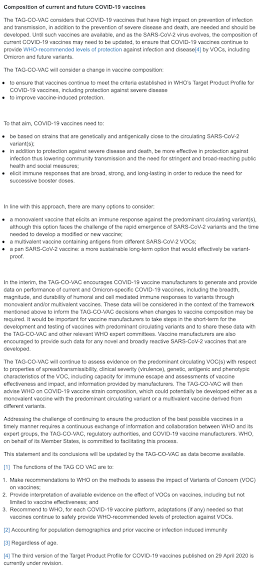
Here is the headline of the document:


Let's pick out some of the most salient points from the interim statement with the key phrases and sentences highlighted:


1.) Right in the introduction, we find this:


"In the context of the circulation of Omicron SARS-CoV-2 Variant of Concern, the TAG-CO-VAC urges broader access globally to current COVID-19 vaccines for primary series and booster doses, in the hope that this also mitigates the emergence and impact of new VOCs (Variants of Concern)".


The WHO certainly has  high "hopes" but is far from certain that the current vaccines and boosters will prevent the emergence and impact of new VOCs, something that you won't hear from your local media or politician.


2.) "With available COVID-19 vaccines, the current focus remains on reducing severe disease and death, as well as protecting health systems. Vaccines that have received WHO Emergency Use Listing, across several vaccine platforms, provide a high level of protection against severe disease and death caused by VOCs. For the Omicron variant, the mutational profile and preliminary data indicate that vaccine effectiveness will be reduced against symptomatic disease caused by the Omicron variant, but protection against severe disease is more likely to be preserved. However, more data on vaccine effectiveness, particularly against hospitalization, severe disease, and death are needed, including for each vaccine platform and for various vaccine dosing and product regimens."


It has baffled me how organizations and politicians can claim that the current vaccines protect against severe disease when there is no way of knowing how severely a given individual will react to being infected.


3.) The World Health Organization then claims that COVID-19 vaccines need to:


a.) be based on strains that are genetically and antigenically close to the circulating SARS-CoV-2 variant(s);


b.) in addition to protection against severe disease and death, be more effective in protection against infection thus lowering community transmission and the need for stringent and broad-reaching public health and social measures;


c.) elicit immune responses that are broad, strong, and long-lasting in order to reduce the need for successive booster doses.


Obviously, from this statement, the WHO is offering a severe condemnation of the current vaccines at preventing transmission, the traditional "job" of a vaccine.  Over the past few weeks, it has become very apparent that the current vaccines have failed at preventing community transmission and are, most certainly, do not provide long-lasting protection unless one happens to think that a few months (or even less) is "long-lasting".  As for boosters, the use of additional doses of COVID-19 vaccines seems to be the fallback position of just about every politician today.  Perhaps it would be wise for them to at least consider what the World Health Organization is saying about the failure of the current vaccines before they open their mouths and spew non-scientific nonsense.


4.) Here are the World Health Organization's recommendations/demands for future COVID-19 vaccines:


a.) a monovalent vaccine that elicits an immune response against the predominant circulating variant(s), although this option faces the challenge of the rapid emergence of SARS-CoV-2 variants and the time needed to develop a modified or new vaccine;


b.) a multivalent vaccine containing antigens from different SARS-CoV-2 VOCs;


c.) a pan SARS-CoV-2 vaccine: a more sustainable long-term option that would effectively be variant-proof. 


The lack of a multivalent vaccine (vaccines that protect against more than one variant of the SARS-CoV-2 virus) is definitely problematic and goes some way to explaining the recent rapid rise in cases among the fully vaccinated and doesn't even seem to have been considered by the manufacturers of the current vaccines (at least not publicly), perhaps because of the haste to get a not-fully-tested product into the arms of human beings.  Interestingly, back in January 21, 2021 as the vaccines were just rolling out, an article in Nature presciently outlined that exact issue:


"Laboratories worldwide are racing to understand the threat that emerging coronavirus variants pose for vaccines. But early insights from these studies are mixed and incomplete. A variant identified in late 2020 in South Africa, called 501Y.V2 (also known as variant B.1.351), is among the most worrying. Lab assays have found that it carries mutations that sap the potency of virus-inactivating ‘neutralizing antibodies’ that were made by people who received either the Pfizer or Moderna RNA vaccines.


Whether these changes are enough to lower the effectiveness of those vaccines is not clear, says Subbarao. “That is the million-dollar question, because we don’t know how much antibody you need.” Other immune responses that vaccines prompt might help to protect against the effects of variants.


But on 28 January, biotech firm Novavax released data from clinical trials showing that its experimental vaccine, designed to combat the original virus, was about 85% effective against a variant identified in the United Kingdom — but less than 50% effective against 501Y.V2. That drop is concerning, say researchers, because it indicates that 501Y.V2 and other variants like it can cause a significant drop in vaccines’ effectiveness.


“I think it’s inevitable for the vaccines to maintain tip-top efficacy, they will need to be updated. The only question is how often and when,” says Paul Bieniasz, a virologist at the Rockefeller University in New York City..."


Lastly, here is one of the key phrases in the document:


"With near- and medium-term supply of the available vaccines, the need for equity in access to vaccines across countries to achieve global public health goals, programmatic considerations including vaccine demand, and evolution of the virus, a vaccination strategy based on repeated booster doses of the original vaccine composition is unlikely to be appropriate or sustainable."


According to the World Health Organization, a booster-based response to the pandemic is neither appropriate nor is it sustainable, something that must really concern Big Pharma whose entire business model over the past 18 months has been COVID-19 vaccine-based.


Just in case it should happen to disappear from the internet, here is a screen capture showing the entire Interim Statement which I have archived here:


From the wording of this interim statement from the World Health Organization, it would almost appear that they have capitulated in the battle against the SARS-CoV-2 virus using mRNA technology which is clearly proving to be a less that satisfying solution to the pandemic.


Addendum:


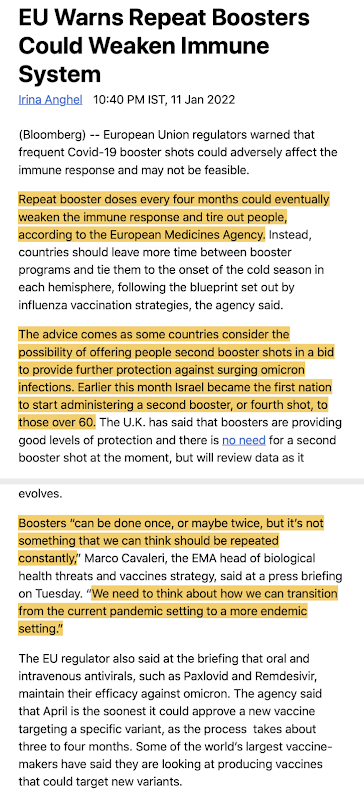
This was reported on Bloomberg on January 11, 2022 quoting from the European Medicines Agency:


Friday, December 31, 2021

The World Health Organization and the Next Global Pandemic

With 2021 having been the year of the COVID-19 pandemic, let's close out this rather dystopic year with a look at what lies ahead for the world if the World Health Organization (aka the Bill Gates Health Organization) gets its way.


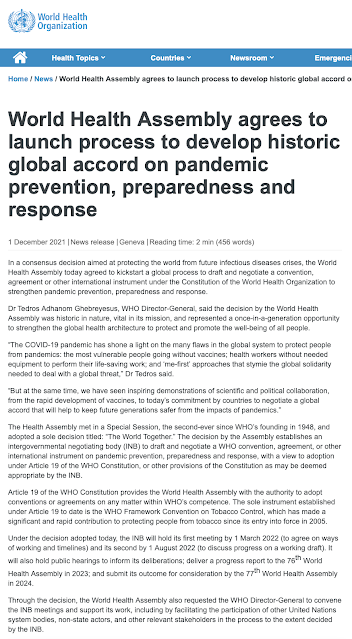
To very little fanfare, on November 28, 2021, the World Health Organization announced that a Special Session of the World Health Assembly had begun the process of establishing an intergovernmental body also known as an INB with the goal of addressing the gaps in preventing, preparing for and responding to health emergencies.  This was only the second time that the Health Assembly had met in a Special Section since the WHO was founded in 1948.   Here is the announcement:


Here's what the World Health Organization's Director-General had to say about the announcement:


"The COVID-19 pandemic has shone a light on the many flaws in the global system to protect people from pandemics: the most vulnerable people going without vaccines; health workers without needed equipment to perform their life-saving work; and ‘me-first’ approaches that stymie the global solidarity needed to deal with a global threat.


But at the same time, we have seen inspiring demonstrations of scientific and political collaboration, from the rapid development of vaccines, to today’s commitment by countries to negotiate a global accord that will help to keep future generations safer from the impacts of pandemics.”


He also stated in his opening remarks to the meeting that:


"COVID-19 has exposed and exacerbated fundamental weaknesses in the global architecture for pandemic preparedness and response: Complex and fragmented governance; Inadequate financing; and insufficient systems and tools. Voluntary mechanisms have not solved these challenges.


The best way we can address them is with a legally binding agreement between nations; an accord forged from the recognition that we have no future but a common future."


The agreement or convention will be adopted under Article 19 of the WHO Constitution which reads as follows:


"The Health Assembly shall have authority to adopt conventions or agreements with respect to any matter within the competence of the Organization. A two-thirds vote of the Health Assembly shall be required for the adoption of such conventions or agreements, which shall come into force for each Member when accepted by it in accordance with its constitutional processes..."


The only instrument established to date under Article 19 is the WHO Framework Convention on Tobacco Control which is dated in 2003 as shown here:


Let's now look at the Provisional Agenda from the World Health Assembly's Second Special Session as noted at the beginning of this posting:


Given the draconian response to the pandemic by certain nations, it isn't terribly surprising to see Australia, Canada, New Zealand, the United Kingdom and the United States among the nations proposing the establishment of an intergovernmental negotiating body for pandemic prevention, preparedness and response.  It also is not surprising to see that the United Nations is using its World Health Organization to further promote its agenda of a global parliamentary body where national governments take a back seat to the diktats issued by a United Nations-led global government.


The INB will hold its first meeting by March 1, 2022 and its second by August 1, 2022 and will deliver a progress report to the 76th World Health Assembly in 2023


Here are some key excerpts from the establishing document:


1.) Acknowledging the need to address gaps in preventing, preparing for, and responding to health emergencies, including in development and distribution of, and unhindered, timely and equitable access to, medical countermeasures such as vaccines, therapeutics and diagnostics, as well as strengthening health systems and their resilience with a view to achieving UHC (universal health care).


2.) Emphasizing the need for a comprehensive and coherent approach to strengthen the global health architecture, and recognizing the commitment of Member States to develop a new instrument for pandemic prevention, preparedness and response with a whole-of-government and whole-of-society approach, prioritizing the need for equity.


3.) Stressing that Member States should guide their efforts to develop such an instrument by the principle of solidarity with all people and countries, that should frame practical actions to deal with both causes and consequences of pandemics and other health emergencies.


This legally binding treaty will give the World Health Organization unfettered powers during an outbreak of infectious disease.  We need to remember that the WHO is substantially funded by Bill Gates, the world's self-annointed czar of vaccines (not to mention purveyor of flawed and virus-prone software) as well as its close links to the World Economic Forum, the purveyor the Great Reset and promoter of a "great new contract in health and healthcare" and its mantra of "building a new immune system for the world", another version of the WHO's global health accord as announced here:


...and quoted here which looks very much like the aims of the WHO's health accord (my bold):


"We count on the commitment of all Forum stakeholders to embrace the Great New Contract for Health and Healthcare and join the collaborative platform we will remember years from now for the positive impact it will make in the fields of epidemic anticipation, preparedness and response."


Under the new global health reality proposed by the WHO, the world's response to a future pandemic will be dictated to the world by a group of unelected health bureaucrats who do not necessarily hold the best interests of humanity at the forefront.  It will be this group that will ultimately have control over the  response to a future pandemic including the shuttering of businesses and schools, preventing us from socializing with family and friends, restricting travel and, perhaps most frightening of all, be responsible for the issuance and further implementation of a digital identification which will be used to control every aspect of our lives.


Happy 2022!


Monday, October 25, 2021

India's Experience with Ivermectin

Back in May 2021, a fascinating article appeared on the World Health Organization's website.  Given that WHO is more-or-less following Bill Gates' COVID-19 pro-vaccine narrative, this article is of particular interest.  Given a recent comment offered by a reader regarding my recent posting on the confusion surrounding the use of ivermectin as a solution to the COVID-19 pandemic , I felt that this information was particularly pertinent.


Here is the article:


As background, Uttar Pradesh is located in the far northeast corner of India and is located on the border with Nepal.  It has an estimated population of 241 million people (2021 estimate), roughly one-sixth of India's total population.  To help battle the COVID-19 pandemic, 141,610 Indian government teams circulated through 97,941 villages throughout Uttar Pradesh for a five day period beginning on May 5, 2021 as the pandemic seemed to be out of control with planning support and training for the effort being provided by the World Health Organization.  The members of each team tested everyone with COVID-19 symptoms using Rapid Antigen Tests. 


Here is the key sentence in the article:


"Those with symptoms are tested and given medicine kits and information on quarantining and isolation, both at home and in hospitals."


While the article does mention that people without COVID-19 were urged to get vaccinated to prevent transmission of the virus, it is interesting to note that those who were tested because they were showing symptoms of COVID-19 were given "medicine kits".  


Unfortunately, the WHO article doesn't tell us what is in these medicine kits, however, an article on MSN (Microsoft Network) dated May 12, 2021 which is sourced from The Indian Express, an Indian media company which publishes newspapers in a selection of major Indian cities, provides us with two of the contents of these kits as shown on this screen capture:


Here is the original article from The Indian Express:


Here are some quotes from the news article with my bolds:


"A year after the country’s first Covid-19 cluster, with 5 cases, was reported in Agra district, the Uttar Pradesh government has claimed that it was the first state to have introduced a large-scale “prophylactic and therapeutic” use of Ivermectin and added that the drug helped the state to maintain a lower fatality and positivity rate as compared to other states.


Citing the results from Agra in the month of May and June last year, following which the use of Ivermectin, a medicine to treat parasitic ailments, along with Doxycycline was introduced as a protocol across the state for both prophylactic as well as treatment purposes, the state Health Department said it would conduct a controlled study once the second wave of the pandemic subsides...


Uttar Pradesh was the first state in the country to introduce large-scale prophylactic and therapeutic use of Ivermectin. In May-June 2020, a team at Agra, led by Dr Anshul Pareek, administered Ivermectin to all RRT team members in the district on an experimental basis. It was observed that none of them developed Covid-19 despite being in daily contact with patients who had tested positive for the virus,” Uttar Pradesh State Surveillance Officer Vikssendu Agrawal said.


He added that based on the findings from Agra, the state government sanctioned the use of Ivermectin as a prophylactic for all the contacts of Covid patients and later cleared the administration of therapeutic doses for the treatment of such patients.


Claiming that timely introduction of Ivermectin since the first wave has helped the state maintain a relatively low positivity rate despite its high population density, he said, “Despite being the state with the largest population base and a high population density, we have maintained a relatively low positivity rate and cases per million of population”. 


He said that apart from aggressive contact tracing and surveillance, the lower positivity and fatality rates may be attributed to the large-scale use of Ivermectin use in the state, adding that the drug has recently been introduced in the National Protocol for Covid treatment and management. “Once the second wave subsides, we would conduct our own study as there has been an emerging body of evidence to substantiate our timely use of Ivermectin from the first wave itself,” Vikasendu told The Indian Express.


Isn't that interesting?  Given that ivermectin is almost never used in cases of COVID-19 in the developed world, India's experience with the anti-parasitic drug has been a great success as you can see on this graphic:


From a peak of 37,944 daily new cases of COVID-19 on April 24, 2021, Uttar Pradesh saw its daily new cases drop to 694 on June 7, 2021 and a further drop to only 11 new cases on October 20, 2021.


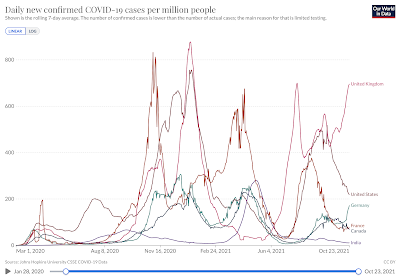
In closing, here is a graphic from Our World in Data showing how India's successful use of ivermectin has resulted in a daily new confirmed COVID-19 case per million load that is far lower that other major developed economies where ivermectin is not widely used as a treatment option:


Doesn't this make you wonder why the developed nations of the world are so reluctant to use ivermectin in the battle against COVID-19?  I suspect that some of you already know the answer to that question.  Given that Microsoft covered India's successful use of Ivermectin back in early May 2021, it simply must be true since they are part of the technocracy that is very carefully guarding the COVID-19 narrative so that the useless eaters are not exposed to disinformation of any type, particularly regarding treatments that do not involve experimental vaccines.


Friday, October 22, 2021

The Confusing Message About Ivermectin

Since the early days of the pandemic, one drug that has been used to solve the "COVID-19 puzzle" has been the object of scorn from the left-leaning mainstream media since it doesn't involve the use of expensive, experimental vaccines brought to the world by Big Pharma.  This has become particularly evident since Joe Rogan brought his use of ivermectin during his experience with COVID-19 to the forefront, creating a sh!tstorm of criticism from the mainstream media which gleefully refers to ivermectin as "horse paste" or "horse dewormer".  In this posting, I want to provide a bit of interesting trivia about ivermectin which actually appears on the website of the National Institutes for Health of which Fauci's National Institute of Allergy and Infectious Diseases (NIAID) is a part, one of 27 Institutes or Centers which make up the NIH.


Let's open with this information on ivermectin from the NIH website regarding the use of the "wonder drug" in humans:


"There are few drugs that can seriously lay claim to the title of ‘Wonder drug’, penicillin and aspirin being two that have perhaps had greatest beneficial impact on the health and wellbeing of Mankind. But ivermectin can also be considered alongside those worthy contenders, based on its versatility, safety and the beneficial impact that it has had, and continues to have, worldwide—especially on hundreds of millions of the world’s poorest people. Several extensive reports, including reviews authored by us, have been published detailing the events behind the discovery, development and commercialization of the avermectins and ivermectin (22,23-dihydroavermectin B), as well as the donation of ivermectin and its use in combating Onchocerciasis and lymphatic filariasis.  However, none have concentrated in detail on the interacting sequence of events involved in the passage of the drug into human use....


Ivermectin proved to be even more of a ‘Wonder drug’ in human health, improving the nutrition, general health and wellbeing of billions of people worldwide ever since it was first used to treat Onchocerciasis in humans in 1988. It proved ideal in many ways, being highly effective and broad-spectrum, safe, well tolerated and could be easily administered (a single, annual oral dose). It is used to treat a variety of internal nematode infections, including Onchocerciasis, Strongyloidiasis, Ascariasis, cutaneous larva migrans, filariases, Gnathostomiasis and Trichuriasis, as well as for oral treatment of ectoparasitic infections, such as Pediculosis (lice infestation) and scabies (mite infestation).  Ivermectin is the essential mainstay of two global disease elimination campaigns that should soon rid the world of two of its most disfiguring and devastating diseases, Onchocerciasis and Lymphatic filariasis, which blight the lives of billions of the poor and disadvantaged throughout the tropics. It is likely that, throughout the next decade, well over 200 million people will be taking the drug annually or semi-annually, via innovative globally-coordinated Mass Drug Administration (MDA) programmes."


In reading the entire article, ivermectin has successfully been used in humans for nearly three decades and, since 1988, has not just been used as "horse paste".


With that in mind, let's now look at with this tweet from the U.S. Food and Drug Administration from August 2021:


Here's another weigh in on ivermectin from the FDA:


As a viable and preferred option to ivermectin, not surprisingly, here's what the FDA recommends to prevent COVID-19 even though none of the vaccines prevent transmission:


"The most effective ways to limit the spread of COVID-19 include getting a COVID-19 vaccine when it is available to you and following current CDC guidance."


The World Health Organization has also weighed into the ivermectin controversy as shown here:


According to the WHO's guidance, ivermectin is only supposed to be used to treat COVID-19 within clinical trials.


Now, let's look at what the NIH has to say about ivermectin in this table regarding the characteristics of antiviral agents that can be used to treat COVID-19:


While the table from the NIH outlining three antivirals which are either approved or under evaluation as treatments for COVID-19, it is, nonetheless, quite interesting to see that "horse paste" makes the list as a potential treatment and would appear to have minimal adverse events associated with its use compared to the myriad of adverse events associated with the use of the mRNA vaccines currently being heavily promoted by public health officials and governments around the world.  Given the haste to which the COVID-19 vaccines were brought to market, it is interesting how slow the drug approval agencies are to provide clearance for the use of the decades-old ivermectin as a treatment for COVID-19, particularly since the use of the drug was proposed by Dr. Pierre Kory during a Senate Homeland Security and Governmental Affairs hearing on December 8, 202 as shown here.


Is is any wonder that the general public is so confused about the most effective treatment options for COVID-19 when even the United States government seems to have difficulty keeping their own narrative straight?  But, then again, how would Big Pharma profit from a drug that costs a few dollars per dose?  Just like other options for treating COVID-19, ivermectin has been turned into a political football, pitting the right against the left.