Showing posts with label artificial intelligence. Show all posts

Wednesday, March 27, 2024

The World Economic Forum, the Fear of Artificial Intelligence in the Workplace and Your Unnecessary Existence

Over the past five years, the global public has become increasingly aware of the World Economic Forum, a collection of global elites who believe that they have the solution to every problem that ails humanity.  With the growth in the importance of artificial intelligence (AI), it's not surprising that the WEF weighs in on this global phenomenon.


In this posting:


...the WEF makes the following observations (with my bolds throughout):


1.) Emerging technologies including AI will disrupt jobs and employees’ skills in the coming years.


2.) Around a fifth of workers in the US say they fear AI will make them obsolete, a phenomenon dubbed “FOBO” (fear of obsolescence).


3.) The World Economic Forum's Future of Jobs report finds that some roles will never be replaced and that AI will lead to job growth in some areas, while upskilling will be key.


The author of the piece, Kate Whiting, Senior Writer for the WEF, then goes on to provide us with the following:


"Imagine waking up one day and finding your job has been automated overnight by intelligent machines. Then you discover even the career you dreamed of pursuing next has already been mastered by AI. 


Quickly, more and more human domains once thought impossible to replicate – art, music, emotion – fall prey to advancing algorithms until all uniquely human talent and purpose dwindles in the face of superior robotic counterparts. Soon your very existence becomes trivial … unnecessary."


It would appear that if anyone should be experiencing FOBO, it's Ms. Whiting because she goes on to inform us that the preceding paragraphs were written by AI.


Here is a graphic from Gallup that shows us the growing percentage of American workers that are concerned about becoming obsolete because of technological advancements:


Gallup and the WEF also note that certain demographics are more concerned about a technological takeover than others:


The author goes on to state the following:


"Is FOBO justified? It largely depends on the profession you’re in as to how many tasks can be automated, but humans will always need to be kept in the loop to some extent – with their work augmented by AI. 


Routine and repetitive tasks are the ones AI is most likely to automate, according to the World Economic Forum’s Jobs of Tomorrow whitepaper, whereas critical thinking and complex problem-solving could be augmented by the technology.


Only 16.1% of an HR manager’s job, for example, shows potential for automation and 22.2% for augmentation, according to the report.


But there are some roles AI will never be able to replace, and in fact, careers in agriculture, education and supply chain and logistics will likely see growth."


I'm not sure about your personal work experience but during my career, I found human resource departments to be an essentially useless appendage with many companies that I worked for totally abandoning the use of HR personnel.


Being the provider of solutions to all problems facing humanity, the WEF provides a solution to the problem of becoming obsolete:


"In the next five years, employees estimate that 44% of workers’ skills will be disrupted, meaning upskilling and life-long learning are now more essential, says the Future of Jobs Report 2023.


The skills most in demand are those that AI can’t replace, including analytical thinking, empathy and active listening, and leadership and social influence.


AI will also create new fields of work, with growing opportunities for: “trainers”, “explainers” and “sustainers”, the Forum’s white paper, Jobs of Tomorrow: Large Language Models and Jobs, found."


Here two summary graphics from the aforementioned WEF white paper on the jobs of tomorrow showing which jobs have the highest potential for large language automation and augmentation:


In an "Editor's Picks" from its website, the WEF makes the following observations about the fear of becoming obsolete in the age of AI:


"As generative AI rapidly evolves, a new fear grips the workforce: FOBO, the Fear of Becoming Obsolete. A recent Gallup survey reveals a 7-point increase since 2021 in US workers who believe new technologies threaten their jobs, reflecting a growing sense of anxiety about AI's impact on the job market. Experts predict that 44% of skills will be disrupted within the next five years, further fueling these concerns.


AI brings opportunities amidst the disruption


However, the rise of AI presents a double-edged sword. While some fear job losses, 50% of organizations anticipate AI-driven job growth. Companies are rapidly adopting generative AI, with specialists in AI and Machine Learning topping the list of fast-growing professions. This suggests that workers can leverage the situation by upskilling themselves in AI.


Human skills remain key


Despite the AI wave, human faculties hold their ground. AI fluency ranks only third on the list of desirable skills by 2027, trailing behind analytical and creative thinking. This underscores the enduring value of uniquely human capabilities, even in an increasingly automated world.


Cautious optimism among workers


Despite the anxieties surrounding FOBO, the overall sentiment towards AI remains positive, as revealed by a global study by PwC. While some express concerns, a third believe it will enhance their productivity and efficiency by freeing them from routine tasks and allowing them to focus on developing more complex and marketable skills."


So, the global ruling class's solution to becoming obsolete is for workers to "upskill".  Is a college graduate worker in their fifties really going to have the ability or desire to upskill when the potential for retirement is only ten to fifteen years away?  Is a worker who didn't graduate from high school going to have the capability or financial resources to upskill in artificial intelligence technology?


Welcome to the WEF's AI-based dystopian future which the global elite claim is the "steam engine of the Fourth Industrial Revolution" as shown here:


You'll do nothing, own nothing and be happy.  Just put up, shut up and eat your insects.


Monday, September 18, 2023

American Workers and Their Fear of Becoming Obsolete

A recent poll by Gallup looks at one of the concerns of a significant percentage of American workers; the fear of job loss.  In particular, we will focus of the fear of job losses related to the implementation of artificial intelligence and other technologies.  This is known as the fear of becoming obsolete or FOBO.


Gallup polled 522 adults throughout August 2023 with 491 of these adults being employed either full- or part-time.  They were asked the following questions:


1.) Please indicate whether you are worried or not worried about each of the following happening to you, personally, in the near future. How about:


a.) that your benefits will be reduced 


b.) that your wages will be reduced 


c.) that your job will become obsolete because of technology 


d.) that you will be laid off 


e.) that your hours at work will be cut back 


f.) that your company will move jobs to countries overseas 


2.) Are you worried that you will be laid off?


3.) Are you worried that your hours at work will be cut back?


4.) Are you worried that your wages will be reduced?


5.) Are you worried that your benefits will be reduced?


6.) Are you worried that your company will move jobs to countries overseas?


7.) Are you worried that your job will become obsolete or unnecessary because of technology?


As I noted above, we will focus on the fear of job loss related to technological advances.  Here is a graphic showing the growing percentage of American workers that are worried that their job will become obsolete because of technology:


Concerns about FOBO have increased from 13 percent in August 2017 to 22 percent in August 2023, an increase of 9 percentage points or 69.2 percent.


The concerns about FOBO vary demographically and have increased over the past two years as shown on this graphic:


Concerns about technologically-driven job obsolescence has grown the most over the past two years among college graduates under the age of 34 with household incomes of less than $100,000.  It's surprising to see that concerns about FOBO is now more-or-less equal among non-college graduates and college graduates when just two short years ago, only 8 percent of college graduates were concerned about technology supplanting their work lives compared to 22 percent of non-college graduates.  


Thanks to Visual Capitalist, we have a clear picture of the American industries that are at the highest potential for automation:


I was rather surprised to see that architecture and engineering were among the most automation vulnerable industries, particularly given the very specific skill sets and extensive education that are required to perform in these industries.  The most ironclad jobs will be among those industries that rely heavily on manual labour (i.e. construction) and while transportation is relatively safe for the time being, jobs will be threatened by the use of AI-driven automation/self-driving vehicles which is expected to impact the trucking industry over the next 5 to 10 years as shown here:


Phase One: will involve a technique called platooning, in which a fleet of trucks will follow a lead truck on the highway


Phase Two: technology will have developed enough to have a human driver in only the lead truck while a convoy of autonomous trucks follows closely behind. Expected by 2025.


Phase Three: the lead trucks are completely autonomous on the highway. However, a human driver will still likely be needed in the lead truck for navigating small roads and loading docks. Expected around 2030.


Phase Four: completely driverless autonomous trucks are on the roads at scale. Optimistic estimates say it will come sometime in the early 2030s, while the more conservative ones say it will take until the end of that decade.”


Let's close with this thought.  With the average cost of college in the United States hitting $36,436 per student per year including tuition and fees, books, supplies and living expenses, one certainly has to question the value of spending four plus years educating oneself after high school.  Perhaps those who take jobs as mechanics, carpenters, electricians and plumbers are the smart ones after all.


Monday, January 16, 2023

ChatGTP and the Great Reset

With the World Economic Forum's concentration on Artificial Intelligence (AI) as the solution to everything that ails the world, I took my first steps into the AI world to help me to better understand what the technology is currently capable of doing.  As such, I signed up so that I could access the ChatGPT (Generative Pre-trained Transformer) chatbot which was launched in late November 2022 by OpenAI.


According to OpenAI, ChatGPT is a chatbot model which has the capability of interacting with humans in a conversational way just as we interact with each other.  ChatGPT is not connected to the internet so its responses to queries are internally generated.  


Here's a quote from OpenAI's website about how ChatGPT was created:


"We’ve trained a model called ChatGPT which interacts in a conversational way. The dialogue format makes it possible for ChatGPT to answer followup questions, admit its mistakes, challenge incorrect premises, and reject inappropriate requests. ChatGPT is a sibling model to InstructGPT, which is trained to follow an instruction in a prompt and provide a detailed response."


We trained this model using Reinforcement Learning from Human Feedback (RLHF), using the same methods as InstructGPT, but with slight differences in the data collection setup. We trained an initial model using supervised fine-tuning: human AI trainers provided conversations in which they played both sides—the user and an AI assistant. We gave the trainers access to model-written suggestions to help them compose their responses. We mixed this new dialogue dataset with the InstructGPT dataset, which we transformed into a dialogue format.


To create a reward model for reinforcement learning, we needed to collect comparison data, which consisted of two or more model responses ranked by quality. To collect this data, we took conversations that AI trainers had with the chatbot. We randomly selected a model-written message, sampled several alternative completions, and had AI trainers rank them. Using these reward models, we can fine-tune the model using Proximal Policy Optimization. We performed several iterations of this process."


Here is a graphic explaining the steps to training ChatGPT:


With that little bit of background, let's look at a sample interaction with ChatGPT.  As I mentioned at the opening of this posting, the World Economic Forum has a fixation on AI, even creating the Global Future Council on the Future of Artificial Intelligence as shown here:


As an exercise, I asked ChatGPT to create a 500 word essay on the negative aspects of the Great Reset, the WEF's other pet project.  Here's what it wrote over a 15 second-long period of time:


"The Great Reset is a term that has been used to describe a proposed global economic and social overhaul that aims to address the issues and challenges arising from the COVID-19 pandemic. While the goals of the Great Reset are commendable, such as reducing inequality and promoting sustainable development, there are also a number of negative aspects that must be considered.


One of the main concerns with the Great Reset is the potential for it to be used as a cover for authoritarianism and the erosion of democratic institutions. The pandemic has provided an opportunity for governments around the world to exert greater control over their citizens, including by limiting civil liberties and increasing surveillance. In some cases, this has been justified as necessary to address the health crisis, but the fear is that these measures will be extended and institutionalized under the guise of the Great Reset.


Another concern is that the Great Reset may lead to increased inequality, rather than reducing it. The most marginalized members of society are often the ones hit hardest by economic downturns, and the Great Reset may exacerbate this. Those at the top of the economic ladder will likely have the resources to recover and may even benefit from the changes, while those at the bottom will be left behind. Moreover, some argue that the Great Reset is a tool for the elite to solidify their power and control over resources, economy and society.


Furthermore, many argue that the Great Reset is focused on promoting an economic model that is not sustainable in the long term. It heavily relies on the expansion of the green economy and the adoption of technologies such as 5G and Artificial Intelligence, but it doesn’t tackle the root causes of environmental problems, such as overconsumption and overproduction. Instead, it might even speed up resource depletion and waste generation, leading to even more environmental problems.


The Great Reset also raises questions about who will control the economic and technological changes it proposes. The private sector will play a central role in the transition to a sustainable economy, but there is a risk that this will lead to corporate capture of the agenda, which will prioritize profits over social and environmental goals.


Additionally, the Great Reset may lead to the loss of jobs and livelihoods as a result of automation and technological change. The shift to a greener economy and the adoption of new technologies will likely require significant changes in the labor market, with many jobs becoming obsolete and new ones being created. However, not everyone will have the skills or resources to adapt, leading to increased unemployment and poverty.


In conclusion, while the Great Reset has the potential to address some of the major issues facing the world today, it also has the potential to create new ones. It is important that the process of implementing the Great Reset is transparent and inclusive, and that the rights and well-being of all members of society are taken into account. There is a need to address the potential negative consequences and make sure that the benefits of the Great Reset are distributed equitably, avoiding exacerbating existing inequalities and environmental problems. Furthermore, the Great Reset's agenda should be held accountable for its actions, ensuring that it serves society and not special interests."


Remember, ChatGPT does not have access to the internet, all of this content is internally generated from what it has learned from its "human handlers".


It's actually pretty hard to argue with ChatGTP's views on the negative aspects of the Great Reset, many of which parallel the concerns about the plan that have been proposed by the "tinfoil hat wearing conspiracy theory crowd".


In a future posting, we'll look at background on OpenAI and help you better understand the role that this organization is playing in the development of Artificial Intelligence and how its leadership views the future.


Tuesday, January 18, 2022

Autonomous Tractors and Farmer-Free Farming

John Deere, one of the companies that has long been associated with the mechanization of farming and the world's second largest manufacturer of agricultural equipment, has now unveiled its latest game-changing farming technology with the revealing of its 8R autonomous tractor.


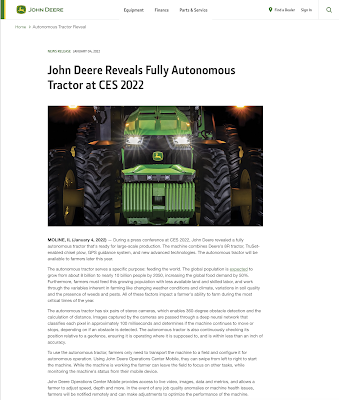
Here is the announcement from the John Deere website:


According to John Deere, the 8R is the first fully autonomous tractor.  The tractor has been in trial since 2018 and will now be released to farmers who will be able to rent the 8R until the company allows farmers to retrofit their existing sub-autonomous 8R tractors.    It is equipped with six pairs of stereo cameras which enable the tractor to detect obstacles over a. 360 degree horizon.  The images that are captured by the stereo cameras are passed through a deep neural network, the standard tool for solving computer vision issues using artificial intelligence techniques.  Each pixel that is captured by the cameras is classified in approximately 100 milliseconds and determines whether the tractor continues to move or stop if an obstacle is detected.  The 8R also checks its position relative to a geofence to ensure that it is operating where it is supposed to with an accuracy of less than one inch.


To use the 8R, farmers will transport the tractor to a field and, using John Deere Operations Center Mobile app, will be able to control and monitor the tractor using their mobile device. The app will also let the farmer control the tractor's speed, depth adjustments and other critical operations from the comfort of their couch or while they are busy with other tasks.  The first autonomous system will allow the farmer to till fields and additional tasks that could be undertaken without an onboard operator are currently under consideration.


Here is a video showing the 8R in operation:


According to John Deere, autonomous tractors have the potential to save farmers money by automating work that is now done by humans, an issue that is becoming increasingly problematic given the shortage of agricultural labourers.  That said, as car manufacturers like Tesla are finding, autonomous vehicles are not always functioning properly and John Deere's Chief Technology Officer, Jahmy Hindman has admitted that the 8R could have difficultly navigating on its own in snow and rain.  As well, the price of these tractors has not yet been released, however, with prices for its other farm equipment being stratospheric, it is likely that only the biggest farming operations (i.e. corporate farms) will be able to afford this technology.  With the list price of a base model 8R 410 (non-autonomous version) running at $517,548 (U.S. dollars), you can be assured that not every farmer in America and around the world will be purchasing the latest in John Deere's technological inventory.  To upgrade to the autonomous version, consumers will add the three camera equipment pods to the front and rear of the tractor and an Nvidia GPU to the 8R 410.  Hindman estimates that the cost for the automous version could add as much as 10 percent to the total cost of the 8R 410.


Nonetheless, this development is playing right into the hands of the largest owner of American farmland.  Not only is Bill Gates a self-proclaimed expert on vaccines and epidemics, he is also a "farmer".  John Deere's 8R autonomous tractor is, most definitely, Farmer Bill Gates' wet dream come true.  No need for farmers on a farm when you have a robot to do all of the dirty work for you!  Farmer-free farming here we come.


Monday, June 7, 2021

Artificial Intelligence, the American Worker and a Universal Basic Income

With the growing talk of official implementation of a universal basic income picking up momentum in the post-pandemic world, a recent development gives us a sense of why governments will be under pressure to ensure the financial security of their citizens.


According to Nation's Restaurant News, McDoncald's CEO Chris Kempczinski told an investor conference being held by AllianceBernstein Strategic Decisions that McDonald's is testing automated voice order-taking at ten drive-through restaurants in the Chicago area.  


Let's look back to September 2019, when McDonald's moved into the voice-based and multi-item conversational ordering technology sector though its acquisition of Apprente as shown here:


Here is a quote from McDonald's press release dated September 10, 2019 outlining the companies rationale for acquiring Apprente:


"Building our technology infrastructure and digital capabilities are fundamental to our Velocity Growth Plan and enable us to meet rising expectations from our customers, while making it simpler and even more enjoyable for crew members to serve guests," said Steve Easterbrook, (then) President and Chief Executive Officer, McDonald's Corporation. "Apprente's gifted team, and the technology they have developed, will form McD Tech Labs, a new group integrated in our Global Technology team that will take our culture of innovation one step further.""


The Apprente team will be the founding member of a new, internal group inside of McDonald's Global Technology Team called McD Tech Labs.  This acquisition builds on the April 2019 acquisition of Dynamic Yield, an artificial intelligence company.  According to Dynamic Yield's CEO, the acquisition:


'....is great news for Dynamic Yield and McDonald’s customers, as well as personalization practitioners everywhere. Dynamic Yield will play a critical role in McDonald’s digital transformation, allowing it to become even more focused on the customer by deploying our technology in outdoor digital Drive-Thru menu displays, as well as other digital customer experience touchpoints, such as self-order kiosks and the McDonald’s Global Mobile App."


Let's go back to the recent revelations made by McDonald's current President and CEO Chris Kempczinski.  He told the investor conference that, while the automated voice-ordering system was 85 percent accurate and can take about 4/5ths of orders in all tests, that it will be some time before the company plans to roll out the system in its 13,673 restaurants (as of December 31, 2020) across the United States and, one has to presume, its 39,198 restaurants around the world. 


Here are some additional quotes from Chris Kempczinski:


"There is a big leap between going from 10 restaurants in Chicago to 14,000 restaurants across the U.S. with an infinite number of promo permutations, menu permutations, dialect permutations, weather — I mean, on and on and on and on.  Do I think in five years from now you're going to see a voice in the drive-thru?  I do, but I don't think that this is going to be something that happens in the next year or so...."


“One of the things that we've learned in our 10 restaurants that we've done it is: How do you train a crew to actually not want to jump in as soon as they hear a question or a pause?  We've had to do a little bit of training of ‘just keep your hands off the steering wheel, let the computer do its work.’”


Kempczinski also noted that staff needed to develop a comfort level with the AI technology: 


“We weren't getting enough of the orders to be actually able to be processed through the voice recognition technology, because as soon as there was a question or a hiccup, the crew had a tendency to just want to jump in. And it took a little bit of time to actually learn to trust the technology.”


Yes, by all means, trust (and learn to love) the technology that is going to put you out of a job.


As shown on this graphic from McDonald's, over the past several years, the company has increased expenditures on technology at the same time as it is reducing General and Administrative (G&A) spending:


Now, let's take a quick look at McDonald's wages for its front line workers (in the United States in U.S. dollars):


Here are the 2020 salaries for the company's Named Executive Officers:


If you were to take the salary of a fast food attendant of $9.83 per hour for a 40 hour week, their before tax income would be $393.20 for a week's work or $20,446.40 for a year's work (no holidays).  At this level, a fast food attendant at McDonalds would have to work for 4.92 years to earn the monthly compensation  (including perquisite and benefits) of $100,560.67 earned by the company's CEO.  And yet the company is looking to replace its front line, low-paid workforce with an AI-equipped automatic ordering system, putting untold thousands of workers out of jobs.  


It's no wonder that there is increasing discussion about a universal basic income.  With technology, particularly artificial intelligence, displacing workers on the low end of the pay scale, the American work force is on the cusp of substantial and permanent changes that will benefit only the few at the top of the salary pyramid.  After all, it's all about profits, isn't it?