Showing posts with label Afghanistan. Show all posts

Sunday, April 23, 2023

China and the Afghanistan Lithium Coup

Here is a recent article that appeared on the Khaama Press News Agency website, an independent news organization which was formed in 2010 to ensure free press and journalism in Afghanistan:


As background, according to Afghanistan's Ministry of Information and Cultures’ analytical data in 2021, Khaama Press was ranked as Afghanistan’s top ranking and number one news website. 


A similar article appeared on the Afghanistan Times news website:


China, a nation whose leadership plays the long-game, is making this move to ensure the security of its supply of lithium, a key component in the global move toward electrification.


Back in 2022, the Brookings Institution took notice of this possibility:


Here is a quote:


"Concern by the United States and its allies about China’s potential push into Afghanistan’s mining sector is well-founded. China is diplomatically and commercially poised to make additional moves in Afghanistan. Beijing is well positioned to strike mining deals with the Taliban. It has kept its diplomatic mission running in Kabul, hinted that it may formally recognize the Taliban government, and voiced opposition to international sanctions against Afghanistan— though has stopped short of trying to lift them. Foreign Minister Wang Yi even made a surprise visit to the country in late March, the highest-ranking foreign official of any country besides Pakistan and Qatar to do so after the Taliban’s rise to power. He denounced “the political pressure and economic sanctions on Afghanistan imposed by non-regional forces.”


Chinese-Afghan mining deals theoretically make sense. Chinese mining companies could provide the Taliban with much-needed cash to soften the blow of a crippling international sanctions program, which has sparked an economic and humanitarian crisis. In exchange, Beijing would get access to a new, bountiful source of minerals critical to the government’s ongoing decarbonization efforts."


In April 2019, this article appeared on the TOLO News website, An Afghani news channel broadcasting from Kabul:


Lithium reserves in Afghanistan were first discovered by scientists from the Soviet Union in the 1980s.  After discovering maps left behind by USSR scientists, the United States Geological Service (USGS) acquired imaging spectrometer data over most of Afghanistan in 2007 to assess the nation's mineral wealth, covering an area of more than 438,000 square kilometres as shown here:


From this data, geologists were able to interpret the geological makeup of the surface minerals.  Rare minerals like lithium, caesium tantalum and niobium occur in three main types of deposits; pegmatites (very coarsely interlocking crystalline igneous rocks that are abundant in quartz, felspar and mica as well as mega-crystals of rare-earth elements), mineralized springs and playa-lake sediments shown on this map:


The most easily extractible resources are located in mineralized spring and playa-lake sediments.  


Here is a map showing the location of rare-metal pegmatites in Afghanistan: 


Here is a table showing rare metal pegmatite reserves in Afghanistan:


While resource assessment is still in the very early stages, it is believed that Afghanistan's reserves of lithium could rival those of Argentina, Bolivia and Chile, the Lithium Triangle Countries or LTCs  which has almost 60 percent of the world's total lithium reserves as shown here:


China is not the only nation in the region that is interested in Afghanistan's lithium resources; India and its massive electronics industry have also been courting Afghanistan's political leaders.


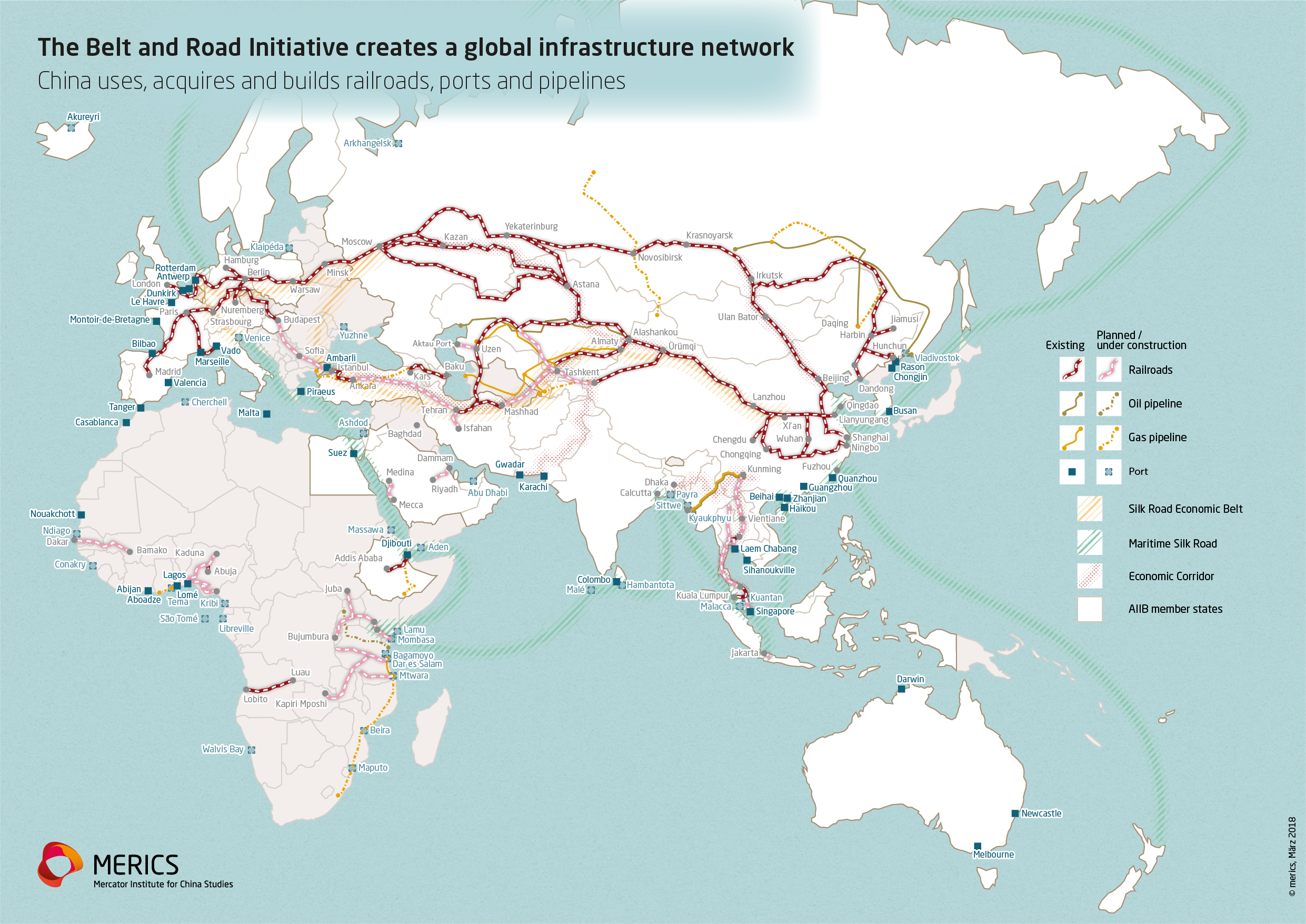
When it comes to protecting its economy and its people, China's leadership is playing the long-game.  The nation uses its economic clout to provide infrastructure and much-needed financial assistance to open doors.  This is in sharp contrast to the United States which uses the threat of financial sanctions and its military might to force nations to hand over their resources.  As you can see on this map, Afghanistan's proximity to China's Belt and Road Initiative is key to understanding why China is so interested in improving diplomatic relations with the war-torn nation:


Monday, May 9, 2022

Women's Rights in Afghanistan - It's 2001 All Over Again

Recent news from Afghanistan is rather sobering given that the United States and its partners spent 20 years in the nation, attempting to install a Western-style democracy in the vacuum created after the Taliban conceded control over the parts of the nation that it ruled with a heavy, conservative Islamic hand.


This news was reported by TOLOnews, Afghanistan's first 24-hour news television network which reports on current affairs, business, regional and world news as quoted here:


"Whether it’s breaking the news, providing in-depth reports or inspiring discussion among Afghanistan’s political leaders, TOLOnews has captured the attention of a nation who want fast, credible and reliable information as it happens, on the ground. Afghanistan’s first 24-hour news and current affairs channel serves Afghans’ growing appetite for the most up to date news, both domestic and international, across broadcast, online and social media platforms. 


An extension of the nation’s most popular channel TOLO TV, TOLOnews’ apolitical format is trusted and respected by audiences, and its programs provide an unparalleled level of in-depth current affairs coverage spanning across Afghanistan’s political, cultural and regional interests.


In Afghanistan, TOLOnews often breaks stories that lead regional and international headlines. More importantly, it is reaching Afghans in remote provinces as well as connecting those in the global diaspora. Boasting the largest newsroom in the country, TOLOnews’ 100 plus news professionals lead the development of the Afghan media industry, which was nonexistent less than a decade ago. Lotfullah Najafizada is the current Director of TOLOnews.


TOLOnews broadcasts in Dari and Pashto, and is available via the internet and social media in English, Dari and Pashto. Its website, www.tolonews.com, is one of the most popular news sites in Afghanistan.


Here is the news item in question dated May 78, 2022:


If you wish, you can watch the news item on TOLOnews' YouTube account here which unfortunately is not in English but will give you a sense of what the supreme leader of the  Islamic Emirate, Malawi Hibatullah Akhundada is announcing for Afghanistan's women:


The video from TOLOnews shows this graphic of acceptable coverings for women which is displayed in shop windows:


Here are some quotes from the announcement with my bolds: 


"A statement from the Vice and Virtue Ministry of the Islamic Emirate reads that hijab is an obligation in Islam and that any dress that covers the body can be considered as hijab given that it is not “thin and tight.” 


When it comes to the type of the covering or hijab that women will need to wear, the statement says that burka is the best type of hijab/covering “as it is part of Afghan culture and it has been used for ages.” It adds that another preferred type of hijab is a long black veil and dress that “should not be thin or tight.” 


The statement, called “the descriptive and accomplishable plan on legitimate hijab,” also instructs women not to step out of home unless it is necessary, calling it one of the best ways of observing hijab.


The plan was announced by the Ministry of Vice and Virtue on Saturday at a press conference in Kabul." 


The plan will be implemented using both encouragement and punishment as follows:


"According to the new plan, if a woman doesn't wear a hijab, first, her house will be located and her guardian will be advised and warned. 


Next, if the hijab is not considered, her guardian will be summoned. If repeated, her guardian (father, brother or husband) will be imprisoned for three days. If repeated again, her guardian will be sent to court for further punishment, the plan reads.  


The statement also said that female public employees will be fired if they don't wear hijab. 


Male public employees will be suspended from their jobs if female members of their families do not wear hijab."


So, basically, under the reimposition of Sharia law, Afghanistan's women are back to where they were in 2001 before the War on Terror officially began on October 7, 2001.


Given the high financial cost of the war in Afghanistan to United States taxpayers as shown here:


...and the high human cost of the war as shown here:


 ...one would have to say that the entire operation has now been proven to be a complete and utter failure for Afghanistan's women who had actually made significant strides during the 20 year period after the Taliban appeared to be defeated.


But, as is typical, the defense industry made billions of dollars of profits thanks to their endless supply of hardware and software designed specifically to maim and kill human beings.  Bravo to them!


Tuesday, August 24, 2021

Can Washington Learn From Its Mistakes in Afghanistan?

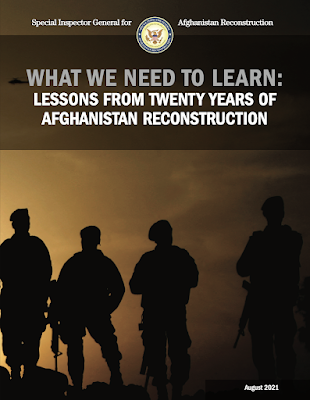
Now that the United States has abandoned its 20 year-long nation building experiment in Afghanistan, the most recent report from the Special Inspector General for Afghanistan (SIGAR) entitled "What We Need to Learn - Lessons From Twenty Years of Afghanistan Reconstruction" seems particularly pertinent:


This is the eleventh "Lessons Learned" report issued by the SIGAR since the Lessons Learned Project was implemented in late 2014.  This report examines the past two decades of reconstruction effort, clearly outlining how Washington struggled to achieve its goals in education, health, rule of law, women's rights, infrastructure and security assistance.


Let's start with this quote from the report's Executive Summary:


"The U.S. government has now spent 20 years and $145 billion trying to rebuild Afghanistan, its security forces, civilian government institutions, economy, and civil society. The Department of Defense (DOD) has also spent $837 billion on warfighting, during which 2,443 American troops and 1,144 allied troops have been killed and 20,666 U.S. troops injured. Afghans, meanwhile, have faced an even greater toll. At least 66,000 Afghan troops have been killed. More than 48,000 Afghan civilians have been killed, and at least 75,000 have been injured since 2001—both likely significant underestimations.


The extraordinary costs were meant to serve a purpose—though the definition of that purpose evolved over time. At various points, the U.S. government hoped to eliminate al-Qaeda, decimate the Taliban movement that hosted it, deny all terrorist groups a safe haven in Afghanistan, build Afghan security forces so they could deny terrorists a safe haven in the future, and help the civilian government become legitimate and capable enough to win the trust of Afghans. Each goal, once accomplished, was thought to move the U.S. government one step closer to being able to depart.


While there have been several areas of improvement—most notably in the areas of health care, maternal health, and education—progress has been elusive and the prospects for sustaining this progress are dubious. The U.S. government has been often overwhelmed by the magnitude of rebuilding a country that, at the time of the U.S. invasion, had already seen two decades of Soviet occupation, civil war, and Taliban brutality."


When the United States undertook its nation-building exercise in Afghanistan, the nation had the following issues:


"Afghans had no experience participating in elections, much less administering them. There was no independent media, and civil society was anemic.  Life expectancy was 56 years, lower than 83 percent of countries at the time.  The mortality rate for children under the age of five was in the bottom 15 percent of countries globally.  Women and girls were officially banned from schools and the workforce. Only 21 percent of eligible children were enrolled in primary school.  Even as late as 2005, 64 percent of Afghan men and boys were illiterate, as were 82 percent of Afghan women and girls."


To assist Afghanistan, the United States government spent billions of dollars running programs with the following rather heady goals:


1.) Train, equip, and pay the salaries for hundreds of thousands of Afghan soldiers and police;


2.) Build a credible electoral process by funding elections, cultivating political parties, and training election officials and observers;


3.) Educate more Afghans, particularly girls and women, by building, repairing, staffing, and equipping schools;


4.) Reintegrate back into society tens of thousands of armed fighters with few other skills, an abundance of weapons, and ample opportunity to resume violence;


5.) Develop the private sector by training entrepreneurs, lowering the costs of starting and running businesses, and creating an environment that would attract foreign and domestic businesses to operate in Afghanistan;


6.) Reduce rampant corruption in the Afghan government to improve its performance and legitimacy;


7.) Reduce the cultivation and trade of poppy and provide alternative livelihoods for Afghan farmers;


8.) Deliver services at the local level so that Afghans in contested territory would come to favor the Afghan government over the Taliban;


9.) Improve the quality and accessibility of health care by building, repairing, staffing, and equipping medical facilities;


10.) Train and empower Afghan officials to sustain the above efforts after the United States departs by collecting their own revenue and effectively managing their own national budget.


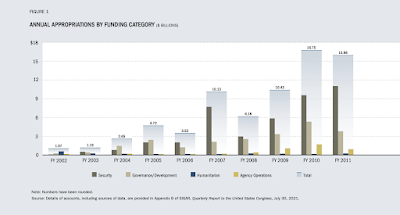
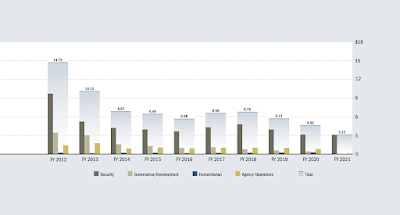
Here's what was spent on each funding category between fiscal 2002 and fiscal 2021:


SIGAR notes that some progress was made as follows:


1.) life expectancy had jumped from 56 years in 2001 to 65 years in 2018


2.) the mortality rate of children under 5 years of age dropped by more than 50 percent


3.) between 2002 and 2009, Afghanistan's per capita GDP nearly doubled and overall GDP nearly tripled even when accounting for inflation, however, the nation's per capita GDP moved from the world's fourth worst to the world's eighth worst.


4.) literacy among 15 to 24 year old males increased by 28 percentage points and 19 percentage points for females between 2005 and 2017.


After more than 760 interviews and reviewing thousands of government documents, SIGAR found that there are seven key lessons that Washington needs to learn before it exports its nation-building "skills" to other conflict zones around the world:


1.) Washington failed to develop a coherent strategy for what it hoped to achieve in Afghanistan - no single agency had the mindset, resources and expertise needed to develop, maintain and manage the efforts to rebuild Afghanistan.  The initial goal of defeating al-Qaeda morphed into the goal of defeating the Taliban which morphed into ridding the nation of corrupt officials who were undermining the American rebuilding efforts.  Here is a graphic showing the growth in the number of enemy-initiated attacks over the period from 2002 to 2020:


2.) Washington failed to understand how long the mission would take - Washington consistently underestimated the amount of time needed to rebuild Afghanistan and the choices made resulted in corruption with American funds ending up in the hands of Afghani powerbrokers.


3.) Washington failed to ensure that the projects were sustainable over the long-term - reconstruction efforts should serve as a foundation for building governments, civil society and commerce indefinitely, however, Washington's efforts were not sustainable over the long-term with billions of tax dollars being wasted as projects were either not used or fell into disrepair.  As well, Afghani nationals and institutions did not have the capacity to take responsibility for managing the projects. 


4.) Washington failed to staff the mission with trained professionals - this was considered by SIGAR to be one of the greatest failures of the mission for both civilian and military personnel.  For example, DoD police advisors watched American television shows to learned about policing and civil affairs teams were created using PowerPoint presentations.  Continuous staff rotations also impeded progress as projects were restarted from scratch and new staff did not learn from the mistakes made by their predecessors.


5.) Washington failed to account for the challenges that were posed by national insecurity - the absence of violence was a precondition for Washington's plans for Afghanistan.  For example, attempts to set up a viable electoral system was made difficult as insecurity spread across the nation, resulting in voters who were intimidated and polling stations that were closed on election days.  American officials were unable to convince rural Afghanis who lived in Taliban-contested areas that there was a benefit to supporting a democratically elected government.


6.) Washington failed to tailor the reconstruction efforts to the Afghani context - a detailed understanding of Afghanistan's social economic and political dynamics was needed to ensure that reconstruction efforts would succeed.  These three dynamics were never understood by U.S. officials who forced Western technocratic models onto Afghan economic institutions, trained local security forces in weapons that they neither understood nor maintain, imposed formal laws on a nation which has traditionally addressed disputes through informal means and struggled to understand the cultural and social barriers that existed for girls and women.


7.) Washington failed to monitor and evaluate the impact of programs - Washington and its representatives in Afghanistan were never able to determine which programs worked and which programs did not.  This was particularly the case in Afghanistan because the environment was complex and unpredictable.  As well, staff turnover was rapid and multiple agencies were needed to coordinate programs, sacristy and access restrictions.  Here is a quote:


"The absence of periodic reality checks created the risk of doing the wrong thing perfectly: A project that completed required tasks would be considered “successful,” whether or not it had achieved or contributed to broader, more important goals."


Let's look at the conclusions of the report:


"This report raises critical questions about the U.S. government’s ability to carry out reconstruction efforts on the scale seen in Afghanistan. As an inspector general’s office charged with overseeing reconstruction spending in Afghanistan, SIGAR’s approach has generally been technical; we identify specific problems and offer specific solutions. However, after 13 years of oversight, the cumulative list of systemic challenges SIGAR and other oversight bodies have identified is staggering. As former National Security Advisor Stephen Hadley told SIGAR, “We just don’t have a post-conflict stabilization model that works. Every time we have one of these things, it is a pick-up game. I don’t have confidence that if we did it again, we would do any better.”


As this report shows, there are multiple reasons to develop these capabilities and prepare for reconstruction missions in conflict-affected countries:


1.) They are very expensive. For example, all war-related costs for U.S. efforts in Afghanistan, Iraq, and Pakistan over the last two decades are estimated to be $6.4 trillion.


2.) They usually go poorly.


3.) Widespread recognition that they go poorly has not prevented U.S. officials from pursuing them.


4.) Rebuilding countries mired in conflict is actually a continuous U.S. government endeavor, reflected by efforts in the Balkans and Haiti and smaller efforts currently underway in Mali, Burkina Faso, Somalia, Yemen, Ukraine, and elsewhere.


5.) Large reconstruction campaigns usually start small, so it would not be hard for the U.S. government to slip down this slope again somewhere else and for the outcome to be similar to that of Afghanistan.


Maybe, just maybe, American taxpayers would be best served if Washington learned its lesson and stayed out of the nation rebuilding business although that is highly doubtful.


Thursday, August 12, 2021

The High Cost of the War in Afghanistan

Updated August 19, 2021

With the Taliban now controlling almost all of Afghanistan as shown in this series of screen captures from FDD's Long War Journal (Taliban-controlled areas are in dark magenta):


Here is a screen capture from Liveuamap showing the current military actions in Afghanistan:


Given that it looks like 20 years of war have essentially accomplished nothing, let's look at the high cost of the war in Afghanistan.


Here is a graphic from the Watson Institute's Costs of War study showing the American costs from fiscal 2001 to fiscal 2021 for the war in Afghanistan which includes the costs for operations in both Afghanistan and Pakistan:


It is important to note that the war in Afghanistan was completely funded using debt which means that American taxpayers will be paying for this war well into the future as interest costs on the amount borrowed continue to accumulate.


Here is a table which shows the Watson Institute's estimated direct war deaths in both Afghanistan and Pakistan:


So, was it all worth it?  I'm guessing that most historians and the majority of Afghanis would say no.  On the other hand, the upper floor, corner office dwellers in America's defense industry would say that it was a resounding success, particularly when it came to their personal finances.

Let's close this posting with a tweet from Aaron Zelin, a Fellow at the Washington Institute for Near East Policy with a specialty in Sunni Arab jihadi groups in North Africa:


And so they did.


Keeping in mind the American experience in Vietnam, what is currently happening in Afghanistan would suggest that, while history doesn't repeat itself, it certainly does rhyme.


Addendum


This tweet from the U.S. Embassy in Kabul tells just how tough the United States is going to get with the Taliban:


Not the dreaded "strong 
condemnation".  Please, don't launch that weapon of mass destruction.


Wednesday, August 4, 2021

Civilian Casualties in Afghanistan - The Devolution of a Nation

With Washington announcing that it is more or less withdrawing from its 20 year war in Afghanistan, recent statistics from a recent report by The United Nations Assistance Mission in Afghanistan or UNAMA shows just how the "achievements" that were allegedly made for the Afghani people during two decade-long war were for naught.  Let's look at some of the details.


UNAMA opens the report by noting that, over the first six months of 2021, there were 5,183 civilian casualties in Afghanistan including 1,659 killed and 3.524 injured.  The total number of civilian casualties over the first six months of 2021 was up by 47 percent when compared to the first half of 2020, reversing the trend over the past four years, reaching the record levels last seen in the first six months of 2014 to 2018 as shown on this graphic:


When compared to the data from the first six months of 2020, the numbers for 2021 look like this:

1.) the number of civilian female children and adult women killed and injured nearly doubled


2.) the number of civilian boys killed increased by 36 percent


3.) the number of adult males killed increased by 35 percent


While the casualties over the first six months of 2021 rose significantly on a year-over-year basis, the numbers for May and June 2021 look even worse than those for the entire first half of the year.  UNAMA notes that over these two months, there were 2,392 civilian casualties, nearly as many as the previous four months of 2021 when there were 2,791 civilian casualties.  This was the highest number of civilian casualties for those two months since UNAMA began to document civilian casualties in 2009.  UNAMA believes that the increased number of civilian casualties is due to the announcements that international military forces were leaving Afghanistan after which the Taliban captured dozens of district administrative centres.  


Here is a graphic showing civilian casualties by incident type for the first six months of 2021:


UNAMA's data shows that just under 40 percent of civilian casualties were caused by non-suicide improvised explosive devices (IEDs).  Civilian casualties from IEDs rose nearly three-fold from the first half of 2020 with non-suicide vehicle-borne and pressure-plate IEDs causing the majority of civilian casualties.  The use of pressure-plate IEDs, nearly all by the Taliban, resulted in 42 percent more civilians casualties during the first half of 2021 compared to the first half of 2020.  Here's a quote from UNAMA's report:


"Pressure plate-IEDs function as victim-activated devices, triggered by any person stepping on them - including children - or any vehicle driving over them. Anti-Government Elements continued to plant pressure-plate IEDs in public areas frequented by civilians. UNAMA documented many incidents where the devices were emplaced on the roads leading into areas under the control of Anti- Government Elements, as well as left in and around civilian homes in villages from which they had recently departed....


UNAMA emphasizes that, as victim-activated devices, the use of pressure-plate IEDs may violate international humanitarian law by virtue of their indiscriminate nature.20 Once emplaced and activated, the user of a pressure-plate IED has no ability to direct its effects towards a particular target, placing civilians at severe risk. UNAMA reiterates its call on the Taliban to permanently ban the use of these indiscriminate devices and reminds the Taliban of commitments on this by its former leader, Mullah Omar."


UNAMA's data also shows that non-suicide vehicle-borne IEDs resulted in more than a ten-fold increase in civilian casualties when compared to the first six months of 2020 with two attacks being responsible for nearly 75 percent of all civilian casualties from non-suicide vehicle-borne IEDs.


Ground engagements between the Taliban and Afghani national security forces are to blame for 33 percent of civilian casualties with the number of these casualties increasing by 41 percent on a year-over-year basis.


Here is a graphic showing civilian casualties by party to the conflict:


According to UNAMA, Taliban forces are responsible for the largest number of civilian casualties (39 percent) followed by Afghani national security forces (23 percent) and undetermined anti-government entities (16 percent).


In closing, let's look at a map which shows how Afghanistan is divided effective the end of July 2021, noting in particular the territory that has been seized by the Taliban since May 1, 2021 in light grey:


Here's what it looked like on August 17th:


As you can see, in less than 3 weeks, the Taliban has managed to gain control over the vast majority of Afghanistan.

Given the impact of a two decade-long war on Afghanistan's civilians, it's looking like Afghanis face a very dire situation once the international military forces abandon them to the Taliban as shown in this quote from UNAMA's report:


"In May and June 2021, UNAMA verified the destruction and looting of civilian homes, schools, clinics, electricity and mobile phone towers, city water supplies, bridges, shops, and residential apartment buildings. 35 The vast majority of incidents of intentional destruction of civilian property that UNAMA verified were attributed to or done with the complicity of Taliban fighters after they took control of a new area."


It certainly seems like the world simply cannot learn the lesson that history has taught; Afghanistan is unconquerable no matter how much military force is used, an expensive lesson learned by the Soviet Union in late 1979 and throughout the 1980s.  The Taliban survived 20 years of attacks by international forces and now look poised to take over the entire nation once again.  While the war may be over for the international forces that have been in Afghanistan since 2001, it certainly appears that the war is far from over for Afghanistan's beleaguered civilian population.