Showing posts with label Department of Homeland Security. Show all posts

Thursday, February 10, 2022

The COVID-19 Pandemic Narrative and the Link to Domestic Terrorism in the United States

Back in June 2021, the United States National Security Council released its strategy paper on countering domestic terrorism:


...which specifically mentioned the following with my bolds throughout:


"Domestic terrorists have – particularly in recent years – often been lone actors or small groups of informally aligned individuals who mobilize to violence with little or no clear organizational structure or direction. These individuals often consume material deliberately disseminated to recruit individuals to causes that attempt to provide a sense of belonging and fulfillment, however false that sense might be. Their ideologies can be fluid, evolving, and overlapping. And they can, in some instances, connect and intersect with conspiracy theories and other forms of disinformation and misinformation. The often solitary and, at times, rapid nature of such mobilization to violence poses a particularly acute challenge to law enforcement and others seeking to prevent, disrupt, and deter domestic terrorism.


These elements combine to form a complex and shifting domestic terrorism threat landscape and create significant challenges for law enforcement. Especially on Internet–based communications platforms such as social media, file–upload sites, and end–to–end encrypted platforms, all of these elements can combine and amplify threats to public safety."


...as well as this:


"For example, the Department of Homeland Security and others are either currently funding and implementing or planning evidence– based digital programming, including enhancing media literacy and critical thinking skills, as a mechanism for strengthening user resilience to disinformation and misinformation online for domestic audiences."


 In other words, a form of government controlled brainwashing.


This is also part of the document:


"These efforts speak to a broader priority: enhancing faith in government and addressing the extreme polarization, fueled by a crisis of disinformation and misinformation often channeled through social media platforms, which can tear Americans apart and lead some to violence."


In my opinion, under the section entitled "Assessment of the Domestic Violence Extremism Threat" on page 10, we find this key paragraph with my bold:


"The Intelligence Community (IC) assesses that domestic violent extremists (DVEs) who are motivated by a range of ideologies and galvanized by recent political and societal events in the United States pose an elevated threat to the Homeland in 2021. Enduring DVE motivations pertaining to biases against minority populations and perceived government overreach will almost certainly continue to drive DVE radicalization and mobilization to violence. Newer sociopolitical developments–such as narratives of fraud in the recent general election, the emboldening impact of the violent breach of the U.S. Capitol, conditions related to the COVID–19 pandemic, and conspiracy theories promoting violence–will almost certainly spur some DVEs to try to engage in violence 


With the focus on so-called "domestic terrorism" which, according to the aformentioned document can be as simple as "disinformation and misinformation" that is posted on social media platforms and the observation that the COVID-19 pandemic is part of the raison d'ĂȘtre for a domestic terrorism prevention program, a recent release from the Department of Homeland Security is particularly concerning.


Before we go any further, let's look at the Department of Homeland Security's definition of mis-, dis- and mal-information or MDM:


"Misinformation, disinformation, and malinformation make up what CISA defines as “information activities”. When this type of content is released by foreign actors, it can be referred to as foreign influence. Definitions for each are below.


Misinformation is false, but not created or shared with the intention of causing harm.


Disinformation is deliberately created to mislead, harm, or manipulate a person, social group, organization, or country.


Malinformation is based on fact, but used out of context to mislead, harm, or manipulate.


Foreign and domestic threat actors use MDM campaigns to cause chaos, confusion, and division. These malign actors are seeking to interfere with and undermine our democratic institutions and national cohesiveness."


Now, let's look at the Department of Homeland Security National Terrorism Advisory System Bulletin dated February 7, 2022:
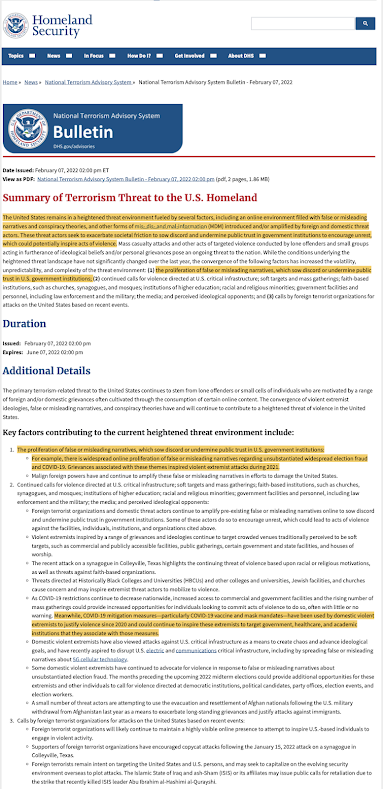


Here is the key sentence:


"Meanwhile, COVID-19 mitigation measures—particularly COVID-19 vaccine and mask mandates—have been used by domestic violent extremists to justify violence since 2020 and could continue to inspire these extremists to target government, healthcare, and academic institutions that they associate with those measures."


Not even eight months after the National Security Council issued its paper on combatting domestic terrorism, particularly as it relates to information that appears on social media platforms, we find that the Department of Homeland Security has already fallen into line by defining the appearance of mis-, dis- and mal-information regarding the COVID-19 pandemic and vaccination response as a threat to the homeland.  It's a good thing that government bodies through the Centers for Disease Control and Prevention and the National Institute of Allergy and Infectious Diseases and their spokespersons have not been responsible for any false or deliberately misleading information over the past two years, isn't it?  We should also note that highly qualified researchers with a COVID-19 narrative that is factual but that differs from the government's could well be considered domestic terrorists under this definition.


In case you were curious, this domestic terrorist threat to the American homeland is set to expire on June 7, 2022 at 02:00 p.m. at which time we can all breathe a sigh of relief.


The Biden Administration's efforts to create a domestic terrorist boogeyman out of thin air should concern us all.  How can we be certain that, in the future, anyone who takes a stand against government won't be classified as a terrorist and treated as such by the justice system?


Wednesday, January 14, 2015

The Department of Homeland Security and the Illusion of Safety

Senator Tom Coburn's recent oversight report on the Department of Homeland Security provides Americans with an interesting glimpse of what goes on inside DHS and whether or not it is fulfilling its five core functions; enhancing national security preparedness, enforcing immigration law, securing America's borders, preventing terrorism and guarding cyberspace.  The report suggests that the Department has been a failure on many counts as you will see in this posting.

In case you've forgotten, DHS was created under George W. Bush's Homeland Security Act of 2002 after the September 11, 2001 terrorist attacks on New York.  It resulted from the consolidation of 22 different government components and offices with the aim of creating a unified department that could focus solely on national security.  Since 2003, DHS has spent approximately $544 billion; its annual budget for 2015 is around $61 billion and it currently employs more than 240,000 people. 

The report shows that the Department is not "successfully executing any of its five main missions.  Let's look at a few examples:

1.) Sharing intelligence information and analyses:  The original mission of the DHS was to receive, analyze and integrate law enforcement and intelligence information to assess, identify and detect terrorist threats.  To this end, the DHS created its own public-private information sharing system called the Homeland Security Information Network or HSIN.  In the first 9 years, a total of $231 million was spent on HSIN; there were 35560 active account holders across the nation but only 4 percent logged into the system on a daily basis and only 12 percent logged into the system once a week.  The main complaint?  The system content was "not useful". 

In addition, DHS was to support so-called fusion centers which would serve as hubs for sharing intelligence between federal state and local officials.  In total, up to $1.4 billion was spent on the 70 fusion centers between 2003 and 2011 but a report from the Permanent Subcommittee on Investigation showed that the DHS's work with the fusion enters had not produced any useful intelligence to support federal anti-terrorism efforts.

2.) DHS preparedness grants to governments to enhance counterterrorism efforts:  The DHS was to provide homeland security grants to lower levels of government that would enable them to enhance their abilities to respond to, prevent and recover from mass destruction incidents.  Since 2003, DHS has spent more than $38 billion on preparedness grants.  The oversight committee found that many states and localities used the preparedness grants for "questionable" purposes including the hardening of county jails, purchasing color printers, paying for first responders to attend a five day spa junket, install bollards and surveillance equipment at a spring-training baseball stadium, to purchase armoured vehicles and to buy long range acoustic devices that are capable of emitting an ear-splitting sound.  As well, as of 2012, $8.3 billion of previously awarded grant funds remained unspent.

3.) Protecting against domestic chemical, biological, radiological and nuclear attacks:  The DHS was set up to prevent domestic chemical, biological, radiological, nuclear and explosive (CNRNE) attacks.  One key example from the fall of 2001 was the use of mail containing anthrax which resulted in five deaths.  DHS's responsibilities are to oversee and secure materials that could be used in an attack or to deploy tools to detect the use of CBRNE materials before they are used in an attack.    As such, DHS launched the BioWatch program in 2003, spending $1.1 billion on its deployment by 2014.  Given the number of false positives and negatives that have been reported over the years, it appears that the system is not effective in preventing an attack or in detecting an attack before it happens.  DHS has also been unable to develop or deploy equipment that could be used to scan cargo for nuclear materials entering the United States.  The DHS proposed the acquisition and deployment of advanced spectroscopic portals for detecting nuclear material, however, after the equipment failed to pass field testing, the program was cancelled....after spending $230 million on developing the scanners.

4.) DHS programs to protect federal buildings:  The DHS has responsibilities for protecting federal facilities under the Federal Protective Service (FPS).   FPS has more than 1300 federal employees and 13,000 contract employees used to protect 9500 federal facilities.  In 2013, one contract security company used by FPS reported that 38 percent of its guards did not receive any training in the use of X-ray or magnetometer screenings from FPS.  As of 2014, FPS was still not providing training for contractors on how to respond to an active shooter.  In addition, it appears that FPS employees and contractors are not prepared to prevent or recognize a potential bombing attack as shown in this quote from the report:

"A Department of Homeland Security OIG Report issued in August 2012 reviewed an incident at the Patrick V. McNamara Federal Building in Detroit. Contract security officers found a bag containing an improvised explosive device outside of the building. The guards brought the bag, which contained a locked safe, inside the building. They attempted to determine the contents of the bag by “shaking and moving the metal safe inside the bag,” which contained the IED, and X- raying the bag.   The Inspector General reports that the security guards placed the bag and its contents at their security console for a period of 21 days.   The report noted that the guards were working with equipment they did not know how to use, procedures for handling found property were unclear, and FPS post inspections did not identify unauthorized items at the post."

5.) Protection of America's international borders:  According to DHS and the Border Patrol, there is an 80 to 85 percent effectiveness rate along the U.S. southern border at catching or turning back those who are trying to enter the United States illegally.  In contrast, a report by the Council on Foreign Relations suggested that the effectiveness rate is between 40 and 45 percent.  Obviously, it is unclear whether DHS is accomplishing its mission of securing America's borders.  Documents show that there are gaps of up to 700 miles along the southern border where there is little DHS deployment or aerial surveillance coverage.  The use of unmanned aerial vehicles has been particularly poor; during 2013, the ten DHS unmanned drones flew a total of 5000 hours, averaging less than 12 hours per week with one aerial asset flying only 7 hours per book.  In addition, a 2012 GAO report on misconduct and corruption in the Border Patrol found that more than 140 former CBP employees had been arrested for corruption offences in including smuggling and 125 had been convicted as of late 2012.  In addition, in 2011, the DHS Office of the Inspector General had 600 open investigations examining CBP employees.

Let's close with two of Senator Coburn's recommendations:

"The most important recommendation is for Congress itself—reforming Congress’s dysfunctional approach to overseeing the Department and setting its priorities, including overcoming the political and parochial interests that too often shape our programs, even those that relate to our national security.

Congress and DHS must also focus on earning and restoring the American people’s trust. This includes ensuring that all of the Department’s programs and operations are consistent with the American people’s Constitutional rights and the proper role of the federal government. Too many of DHS’s programs have faced questions in this regard. We have also witnessed incidents where the Department’s programs have raised concerns about excessive federal authority or otherwise contributed to some of the public’s distrust of law enforcement. Congress has a duty to conduct vigorous and persistent oversight of DHS’s programs to ensure that they are operating in a manner consistent with the Constitution."


Given the $544 billion spent over the past decade on homeland security, one really has to wonder if our "safety" is just an illusion?