Showing posts with label Federal Reserve. Show all posts

Friday, February 7, 2025

Mark Carney - The Inflationary Central Banker

Mark Carney is selling himself as the consummate economist who will be able to steer Canada through whatever issues the nation will fact as it deals with the Trump 2.0 Administration.  In this posting, we'll take a very brief look at just how accurate his predictions were about central bank intervention during the COVID-19 pandemic.


On March 18, 2021, this article appeared in Canada's Globe and Mail:


When he was asked the following question:


"In the book (Value(s): Building a Better World for All), you talk about being worried about the amount of public debt and purchases by central banks. What concerns you the most?


Here is his response:


"I definitely agree with the stance that the major central banks have taken in terms of support. The pandemic is a huge disinflationary, if not deflationary shock, and so the right monetary policy response was in the direction they’ve taken. As well, I’d agree, given that they have fewer and fewer options to provide stimulus when needed, that the shift in the Fed’s reaction function toward this flexible average inflation targeting—so they’d have a bit of an overshoot coming out of this—is also something that’s supported for a durable recovery. We’re gonna get a quick bounce back as things reopen. The question is, does it extend? And I think the Fed’s policy will help it extend."


Not surprisingly, Carney agreed with the stance that his fellow central bankers, particularly at the Federal Reserve, took to prevent disinflation/deflation during the pandemic, admitting that they would have to overshoot their inflation target of 2 percent to support a durable post-pandemic recovery.


Here's what the Federal Reserve did to stimulate the COVID economy:


During most of 2019, the Fed's balance sheet hovered around the $4 trillion mark.  On February 26, 2020, the balance sheet stood at $4.159 trillion, rising to $7.17 trillion in June 2020, an increase of $3.011 trillion or 72.4 percent.  BY the time that Mark Carney made his comments as noted above, the Fed's balance sheet had risen to $7.904 trillion, an increase of $3.745 trillion or 90 percent above its pre-pandemic level.  The balance sheet continued to rise, hitting a peak of $8.965 trillion in April 2022, a total increase of $4.806 trillion or 115.6 percent from its pre-pandemic level.  Since then, the Fed's balance sheet has begun a very slow decline to just below $7 trillion.


So, what was the result of all of this money printing?  The M2 measure of the supply of money did this:


...M1 money supply did this:


...and real M1 money supply did this:


As a result of the unprecedented increase in the supply of money (after all, all of that "helicoptered money" has to go somewhere), this happened:


The average consumer price index for all goods for all consumers rose by a maximum of 9 percent in June 2022, the highest level of inflation going back to December 1981.  According to Shadowstats, the situation was far worse with consumer inflation hitting nearly 13 percent using the pre-1990 definition of inflation and nearly 17.5 percent (which is actually worse than the rate of inflation back in the early 1980s) using the pre-1980 definition of inflation as shown here:


Please keep in mind that while politicians would have us believe that inflation is under control because the rate of inflation has dropped to something approximating the Fed's 2 percent target, the prices of goods and services have NOT dropped, they are just inflating at a lower rate.


Let's repeat what Carney said for emphasis:


"I definitely agree with the stance that the major central banks have taken in terms of support. The pandemic is a huge disinflationary, if not deflationary shock, and so the right monetary policy response was in the direction they’ve taken. As well, I’d agree, given that they have fewer and fewer options to provide stimulus when needed, that the shift in the Fed’s reaction function toward this flexible average inflation targeting—so they’d have a bit of an overshoot coming out of this—is also something that’s supported for a durable recovery."


Is this the kind of economist that Canada needs in a leadership position?  For someone who thinks that his level of intelligence far exceeds that of the sweaty peasants and with his experience as a leading central banker, he didn't even have the ability to see that the Fed's actions (as well as the actions of other central banks) during the early stages of the pandemic were going to lead to very painful levels of inflation for consumers, many of whom will not recover financially from this economic shock treatment.  He couldn't even seem to grasp the concept that printing unprecedented amounts of "money" would result in a punitive inflationary nightmare.


But then again, does Carney really care what is best for Canadians or is he in it to remold Canada into a World Economic Forum approved dystopia?


Monday, January 27, 2025

The Trump Administration's Ban on Central Bank Digital Currency

Since Donald Trump occupied the Oval Office for the second time on January 20th, 2025, he has signed a significant number of Executive Orders covering a very wide range of issues.  As someone who has been following the development of digital currencies for many years, one Executive Order that caught my eye was "Strengthening American Leadership in Digital Financial Technology" which was signed on January 25th, 2025:


Inside this executive order, we find this under section 1 (v) (my bolds throughout):


"...taking measures to protect Americans from the risks of Central Bank Digital Currencies (CBDCs), which threaten the stability of the financial system, individual privacy, and the sovereignty of the United States, including by prohibiting the establishment, issuance, circulation, and use of a CBDC within the jurisdiction of the United States."


The Executive Order defines Central Bank Digital Currencies as "a form of digital money or monetary value, denominated in the national unit of account, that is a direct liability of the central bank."


In Section 5, we find this:


"a)  Except to the extent required by law, agencies are hereby prohibited from undertaking any action to establish, issue, or promote CBDCs within the jurisdiction of the United States or abroad.


(b)  Except to the extent required by law, any ongoing plans or initiatives at any agency related to the creation of a CBDC within the jurisdiction of the United States shall be immediately terminated, and no further actions may be taken to develop or implement such plans or initiatives."


It is important to note that the Federal Reserve is not an agency of the United States federal government and that it exists because of an act of Congress. According to the Fed, it 


"...enjoys a unique public/private structure that operates within the government, but is still relatively independent of government to isolate the Fed from day-to-day political pressures in fulfilling its varying roles. As stated in The Federal Reserve System Purposes & Functions:


The Federal Reserve System is considered to be an independent central bank. It is so, however, only in the sense that its decisions do not have to be ratified by the President or anyone else in the executive branch of the government. The entire System is subject to oversight by the U.S. Congress….the Federal Reserve must work within the framework of the overall objectives of economic and financial policy established by the government."


While this particular Executive Order isn't as attention-grabbing as the Executive Orders that covered issues like America's withdrawal from the World Health Organization and ending DEI programs, to those of us that have been paying attention to the unceasing movement toward global adoption of central bank digital currencies, this could be a game-changer.  In my opinion and in light of this development, there could be one of two scenarios that play out:


1.) with the American economy being the largest economy in the world, Washington's ban on central bank digital currencies could slow up adoption of CBDCs by other economies.


2.) the creation of a crisis in the world's financial markets which could be used to negate the Trump Administration's ban on CBDCs, all in the name of rescuing the global economy.


In any case and until proven otherwise, I think that the Trump Administration's ban on CBDCs has done all of us a great (and perhaps temporary favour) by preventing the world's most influential central bank from issuing a Central Bank Digital Currency within the jurisdiction of the world's largest economy.  You can just imagine central bankers' heads exploding all over the world thanks to this development.


Wednesday, June 21, 2023

How Americans Feel About a Central Bank Digital Currency

With the Federal Reserve announcing its FedNow instant payments service which is essentially the "plumbing" for a central bank digital currency ecosystem which will launch in July 2023 and that expansion of the service is planned for the future:


...a recent survey by the Cato Institute is particularly timely.


While some people feel that we are already living in a digital dollar reality brought to us by our use of credit and debit cards and other digital payment platforms like PayPal, Apple Pay, Google Play, Zelle etcetera, in fact, there is a big difference between the current platforms and what is being proposed by the Federal Reserve and other central banks around the world.  The digital dollars of today are a liability of the private commercial bank sector.  In contrast, a central bank digital currency is a liability of a central bank, meaning that there is a direct connection between a nation's central bank and the citizens of a nation.   Rather than a government having to request payment information from a commercial bank through various legal procedures, the government could technically get your personal spending information directly from a central bank without requiring legal permission from a court.


In its 2023 CBDC National Survey, the Cato Institute examines how Americans feel about the implementation of a central bank digital currency by the Federal Reserve.  Let's go through some of the questions and responses.


Here is the first question.  There are proposals for the Federal Reserve to begin offering a government-issued digital currency, called a “central bank digital currency” (CBDC). Would you support or oppose the proposal?


While only 16 percent of Americans support a CBDC as shown here:


...the support varies significantly by party affiliation with 22 percent of Democrats supporting the idea compared to only 11 percent of Republicans and 14 percent of independents.  A very substantial portion of Americans are not particularly familiar with the concept of a central bank digital currency which is extremely concerning given that the implementation of a CBDC will be a financial game-changer with far-reaching consequences for all of us.  Only 36 percent of Republicans are neutral on or not familiar with CBDCs compared to 56 percent of Democrats and 59 percent of Independents.


Here is a graphic breaking down support for a Federal Reserve CBDC by various demographics:


In general Americans who are Black (32 percent), Males (22 percent), Americans under the age of 29 (32 percent), high income (21 percent) and highly educated (25 percent) are supportive of CBDCs.


When asked about their concerns about CBDCs, a key concern is the potential lack of privacy or an increase in government control.  This is particularly key given the concept that CBDCs could be programmable.  Let's break this down further:


1.) 74 percent would oppose CBDCs if it meant that governments could control how people spend their money.


2.) 68 percent would oppose CBDCs if it meant that government could monitor their spending.


3.) 68 percent would oppose CBDCs if it meant that all U.S. cash would be abolished.


4.) 65 percent would oppose CBDCs if it meant that they attracted cyberattacks by accumulating personal financial data into a single large database.


5.) 64 percent would oppose CBDCs if it meant that the government could charge a tax on those who don't spend money during recessions.


6.) 59 percent would oppose CBDCs if it meant that the government could freeze the digital bank accounts of political protestors.


The last issue is one that should be of concern to all of us given the actions of the Canadian government during the Truckers' Protest in February 2022 when the Trudeau government froze the bank accounts of Canadians who donated to the protest as well as those who participated.


Here are some additional so-called benefits regarding CBDCs and how Americans feel about them:


Not surprisingly, a majority of Republicans did not support any of these "benefits", however 37 percent were supportive of government being able to ensure that welfare payments were spent on their intended purpose whereas 55 percent of Democrats were supportive of CBDCs allowing unbanked Americans to have access to a "banking system".  Here is a graphic showing the divide along party lines for compelling reasons to oppose and support a CBDC:


To summarize, 76 percent of Americans are more concerned about the potential risks of a CBDC than the potential benefits that they supposedly could offer.  Only 24 percent state that "government should issue a central bank digital currency because it would reduce financial crime and other illegal activity and would increase access to the financial system.”  By party alignment, 85 percent of Republicans and 68 percent of Democrats believe that government should not allow the issuance of a CDBC.


Since it appears that, in general, Americans are overwhelmingly against the implementation of a Federal Reserve CBDC and since the Federal Reserve is already taking the first steps toward a CBDC ecosystem, one has to wonder how the Fed and the political class in Washington will force feed this to the useless eaters.  Will there be a significant fiscal or financial event that will be sold to the peasants as an existential crisis similar to the narrative used to get Americans to line up for vaccines during the COVID-19 pandemic?


Wednesday, May 31, 2023

Main Street America's Confidence in Federal Reserve Chair Jerome Powell

Remember this from Federal Reserve Chair Jerome Powell?


So, how has that worked out for Main Street America over the past year?


With that in mind, let's look at how Americans feel about the Federal Reserve and how much trust they put in this non-governmental banking cartel. A poll taken by Gallup between April 3 and April 25, 2023, found the following when asked how much confidence they had in Jerome Powell to do "the right thing for the economy":


A great deal of confidence - 4 percent


A fair amount of confidence - 32 percent


Only a little confidence - 26 percent


Almost no confidence - 28 percent


Nine percent of respondents had no opinion.


Compared to the results of a similar poll taken in 2022, confidence (a great deal or fair amount) in Jerome Powell's capabilities dropped by 7 percentage points from 43 percent in 2022 to 36 percent in 2023, the lowest rating that he has received during his six years as Federal Reserve Chairman.  It is also the lowest rating that a Fed chair has received since Gallup started this poll in 2001.


Here is a graphic showing how Jerome Powell's confidence rating compares to the previous occupiers of the Federal Reserve's chair going back to 2001:


Here is a table showing the data in detail:


Americans are showing a growing lack of confidence in the Federal Reserve's ability to improve their economic situation.  With the Fed's key interest rate approaching 20 year highs which has had a significant impact on the cost of consumer borrowing as shown here:


...with recent failures in the banking sector as shown here despite Powell's assertion that the U.S. banking sector was healthy:


...and with the odds of a recession growing by the day, Main Street America aka "the serf class" has every right to be disillusioned with the Federal Reserve's growing inability to manage the economy.  Unfortunately, given the Fed's self-granted powers, there is almost nothing that the suffering class can do about it.


Monday, March 27, 2023

Jerome Powell and the Sustainability of America's Debt

In a recent meeting of the Senate Banking Committee, some comments from Federal Reserve Chair Jerome Powell should give us pause to ponder America's fiscal future.  Let's start with his response to a question from Senator Cynthia Lummis and then look at some background data showing the seriousness of the issue.


At the 1 hour and 52 minute mark, we find this exchange:


Lummis (R- Wyoming):  Thank you very much Madam Chairman and welcome Chairman Powell.  When you are setting these rates and making these deacons and seeking that 2 percent magic number (the Fed's inflation target), are you considering the cost of borrowing for the United States knowing that Congress has over-borrowed and that we have over-spent and that the national debt is now at least 97 percent of GDP and that we are going to face challenges of our own making?  This is not about what the Fed has done, this is about what the Congress has done that you have to factor into your decisions.  Do you think about the cost of borrowing for the United States itself?


Powell:  No we do not and we're not going to.  In other words, that would  be fiscal dominance.  If we were, you know, constrained in our monetary policy by the budgetary situation of the United States and we're not, we're clearly not, the path we're on is not sustainable but the level of debt that we have is not unsustainable....is sustainable, put it that way.  We don't think about interest costs when we make monetary policy.  We think about maximum employment and price stability.


Lummis: It's your opinion that the level of debt that we have is sustainable?


Powell:  Yes.  Clearly, we have the largest economy in the world.  We can service this debt.  That's not the problem.  The problem is that we are on a path where the debt is growing substantially faster than the economy.  And that's kind of, by definition, in the long-run, unsustainable.  And the way countries have gotten or have fixed that is with longer term programs that have bipartisan support and that address the actual problem in the budget.  That is really the formula.


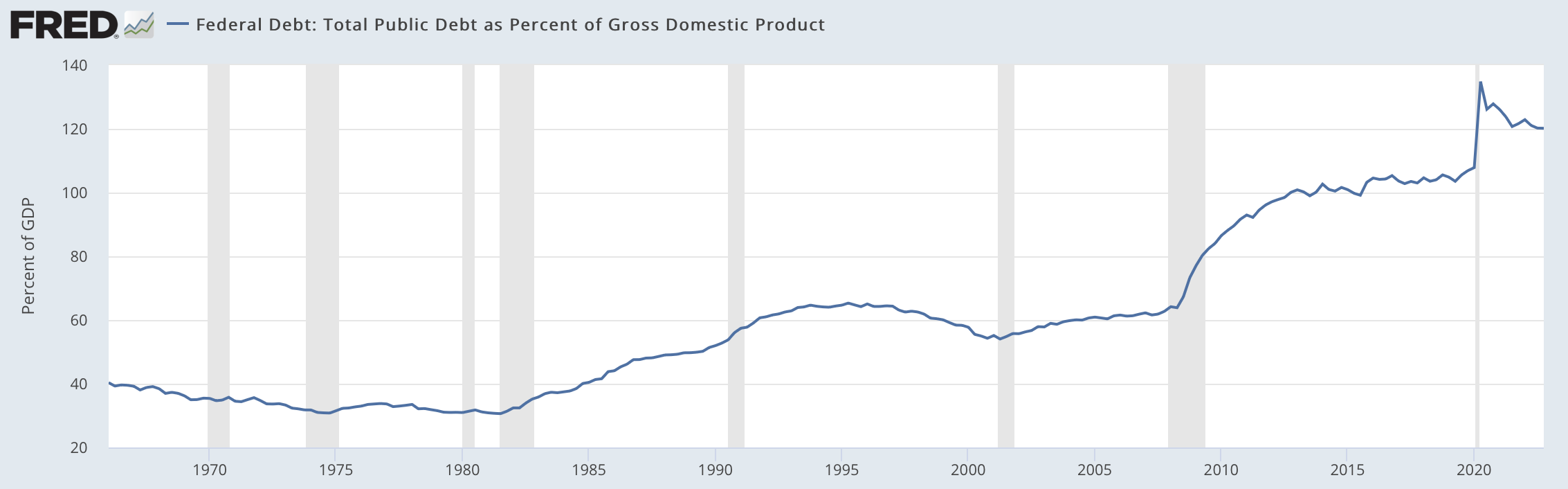
Actually, to correct Senator Lummis, America's federal debt-to-GDP was 120 percent in Q3 2022 as shown here:


Let's look at some background data.  Here is a graphic showing the United States federal debt which hit $31.419 trillion at the end of the fourth quarter 2022:


According to Debt-to-the Penny, the debt is now $31.458 trillion effective March 22, 2023.


While we are discussing debt and as additional background, here is a graphic showing the total debt of the United States including consumer, corporate and government debt:


Now, let's go back to America's federal government debt.  Here is a graphic showing the mounting interest payments on just the federal debt:


Interest payments on the federal debt have risen from $591.636 billion in Q2 2019 to $852.599 billion in Q4 2022, an increase of $260.963 billion or 44.1 percent.  These are tax dollars that could certainly be used to deliver much needed programs for American taxpayers.  In fact, according to the 2024 Fiscal Year Presidential Budget, the $852 billion would more than cover the budget for Medicare.  It is also important to note that this budget is projected to add another $17.054 trillion to the federal debt over the next decade as shown here:


Now, since politicians are famous for using the debt-to-GDP statistic, stating that thanks to more-or -less endless economic growth, the nominal level of the federal debt is meaningless, let's look at a graphic showing the total federal debt of the United States in blue versus GDP in red:


You will observe that for most of the past 50 years, nominal GDP exceeded the level of federal debt, became more or less equal over the period from the end of 2011 to the middle of 2019 but since then, GDP growth has been exceeded by federal debt growth, a trend that is most definitely not healthy as it will lead to higher and higher debt-to-GDP levels.


If we look at total debt of the United States and compare it to GDP, you'll see that the trend is even more worrisome:


The growth in total debt in the United States is accelerating at a far faster rate than growth in the economy.


If you want to see why the problem worsened, here is your answer:


The prolonged periods of near zero interest rates between 2009 and 2016 and again from 2020 to 2022 led to a massive expansion in personal, corporate and government debt as consumers, corporate leaders and politicians were lulled into a false sense of interest rate reality.


While Jerome Powell may believe that the strength of the United States economy will allow the nation to continue to service growing levels of its multi-sector debt, he does admit that economic growth is not keeping up with the growth in debt, an unsustainable scenario over the long-run.  What he doesn't mention is that it is largely the Federal Reserve's loose monetary policy since the Great Recession that has been responsible for the unfettered growth in debt.


But, then again, when did the braintrust at the Federal Reserve ever see the negative repercussions of their meddling ways and when did politicians ever experience the downside of their overspending ways?


Friday, March 10, 2023

Anti-CBDC Legislation in the United States - Waking Up to the Privacy Pitfalls

The global central bankster cabal is making very clear moves toward a central bank digital currency (CBDC) ecosystem and it appears that most governments are going along with the game since it will be part of their plan to control all of society and will form a key part of the looming social credit score system.  Fortunately, at least a handful of members of the United States Congress have seen the dangers of  a future where unelected central bankers are "in charge of the henhouse".


As background, here is a map from the Atlantic Council's Central Bank Digital Currency Tracker website showing the near universality of the experimentation with and implementation of CBDCs:


Several of the world's largest economies have either launched a pilot program (China, Russia and India among others) or are in the development stage of a CBDC program (the United States, the United Kingdom, Canada, Brazil and most of Europe among others).


In the case of the United States, here is the timeline for a CBDC which will be used for both wholesale and retail applications:


"Treasury Secretary Janet Yellen and Federal Reserve Chairman Jerome Powell have reaffirmed the United States' interest in a digital dollar. At the NYTimes Dealbook Conference, in response to our tracker, Secretary Yellen said: “I think it [the digital dollar] could result in faster, safer, and cheaper payments, which I think are important goals." During a testimony before the Senate Banking Committee, Powell began by confirming, “We are looking carefully, very carefully at the question of whether we should issue a digital dollar." 


Individual Federal Reserve banks are also partnering with various stakeholders on their research. The New York Fed is working with the Bank of International Settlements to identify critical trends and financial technology relevant to central banks. The Federal Reserve Bank of Boston is collaborating with the Massachusetts Institute of Technology's Digital Currency Initiative on "Project Hamilton." The findings of the first phase of Project Hamilton indicated that the processor could bring 99% of transactions to completion in under five seconds, and could settle between 170,000 and 1.7 million transactions per second. In addition to the government-led developments, there are also several private sector projects exploring different models of a digital dollar. 


In March 2022, the Biden administration signed an Executive Order on ensuring responsible innovation in digital assets. The EO calls for reinforcing American leadership in the financial system, maintaining the stability of the financial system and exploring a possible CBDC. The order encourages research efforts of the Fed, calls for US involvement in cross-border, multi-lateral testing and promotes standard-setting efforts by US. In May 2022, Vice Chair of the Federal Reserve Board of Governors, Lael Brainard, testified to Congress regarding the Fed's authority to issue a CBDC. She also expressed concerns that given developments in Europe, the US might fall behind on the technological advantages of CBDCs. In September 2022, seven reports were released which dove into the issues of consumer and investor protection, illicit finance and environmental risk mitigation, design principles for a US CBDC and US leadership in digital asset technology. In November 2022, The Federal Reserve of New York announced Project Cedar, which tested wholesale application of a CBDC.


The Federal Reserve/Biden Administration will not see the United States left behind when it comes to development and implementation of CBDC technology as they claim that this new payment system could jeopardize the nation's security and geopolitical objectives if another nation were to control this new ecosystem.


That said, as I noted at the beginning of this posting, a handful of congressional members believe that the implementation of CBDC's will strip Americans of their right to financial privacy.  Here is the announcement from House Majority Whip Tom Emmer who introduced the CBDC Anti-Surveillance State Act:


The objective of the bill is to ensure that the Federal Reserve does not have the ability to issue a CBDC directly to an individual which would give it an instrument to collect personal information on all Americans as the retail bank sector does now.  The bill also bars the Federal reserve from using CBDCs to implement monetary policy (i.e. control the economy).  In addition, the findings of any studies and pilot programs on the use of CBDCs must be reported each quarter to Congress.


Here is the text of the bill:


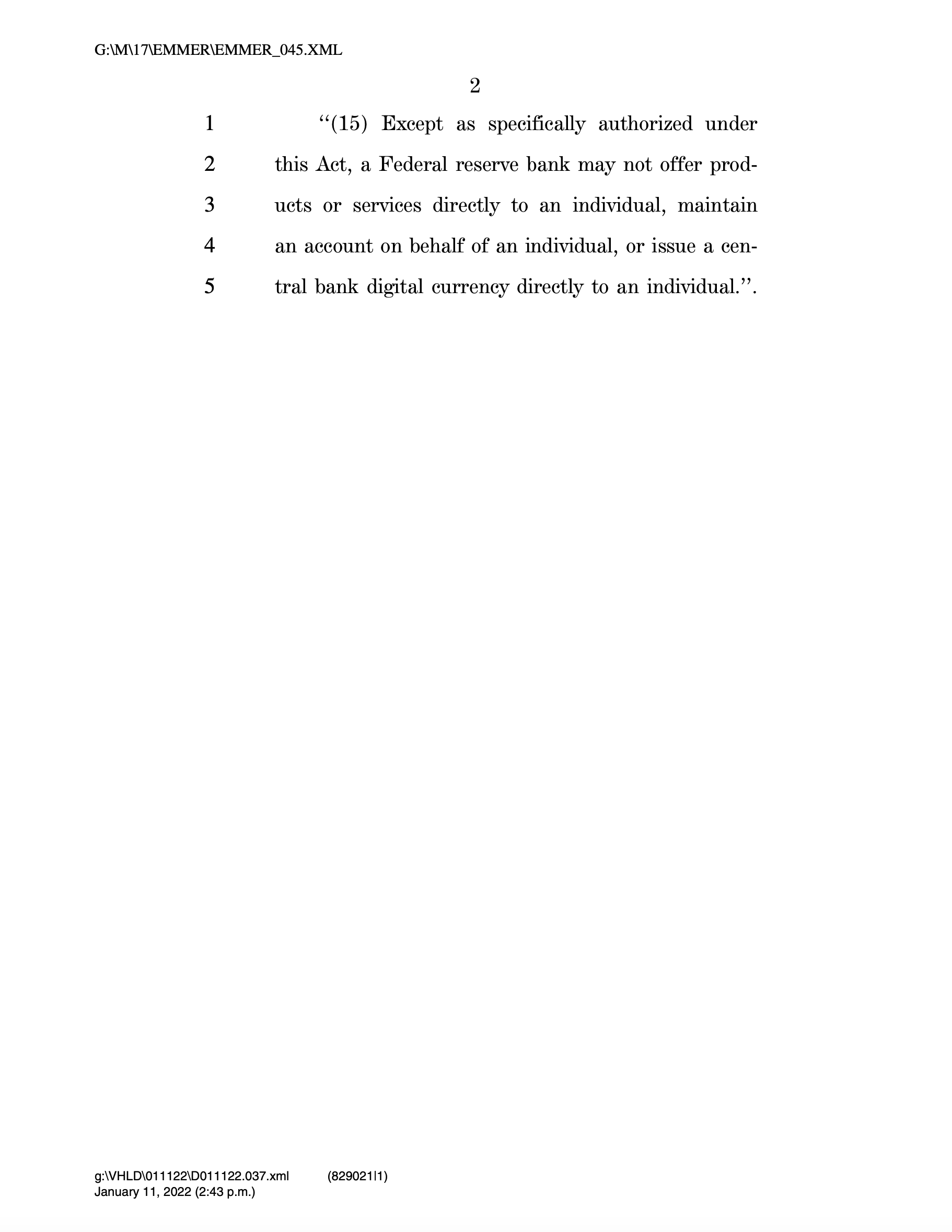
This is not Congressman Ted Emmer's first "kick at the CBDC can".  Back in January 2022, he introduced a bill that would prohibit the Federal Reserve from issuing a CBDC directly to individuals through the utilization of a Federal Reserve retail bank account, noting that "...requiring users to open an account at the Fed to access a CBDC would put the Fed on an insidious path akin to China's digital authoritarianism."  I personally find that logic difficult to argue with.


Here is the text of that bill:


While I don't generally trust the motivations of politicians, it is interesting to note that at least some members of the United States Congress are "woke" when it comes to the issuance of CBDCs and the accompanying abuse of what little remains of our privacy, something that seems to have evaded the vast majority of the world's political class.  Either that or they simply don't care.