Showing posts with label Klaus Schwab. Show all posts

Monday, November 21, 2022

Klaus Schwab - China as a Model for the Global Future

A recent interview on  China Global Television Network or CGTN, China's English-language, Chinese Communist Party-controlled news channel gives us some interesting insight into the world's self-appointed ruler, Klaus Schwab.  The interview was held at the end of the 2022 edition of the APEC meeting global leaders which was held in Bangkok, Thailand.


Here is a complete transcript of Tian Wei's interview with Klaus Schwab:


Wei - In the APEC this year, both the leaders' meeting and also the APEC CEO summit you just spoken at the opening panel Professor, so how do you see would be able to with our capability to carry on this kind of discussion in the right direction?


Schwab - We have to define the specific elements of the global system for example, nature and environment, climate change and then to see what are actually see areas where can make true progress where we can have a real impact.  I'm very glad that China is integrated into our initiative to plant one trillion trees in the next ten years by making its own contribution.  We have to try with a collaborative platform where we integrate the best people, the most relevant people and then to work for progress.  Now, surveys has been formed but we have to go one step further.  We have to have a strategic mood.  We have to construct the world of tomorrow.  It's a systemic transformation of the world.  So, we have to define how the world should look like which we want to come out of this transformation period.  


Note that - "WE have to define how the world should look like" after the Great Reset.  To hell with what the sweaty masses of the organ donor class want for their futures.


Wei - Earlier we have the Great Narrative also called the globalization and everybody believes it and everybody think this is our shared future.  Now, as world is changing, we need to reshape again the vision as you just said but how to bring everybody on board?


Schwab - So, it's now the opinion globalization has failed and we are entering into an era of deglobalization.  I think that's wrong.  We, of course, have three shaping of certain supply chains so for certain physical goods we may see much more reshoring or home shoring.  In reality, the world has moved closer together because we are moving from a physical world much more in a digital world and the digital world by nature is much more globally oriented.  Now you asked how to do it?


Wei - Yes.


In his response, we see how Schwab is proposing to promote his Great Reset to the global unwashed.


Schwab - I think it needs what we feel in the World Economic Forum a multi-stakeholder approach.  It suddenly governments who have to be in the lead but business, most of the solutions, will come from innovation from business and we have to integrate the large population.  We have to mentor the population and to show through our good examples that the future requires this change and such change, at the end, ultimately, will be beneficial for them.


See, it's all for our own good!  We're just too ignorant to see it and we will have to be reeducated so that we'll be capable of understanding that the global ruling class is just acting to benefit us.


Here is the final interesting exchange:


Wei - From your perspective, how do you understand this ambition of China to have the Chinese pass toward modernization and share it with the developing world?


In his answer to this question, we see the real Schwab agenda.


Schwab - I respect China's achievements which are tremendous over the last over forty years since the opening up and policy and reform policy came into action.  I think it's a role model for many countries but I think also we should leave it to each country to make its own decision what system it wants to adapt and I think we should be very careful in imposing systems but the Chinese model is certainly a very attractive model for quite a number of countries.


So, each nation will be allowed to choose its "system" but we, as individuals, have no choice when it comes to the imposition of the Great Reset.  Schwab also clearly shows that he has no objection to other nations adopting China's style of dictatorship and top-down economic approach because it is a "very attractive" societal model.


Here is the interview with CGTN's Tian Wei keeping in mind that Schwab, as a key part of the global technocracy and the architect of the WEF's Great Reset, was in attendance so that you can hear how Klaus Schwab can talk for five minutes and basically say nothing:


For those of you that either weren't aware or had forgotten, another global "leader" (and I use the word very loosely) and an acolyte of Schwab's who also admires China's ability to get things done:


Now we know where Justin Trudeau sourced his ideas for his government's heavy-handed approach during the pandemic, particularly his response to the truckers' protest and how it likely received the approval of Schwab through his minion, Canada's Deputy Prime Minister and WEF Trustee, Chrystia Freeland.


Thanks to this interview on China's government television network, Klaus Schwab, the self-appointed guardian of the global future, has made his preferences for our transhumanist and dystopic future very clear.  Watch China and we'll get a sense of the roadmap that Schwab wants for the world and it most certainly isn't freedom of person.


Thursday, January 20, 2022

Simulating A Global Financial Collapse - A Prediction for the Future

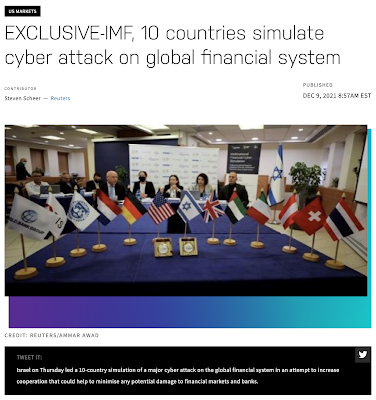
While it didn't really make headline news, a recent simulation gives us a sense of what could happen to the global financial system if an unthinkable catastrophe damages or destroys the world's digital infrastructure.


Here is the report on the simulation of a cyber attack on the world's financial system from the NASDAQ website:


On December 9, 2021, Israel led a ten nation simulation of a major cyber attack on the global financial system under the moniker "Collective Strength".  This exercise which took place over ten days was undertaken to ensure that should such an attack take place in the real world, cooperation among nations would minimize damage to the banking and stock market sectors.  The participants included treasury officials from Austria, Germany, Israel, Italy, the Netherlands, Thailand, the United Arab Emirates, the United Kingdom and the United States and also included officials from the International Monetary Fund, the World Bank and the Bank of International Settlements (BIS), the central bank for central banks.


The exercise featured several different scenarios which involved attacks on the integrity of transactions between importers and exporters, liquidity, foreign exchange, bond markets and, most interesting given the post-truth era that we live in, fake news reports which resulted in a run on banks and turmoil in global markets.  In the simulation, participants were faced with the following:


"The banks are appealing for emergency liquidity assistance in a multitude of currencies to put a halt to the chaos as counterparties withdraw their funds and limit access to liquidity, leaving the banks in disarray and ruin."


One of the groups involved is Tel Aviv-based BeST or Be Strategic Solutions, a crisis management software company which has run simulations involving cyber and data privacy issues and physical security among others as shown here:  


Now, let's look at another aspect of cybersecurity.  It is not terribly surprising, but the man with all of the answers has a stake in cybersecurity.  At the Cyber Polygon 2021 event held in June 2021, the founder of the World Economic Forum,one Klaus Schwab, made some interesting comments about securing the global digital infrastructure.    You can find Schwab's comments at the 2 hour and 15 minute mark in this video:


Here is a quote:


"We have come together today to discuss how we can --- your digital infrastructure systems and protect companies but also societies from cyber attacks.  We must do so with a broader mission in mind; to improve the state of our digital world by enhancing, on the one hand, global cooperation but also public-private corporation (a much-used Schwab buzz phrase)....


Digital connections are embedded in our homes, our workplaces and through operation technology our critical infrastructure.... (this connectivity) has enabled us to continue to function during a time of unprecedented crisis.  Technology has been central to the way we have collectively managed the COVID-19 pandemic and the global crisis.  Digital infrastructure made it possible to deliver essential services.  It helped business to run.  And it helped us to maintain contact with each other."


...(digitalization) has also opened us up to new challenges.  One of the most important amongst them is how to ensure digital technologies and communications are safe, secure and trustworthy.  Many technology leaders have noted that within a few short months, we have achieved advances in digital transformation that might have otherwise taken years.  But this digital dividend...is fragile.  Cyber incidents can undermine the trust in key online services and they could derail adoption of socially valuable innovations."


As a technology "guru", Schwab's vision of the future relies very, very heavily on a healthy global digital infrastructure, particularly necessary for his transhumanist vision where Homo superiorus relies on a merger of biology and technology for the creation of a new superior form of humanity.  It isn't surprising that the World Economic Forum is playing a key role in global cybersecurity given that its entire raison d'ĂȘtre is ensuring that the global elite remain just that, elite.


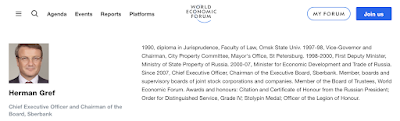
As an aside, you'll notice that one individual is given top billing in Schwab's opening comments; Herman Gref, Chief Executive Officer and Chairman of the Board of Sberbank (a Russian bank) who just happens to be on the Board of Trustees for the WEF as shown here:


The presence of Sberbank's leader on both the WEF's Board of Trustees and at the Cyber Polygon exercise is quite interesting given that the bank is only in 51st place among global banks in 2021 and 402nd place in 2020 when ranked by sales, profit, assets and market value.


Let's close this posting with a couple of thoughts.  First, back in October 2019, this simulation took place:


Coincidentally (?), four months later, the globe was experiencing a massive reality check as the COVID-19 pandemic took place.  Now, we have another simulation, this time of a cyber attack on the world's financial system.  How long will it be before this too is a real world occurrence?


Second, the potential for a cyber attack on key parts of the global financial infrastructure should make one realize just how fragile our entire economy has become.  We are fully reliant on the digital infrastructure for nearly every aspect of our lives; from the production and delivery of electricity, food, fuel, water and the other necessities of life along with the financial services that we all use on a daily basis.  What would happen if the entire banking system was shut down, making it impossible to use credit and debit cards or withdraw fiat currency from our local ATMs etcetera?  


While Schwab rightly points out that the world has made unprecedented advances in digital services over that past two years that would not have been possible without the COVID-19 pandemic, I would suggest that this transformation has made the global digital infrastructure even more vulnerable, creating a world that was completely unthinkable three decades ago and, should it shut down, would push the vast majority of humanity back to the comparatively primitive lives that were lived by our great grandparents.


Wednesday, December 8, 2021

The Fourth Industrial Revolution and Inequality - A Primer for Class Warfare

For anyone who has been paying attention since the beginning of the COVID-19 pandemic, it is clear that there is an underlying agenda being promoted by the global ruling class through their World Economic Forum.  While the "Build Back Better" or "Great Reset" narrative setting up our post-pandemic world sounds like it may lead to positive changes in the world, in fact, the WEF has already clearly stated the negative impacts of Klaus Schwab and his Fourth Industrial Revolution, another moniker for the Great Reset.


As background and just in case you haven't been paying attention, here is a brief discussion from 2016 of the Fourth Industrial Revolution sourced from the World Economic Forum and written by none other than Herr Schwab himself:


Here is a key quote which sets the stage for the Fourth Industrial Revolution:


"The First Industrial Revolution used water and steam power to mechanize production. The Second used electric power to create mass production. The Third used electronics and information technology to automate production. Now a Fourth Industrial Revolution is building on the Third, the digital revolution that has been occurring since the middle of the last century. It is characterized by a fusion of technologies that is blurring the lines between the physical, digital, and biological spheres.


There are three reasons why today’s transformations represent not merely a prolongation of the Third Industrial Revolution but rather the arrival of a Fourth and distinct one: velocity, scope, and systems impact. The speed of current breakthroughs has no historical precedent. When compared with previous industrial revolutions, the Fourth is evolving at an exponential rather than a linear pace. Moreover, it is disrupting almost every industry in every country. And the breadth and depth of these changes herald the transformation of entire systems of production, management, and governance....


The possibilities of billions of people connected by mobile devices, with unprecedented processing power, storage capacity, and access to knowledge, are unlimited. And these possibilities will be multiplied by emerging technology breakthroughs in fields such as artificial intelligence, robotics, the Internet of Things, autonomous vehicles, 3-D printing, nanotechnology, biotechnology, materials science, energy storage, and quantum computing."


Here is what Schwab sees as the "upside" to the Fourth Industrial Revolution:


"Like the revolutions that preceded it, the Fourth Industrial Revolution has the potential to raise global income levels and improve the quality of life for populations around the world. To date, those who have gained the most from it have been consumers able to afford and access the digital world; technology has made possible new products and services that increase the efficiency and pleasure of our personal lives. Ordering a cab, booking a flight, buying a product, making a payment, listening to music, watching a film, or playing a game—any of these can now be done remotely.


In the future, technological innovation will also lead to a supply-side miracle, with long-term gains in efficiency and productivity. Transportation and communication costs will drop, logistics and global supply chains will become more effective, and the cost of trade will diminish, all of which will open new markets and drive economic growth."


As well, back in 2016, Schwab "blessed" the world with his mind-numbingly boring and excessively esoteric book "The Fourth Industrial Revolution" as shown here:


And yet, in this epitaph for humanity, there are some glimpses of what the future of the world could look like, particularly for certain, select humans, as the world moves into its fourth technological revolution.  In this tome (or, better yet, tomb) for humanity, Schwab outlines his vision for what lies ahead and, given his penchant for all things technological and digital, clearly outlines the importance of technology to our new world:


"We have yet to grasp fully the speed and breadth of this new revolution. Consider the unlimited possibilities of having billions of people connected by mobile devices, giving rise to unprecedented processing power, storage capabilities and knowledge access. Or think about the staggering confluence of emerging technology breakthroughs, covering wide-ranging fields such as artificial intelligence (AI), robotics, the internet of things (IoT), autonomous vehicles, 3D printing, nanotechnology, biotechnology, materials science, energy storage and quantum computing, to name a few. Many of these innovations are in their infancy, but they are already reaching an inflection point in their development as they build on and amplify each other in a fusion of technologies across the physical, digital and biological worlds.


We are witnessing profound shifts across all industries, marked by the emergence of new business models, the disruption of incumbents and the reshaping of production, consumption, transportation and delivery systems. On the societal front, a paradigm shift is underway in how we work and communicate, as well as how we express, inform and entertain ourselves. Equally, governments and institutions are being reshaped, as are systems of education, healthcare and transportation, among many others. New ways of using technology to change behaviour and our systems of production and consumption also offer the potential for supporting the regeneration and preservation of natural environments, rather than creating hidden costs in the form of externalities."


Doesn't that sound utopic? 


Of course, like with all wonderful things, there is a downside.  While the ruling class gets wealthier and wealthier and societal inequality continues to grow, a fact that has become very clear during the pandemic which has locked down and economically punished the serf/organ donor/useless eater class as shown here:


...and, in response, here:


Not surprisingly, this "wrench in the gears of progress" concerns Herr Schwab and his fellow ruling class peers as quoted from section 3.5 "The Individual" in his aforementioned book.  In this quote, he discusses inequality but not the inequality that most of us consider when we hear the term (with all bolds being mine):


"Until now, technology has primarily enabled us to do things in easier, faster and more efficient ways. It has also provided us with opportunities for personal development. But we are beginning to see that there is much more on offer and at stake. For all the reasons already mentioned, we are at the threshold of a radical systemic change that requires human beings to adapt continuously. As a result, we may witness an increasing degree of polarization in the world, marked by those who embrace change versus those who resist it.


This gives rise to an inequality that goes beyond the societal one described earlier. This ontological inequality will separate those who adapt from those who resist – the material winners and losers in all senses of the word. The winners may even benefit from some form of radical human improvement generated by certain segments of the fourth industrial revolution (such as genetic engineering) from which the losers will be deprived. This risks creating class conflicts and other clashes unlike anything we have seen before. This potential division and the tensions it stirs will be exacerbated by a generational divide caused by those who have only known and grown up in a digital world versus those who have not and who must adapt. It also gives rise to many ethical issues."


And there you have it.  Schwab is concerned that his precious technology will separate the world into two classes:


1.) Winners who will accept and thereby benefit from the gifts offered by the Fourth Industrial Revolution and its accompanying technological/digital advances and how these advances will benefit the human body itself, leading to the evolution toward what I call Homo Superiorus.


2.) Losers who choose not to adapt to and evolve with these technological and digital world marvels.


Schwab states that it is this societal divide that will result in "class conflicts and clashes unlike anything we have seen before", in other words, class warfare.  


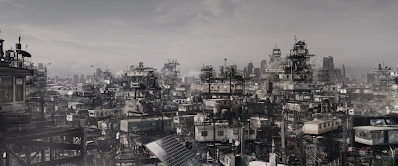
This brings to mind two movies of relatively recent vintage.  Here is a screen capture from Ready Player One, a dystopic vision of the future  (2045) where the vast bulk of humanity lives in squalid poverty, thriving only in an online fantasy world:


An even better analogy is found in the movie Elysium where an overpopulated Earth is populated with masses of impoverished humanity while the select few oligarchs live on a luxurious, technically advanced  artificial world that orbits the planet.


Without exaggeration, I believe that this could be our future if we relent to the forces that are now rebuilding society without our permission and, in many cases, without our knowledge.  The growing use of universal basic incomes, the development of central bank digital currencies and the issuance of universal so-called vaccine passports are three additional methods of rebuilding society for the benefit of "the few", a scenario that would have been unthinkable even a very short time ago.


Keeping in mind that many of the world's current political leaders and technocrats have close and historic associations with the World Economic Forum, Schwab's vision of a class war which pits technological "winners" against technological "losers" could prove to be prescient.  The Fourth Industrial Revolution will create a massive global underclass that will be forced to forage for their very existence while the technocracy rules from “on high”.


Remember readers, most importantly, resistance is not futile.  We do NOT have to be assimilated.


Monday, November 29, 2021

The World Economic Forum - Threats to Klaus Schwab's Vision of the New Global Order

While I rarely quote from the legacy media because of their reputation for nonfactual reporting, a recent story in an overseas media platform drew my attention and this posting is based on a news item dated November 27, 2021.  


As anyone who has been paying attention over the past two years (give or take a couple of months), our overlords have begun to roll out their plans for what the world will look like after the pandemic.  This is being undertaken using the Great Reset, Fourth Industrial Revolution and Build Back Better monikers which, on the surface, sound like the world will become a utopia for the useless eater/organ donor class.  The greatest proponent of this philosophy is Klaus Schwab, leader and founder of the World Economic Forum which is taking the publicly proclaimed lead on this issue.  Schwab is joined by the world's elite/private jet class in transforming the world to a private-public partnership where governments and the world's most influential corporations take the lead in a new world order.  The WEF's vision has flown pretty much under the mainstream media's radar even though they are a key part of the program since it is their promotion that will brainwash the masses into accepting their new role in a society that suffers from hyper inequality.  That said, there are a growing number of the proletariat who have become aware of the WEF's agenda and have done what they can to ensure that the public is well informed on the intents of the global aristocracy.


Now, let's look at the recent news item on the WEF which appeared on the SwissInfo website:


Here is a quote from the article with my bolds:


"Members of the Open Forum event have increasingly been intimidated and even received death threats from conspiracy theorists during the Covid pandemic, a spokesman for the forum organisers told the Swiss news agency, Keystone-SDA, on Friday.


It was decided to cancel the event in January as it was difficult to ensure security at an open doors event, the spokesman added.


Additional measures have been taken, including regular postal mail checks, he said but gave no further details.


The Open Forum panel discussions at a local school in Davos were launched in 2003 following criticism about the closed-door main WEF event."


I love how they refer to anti-WEFer's as "conspiracy theorists".  We are far from seeing conspiracies given that the World Economic Forum has been very clear in outlining its vision for the post-pandemic world.


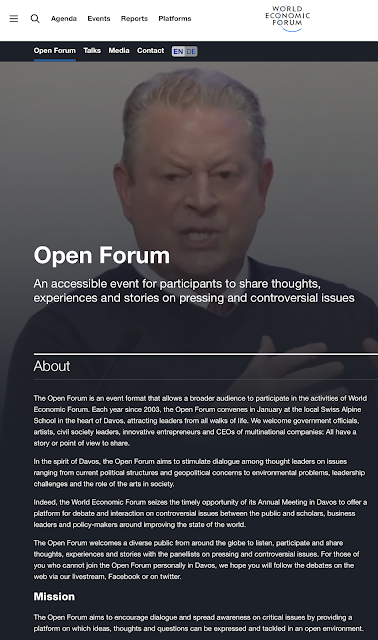
Here is a bit of background on the Open Forum from the WEF's website:


See, the global rulers really DO care about what the useless masses have to say!  But, apparently not enough to actually put themselves at risk by attending the Open Forum sessions.


Recall that the World Economic Forum believes and uses its online platform to promote the following:


1.) Cold Showers:


2.) Eat Weeds:


3.) Eat Insects:


4.) ...and, most importantly, own nothing:


And, let's not forget that Schwab is a big promoter of a transhuman/post-Homo sapiens world as quoted from Chapter 11 Section 2.3 in his Shaping the Fourth Industrial Revolution missive:


"The future will challenge our understanding of what it means to be human, from both a biological and a social standpoint. Emerging biotechnology agendas promise to improve and augment human lifespans and to enhance physical and mental health. The opportunity for the integration of digital technologies with biological tissues is also growing, and what that portends for the next decades is inspiring a range of emotions, from hope to wonder to fear.


After all, it is the very least that the grubby, sweat while we work class can do to save the world's resources for the ruling class, isn't it?


Unfortunately for the WEF who believe that the world is comprised of chess pieces that make predictable moves, the behaviour of all human beings cannot be predicted.  Each of us has the capacity to make choices that are in our best personal and collective interests.  While the vast majority of humans just go along with the flow, a significant minority will choose their own path and will believe that the World Economic Forum's view of the world will lead to a dystopia that must be halted in its tracks.  Perhaps the latest development in Klaus Schwab's world will cause him to ponder the wisdom of trying to herd human beings which, apparently, is akin to herding cats.  It looks good on paper but doesn't work in reality.


Klaus, it's like you said just over a year ago, you had better prepare for an angrier world:


...because it looks like it may be here.  Maybe it's just time for Klaus to take that well-deserved retirement.


Friday, June 25, 2021

Who Funds the World Economic Forum?

Since the beginning of the global pandemic, the World Economic Forum has taken on a new life, appearing as the non-governmental group that will solve all of the world's problems.  In this posting, I want to explore how the WEF is funded and its key partners who provide the funding necessary to keep Klaus Schwab's vision for the world alive.


Let's start by looking at some background about the World Economic Forum and its goals to help us put the importance of its funding partners into context.  This organization, founded in 1971 by Klaus Schwab (then known as the much less grand European Management Forum), seeks to create a new global economic reality known as the Great Reset, a merging of corporate and government bodies to create stakeholder capitalism which the WEF claims will benefit the global population.  Here is what the WEF has to say about stakeholder capitalism as written by the group's founder and Executive Chairman in January 2021:


Here is a quote from Schwab's musings:


"The stakeholder concept goes a long way back: more than 50 years. I first wrote about it in 1971, when I was a young business academic. But its roots go even further. In the 1950s and 1960s, it was quite natural for a company and its CEO to consider not just shareholders, but everyone who as a “stake” in the success of a firm. 


That is the core of stakeholder capitalism: it is a form of capitalism in which companies do not only optimize short-term profits for shareholders, but seek long term value creation, by taking into account the needs of all their stakeholders, and society at large."


According to Schwab, the biggest challenges in the world can be best met through "private-public cooperation".


Here are the key stakeholders in Schwab's vision:


1.) governments of countries, states, and local communities 


2.) civil society from unions to NGOs, from schools and universities to action groups


3.) companies constituting the private sector, whether freelancers or large multinational companies)


4.) the international community consisting of international organizations such as the UN as well as regional organizations such as the European Union or ASEAN (and we might add the World Economic Forum, of course)


Here is Schwab's global stakeholder model:


You will notice that companies form a key part of Schwab's vision of a global stakeholder model.


Keeping the importance of companies to the "new global reality" (aka the Great Reset) in mind, we need to know who are the stakeholders in the World Economic Forum since the organization exists for the global elite (i.e. you and I are most definitely not welcome to attend their Davos meetings).  While it is little-discussed, one might ask who is funding the World Economic Forum?  The WEF is an International Institute under Swiss law, a not-for-profit, politically neutral organization.  Here is a webpage from the WEF's website answering "Who pays for Davos?":


Note that funding is sourced from membership fees paid by the world's most significant corporations who join the Forum as members and partners.  There are different levels of memberships and partners as shown here:


...with fees varying from CHF60,000 to CHF600,000 (1 Swiss franc (CHF) = $1.11 US) depending on the level of participation by the partner/member.  Included with most memberships/partnerships is the opportunity to participate int he WEF's annual meeting in Davos for the CEO of the company, however, additional fees over the cost of membership or partnership fees are incurred.


It is also noted on the funding page that the forum works with government agencies and in certain cases, these government agencies provide funding to the WEF.


From the WEF's 2019-2020 Annual Report, we find the following balance sheet (all figures are denominated in thousands of Swiss francs (CHF)):


Total revenues of CHF367.004 million in fiscal 2019 - 2020 is up CHF161.246 million Swiss francs or 78.37 percent over the five year period from fiscal 2014 - 2015.  By far, the largest growth in revenue came from partnership revenue which grew from CHF114.896 million in 2014 - 2015 to CHF262.278 million in 2019 - 2020, an increase of 128.3 percent.  The WEF is also has substantial assets of CHF596.385 million with CHF107.338 million in cash and equivalents.


Since the World Economic Forum is mainly funded through fees charged to its partners. let's take a look at a few of the key members:


1.) Big Pharma/Medical:


Abbot Laboratories, AstraZeneca, Bayer, Johnson & Johnson, Mayo Clinic, Merck, Moderna, Novartis, Roche, Sanofi, Sun Pharmaceutical Industry, Takeda Pharmaceutical, Teladoc Health, Thermo Fisher Scientific, 


2.) Resource:


Anglo American, Baker Hughes, bp, Chevron, Hess Corporation, Hunt Consolidated Energy, Occidental, Royal Dutch Shell, Saudi Aramco, Schlumberger, Sinochem Group, Teck Resources 


3.) Big Tech:


Adobe Systems, Alibaba Group, Amazon Web Services, Apple, Dell Technologies, Ericsson, Facebook, Google, Fujitsu, Hewlett Packard Enterprise, Hitachi, Honeywell, Huawei Technologies, IBM, Infosys, Intel, Ipsos, LinkedIn, Microsoft, Mozilla, NEC, Nokia, PayPal, Qualcomm, Siemens, Sony, Tencent Holdings, Verizon Communications, Zoom, Zurich Insurance Group


4.) Finance and Insurance:


AIG, Allianze, Allied Bank, Bank of America, Barclays, BMO Financial Group, Brookfield Asset Management, Citi, Caisse de depot de placement du Quebec, CPP Investments, Deutsche Bank, Equifax, European Investment Bank, Goldman Sachs, HSBC, ING Group, JPMorgan Chase & Co, Kaiser Permanente, Manulife, Mastercard, Morgan Stanley, Nasdaq, NCB Universal, Nikkei, NYSE, OMERS, Ontario Teachers' Pension Plan, Prudential, Qatar Development Bank, Qatar National Bank, Royal Bank of Canada, Sberbank, Standard Bank Group, Standard Chartered Bank, State Bank of India, SWIFT, UBS, UPS, Visa, VTB Bank, 


5.) Defence:


BAE Systems, Boeing, Lockheed Martin 


6.) Foundations:


Bill & Melinda Gates Foundation, Open Society Foundations, Swarovski Foundation 


7.) Food/Agricultural:


Cargill, Nestle, Pepsico, The Coca-Cola Company, Tyson Foods, Wellcome Trust


8.) Other:


Airbus, Dow, Fluor, Honda Motor, Hyundai Motors, McKinsey & Company,  Mitsubishi Corporation, Proctologist's & Gamble, Ralph Lauren, SNC-Lavalin, Stanley Black & Decker, TIME, Toyota Motor Corporation, The LEGO Brand Group, Unilever, Volkswagen Group, Volvo Group, Walmart, Western Union, YMCA of the US


This is far from a complete listing of "who's who" among the World Economic Forum's partners.  If you are interested in the entire listing, please click here for a searchable list.


It is an interesting exercise to see who is providing the financial backing for one of the world's most powerful non-governmental organizations.  One has to wonder if the leaders of these companies aren't expecting to get special favours from the World Economic Forum as the Great Reset is implemented, particularly those in the finance/insurance and technology sectors given Schwab's penchant for digital currencies as quoted here:


Digital currency, a cross-cutting topic that requires input across sectors, functions, and geographies, is a key area of interest for the Forum,” said Klaus Schwab, Founder and Executive Chairman of the World Economic Forum. “Building on our long history of public-private cooperation, we hope that hosting this consortium will catalyse the conversations necessary to inform a robust framework of governance for global digital currencies.


....and his obsession with all things technological as he promotes his transhumanistic vision as shown here:


After all, it is a rule of thumb that companies do whatever they can to maximize profits, sweaty masses/useless eaters be damned, no matter how Klaus Schwab and the World Economic Forum try to convince us otherwise.