Showing posts with label human rights. Show all posts

Wednesday, September 25, 2024

Washington's Cynical Approach to Global Human Rights

Have you ever noticed that obvious human rights abuses in some nations are ignored by Washington whereas those in other nations are emphasized?  For example, it's perfectly fine for Saudi Arabia to use the death penalty as the primary means of punishment for a wide range of crimes well beyond intentional killings (i.e for activists who criticize the nation), punish freedom of expression and failing to protect women and children from gender-based violence whereas, Iran, who has similar issues is vilified as an example of the worst human rights abusers on earth.


Fortunately, a leaked document from back in 2017 when newly minted Secretary of State Rex Tillerson was learning the ropes of international diplomacy tells the world all that they need to know about how Washington views human rights.  The memo was written by Brian Hook, the Director of Policy Planning in the State Deparmentfrom 2017 to 2018 under Secretary of State Rex Tillerson the U.S. Special Representative for Iran and Senior Policy Advisor to the Secretary of State Mike Pompeo from 2018 to 2020.


Let's look at some key excerpts from the memo which covers the subject "Balancing Interests and Values" as they refer to human rights and democracy promotion in American foreign policy.  First, we find this with my bold:


"The liberal/idealist/Wilsonian view is that other countries, including US allies, should be pressed to adopt democratic reforms and human rights practices in accordance with American preferences.


The "realist” view is that America's allies should be supported rather than badgered, for both practical and principled reasons, and that while the United States should certainly stand as moral example, our diplomacy with other countries should focus primarily on their foreign policy behavior rather than on their domestic practices as such."


So, in other words, one should ignore the "bad human rights practices" of America's allies because these are domestic issues within these nations and that these nations should be supported no matter how they mistreat their citizens.  Rather, Washington should be focussing on the foreign policies of these "friends" and ignore their bad behaviours.


The memo goes on to outline the history of America's involvement (i.e. meddling) in the world when it came to its relationship with various nations and their human rights records.  The author of the memo approves of how President Ronald Reagan handled its role in the world as follows:


"As he (Reagan) stated at the 1980 Republican convention, "The basis of a free and principled foreign policy is one that takes the world as it is, and seeks to change it by leadership and example; not by harangue, harassment or wishful thinking." Or again, from Reagan's 1981 inaugural address, with reference to US allies: "We will not use our friendship to impose on their sovereignty, for our own sovereignty is not for sale."


During Reagan's second term, his administration began to move in the direction of more pointed pressure for liberalization with regard to allies such as Chile, South Korea, and the Philippines.  But these efforts bore fruit in part because viable democratic and pro-American forces existed in each country -- and the US continued to provide vital reassurance. Reagan's first instinct was always to back allies against adversaries, even in controversial cases, including through his second term. South Africa would be an excellent example. The approach used there was called "constructive engagement," and in the long run it worked."


In contrast, Hook notes that President Jimmy Carter's approach was a complete failure, observing that Carter's badgering of American allies, particularly Iran, "unintentionally strengthened anti-American radicals" and ended up "facilitating the job of the insurgents" despite the fact that the anti-American movement was alive and well in Iran before Carter took office.


Hook then goes on to outline the partial failures of the post-Cold War presidents who used American power to nudge nations toward positive social changes which ended up failing as was the case in Iraq, Afghanistan and the nations that were subjected to the Arab Spring movement.  


Here's the most important part of the memo which clearly outlines the cynicism in Washington's approach to human rights with my bolds:


"In the case of US allies such as Egypt, Saudi Arabia, and the Philippines, the Administration is fully justified in emphasizing good relations for a variety of important reasons, including counter-terrorism, and in honestly facing up to the difficult tradeoffs with regard to human rights.


It is not as though human rights practices will be improved if anti-American radicals take power in those countries. Moreover, this would be a severe blow to our vital interests. We saw what a disaster Egypt's Muslim Brotherhood turned out to be in power. After eight years of Obama, the US is right to bolster US allies rather than badger or abandon them.


One useful guideline for a realistic and successful foreign policy is that allies should be treated differently -- and better -- than adversaries. Otherwise, we end up with more adversaries, and fewer allies. The classic dilemma of balancing ideals and interests is with regard to America's allies. In relation to our competitors, there is far less of a dilemma. We do not look to bolster America's adversaries overseas; we look to pressure, compete with, and outmaneuver them. For this reason, we should consider human rights as an important issue in regard to US relations with China, Russia, North Korea, and Iran. And this is not only because of moral concern for practices inside those countries. It is also because pressing those regimes on human rights is one way to impose costs, apply counter-pressure, and regain the initiative from them strategically."


And there you have it.  The American political establishment's approach to human rights is to be guided by each nation's value to Washington's global agenda; if the nation (i.e. China, Russia etcetera) is seen to be working against American hegemony, it's human rights record is to be used as a cudgel to beat it into submission to American "democratic" values.  In contrast, the human rights abuses of those nations that are viewed as friendly to America are to be treated as though their obvious abuses simply don't exist and never happened at all.


Tuesday, November 21, 2023

How Israel Treats Palestinian Children

While politicians and the mainstream media vilify and prosecute Hamas for its kidnapping of Israeli citizens, one examination of the treatment of human beings, particularly children, in Israel/Palestine sheds a different light on the actions of the "terrorists" who are currently the target of massive Israeli bombardments.


To set the stage for this posting, it is important to consider that of the 2.9 million Palestinians living in the West Bank, 45 percent are children under the age of 18.  These children are highly vulnerable to prosecution by Israel with between 500 and 700 Palestinian children being prosecuted annually.  According to a report by Save the Children, Palestinian children who find themselves in the unfortunate position of being detained by the Israeli military detention system are likely to face inhumane treatment, often for the "crime" of throwing stones at Israeli tanks and other heavily armed military vehicles.  Save the Children's consultation found the following:


1.) 47 percent were denied contact with a lawyer.


2.) 52 percent were threatened with harm to their families.


3.) 81 percent suffered physical beatings


4.) 86 percent were subjected to strip searches


5.) 88 percent did not receive adequate and timely healthcare even when it was clearly requested


6.) 89 percent suffered verbal abuse


Additionally, up to half of the children detained reported that they were held in isolation or solitary confinement for periods of up to several weeks during which they were not allowed to see their families. 


Another study by the Defense for Children International have found the following issues among arrested Palestinian children:


1.) 73 percent experienced physical violence following arrest


2.) 95 percent were hand-tied


3.) 86 percent were blindfolded


4.) 49 percent were detained from their homes in the middle of the night


5.) 64 percent faced verbal abuse, humiliation, or intimidation


6.) 74 percent of children were not properly informed of their rights


7.) 96 percent were interrogated without the presence of a family member


8.) 20 percent were subject to stress positions


9.) 49 percent signed documents in Hebrew, a language most Palestinian children don’t understand


Palestinian children who are detained by Israel are not subject to the civilian justice system, rather, they are subject to military prosecution.  This is in clearly violation of international law and Israel finds itself standing out as the only nation in the world that prosecutes children in military courts automatically.  This, despite the fact that Israel actually ratified the United Nations Convention on the Rights of the Child in 1991which, under Article 27, states that: 


"States Parties shall ensure that:


(a) No child shall be subjected to torture or other cruel, inhuman or degrading treatment or punishment. Neither capital punishment nor life imprisonment without possibility of release shall be imposed for offences committed by persons below eighteen years of age;


(b) No child shall be deprived of his or her liberty unlawfully or arbitrarily. The arrest, detention or imprisonment of a child shall be in conformity with the law and shall be used only as a measure of last resort and for the shortest appropriate period of time;


(c) Every child deprived of liberty shall be treated with humanity and respect for the inherent dignity of the human person, and in a manner which takes into account the needs of persons of his or her age. In particular, every child deprived of liberty shall be separated from adults unless it is considered in the child's best interest not to do so and shall have the right to maintain contact with his or her family through correspondence and visits, save in exceptional circumstances;


(d) Every child deprived of his or her liberty shall have the right to prompt access to legal and other appropriate assistance, as well as the right to challenge the legality of the deprivation of his or her liberty before a court or other competent, independent and impartial authority, and to a prompt decision on any such action.


...and, under Article 40:


1. States Parties recognize the right of every child alleged as, accused of, or recognized as having infringed the penal law to be treated in a manner consistent with the promotion of the child's sense of dignity and worth, which reinforces the child's respect for the human rights and fundamental freedoms of others and which takes into account the child's age and the desirability of promoting the child's reintegration and the child's assuming a constructive role in society.


Every child alleged as or accused of having infringed the penal law has at least the following guarantees:


(i) To be presumed innocent until proven guilty according to law;


(ii) To be informed promptly and directly of the charges against him or her, and, if appropriate, through his or her parents or legal guardians, and to have legal or other appropriate assistance in the preparation and presentation of his or her defence;


(iii) To have the matter determined without delay by a competent, independent and impartial authority or judicial body in a fair hearing according to law, in the presence of legal or other appropriate assistance and, unless it is considered not to be in the best interest of the child, in particular, taking into account his or her age or situation, his or her parents or legal guardians;


(iv) Not to be compelled to give testimony or to confess guilt; to examine or have examined adverse witnesses and to obtain the participation and examination of witnesses on his or her behalf under conditions of equality;


(v) If considered to have infringed the penal law, to have this decision and any measures imposed in consequence thereof reviewed by a higher competent, independent and impartial authority or judicial body according to law;


(vi) To have the free assistance of an interpreter if the child cannot understand or speak the language used;


(vii) To have his or her privacy fully respected at all stages of the proceedings.


It would appear that from Israel's perspective, the Convention on the Rights of the Child apply only to non-Palestinian children.


Since 2000, an estimated 10,000 Palestinian children have been detained by Israeli forces in the occupied West Bank and held in their military detention system.


Isnt' it funny how you won't see this reported on the Western mainstream media?  But then why would you expect Israel to treat the offspring of "human animals" with any sort of compassion?  If Israel is really trying to create the next generation of occupation resistance fighters, it would appear that their current treatment of Palestinian children will do and has done exactly that.


Wednesday, September 21, 2022

Ukraine - War Crimes and Its Civilian Population

While the Western media's narrative on Ukraine has strictly followed the "if anything bad happens to civilians in Ukraine (including both Donetsk and Luhansk), the Russians are to blame" mantra, a recent press release from Amnesty International suggests that this is not completely accurate.  Let's look at some of the highlights which show that the Ukrainians are not completely blame free as shown in the release:


As background, under international law, all parties to a conflict must avoid, wherever possible, locating military objectives near densely populated areas and are obliged to protect civilians from the effects of attacks including moving civilians from the vicinity of military operations and giving warnings to civilians if attacks could result in danger.


Here are some quotes from the International Committee of the Red Cross on international humanitarian law which falls under the Fourth Geneva Convention (aka the Geneva Convention Relative to the Protection of Civilian Persons in Time of War of August 12, 1949) which has sections that apply directly to the protection of civilians:


"During the past 60 years the main victims of war have been civilians. The protection of civilians during armed conflict is therefore a cornerstone of international humanitarian law. This protection extends to their public and private property. IHL also identifies and protects particularly vulnerable civilian groups such as women, children and the displaced.


During World War II, and in many of the conflicts since, civilians have been the main victims of armed conflict. Civilians have always suffered in war, but the brutal impact of World War II, which included mass extermination, indiscriminate attacks, deportations, hostage taking, pillage and internment, took a high toll of civilian life. The response of the international community was the Fourth Geneva Convention adopted in 1949."


Under the Fourth Geneva Convention, we find the following articles which relate to the treatment of civilians in time of war:


Articles 13 and 32


Civilians are to be protected from murder, torture or brutality, and from discrimination on the basis of race, nationality, religion or political opinion.


Article 14


Hospital and safety zones may be established for the wounded, sick, and aged, children under 15, expectant mothers and mothers of children under seven.


Article 18


Civilian hospitals and their staff are to be protected.


Articles. 24 and 25


This Convention provides for the care of children who are orphaned or separated from their families. The ICRC’s Central Tracing and Protection Agency is also authorized to transmit family news and assist with family reunifications, with the help of Red Cross and Red Crescent national societies.


Article 27


The safety, honor, family rights, religious practices, manners and customs of civilians are to be respected.


Articles 33 and 34


Pillage, reprisals, indiscriminate destruction of property and the taking of hostages are prohibited.


Let's go back to the Amnesty International press release.  The press release opens with this:


"The Ukrainian military has endangered Ukrainian civilians by establishing bases and operating weapons systems in residential areas - including in schools and hospitals - as it has sought to repel the Russian invasion, Amnesty International said today.


Ukraine’s tactics have violated international humanitarian law as they’ve turned civilian objects into military targets. The ensuing Russian strikes in populated areas have killed civilians and destroyed civilian infrastructure."


Between April and July, Amnesty staff spent time investigating Russian strikes in Kharkiv, Donbas and Mykolaiv regions, interviewing survivors, relatives of attack victims and witnesses of attacks along with performing remote-sensing (including satellite imagery) and weapons analysis.  They found evidence that Ukrainian forces were launching strikes from within civilian areas and infrastructure (i.e. using civilians as human shields) in 19 towns and villages in the aforementioned regions.  They noted that Ukrainian soldiers located themselves in civilian areas that were miles from the front lines and that alternative locations could have been used which would not have endangered civilian lives including military bases and heavily wooded areas.


Here is an example provided by the mother of a 50-year-old man who was killed in a rocket attack in a village located to the south of Mykolaiv on June 10, 2022:


The military were staying in a house next to our home and my son often took food to the soldiers. I begged him several times to stay away from there because I was afraid for his safety. That afternoon, when the strike happened, my son was in the courtyard of our home and I was in the house. He was killed on the spot. His body was ripped to shreds. Our home was partially destroyed.” 


Other witnesses in Donbas reported that Ukrainian military were located in their neighbourhoods with Amnesty staff witnessing Ukrainian soldiers using a residential building that was located 20 yards from the entry to an underground shelter.  Witnesses also noted that outgoing Ukrainian arms fire is followed by incoming fire.  In another attack, on May 18, 2022, a Russian missile struck the front of a residential high-rise building resulting in significant damage to it and several surrounding buildings; witnesses reported to Amnesty staff that Ukrainian forces had been using a building across the street.  Amnesty staff found sandbags, plastic sheeting covering the windows and American-made first-aid equipment both inside and outside the building.


This press release from Amnesty International is the first hint from a Western-based organization which suggests that all war crimes being committed during the conflict in Ukraine cannot be blamed on Russia, totally contrasting the Western narrative.


Let's close with this quote from a Ukrainian civilian whose home was damaged during a strike:


"We have no say in what the military does, but we pay the price."


It's obvious that the current conflict in Ukraine is not a black and white issue.  Both sides have been involved in what can only be termed crimes against civilians and one has to be very cautious about believing the narratives being promoted by governments who have their own best interests at heart as the West uses Ukraine and its beleaguered civilian population to fight a proxy war with Russia.  We also have to consider the fact that tens of billions of dollars worth of arms have been supplied to Ukraine's military without any official tracking system to ensure that this materiel doesn't end up in the hands of black marketeers and other entities that may ultimately use them for nefarious purposes should Ukraine end up being a failed state.


Sunday, August 14, 2022

China, Human Rights and American Repentance

Following the furor that was raised over Nancy Pelosi's controversial August 12th, 2022 visit to Taiwan and the fact that several members of Congress are about to follow in her footsteps as shown here:


....China has, once again, weighed into the issue during a recent press conference held by China's Foreign Ministry Spokesperson, Wang Wenbin.


On August 12, 2022, a representative from China's CCTV, a state-owned broadcaster controlled by the Chinese Communist Party, posed the following question to Wang Wenbin:


"US House Speaker Nancy Pelosi said at a recent press conference with the Congressional delegation to Asia that Taiwan is one of the freest “countries” in the world and their visit is to salute this democracy. She also noted that the visit signals no departure from the US government’s one-China policy and they are not trying to upset the status quo across the Taiwan Strait. What’s your comment?"


Here is the response from Wang Wenbin:


"Pelosi’s remarks are further proof that her visit to China’s Taiwan region shows connivance and support for “Taiwan independence” separatist forces. She openly referred to Taiwan as a “country”. This is a serious political provocation that violates the one-China principle and the three Sino-US joint communiqués. The DPP authorities have redoubled efforts within the island to remove the Chinese identity of Taiwan and push for “incremental independence”, and sought every means to create “two Chinas” and “one China, one Taiwan” in the international arena. Against such a background, Pelosi chose to visit Taiwan and claimed in a high-profile fashion that she was there on behalf of the US. The visit was clearly official in nature and aimed to provoke cross-Strait confrontation and interfere in China’s internal affairs. This is an extremely egregious move. To defend our sovereignty and territorial integrity, to uphold the basic norm in international relations of non-interference in other countries’ internal affairs, and to truly safeguard peace and stability in the Taiwan Strait, China has every right to take resolute countermeasures in response to the US’s provocations. Such measures are absolutely necessary under those circumstances."


Here is the key part of his response with my bolds:


"Pelosi will achieve nothing by using democracy as a pretext for her visit. Her visit has nothing to do with democracy. It was a political stunt that went against the will of the more than 1.4 billion Chinese people, including our compatriots in Taiwan, and challenged the one-China principle widely accepted by the international community. Her visit tramples on democracy and shows how the US puts its selfish interests above international justice. If Pelosi truly cares about democracy and human rights, she should visit Afghanistan, Iraq, Syria and Libya instead, where she could express repentance over the hundreds of thousands of innocent civilians killed by the US military and vow to prevent such atrocities caused by US violation of UN Charter and norms in international relations from happening again."


In a Google search, the only reference to this comment about American repentance was found on Iran's Press TV as shown here:


You have to admit that it's pretty hard to argue with China's logic, isn't it?  The members of Congress who are visiting Taiwan would do well to keep that in mind during their visit to Taiwan.


Friday, August 5, 2022

The United States and Saudi Arabia - Human Rights and Arms Sales

Washington loves to use human rights violations as an excuse to either sanction or take military action against nations that it deems have unacceptable behaviour toward its citizens, and, in a unipolar world, their actions went unchecked.  There is, however, one nation that gets an exemption; Saudi Arabia, Washington's second-best friend in the Middle East and ground zero for a war with Iran.  In this posting, we'll look at what the Department of State has to say about human rights in Saudi Arabia followed by some recent news.


On an annual basis, the U.S. Department of State releases Country Reports on many nations around the world.  The latest report on Saudi Arabia opens with this stage-setting information:


"The Kingdom of Saudi Arabia is a monarchy ruled by King Salman bin Abdulaziz Al Saud, who is both head of state and head of government. The 1992 Basic Law sets out the system of governance, rights of citizens, and powers and duties of the government, and it provides that the Quran and Sunna (the traditions of the Prophet Muhammad) serve as the country’s constitution. It specifies that the rulers of the country shall be male descendants of the founder, King Abdulaziz (Ibn Saud).


The State Security Presidency, National Guard, and Ministries of Defense and Interior, all of which report to the king, are responsible for law enforcement and maintenance of order. The State Security Presidency includes the General Directorate of Investigation (mabahith), Special Security Forces, and Special Emergency Forces; police are under the Ministry of Interior. Civilian authorities generally maintained effective control over the security forces. There were credible reports that members of the security forces committed some abuses."


The report is divided into several sections, however, to keep this posting to a reasonable length, I will deal with two sections along with examples for each section.  It is important to keep in mind that the nation is under sharia law.


1.) Respect for the Integrity of the Person


a.) Arbitrary Deprivation of Life and Other Unlawful or Politically Motivated Killings:


Capital punishment can be imposed for violations including apostasy, sorcery and adultery.  Recently, the Saudi Government announced a moratorium on the deal penalty for drug-related offences by the changes to the law have not been published.  Minors' prison sentences are capped at 10 years (with adults being defined as those aged 18 and older) with the exception of a category of crimes that includes various types of murder and those crimes that carry specific penalties under the nation's interpretation of sharia law.  Lengthy prison sentences or death are prescribed for individuals who are convicted of terrorism or political protests.


b.) Disappearances:


There are outstanding reports of disappearances carried out by or on behalf of government authorities including several members of the royal family that were detained in March 2020 who stand accused of contact with foreign powers to carry out a coup d'état.  Here is another example:


"On April 5, the Specialized Criminal Court sentenced Abdulrahman al-Sadhan to 20 years’ imprisonment, followed by a 20-year travel ban, on terrorism financing and facilitation charges. After his arrest in 2018, al-Sadhan was detained incommunicado for two years before being allowed to speak with his family. Legal proceedings against him began on March 3 in a process that Amnesty International said was marred by rights violations. Al-Sadhan reportedly tweeted comments critical of the government and sympathetic to ISIS, which family members claimed were satirical in nature. Family members alleged that al-Sadhan was physically abused during his detention and that he was unable to present a proper legal defense during his trial."


c.) Torture and other Cruel, Inhuman or Degrading Treatment or Punishment:


While the law prohibits torture, there were reports by human rights organizations and the United Nations that such actions had taken place when officials try to extract "confessions" through the use of torture.  Here is an example:


"In July Human Rights Watch reported anonymous accounts from prison guards alleging torture of political detainees, including of prominent activists Loujain al-Hathloul and Mohammed al-Rabea. They alleged women’s rights activists and others were subjected to electric shocks, beatings, whippings, and sexual abuse. In February, following her sentencing and conditional release, al-Hathloul’s family reported that an appeals court rejected a lawsuit regarding her claims of torture. In December 2020 the Riyadh Criminal Court had previously dismissed her claim, citing a lack of evidence."


Courts also continue to sentence individuals to corporal punishment (i.e. flogging) for offenses including drunkeness, sexual conduct between unmarried persons and false accusations of adultery.  One individual who was found guilty of drug trafficking was sentenced to 5,000 lashes, however, his sentence was changed to five years in prison, a five year travel ban and a large fine.  Saudi activist Raif Badawi was originally sentenced to 1,000 lashes, 10 years in prison and a ten-year travel ban with his sentence including 50 lashes every week for 19 weeks after his initial flogging.  Physicians who examined him stated that his health would not permit further floggings because his initial wounds had not healed properly.  In 2020, Saudi Arabia's Supreme Court announced the abolition of flogging which would be replaced by fines and imprisonment as shown here:


e.) Denial of Fair Public Trial:


While the nation's law states that authorities may not detain a persons for more than 24 hours, certain government departments including the State Security Presidency have the authority to arrest and detail persons indefinitely without judicial oversight, notification of charges or effective access to legal counsel or family members even though the law requires that authorities file charges within 72 hours of arrest and hold a trial within six months.  There are reports that authorities have held suspects up to 12 months in investigative detention without access to legal council with authorities complete a full investigation of the case.  Here is an example:


"On May 6, Prisoners of Conscience reported that dozens of journalists and bloggers remained under arbitrary arrest. In November Prisoners of Conscience reported that authorities had detained blogger Zainab al-Hashemi and university student Asmaa al-Subaie since May without charge. The two were reportedly arrested with other online activists. As of year’s end, their whereabouts were unknown."


While the law states that court hearings must be public, courts can be closed at the discretion of a judge.  Authorities are allowed to close a trial depending on the sensitivity of a case to national security, the reputation of the defendant or the safety of witnesses.   Authorities must offer defendants a lawyer at government expense, however, activists state that many political prisoners were not able to or allowed to retain or consult with an attorney during critical pareses of an investigation or trail.   In certain circumstances, the testimony of a women in court equals one-half that of a man and judges have the discretion to discredit the testimony of non-practicing Sunni Muslims, Shia Muslims and persons of other religions.


2.) Respect for Civil Liberties


a.) Freedom of Expression Including for Members of the Press and Other Media:


The law does not provide for or protect freedom of expression inducing for members of the press and other media as quoted here:


"Media are prohibited from committing acts that lead to disorder and division, affect the security of the state or its public relations, or undermine human dignity and rights.” Authorities are responsible for regulating and determining what speech or expression undermines internal security. The government can ban or suspend media outlets if it concludes they violated the press and publications law, and it monitored and blocked hundreds of thousands of internet sites. There were frequent reports of restrictions on free speech."


Counterterrorism laws are defined as:


"...any conduct...intended to disturb public order...or destabilize the state or endanger its national unity.” The law also penalizes “anyone who challenges, either directly or indirectly, the religion or justice of the king or crown prince...or anyone who establishes or uses a website or computer program...to commit any of the offenses set out in the law.”


Here are more details on freedom of expression for members of the press including online media:


"The law governs printed materials; printing presses; bookstores; the import, rental, and sale of films; television and radio; foreign media offices and their correspondents; and online newspapers and journals. Media fall under the jurisdiction of the Ministry of Media. The ministry may permanently close “whenever necessary” any means of communication – defined as any means of expressing a viewpoint that is meant for circulation – that it deems is engaged in a prohibited activity, as set forth in the law.


Government policy guidance instructs journalists in the country to uphold Islam, oppose atheism, promote Arab interests, and preserve cultural heritage. The press law requires all online newspapers and bloggers to obtain a license from the ministry. The law bans publishing anything “contradicting sharia, inciting disruption, serving foreign interests that contradict national interests, and damaging the reputation of the grand mufti, members of the Council of Senior Religious Scholars, or senior government officials.”


I think that information the information that I have provided in this posting gives you a sense of "freedom", Saudi Arabian-style.  If you wish to read additional information, please click here for the entire Department of State Report.


Now, let's look at recent news as announced by the Defense Security Cooperation Agency which can only have made Raytheon's corner office dwellers happy:


I find it interesting that the sale of these PATRIOT Missiles will accomplish two purposes:


1.) allow Saudi Arabia to protect its borders from Houthi cross-border unmanned aerial and ballistic missile attacks on civilian sites and critical infrastructure in Saudi Arabia not to mention protecting the 70,000 United States citizens who live in Saudi Arabia.  This, despite the fact that the war has resulted in  nearly 15,000 Yemeni civilian casualties, most of them in air strikes by the Saudi-led and American-armed coalition forces as shown here:


...and here:


2.) Here's a quote from the press release:


"This proposed sale will support the foreign policy goals and national security objectives of the United States by improving the security of a partner country that is a force for political stability and economic progress in the Gulf region."


In other words, the sale will support Washington's moves toward a war with Iran.


This sentence in the press release is for irony-impaired politicians:


"The proposed sale of this equipment and support will not alter the basic military balance in the region."


At least not until the Russians or Chinese sell the Iranians additional materiel to counter Washington's sale of $3 billion worth of Patriot missiles and other products from America's defense contractors.


While it is not terribly surprising, Washington can clearly speak out of "both sides of its mouth" when it comes to manipulating the narrative to suit its own purposes.  The fact that politicians of both stripes can totally ignore Saudi Arabia's egregious behaviour when it comes to human rights and, at the same time, justify selling the Saudi royal family billions of dollars worth of arms is nothing short of appalling. 


Monday, February 14, 2022

The High Human Cost of the War in Yemen

One war in the world is now in its seventh year but you would never know it unless you happen to get your news from a non-mainstream source.  


Here is some background from the Council on Foreign Relations and the Brookings Institution regarding this ongoing conflict which involves one of the world's most underdeveloped nations and one of Washington's best friends in the Middle East (with my bold):


"Yemen’s civil war began in 2014 when Houthi insurgents—Shiite rebels with links to Iran and a history of rising up against the Sunni government—took control of Yemen’s capital and largest city, Sana’a, demanding lower fuel prices and a new government. Following failed negotiations, the rebels seized the presidential palace in January 2015, leading President Abd Rabbu Mansour Hadi and his government to resign. Beginning in March 2015, a coalition of Gulf states led by Saudi Arabia launched a campaign of economic isolation and air strikes against the Houthi insurgents, with U.S. logistical and intelligence support.


The Saudis intervened in March 2015 to support Hadi. The main driver behind the intervention was Prince Mohammed bin Salman (MBS) who promised a short, decisive war. Instead it became a stalemate with catastrophic consequences for the Yemeni people. The Saudis blockaded the country, denying food and medicine to most of the population.


President Barack Obama backed the Saudi war. The United States supported the passage of United Nations Security Council Resolution 2216, which sanctions the Houthis and Saleh, endorses Hadi’s government, and calls for the rebels to disarm. It’s completely unbalanced and a barrier to getting peace. Iran supports the Houthis with expertise, arms, and ballistic missiles smuggled into the country. The United States provides intelligence and crucial logistical support for the Saudis and their allies. 


President Trump doubled down on Obama’s support for MBS’s war. The administration has focused on Iran’s support for the Houthis and ignored egregious Saudi bombings of school and hospitals. The Saudis’ war is very expensive for the kingdom, disastrously devastating for Yemen, and a strategic plus for Iran.


Saudi oil wealth explains much about why America has consistently subsumed its Yemen policy to the designs of the kingdom.


According to the Brookings Institution, the war in Yemen costs the Saudis at least $50 billion annually.  It is also important to remember that the United States has sold significant arms to the Saudi royal family, arms that are being used against Yemeni civilians.  Under the Trump administration, Washington signed arms deal in May 2017 as shown here:


...and the Biden Administration as shown here:


...along with diplomatically backing Saudi Arabia as shown here:


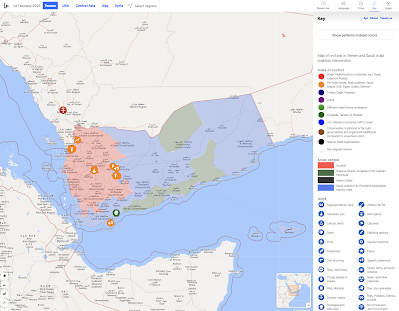
As background, here is a current map showing the situation on the ground in Yemen showing that Saudi Arabia controls a substantial portion of the nation:


Now, let's look at the impact of Washington's relationship with Saudi Arabia, particularly the impact of the Saudi royal family's war on Yemen's civilians.  According to a recent report from the United Nations:


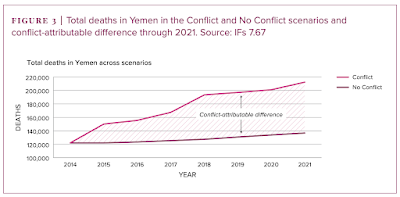
...the conflict has resulted in significantly higher deaths than would normally have been expected as shown on this graphic which compares the conflict and no-conflict scenarios (page 32 of the report):


It has also resulted in a significant loss of economic output as shown here (page 33 of the report):


The conflict has also resulted in significant damage to over one-third of Yemen's schools, 40 percent of health facilities, 40 percent of housing assets, 40 percent of water, sanitation and hygiene assets and over half to he nation's power infrastructure.  The estimated cost to recover the lost infrastructure is estimated at between $20 billion and $25 billion over a five year period.


Here is a table showing the contrast between the conflict and no-conflict scenarios (page 33 of the report):


Entesaf Organization for Women and Child Rights has recently released a report with the following information:


1.) approximately 800,000 women are among Yemenis displaced by the war.


2.) between the start of aggression on March 26, 2015 to December 8, 2021, 2412 women were killed and 2825 were injured as a result of Saudi-led raids.


3.) 1.2 milion Yemeni women suffer from malnutrition with 8000 dying annually due to the blockade.  Of the displaced women, half are pregnant and more than 70 percent of birth medicines are not available in Yemen due to the Saudi-led blockade of all sea, land and air borders since November 2017.  In addition, out of every 1000 live births, more than 27 die annually. 


4.) More than 400,000 Yemeni children are suffering from severe malnutrition with 80,000 of those at risk for death.


Here is a video explaining the plight of Yemen's children:


In large part, the blame for this suffering of Yemen's civilians must be laid at the feet of the decision makers from both parties in Washington who repeatedly find themselves siding with Saudi Arabia, a nation well known for its human rights abuses.  While this sort of behaviour is frequently used by Washington to justify military intervention, such is not the case with Saudi Arabia simply because the Saudi royal family controls the world's most productive oil fields.